
Breed profile · Working Group · the colossal guardian
Mastiff
The Mastiff is a large, massive, symmetrical dog — dogs at least 30 inches at the shoulder and bitches at least 27-1/2, 160 to 230 pounds for dogs and 120 to 170 for bitches, with a short coarse coat in fawn, apricot, or brindle, a massive broad head, a dark muzzle, and a black mask — a combination of grandeur and good nature, courage and docility, dignified rather than gay, and a formidable protector of those they hold dear.
Help us improve it. This is one of ThePetAdvisor’s breed profiles, built from public sources with generous links to the people who actually own this breed’s knowledge. If something’s off or missing, the parent club can claim the page and set it straight — see the bottom of the page.
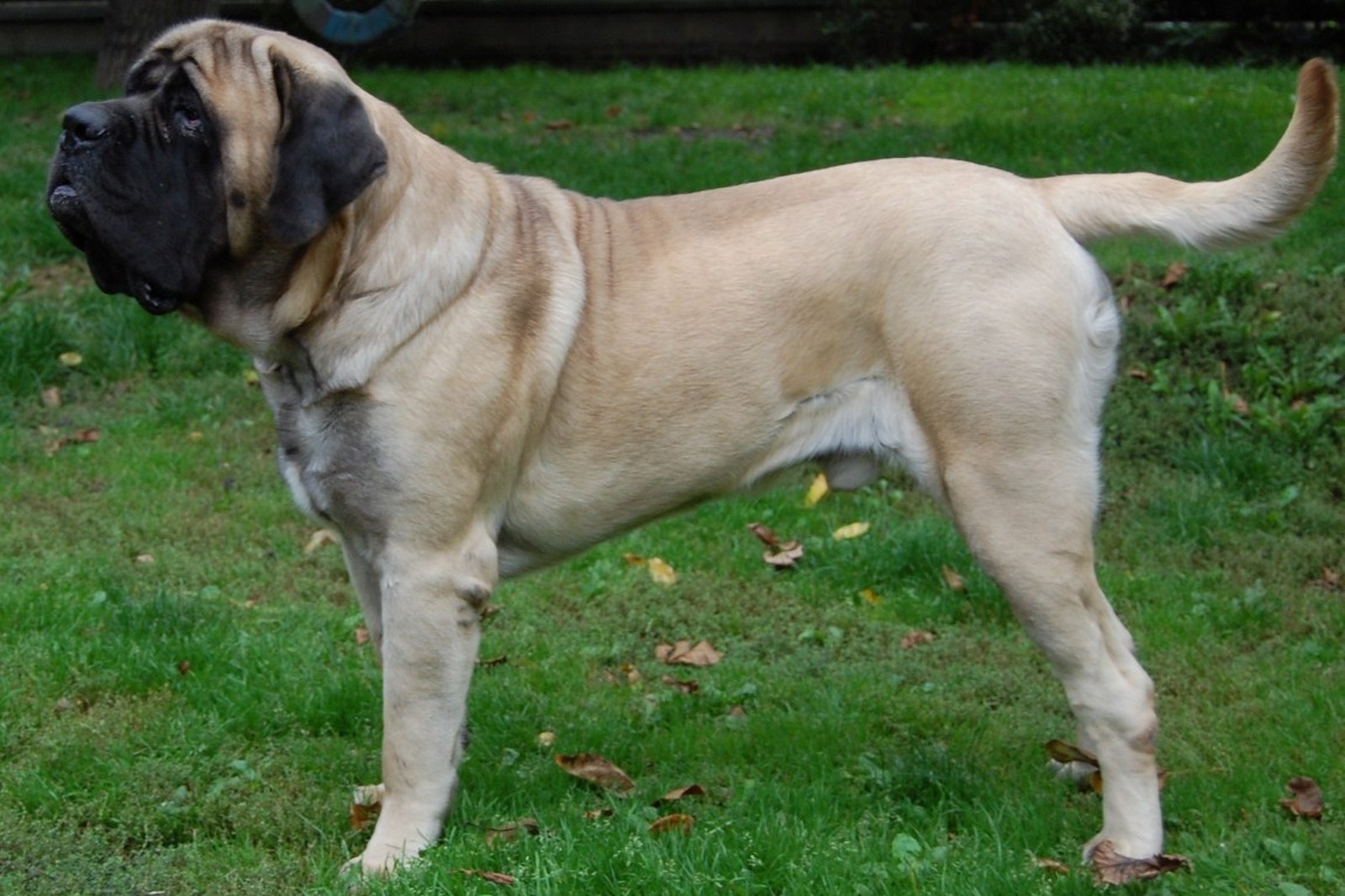

Do you have a better photo of a Mastiff in the American show ring? If you have a show photo you’d let us use, email it to [email protected] — tell us the dog’s name and the show, and it may be featured here. Please only send photos you took yourself or have the photographer’s permission to share, and tell us the photographer’s name.
1. Breed at a glance
Working — recognized by the AKC in 1885
Dogs at least 30 in, bitches at least 27-1/2 in at the shoulder. Weight 160 to 230 lb for dogs, 120 to 170 lb for bitches.
Straight, coarse, moderately short, with a dense short undercoat; no fringe. Fawn, apricot, or brindle, with a dark muzzle, ears, and nose.
A combination of grandeur and good nature, courage and docility. Dignity, rather than gaiety, is the correct demeanor.
6 to 10 years.
Size, coat, color, and temperament facts are from the AKC standard (approved November 12, 1991; effective December 31, 1991). Weight (160 to 230 pounds for dogs, 120 to 170 pounds for bitches) and lifespan (6 to 10 years) are the breed’s commonly published figures (AKC Mastiff breed page).
2. History
The Mastiff is a British breed, and the name has been known on the British Isles for millennia. The Romans exported British dogs to fight in the Colosseum, and modern DNA research says the breed has no single progenitor — the Mastiff is a British original, not a Roman import. The name first appears in print in The Book of Saint Albans (1465). At Agincourt in 1415, Sir Piers Legh was wounded and his Mastiff stood over him through the battle; the dog survived, was brought home, and founded the Lyme Hall strain — the world’s oldest Mastiff kennel. (Sources: AKC, Mastiff History: Where the Breed Originated; Wikipedia, English Mastiff.)
The breed’s reputation was already fixed by 1800, when Sydenham Edwards wrote in Cynographia Britannica, “What the Lion is to the Cat the Mastiff is to the Dog.” The AKC recognized the Mastiff in 1885, but the breed nearly vanished in America in the early twentieth century: from 1906 to 1918, only 24 Mastiffs were registered in the United States, and after 1910 none of them was American-bred. By the end of World War I the breed was extinct outside Great Britain except for a few exports to North America. The restart came from Beowulf, a dog bred in Canada in 1918. (Sources: AKC, Mastiff History; Wikipedia, English Mastiff.)
The Second World War nearly finished the breed a second time. The post-war gene pool came down to 14 Mastiffs — 12 imports, plus Buster of Saxondale and Buddy — and a single bitch puppy that reached maturity in Britain, Nydia of Frithend. North American dogs were sent back to Britain to rebuild the breed there. In 1959 a Dogue de Bordeaux, Fidelle de Fenelon, was imported to the United States and registered as a Mastiff, becoming the 16th animal in the post-war gene pool. The parent club, the Mastiff Club of America, was founded on March 13, 1929; it held its first national specialty in 1940 and its first independent specialty in 1983. (Sources: AKC, Mastiff History; Wikipedia, English Mastiff; AKC Library & Archives, Mastiff Club of America collection.)
3. The standard and why it’s written that way
- Large, massive, symmetrical — the whole dog first. The standard opens with the whole dog: “The Mastiff is a large, massive, symmetrical dog with a well-knit frame. The impression is one of grandeur and dignity.” Everything else in the standard is a detail of that sentence. (Source: AKC standard.)
- Size — a minimum, not a target. “Dogs — minimum 30 inches at the shoulder. Bitches — minimum 27-1/2 inches at the shoulder.” Proportion is rectangular, and the substance is massive and heavy-boned: height should come from depth of body rather than excessive leg. (Source: AKC standard.)
- The head: massive and broad. The head is massive and broad; the eyes are brown, the darker the better; the ears are small, V-shaped, and dark. The muzzle is half the length of the skull, dark — the blacker the better. A scissors bite is preferred, and a moderately undershot bite is not faulted if the teeth are not visible when the mouth is closed. (Source: AKC standard.)
- Coat — straight, coarse, and short. “Straight, coarse, moderately short” outer coat with a dense short undercoat, and no fringe. The coat is shown as it grows: nothing in the standard asks for trimming or sculpting. (Source: AKC standard.)
- Color — fawn, apricot, or brindle. “Fawn, apricot, or brindle”; the muzzle, ears, and nose dark, the blacker the better. A small white patch on the chest is permitted; excessive white, or white elsewhere, is a fault. (Source: AKC standard.)
- Gait and temperament, in the standard’s own words. Gait: the Mastiff’s movement denotes power and strength. Temperament: “A combination of grandeur and good nature, courage and docility. Dignity, rather than gaiety, is the Mastiff’s correct demeanor. Judges should not condone shyness or viciousness.” (Source: AKC standard.)
4. Temperament & living with one
The AKC sums the breed up in a sentence: “The colossal Mastiff belongs to a canine clan as ancient as civilization itself. A massive, heavy-boned dog of courage and prodigious strength, the Mastiff is docile and dignified but also a formidable protector of those they hold dear.” The standard’s temperament line says the same thing in breeder’s language: “A combination of grandeur and good nature, courage and docility. Dignity, rather than gaiety, is the Mastiff’s correct demeanor.” That is the guardian in a pet’s life: a dog bred to watch over its people for thousands of years, deciding for itself what is a threat and what is not. (Sources: AKC Mastiff breed page; AKC standard.)
What that means in practice is a dog that guards by presence and by voice rather than by pursuit, and a dog noted for its gentle and loving nature with its own people. It needs early and thorough socialization, consistent training from an owner the dog respects, a securely fenced yard, and room to move — it is not an apartment dog, and it is not a dog for a household that wants something small, quiet, or decorative. It is generally good with family children when properly socialized, and it chooses whom to trust. And the practical side of a 160-to-230-pound dog is not small: food, veterinary care, and drool all scale with the size. Be prepared for drool. (Sources: Wikipedia, English Mastiff; VCA Animal Hospitals, Mastiff.)
5. Grooming
- Weekly brushing is enough most of the year. The coat is short, straight, and coarse, and it needs only occasional brushing, once every week or so, to remove dead hair. Shedding is average. (Sources: AKC standard; VCA Animal Hospitals, Mastiff.)
- Bathe when dirty, and keep the ears and eyes clear. The short coat is low-maintenance, and a bath when the dog is dirty is plenty for most dogs. Keep the pendant ears clean and dry, watch the eyes for discharge, and keep the nails trimmed — a 200-pound dog with long nails is hard on floors and on feet. (Source: VCA Animal Hospitals, Mastiff.)
- Be prepared for drool. The Mastiff’s loose flews mean drool, especially after drinking and in warm weather. Towels by the water bowl are part of the routine, not an afterthought. (Source: VCA Animal Hospitals, Mastiff.)
6. Health testing
- Ten tests for a CHIC number. For a CHIC number, the Mastiff needs ten evaluations on the AKC’s Working Group health-testing list: a patella evaluation, a hip evaluation, an elbow evaluation, a cardiac exam, an ophthalmologist exam, a cystinuria DNA test, autoimmune thyroiditis, a dominant progressive retinal atrophy (dPRA) DNA test, a degenerative myelopathy (DM) DNA test, and a canine multifocal retinopathy type 1 (CMR) DNA test. Breeders must agree to have all test results, positive or negative, published in the CHIC database. (Source: AKC Working Group Health Testing Requirements.)
- The watch list: hips, bloat, weight, and bone cancer. Health problems seen in the breed include hip dysplasia, gastric torsion (bloat), obesity, osteosarcoma, and cystinuria; occasionally cardiomyopathy, allergies, hypothyroidism, progressive retinal atrophy, and entropion. None of this is a reason not to own a Mastiff. All of it is a reason to buy from a breeder who tests — and to know the signs of bloat, the gastric emergency every giant-breed owner should recognize. (Source: Wikipedia, English Mastiff.)
- Lifespan: 6 to 10 years. The commonly published lifespan is 6 to 10 years; a UK study put life expectancy at 9 years. (Sources: AKC Mastiff breed page; Wikipedia, English Mastiff.)
7. The annual Mastiff specialty dog show
A specialty is the breed’s All-Star show — its Super Bowl. Once a year, the best Mastiffs from across the country, and often from around the world, come together in one place.
The Mastiff Club of America’s national specialty: a full show week with the conformation specialty at its center, and puppy and veteran sweepstakes, futurity and maturity, junior showmanship, obedience and rally, and an independent specialty from a regional club around it. The 2026 show: May 18–22 at the Cache County Fairgrounds in Logan, Utah, with 94 Mastiffs in the specialty. The 2025 show: May 20–24 at the MeadowView Conference Resort in Kingsport, Tennessee, with 120 Mastiffs. The 2027 show: May 29–30 at the Crowne Plaza Asheville in Asheville, North Carolina. The national-specialty winner: the Old English Mastiff Club Challenge Trophy — the Best of Breed silver cup presented by the Old English Mastiff Club in 1932, a perpetual trophy engraved with each year’s winner — and the Michael Gensburger Memorial Best of Breed Trophy, first presented in 2003.
The standard, in brief: a large, massive, symmetrical dog, dogs at least 30 inches and bitches at least 27-1/2 inches at the shoulder, with the massive broad head, the dark muzzle and ears, the short coarse coat — fawn, apricot, or brindle — and the dignified, good-natured carriage.
The 78th Annual National Specialty — a show week, Monday–Friday, May 18–22, 2026, with conformation Thursday–Friday, May 21–22, 2026, at the Cache County Fairgrounds, 450 South 500 West, Logan, Utah. Entry: 116 entries and 94 competitors (37 dogs, 57 bitches). Entries opened Wednesday, December 31, 2025, and closed Wednesday, April 29, 2026, at noon PDT. Event Chair: Toni Hyland. Superintendent: BaRay Event Services. The national was dedicated to Dee Gensburger. (Sources: AKC event search, event 2026200411; 2026 National Specialty premium list (BaRay Event Services).)
National specialty judges: Mrs. L A Hagey — regular and non-regular classes. Mark Tichenor — sweepstakes and veteran sweepstakes. M L Speer — junior showmanship. Futurity and maturity ran under event 2026200424; the premium lists Laura Hagey for futurity with a judge-change note, so the futurity judge is not fully confirmed. (Sources: AKC event search, event 2026200411; 2026 National Specialty premium list (BaRay Event Services).)
Results (MCOA National Specialty Results; AKC event search, event 2026200411). Best of Breed: GCHB CH R3 There’s Your Trouble CGC. Best of Opposite Sex: GCHP CH Impeccable’s Odysseus The Faithful CGCA. Select Dog: GCHB CH Epics Slow Your Roll. Select Bitch: GCH CH Suvi Hallmark’s Alls Well That Ends Better. Winners Dog and Best Puppy: J&P K9 Power Of God At Luper’s. Winners Bitch, Best of Winners, and Best Bred-By-Exhibitor: Lakeside Mn She Was A Showgirl CGC TKN ATT. Best Veteran: GCHP CH Marshalsea the Son Also Rises FDC CGCU. Best Stud Dog: GCHG CH R3 Two Wraps and a Hooey FDC CGC ATT. Awards of Merit: GCH CH Bluebonnet’s Lazy D’s Three’s Company and GCHG CH R3 Cabezon One More Ride FDC CGC ATT FITB. Best Junior Handler: Lennox Bogle. (Sources: MCOA, National Specialty Results; AKC event search, event 2026200411.)
The 79th Annual National Specialty: a two-day show, Saturday–Sunday, May 29–30, 2027, at the Crowne Plaza Asheville, 1 Resort Drive, Asheville, North Carolina — the 2027 MCOA National Specialty, “Heart of the South,” with the show week running May 25–30, 2027. Superintendent: Jim Rau Dog Shows, Ltd. Judges have not yet been published, and the AKC event number has not been found. The host-hotel block runs May 24–29, 2027, with reservations due by Saturday, April 24, 2027. (Sources: AKC Upcoming National Specialties; MCOA, 2027 National Specialty host hotel.)
Past national specialties: 2025 · 2024 · 2023
Mastiff Club of America — mastiffclubofamerica.com
8. Regional specialties through the year: smaller regional shows
The national is the anchor, but the breed’s year also runs through regional specialties — smaller regional shows, not the national — held by the parent club and the regional Mastiff clubs. These are the 2027 regionals verified from club sources so far:
No regional specialties announced yet for 2027.
Past regional specialties: 2026 · 2025 · 2024
More regional specialties will be added here as their programs are verified — this section is built from show data, not guesswork. Browse upcoming show weekends →
9. Clubs
- Mastiff Club of America (parent club) — the AKC parent club for the breed in the United States, founded March 13, 1929, and incorporated under New York State laws shortly thereafter. It runs the national specialty, held in Logan, Utah in 2026 and scheduled for Asheville, North Carolina in 2027. 2026 officers: President Mary Lynn Speer; AKC Delegate Karen Park, who is also the National Specialty Advisor. (Sources: Mastiff Club of America; AKC Library & Archives, Mastiff Club of America collection.)
- Regional Mastiff clubs. The Redwood Empire Mastiff Club holds the independent specialty inside national week; the Rocky Mountain Mastiff Fanciers and the Empire State Mastiff Fanciers hold regional specialties of their own — Empire State hosted the 2024 independent specialty at Peek’n Peak. (Sources: 2026 National Specialty premium list (BaRay Event Services); BaRay judging program, Mastiff concurrent specialty cluster, May 2026.)
If you are new to the breed, the national specialty itself is the better first stop than a breeder’s website: the people there have owned, shown, and worked Mastiffs, and they will tell you the truth about the size, the strength, the drool, and the guarding before you fall for a puppy.
10. Rescue
- Start with Southern States Mastiff Rescue. Southern States Mastiff Rescue is an all-volunteer 501(c)(3) based in Pittsboro, North Carolina, established in 2005, serving Virginia, North Carolina, South Carolina, Georgia, Tennessee, Alabama, and Mississippi, and it has placed more than 1,500 English Mastiffs. Contact: [email protected]; phone (336) 560-7787. (Source: Southern States Mastiff Rescue.)
- Mastiffs To Mutts Rescue, Inc. Mastiffs To Mutts Rescue is a foster-based rescue with no shelter, serving the Mid-Atlantic — Pennsylvania, Ohio, New Jersey, Delaware, Maryland, West Virginia, Virginia, and parts of North Carolina and Kentucky. Contact: [email protected]; Pennsylvania Kennel License 05845. (Source: Mastiffs To Mutts Rescue.)
- Great Lakes Mastiff Rescue also takes in Mastiffs, serving Illinois, Indiana, Ohio, Michigan, and Wisconsin.
- Adults and seniors. A rescued Mastiff is usually an adult, often one whose owner underestimated the size, the strength, the drool, and the sheer cost of feeding a 160-to-230-pound dog, and it will arrive with its temperament and size visible before you commit. What you get in return is a dog whose character you can see before you commit and a lower price. Either way, be honest with yourself first: a Mastiff needs space, a securely fenced yard, daily exercise, consistent training, and an owner who finds a huge, dignified, watchful dog reassuring rather than alarming.
11. Breeder vs. rescue: honest guidance
- If you buy: start with the parent club, the Mastiff Club of America, and its breeder list. Ask for the parents’ health results — patellas, hips, elbows, cardiac, eyes, and the DNA tests for cystinuria, dPRA, DM, and CMR — and look the results up in the OFA database yourself. Expect to wait for a puppy from a careful breeder: this is a long-lived fancy with a small gene pool, and a good breeder will have the answers, will ask you as many questions as you ask them, and will take the puppy back for its whole life if you cannot keep it.
- If you rescue: a rescued Mastiff is usually an adult, often one whose owner underestimated the size, the strength, the drool, and the cost of feeding a 160-to-230-pound dog, and it will arrive with its temperament visible before you commit. What you get in return is a dog whose character you can see before you commit and a lower price. Either way, be honest with yourself first: a Mastiff needs space, a securely fenced yard, daily exercise, consistent training, and an owner who finds a huge, dignified, watchful dog reassuring rather than alarming. It is not a dog for a household that wants a quiet, decorative, or easy first dog.
- One standard — no separate varieties to pay extra for. The Mastiff is shown under a single standard, with no AKC-recognized varieties and no miniature Mastiff. A breeder selling a “mini” Mastiff at a premium is selling you a label.
12. Claim this page
This page belongs to the breed, and the people who know the breed best are the Mastiff Club of America and its members. If you are with the parent club — or you are a breeder, a judge, a handler, or a rescue volunteer who spotted something wrong, missing, or out of date — this page is yours to set straight. Tell us what needs fixing and where the correction is documented, and we will fix it and credit the source. Contact the site through the About page, and mention “Mastiff breed profile.”
Sources
- AKC Mastiff breed page — akc.org/dog-breeds/mastiff
- Mastiff Club of America, Breed Standard (AKC standard approved November 12, 1991; effective December 31, 1991) — mastiffclubofamerica.com/breed-standard
- AKC, Mastiff History: Where the Breed Originated (published May 11, 2021; updated May 17, 2024) — akc.org/expert-advice/dog-breeds/mastiff-history
- Wikipedia, English Mastiff (history, temperament, health, life expectancy) — en.wikipedia.org/wiki/English_Mastiff
- AKC Working Group Health Testing Requirements — akc.org/breeder-programs/breed-health-testing-requirements/working-group-health-testing-requirements
- VCA Animal Hospitals, Mastiff (grooming, drool) — vcahospitals.com/know-your-pet/dog-breeds/mastiff
- AKC Upcoming National Specialties — apps.akc.org/apps/events/conformation/national_specialties.cfm
- MCOA, 2027 National Specialty host hotel — mastiffclubofamerica.com/nationalspecialty/hosthotel
- 2026 National Specialty premium list (BaRay Event Services) — baray-production-storage.s3.us-west-2.amazonaws.com premium list
- BaRay judging program, Mastiff concurrent specialty cluster, May 2026 — baray-production-storage.s3.us-west-2.amazonaws.com judging program
- MCOA, National Specialty Results — mastiffclubofamerica.com/nationalspecialtyresults
- 2025 National Specialty premium list (Rau Dog Shows) — raudogshows.com 2025 premium list
- 2024 National Specialty premium list (Rau Dog Shows) — raudogshows.com 2024 premium list
- 2026 National Specialty, AKC event search, event 2026200411 — apps.akc.org/apps/events/search/index_results.cfm
- 2025 National Specialty, AKC event search, event 2025200413 — apps.akc.org/apps/events/search/index_results.cfm
- 2024 National Specialty, AKC event search, event 2024200409 — apps.akc.org/apps/events/search/index_results.cfm
- 2023 National Specialty, AKC event search, event 2023200409 — apps.akc.org/apps/events/search/index_results.cfm
- Mastiff Club of America collection, AKC Library & Archives — akc.libraryhost.com/repositories/2/resources/61
- Southern States Mastiff Rescue — southernstatemastiffrescue.com
- Mastiffs To Mutts Rescue, Inc. — mastiffstomutts.org
- Crowne Plaza Resort Asheville (IHG) — ihg.com Crowne Plaza Asheville