The Reading Room • Dog Sports
Planning your dog sport season? Create your free ThePetAdvisor account — track your dogs and never miss a closing date.
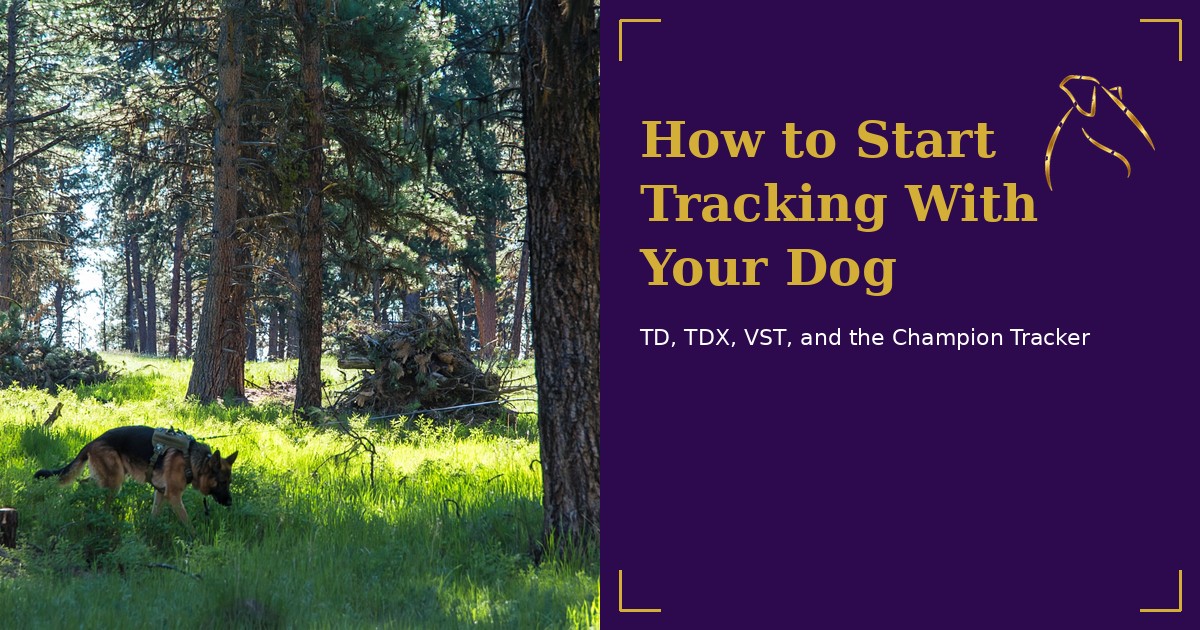
Imagine this: your dog, in a harness and on a long line, nose to the ground, following a scent trail laid hours ago across a field you have never seen. You don’t know where it goes. Your dog does. Tracking is the one AKC sport where the dog is completely in charge — a dog is judged on nothing but whether it can find the track and the articles at the end. It is one of the oldest AKC sports, with tracking regulations dating back to 1936, and it remains the foundation of all canine search-and-rescue work.
What is tracking?
Tracking is a canine sport that demonstrates a dog’s natural ability to recognize and follow a human scent trail. Before the test, a tracklayer (the person who walks the course to lay the scent) plots a course across terrain and drops articles (small scented objects — a glove, a wallet, a sock — that the dog must find and indicate) along it. The track is aged (left to sit, so the scent settles and becomes harder to follow) for a set time, and then the dog and handler team runs it. The handler follows on a long leash, at least 20 feet behind the dog, and may encourage the dog throughout. There is no scoring and no time limit — a dog is judged pass or fail, as long as it is working.
The magic of tracking is the role reversal. In almost every other sport, the handler directs and the dog responds. In tracking, as the American Boxer Club puts it, “in tracking the dog is completely in charge, for only he knows how to use his nose to find and follow the track.” Your job is to follow, read your dog, and stay out of its way.
Which dogs can track?
Any dog with a nose — which is to say, any dog. Every dog is born knowing how to follow a scent; training simply teaches the dog to do it on cue and to indicate the articles it finds. Dogs must be at least 6 months old to enter a test, and mixed-breed dogs are eligible through the AKC Canine Partners program, earning the same titles as purebreds. Bloodhounds and other scent hounds are the classic tracking breeds, but the first dog to ever earn the advanced TDX title was a Dachshund, and German Shepherds, Boxers, Newfoundlands, and countless other breeds track competitively.
How is tracking different from other dog sports?
Three things set tracking apart. First, it is pass or fail — there are no points, no placements, no ribbons for second place. A pass earns the title in one try; a fail means trying again. Second, the dog works independently: you cannot see the track, so you must trust your dog’s nose over your own instincts. Third, tests are scarce. A tracking test can only judge a handful of dogs in a day, demand far outstrips the number of slots, and most tests fill by lottery draw. Trackers describe their community as uniquely close-knit — everyone shares in the excitement of a pass and the disappointment of a fail.
What are the tracking titles?
Three levels of increasing difficulty. Each title is earned with a single passing run, and the TD must be earned before competing for the TDX or VST. All are suffix titles, going after the dog’s name.
- TD — Tracking Dog
- The entry level. The track is 440 to 500 yards long with 3 to 5 turns (at least two at 90 degrees), aged 30 minutes to 2 hours. The start is marked with two flags — one at the start, one 30 yards away to indicate the direction of the first leg. The dog must find a glove or wallet at the end of the track. Tracks are plotted in an open field with uniform cover; there are no obstacles. Estimated pass rate: roughly half of teams pass.
- TDX — Tracking Dog Excellent
- The wilderness test. The track is 800 to 1,000 yards long with 5 to 7 turns, aged 3 to 5 hours. It starts at a single flag — dog and handler must figure out the direction themselves. The track includes at least two obstacles (roads, streams, fences, changes of terrain or vegetation) and two sets of cross tracks (diversionary tracks laid by a different person, about an hour and a half fresher than the primary track) designed to lure the dog off course. There are four articles to find — one at the start, two along the way, one at the end. Requires the TD first. Estimated pass rate: roughly one in four.
- VST — Variable Surface Tracking
- The urban test, introduced in 1995. The track is 600 to 800 yards long with 4 to 8 turns, aged 3 to 5 hours, and must cover a minimum of three different surfaces — vegetation plus at least two non-vegetated surfaces such as asphalt, concrete, gravel, hard pan, mulch, or sand. At least one turn must be on a non-vegetated surface — the infamous “moment of truth”, a 90-degree turn on pavement where scent is hardest to follow. Articles must be one each of leather, cloth, plastic, and metal. Requires the TD first. Estimated pass rate: roughly one in twenty.
There is also an optional TDU (Tracking Dog Urban) title — tracking in urban environments with varied surfaces. Clubs are not required to offer it, and it is not required for the TDX, VST, or CT.
What does the Champion Tracker (CT) title mean?
CT — Champion Tracker is one of the most prestigious titles in all of AKC. It is a prefix title, so it goes before the dog’s name, and it is awarded only to dogs that have earned all three tracking titles: TD, TDX, and VST. There are no additional tests and no extra requirements — pass all three and the CT is yours. The first dog to earn it was Darlene Ceretto’s German Shepherd Dog Sealair’s Raggedy Ann UD TDX in 1995, the same year the VST test debuted.
How do I actually get started?
The honest path, step by step:
- Find a class or instructor. Many AKC obedience clubs offer tracking classes, and some are tracking-only clubs. Go to AKC’s club search or training resources and ask — trackers are famously welcoming, and most clubs let you watch or volunteer before you commit. Attending a test as a spectator (or volunteer) is the single best way to understand what you’re getting into.
- Get the equipment. Tracking needs very little gear: a non-restrictive harness (never track on a collar), a 20 to 40 foot lead, a few flags to mark your practice tracks, and an open grassy area free of obstacles like roads, ditches, or woods.
- Start with food drops. Lay a short, straight track by shuffling your feet, drop tiny treats along it, and let your dog learn that following your scent pays off. Keep sessions short and fun. As the dog catches on, fade the food, lengthen the track, and start aging it — add one component at a time (age or length, never both on the same track), working up to a two-hour-old track.
- Teach the indication. AKC requires that “the dog must clearly indicate or retrieve the article.” Your dog can sit, down, bark, stand and wait, nudge it, or pick it up — whatever is clear and reliable. Teach this as its own game, separate from tracking, until it is automatic.
- Get certified. Before entering a TD test, your dog must complete a regulation TD track under the observation of an AKC-approved or provisional judge. The resulting certification form accompanies your entry form and is good for one year.
- Enter a test. Find tracking tests on the AKC Events Calendar or here on ThePetAdvisor. Because entries outnumber slots, most tests fill by draw — so enter early, enter often, and don’t be discouraged if you don’t get in on the first try.
What should I watch for at my first test?
Tracking tests are quiet, serious affairs — and they run rain or shine. The guidance experienced trackers give beginners, over and over:
- Know the regulations. Read the AKC Tracking Regulations before test day. Judges follow them exactly, and knowing them is part of the game.
- Volunteer at a test first. Cross-track laying, article placement, gallery marshalling — you’ll learn more about test procedure in one volunteer shift than in a month of reading.
- Dress for the weather and plan for the worst. Unless conditions are truly dangerous, tracking tests go on as scheduled.
- Let your dog take scent at the start. Rushing the start flag is the classic rookie error — an impulsive dog that never took enough scent at the start gets lost later. Give your dog time to work the scent pad.
- Stay at least 20 feet behind your dog. The long line is your dog’s workspace. Stay back, keep it loose, and let the dog move.
- Trust your dog. When your dog insists the track goes left and your brain says right, follow the dog. You’re wrong more often than the dog is.
- Thank your judges and tracklayers. They plotted the course at dawn so you could run it at noon.
One more: the pass/fail nature cuts both ways. There’s no salvaging a bad run with partial credit — but there’s also no such thing as a meaningless pass. Every CT started with one dog, one track, one morning.
Upcoming tracking events on ThePetAdvisor
Real tracking events on the schedule right now:
- Loading upcoming events…
Sources: AKC: History of Tracking Events, AKC: Companion Dog Sports, AKC: Canine Partners Program, Croix Valley Tracking Club: Tracking 101, Rhodesian Ridgeback Club of the United States: Tracking, American Boxer Club: Tracking, Newfoundland Club of America: Tracking.
Planning your dog sport season? Create your free ThePetAdvisor account — track your dogs and never miss a closing date.
Frequently asked questions
How do you get started in AKC tracking with your dog?
Find a tracking class or experienced instructor through an AKC club, get a harness and a 20 to 40 foot lead, and train on short scent tracks with food drops to build your dog’s confidence. Before entering a Tracking Dog (TD) test, the dog must be certified on a regulation TD track by an AKC-approved or provisional judge — the certification form accompanies your entry.
What is the difference between TD, TDX, and VST in tracking?
TD (Tracking Dog) is the entry level: a 440 to 500 yard track aged 30 minutes to 2 hours with 3 to 5 turns, ending with a single article. TDX (Tracking Dog Excellent) is harder: 800 to 1,000 yards aged 3 to 5 hours with 5 to 7 turns, cross tracks, obstacles, and four articles. VST (Variable Surface Tracking) is urban tracking: 600 to 800 yards aged 3 to 5 hours across at least three different surfaces including pavement or concrete.
How does a dog earn the Champion Tracker (CT) title?
A dog earns the Champion Tracker title by passing all three tracking tests: TD, TDX, and VST. Each title is earned with a single passing run, and the CT is a prefix title — it goes before the dog’s name.
Can mixed breed dogs compete in AKC tracking?
Yes. Mixed-breed dogs compete in AKC tracking through the AKC Canine Partners program — AKC lists tracking among the sports open to Canine Partners enrollees. They earn the same TD, TDX, VST, and CT titles as purebred dogs.
Do you need a certification before entering an AKC tracking test?
Yes. Before entering a Tracking Dog (TD) test, the dog must complete a regulation TD track under the observation of an AKC-approved or provisional judge. The resulting certification form must accompany your entry form. The certification is valid for one year.
Following your dog’s nose into tracking?
Record every title on your dog’s ThePetAdvisor profile — track progress toward the next one, and plan your weekends around the sports you love.