The Reading Room • Dog Sports
Planning your dog sport season? Create your free ThePetAdvisor account — track your dogs and never miss a closing date.
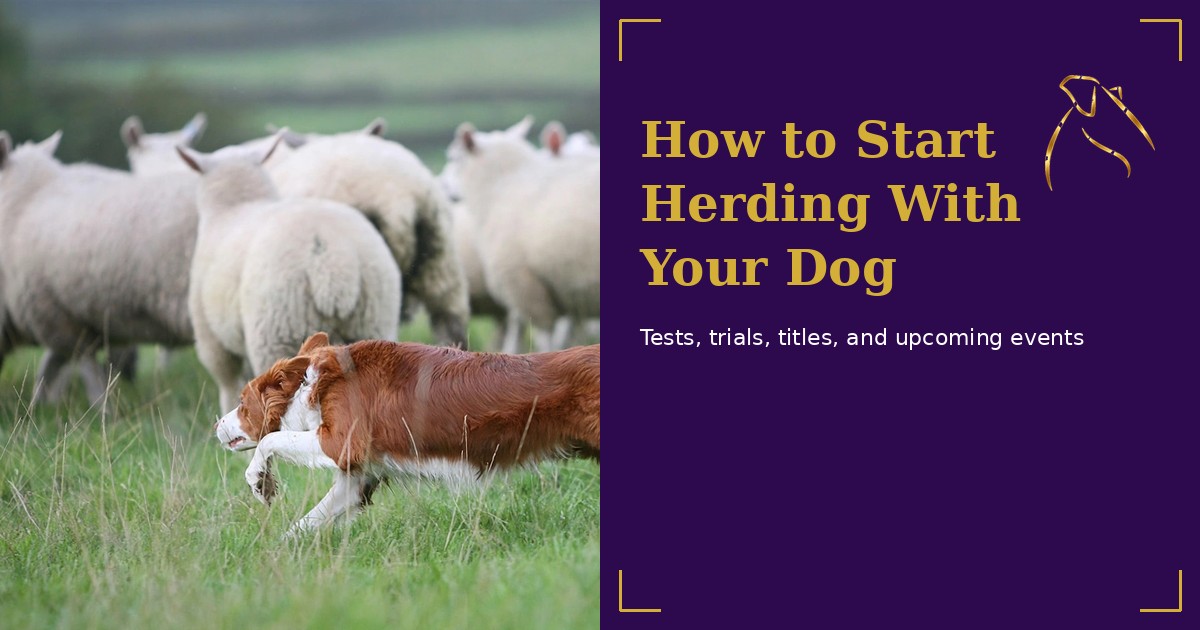
Watch a good herding dog work and you’ll never forget it: the wide looping outrun (the run the dog makes around the stock to gather it), the calm lift (the moment the dog takes control of the stock and starts it moving), the steady fetch (bringing the stock toward the handler), and the precise drive (pushing the stock away from the handler in a chosen direction). It looks like magic. It isn’t — it’s instinct shaped by training, and your dog might have more of that instinct than you think.
Which dogs can herd?
AKC herding is open to every breed in the Herding Group — Border Collies, Australian Shepherds, German Shepherd Dogs, Belgian Tervuren, Pembroke Welsh Corgis, and the rest — plus dozens of other breeds with working-dog roots: Rottweilers, Samoyeds, Bernese Mountain Dogs, Boxers, Giant Schnauzers, and many more. See the full AKC eligible-breeds list. If your dog is a different breed but shows interest, the American Herding Breed Association (AHBA) welcomes all breeds at the trial level (its entry-level HCT test is limited to listed herding breeds), and the Australian Shepherd Club of America (ASCA) offers all-breed herding events.
How do I find out if my dog has the instinct?
Start with a herding instinct test. Herding trainers offer them, and they’re often available at herding events themselves — ask around at any trial and someone will point you to the tester. Your dog is introduced to livestock, usually sheep, and the tester watches for sustained interest: does the dog circle the stock, move toward it, try to keep it together, show that spark of wanting to control the animals — all without aggression?
A dog that passes two instinct tests under two different judges earns a Herding Instinct Certificate. One thing to know: the certificate is not a title and doesn’t go after your dog’s name. (Some breeders still list “HIC” after names from an old rule — that’s outdated.) Think of it as your green light to start training.
What are the HT and PT test levels?
Before trials, there are two test levels. Each requires two qualifying runs to earn the title.
- HT — Herding Tested
- The entry level. In a small yard, a dog is judged on moving stock in a figure-8 pattern around pylons, showing a controlled stop (usually a sit or down), and coming back to the handler at the end. It proves the dog can be directed around stock.
- PT — Pre-Trial Tested
- The higher test level. The dog must show three controlled stops: a controlled pause at the start, one stop on course, and one stop while the handler opens the pen gate. Many handlers treat it as the stepping stone to trials, but AKC requires no test title before entering trial classes. Clubs may offer it in a “Boundary” style, where the dog works stock along a fence line — the premium list will say which style is offered.
Many handlers of traditional herding breeds skip straight to PT. If your dog is newer to stock, HT is the kinder starting point.
How do herding trials work?
Trials have three levels — Started, Intermediate, and Advanced — and each level requires three qualifying scores under different judges. A dog is judged on calm, controlled, precise stock work: gathering the stock, moving it where the handler directs, and completing each element of the course without upsetting the animals.
Each level is run on one of four courses, and each course can use sheep, cattle, or ducks (the animals are called stock). Here’s what each course asks for:
- Course A — the arena course
- Run in a fenced arena. The dog moves stock through a series of obstacles — gates, chutes, freestanding panels — and finishes by penning (putting the stock into a pen and closing the gate). Tests close control and precision.
- Course B — the Border Collie course
- A modified version of the classic British sheepdog trial. The dog makes an outrun (a wide run around the stock), performs the lift (taking control), fetches (brings the stock to the handler), then wears (moves the stock side to side, keeping it grouped) and drives (pushes the stock away from the handler through obstacles) before penning. At the Advanced level, the dog must also perform a shed — separating specific animals from the group.
- Course C — the European course
- Reflects herding as practiced in Europe: large flocks worked in big, open, often unfenced areas, in the style of German herding trials. Tests the dog’s ability to manage a lot of stock over distance.
- Course D — the ranch course
- Added in 2018, this simulates real ranch work with customizable obstacles — chutes, sorting pens, bridges, and gate work — designed fresh for each facility by the course director. The closest thing to an actual day’s work on a working ranch.
What do the titles mean — and what is HSAs?
Herding titles look like alphabet soup until you learn the code. Every trial title combines three things: the level, the course, and the stock.
- HS — Herding Started
- The Started-level title. Add the course and stock: HSAs = Started, Course A, sheep. HSBd = Started, Course B, ducks.
- HI — Herding Intermediate
- The Intermediate-level title. HIAs = Intermediate, Course A, sheep. HIBc = Intermediate, Course B, cattle.
- HX — Herding Excellent
- The Advanced-level title. HXAs = Advanced (Excellent), Course A, sheep. HXAc = Advanced, Course A, cattle.
The letters after the level are always in the same order: course first, then stock. Course is A, B, or C. Stock is s (sheep), c (cattle), or d (ducks). Dogs can hold multiple herding titles at once — a dog with Started titles on ducks and sheep plus an Intermediate on sheep might read HSAds HSAs HIAs.
Beyond the base titles, dogs can earn Master titles by piling up additional qualifying scores at the same level — for example, HSBDM (Herding Started, Course B, Ducks, Master). And at the very top sits HC — Herding Champion, a prefix title that goes before the dog’s name.
How do I actually get started?
The honest path, step by step:
- Take an instinct test. Find a herding trainer or attend a trial that offers testing. If your dog lights up around stock, you’re in business.
- Find a trainer. This matters more than anything else. Herding is not a sport you learn from videos — you need access to stock and someone who can read both your dog and the livestock. Ask local Herding Group breed clubs who they recommend, and watch a few lessons before committing.
- Train on sheep first. Sheep are the standard beginner stock: they flock together naturally and move predictably. Ducks are smaller and twitchier; cattle are bigger, stronger, and less forgiving of mistakes.
- Expect a year or more of lessons. Most handlers train once or twice a week for six months to a year before entering a test, and a year or two before competing at the Intermediate level. There are no shortcuts — and that’s the point.
- Enter a test. When your trainer says you’re ready, enter an HT or PT at a local trial. Each day of a trial is a separate show, so a two-day weekend gives you two chances to qualify.
What should I watch for at my first trial?
Go watch before you enter. You’ll see handlers walking the course, judges briefing the gallery, and dogs of wildly different experience levels working the same stock. Watch how the best handlers stay quiet — the less you say, the better the dog looks. Watch how a good dog gathers (collects scattered stock into a group) without rushing, and how it rates its speed to the stock’s mood. Calm stock, calm dog, calm handler: that’s the whole game.
Upcoming herding events on ThePetAdvisor
Real herding events on the schedule right now:
- Loading upcoming events…
Sources: AKC Herding, AKC Titles A–Z, National Herding Foundation: Herding Instinct Test, AKC Herding Regulations (PDF).
Planning your dog sport season? Create your free ThePetAdvisor account — track your dogs and never miss a closing date.
Frequently asked questions
What dog breeds are eligible to compete in AKC herding trials?
All Herding Group breeds are eligible, plus dozens of other working breeds. AHBA welcomes all breeds at the trial level; ASCA offers all-breed herding events.
What is the difference between Herding Tested (HT) and Pre-Trial Tested (PT)?
HT (Herding Tested) is the entry test level: the dog moves stock in a figure-8 pattern, shows a stop, and recalls to the handler. PT (Pre-Trial Tested) is the higher test level: the dog must show three controlled stops, including one while the handler opens the pen gate.
What do AKC herding titles like HSAs mean after a dog's name?
Herding titles combine the level, the course, and the stock. HSAs means Herding Started on Course A with sheep. HXAc means Herding Excellent on Course A with cattle. HS is Started, HI is Intermediate, HX is Excellent; A, B, C, and D are the four courses; s, c, and d stand for sheep, cattle, and ducks.
How can I tell if my dog has herding instinct?
Start with a herding instinct test, offered by herding trainers and at many herding events. The dog is introduced to livestock (usually sheep) and the tester watches for sustained interest — circling the stock, moving toward it, trying to control it — without aggression. Passing two instinct tests under two different judges earns a Herding Instinct Certificate, which is a certificate, not a title.
What are the four AKC herding trial courses?
Course A takes place in an arena and requires the dog to move livestock through obstacles and into a pen. Course B is a modified Border Collie course requiring an outrun, lift, fetch, wear, drive, and pen — Advanced adds a shed. Course C reflects European herding with large flocks in open areas. Course D, added in 2018, simulates ranch work with customizable obstacles like chutes, sorting pens, and bridges.
Chasing herding titles with your dog?
Record every title on your dog’s ThePetAdvisor profile — track progress toward the next one, and plan your weekends around the sports you love.