The Reading Room • Dog Sports
Planning your dog sport season? Create your free ThePetAdvisor account — track your dogs and never miss a closing date.
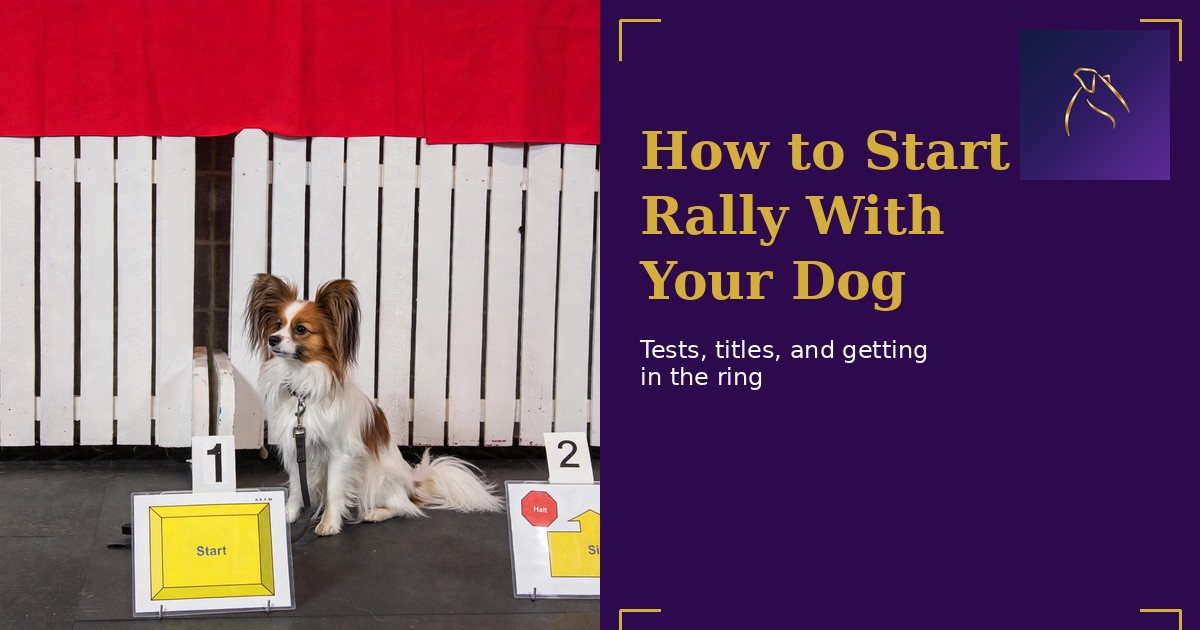
Picture this: you and your dog walk into a ring together, and instead of a judge barking orders at you, there’s a course of numbered signs (instruction placards, each one describing a skill to perform at that spot) laid out like a treasure map. You move through them side by side — a sit here, a turn there, a jump, a figure-8 — at your own pace, talking to your dog the whole way. That’s rally. It’s the friendliest doorway into AKC dog sports, and it was built for exactly the dog sitting next to you right now.
What is rally obedience?
Rally is a team sport where a dog and handler navigate a course (a mapped-out sequence of numbered signs set up in a ring) together. Each station (one numbered sign along the course) tells you what to do: “Halt-Sit,” “Right Turn,” “Call Front,” and dozens more, getting harder as you move up the levels. You start with 100 points, the judge deducts points for mistakes — a crooked sit, a missed sign, a tight leash — and if you finish with 70 or more, you earn a qualifying score, also called a leg (one qualifying run toward a title).
The judge says only two things to you: “Are you ready?” and “Forward.” After that, the course is yours. You walk it beforehand without your dog, plan your path, and then run it together.
Which dogs can compete in AKC rally?
Almost any dog. Rally is open to all AKC-registered breeds, and mixed-breed dogs compete through the AKC Canine Partners program — same classes, same titles, no separate division. Dogs must be at least 6 months old and in good health. There’s no athletic prerequisite: senior dogs, small dogs, giant dogs, and couch potatoes all do rally. If your dog knows sit, down, and can walk on a loose leash, you have the foundation.
Can’t get to trials yet? AKC also offers virtual rally titles — you video your run at home and submit it. A great option for shy or reactive dogs, or anyone far from a trial site.
How is rally different from obedience?
This is the question everyone asks, and the answer is the reason rally exists. In traditional obedience, you give one cue — any extra talking, encouraging, or gesturing costs you points. The dog is judged on precision: exact heel position, crisp responses, silence between exercises.
In rally, unlimited communication is encouraged, not penalized. You can talk to your dog, repeat cues, clap your hands, pat your legs, and praise throughout the course. A dog is judged on teamwork and willingness, not perfection — a happy dog working with its handler outscores a precise dog working joylessly. The courses also change at every trial, so you’re always reading a fresh map instead of drilling the same routine.
One caveat: in Excellent and Master, you may not pat your legs or clap your hands. Everything else — talking, praising, hand signals — stays.
What are the rally levels and titles?
Five levels, each harder than the last. Most titles take three qualifying scores of 70+ under at least two different judges.
- Novice — RN (Rally Novice)
- The starting point. All exercises on leash, 10–15 stations, no jumps. Turns, pace changes, halts, and basic position work. Three qualifying scores earns the RN.
- Intermediate — RI (Rally Intermediate)
- The bridge class — and it’s optional. Same skills as Advanced but on leash with no jump, 12–17 stations. You can skip straight from Novice to Advanced if you’re ready. Requires the RN first.
- Advanced — RA (Rally Advanced)
- The first off-leash level. 12–17 stations, one jump. The dog works jumps, moving stands, and harder position changes. Requires the RN (not the RI).
- Excellent — RE (Rally Excellent)
- Off leash, 15–20 stations, two jumps, and no patting or clapping. Backing up in heel position, distance work, and the hardest Novice-through-Advanced signs combined. Requires the RA.
- Master — RM (Rally Master)
- The summit of the standard levels. Off leash, 15–20 stations, one jump, no patting or clapping — and this one takes ten qualifying scores under two different judges, not three. Requires the RE.
At every level there are A and B classes. A is for handlers who have never titled a dog at that level (or any level in AKC obedience); B is for everyone else. Both are judged identically — you just place against your own class.
What do rally titles like RAE mean — and what is RACH?
Past Master, rally has two titles for the truly committed:
- RAE — Rally Advanced Excellent
- After earning the RE, qualify in both Advanced B and Excellent B at the same trial — a double qualifying score, or double Q — ten times. Each run must score 70+. Earn it again and the number follows: RAE2, RAE3, and so on.
- RACH — Rally Champion
- The top of the mountain — and a prefix title, so it goes before the dog’s name. To earn it, a dog must hold the RM, then earn 20 triple qualifying scores (qualifying in Advanced B, Excellent B, and Master at the same trial — a triple Q) plus 300 championship points, with at least 150 from the Master class. Championship points only count on scores of 91 or higher (a 100 earns 5 points, a 91 earns 1). Like RAE, it numbers up: RACH2, RACH3.
All rally titles except RACH go after the dog’s name. When a dog earns a higher title, it replaces the lower one — a dog with an RE doesn’t keep listing its RA.
How do I actually get started?
The honest path, step by step:
- Take a class. Find an AKC club or training facility offering rally. Most clubs welcome observers — go watch a class before signing up. Expect to repeat Novice at least once; most teams train two to four months before their first trial.
- Learn the signs at home. AKC publishes every rally sign online. Print a few, set them up in your yard or living room, and practice reading them quickly. Start with sit, down, stays, and heeling.
- Keep sessions short and fun. Ten to fifteen minutes, a few times a week, with treats, toys, and praise. Rally rewards enthusiasm — a dog that loves the game will always outscore a drilled one.
- Practice the course walk. At trials you walk the course without your dog first. Practice this at home: memorize the sequence, plan where you’ll slow down, and rehearse it mentally. Handlers lose more points to their own mistakes than their dogs’.
- Enter Novice A. Novice A is designed for first-timers, and judges know it — they want you to have a good experience. Each day of a trial is a separate show, so a two-day weekend gives you two chances at a leg.
What should I watch for at my first trial?
Go early, bring a crate and a chair, and watch a few runs before yours. The tips experienced handlers give beginners, over and over:
- Don’t enter the ring until the judge invites you. The rally ring is the judge’s house — wait to be asked in.
- Keep slack in the leash. A tight leash costs points in Novice. Hold it loosely and let your dog move.
- Read every sign early. Know your lefts from your rights before you reach the station. Most handler errors come from misreading, not from the dog.
- Pause after every walk-around. Any sign where you walk around your dog requires a visible pause when you return to heel position. Forgetting it is a 10-point deduction — the single most common handler error in rally.
- Don’t praise until you cross the finish. The timer doesn’t stop until both of you cross the finish line. Celebrate after.
- Thank your judge and stewards. Then go reward your dog like they just won Westminster — because to them, they did.
One more: your run will feel worse than it looks. Have someone video it — you’ll be surprised how good the teamwork reads from outside the ring.
Upcoming rally events on ThePetAdvisor
Real rally events on the schedule right now:
- Loading upcoming events…
Sources: AKC Rally 101, AKC: Getting Started in Rally, AKC: Dog Sport Titles, Whole Dog Journal: How to Get Involved in Rally.
Planning your dog sport season? Create your free ThePetAdvisor account — track your dogs and never miss a closing date.
Frequently asked questions
What is the difference between AKC rally and AKC obedience?
In rally, handlers can talk to their dogs, repeat cues, clap, pat their legs, and encourage their dogs throughout the course — unlimited communication is encouraged. In traditional obedience, you give a single cue and additional encouragement costs points. Rally is judged on teamwork and willingness; obedience is judged on precision.
Can mixed breed dogs compete in AKC rally?
Yes. Mixed-breed dogs compete in AKC rally through the AKC Canine Partners program. They compete in the same classes and earn the same titles as purebred dogs, with no distinction in scoring or eligibility once registered.
How many qualifying scores do you need for a rally title?
Most rally titles require three qualifying scores of 70 or higher under at least two different judges. The exceptions are Rally Master (RM), which requires ten qualifying scores, RAE (ten double qualifying scores), and RACH (twenty triple qualifying scores plus 300 championship points).
What does RAE mean in rally obedience?
RAE stands for Rally Advanced Excellent. To earn it, a dog and handler team must qualify in both the Advanced B and Excellent B classes at the same trial, ten separate times. Each qualifying run must score 70 or higher.
How do you earn a Rally Champion (RACH) title?
To earn the RACH, a dog must first hold the Rally Master title, then earn 20 triple qualifying scores (qualifying in Advanced B, Excellent B, and Master at the same trial, 20 times) plus 300 championship points, with at least 150 points from the Master class. Championship points are only awarded for scores of 91 or higher. RACH goes before the dog’s name.
Chasing rally titles with your dog?
Record every title on your dog’s ThePetAdvisor profile — track progress toward the next one, and plan your weekends around the sports you love.