
Breed profile · Toy Group · the steel-blue and tan toy terrier from Yorkshire
Yorkshire Terrier
The Yorkshire Terrier is a compact, toy-size terrier of no more than seven pounds whose crowning glory is a straight silky coat of steel blue and rich golden tan. Beneath that floor-length coat beats the heart of a feisty, old-time terrier — a mill ratter turned Victorian lapdog, and now one of the most popular toy breeds in America. The AKC recognized the breed in 1885, and the Yorkshire Terrier Club of America is the parent club.
Help us improve it. This is one of ThePetAdvisor’s breed profiles, built from public sources with generous links to the people who actually own this breed’s knowledge. If something’s off or missing, the parent club can claim the page and set it straight — see the bottom of the page.
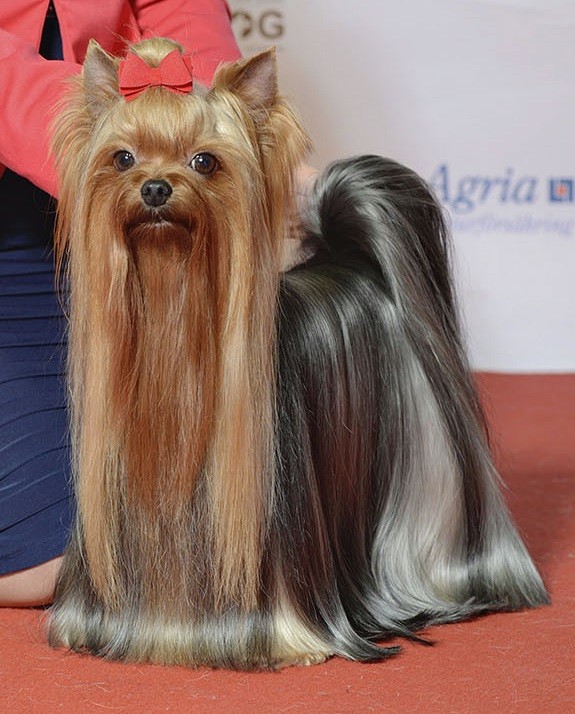

Do you have a better photo of a Yorkshire Terrier in the American show ring? If you have a show photo you’d let us use, email it to [email protected] — tell us the dog’s name and the show, and it may be featured here. Please only send photos you took yourself or have the photographer’s permission to share, and tell us the photographer’s name.
1. Breed at a glance
Toy Group; recognized by the AKC in 1885
Height 7–8 in at the shoulder; weight must not exceed 7 lb
Long, straight, glossy and silky; dark steel blue and rich golden tan; puppies born black and tan
11–15 years
Affectionate, sprightly, and tomboyish; feisty, brave, and sometimes bossy
Yorkshire Terrier Club of America, the AKC parent club
A Yorkshire Terrier is a very small dog with a very large opinion of itself — the AKC calls the breed affectionate, sprightly, and tomboyish, and the parent club puts it more bluntly: feisty, brave, and sometimes bossy, packing big attitude into a small, but self-important, package. It is a toy dog by size and a terrier by temperament, and the whole breed is built around one thing: the coat. A floor-length fall of dark steel blue and rich golden tan, parted down the middle and hanging straight, is the silhouette that says Yorkie at a glance — and the grooming that keeps it is the price of owning one. (Sources: AKC, Yorkshire Terrier; The Yorkshire Terrier Club of America.)
2. History
The Yorkshire Terrier’s ancestors are the small terriers Scottish weavers brought south to Yorkshire and Lancashire in the middle of the 19th century, when the Industrial Revolution moved textile work out of Scotland. There, the Scottish arrivals were crossed with local dogs — in particular the Waterside, or Otter, Terrier and the Old English Terrier — and the little dogs went to work as ratters in the mills where their owners worked and in the cramped housing where they slept. Originally known and shown as the Broken Haired Scotch Terrier or Toy Terrier, the breed’s deeper roots run to the Clydesdale and Paisley Terriers of Scotland, whose silky blue-and-tan coats are the same distinctive coloring the Yorkshire Terrier carries today. (Source: AKC, Yorkshire Terrier History.)
If one dog is responsible for the Yorkshire Terrier as it is known today, it is Huddersfield Ben, born in 1865 in the town that gave him his name. Ben was a favorite in the show ring and also excelled at rat-baiting competitions, and as a stud dog his genes have come down to virtually every Yorkshire Terrier alive today — he is still called the father of the breed. By the 1870s the dogs were so popular in Yorkshire and beyond that they earned the name Yorkshire Terrier, and all mention of their Scottish roots was, as the AKC puts it, obliterated. The first Yorkshire Terrier known to have been born in the United States was John Marriot’s Jack, born in New York City in 1872; the AKC registered its first Yorkshire Terrier, a female named Belle, in 1885, the year the breed was recognized. The first licensed specialty for Yorkshire Terriers was held February 12, 1918, by the Yorkshire Terrier Association of America, one of the three breed clubs formed before the present parent club. (Sources: AKC, Yorkshire Terrier History; YTCA Heritage, reprinted at Top Notch Toys.)
The breed’s popularity fell away in the 1940s, when grooming demands lost out to a wartime-distracted America — and it was rekindled by a 4-pound Yorkie named Smoky, found in a foxhole in the New Guinea jungle. Smoky accompanied an American GI on combat flights over the Pacific, survived 150 air raids, warned of incoming shells, and ran telegraph wire through narrow pipes to help build a critical airbase; after the war she became the first documented therapy dog, cheering patients at veterans hospitals with tricks that included walking a tightrope blindfolded. From mill ratter to Victorian lapdog to war dog to therapy dog, the Yorkshire Terrier has come full circle — and the 2026 national specialty in Jacksonville, Florida, was the parent club’s 75th-anniversary show. (Sources: AKC, Yorkshire Terrier History; Obedience Training Club of Palm Beach County, Lead Lines, July 2026.)
3. The standard and why it is written that way
- General appearance — a long-haired toy terrier. “That of a long-haired toy terrier whose blue and tan coat is parted on the face and from the base of the skull to the end of the tail and hangs evenly and quite straight down each side of body. The body is neat, compact and well proportioned. The dog’s high head carriage and confident manner should give the appearance of vigor and self importance.” The standard was approved April 12, 1966, and has not been amended since except for the disqualification added October 1, 2007. (Source: The Yorkshire Terrier Club of America, Official Standard.)
- Head — small, flat, and sharp-eyed. Small and rather flat on top, the skull not too prominent or round, the muzzle not too long, with the bite neither undershot nor overshot and teeth sound; either scissors bite or level bite is acceptable. The nose is black. Eyes medium in size and not too prominent, dark in color and sparkling with a sharp, intelligent expression, with dark eye rims. Ears small, V-shaped, carried erect and set not too far apart. (Source: The Yorkshire Terrier Club of America, Official Standard.)
- Body, legs & tail — neat, compact, and level. Well proportioned and very compact, the back rather short, the back line level, with height at shoulder the same as at the rump. Forelegs straight, elbows neither in nor out; hind legs straight when viewed from behind, with stifles moderately bent when viewed from the sides. Feet round with black toenails. The tail is docked to a medium length and carried slightly higher than the level of the back. (Source: The Yorkshire Terrier Club of America, Official Standard.)
- Coat — quality, texture, and quantity first. “Quality, texture and quantity of coat are of prime importance. Hair is glossy, fine and silky in texture. Coat on the body is moderately long and perfectly straight (not wavy).” It may be trimmed to floor length to give ease of movement and a neater appearance. The fall on the head is long, tied with one bow in center of head or parted in the middle and tied with two bows, and the hair on the muzzle is very long. Hair should be trimmed short on the tips of the ears and may be trimmed on the feet. (Source: The Yorkshire Terrier Club of America, Official Standard.)
- Color — dark steel blue and rich golden tan, nothing else. Puppies are born black and tan and are normally darker in body color, showing an intermingling of black hair in the tan until they are matured. In adult dogs, the blue is a dark steel blue, not a silver blue, and not mingled with fawn, bronzy, or black hairs, extending over the body from the back of the neck to the root of the tail; the hair on the tail is a darker blue. The tan is darker at the roots than in the middle, shading to still lighter tan at the tips, with no sooty or black hair intermingled with any of the tan. The head fall is a rich golden tan, deeper at the sides of the head, at the ear roots, and on the muzzle; the chest and legs are a bright, rich tan, not extending above the elbow on the forelegs nor above the stifle on the hind legs. (Source: The Yorkshire Terrier Club of America, Official Standard.)
- Weight — must not exceed seven pounds. The standard gives no height figure at all — the single hard number is the weight ceiling, and a dog over it cannot be a correct Yorkshire Terrier however good its coat. (Source: The Yorkshire Terrier Club of America, Official Standard.)
- Disqualification — the hard line. Any solid color or combination of colors other than blue and tan as described above. Any white markings other than a small white spot on the forechest that does not exceed 1 inch at its longest dimension. The disqualification was added October 1, 2007. (Source: The Yorkshire Terrier Club of America, Official Standard.)
- Why it is written that way. Every clause in the standard points back to the coat: quality, texture, and quantity come first because the floor-length silk fall is the breed’s signature, the thing a judge sees from across the ring. The color rules exist because a Yorkie is born black and tan and only grows into its blue and tan — so the standard has to describe the adult coat, not the puppy’s, and to draw a hard line against every other color with a disqualification rather than a fault. And the 7-pound ceiling is the breed’s other anchor: without it, the toy terrier drifts back toward the 11- and 12-pound ratters it started as, and the dog on the lap stops being a Yorkie at all.
4. Temperament & living with one
The AKC’s summary is short: beneath the dainty, glossy, floor-length coat beats the heart of a feisty, old-time terrier, and the breed is affectionate, sprightly, and tomboyish. The parent club’s version is shorter still: feisty, brave, and sometimes bossy, packing big attitude into a small, but self-important, package. Both are describing the same dog — a ratter that became a lapdog and never quite believed the demotion. (Sources: AKC, Yorkshire Terrier; The Yorkshire Terrier Club of America.)
- With its own people: devoted and intensely bonded, often to one person above all. A Yorkie leans on its people, follows them from room to room, and expects to be part of whatever is happening — on a lap, in a bag, or at the foot of the bed.
- With strangers: alert and watchful rather than shy. The breed is quick to announce a visitor, and early socialization is what turns that wariness into confidence instead of fear or snapping. The terrier in the breed means a dog with opinions about who belongs in the house.
- Training: bright and quick to learn — and famously self-willed. A Yorkie responds to fair, consistent training and to praise, and it notices inconsistency at once. House-training takes patience: a small dog’s accidents are easy to miss, and a self-willed dog notices when you do.
- Exercise: small but not sedentary. A Yorkie needs daily walks and play, and it is quick and agile for its size — it was built to hunt vermin in mills, not to sit still. What it does not need is a yard: it is an indoor dog that goes out, not an outdoor dog that comes in, and it chills easily in cold weather.
- Fragility: the size that makes the breed portable also makes it breakable. A Yorkie can be seriously hurt by a fall from a couch or a step from a careless foot, and it needs supervision around small children, not just affection.
- First-dog honesty: this is a lot of personality — and a lot of grooming — for a first-time owner. The confidence, the barking, and the willfulness all demand an owner who trains from day one and keeps training, and who brushes every day or keeps the coat clipped short. If that sounds like a burden rather than a pleasure, a softer breed is the honest choice.
5. Grooming
The Yorkshire Terrier’s coat is a single layer with no undercoat, very similar to human hair — which is why it grows long, mats when it is dirty, and needs daily attention in full coat. The parent club’s own grooming guide is the authority here, and its first rule is that any hair type grows best when the Yorkie is in good health and being fed a correct diet. (Source: The Yorkshire Terrier Club of America, Grooming the Yorkshire Terrier.)
- Daily brushing: a good brushing every day keeps the tangles away. Work mats out gently with your fingers first and then a wide-tooth metal comb, always from the ends of the hair toward the body, with a little detangler to save coat — never pull mats out. A cotton coat mats easily and needs daily brushing and a conditioner with a slight oil base; a woolly coat is thick and full and needs brushing once or twice a day.
- Bathing: once every week or two, more often for some dogs. First make sure all the tangles are out, then shampoo and rinse — and rinse again, because soap left in dulls the coat and can cause itching — then use a good conditioner. Cleanliness matters because dirty hair cannot grow well.
- Eyes & ears: clean the corners of the eyes every day if your Yorkie tears a lot, or staining and whisker rot follow. The ears are prick and stand on their own; never use cotton swabs in the ear canal — use a good ear flush or powder if needed, and have any unusual smell or continued scratching checked by a veterinarian.
- Teeth & nails: clean the teeth every day — brush, pretreated pads, or gauze wrapped around a finger — and trim the toenails at least every two weeks. Keep the hair on the pads of the feet clipped so the dog does not slip on slippery floors.
- The clipped option: a full floor-length coat is a show coat, not a requirement for a pet. Many owners keep the coat in one of the numerous clipped styles — the usual answer for a cotton coat, and the honest answer for anyone who will not brush every day.
6. Health testing
The parent club’s CHIC requirements, as published by the OFA, are an ACVO eye exam and a patella evaluation, with Legg-Calve-Perthes evaluation recommended as well. A CHIC number requires the breed-specific results to be released publicly, pass or fail. The lists:
- Patella evaluation — the big one. Patellar luxation — slipping kneecaps — is the most common joint problem in the breed, and the OFA evaluation grades it from normal to Grade IV. Dogs must be at least 12 months old for an official OFA patella evaluation. (Sources: OFA, CHIC Program: Yorkshire Terrier; Embark, Genetic Health Tests for Yorkshire Terriers.)
- ACVO eye exam. The eye exam by a board-certified ACVO ophthalmologist screens for hereditary eye disease, including cataracts and progressive retinal atrophy. Eye clearances are renewed annually, because some eye diseases develop later in life. (Sources: OFA, CHIC Program: Yorkshire Terrier; Embark, Genetic Health Tests for Yorkshire Terriers.)
- Legg-Calve-Perthes evaluation — recommended. Legg-Calve-Perthes disease is a hip-joint disease of young small dogs, in which the head of the femur loses blood supply, weakens, and collapses, causing limping and hip pain. The OFA lists it as optional but recommended for the breed. (Sources: OFA, CHIC Program: Yorkshire Terrier; Embark, Genetic Health Tests for Yorkshire Terriers.)
- Genetic tests to ask about: DNA tests exist for primary lens luxation, a painful and potentially blinding inherited eye condition, and for progressive retinal atrophy (prcd-PRA), a degenerative eye disorder that causes blindness in both eyes over time. (Source: Embark, Genetic Health Tests for Yorkshire Terriers.)
- Other conditions to ask about: the breed’s small size brings its own risks — a dropped or stepped-on Yorkie is an emergency — and Yorkies are prone to dental crowding in their small mouths, so dental care matters more in a Yorkie than in most breeds. Tracheal collapse and liver shunt are also conditions Yorkshire Terrier owners should know by name and ask a breeder about.
Ask any breeder for the parents’ results for the eye exam, the patella evaluation, and the Legg-Calve-Perthes evaluation, and look them up in the OFA database yourself before you commit. The breed’s 11-to-15-year lifespan is a long one for any dog, and the testing exists so that those years are healthy ones.
7. The annual Yorkshire Terrier specialty dog show
A specialty is the breed’s All-Star show — its Super Bowl. Once a year, the best Yorkshire Terriers from across the country, and often from around the world, come together in one place.
The Yorkshire Terrier Club of America’s national specialty: one national event each year, with conformation, sweepstakes, and junior showmanship. The 2026 national: May 27, at the Southbank Hotel Jacksonville Riverwalk in Jacksonville, Florida, with 62 competitors and 73 entries in conformation. The 2025 national: September 2, at the Embassy Suites by Hilton Lexington in Lexington, Kentucky, with 84 competitors and 96 entries. The 2027 national: December 19, in Orlando, Florida, in conjunction with the AKC National Championships.
The standard, in brief: a long-haired toy terrier with a blue and tan coat parted on the face and from the base of the skull to the end of the tail, hanging evenly and quite straight down each side of the body. Weight not to exceed 7 pounds. Dark steel blue from the back of the neck to the root of the tail, never silver blue; rich golden tan on the head, chest, and legs. Small V-shaped ears, carried erect.
The 2026 National Specialty — Wednesday, May 27, 2026, at the Southbank Hotel Jacksonville Riverwalk, 1515 Prudential Dr, Jacksonville, Florida. Entry: 73 entries / 62 competitors in conformation. Entries closed May 6, 2026. Event Chair: Dave King, Corinth, Mississippi. Superintendent: Onofrio Dog Shows, L.L.C. The 2026 national: the club’s 75th-anniversary show. (Sources: AKC event search, event 2026078005; Obedience Training Club of Palm Beach County, Lead Lines, July 2026.)
National specialty judge: Mr. R V Filburn JR — conformation and junior showmanship. Sweepstakes offered; the sweepstakes judge not confirmed in an official source as of November 2026. (Source: AKC event search, event 2026078005.)
Results (2026 national). Best of Breed: GCHS CH Magnifique’s If I Can Dream (bitch). Best of Opposite Sex: CH Parkside’s Steal My Heart (dog). Winners Dog: Blue-Fantasy’s Troublemaker; Winners Bitch and Best of Winners: Sapphire’s Something Royal. Select Dog: CH Alvaur Captain America; Select Bitch: GCHB CH Oakhurt’s Bedazzling Footloose And Fancyfree. Best Junior Handler: Ellery Rusch; Reserve Best Junior Handler: Zachariah Parrow. (Source: AKC event search, event 2026078005.)
The 2027 National Specialty: Sunday, December 19, 2027, one day, in Orlando, Florida, in conjunction with the AKC National Championships sponsored by Royal Canin. Tentative national-week schedule: Tuesday–Thursday, December 14–16, 2027 — All-Breed Shows; Friday, December 17, 2027 — Central Florida YTC Regional Specialty; Friday evening, December 17, 2027 — YTCA Top Twenty Event; Saturday, December 18, 2027 — AKC National Championships; Sunday, December 19, 2027 — YTCA National Specialty. Venue, AKC event number, judges, entries, and closing date not yet published as of November 2026. (Source: The Yorkshire Terrier Club of America.)
Past national specialties: 2025
Yorkshire Terrier Club of America — yorkshireterrierclubofamerica.org
8. Regional specialties through the year: smaller regional shows
The national is the anchor, but the breed’s year also runs through regional specialties — smaller regional shows, not the national — held around the country, including the regional specialty that runs with the national. These are the 2026 regionals verified from club and AKC sources so far:
Seven regional Yorkshire Terrier specialties verified for 2026 so far, including the regional specialty that runs with the national in Jacksonville, Florida, and the Central Florida specialty still to come in Orlando in December:
- Yorkshire Terrier Club of America regional specialty — Thursday, May 28, 2026, Jacksonville, Florida: at the Southbank Hotel Jacksonville Riverwalk (AKC event 2026078006), the day after the national. Judge: Mrs. S Dillin. Entry: 69 entries / 57 competitors. Best of Breed: Sapphire’s Something Royal (bitch) — Winners Bitch and Best of Winners at the national the day before; Best of Opposite Sex: CH Parkside’s Steal My Heart (dog) — also Best of Opposite Sex at the national. Winners Dog: Tyava’s Thunderstruck. Event Chair: Dave King. Superintendent: Onofrio Dog Shows, L.L.C.
- Mount Rainier Yorkshire Terrier Club specialty — Thursday, August 13, 2026, Enumclaw, Washington: at the Enumclaw Expo Center (AKC event 2026418101). Judge: D P Cline. Entry: 28 entries / 25 competitors. Best of Breed: GCHG CH Blue-Fantasy’s Mr. Lover Lover (dog); Best of Opposite Sex: CH Firacres Beyond Expectations TKN (bitch). Winners Dog: Images Party On; Winners Bitch: Palmridge’s The Life Of A Showgirl. Superintendent: BaRay Event Services, Inc.
- Delaware Valley Yorkshire Terrier Club specialty — Friday, August 21, 2026, Morgantown, Pennsylvania: at the Holiday Inn Morgantown (AKC event 2026052903). Judge: Dr. J V Ioia. Entry: 40 entries / 35 competitors. Best of Breed: GCHB CH Oakhurst’s Good Morning America Dark Knight Rises (dog); Best of Opposite Sex: GCH CH Caraneal’s Midnight In Paris (bitch). Winners Dog: CH Hihopes Celine’s Legacy; Winners Bitch: Vanica’s Best Pint Of Guinness. Event Secretary: Teresa Cuchiaro.
- Yorkshire Terrier Club of the Nation’s Capital specialty (1 of 3) — Friday, October 9, 2026, Sterling, Virginia: at the DoubleTree by Hilton Dulles Airport (AKC event 2026241402). Judge: D A Johnson. Entry: 25 entries / 23 competitors. Best of Breed: GCHG CH Blue-Fantasy’s Mr. Lover Lover (dog); Best of Opposite Sex: Paddington’s Star Of The Sea (bitch). Winners Dog: Blue-Fantasy’s Jack Daniel’s On The Rocks; Winners Bitch: Paddington’s Star Of The Sea.
- Yorkshire Terrier Club of the Nation’s Capital specialty (2 of 3) — Friday, October 9, 2026, Sterling, Virginia: at the DoubleTree by Hilton Dulles Airport (AKC event 2026241403). Judge: Mrs. C Goodin. Entry: 27 entries / 21 competitors. Best of Breed: GCHG CH Blue-Fantasy’s Mr. Lover Lover (dog); Best of Opposite Sex: Paddington’s Star Of The Sea (bitch). Winners Dog: Wolpert’s I’M A Show Off; Winners Bitch: Paddington’s Star Of The Sea.
- Yorkshire Terrier Club of the Nation’s Capital specialty (3 of 3) — Friday, October 9, 2026, Sterling, Virginia: at the DoubleTree by Hilton Dulles Airport (AKC event 2026241404). Judge: Mr. T Clyde. Entry: 28 entries / 22 competitors. Best of Breed: GCHG CH Blue-Fantasy’s Mr. Lover Lover (dog); Best of Opposite Sex: GCH CH Caraneal’s Midnight In Paris (bitch). Winners Dog: Blue-Fantasy’s Mr. Electric Blue; Winners Bitch: Blue-Fantasy’s Bad Bunny. Event Chair for the three Sterling specialties: Robert Franzoni. Event Secretary: Teresa Cuchiaro.
- Central Florida Yorkshire Terrier Club specialty — Friday, December 11, 2026, Orlando, Florida: at the Orange County Convention Center, North/South Building, 9899 International Drive (AKC event 2026444301), during Orlando Championship Week. Judge: Sharon Masnick. Entries close November 11, 2026. Superintendent: MB-F Inc. Show not yet held as of November 2026.
The 2027 regionals announced so far:
Two regional Yorkshire Terrier specialties announced for 2027 so far, both from the parent club’s site; venues and judges not yet published as of November 2026:
- YTCA regional specialties — Friday, January 29, 2027, New York: the parent club hosts two regional specialties in New York — one designated regional specialty and one evening regional specialty. The Yorkshire Terrier Club of Greater New York hosts its regional specialty the next day, Saturday, January 30, 2027.
- Central Florida Yorkshire Terrier Club regional specialty — Friday, December 17, 2027, Orlando, Florida: the regional specialty in the 2027 national week, the day before the AKC National Championships and two days before the YTCA National Specialty.
Past regional specialties: 2025
More regional specialties will be added here as their programs are verified — this section is built from show data, not guesswork. Browse upcoming show weekends →
9. Clubs
- Yorkshire Terrier Club of America (YTCA) (parent club) — the AKC-recognized national breed club for the Yorkshire Terrier, and the only Yorkshire Terrier club the AKC recognizes as the parent club. Its mission: to preserve and protect the Yorkshire Terrier breed as recognized by the AKC, to provide education and encourage the breeding of true type, good health, and sound temperament, and to promote camaraderie and cooperation among members, always keeping in mind that the purpose of the club is the best interest of the breed. It maintains the breed standard, holds the national specialty each year, and publishes the quarterly E-Express. (Sources: The Yorkshire Terrier Club of America; The Yorkshire Terrier Club of America, About Yorkies.)
- YTCA member clubs. Local and regional Yorkshire Terrier clubs across the country hold the regional specialties in section 8, including the Central Florida Yorkshire Terrier Club, the Delaware Valley Yorkshire Terrier Club, the Mount Rainier Yorkshire Terrier Club, the Yorkshire Terrier Club of the Nation’s Capital, and the Yorkshire Terrier Club of Greater New York — and, among others, the Yorkshire Terrier Club of Northern California, the Yorkshire Terrier Club of Greater Kansas City, the Yorkshire Terrier Club of Oklahoma City, the Yorkshire Terrier Club of Southeastern Michigan, the Yorkshire Terrier Club of the Carolinas, and the Watchung Mountains Yorkshire Terrier Club. (Sources: AKC Club Search, Y clubs; AKC event records in section 8.)
- AKC Marketplace and breeder referral. The AKC’s club directory lists each club’s breeder-referral and rescue contacts, and the YTCA is the first stop for anyone looking for a puppy from a breeder who works under the club’s code. (Source: AKC Club Search, Y clubs.)
10. Rescue
- Yorkshire Terrier National Rescue, Inc. (YTNR). The national breed-only rescue for Yorkshire Terriers — a nonprofit 501(c)(3) that has rescued and re-homed Yorkshire Terriers since 1997. Its dogs live in foster homes and are spayed or neutered, heartworm tested, medically cleared, vaccinated, and microchipped before placement, and adoptions run on an application with a donation based on the dog’s age, health, and medical expenses. (Sources: Yorkshire Terrier National Rescue; AKC Rescue Network, Y Breeds.)
- YTCA Rescue, Inc. The parent club’s own rescue — a national 501(c)(3) dedicated to saving purebred Yorkshire Terriers, affiliated with the Yorkshire Terrier Club of America. The AKC Rescue Network lists the parent club’s rescue contact as Barbara Meskan ([email protected]). (Sources: YTCA Rescue, Inc., Adopt-a-Pet; AKC Rescue Network, Y Breeds.)
- AKC Rescue Network. The AKC’s rescue network lists Yorkshire Terrier rescue organizations under its Y breeds page, and the parent club is the first stop if you do not know which contact covers your area. (Source: AKC Rescue Network, Y Breeds.)
- Yorkies are common in rescue. The breed’s popularity cuts both ways: Yorkies turn up in shelters and in breed rescue often enough that a rescued Yorkie is easy to find and usually an adult, and it will arrive with its temperament visible before you commit. A rescue is the honest first stop if you want the breed without the puppy wait — and without the grooming learning curve of a puppy in full coat.
11. Breeder vs. rescue: honest guidance
- If you buy: start with the parent club, the Yorkshire Terrier Club of America — contact the club directly for a breeder referral — and ask for the parents’ health-test results — eye exam, patella evaluation, and Legg-Calve-Perthes evaluation — and look the results up in the OFA database yourself. Expect to wait for a puppy from a careful breeder: a good breeder will have the answers, will ask you as many questions as you ask them, and will take the puppy back for its whole life if you cannot keep it.
- If you rescue: a rescued Yorkie is usually an adult, and it will arrive with its temperament visible before you commit. What you get in return is a dog whose character you can see before you commit and a lower price. Either way, be honest with yourself first: a Yorkie needs daily grooming or a clipped coat, patient house-training, and an owner who socializes and trains from day one — not a purse and a hope.
- Watch out for “teacup” marketing. There is no teacup variety — the standard describes one Yorkshire Terrier, not over 7 pounds. A seller’s “teacup” label is a sales description, not a variety and not a mark of quality or health; the tiniest dogs carry the most risk, not the most value. The parent club’s rescue arm puts it plainly: there is no such thing as a Tea-Cup Yorkie. Judge the dog in front of you against the standard — the steel-blue and tan coat, the small erect ears, the confident manner — not against a listing’s adjectives.
- Watch out for “rare color” marketing. Parti-color, chocolate, solid gold, and black-and-tan adult coats are disqualifications under the standard, not rare colors worth a premium. Puppies are born black and tan and the adult blue and tan takes time to come in — a seller charging extra for a color the standard disqualifies is selling you a fault.
- Small-dog honesty: a Yorkie is not a toy and not a starter pet for small children. The size that makes the breed portable also makes it fragile, and the terrier temperament that makes it charming also makes it willful and vocal. If that sounds like a burden rather than a pleasure, a sturdier breed is the honest choice.
12. Claim this page
This page belongs to the breed, and the people who know the breed best are the Yorkshire Terrier Club of America and its members. If you are with the parent club — or you are a breeder, a judge, a handler, or a rescue volunteer who spotted something wrong, missing, or out of date — this page is yours to set straight. Tell us what needs fixing and where the correction is documented, and we will fix it and credit the source. Contact the site through the About page, and mention “Yorkshire Terrier breed profile.”
Sources
- AKC, Yorkshire Terrier breed page — akc.org/dog-breeds/yorkshire-terrier
- AKC, Yorkshire Terrier History — akc.org
- AKC, Is the Yorkshire Terrier the Right Breed for Your Lifestyle? — akc.org
- AKC Upcoming National Specialties — apps.akc.org
- AKC event search, event 2026078005 (2026 national) — apps.akc.org
- AKC event search, event 2026078006 (2026 regional) — apps.akc.org
- AKC event search, event 2025078008 (2025 national) — apps.akc.org
- AKC event search, event 2025078009 (2025 regional) — apps.akc.org
- AKC event search, event 2026444301 (Central Florida, 2026) — apps.akc.org
- AKC event search, event 2026418101 (Mount Rainier, 2026) — apps.akc.org
- AKC event search, event 2026052903 (Delaware Valley, 2026) — apps.akc.org
- AKC event search, event 2026241402 (Nation’s Capital 1, 2026) — apps.akc.org
- AKC event search, event 2026241403 (Nation’s Capital 2, 2026) — apps.akc.org
- AKC event search, event 2026241404 (Nation’s Capital 3, 2026) — apps.akc.org
- AKC Rescue Network, Y Breeds — akc.org/akc-rescue-network-y-breeds
- AKC Club Search, Y clubs — apps.akc.org
- The Yorkshire Terrier Club of America — yorkshireterrierclubofamerica.org
- The Yorkshire Terrier Club of America, About Yorkies: Official Standard and Grooming — yorkshireterrierclubofamerica.org/yorkies
- YTCA Heritage, reprinted at Top Notch Toys — topnotchtoys.com
- Obedience Training Club of Palm Beach County, Lead Lines, July 2026 (75th-anniversary show) — s10060.pcdn.co (PDF)
- Yorkshire Terrier Club of the Nation’s Capital, 2026 Events — yorkshireterrierclubofthenationscapital.org
- OFA, CHIC Program: Yorkshire Terrier — ofa.org
- Embark, Genetic Health Tests for Yorkshire Terriers — embarkvet.com
- Yorkshire Terrier National Rescue — yorkierescue.com
- YTCA Rescue, Inc., Adopt-a-Pet — adoptapet.com
- Svenska Mässan, NO UCH SE UCH Oxzar Amazing Bel’s Toffy at MyDOG, Sweden, January 2016, Wikimedia Commons (CC BY-SA 4.0) — commons.wikimedia.org