
Breed profile · Sporting Group · the supreme gundog
Wirehaired Pointing Griffon
The Wirehaired Pointing Griffon — the “supreme gundog” of the AKC standard — is a medium-sized, noble, square-headed hunting dog bred to cover all the terrain a walking hunter meets, pointing in the field and retrieving in the water. Dutch sportsman Eduard Karel Korthals developed the breed in the 1870s and 1880s, and the AKC recognized it in 1887. The American Wirehaired Pointing Griffon Association runs the national specialty every year — a full week that runs from conformation and sweepstakes through hunt tests.
Help us improve it. This is one of ThePetAdvisor’s breed profiles, built from public sources with generous links to the people who actually own this breed’s knowledge. If something’s off or missing, the parent club can claim the page and set it straight — see the bottom of the page.
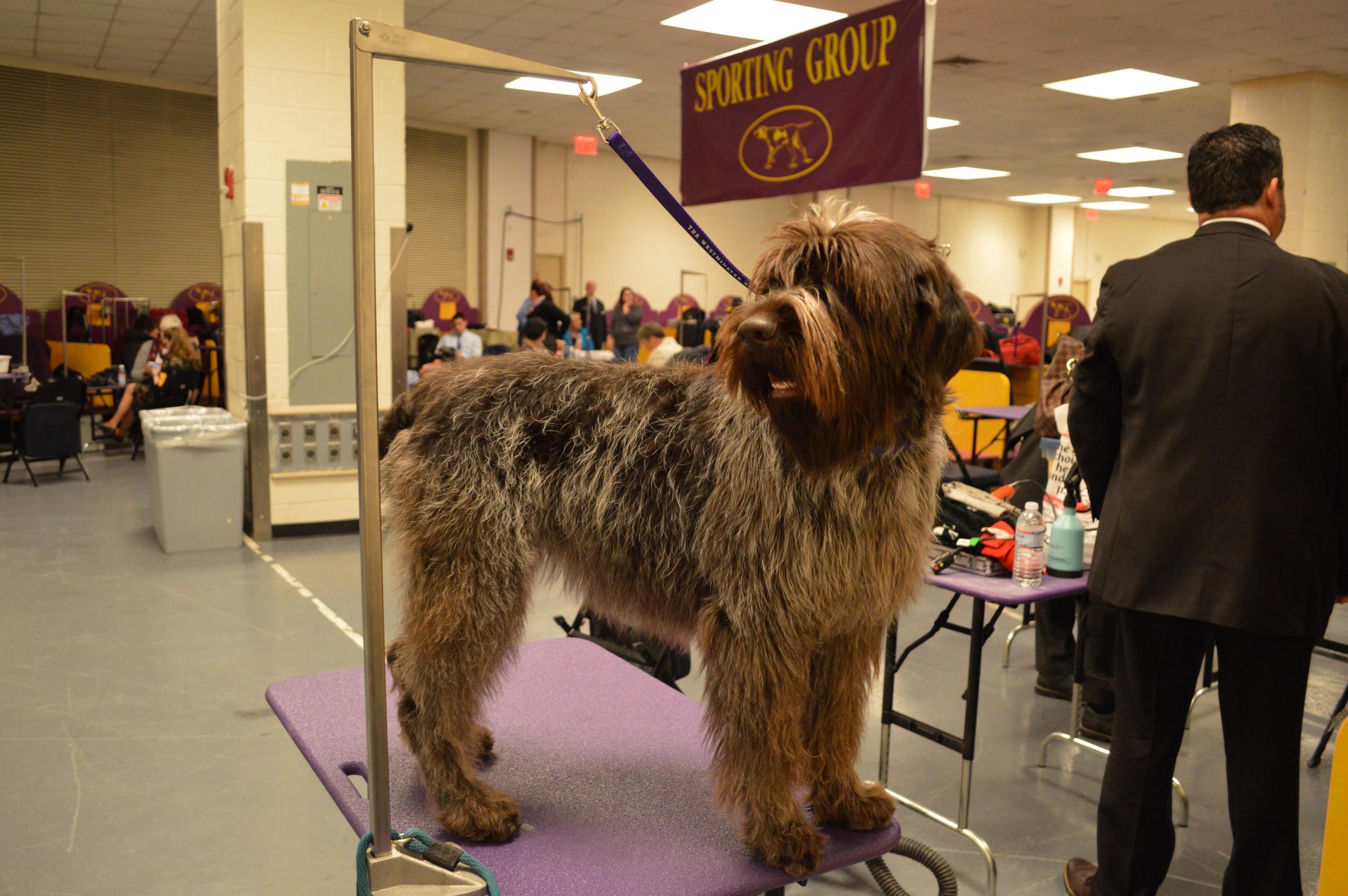

Do you have a better photo of a Wirehaired Pointing Griffon in the American show ring? If you have a show photo you’d let us use, email it to [email protected] — tell us the dog’s name and the show, and it may be featured here. Please only send photos you took yourself or have the photographer’s permission to share, and tell us the photographer’s name.
1. Breed at a glance
Sporting Group; AKC-recognized since 1887
Dogs 22–24 in, bitches 20–22 in; males 50–70 lb, females 35–50 lb (AWPGA)
Hard, coarse, wiry double coat; steel gray with brown markings preferred
12–15 years (AKC)
Quick and intelligent, easily trained, outgoing, willing to please
American Wirehaired Pointing Griffon Association
2. History: the Korthals Griffon
The Wirehaired Pointing Griffon was developed in the 1870s and 1880s by Dutch sportsman Eduard Karel Korthals, who wanted a versatile gundog that could point in the field and retrieve in the water — and the breed is still known in much of the world as the Korthals Griffon. The breed standard was established in 1886, and the AKC recognized the breed in 1887, making it one of the earlier sporting breeds to receive American recognition. The FCI lists the breed as standard 107, in Group 7 (pointing dogs), section 1.3, the griffon type.
In the United States the American Wirehaired Pointing Griffon Association is the AKC parent club, and it guards both sides of the breed: the conformation standard, approved in 1991, and the working ability the breed was built for. In 2018 the club adopted a Working Standard that judges field performance alongside conformation, and in 2014 it launched a free, open health and pedigree database so breeders and buyers can check a dog’s health record against its pedigree.
Today the Griffon is a small-population breed in the show ring and a working dog first everywhere else — a pointer and a water retriever that still earns its keep in the field, and a regular at the national specialty, where the week runs from the conformation ring straight through to hunt tests.
3. The standard: the supreme gundog
The AKC standard was approved on October 8, 1991, and effective November 28, 1991. It opens with the general appearance: “Medium sized, with a noble, square-shaped head, strong of limb, bred to cover all terrain encountered by the walking hunter. Movement showing an easy catlike gracefulness. Excels equally as a pointer in the field, or a retriever in the water. Coat is hard and coarse, never curly or woolly, with a thick undercoat of fine hair, giving an unkempt appearance.”
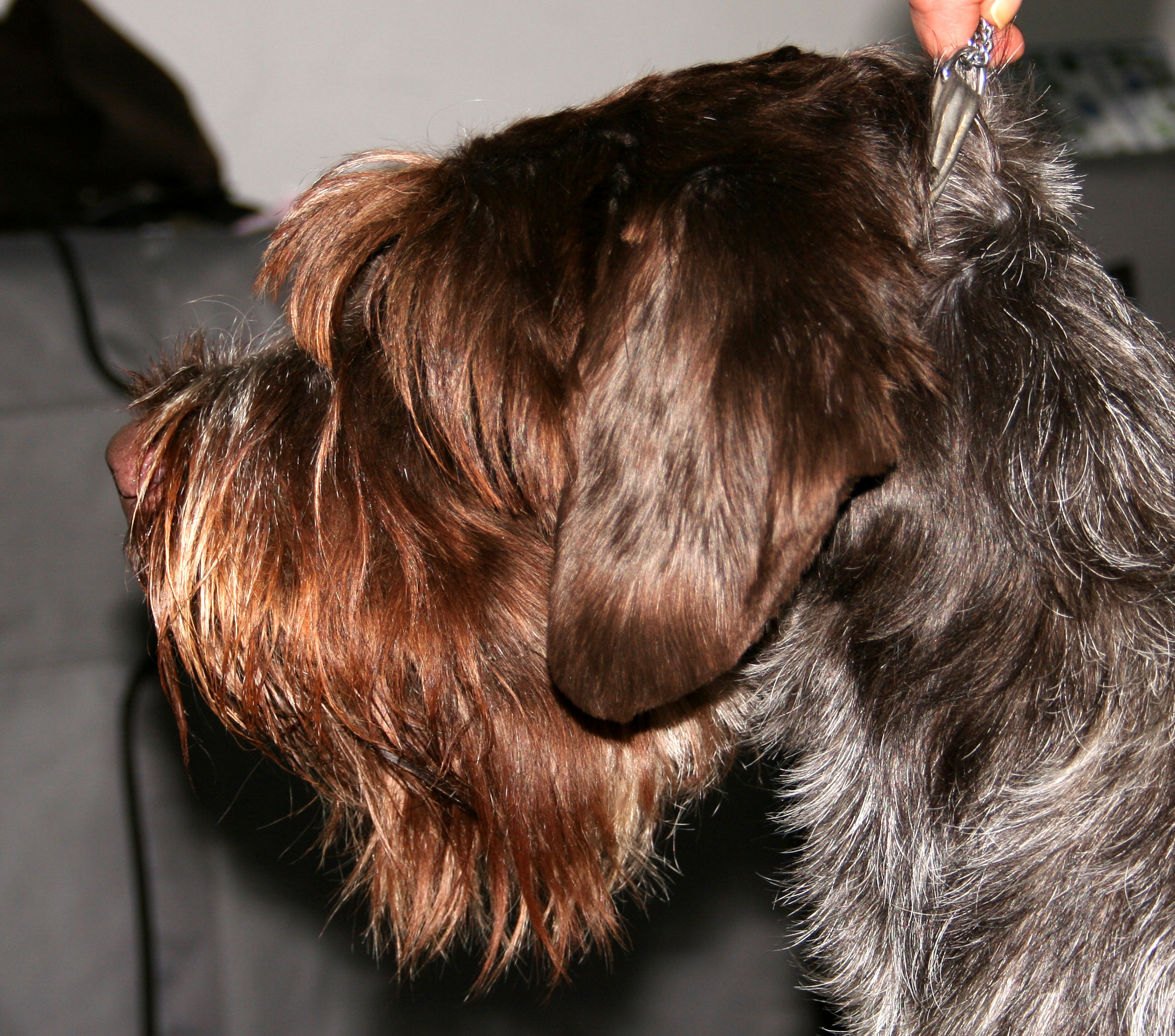

Size. Dogs 22 to 24 inches at the shoulder, bitches 20 to 22 inches — and the standard is blunt that correct size matters: oversize is to be severely penalized. The body is slightly longer than tall, in a ratio of 10 to 9, and the substance is medium, reflecting the breed’s work as an all-terrain hunting dog. Weight is 50 to 70 pounds for males and 35 to 50 for females, per the parent club.
Head and body. The head is in proportion to the dog, with a skull of medium width, a square muzzle and head in profile, and a stop and occiput only slightly pronounced. The required abundant mustache and eyebrows — extensions of the undercoat — give the Griffon its friendly expression and its somewhat untidy appearance. The eyes are large and well open, more rounded than elliptical, in all shades of yellow and brown. The nose is always brown, with well-open nostrils — any other nose color is a disqualification. The bite is scissors; an overshot or undershot bite is a serious fault. The tail extends from the back in a continuation of the topline and is docked by one-third to one-half of its length.
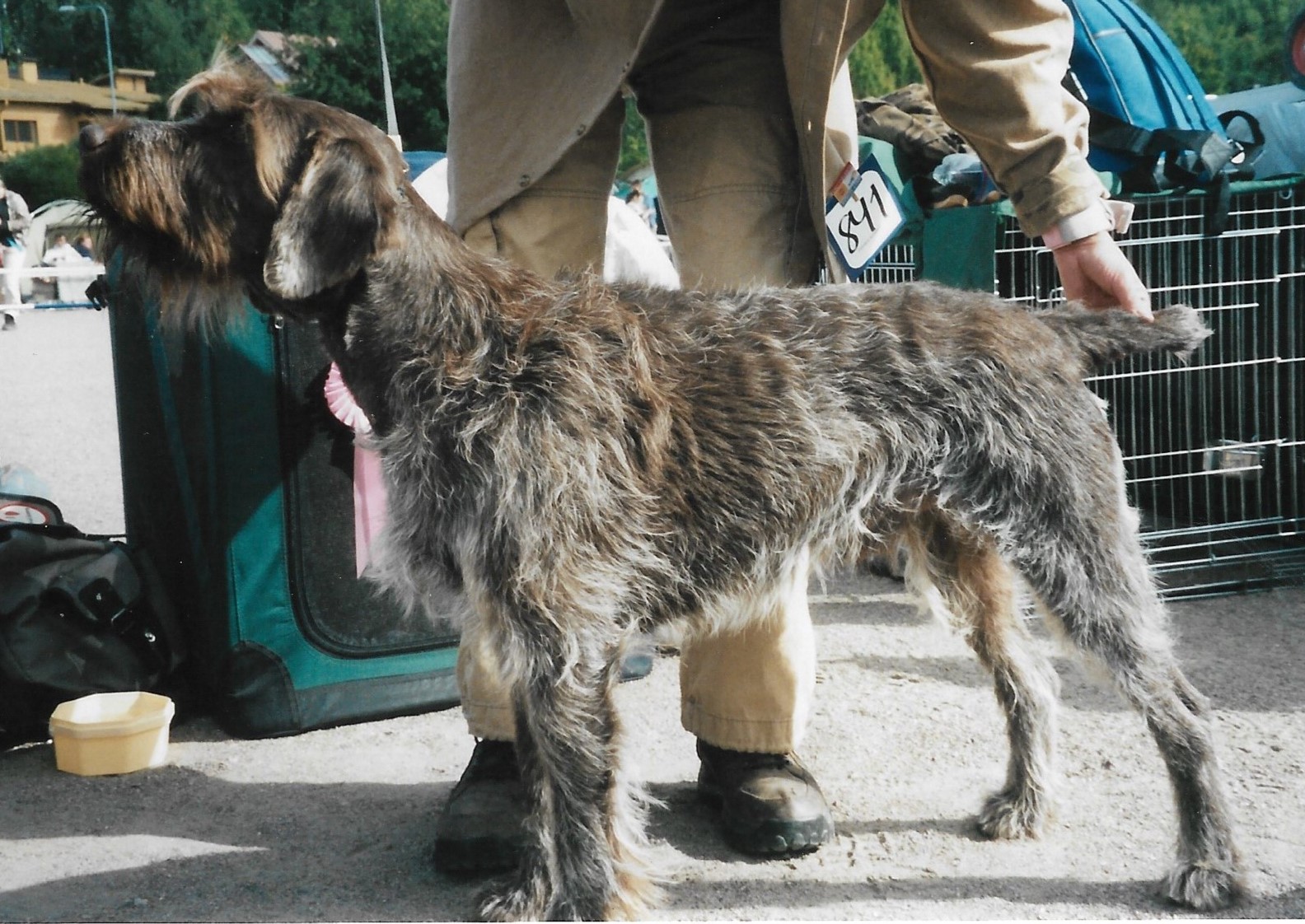
Coat and color. The coat is one of the breed’s distinguishing features: a double coat, the outer coat medium length, straight and wiry, never curly or woolly, over a fine, thick down undercoat that insulates and resists water. The breed should be exhibited in full body coat, not stripped short in pattern, and trimming and stripping are allowed only around the ears, top of head, cheeks, and feet; any plume on the tail is prohibited. Color is preferably steel gray with brown markings, frequently chestnut brown, or roan, white and brown; white and orange is also acceptable. A uniformly brown coat, an all-white coat, or white and orange are less desirable — and a black coat disqualifies.
4. Temperament: quick, willing, and devoted
The standard’s temperament paragraph is the whole pitch: “The Griffon has a quick and intelligent mind and is easily trained. He is outgoing, shows a tremendous willingness to please and is trustworthy. He makes an excellent family dog as well as a meticulous hunting companion.” The AKC sums the breed up as outgoing, eager, and quick-witted — incomparable in the field and loving at home — and the standard’s general appearance adds that the Griffon’s easy trainability, devotion to family, and friendly temperament endear him to all.
That willingness to please is the breed’s charm and its training note in equal measure. Griffons want to work with their people, and they learn fast when the work is real — pointing, retrieving, tracking, and the field work the parent club builds into the national specialty week. They are devoted family dogs, good with children where interactions are appropriate, and social with other dogs in the field. What they are not is a dog that is happy left alone in a yard: a Griffon with no job invents one, and the result is rarely what the owner had in mind.
In the house, expect a dog that is affectionate, alert, and always near its people — and expect it to follow you to the door every time you pick up a pair of boots. Give a Griffon daily work, a job to do, and a place beside its people, and it gives back a devotion that is hard to match — for 12 to 15 years.
5. Grooming and everyday care
The wiry double coat is the practical part of the breed: the harsh outer coat sheds dirt and water, the fine undercoat insulates, and the dog is shown in full coat, not stripped short. Grooming is modest by sporting-breed standards — regular brushing to keep the undercoat from matting, and trimming only around the ears, top of head, cheeks, and feet. The ears lie flat and close to the head, so check and dry them after water work; a hunting dog that swims is a dog whose ears need attention.
Exercise is not optional, and that is the real commitment. A Griffon is bred to cover all terrain for a walking hunter, and it needs daily work — field work, long walks, swimming and retrieving — not a lap around the block. A securely fenced yard is a convenience, not a substitute: what a Griffon really needs is a job, every day, with its people.
Feeding is straightforward but scaled to a medium hunting dog: a good-quality food, measured meals, and a lean weight at 50 to 70 pounds for a male and 35 to 50 for a female. Extra weight makes the joints work harder, and a Griffon that is allowed to get fat is a Griffon heading for the vet. Because the breed is food-motivated and always ready to work for a reward, watch the treats — you should be able to feel the ribs without pressing hard under the coat.
6. Health: the tests that matter
The American Wirehaired Pointing Griffon Association takes part in the Canine Health Information Center (CHIC) program run by the Orthopedic Foundation for Animals, and three tests are required for a CHIC number: a hip evaluation (OFA or PennHIP), an elbow evaluation (OFA), and an ophthalmologist evaluation (an annual eye exam, CAER). The club also recommends thyroid testing, which it added to its program in 2017. The AWPGA launched a free, open health and pedigree database in 2014, and the OFA keeps the open registry for hips, elbows, eyes, and thyroid. A CHIC number means the tests were done and published by the OFA — it does not mean the dog passed them.
The main issues to watch are hip and elbow dysplasia, eye disease, and bloat — the concerns that come up most often for the breed. Progressive retinal atrophy and hypothyroidism are also seen, and ear infections are a recurring management issue for a drop-eared water dog. The AKC lists the breed’s lifespan as 12 to 15 years — a long working life for a sporting dog, and the reason the testing above matters so much: a Griffon is a long commitment, and the health screening is how you protect it.
7. The annual Wirehaired Pointing Griffon specialty dog show
A specialty is the breed’s All-Star show — its Super Bowl. Once a year, the best Wirehaired Pointing Griffons from across the country, and often from around the world, come together in one place.
The American Wirehaired Pointing Griffon Association’s national specialty: one national event each year, a full specialty week that runs from conformation and sweepstakes through hunt tests — the field work is as much a part of the week as the ring. The 2026 national ran October 22–27 in Dixon, California, with the conformation specialty on Friday, October 23, and AKC double hunt tests closing the week at Quail Point Hunt Club in Zamora. The 2027 national: not yet announced.
The standard, in brief: a medium-sized, noble, square-headed gundog, 22 to 24 inches at the shoulder for dogs and 20 to 22 for bitches, slightly longer than tall, with a hard, coarse, wiry double coat that is never curly or woolly, the required mustache and eyebrows, and a brown nose — any other nose color, and a black coat, are disqualifications. In color, steel gray with brown markings is preferred, with chestnut brown, roan, white and brown, and white and orange also acceptable. In temperament it is quick and intelligent, easily trained, outgoing, and tremendously willing to please — the standard calls the breed the “supreme gundog.”

The 2026 AWPGA National Specialty — Thursday, October 22–Tuesday, October 27, 2026, at the Dixon May Fairgrounds, 655 S 1st St, Dixon, California 95620, held with the Sacramento Valley Dog Fanciers Association (SVDFA) all-breed shows. The national specialty itself — conformation, sweepstakes, and junior showmanship — was Friday, October 23, 2026, in the morning. Entries closed Wednesday, October 7, 2026, at noon PDT. Event Chair: Elizabeth Crisp Blake. Superintendent: BaRay Event Services, Inc.
The week ran the full Griffon program: an optional Napa winery visit, the annual meeting, and a welcome reception at Ruhstaller Farm, 6686 Sievers Rd, Dixon, on Thursday, October 22; sweepstakes and the national specialty on Friday morning, judges education in the afternoon, and the awards banquet in the evening; the Western Regional Specialty on Saturday morning and the Wirehaired Pointing Griffon Club of Northern California specialty early Saturday afternoon; the AWPGA supported entry on Sunday, October 25, concluding the conformation portion; and AKC double hunt tests at Quail Point Hunt Club, 29625 County Road 14, Zamora, California, on Monday and Tuesday, October 26–27. The host hotel was The Prodigy, 4100 Chiles Road, Davis, California. The Friday national specialty judge, the sweepstakes judge, and the entry counts had not been identified in the published premium as of November 2026.
Results (2026 national). Best of Breed and the other top winners had not been published in an official source as of November 2026 and will be added here when they are.
The dates for the annual 2027 Wirehaired Pointing Griffon specialty dog show had not been announced as of November 2026. The AKC’s Upcoming National Specialties list, which runs through October 2027, carries no American Wirehaired Pointing Griffon Association entry. This page will be updated when the club announces the 2027 national.
The club’s national has moved around the country in recent years — North Carolina in 2024, Tennessee in 2025, California in 2026 — so the 2027 location is the detail to watch for.
Past national specialties: 2025 · 2024
American Wirehaired Pointing Griffon Association — awpga.com
8. Regional specialties through the year: smaller regional shows
The national is the anchor, but the breed’s year also runs through regional specialties — smaller regional shows, not the national — held around the country, including the regional specialties that run with the national. These are the 2026 regionals verified from club and AKC sources.
Regional Wirehaired Pointing Griffon specialties verified for 2026:
- Western Regional Specialty — Saturday, October 24, 2026, Dixon, California: held as the designated specialty with the Sacramento Valley Dog Fanciers Association at the Dixon May Fairgrounds (AKC event 2026462809). The Best of Breed winner progressed to Groups late in the afternoon. Judge unconfirmed.
- Wirehaired Pointing Griffon Club of Northern California Specialty — Saturday, October 24, 2026, Dixon, California: early afternoon at the Dixon May Fairgrounds, with the national specialty week. Judge unconfirmed.
- AWPGA Supported Entry — Sunday, October 25, 2026, Dixon, California: with the Sacramento Valley Dog Fanciers Association at the Dixon May Fairgrounds, concluding the conformation portion of the national week.
Other 2026 regional specialties had not been verified from club or AKC sources as of November 7, 2026.
More regional specialties will be added here as their programs are verified — this section is built from show data, not guesswork. Browse upcoming show weekends →
9. Clubs
The American Wirehaired Pointing Griffon Association (AWPGA) is the AKC parent club for the breed in the United States. It is the guardian of the breed and determines the official breed conformation standard, runs the national specialty every year, and promotes responsible breeding, education, research, and rescue — including the free, open health and pedigree database it launched in 2014 and the Working Standard it adopted in 2018, which judges field performance alongside conformation. The club’s current officers are listed on its website at awpga.com.
Regional clubs around the country run the regional specialties and the local life of the breed, among them the Wirehaired Pointing Griffon Club of Northern California, the Wirehaired Pointing Griffon Club of the Midwest, and the WPG Club of North Texas, which ran supported entries during the 2025 national specialty week in Lebanon, Tennessee.
10. Rescue
The main breed-specific rescue is AWPGA Rescue, run by the American Wirehaired Pointing Griffon Association — the only national AKC breed rescue dedicated to the Wirehaired Pointing Griffon. It rehomes purebred Griffons across the United States and Canada, and on average it takes in fewer than 30 dogs a year, most of them pulled from high-kill shelters. Because the breed is a high-energy hunting dog, the rescue’s first effort is to place dogs in hunting homes when that fits the dog. Every rescued Griffon is spayed or neutered and microchipped before adoption, the adoption fee is $130, and you must be an AWPGA member in good standing to be considered. The rescue cannot accept any Griffon with a history of biting. Contact: awpga.com/awpga-rescue, [email protected]. Rescue Chair: Marty Ingram.
A rescue Griffon is usually an adult whose temperament and field drive are already known, which matters with a breed this driven: you will know whether the dog hunts, how it is with other dogs, and what it needs from a home before you commit. Expect an application, references, and a careful match — the rescue works to place each dog with the most suitable home from its pool of screened applicants, and it will not transfer a hard-to-place dog to another rescue or shelter. A rescue Griffon still needs the same things a puppy does: daily work, a job to do, and a household that understands a hunting dog.
11. Breeder vs. rescue: honest guidance
Either route starts with the same question: has this dog’s health been tested? From a breeder, ask for the CHIC numbers of both parents — the hip evaluation, the elbow evaluation, and the ophthalmologist’s eye examination, plus the thyroid testing the club recommends — and check them on the OFA database yourself, by the parents’ registered names. Ask what health issues the breeder sees in their stock, and meet at least the dam. And be honest with yourself about the work: this is a dog bred to cover all terrain for a walking hunter, and a breeder who asks what you will do with the dog is doing you a favor.
From rescue, expect an adult dog whose drive and temperament are already known, placed by a program that will match the dog to your life rather than the other way around — and that will ask you to join the parent club as a member in good standing. Budget for the same things either way: joint and eye care, and the time a hunting dog demands every single day. Whichever route you take, the dog that fits is a quick, willing, outgoing Griffon that wants to work with its people — and will be happiest doing exactly that.
12. Claim this page
This page was built from public sources — the AKC standard, the parent club’s own material, AKC event records, and the rescue program’s site — and it is a starting point, not the last word. If you are with the American Wirehaired Pointing Griffon Association or a regional club and something here is wrong or missing, you can claim this page and set it straight: email [email protected] and tell us what needs fixing. Corrections from the people who own the breed are how this page gets better.
Sources
- AKC, Wirehaired Pointing Griffon
- AKC, Official Standard of the Wirehaired Pointing Griffon (approved October 8, 1991; effective November 28, 1991)
- American Wirehaired Pointing Griffon Association
- American Wirehaired Pointing Griffon Association, 2026 National Specialty
- American Wirehaired Pointing Griffon Association, AWPGA Rescue
- Korthals Griffon Canine Health Center (AWPGA CHIC requirements)
- Furlyo, Wirehaired Pointing Griffon (history, FCI standard 107, CHIC program, health issues)
- Dog-Breeds.net, Wirehaired Pointing Griffon (health issues)
- The Griffonnier, Winter 2025 (2025 National Specialty Issue)
- The Griffonnier, Spring 2024 (2024 National Specialty information)
- AWPGA Board of Directors meeting minutes, April 17, 2024
- Sacramento Valley Dog Fanciers Association premium, October 24–25, 2026 (AKC event plans)
- AKC hunt test premium, October 26–27, 2026 (event 144706908)
- AKC event search, AWPGA designated specialty, October 24, 2026 (event 2026462809)
- AKC, Upcoming National Specialties list
- Wikimedia Commons, Wirehaired Pointing Griffon (Pets Adviser, CC BY 2.0)
- Wikimedia Commons, Gryfon Korthalsa (Pleple2000, CC BY-SA 3.0)
- Wikimedia Commons, DocFile Korthals (Canarian, CC BY-SA 4.0)