
Breed profile · Terrier Group · the little white earthdog
West Highland White Terrier
The West Highland White Terrier — the Westie — is a small, game, hardy-looking terrier in a hard white double coat, with dark piercing eyes, a black nose, and a carrot-shaped tail carried jauntily upright. It was bred in the Scottish Highlands to go to ground after badger and vermin, and it still carries that fearless, self-reliant terrier spirit into the house: smart, confident, and always entertaining. The AKC recognized the breed in 1908, and the West Highland White Terrier Club of America is the parent club.
Help us improve it. This is one of ThePetAdvisor’s breed profiles, built from public sources with generous links to the people who actually own this breed’s knowledge. If something’s off or missing, the parent club can claim the page and set it straight — see the bottom of the page.
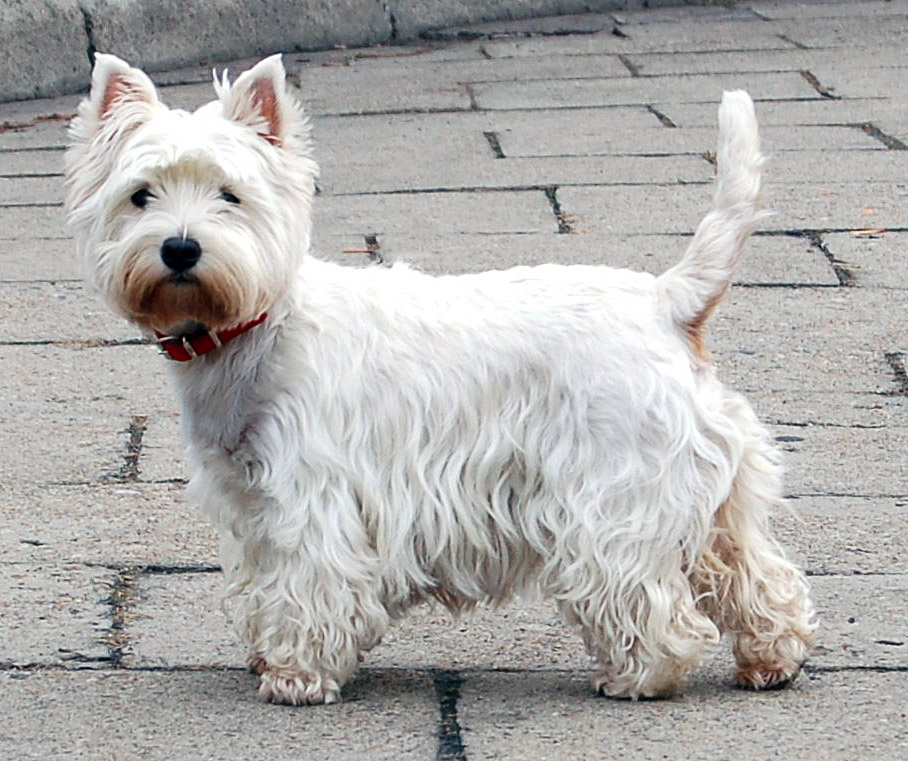
Do you have a better photo of a West Highland White Terrier in the American show ring? If you have a show photo you’d let us use, email it to [email protected] — tell us the dog’s name and the show, and it may be featured here. Please only send photos you took yourself or have the photographer’s permission to share, and tell us the photographer’s name.
1. Breed at a glance
Terrier Group; recognized by the AKC in 1908
Dogs 11 in at the withers, bitches 10 in; 15–20 lb
Hard white double coat, about 1½–2 in; white is the only color
13–15 years
Alert, confident, courageous, self-reliant, friendly
The Westie is a small terrier with a big opinion of itself — the standard says it is “possessed with no small amount of self-esteem,” and anyone who has lived with one will agree. It stands 10 to 11 inches at the shoulder and weighs 15 to 20 pounds, all of it packed into a compact, well-boned body built for work underground. The white double coat is hard and weather-resistant, the eyes dark brown and piercing under heavy brows, the ears small and prick, the tail short and carrot-shaped. Underneath the pretty white coat is a genuine earthdog: fearless, strong-willed, and built to hunt. (Sources: AKC, West Highland White Terrier; AKC, Official Standard of the West Highland White Terrier.)
2. History
The Westie comes from the white terriers of Scotland — small earthdogs bred on Highland estates to hunt vermin in rough terrain, where a white coat meant the dog could be told apart from the fox at a glance.
- The Malcolm legend. Colonel Edward Donald Malcolm, 16th Laird of Poltalloch, is credited with creating the modern breed from his Poltalloch Terrier. The story — told by the parent club — is that Malcolm shot one of his own reddish terriers while hunting, mistaking it for a fox, and vowed to breed only white dogs from then on. Related strains were bred on other estates: the Roseneath Terriers of George Campbell, 8th Duke of Argyll, and the Pittenweem Terriers of Dr. Edwin Flaxman.
- From estate dogs to a breed. The first breed club was set up in Scotland in 1904; The Kennel Club recognized the breed in 1907, and the dogs appeared at Crufts the same year. The first member of the breed to win a show championship was Ch. Morvan, in 1905, owned by Colin Young.
- Across the Atlantic. The breed was imported into the United States in 1907–08 — Robert Goelet imported Ch. Kiltie and Ch. Rumpus Glenmohr — and the AKC first registered the breed in 1908 under the name Roseneath Terrier. On May 31, 1909, the AKC changed the name to West Highland White Terrier, and the Roseneath Terrier Club of America became the West Highland White Terrier Club of America the same year.
- At Westminster. Westies have won Best in Show at Westminster twice: Ch. Wolvey Pattern of Edgerstoune, owned by Constance Winant, in 1942, and Ch. Elfinbrook Simon, owned by Barbara Worcester, in 1962. A first Crufts Best in Show followed in 1976.
- Today. The Westie remains one of the most popular terriers in America, ranked 42nd of 197 AKC breeds — a small dog with a large following, kept as a companion far more often than as the working earthdog it was bred to be.
From a white earthdog on a Scottish estate to a family favorite on both sides of the Atlantic, the Westie has kept its working terrier spirit intact — the white coat was bred for the hunt, and the attitude came with it. (Sources: Wikipedia, West Highland White Terrier; National Purebred Dog Day, The Westie’s 1900s Identity Crisis; Britannica, West Highland white terrier; Wikipedia, List of Best in Show winners of the Westminster Kennel Club Dog Show; AKC, West Highland White Terrier.)
3. The standard and why it is written that way
Read the standard as an engineering spec for an earthdog, and every odd detail clicks into place. The quotes below are from the current official standard, approved February 13, 2024 and effective May 1, 2024.
- Built for the earth. “The West Highland White Terrier, originally bred to hunt in packs for badger and eradicate vermin in the rough terrain of the Scottish Highlands, is a small, wellboned, hardy-looking terrier, exhibiting confidence…” And: “The breed requires moderation both in structure and presentation, and any exaggerations are discouraged.”
- Small and compact. “The ideal size is eleven inches at the withers for dogs and ten inches for bitches. A slight deviation is acceptable.” The body between the withers and the root of the tail is slightly shorter than the height at the withers: “Short-coupled and well boned.”
- The white double coat. “The white double coat is hard and weather-resistant, consisting of straight, hard hair and a short, soft undercoat.” The longer jacket hair is about 1½ to 2 inches, plucked and trimmed to blend into the shorter coat; the head is plucked and shaped “to provide a roundish frame for the face.”
- White — and only white. “The color is white, as defined by the breed’s name. A hard straight coat which has some wheaten tipping is preferable to a soft white coat.” The current standard lists no disqualifications: a Westie of any other color is simply not a Westie under the standard.
- Head and expression. The head is shaped “to present a roundish appearance from the front,” with eyes “widely set apart, medium in size, almond shaped, dark brown in color, and deep set,” giving “a piercing look” from under heavy brows. The ears are “small, prick… and carried tightly erect” and “must never be cropped.” The nose is “large and black.” The teeth are large for the size of the dog, with six incisor teeth between the canines, and “a tight scissors or level bite is equally correct.”
- The carrot tail. “Relatively short, with good substance, and shaped like a carrot… carried upright or slightly forward but not curled over the back. The tail is never docked.” The tail’s thick base is a working feature: a Westie stuck in a burrow could be pulled out by it.
- Movement is the exam. “Movement is free and easy all around… powerful with equally ample reach and drive. The topline remains level.” A stiff, stilted gait is a fault — the dog was built to cover rough ground all day.
- Temperament in the standard. “Alert, confident, courageous, self-reliant, and Friendly — Possessing no small amount of self-esteem.” The faults listed are excess timidity and excess pugnacity.
The most important thing to know about the modern standard is what it does not do: it never asks for exaggeration. A Westie is a moderate, compact, hard-coated working terrier, and the 2024 revision says so plainly — moderation in structure and presentation, with exaggerations discouraged. (Sources: AKC, Official Standard of the West Highland White Terrier; AKC, West Highland White Terrier ‘Westie’ Facts You May Not Know.)
4. Temperament & living with one
The AKC’s own warning is the place to start: “Don’t let those dark, beguiling eyes and that brilliant white coat lull you into a false sense of security. The West Highland White Terrier is anything but a lapdog.”
- A terrier first. Tenacious, spirited, and built for hard work — the Westie was bred to hunt vermin on farms, mines, and large estates, and it still has the energy and the opinions of a working dog.
- Family dog, on terrier terms. Westies bond closely with their owners and enjoy children, particularly those who respect this feisty terrier’s boundaries. They are always eager for a game of catch or fetch, and they thrive in high-energy households — though they can adapt to apartment life with adequate stimulation.
- Smart, and they know it. Westies master commands easily but carry an independent streak that needs patience and positive reinforcement to overcome. Consistent sessions, plenty of treats, and a good sense of humor work better than drilling.
- Exercise is not optional. Westies need daily walks, playtime, training, and enrichment. They are not suited to a sedentary, slow-paced lifestyle: boundless energy that is not harnessed and shaped early turns into problem behaviors, including digging and barking.
- Digging and barking come with the breed. Digging is instinctive — the dog was bred to go underground — and the loud, persistent bark is a working tool: a Westie stuck in a burrow barked so its owner could find it. A sandbox with buried toys beats a flowerbed.
- Prey drive is real. A dog bred to kill vermin will chase small animals and can be feisty with other dogs. Early and thorough socialization is not optional, and off-leash time belongs in a secure area.
The honest summary: a wonderful, entertaining family dog for an owner who will exercise it, train it with patience, and laugh at it — and a handful for a quiet household that wants a dog to lie around. (Sources: AKC, West Highland White Terrier ‘Westie’ Facts You May Not Know; AKC, West Highland White Terrier.)
5. Grooming
Grooming a Westie is a real, regular commitment — the white double coat is the breed’s calling card, and it takes work to keep it that way. Brush and comb a few times a week to prevent matting and keep the coat and skin healthy; the dead coat tends to stay in the coat rather than shedding onto the furniture, which keeps fur off the sofa but makes brushing necessary. Most pet Westies are clippered, with the body clipped and the head kept rounded and the hair trimmed close to the eyes, and a groomer visit every 4 to 6 weeks keeps that style in shape.
Show dogs are groomed differently: hand-stripping — plucking dead hairs by hand — preserves the hard, weather-resistant texture of the coat, and handlers groom their dogs every 1 to 3 weeks. Clipping softens the coat over time, which is fine for a pet but not for the ring. Bathe only when needed, as too much shampoo damages the harsh coat; letting mud dry and brushing it out is often the best clean-up after an outdoor adventure. Regular grooming also helps prevent dry skin, itching, and irritation, which Westies are prone to. Ears need weekly attention, nails trimming every few weeks, and teeth brushing — and the breed sheds less than many, but it still sheds. (Sources: AKC, West Highland White Terrier ‘Westie’ Facts You May Not Know; Petfinder, West Highland White Terrier.)
6. Health testing
The West Highland White Terrier Club of America’s CHIC program sets the health testing a responsible breeder should do — and the results should be registered with the Orthopedic Foundation for Animals, where anyone can look them up.
- Patella Evaluation. A veterinarian evaluates the kneecaps for luxation; dogs should be at least one year old. Patellar luxation is one of the breed’s most common orthopedic problems.
- Hip Evaluation. A hip X-ray, evaluated by OFA, done at two years or older; the same X-ray also screens for Legg-Calvé-Perthes disease, the hip-joint disease of small terriers.
- Ophthalmologist Evaluation. An eye exam by a board-certified veterinary ophthalmologist, to diagnose hereditary eye disease including cataracts and dry eye (keratoconjunctivitis sicca). The parent club recommends annual eye exams until the dog is at least eight years old.
- Craniomandibular Osteopathy (CMO). A DNA test for the inherited bone disease of the jaw — “lion jaw” — that strikes puppies. The parent club’s 2016 health statement noted the test, then new from Michigan State University, and hoped it would be added to the CHIC requirements; it now is.
Also worth asking about: conditions with no screening test — atopic dermatitis (skin allergies), idiopathic pulmonary fibrosis, and copper hepatopathy — where the breeder’s honesty about their lines’ health history is the only screen there is. A DNA test for pyruvate kinase deficiency, a cause of hemolytic anemia, is also available. A CHIC number confirms the testing was done and published; it is not a guarantee of health, and it does not replace asking the breeder what they know about the health of their own lines. (Sources: AKC, Terrier Group Health Testing Requirements; West Highland White Terrier Club of America, Official Breed Club Health Statement.)
7. The annual West Highland White Terrier specialty dog show
A specialty is the breed’s All-Star show — its Super Bowl. The West Highland White Terrier Club of America holds two national specialties a year: the October national at Montgomery and the National Roving Specialty, which moves to a different city each year.
The club calls it the national roving specialty — the same kind of event other clubs call a floating, rotating, or traveling national.
Every breed has one show a year that matters most: the parent club’s national specialty — and the West Highland White Terrier Club of America holds two a year: a roving national, held at a different show around the country each year, and the October national at Montgomery, held each October in Pennsylvania as part of the Montgomery weekend cluster.
The most recent national specialty was Sunday, October 4, 2026, at the Montgomery County Kennel Club show, Macungie Memorial Park, Macungie, Pennsylvania, judged by Mr. Richard Powell. Marjorie Underwood, originally assigned, was unable to serve. National Specialty Week ran September 27 – October 5, 2026. (Sources: West Highland White Terrier Club of America, Westie Update, June 2026; WHWTCA 2026 premium list.)
The roving national
The year’s other national specialty, the roving national, was Saturday, May 30, 2026, in Oklahoma City, Oklahoma. The club sponsors a National Specialty and a National Roving Specialty each year. (Source: The Canine Chronicle, June 5, 2026.)
The October 2027 Montgomery national had not been announced as of November 2026; dates and judges to be announced.
The roving national
The 2027 Roving Specialty is announced for April 14–18, 2027, at the Peach Blossom Cluster in Perry, Georgia. The exact conformation day within the cluster was not stated in the announcement. (Source: WHWTCA Westie Update, August 2026.)
Full Montgomery weekend guide →
8. Regional specialties through the year: smaller regional shows
The national is the anchor, but the breed’s year also runs through regional specialties — smaller regional shows, not the national — held by regional West Highland White Terrier clubs around the country. These are the 2026 regionals verified from club sources so far:
No regional specialties announced yet for 2026.
More regional specialties will be added here as their programs are verified — this section is built from show data, not guesswork. Browse upcoming show weekends →
9. Clubs
The parent club is the West Highland White Terrier Club of America (WHWTCA), at westieclubamerica.com — the club that sets the national standard, runs the national specialty and the national roving specialty, publishes the quarterly Westie Imprint and the monthly Westie Update, and provides health, grooming, and rescue information. It sponsors a National Specialty and a National Roving Specialty each year, plus regional specialties, regional events, and Futurity and Maturity sweepstakes.
Regional specialty clubs verified in the AKC club search index during this build:
- West Highland White Terrier Club of California
- West Highland White Terrier Club of Greater Atlanta
- West Highland White Terrier Club of Greater Denver
- West Highland White Terrier Club of Greater New York
- West Highland White Terrier Club of Indiana, Inc.
- West Highland White Terrier Club of New Jersey
- West Highland White Terrier Club of Northern Illinois
- West Highland White Terrier Club of Northern Ohio
- West Highland White Terrier Club of Southeast Texas
- West Highland WhiteTerrier Club of Puget Sound
Regional clubs run the regional specialties listed in section 8 and are the best first contact for anyone looking for a breeder, a training contact, or a local event. (Sources: West Highland White Terrier Club of America; AKC, Club Search Index.)
10. Rescue
Westies come into rescue as owner surrenders, strays, and dogs from commercial breeding situations — and because the breed is long-lived and strong-willed, a rescue Westie is often an adult whose temperament you can see before you commit. The parent club’s rescue committee is the first place to look, and these breed-specific groups take Westies in, foster them, and place them:
- West Highland White Terrier Club of America, Rescue Committee. The parent club’s rescue arm; the club’s site provides contact information for Westie rescue organizations. westieclubamerica.com
- Westie Rescue Michigan Inc. A nonprofit serving Michigan’s Lower Peninsula, with a foster program and placement in adoptive homes. westierescue-mi.com
- Westie Rescue of Orange County & Beyond. An all-volunteer 501(c)(3) serving California, Arizona, and Nevada, specializing in Westie skin issues and senior Westies. westierescueoc.com
- Westie Rescue and Placement (WRAP) of Northern California. An all-volunteer 501(c)(3) founded June 16, 2016, providing foster rehabilitation and placement in Northern California. westierescuenorcal.org
- Westie Rescue of North Texas. Rescuing and rehabilitating abused, abandoned, neglected, homeless, and surrendered Westies in North Texas. wrnt.org
- Northern New England Westie Rescue Inc. An all-volunteer 501(c)(3) in New Hampshire, primarily rescuing Westies from puppy-mill situations in the Midwest and placing them in New England. nnewestierescue.org
- Westie Rescue of the Mid-Atlantic States, Inc. An all-volunteer 501(c)(3) covering the greater Washington, D.C. area, Delaware, Maryland, Virginia, West Virginia, North Carolina, and parts of Pennsylvania and New Jersey.
Most of these groups place dogs on an application with references, and many will transport within their region. Ask what the dog’s health history is — especially skin and ears — and whether it has had an eye exam: a rescue that cannot tell you anything about the dog’s health is a rescue to question. (Sources: West Highland White Terrier Club of America; Westie Rescue Michigan; Westie Rescue of Orange County & Beyond; Westie Rescue and Placement of Northern California; Westie Rescue of North Texas; Northern New England Westie Rescue; Westie Rescue of the Mid-Atlantic States.)
11. Breeder vs. rescue: honest guidance
Both routes can end with a great dog. The honest difference is what you know going in — and with a Westie, what you know about the skin, the eyes, and the temperament matters more than usual.
- Choose a breeder if you want a puppy for showing, performance, or a specific purpose, and you want the health testing, pedigree, and early socialization that come with a careful breeding program. Ask for the CHIC health results in section 6, ask what the breeder does about skin allergies and the conditions with no screening test, meet the dam if you can, and be ready to wait — good breeders have waiting lists.
- Choose rescue if you want an adult dog whose temperament, energy level, and tolerance for children and other pets you can see before you commit, and you are comfortable with a dog that may need training and patience. Rescue is also the right route if you want to give a home to a dog that needs one.
- Either way, verify. Ask for health testing, ask what the dog’s lines are known for, and meet the dog before you commit. A breeder who will not show you health results and a rescue that will not let you meet the dog are both telling you something.
A West Highland White Terrier is a thirteen-to-fifteen-year commitment to a small, strong-willed terrier that needs real exercise, real grooming, and real training every day. The right question is not breeder or rescue — it is whether your life has room for a dog that was bred to dig, bark, and hunt.
12. Claim this page
This page was built from public sources — the AKC standard, the parent club’s own material, AKC event records, and the rescue groups’ sites — and it is a starting point, not the last word. If you are with the West Highland White Terrier Club of America or a regional club and something here is wrong or missing, you can claim this page and set it straight: email [email protected] and tell us what needs fixing. Corrections from the people who own the breed’s knowledge are always welcome.
Sources
- AKC, West Highland White Terrier
- AKC, Official Standard of the West Highland White Terrier
- AKC, West Highland White Terrier ‘Westie’ Facts You May Not Know
- AKC, Terrier Group Health Testing Requirements
- West Highland White Terrier Club of America, Official Breed Club Health Statement
- West Highland White Terrier Club of America
- Wikipedia, West Highland White Terrier
- Wikipedia, List of Best in Show winners of the Westminster Kennel Club Dog Show
- National Purebred Dog Day, The Westie’s 1900s Identity Crisis
- Britannica, West Highland white terrier
- AKC, Club Search Index (regional clubs)
- Petfinder, West Highland White Terrier
- Westie Rescue Michigan
- Westie Rescue of Orange County & Beyond (Chewy listing)
- Westie Rescue and Placement of Northern California (PetShelters listing)
- Westie Rescue of North Texas (PetShelters listing)
- Northern New England Westie Rescue (PetShelters listing)
- Westie Rescue of the Mid-Atlantic States (listing)
- Wikimedia Commons, West Highland White Terrier Krakow (hero photo)
