
Breed profile · Terrier Group · the game black-and-tan terrier from Wales
Welsh Terrier
The Welsh Terrier is a sturdy, compact, rugged dog of medium size with a coarse wire-textured coat — black jacket, tan head and legs, and the outline of a small Airedale with a character all its own. It is game, not quarrelsome: alert and spirited, friendly and full of courage, bred in Wales to take on badger, fox, and otter. The AKC recognized the breed in 1888, and the Welsh Terrier Club of America, founded in 1900, is the parent club. The club holds two specialties a year: a Floating Specialty that travels around the country, and the October national at Montgomery.
Help us improve it. This is one of ThePetAdvisor’s breed profiles, built from public sources with generous links to the people who actually own this breed’s knowledge. If something’s off or missing, the parent club can claim the page and set it straight — see the bottom of the page.
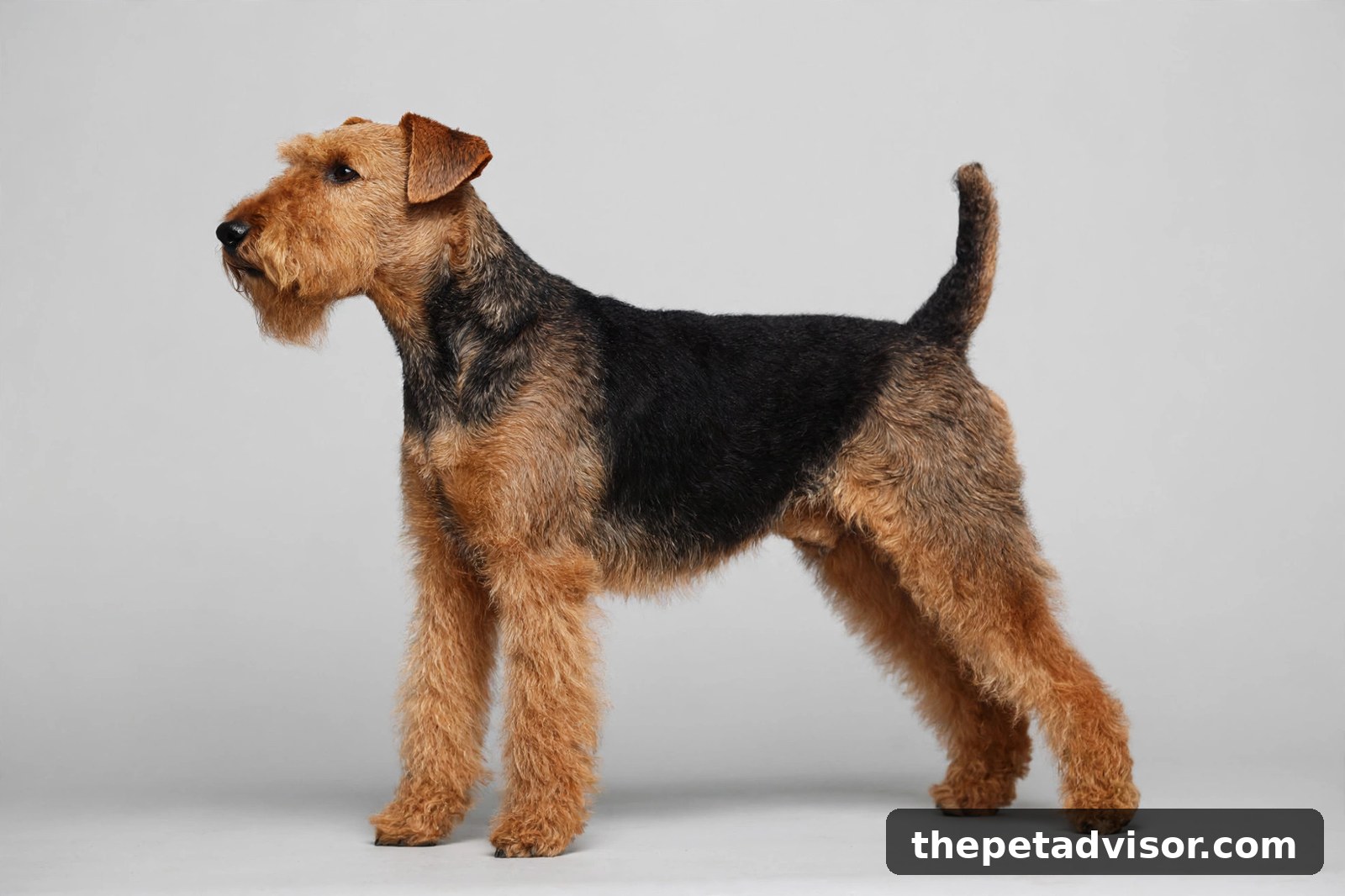
Do you have a photo of a Welsh Terrier in the American show ring? We’d love this page to lead with one. If you have a show photo you’d let us use, email it to [email protected] — tell us the dog’s name and the show, and it may be featured here. Please only send photos you took yourself or have the photographer’s permission to share, and tell us the photographer’s name. We couldn’t find a public photo of a Welsh Terrier in the American show ring that we were free to share, so the photo leading this page was made with AI. We’d much rather lead with a real one — if you’re a club member with an approved photo, we’d love to feature it.
1. Breed at a glance
Terrier Group; recognized by the AKC in 1888
Males about 15–15½ in at the withers, about 20 lb; bitches proportionally smaller
Hard, wiry, dense double coat; black (or grizzle) jacket with clear tan head, legs, and underbody
12–15 years
Game, alert, spirited, friendly — “game, not quarrelsome”
The Welsh Terrier is a sturdy, compact, rugged dog of medium size — a square dog, about as high as it is long, with a coarse wire-textured coat. The legs, underbody, and head are tan; the jacket is black, or occasionally grizzle. It looks very much like a miniature Airedale, but it is its own dog: smaller, squarer, and with a rectangular head and a neat beard. Underneath it all is a working terrier, bred to go to ground after badger, fox, and otter — game, alert, and spirited, but friendly and showing self-control. (Sources: AKC, Welsh Terrier; AKC, Official Standard of the Welsh Terrier; Canadian Kennel Club, Welsh Terrier.)
2. History
The Welsh Terrier is one of the oldest terrier breeds, descended from the old black-and-tan working terriers of Wales — the Old English Black and Tan Terrier — bred by Welsh farmers to hunt badger, fox, otter, and vermin in rough country. It has been known in Wales since 1737, and it was once called the Black and Tan Wire Haired Terrier and the Old English Terrier.
- The name battle. The breed's first outing at a dog show was at the Lleyn & Eifionydd Agricultural Society event in Pwllheli, North Wales, in 1884. English fanciers tried to claim the dog under long names of their own — the Old English Wire-Haired Black and Tan Terrier — but the Welsh breeders who had formed their club in 1886 prevailed, and The Kennel Club recognized the breed as the Welsh Terrier in 1887.
- Coming to America. The first Welsh Terriers were brought to the United States in 1888, and the AKC recognized the breed the same year — one was shown at Westminster by Prescott Lawrence in 1888. The Welsh Terrier Club of America was founded in 1900 as a member club of the AKC, to protect the natural instincts and characteristics of the breed.
- At Westminster. A Welsh Terrier has won Best in Show at Westminster once: Ch. Flornell Rare-Bit of Twin Ponds, owned by Mrs. Edward P. Alker, won in 1944 over 2,510 dogs. The English-bred dog retired after his Westminster victory with 27 bests in show.
- A presidential Welshie. President John F. Kennedy's Welsh Terrier was Charlie, a gift from Jacqueline Kennedy during the presidential campaign — she called him “Jack's dog.” Charlie swam laps with the president, took long evening walks with the First Couple, and was said to be President Kennedy's favorite dog.
From a farmer's vermin dog in the Welsh hills, the Welsh Terrier grew into a show dog and a family dog — without ever losing the game, independent spirit that made it. (Sources: Canadian Kennel Club, Welsh Terrier; National Purebred Dog Day, The “Loveable Rogue”; Welsh Terrier Club of America; Welsh Terrier Record Holders, Mrs. Edward P. Alker; John F. Kennedy Presidential Library, Pets in the Kennedy White House.)
3. The standard and why it is written that way
The standard describes a square, workmanlike terrier, and every part of it follows from the job — a dog built to go to ground after dangerous quarry and come back out again. The Welsh Terrier is a sturdy, compact, rugged dog of medium size with a coarse wire-textured coat, about as high as it is long.
- Size. Males are about 15 inches at the withers, with an acceptable range between 15 and 15½ inches; bitches may be proportionally smaller. Twenty pounds is considered an average weight, varying a few pounds with the height of the dog and the density of bone.
- Head. The entire head is rectangular. The eyes are small, dark brown, and almond-shaped, well set in the skull — their set, color, and position, combined with the use of the ears, give the “Welsh Terrier expression.” The ears are V-shaped and small, the fold just above the topline of the skull, carried forward close to the cheek. The muzzle is strong and squared off, never snipy; the nose is black. A scissors bite is preferred, but a level bite is acceptable.
- Coat. Hard, wiry, and dense, with a close-fitting thick jacket and a short, soft undercoat. Furnishings on the muzzle, legs, and quarters are dense and wiry.
- Color. The jacket is black, spreading up onto the neck, down onto the tail, and into the upper thighs. The legs, quarters, and head are clear tan — a deep reddish color, with slightly lighter shades acceptable. A grizzle jacket is also acceptable.
- Tail. Docked to a length approximately level with the occiput, to complete the square image of the whole dog, and carried upright.
- Movement. A terrier trot typical of the long-legged terrier — straight, free, and effortless, with good reach in front, strong drive behind, and feet naturally tending to converge toward a median line of travel as speed increases.
- Temperament in the standard. A game dog — alert, aware, spirited — but at the same time friendly and showing self-control. Intelligence and a desire to please are evident in its attitude. A specimen showing an overly aggressive attitude, or shyness, should be penalized.
- Disqualifications. None. The current AKC standard (approved August 10, 1993; effective September 29, 1993) lists no disqualifications: any deviation from the standard is a fault, and the seriousness of the fault depends on the extent of the deviation.
The most important thing to know about the modern standard is the square: the docked tail, the level topline, and the compact body are all meant to complete the image of a dog as high as it is long. (Sources: AKC, Official Standard of the Welsh Terrier; Canadian Kennel Club, Welsh Terrier.)
4. Temperament & living with one
Welsh Terriers are as alert and spirited as any self-respecting terrier, but a bit calmer than most — “game, not quarrelsome,” as breed fanciers say. They are friendly and outgoing to people and other dogs, showing spirit and courage, and they bond hard to their families.
- Game, not quarrelsome. The standard's own words: a game dog — alert, aware, spirited — but friendly and showing self-control. A Welsh Terrier stands its ground when challenged, but it is not looking for a fight, and an overly aggressive or shy dog is penalized in the ring.
- Smart and independent. Intelligence and a desire to please are evident in the breed's attitude, but this is still a terrier: it thinks for itself, it can be stubborn, and it needs consistent, positive training from the start. Harsh methods backfire.
- Prey drive is real. This is a hunting breed, bred to chase and kill vermin. An untrained Welsh Terrier — and sometimes even a trained one — will chase after small animals, including cats, and fight back if challenged by other dogs. A fenced yard and a leash on walks are not optional.
- With children and other dogs. Usually good with children and friendly toward nearly every person they meet. They are sturdy and exuberant, so small children can get knocked over in the excitement. Early socialization with other dogs matters; same-sex scrappiness is not uncommon.
- Exercise is not optional. Plan on at least an hour of active exercise a day, plus training and mental work. A Welsh Terrier that does not get enough work will find its own — usually by digging, barking, or chewing.
The honest summary: this is a cheerful, tireless companion for an active owner who will train it and give it a job every day, and a handful for a quiet household that wants a dog to lie around. (Sources: AKC, Welsh Terrier; AKC, Official Standard of the Welsh Terrier; Chewy, Welsh Terrier.)
5. Grooming
Grooming a Welsh Terrier is straightforward but not optional. The hard, wiry double coat is built to repel dirt and water, and it sheds very little — but it needs regular work to keep its texture and color.
Brush once or twice a week with a pin or slicker brush to remove dead, loose hair before it mats. Bathe only when the dog needs it — the wiry coat does not hold dirt, so baths are a rare occurrence. The coat should be hand-stripped two or three times a year: the dead outer coat is pulled out by hand or with a stripping knife so a new harsh wire coat can grow in. A pet Welsh Terrier can be clipped short instead, which is much easier — but clipping softens the coat and fades the color over time, and it can take months of stripping to get the wire texture back. Nails should be trimmed regularly, ears checked and cleaned, and teeth brushed. The breed is low-shedding, but it is not hypoallergenic. (Sources: AKC, Welsh Terrier; The Nest, Welsh Terrier Grooming Instructions; 33rd Square, The Wonderful Welsh Terrier; Curex, Is the Welsh Terrier Hypoallergenic?.)
6. Health testing
The Welsh Terrier Club of America participates in the OFA Canine Health Information Center (CHIC) program, and the club publishes the testing a responsible breeder should do — with results registered with the Orthopedic Foundation for Animals, where anyone can look them up.
- Eyes. An eye exam by a board-certified ophthalmologist, with results registered with OFA.
- Primary lens luxation (PLL). A DNA test, with results published. PLL is a painful inherited eye disorder in which the lens moves from its normal position, causing inflammation and glaucoma — and, untreated, blindness. The DNA test has been available since 2009; about a quarter of Welsh Terriers tested in the United States database were carriers as of late 2018, so never breed two carriers together. Carriers should not be removed from breeding outright, but they must only be bred to clear dogs.
- Permanent identification. A microchip, so the test results are tied to the right dog.
Also worth asking about: the club's health committee has said patella and heart checks should simply be done on all breeding animals as a minimum, even though they are not part of the CHIC list. The club's formal health statement (approved August 17, 2016) recommends PLL testing and states there are no required tests at this time — the CHIC list above is the club's published route to a CHIC number. Welsh Terriers are generally a healthy breed with a 12-to-15-year lifespan. A CHIC number confirms the testing was done and published; it is not a guarantee of health, and it does not replace asking the breeder what they know about the health of their own lines. (Sources: AKC, Terrier Group Health Testing Requirements; Welsh Terrier Club of America, New Health Clearance Recommendations; Welsh Terrier Club of America, Official Breed Club Health Statement; UC Davis Veterinary Genetics Laboratory, Primary Lens Luxation.)
7. The annual Welsh Terrier specialty dog show
A specialty is the breed’s All-Star show — its Super Bowl. The Welsh Terrier Club of America holds two national specialties a year: the October national at Montgomery and the Floating Specialty, which moves to a different city each year.
The club calls it the floating specialty — the same kind of event other clubs call a roving, rotating, or traveling national.
Every breed has one show a year that matters most: the parent club’s national specialty — and the Welsh Terrier Club of America holds two a year: a floating specialty, held at a different show around the country each year — the club’s Floating Specialties are held throughout the USA — and the October national at Montgomery, held each October in Pennsylvania as part of the Montgomery weekend cluster.
The most recent national specialty was Sunday, October 4, 2026, at the Montgomery County Kennel Club show, Macungie Memorial Park, Macungie, Pennsylvania. (Source: Montgomery County KC premium list.)
The Floating Specialty
The year’s other specialty, the floating specialty, was Saturday, March 14, 2026, at the Kentuckiana Cluster in Louisville, Kentucky. Conformation judge Mrs. Polly Smith; sweepstakes judge Ms. Deirdre Maureen Dawson. (Source: Welsh Terrier Club of America, Kentuckiana Cluster 2026.)
The October 2027 Montgomery national had not been announced as of November 2026; dates and judges to be announced.
The Floating Specialty
The 2027 floating specialty had not been announced as of November 2026.
Full Montgomery weekend guide →
8. Regional specialties through the year: smaller regional shows
The national is the anchor, but the breed’s year also runs through regional specialties — smaller regional shows, not the national — held by regional Welsh Terrier clubs around the country. These are the 2026 regionals verified from club sources so far:
No regional specialties announced yet for 2026.
More regional specialties will be added here as their programs are verified — this section is built from show data, not guesswork. Browse upcoming show weekends →
9. Clubs
The parent club is the Welsh Terrier Club of America (WTCA), at welshterrier.org — founded in 1900 as a member club of the AKC, it runs the national specialty and the Floating Specialty, keeps a breeder referral service, publishes health information, and encourages the organization of independent local Welsh Terrier specialty clubs.
Regional specialty clubs verified during this build:
- Welsh Terrier Club of Southern California — licensed by the AKC for Welsh Terrier specialties and earthdog tests, territory Los Angeles.
- Welsh Terrier Club of Northern Illinois — formed in 1962, incorporated in Illinois in 1970; held its first AKC-sanctioned conformation show in 1971 and its 50th anniversary show in Grayslake, Illinois, in 2021. wtcni.org
In the United Kingdom, the Welsh Terrier Club (founded in Britain in 1886) and the Welsh Terrier Association serve the same role. Regional clubs are the best first contact for anyone looking for a breeder, a training contact, or a local event. (Sources: Welsh Terrier Club of America; AKC, Club Search Index; Welsh Terrier Club of Northern Illinois; ShowSight, Welsh Terrier.)
10. Rescue
Welsh Terriers come into rescue when an owner dies, moves, or can no longer keep a dog with this much terrier in it — a game, independent dog does not settle into a home that cannot handle it. The parent club's rescue arm is the first place to look:
- WTCARES (Welsh Terrier Club of America Rescue). Formed as a committee of the Welsh Terrier Club of America in the early 1980s and a charitable trust established by the WTCA in 2007. Rescues are fostered by volunteers and evaluated for temperament, training, and suitability for placement; all are up to date on shots, spayed or neutered, and have any health issues treated before placement. Adoption fee $250. An adoption application is required — dogs are not placed on an email inquiry alone. welshterrierrescue.com
- AKC Rescue Network. The AKC's breed rescue listing for Welsh Terriers, pointing to the Welsh Terrier Club of America. akc.org/akc-rescue-network/rescue-network-w-breeds/
Most of these dogs are adults, so you know their size, temperament, and terrier drive before you commit — a real advantage with a breed this game. Ask what is known about the dog's eye history: a rescue that cannot tell you anything about primary lens luxation is a rescue to question. (Sources: WTCARES, Rescue and Re-homing; AKC, Rescue Network W Breeds.)
11. Breeder vs. rescue: honest guidance
Both routes can end with a great dog. The honest difference is what you know going in — and with a Welsh Terrier, what you know about the eyes and the temperament matters more than usual.
- Choose a breeder if you want a puppy for showing, performance, or a specific purpose, and you want the health testing, pedigree, and early socialization that come with a careful breeding program. Ask for the CHIC health results in section 6 — especially the PLL DNA test — meet the dam if you can, and be ready to wait — good breeders have waiting lists.
- Choose rescue if you want an adult dog whose temperament, prey drive, and energy level you can see before you commit, and you are comfortable with a dog that may need training and patience. Rescue is also the right route if you want to give a home to a dog that needs one.
- Either way, verify. Ask for health testing, ask what the dog's lines are known for, and meet the dog before you commit. A breeder who will not show you health results and a rescue that will not let you meet the dog are both telling you something.
A Welsh Terrier is a twelve-to-fifteen-year commitment to a game, spirited dog that needs real work and real training every day. The right question is not breeder or rescue — it is whether your life has room for a terrier that was bred to take on a badger.
12. Claim this page
This page was built from public sources — the AKC standard, the parent club's own material, AKC event records, and the rescue group's site — and it is a starting point, not the last word. If you are with the Welsh Terrier Club of America or a regional club and something here is wrong or missing, you can claim this page and set it straight: email [email protected] and tell us what needs fixing. Corrections from the people who own the breed's knowledge are always welcome.
Sources
- AKC, Welsh Terrier
- AKC, Official Standard of the Welsh Terrier
- AKC, Terrier Group Health Testing Requirements
- Welsh Terrier Club of America, Official Breed Club Health Statement
- Welsh Terrier Club of America
- Welsh Terrier Club of America, Kentuckiana Cluster 2026 (Floating Specialty)
- Montgomery County KC premium list, Oct 4, 2026
- Welsh Terrier Club of America, New Health Clearance Recommendations
- UC Davis Veterinary Genetics Laboratory, Primary Lens Luxation
- WTCARES, Rescue and Re-homing
- AKC, Rescue Network W Breeds
- AKC, Club Search Index (regional clubs)
- Welsh Terrier Club of Northern Illinois
- AKC, Facts About the Welsh Terrier That You May Not Know
- John F. Kennedy Presidential Library, Pets in the Kennedy White House
- Welsh Terrier Record Holders, Mrs. Edward P. Alker
- Wikipedia, List of Best in Show winners of the Westminster Kennel Club Dog Show
- National Purebred Dog Day, The “Loveable Rogue”
- ShowSight, Welsh Terrier
- Canadian Kennel Club, Welsh Terrier
- Chewy, Welsh Terrier
- The Nest, Welsh Terrier Grooming Instructions
- 33rd Square, The Wonderful Welsh Terrier
- Curex, Is the Welsh Terrier Hypoallergenic?