
Breed profile · Sporting Group · Germany's sleek and swift 'Gray Ghost'
Weimaraner
The Weimaraner — Germany's sleek and swift 'Gray Ghost,' a medium-sized gray hunting dog bred by the nobles of the Weimar court — is beloved by hunters and pet owners alike for its friendliness, obedience, and beauty. The Weimaraner Club of America runs the national specialty every year, and the 2026 national ran May 9–15 in Bennett, Colorado.
Help us improve it. This is one of ThePetAdvisor’s breed profiles, built from public sources with generous links to the people who actually own this breed’s knowledge. If something’s off or missing, the parent club can claim the page and set it straight — see the bottom of the page.
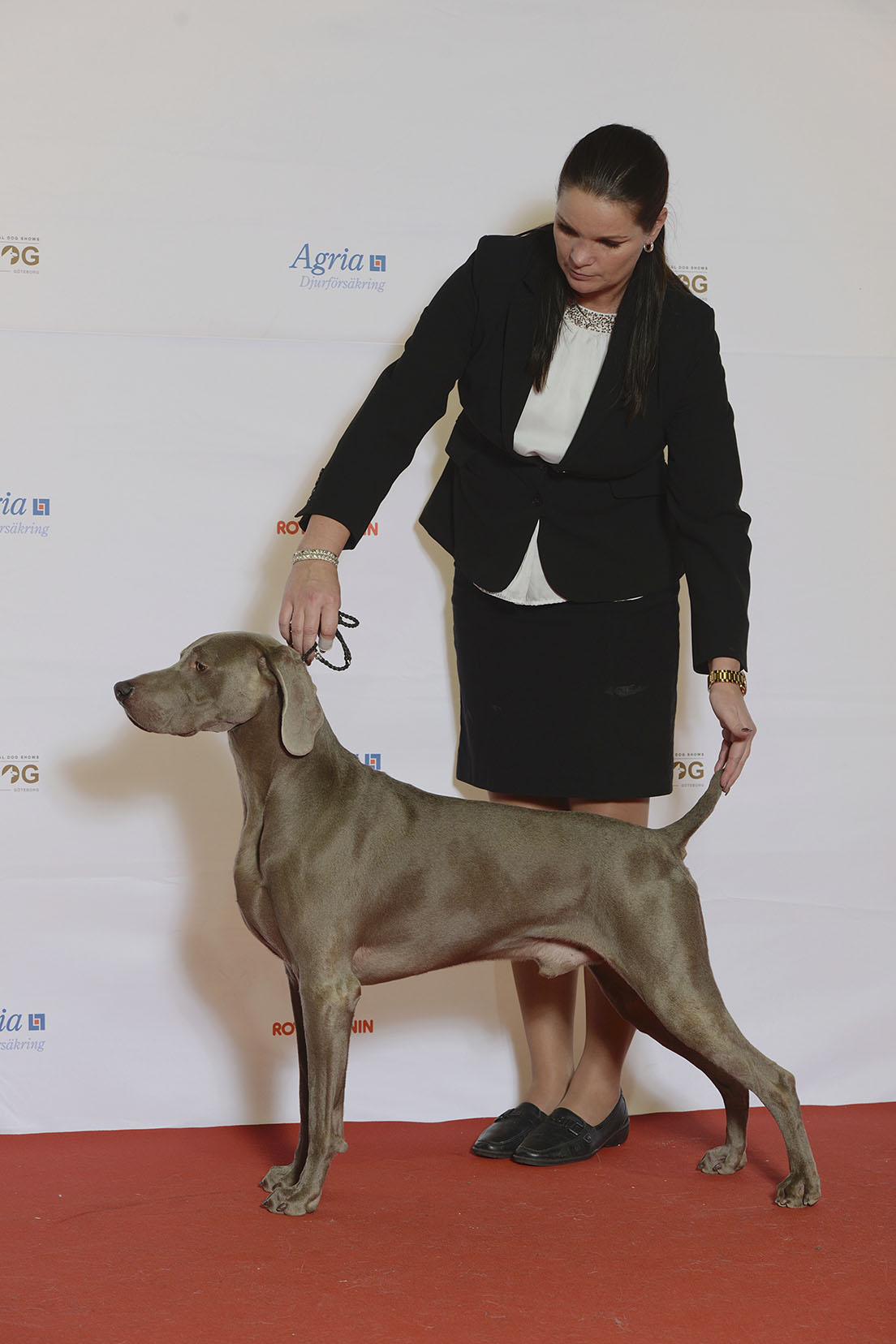

Do you have a better photo of a Weimaraner in the American show ring? If you have a show photo you’d let us use, email it to [email protected] — tell us the dog’s name and the show, and it may be featured here. Please only send photos you took yourself or have the photographer’s permission to share, and tell us the photographer’s name.
1. Breed at a glance
Sporting Group; AKC-recognized since 1943
Dogs 25–27 in, bitches 23–25 in; 55–90 lb
Short, smooth, sleek; solid mouse-gray to silver-gray
10–13 years (AKC)
Friendly, fearless, alert, obedient
Weimaraner Club of America, Inc.
2. History: the Gray Ghost of Weimar
The Weimaraner is a German hunting dog, bred in the 19th century by the nobles of the court at Weimar, who hunted bear, boar, and deer and needed a dog with exceptional tracking ability, speed, courage, and durability. Their breeding programs developed those traits — and, more likely by accident, produced the distinctive gray coat that is the hallmark of the breed.
The German Weimaraner Club was formed to protect the breed, and membership was restricted — only members were permitted to own and breed the dogs, and few outsiders knew much about the great gray hunting dog. In the latter half of the 19th century the breed was converted from a bear and deer hunter to a ‘fur and feathers’ dog, a versatile pointer and retriever — but much of the original hunting instinct remains, and it has to be taken into consideration when deciding to buy a Weimaraner.
The breed came to America through Howard Knight, a New England sportsman who applied for membership in the German club in 1928 and was sent two sterilized dogs. He persisted, and in 1938 three bitches and a puppy dog were sent to him — litter sisters Adda and Dorle v. Schwarzen Kamp, the year-old bitch Aura v. Gaiberg, and the puppy dog Mars aus der Wulfsreide. The Weimaraner Club of America was formed in 1942 and wrote the breed’s standard; the AKC recognized the breed in 1943, the year it made its Westminster debut.
The last half of the 1950s brought the breed fame, fortune, and problems: the Weimaraner became a status symbol, the more it cost the more status it afforded, and many of the animals produced in the boom were ill bred, ill tempered, and ugly — the once-rare Gray Ghost ended up ‘free to good home.’ The breed’s quality survived among dedicated breeders who maintained the standard, and by the mid-1960s the breed was recovering. Today it is still a working dog at heart — the national specialty week still runs hunt tests and field events alongside the conformation show.
3. The standard: grace, speed, stamina, alertness and balance
The AKC standard was approved on December 14, 1971. It opens with the general appearance: “A medium-sized gray dog, with fine aristocratic features. He should present a picture of grace, speed, stamina, alertness and balance. Above all, the dog's conformation must indicate the ability to work with great speed and endurance in the field.”
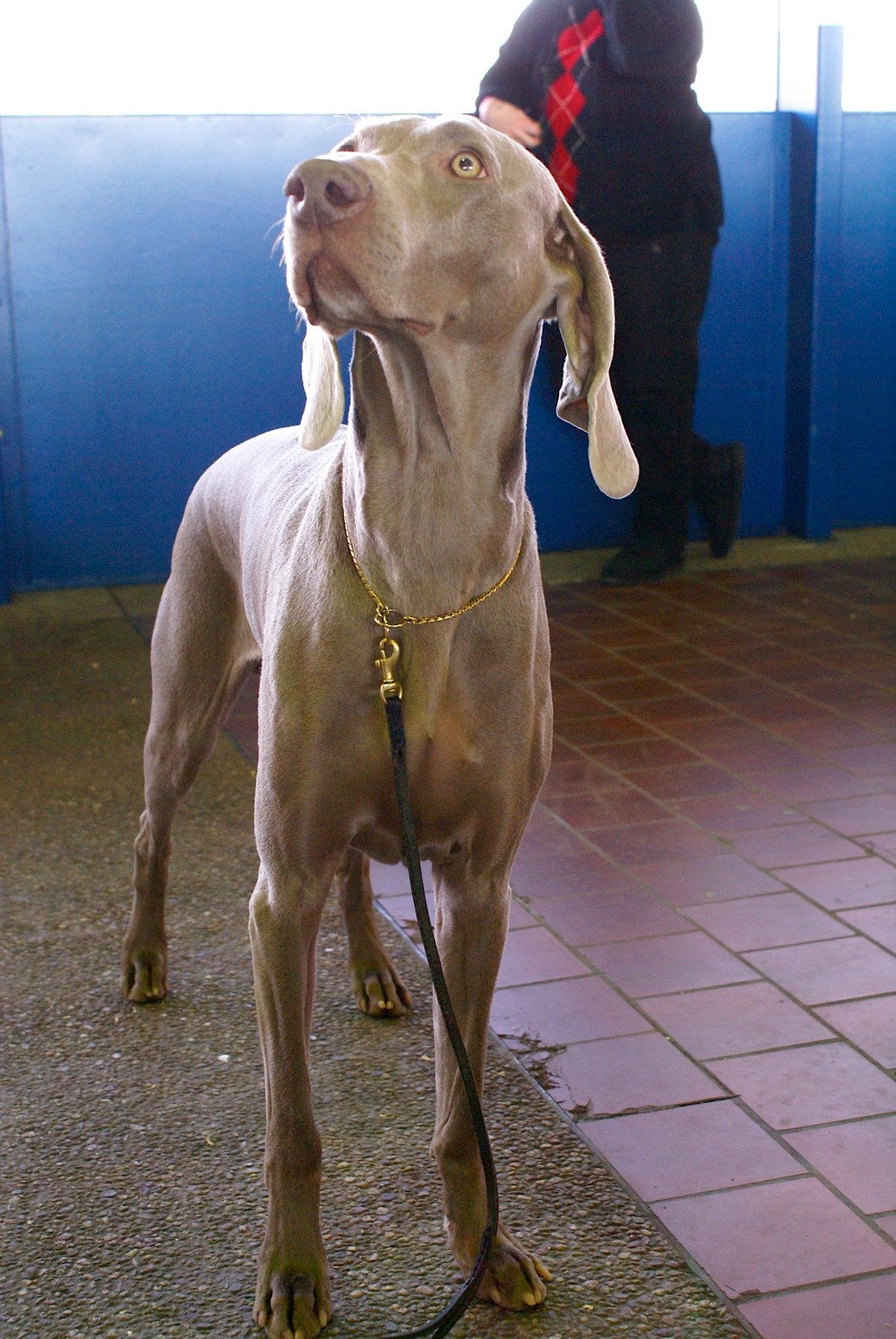

Size. Dogs 25 to 27 inches at the shoulder, bitches 23 to 25 inches; one inch over or under is allowable but penalized, and dogs under 24 or over 28 inches, or bitches under 22 or over 26 inches, are disqualified. Males run 70 to 90 pounds, females 55 to 75 pounds. The back is moderate in length, straight and strong, sloping slightly from the withers; the chest is well developed and deep, the ribs well sprung and long.
Head. The head is moderately long and aristocratic, with a moderate stop, a slight median line, and a rather prominent occipital bone. The ears are long and lobular, slightly folded and set high; drawn snugly alongside the jaw, they should end about two inches from the point of the nose. The eyes are shades of light amber, gray, or blue-gray, and may appear almost black when dilated with excitement. The nose is gray, the lips and gums pinkish flesh shades, and the bite scissors — complete dentition is greatly desired.
Coat, color, and tail. The coat is short, smooth and sleek, a solid color in shades of mouse-gray to silver-gray, usually blending to lighter shades on the head and ears. A small white marking on the chest is permitted, but it is penalized on any other portion of the body. The tail is docked to about six inches at maturity and carried with confidence; a non-docked tail is penalized. The disqualifications are a deviation in height of more than one inch from the standard either way, a distinctly long coat, and a distinctly blue or black coat.
4. Temperament: friendly, fearless, alert and obedient
The standard sums the temperament up in four words: “friendly, fearless, alert and obedient.” The AKC calls the Weimaraner “beloved by hunters and pet owners alike for their friendliness, obedience, and beauty,” and adds the part that matters most for a prospective owner: “They enjoy exercise, and plenty of it, along with lots of quality time with their humans.” This is a dog that was bred to work all day beside a hunter, and it does not switch that off in the house.
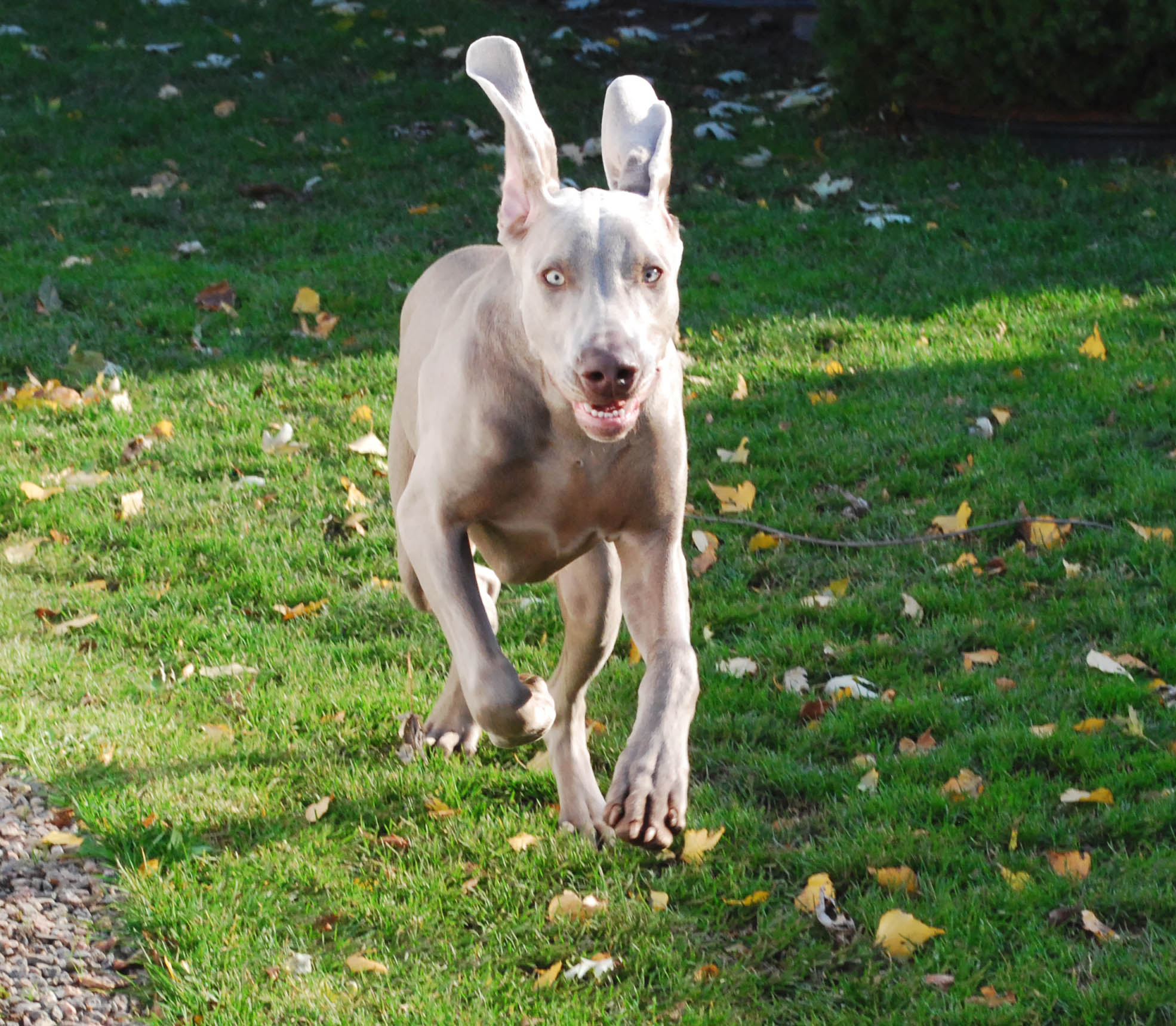

A Weimaraner bonds hard to its people — the breed is famous for it, and the nickname ‘velcro dog’ is earned. That devotion has a cost: left alone for long hours, a Weimaraner gets anxious and destructive, and a bored Weimaraner will chew, dig, and counter-surf with real enthusiasm. They are intelligent and quick to learn, and they respond to consistent, positive training; harsh corrections shut them down. They are good with children they grow up with, but they are big, strong, and boisterous, so small children need supervision around them.
The hunting instinct is still there. Weimaraners point, retrieve, and track, and they will chase — a squirrel, a deer, a cat that runs — so off-leash time belongs in a securely fenced area or on a long line, and recall training is a long project, not a weekend. The breed’s versatility is real enough that the national specialty awards a Most Versatile Weimaraner, for points in at least three of eight venues: agility, conformation, obedience, rally, tracking, shooting ratings, retrieving ratings, and hunting tests.
5. Grooming and everyday care
Grooming is the easy part: the short, smooth coat needs a weekly brush and an occasional bath, and that is about it. The long, lobular ears need regular checking and cleaning — they trap moisture, and ear infections are one of the breed’s common complaints. Nails need trimming, and teeth need brushing; like many sporting breeds, Weimaraners can build tartar.
Exercise is the hard part, and it is non-negotiable: a daily long walk or run, plus a job — hunting, agility, nose work, dock diving, or a long off-leash run in a fenced area. A Weimaraner that gets an hour of real exercise and mental work is a calm, pleasant house dog; one that gets a walk around the block is a demolition crew. This is not a breed for a sedentary household or for an owner who is away all day.
Feeding is straightforward: a good-quality food, measured meals, and a lean weight at 55 to 90 pounds. Because the breed is deep-chested, feed two or more smaller meals a day rather than one large one, and do not feed immediately before or after hard exercise — deep-chested breeds are prone to bloat, a sudden and life-threatening twisting of the stomach, and your veterinarian can talk to you about a preventive gastropexy at the time of spaying or neutering.
6. Health: the tests that matter
The Weimaraner Club of America’s CHIC profile calls for seven tests for breeding stock: a hip evaluation, a cardiac exam, an ophthalmologist evaluation, a thyroid evaluation, and three DNA tests — Spinal Dysraphism (SD), Hypomyelination (HYM), and Hyperuricosuria (HUU). A CHIC number means the tests were done and published by the OFA — it does not mean the dog passed them. Ask for the parents’ CHIC numbers and look them up yourself on the OFA database.
The tests point at the breed’s known weak spots. Hip dysplasia is the most common orthopedic problem, and the hip evaluation watches for it. The DNA tests screen for three inherited conditions: spinal dysraphism, a malformation of the spinal cord; hypomyelination, a defect in the insulation of the nerves; and hyperuricosuria, which causes uric acid stones. The cardiac and thyroid tests watch for heart disease and autoimmune thyroiditis. Beyond the CHIC list, the breed’s other issues to know are bloat — deep-chested dogs are prone to it, and it is a veterinary emergency — ear infections, and skin and food allergies. The AKC lists the breed’s lifespan as 10 to 13 years.
7. The annual Weimaraner specialty dog show
A specialty is the breed’s All-Star show — its Super Bowl. Once a year, the best Weimaraners from across the country, and often from around the world, come together in one place.
The Weimaraner Club of America’s national specialty: one national event each year, a full specialty week built around conformation, sweepstakes, futurity, and junior showmanship, with obedience, rally, agility, hunt tests, and the Top 20 Invitational alongside. The 2026 national ran May 9–15 in Bennett, Colorado, with the conformation specialty Thursday–Friday, May 14–15, and the Grand Banquet on Thursday evening. The 2027 national: not yet announced.
The standard, in brief: a medium-sized gray dog, dogs 25 to 27 inches at the shoulder and bitches 23 to 25, in shades of mouse-gray to silver-gray, with a short, smooth, sleek coat. A distinctly blue or black coat is a disqualification. The temperament is friendly, fearless, alert, and obedient — a versatile hunting dog that needs work and exercise.
The 2026 WCA National Specialty — national week Saturday, May 9–Friday, May 15, 2026, at Elevate Ranch, 1050 S Manila Rd, Bennett, Colorado. Conformation ran Thursday–Friday, May 14–15, judged by Pluis Davern, with 115 Weimaraners entered for 173 total entries and 50 dogs in the Best of Breed competition (22 dogs, 28 bitches). The national was dedicated to the memory of Marge Davis of Seabreeze Weimaraners. Event Secretary: Cyndi Skinner, c/o DogZibit. The host hotel was the Comfort Inn & Suites, 1097 Cedar St, Bennett, Colorado. Show hours 8:00 am–6:00 pm; unbenched, indoors.
The week opened with a double double hunt test in Keenesburg on Saturday–Sunday, May 9–10, run by the Vizsla Club of Colorado. Monday, May 11 was setup and the Welcome Party. Tuesday, May 12 brought the Mile High Weimaraner Club 4–6 Month Puppy competition, sweepstakes judged by Stephanie Meyer, and junior showmanship and specialty judged by Cindy Vogels, plus agility and the Stud Dog Social. Wednesday, May 13 was the Mile High finish specialty, obedience and rally, and the Top 20 prejudging — rally, judged by Janice Anthes, drew 31 dogs and 44 entries, and the first obedience trial, judged by Carole Evans, drew 21 dogs and 27 entries. Thursday, May 14 was the WCA 4–6 Month Puppy competition and Futurity and Maturity, judged by Alessandra Folz, junior showmanship and the National Specialty, judged by Pluis Davern, the membership meeting, and the Grand Banquet with the Top 20 presentation and WCA awards. Friday, May 15 closed the week with Stud Dog and Brood Bitch, judged by Folz, the Rescue Parade, and the completion of the National Specialty. A judges education seminar ran Thursday morning, with ringside mentoring Friday.
Results (2026 national). Best of Breed and the other top winners had not been published in an official source as of November 2026 and will be added here when they are.
The dates for the annual 2027 Weimaraner specialty dog show had not been announced as of November 2026. The AKC’s Upcoming National Specialties list, which runs through October 2027, carries no Weimaraner Club of America entry. This page will be updated when the club announces the 2027 national.
The national has moved around the country in recent years — Perry, Georgia in 2024, Wilmington, Ohio in 2025, Bennett, Colorado in 2026 — so the 2027 location is the detail to watch for.
Past national specialties: 2025
Weimaraner Club of America — weimaranerclubofamerica.org
8. Regional specialties through the year: smaller regional shows
The national is the anchor, but the breed’s year also runs through regional specialties — smaller regional shows, not the national — held around the country, including the regional specialties that run with the national. These are the 2026 regionals verified from club and AKC sources.
Regional Weimaraner specialties verified for 2026:
- Mile High Weimaraner Club Specialty — Tuesday–Wednesday, May 12–13, 2026, Elevate Ranch, Bennett, Colorado: held with the national specialty week; judged by Cindy Vogels, sweepstakes judged by Stephanie Meyer; 108 Weimaraners entered for 159 total entries (AKC event 2026168107).
- Valley of the Sun Weimaraner Club Specialty — Friday, January 30, 2026, Arizona State Fairgrounds, Phoenix, Arizona: judged by S Dankner; 12 entries (4 dogs, 8 bitches).
- Weimaraner Club of Albuquerque Specialty — Friday, May 8, 2026, Expo New Mexico, Albuquerque, New Mexico: judged by E Liebes; 12 entries (6 dogs, 6 bitches).
- Tarheel Weimaraner Club Specialty — Saturday, September 5, 2026, NC State Fairgrounds, Raleigh, North Carolina: judged by B H Humer; 39 entries (19 dogs, 20 bitches).
Other 2026 regional specialties had not been verified from club or AKC sources as of November 7, 2026.
More regional specialties will be added here as their programs are verified — this section is built from show data, not guesswork. Browse upcoming show weekends →
9. Clubs
The Weimaraner Club of America, Inc. (WCA) is the AKC parent club for the breed in the United States, formed in 1942. It is the guardian of the breed and determines the official breed conformation standard, runs the national specialty every year, and promotes responsible breeding, education, research, and rescue. The club runs a breeder referral service — it does not endorse or recommend specific breeders — and its Code of Ethics commits member breeders to take back any dog they bred. The club’s 2026 officers: President Barb Shepard, Vice President Frank Sommer, Secretary Brenda Reinert, and Treasurer Esteri Hinman; Executive Secretary Cindy Moore. The club’s website is at weimaranerclubofamerica.org.
Regional clubs around the country run the regional specialties and the local life of the breed, among them the Mile High Weimaraner Club, the Greater Cincinnati Weimaraner Club, the Tarheel Weimaraner Club, the Valley of the Sun Weimaraner Club, the Weimaraner Club of Albuquerque, and the Western Washington Weimaraner Club. The breed also has a field community of its own: the national specialty week still runs hunt tests and field trials alongside the conformation show, and the Most Versatile Weimaraner award recognizes dogs that earn points in at least three of eight venues.
10. Rescue
There is no single national WCA rescue shelter: rescue runs through the WCA Rescue Committee and the Weimaraner Foundation Fund, which supports rescue, health, and education, and through regional clubs and independent rescues. The AKC Rescue Network lists the WCA rescue contact as Rebecca Weimer — [email protected], 618-236-1466. The Weimaraner Foundation Fund is at weimaranerfoundationfund.org.
The regional rescues do the daily work. Tarheel Weimaraner Rescue, a 501(c)(3) serving North and South Carolina and the borders of Tennessee and Virginia, has placed more than 800 Weimaraners in fifteen years. Weim Friends Rescue, an all-volunteer 501(c)(3) based in Cincinnati, Ohio, is foster-based and takes applications from within about four hours of downtown Cincinnati, with adoption fees from $200 for seniors to $450 for puppies. Weimaraner Rescue of Texas, an all-volunteer 501(c)(3) running since 1989, has saved more than 1,600 dogs. The Atlanta Weimaraner Club Rescue is a 501(c)(3) serving the Atlanta area. Expect an application, references, and a home visit — and expect an adult dog: puppies are rare in rescue.
11. Breeder vs. rescue: honest guidance
Either route starts with the same question: has this dog’s health been tested? From a breeder, ask for the CHIC numbers of both parents — the hip evaluation, the cardiac exam, the eye examination, the thyroid evaluation, and the three DNA tests (Spinal Dysraphism, Hypomyelination, Hyperuricosuria) — and check them on the OFA database yourself, by the parents’ registered names. Ask what health issues the breeder sees in their stock, and meet at least the dam. And be honest with yourself about the exercise: a Weimaraner needs an hour or more of real activity every day, and a breeder who asks how you will provide it is doing you a favor.
From rescue, expect an adult dog whose temperament is already known, placed by a program that will match the dog to your life rather than the other way around. Budget for the same things either way: training, exercise, and a vet who knows the breed’s bloat risk. Whichever route you take, the dog that fits is a friendly, fearless, alert, and obedient hunting dog that wants to work — and will be happiest doing exactly that, with you.
12. Claim this page
This page was built from public sources — the AKC standard, the parent club’s own material, AKC event records, and the rescue programs’ sites — and it is a starting point, not the last word. If you are with the Weimaraner Club of America or a regional club and something here is wrong or missing, you can claim this page and set it straight: email [email protected] and tell us what needs fixing. Corrections from the people who own the breed are how this page gets better.
Sources
- AKC, Weimaraner
- AKC, Official Standard of the Weimaraner (approved December 14, 1971)
- Weimaraner Club of America
- Weimaraner Club of America, History of the Weimaraner
- Weimaraner Club of America, 2026 National Specialty
- Weimaraner Club of America, 2025 National Specialty
- AKC, Upcoming National Specialties list
- AKC, Sporting Group Health Testing Requirements
- PetMD, Weimaraner Dog Breed Health and Care
- AKC Rescue Network, W Breeds (Weimaraner Club of America rescue contact)
- Tarheel Weimaraner Rescue
- Weim Friends Rescue, Adoption Process
- Weimaraner Rescue of Texas
- Wikimedia Commons, BIR Grupp 7 — Weimaraner, Korthårig, Warrior's Song (Svenska Mässan, CC BY 2.0)
- Wikimedia Commons, 2014 Westminster Kennel Club Dog Show (Pets Adviser, CC BY 2.0)
- Wikimedia Commons, Bweimarcourse (Vincent Côté, CC BY-SA 3.0)