
Breed profile · Sporting Group · recognized 1960
Vizsla
The Vizsla is a medium-sized, short-coated hunting dog of distinguished appearance — solid golden rust, robust but lightly built, and a versatile gun dog that points and retrieves with equal enthusiasm. Hungarians call it the Vizsla, “pointer,” and the breed's fanciers call it the “Velcro Vizsla,” because this dog bonds so hard to its people that it follows them from room to room. The American Kennel Club recognized the breed in 1960, and the Vizsla Club of America's national specialty gathers the breed's best in Morgantown, West Virginia, in May 2027.
Help us improve it. This is one of ThePetAdvisor’s breed profiles, built from public sources with generous links to the people who actually own this breed’s knowledge. If something’s off or missing, the parent club can claim the page and set it straight — see the bottom of the page.
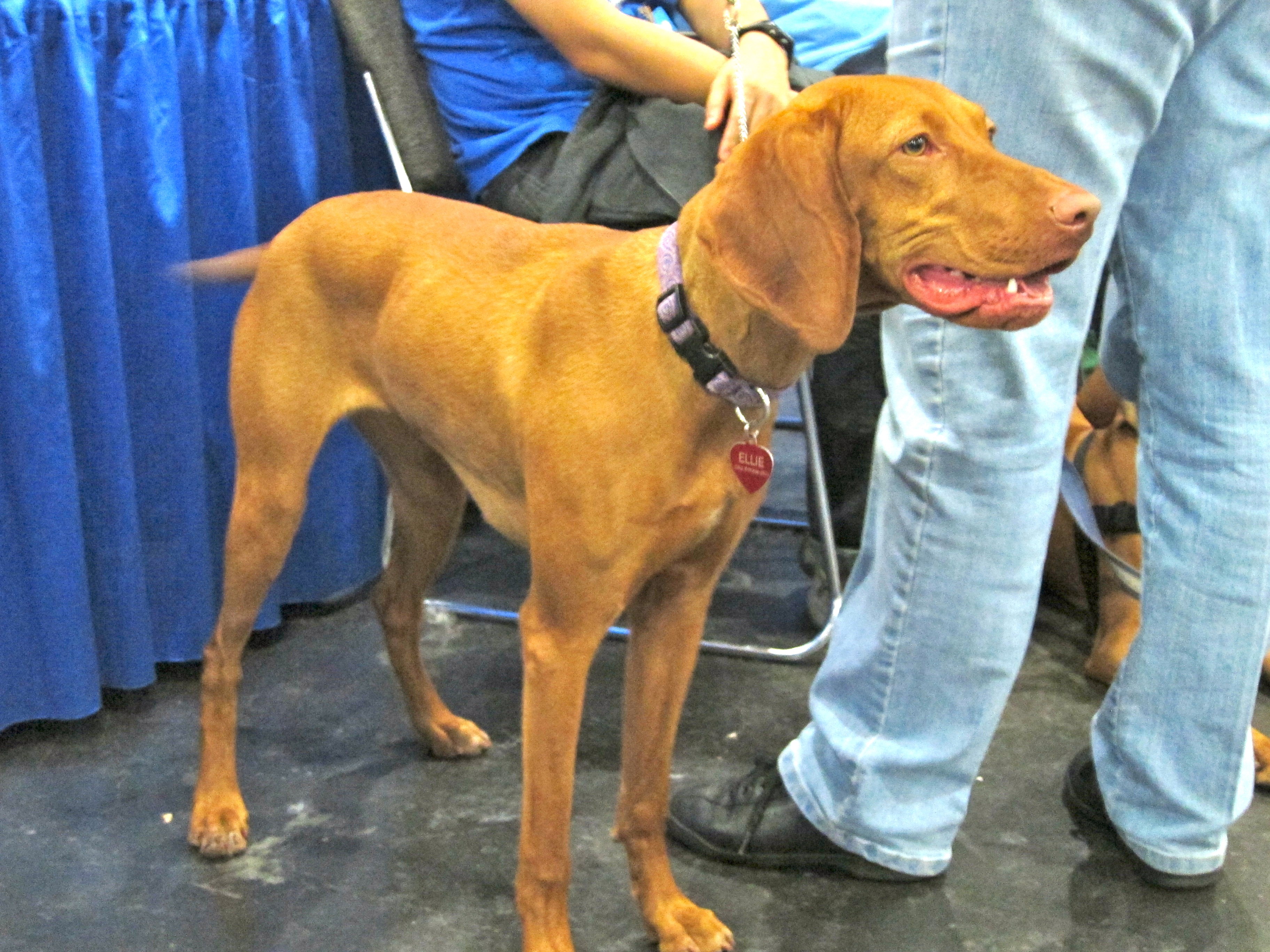
Do you have a better photo of a Vizsla in the American show ring? If you have a show photo you’d let us use, email it to [email protected] — tell us the dog’s name and the show, and it may be featured here. Please only send photos you took yourself or have the photographer’s permission to share, and tell us the photographer’s name.
1. Breed at a glance
At a glance:
- Group: Sporting.
- AKC recognition: November 25, 1960 — the 115th breed recognized by the American Kennel Club.
- Parent club: Vizsla Club of America, Inc., founded in 1953 as the Magyar Vizsla Club of America and renamed the Vizsla Club of America on November 26, 1960.
- Size: ideal 22 to 24 inches at the withers for males, 21 to 23 inches for females; disqualification for more than 1½ inches over or under.
- Weight: males 55 to 60 pounds, females 44 to 55 pounds; typical range 45 to 65 pounds.
- Life expectancy: 12 to 14 years.
- Coat: short, smooth, dense, and close-lying, with no woolly undercoat.
- Color: golden rust in varying shades — the only color. Solid dark mahogany and pale yellow are faulty; white anywhere but the forechest and toes is disqualifying.
- Temperament: lively, gentle-mannered, demonstrably affectionate and sensitive, fearless, with a well-developed protective instinct.
- Nickname: the “Velcro Vizsla” — a dog that reaches its full potential only as a family member, not kenneled after a hunt.
2. History
The Vizsla's name is the Hungarian word for “pointer,” and the breed is among the oldest hunting dogs in Europe. Its ancestors were the hunting dogs of the Magyars, the nomadic warriors who settled the Carpathian Basin in the 8th century — swift, golden dogs that pointed and retrieved for hunters on horseback, guarded by the Hungarian aristocracy and known for centuries as the “yellow pointers.”
The breed nearly vanished twice. The Turkish Occupation (1526–1696) and, later, the Hungarian Civil War of 1848–49 cut the population to about a dozen true-type dogs. After the Second World War and the Russian occupation, it nearly vanished again — and was saved in part by one woman: Elizabeth Mihalyi, who escaped to Austria with her Vizsla, Panni XV, and bred her to a dog named Betyar. The Panni-Betyar line became the foundation stock of the American breed.
The American story began in Kansas City. In 1950, Sari and two puppies arrived from Austria; in March 1952, Sari whelped the first United States litter, sired by Rex. In 1953, the Magyar Vizsla Club of America was incorporated in Missouri by Frank Tallman. The first Vizsla was registered with the American Kennel Club on July 26, 1959 — Rex Z Arpadvar — and the AKC recognized the breed on November 25, 1960, the 115th breed recognized. The club renamed itself the Vizsla Club of America the next day.
The first VCA national specialty was held in 1965 in Chagrin Falls, Ohio, won by Gypsy's Bronze Bomber. The breed went on to produce the first AKC Triple Champion and the first Quintuple Champion (Chartay). Vizslas have worked as search-and-rescue dogs after September 11, 2001, and the breed is among the top three used by the Transportation Security Administration — a working record that matches the standard's insistence on a dual dog, one that can win in the field and in the ring.
3. The standard and why it's written that way
The AKC standard for the Vizsla, approved January 13, 2009 and effective April 1, 2009, describes a dual dog — and it means it. Every point below comes from the standard itself.
- General appearance: a medium-sized, short-coated hunting dog of distinguished appearance and bearing, robust but rather lightly built. The standard is explicit: the Vizsla is a dual dog, bred to be a field dog and a show dog, and “field-conditioned coats, brawny and sinewy condition, and honorable scars” are never penalized. (AKC breed standard)
- Size, measured, and a hard line: ideal height at the highest point over the shoulder blades is 22 to 24 inches for males and 21 to 23 inches for females; the dog is slightly longer than tall. More than 1½ inches over or under the ideal is a disqualification — for males, over 25½ or under 20½ inches; for females, over 24½ or under 19½ inches. (AKC breed standard)
- Head and expression: lean and muscular, with a muzzle equal to or slightly shorter than the skull, square and deep, ending in a blunt, squared-off nose. The nose is self-colored — a partially or completely black nose is a disqualification. Ears are thin, silky, and proportionately long, with rounded-leather ends, set fairly low. Eyes blend with the coat; yellow eyes are faulty. (AKC breed standard)
- Coat and color: short, smooth, dense, and close-lying, with no woolly undercoat; a distinctly long coat is a disqualification. The color is golden rust in varying shades, with a lighter shading on the neck and shoulders common and a slight lightening under the belly and chest acceptable. Solid dark mahogany and pale yellow are faulty. White on the forechest (as small as possible) and on the toes is permissible; solid white extending above the toes or white anywhere else except the forechest, and white on the shoulders or neck, are disqualifications. (AKC breed standard)
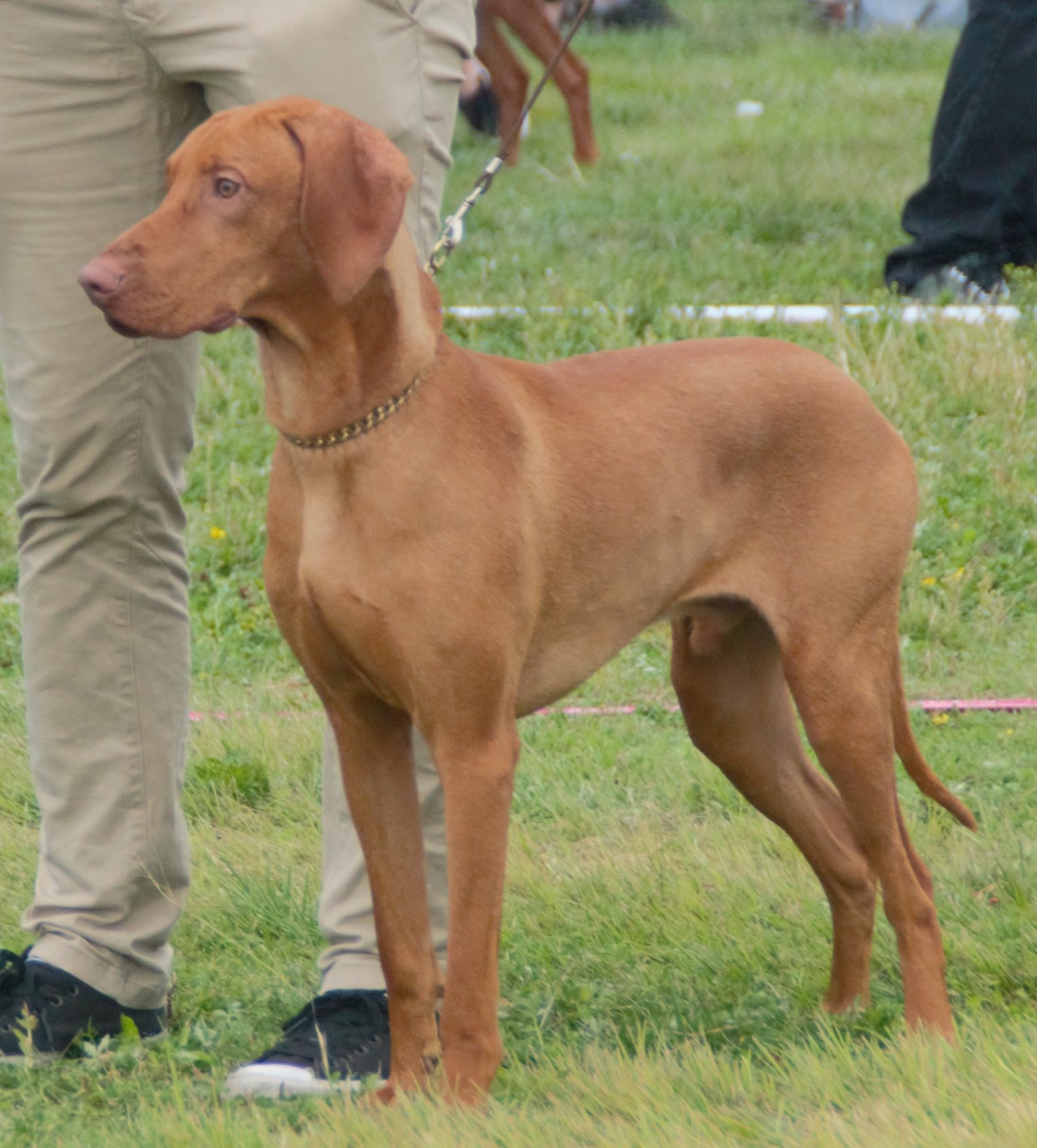
- Tail: set just below the level of the croup, thicker at the root, docked one-third off, and carried at or near the horizontal. Ideally the docked tail reaches the back of the stifle joint, and the docked tail is preferred over the undocked. (AKC breed standard)
- Gait: far reaching, light footed, graceful, and smooth, with a powerful drive from the hindquarters. At a fast trot the dog single-tracks. (AKC breed standard)
- Temperament, written into the standard: a natural hunter with a good nose and an above-average ability to take training. Lively, gentle-mannered, demonstrably affectionate and sensitive, fearless, and with a well-developed protective instinct. Shyness, timidity, or nervousness is penalized. (AKC breed standard)
- Why the standard is written this way: the Vizsla was bred to do everything — point, retrieve, work water and field, and live in the house — and the standard protects that versatility. The disqualifications are all about function and identity: height limits keep the dog an efficient medium-sized athlete, the color rules keep the breed unmistakable, and the temperament paragraph exists because a gun dog that cannot take training, or that fears its own shadow, is useless in the field no matter how pretty it is.
4. Temperament & living with one
The Vizsla is the dog world's most famous shadow. Fanciers call the breed the “Velcro Vizsla” for a reason: this is a dog that bonds to its people with an intensity few breeds match, following its owners from room to room, leaning against them, and sleeping pressed against them. The parent club puts it plainly — a Vizsla reaches its full potential only when accepted as a family member, not kenneled after a hunt.
That devotion comes with a price. A Vizsla left alone for long hours is a dog in distress: separation anxiety, destructive chewing, and incessant vocalizing are the breed's classic failure modes, and they are almost always a management problem, not a temperament problem. This is a breed for people who are home, or who can take the dog with them.
In the house, Vizslas are gentle-mannered, demonstrably affectionate, and sensitive — the standard's words — and they are fearless with a well-developed protective instinct, so they notice strangers and announce them. They are also exuberant athletes. A Vizsla needs a job every day: field work, agility, scent work, dock diving, long runs, or serious training. A tired Vizsla is a calm, charming house dog. An unexercised one is a demolition crew.
Training is the breed's great strength. The standard notes an above-average ability to take training, and Vizslas excel across obedience, rally, agility, hunt tests, and field trials. They are soft dogs, though — heavy-handed methods shut them down. Short, upbeat, reward-based sessions, built on the relationship the dog already wants, get the best of them.
5. Grooming
The Vizsla is one of the lowest-maintenance coats in the Sporting Group. A weekly brush with a rubber curry or hound glove removes dead hair and keeps the short, dense coat glossy; a bath only when the dog is actually dirty. There is no undercoat to blow, no trimming, no stripping, and no mats to fight.
What needs attention instead:
- Nails: the standard calls for short, brown nails; keep them trimmed, since a running dog with long nails is a dog that slips and strains.
- Ears: long, pendulous ears trap moisture. Check them weekly and clean as needed, especially after swimming or field work.
- Skin: the short coat leaves skin exposed; check for scrapes after field work — and remember the standard's line that honorable scars are never penalized.
- Cold: with no woolly undercoat, a Vizsla feels the cold. A coat for winter walks and a warm bed are not luxuries for this breed.
- Teeth: brush regularly; the scissors bite the standard calls for is worth protecting.
6. Health testing
The Vizsla Club of America's official health statement, approved by the VCA board on November 20, 2024, sets the testing a responsible breeder does — and the CHIC program turns it into a checklist with numbers you can verify.
Required for a CHIC number:
- Hip dysplasia — OFA or PennHIP evaluation at 24 months or older.
- Autoimmune thyroiditis — OFA thyroid evaluation, repeated every other year.
- Eyes — examined by a board-certified veterinary ophthalmologist, registered with OFA, annually.
Recommended in addition:
- Elbow dysplasia — OFA evaluation at 24 months or older.
- Cardiac — evaluation by a board-certified cardiologist, registered with OFA, at 12 months or older.
An AKC DNA number is required before any mating, and permanent identification (microchip or tattoo) is required for CHIC certification. The club's code of ethics also names the conditions breeders must watch for, including epilepsy, progressive retinal atrophy, von Willebrand's disease, entropion, and cranial muscular atrophy, and requires that breeding stock be free of serious hereditary defects. When you talk to a breeder, ask for the OFA or CHIC numbers — and look them up on the OFA database before you put down a deposit. (Vizsla Club of America, Official Health Statement)
7. The annual Vizsla specialty dog show
A specialty is the breed’s All-Star show — its Super Bowl. Once a year, the best Vizslas from across the country, and often from around the world, come together in one place.
The Vizsla Club of America’s national specialty: the annual Vizsla specialty dog show. The 2027 national: May 5–7, 2027, at Mylan Park in Morgantown, West Virginia, superintendent Onofrio Dog Shows. The 2026 national: April 9–10, 2026, at Galway Downs in Temecula, California, 206 dogs in the entry. Best of Breed: CH Rhapsody My Name in Lights JH. The 2025 national: April 24–26, 2025, at the South Sioux City Marriott Riverfront in South Sioux City, Nebraska, 205 dogs in the entry. Best of Breed: GCHB CH Tivoliz Hippo Hippo Hooray JH. The 2024 national: April 25–27, 2024, at the Boxboro Regency Hotel & Conference Center in Boxborough, Massachusetts, 284 dogs in the entry. Best of Breed: GCHB Renaissance N Brittania’s Changing The Game JH. The 2023 national: April 30–May 2, 2023, at the Cowlitz County Fairgrounds in Longview, Washington, 214 dogs in the entry. Best of Breed: GCHP CH Sierra Ridge Born To Love You JH.
The 2026 National Specialty — national week Monday, April 6 – Saturday, April 11, 2026, at Galway Downs, 38801 Los Corralitos, Temecula, CA 92592, hosted by the South Coast Vizsla Club (its 50th anniversary year). Conformation Thursday, April 9 – Friday, April 10, 2026. Entries closed Wednesday, March 11, 2026. AKC event number 2026080407. Superintendent: BaRay Event Services, Inc. Conformation, 4–6 Month Beginner Puppy, and Junior Showmanship: Douglas A. Johnson. Sweepstakes and Veteran Sweepstakes: Valerie Nunes-Atkinson. Obedience: Kathy Moore. Rally: Samantha Williams. Agility: Jim Primmer. National Event Chair: Sebastian Duran; VCA Show Chair: Karen Burgess. Entry fees $47 first entry, $32 each additional entry, $25 Beginner Puppy and Junior Showmanship only. National-week schedule: agility Monday, April 6; obedience and rally Tuesday, April 7; scent work, sweepstakes, Iron Dog, and the South Coast 50th anniversary celebration Wednesday, April 8; regular classes Thursday, April 9; balance of classes, Junior Showmanship, and Best of Breed Friday, April 10; South Coast Vizsla Club specialty Saturday, April 11. (Sources: Vizsla Club of America, 2026 National Events premium list; AKC event search, event 2026080407; Vizsla Club of America, 2026 National Specialty and Companion Events.)
Results (2026 national). Best of Breed: CH Rhapsody My Name in Lights JH. Best Junior Handler: Tatum Duvall; Reserve Best Junior Handler: Charlotte Jones. Winners Dog, Winners Bitch, and Best of Opposite Sex not confirmed in an accessible official source. (Sources: Vizsla Club of America, National Event Winners; AKC event search, event 2026080407.)
The 2027 National Specialty: conformation Wednesday, May 5 – Friday, May 7, 2027 (3 days), at Mylan Park, Morgantown, West Virginia. Superintendent: Onofrio Dog Shows, L.L.C. Judges, premium, AKC event number, entry fees, entries opening/closing, event chair, and national-week dates beyond the three conformation days not yet published as of November 7, 2026. (Sources: AKC, Upcoming National Specialties.)
Past national specialties: 2025 · 2024 · 2023
8. Regional specialties through the year: smaller regional shows
The national is the anchor, but the breed’s year also runs through regional specialties — smaller regional shows, not the national — held by the Vizsla Club of America’s member clubs around the country, usually as designated specialties with all-breed shows or as hosted specialties during national week. These are the 2026 regionals verified from club and AKC sources so far:
Two Vizsla specialties verified for 2026 beyond the national itself:
- South Coast Vizsla Club Specialty — Saturday, April 11, 2026, Galway Downs, Temecula, California: closing show of national week, held with the Vizsla Club of Southern California. Judge Shelley S. Hennessy; 152 dogs, 154 entries. (Sources: Vizsla Club of America, 2026 National Events premium list; Vizsla Club of America, 2026 judging program.)
- Vizsla Club of America Regional Specialty — Sunday, May 31, 2026, Medicine Creek Winery, Olympia, Washington: AKC event number 2026080412; entries closed Wednesday, May 13, 2026; entry limit 100. Event chair Jill Brennan. Superintendent: BaRay Event Services, Inc. Judges and results not confirmed in an accessible official source. (Source: AKC event search, event 2026080412.)
The 2027 regionals announced so far:
One regional specialty announced so far for 2027:
- Vizsla Club of Metro Atlanta Specialty — Sunday, April 18, 2027, Perry, Georgia (Peach Blossom Cluster): the club’s annual specialty at the Peach Blossom Cluster. Judges and results not yet published. (Source: ThePetAdvisor, All show weekends.)
Past regional specialties: 2025 · 2024
More regional specialties will be added here as their programs are verified — this section is built from show data, not guesswork. Browse upcoming show weekends →
9. Clubs
The parent club is the Vizsla Club of America, Inc. (VCA), founded in 1953 as the Magyar Vizsla Club of America and renamed in 1960. The VCA runs the national specialty, maintains the breed's rescue program, publishes the breed's health guidance, and supports 35 affiliated regional specialty clubs across the country. Club officers for 2026: President Jamie Walton, Vice President Jessica Vetter, Recording Secretary Vicky Osborn, Treasurer Paul Hussa, AKC Delegate Kathy Rust, and Corresponding Secretary Ginger Sammonds. (Vizsla Club of America)
Regional clubs include the South Coast Vizsla Club, Vizsla Club of Metro Atlanta, Twin Cities Vizsla Club, Vizsla Club of Central New England, Vizsla Club of Michigan, Vizsla Club of Long Island, Central Wisconsin Vizsla Club, Vizsla Club of Illinois, Vizsla Club of Greater Cleveland, Vizsla Club of Northern California, Vizsla Club of Southern California, Vizsla Club of the Carolinas, Puget Sound Vizsla Club, Trails End Vizsla Club of Oregon, and CT Valley Vizsla Club.
One note for newcomers: the Wirehaired Vizsla is a separate breed with its own parent club, the Wirehaired Vizsla Club of America. The smooth-coated Vizsla on this page and the wirehaired variety are not the same dog, and their clubs, standards, and specialties are separate.
10. Rescue
The Vizsla Club of America's breed rescue program began in 1991, with Rick Davis as its first chairman. Dogs coming into rescue are spayed or neutered and temperament-tested before placement, the work is done by volunteers, and it is funded by donations. The VCA Welfare Foundation — a 501(c)(3) established in 2000 — supports health research, rescue, and education for the breed.
Regional rescue programs include:
- Long Island Vizsla Rescue (Vizsla Club of Long Island) — founded in 2003, a 501(c)(3) since 2013; contact [email protected].
- Vizsla Club of Central New England rescue — places about 12 dogs a year; adoption fee $350 ($200 for dogs over 7).
- Twin Cities Vizsla Club rescue — serving Minnesota, South Dakota, and North Dakota.
- Vizsla Club of Michigan rescue and CT Valley Vizsla Club rescue — regional programs of the VCA member clubs.
Start with the Vizsla Club of America, which can direct you to the rescue coordinator for your state. Rescue Vizslas are usually adults or adolescents whose temperament is already known — a real advantage for a first-time Vizsla owner, provided the home can meet the breed's exercise and companionship needs.
11. Breeder vs rescue
From a breeder: expect a breeder who shows, hunts, or competes with their dogs, health-tests every breeding dog, and takes a puppy back for life. Ask for CHIC numbers — hips, thyroid, and eyes are required — plus the optional elbow and cardiac screens, and verify them on the OFA database. Ask how the puppies are raised in the home, what the parents hunt or compete in, and what the breeder expects of you. A breeder who won't answer, or who has puppies always available, is a warning sign.
From rescue: expect an application, a phone interview, and often a home visit. Rescue dogs are adults or adolescents, spayed or neutered, temperament-tested, and placed by people who know the breed's needs — which means the rescue will ask hard questions about exercise, work hours, and fencing. That scrutiny is a feature: a Vizsla in the wrong home is a miserable dog.
Either way: the right question is not “breeder or rescue?” but “does this dog, and this source, fit a life with a high-energy, deeply people-oriented hunting dog?” A Vizsla that works and lives with its people is one of the great companions in the dog world. A Vizsla left alone in a yard is a tragedy in slow motion.
12. Claim this page
This page is maintained by ThePetAdvisor and built from public sources — the AKC standard, the Vizsla Club of America's publications, and AKC event records. If you are an officer of the Vizsla Club of America, a regional club officer, a rescue coordinator, or a breeder, and you spot an error or have a correction, we would rather hear it from you than from a search result.
Send corrections, specialty dates, or photos to [email protected] with “Vizsla” in the subject line. We check every message.
Sources
- American Kennel Club, Vizsla breed page
- American Kennel Club, Official Standard of the Vizsla (approved January 13, 2009; effective April 1, 2009)
- Vizsla Club of America, Vizsla Breed History
- Vizsla Club of America, Official Health Statement (approved by the VCA Board of Directors, November 20, 2024)
- Vizsla Club of America, National Event Winners
- Vizsla Club of America, 2026 National Specialty and Companion Events
- Vizsla Club of America, 2026 National Events premium list (BaRay Event Services)
- Vizsla Club of America, 2025 National Events premium list (BaRay Event Services)
- Vizsla Club of America, 2024 National Events premium list (Rau Dog Shows)
- AKC, Upcoming National Specialties
- AKC event search, event 2026080407 (2026 national specialty)
- AKC event search, event 2025080406 (2025 national specialty)
- AKC event search, event 2024080408 (2024 national specialty)
- AKC event search, event 2023080402 (2023 national specialty)
- Wikimedia Commons, Vizsla at AKC Meet the Breeds, New York City (Pets Adviser, CC BY 2.0)
- Wikimedia Commons, Vizsla standing in profile (Canarian, CC BY-SA 4.0)

