
Breed profile · Working Group · the ancient Himalayan guardian
Tibetan Mastiff
The Tibetan Mastiff is Tibet’s ancient guardian: a large, substantial, heavy-boned dog, dogs 26 to 29 inches at the shoulder and bitches 24 to 27, 90 to 150 pounds for dogs and 70 to 120 for bitches, with a thick double coat and a heavy mane, a broad head, deep-set almond eyes, and a tail curled over the back — aloof and watchful with strangers, devoted to its own people, and bred for millennia to guard homes, monasteries, and flocks on the high Himalayan plateau.
Help us improve it. This is one of ThePetAdvisor’s breed profiles, built from public sources with generous links to the people who actually own this breed’s knowledge. If something’s off or missing, the parent club can claim the page and set it straight — see the bottom of the page.
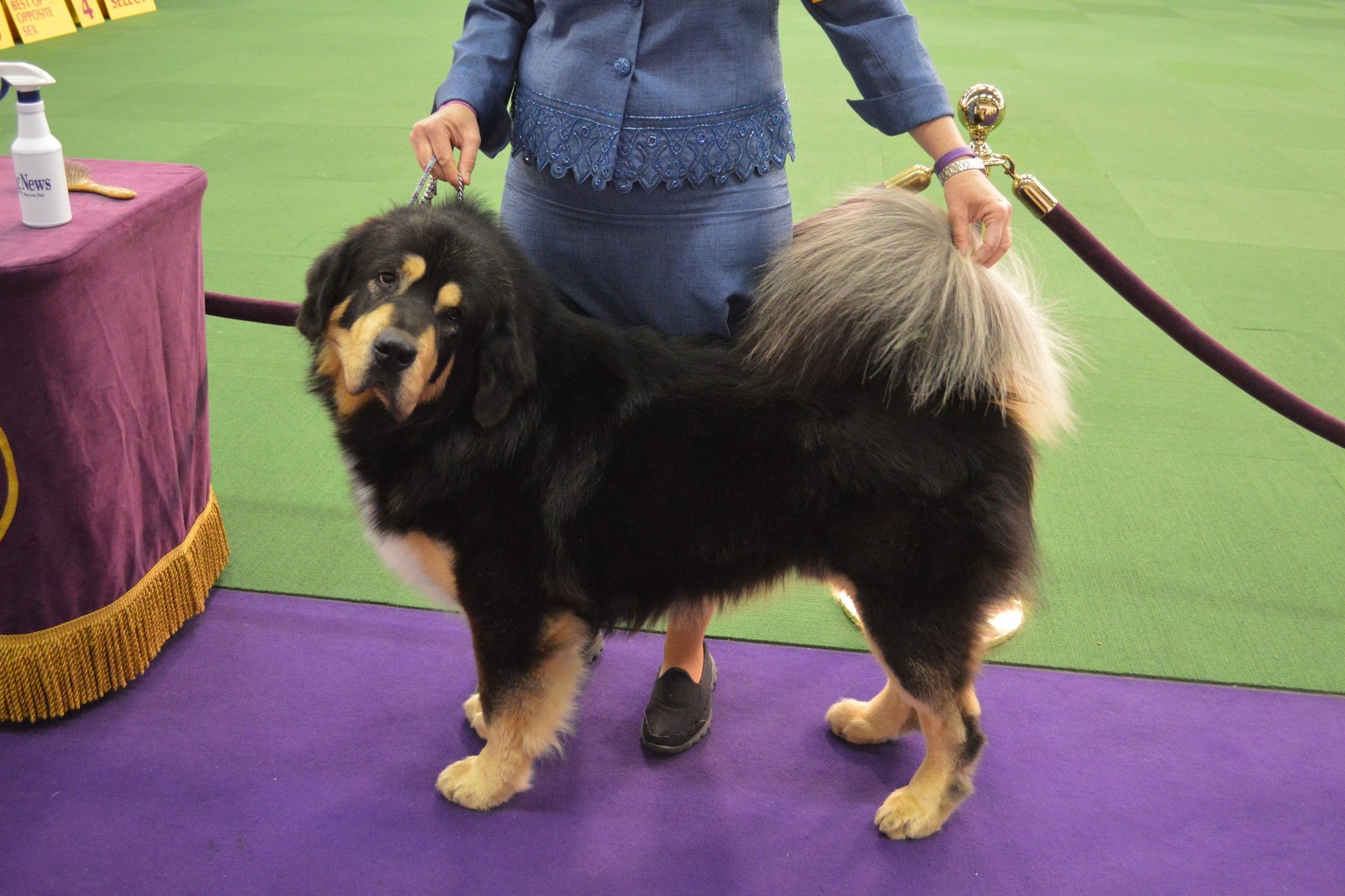
Do you have a better photo of a Tibetan Mastiff in the American show ring? If you have a show photo you’d let us use, email it to [email protected] — tell us the dog’s name and the show, and it may be featured here. Please only send photos you took yourself or have the photographer’s permission to share, and tell us the photographer’s name.
1. Breed at a glance
Working — recognized by the AKC in 2006
Dogs 26–29 in, bitches 24–27 in at the shoulder. Weight 90 to 150 lb for dogs, 70 to 120 lb for bitches.
Double, with fairly long, thick, coarse guard hair and a heavy soft undercoat; neck and shoulders heavily coated, giving a mane-like appearance. Black, brown, and blue/grey, all with or without tan markings; also gold.
Highly intelligent, independent, strong-willed, and rather reserved. Aloof with strangers and highly protective of its charges and its property.
10 to 12 years.
Size, coat, color, and temperament facts are from the AKC standard (approved February 10, 2012; effective February 29, 2012). Weight (90 to 150 pounds for dogs, 70 to 120 pounds for bitches) and lifespan (10 to 12 years) are the breed’s commonly published figures (AKC Tibetan Mastiff breed page).
2. History
The Tibetan Mastiff is one of the world’s oldest guardian breeds, developed over thousands of years in Tibet. In Tibet the breed is known as the Do-Kyi, meaning “tied dog,” for its traditional role guarding homes, temples, and encampments while tethered near entrances. Historical references describe large Tibetan dogs as early as 1100 B.C., and many experts consider the Tibetan Mastiff foundational stock for numerous modern working breeds. The dogs guarded nomadic camps, monasteries, and livestock on the high-altitude Chang Tang Plateau, where elevations average roughly 16,000 feet — the cold, snow, and rugged terrain shaping the thick coat and resilience the breed still carries. (Sources: AKC, Tibetan Mastiff History; American Tibetan Mastiff Association, Brief History.)
The breed reached the West in the nineteenth century. The Viceroy of India sent a “large dog from Tibet” named “Siring” to Queen Victoria in 1847, and the Kennel Club later classified the breed as the Tibetan Mastiff. In 1874 the Prince of Wales, later Edward VII, imported two more dogs, exhibited at the Alexandra Palace Show in 1875. In 1928 Colonel and Mrs. Bailey imported four Tibetan Mastiffs acquired during the Colonel’s service in Nepal and Tibet, and in 1931 Mrs. Bailey formed the Tibetan Breeds Association and the first official breed standard was adopted by The Kennel Club — the standard later used by the Fédération Cynologique Internationale (FCI). Marco Polo, centuries earlier, had described the dogs as being as large as small donkeys. (Sources: AKC, Tibetan Mastiff History; American Tibetan Mastiff Association, Brief History.)
In the United States the first documented importation came in 1958, when Nepal’s foreign ministry sent a pair of the dogs as a gift to President Dwight D. Eisenhower. Modern development began in 1966, when Ann Rohrer, founder of the American Tibetan Mastiff Association, acquired Jumla’s Kalu of Jumla while working for the U.S. government in Kathmandu, Nepal. Beginning in 1970, more Tibetan Mastiffs were imported from Nepal and India, and fanciers built breeding programs from those foundation dogs. The American Tibetan Mastiff Association was founded in 1974, with Jumla’s Kalu of Jumla as its dog #001. The first National Specialty Match was held in the United States in connection with the California Rare Breeds Dog Association in October 1979, and the first National Specialty Show was held in 1983. The breed entered the AKC Foundation Stock Service in 1996, the Miscellaneous Class in January 2005, and the AKC recognized the breed in 2006, with eligibility to compete in the Working Group from January 1, 2007. The breed first competed at the Westminster Kennel Club Dog Show in 2008. (Sources: AKC, Tibetan Mastiff History; American Tibetan Mastiff Association, Brief History; Wikipedia, Tibetan Mastiff.)
3. The standard and why it’s written that way
- Noble and impressive — large, but not a giant breed. The standard opens with the whole dog: “Noble and impressive: a large, but not a giant breed. An athletic and substantial dog, of solemn but kindly appearance. The Tibetan Mastiff stands well up on the pasterns, with strong, tight, cat feet, giving an alert appearance. The body is slightly longer than tall. The hallmarks of the breed are the head and the tail.” The head is broad and impressive, the eyes deep-set and almond shaped, the muzzle broad and well-padded, giving a square appearance, and the typical expression is one of watchfulness. The tail and britches are well feathered and the tail is carried over the back in a single curl falling over the loin, balancing the head. (Source: AKC standard.)
- Size — a preferred range, with a hard floor under it. “Dogs — preferred range of 26 to 29 inches at the withers. Bitches — preferred range of 24 to 27 inches at the withers. Dogs and bitches that are 18 months or older and that are less than 25 inches at the withers in the case of dogs or 23 inches at the withers in the case of bitches to be disqualified.” All dogs and bitches within the preferred range are judged equally, with no preference to be given to the taller dog. Proportion is slightly longer than tall (10–9), and the substance should be impressive for the size, both in bone, body, and muscle. (Source: AKC standard.)
- The head: broad, heavy-browed, and watchful. “Broad, strong with heavy brow ridges. Heavy wrinkling to be severely faulted.” The expression is “noble, intelligent, watchful and aloof.” The eyes are very expressive, medium size, any shade of brown, deep-set, well apart, almond-shaped, and slightly slanting. The ears are medium size, V-shaped, pendant, set on high, dropping forward and hanging close to the head. The muzzle is broad, well filled, and square when viewed from all sides, and the bite is scissors, with a level bite acceptable. Undershot or overshot bite is a disqualification. (Source: AKC standard.)
- Coat — thick, coarse, and maned, shown naturally. “Double-coated, with fairly long, thick coarse guard hair, with heavy soft undercoat in cold weather which becomes rather sparse in warmer months. Hair is fine but hard, straight and stand-off; never silky, curly or wavy. Heavy undercoat, when present, rather woolly. Neck and shoulders heavily coated, especially in dogs, giving mane-like appearance. Tail and britches densely coated and heavily feathered. The Tibetan Mastiff is shown naturally. Trimming is not acceptable except to provide a clean cut appearance of feet and hocks. Dogs are not to be penalized if shown with a summer coat.” (Source: AKC standard.)
- Color — black, brown, blue/grey, or gold, with or without tan. “Black, brown, and blue/grey, all with or without tan markings ranging from a light silver to a rich mahogany; also gold, with shades ranging from a pure golden to a rich red gold. White markings on chest and feet acceptable.” Tan markings may appear above the eyes, around the eyes, on the muzzle, throat, legs, breeches, and the underside of the tail. All other coat colors — white, cream, wolf sable, brindle, and particolors — are disqualifications. (Source: AKC standard.)
- Tail, gait, and temperament, in the standard’s own words. Tail: “Well feathered, medium to long, not reaching below the hock, set high on line with the back. When alert or in motion, the tail is always carried curled over the back.” Gait: “The gait of a Tibetan Mastiff is athletic, powerful, steady and balanced, yet at the same time, light-footed and agile. … Sound and powerful movement more important than speed.” Temperament: “The Tibetan Mastiff is a highly intelligent, independent, strong willed and rather reserved dog. He is aloof with strangers and highly protective of his charges and his property. In the ring he may exhibit reserve or lack of enthusiasm, but any sign of shyness is unacceptable and must be severely faulted as inappropriate for a guardian breed.” (Source: AKC standard.)
4. Temperament & living with one
The AKC sums the breed up in a sentence: “Watchful, aloof, imposing, and intimidating: The ancient Tibetan Mastiff is the guardian dog supreme. These densely-coated giants are mellow and calm around the house, sweetly devoted to family, and aloof and territorial with strangers.” The standard’s temperament line says the same thing in breeder’s language: “highly intelligent, independent, strong willed and rather reserved,” “aloof with strangers and highly protective of his charges and his property.” That is the guardian in a pet’s life: a dog bred to watch a home, a monastery, or a nomad’s camp for thousands of years, deciding for itself what is a threat and what is not. (Sources: AKC Tibetan Mastiff breed page; AKC standard.)
What that means in practice is a dog that guards by presence and by voice rather than by pursuit. The parent club’s president, Martha Feltenstein, puts it plainly: “They are not dogs who will chase somebody down. They just want you to go away. They put up this incredible display, you go away, and they just go back to sleep.” The breed is a nocturnal sentry by heritage, barking at unidentified sounds through the night and often sleeping during the day, and it is not recommended for novice owners. It needs early and thorough socialization, consistent training from an owner the dog respects, a securely fenced yard, and room to move — it is not an apartment dog. It is generally good with family children when properly socialized, but it can be dog-aggressive, particularly with dogs of the same sex, so introductions to other dogs need care. It is devoted to its own people and gentle with them, and it chooses whom to trust. (Sources: AKC, Tibetan Mastiff History; Wikipedia, Tibetan Mastiff; Furry Critter, Tibetan Mastiff.)
5. Grooming
- Weekly brushing most of the year — daily during the coat blow. The heavy double coat sheds moderately most of the year, and a weekly brushing with a slicker or a long pin brush to remove surface dirt, plus a wide-tooth comb on the tail, mane, and breeches to remove tangles, is all that is required. Once a year, in late spring or summer, the dog “blows” its undercoat in a massive shed lasting two to four weeks, and during that time daily brushing with an undercoat rake or de-shedding tool is the way through it. (Sources: Tibetan Mastiff care (AKC text, via Moore Family Newfoundlands); Furry Critter, Tibetan Mastiff.)
- Shown naturally — no clipping. The standard is explicit: “The Tibetan Mastiff is shown naturally. Trimming is not acceptable except to provide a clean cut appearance of feet and hocks.” A pet clip is a trade: easier upkeep, a softer coat, and a dog that no longer looks quite like the standard’s picture. (Source: AKC standard.)
- Bathe when dirty, and keep the ears and eyes clear. The coat is low-maintenance most of the year, and a bath every four to six weeks is plenty for most dogs. Keep the pendant ears clean and dry, watch the deep-set eyes for discharge, and keep the heavy mane and breeches free of mats — that is where tangles start. (Sources: Furry Critter, Tibetan Mastiff; Dog Temperament, Tibetan Mastiff Coat Care.)
6. Health testing
- Four tests for a CHIC number. For a CHIC number, the Tibetan Mastiff needs four evaluations: an OFA hip evaluation, an OFA elbow evaluation, an eye examination by a board-certified veterinary ophthalmologist, and a thyroid evaluation. That is the parent club’s list on the AKC’s Working Group health-testing page. Breeders must agree to have all test results, positive or negative, published in the CHIC database. (Sources: AKC Working Group Health Testing Requirements; American Tibetan Mastiff Association health statement.)
- The parent club’s bar, in its own words. The American Tibetan Mastiff Association’s health statement (March 3, 2015) recommends testing dogs and bitches prior to breeding for: hips, OFA excellent, good, or fair only, or PennHIP no greater than the average for large-breed dogs; elbows, OFA normal; a biannual eye exam, OFA clear; and an annual complete thyroid panel. (Source: American Tibetan Mastiff Association health statement.)
- The watch list: hips, elbows, thyroid, eyes, seizures, and bloat. Health problems seen in the breed include hip dysplasia, elbow dysplasia, hypothyroidism, and eye problems such as entropion, ectropion, progressive retinal atrophy, and cataracts. The parent club’s own flier names hip and elbow dysplasia, low thyroid, and seizure disorder as the problems to discuss with a breeder, and the breed is also prone to bloat, the gastric emergency every giant-breed owner should know the signs of. None of this is a reason not to own a Tibetan Mastiff. All of it is a reason to buy from a breeder who tests. (Sources: American Tibetan Mastiff Association breed flier; MetLife Pet Insurance, Tibetan Mastiff.)
- Lifespan: 10 to 12 years. The commonly published lifespan is 10 to 12 years. (Source: AKC Tibetan Mastiff breed page.)
7. The annual Tibetan Mastiff specialty dog show
A specialty is the breed’s All-Star show — its Super Bowl. Once a year, the best Tibetan Mastiffs from across the country, and often from around the world, come together in one place.
The American Tibetan Mastiff Association’s national specialty: a one-day show inside a bigger all-breed weekend, with the conformation specialty at its center and puppy and veteran sweepstakes, a 4-to-6-month puppy competition, and a Parade of Rescues around it. The 2026 show: Friday, April 17, at the Maryland State Fairgrounds in Timonium, Maryland, with 15 Tibetan Mastiffs in the specialty. The 2025 show: Saturday, April 12, at the Sussex County Farm & Horse Show Grounds in Augusta, New Jersey, with 11 Tibetan Mastiffs. The 2027 show: Saturday, February 27, at the Alliant Energy Center in Madison, Wisconsin. The national-specialty winner: the Ann Rohrer Founder’s Trophy, in honor of the club’s founder.
The standard, in brief: a large, substantial guardian, dogs 26 to 29 inches and bitches 24 to 27 inches, with the broad head, the heavy mane, the tail curled over the back, and the thick double coat — black, brown, blue/grey, or gold, with or without tan markings — and the watchful, aloof, independent carriage.
The 19th Annual National Specialty — a one-day show, Friday, April 17, 2026, at the Maryland State Fairgrounds (Cow Palace), 2200 York Rd., Timonium, Maryland, opening a weekend with two all-breed shows on Saturday and Sunday at the same site. Entry: 17 entries and 15 competitors (6 dogs, 9 bitches). Entries opened Wednesday, February 25, and closed Wednesday, April 1, 2026, at noon. Event Chair: Martha Feltenstein. Superintendent: MB-F, Inc. (Sources: AKC event search, event 2026625401; American Tibetan Mastiff Association, 2026 National Specialty save the date; Baltimore County Combined Specialties premium list.)
National specialty judges: Mr. Edward Fojtik — regular and non-regular classes. Ms. Deb Lindsay — sweepstakes and veteran sweepstakes. (Source: American Tibetan Mastiff Association, 2026 National Specialty save the date.)
Results (AKC event search, event 2026625401). Best of Breed: CH Drakyi Tashi Queen Of The Ring (bitch). Best of Opposite Sex: GCHB CH Hi-Stand’s Into The Blu Mystic ATT. Select Dog: GCH CH Great North Woods New Kid In Town. Select Bitch: GCHB CH Irie Dreamcatcher Bubbledog. Best Owner-Handled: GCH CH Aujudon’s Show Some Respect. Winners Bitch: West Wing Monet. Reserve Winners Bitch: Aujudon’s Foreign Affair. Best Veteran (non-regular veteran dogs): GCHB CH Northstar’s Whiskey Glasses. (Source: AKC event search, event 2026625401.)
The 2027 National Specialty: a one-day show, Saturday, February 27, 2027, at the Alliant Energy Center, 1919 Alliant Energy Center Way, Madison, Wisconsin. Judge: Ms. Barbara Muller — conformation, with sweepstakes also on the program (sweepstakes judge to be confirmed from the premium list). Entries open Wednesday, January 20, 2027, and close Wednesday, February 10, 2027, with a 100-entry limit. Event Chair: Martha Feltenstein. Superintendent: MB-F, Inc. The same weekend: a parent-club specialty on Friday, February 26 (judge Ms. Kimberly Anne Meredith), a 4-to-6-month beginner puppy competition on Saturday (judge Ms. Barbara Muller), and a parent-club specialty on Sunday, February 28 (judge Mr. John C Ramirez). (Sources: AKC Upcoming National Specialties; AKC event search, event 2027625403; AKC event search, event 2027625401 (Friday specialty); AKC event search, event 2027625404 (Sunday specialty).)
Past national specialties: 2025
American Tibetan Mastiff Association — tibetanmastiff.org
8. Regional specialties through the year: smaller regional shows
The national is the anchor, but the breed’s year also runs through regional specialties — smaller regional shows, not the national — held by the parent club itself around the national weekend. These are the 2027 regionals verified from club sources so far:
- Parent-club specialty, Alliant Energy Center, Madison, WI — Friday, February 26, 2027: the parent club’s specialty opening the national weekend. Conformation judge Ms. Kimberly Anne Meredith. Entries open Wednesday, January 20, 2027, and close Wednesday, February 10, 2027, with a 100-entry limit. (Source: AKC event search, event 2027625401.)
- Parent-club specialty, Alliant Energy Center, Madison, WI — Sunday, February 28, 2027: the parent club’s specialty closing the national weekend. Conformation judge Mr. John C Ramirez. Entries open Wednesday, January 20, 2027, and close Wednesday, February 10, 2027, with a 100-entry limit. (Source: AKC event search, event 2027625404.)
Past regional specialties: 2025
More regional specialties will be added here as their programs are verified — this section is built from show data, not guesswork. Browse upcoming show weekends →
9. Clubs
- American Tibetan Mastiff Association (parent club) — the AKC parent club for the breed in the United States. It was incorporated in 1974 in Kentucky as a national club for Tibetan Mastiff fanciers, founded by Ann Rohrer, and it turned its registry over to the AKC Foundation Stock Service in August 2002 as the first step toward AKC recognition. It runs the national specialty, held in Augusta, New Jersey in 2025, in Timonium, Maryland in 2026, and scheduled for Madison, Wisconsin in 2027. President Martha Feltenstein (2026). (Sources: American Tibetan Mastiff Association; American Tibetan Mastiff Association, History of the Club.)
If you are new to the breed, the national specialty itself is the better first stop than a breeder’s website: the people there have owned, shown, and worked Tibetan Mastiffs, and they will tell you the truth about the size, the independence, the night barking, and the guarding before you fall for a puppy.
10. Rescue
- Start with Tibetan Mastiff Rescue, Inc. Tibetan Mastiff Rescue, Inc. is the only 501(c)(3) rescue organization in the United States dedicated to the rescue, rehabilitation, and rehoming of Tibetan Mastiffs. It pulls dogs from shelters and other situations, houses them, trains them for family living, deals with their medical issues, and evaluates their temperaments before placement. The rescue’s contact is Elizabeth Justus Dickenson of Bean Station, Tennessee, at [email protected]. (Sources: Tibetan Mastiff Rescue, Inc.; AKC Rescue Network, T breeds.)
- Who the rescue can help — and who it cannot. The rescue exists for Tibetan Mastiffs that have been abandoned, placed in shelters, or belong to people who have died or suffered a serious illness that leaves them incapable of caring for the dog. It is not set up for dogs whose owners find them inconvenient, uninteresting, or no longer wanted because of a move, and it will not take in a dog that has shown unwarranted aggression toward people. Its resources are limited, and they go to the dogs with no known owner or no capable owner. (Source: Tibetan Mastiff Rescue, Inc., Is Your Tibetan Mastiff Eligible?.)
- Other giant-breed rescue. Gentle Giants Rescue also takes in Tibetan Mastiffs among other giant breeds. If you bought your Tibetan Mastiff from a responsible breeder, contact the breeder first — most responsible breeders include a take-back clause in their contracts and want to know if the dog needs help.
- Adults and seniors. A rescued Tibetan Mastiff is usually an adult, often one whose owner underestimated the size, the independence, the night barking, and the guarding instinct a 100-plus-pound guardian brings into a house, and it will arrive with its temperament and coat visible before you commit. What you get in return is a dog whose character you can see before you commit and a lower price. Either way, be honest with yourself first: a Tibetan Mastiff needs space, a securely fenced yard, daily exercise, consistent training, and an owner who finds a huge, independent, watchful dog reassuring rather than alarming.
11. Breeder vs. rescue: honest guidance
- If you buy: start with the parent club, the American Tibetan Mastiff Association, and its breeder list. Ask for the parents’ health results — hips, elbows, eyes, and thyroid — and look the results up in the OFA database yourself. Expect to wait for a puppy from a careful breeder: this is a rare breed, and a good breeder will have the answers, will ask you as many questions as you ask them, and will take the puppy back for its whole life if you cannot keep it.
- If you rescue: a rescued Tibetan Mastiff is usually an adult, often one whose owner underestimated the size, the independence, the night barking, and the guarding instinct, and it will arrive with its temperament visible before you commit. What you get in return is a dog whose character you can see before you commit and a lower price. Either way, be honest with yourself first: a Tibetan Mastiff needs space, a securely fenced yard, daily exercise, consistent training, and an owner who finds a huge, independent, watchful dog reassuring rather than alarming. It is not a dog for a household that wants a quiet, decorative, or easy first dog.
- One standard in the West — no separate varieties to pay extra for. In the West the breed is shown under one standard. The Indian breed standard separates the breed into Lion Head and Tiger Head varieties, but those are not AKC varieties, and there is no miniature Tibetan Mastiff. A breeder selling a “mini” or a premium-priced “Lion Head” as a separate American variety is selling you a label.
12. Claim this page
This page belongs to the breed, and the people who know the breed best are the American Tibetan Mastiff Association and its members. If you are with the parent club — or you are a breeder, a judge, a handler, or a rescue volunteer who spotted something wrong, missing, or out of date — this page is yours to set straight. Tell us what needs fixing and where the correction is documented, and we will fix it and credit the source. Contact the site through the About page, and mention “Tibetan Mastiff breed profile.”
Sources
- AKC Tibetan Mastiff breed page — akc.org/dog-breeds/tibetan-mastiff
- AKC Official Standard of the Tibetan Mastiff (approved February 10, 2012; effective February 29, 2012) — images.akc.org/pdf/breeds/standards/TibetanMastiff.pdf
- AKC, Tibetan Mastiff History: From Himalayan Guardian to Modern Companion (January 31, 2022; updated September 14, 2026) — akc.org/expert-advice/dog-breeds/tibetan-mastiff-history
- American Tibetan Mastiff Association, Brief History — tibetanmastiff.org/brief-history
- American Tibetan Mastiff Association, History of the Club — tibetanmastiff.org/history_of_club
- AKC Working Group Health Testing Requirements — akc.org/breeder-programs/breed-health-testing-requirements/working-group-health-testing-requirements
- American Tibetan Mastiff Association health statement (March 3, 2015) — cdn.akc.org/Marketplace/Health-Statement/Tibetan-Mastiff.pdf
- American Tibetan Mastiff Association breed flier — cdn.akc.org/TibetanMastiff-club-flier.pdf
- AKC Upcoming National Specialties — apps.akc.org/apps/events/conformation/national_specialties.cfm
- 2026 National Specialty, AKC event search, event 2026625401 — apps.akc.org/apps/events/search/index_results.cfm
- 2026 National Specialty save the date, American Tibetan Mastiff Association — tibetanmastiff.org 2026 save the date
- 2025 National Specialty, AKC event search, event 2025625401 — apps.akc.org/apps/events/search/index_results.cfm
- 2025 Tibetan Specialty premium list (Rau Dog Shows) — raudogshows.com 2025 premium list
- 2027 National Specialty, AKC event search, event 2027625403 — apps.akc.org/apps/events/search/index_results.cfm
- 2027 Friday and Sunday specialties, AKC event search, events 2027625401 and 2027625404 — apps.akc.org/apps/events/search/index_results.cfm (2027625401)
- 2025 Parent Club Specialty, AKC event search, event 2025625403 — apps.akc.org/apps/events/search/index_results.cfm
- Tibetan Mastiff Rescue, Inc. — tibetanmastiffrescueinc.org
- AKC Rescue Network, T breeds — akc.org/akc-rescue-network/rescue-network-t-breeds
- Modern Molosser, Ann Rohrer Introduced the Tibetan Mastiff to America (Ann Rohrer Founder's Trophy) — modernmolosser.com/ann-rohrer-introduced-the-tibetan-mastiff-to-america
- Furry Critter, Tibetan Mastiff (history, temperament, grooming) — furrycritter.com/pages/descriptions/dogs/t/tibetan_mastiff.htm
- MetLife Pet Insurance, Tibetan Mastiff (health) — metlifepetinsurance.com/blog/breed-spotlights/tibetan-mastiff
- Wikipedia, Tibetan Mastiff (Westminster debut 2008; Lion Head / Tiger Head varieties) — en.wikipedia.org/wiki/Tibetan_Mastiff