
Breed profile · Terrier Group · the small Staffie from Staffordshire
Staffordshire Bull Terrier
The Staffordshire Bull Terrier is the small, muscular terrier from England’s Black Country — a former pit dog remade, through careful breeding, into a mild, playful companion famous for its devotion to children. At 14 to 16 inches and 24 to 38 pounds it is the compact one of the bull-and-terrier breeds: not to be confused with the larger American Staffordshire Terrier or the Bull Terrier. Its national specialty moves around the country each year, and the parent club, the Staffordshire Bull Terrier Club of America, celebrated its fiftieth anniversary in 2024.
Help us improve it. This is one of ThePetAdvisor’s breed profiles, built from public sources with generous links to the people who actually own this breed’s knowledge. If something’s off or missing, the parent club can claim the page and set it straight — see the bottom of the page.
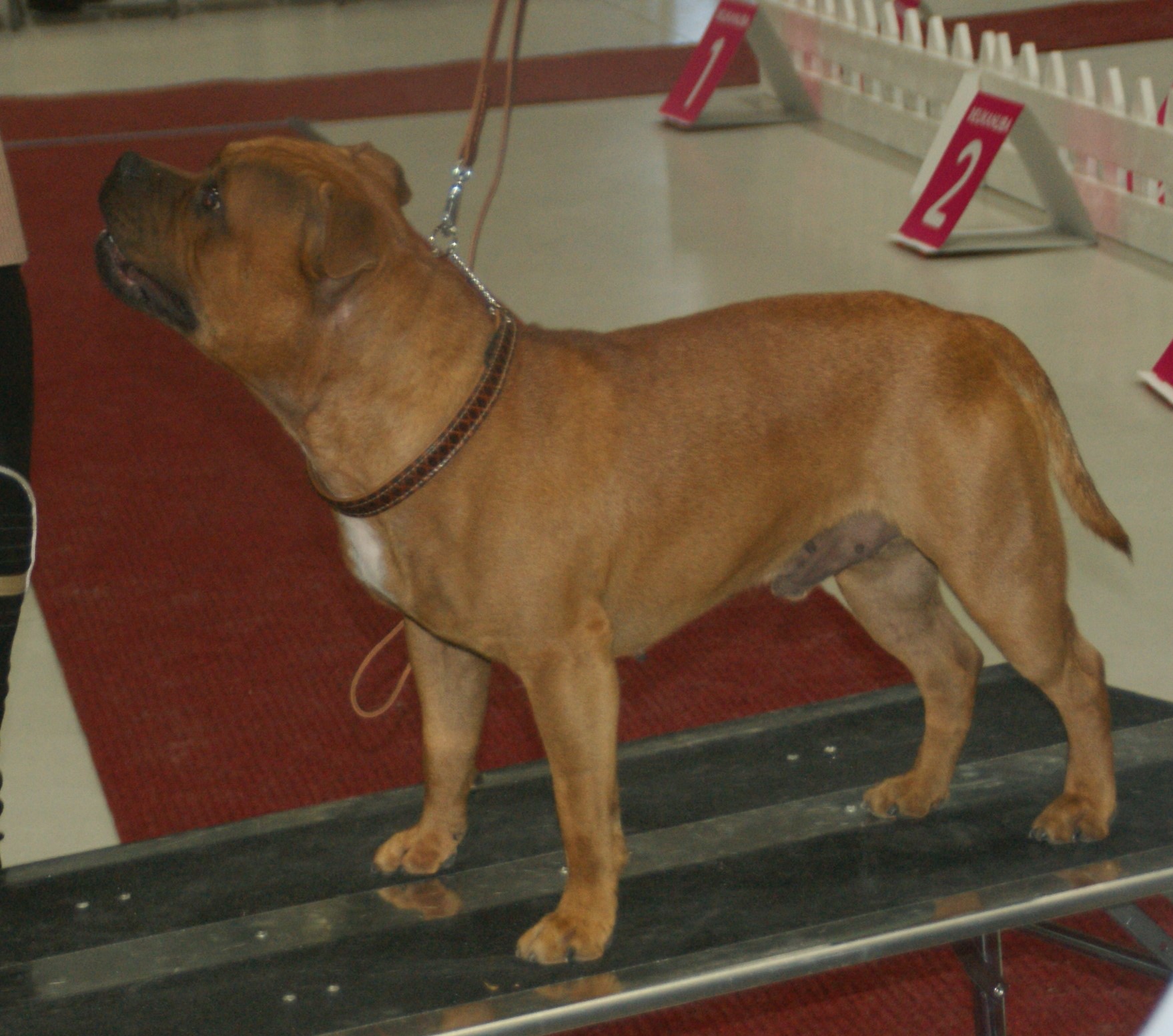

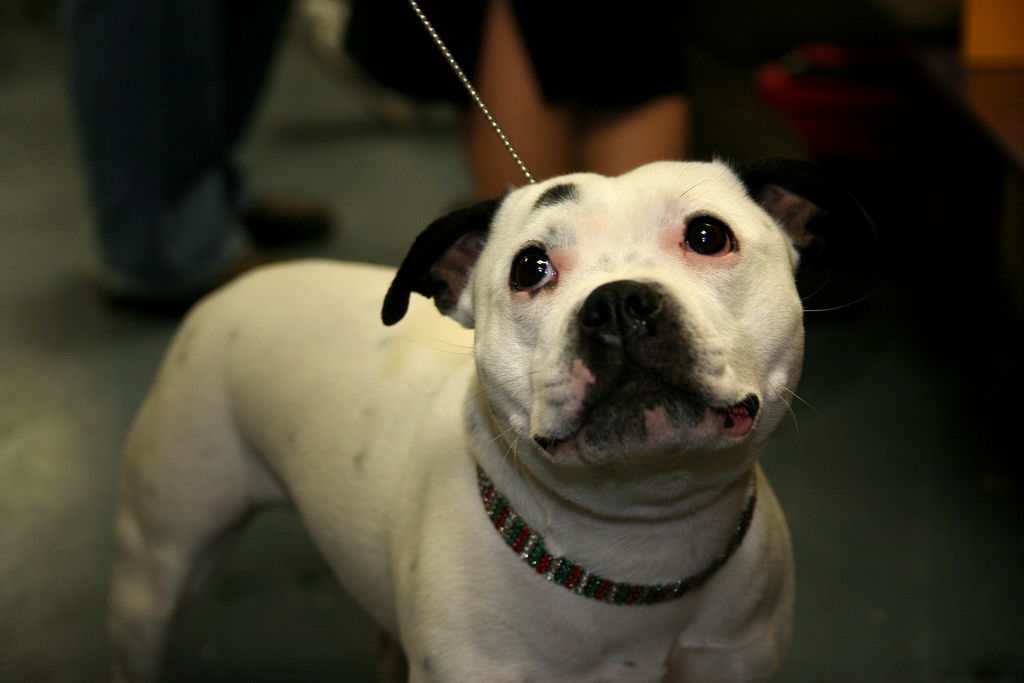
Do you have a better photo of a Staffordshire Bull Terrier in the American show ring? If you have a show photo you’d let us use, email it to [email protected] — tell us the dog’s name and the show, and it may be featured here. Please only send photos you took yourself or have the photographer’s permission to share, and tell us the photographer’s name.
1. Breed at a glance
Terrier Group; AKC-recognized since 1974
14–16 in, 24–38 lb
Smooth, short; red, fawn, white, black, blue, brindle
12–15 years (AKC)
Courageous, tenacious, affectionate; devoted to children
Staffordshire Bull Terrier Club of America
2. History: from the pit to the parlor
The Staffordshire Bull Terrier descends from the bull-and-terrier crosses refined in Staffordshire and the English Black Country in the 19th century — bulldogs crossed with terriers to make a smaller, quicker, more agile dog for the pit. When bull-baiting was banned in 1835, the dogs were turned to dog fighting, and the breed’s early history is inseparable from that blood sport. The turn came in the 1930s, when breeders began selecting for temperament as well as muscle.
In June 1935, the Staffordshire Bull Terrier Club was formed at the Old Cross Guns pub in Cradley Heath, and the Kennel Club accepted the breed into its stud book the following month. The very first Staffordshire Bull Terrier show was held that year on the bowling green of the Conservative Club at Cradley Heath.
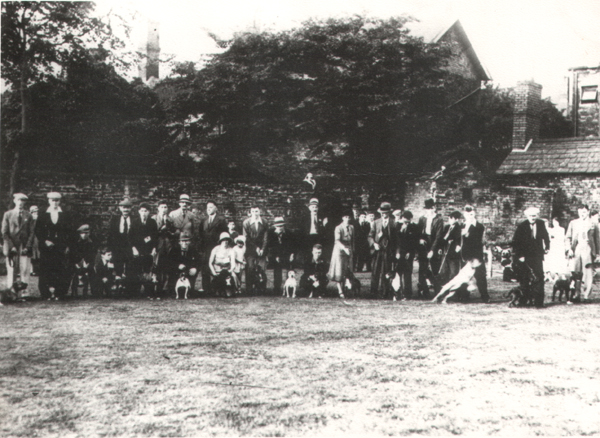

The Fédération Cynologique Internationale recognized the breed in 1954. In the United States, the Staffordshire Bull Terrier Club of America was founded in 1974, and the AKC accepted the breed for registration the same year; the United Kennel Club followed in 1975. In July 2024 the parent club celebrated its fiftieth anniversary with a Golden Jubilee national specialty weekend at Purina Farms in Missouri.
Do not confuse the Staffie with its cousins. The American Staffordshire Terrier is the larger American descendant, recognized by the AKC in 1936 and renamed in 1972. The Bull Terrier is a separate, egg-headed breed. The Staffie is the smaller British original, and its modern claim to fame in the American ring belongs largely to one dog: GCHG CH Wavemaker Nonesuch (“Felix”), who won Best of Breed at the SBTCA National Specialty in 2025, Best of Opposite Sex at the Golden Jubilee national in 2024, and Select Dog at Westminster in 2023 and 2024.
3. The standard: great strength for its size
The AKC breed standard was approved July 8, 2025, and took effect September 30, 2025 — the newest version of the standard, which added the merle pattern to the disqualifications. In brief, the standard describes “a smooth-coated dog” that “gives the impression of great strength for his size” and is “a well put together dog” with a muscular body, powerful stance, and a confident, wagging-tail manner.
Size: 14 to 16 inches at the shoulder; dogs 28 to 38 pounds, bitches 24 to 34 pounds. Non-conformity to these limits is a fault. The length of the back, from withers to tail set, equals the distance from withers to ground.
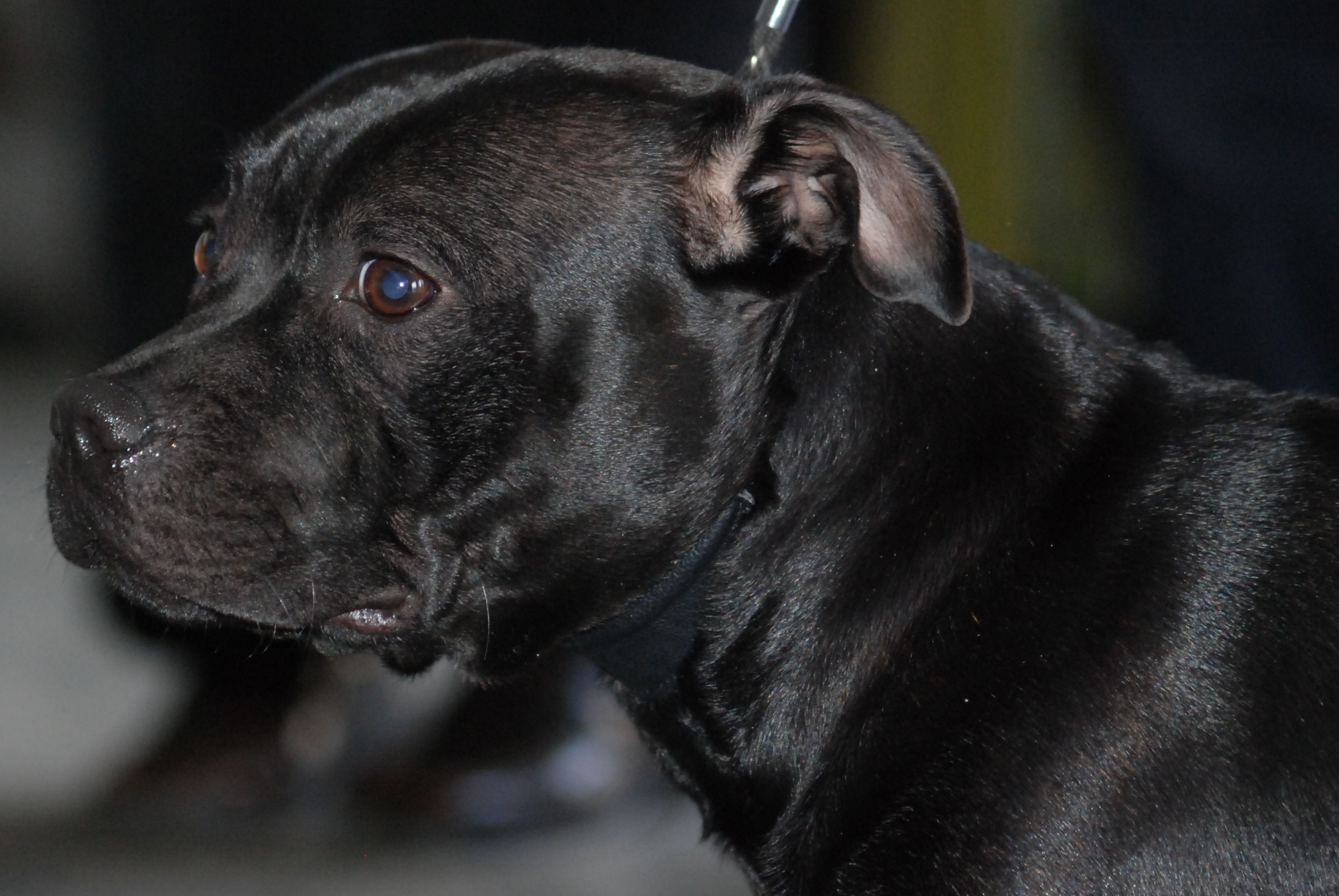

Head: short, deep through, and broad, with pronounced cheek muscles, a distinct stop, and a short foreface. The nose is black; a pink (“Dudley”) nose is a serious fault. Eyes are dark, preferably, round and of medium size; light eyes or pink eye rims are a fault, except where the coat around the eye is white. Ears are rose or half-pricked and not large; a full drop or full prick ear is a serious fault. The bite is a scissors bite — the outer side of the lower incisors touching the inner side of the upper incisors — and a badly undershot or overshot mouth is a serious fault.
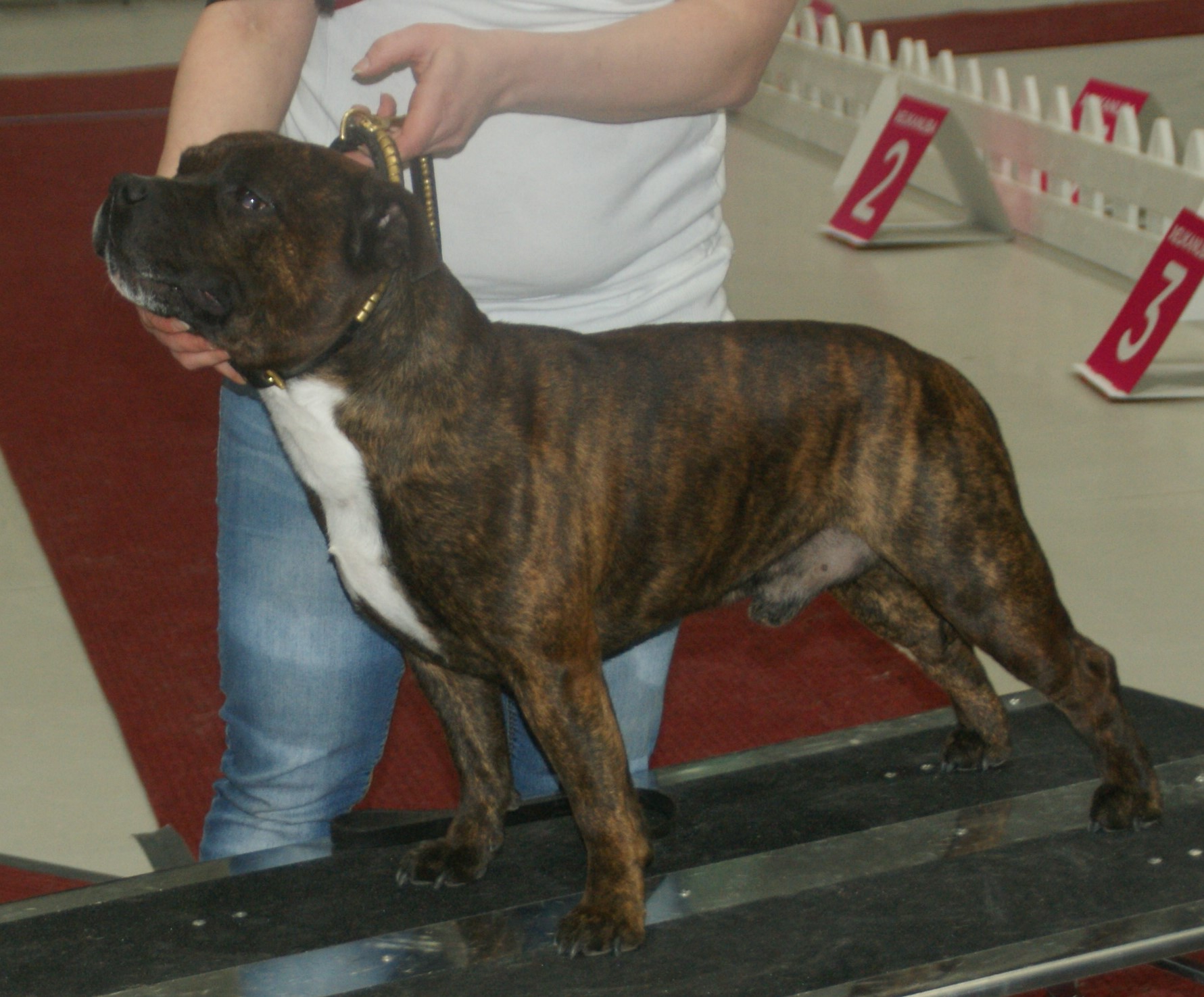
Body: close-coupled, with a level topline, wide front, and deep brisket. The tail is undocked, of medium length, low set, tapering to a point and carried rather low — the standard calls it “the old-fashioned pump handle”. A tail that is too long or badly curled is a fault.
Coat and color: smooth, short, and close; the coat is not to be trimmed or de-whiskered. Colors are red, fawn, white, black, or blue, or any of those with white, and any shade of brindle, or any shade of brindle with white.
Disqualifications: black-and-tan, liver color, and the merle pattern. The standard notes that “the Merle pattern does not exist genetically in the breed and shall be disqualified.”
4. Temperament: courage, and a special feel for kids
The standard’s temperament paragraph is the heart of the breed: the Staffordshire Bull Terrier is “a dog of indomitable courage, high intelligence, and tenacity” whose “affection for its friends, and children in particular, its off-duty quietness and trustworthy stability, makes it a foremost all-purpose dog.” The AKC’s own summary agrees: from a brawling past, good breeding made “a mild, playful companion with a special feel for kids.”

In the house a Staffie is typically quiet, affectionate, and people-oriented — happiest on the sofa with its family, and famously tolerant of children. Out of the house it is a bold, energetic terrier that needs early socialization, firm and consistent training, and daily vigorous exercise: a bored Staffie will find its own work, and it will usually involve chewing or digging.
One practical reality before you buy: the breed appears on dangerous-dog and breed-restricted lists in many communities, which can affect housing, insurance, and air travel. Check your local rules and your insurer’s list first — and know that a reputable breeder will ask about exactly that.
5. Grooming, exercise & everyday care
Grooming: the smooth, short coat is low-maintenance — a weekly brushing keeps it tidy, with a bath only when the dog is dirty. The standard says the coat is not to be trimmed or de-whiskered. Keep the nails trimmed and the teeth brushed; the breed’s heavy chewing habit makes dental care worth the routine.
Exercise: a Staffie is a muscular athlete in a compact frame and needs daily vigorous exercise — long walks, play, and training that works the mind as well as the body. Earthdog, barn hunt, agility, and obedience all suit the breed, and a job is the best antidote to the digging and chewing that come with boredom.
Feeding: a 24-to-38-pound dog with a heavy build eats like a bigger dog, so measure meals and watch the waistline; the breed’s appetite is enthusiastic. A sturdy crate and tough chew toys are practical household equipment — this is a breed that chews hard and loves it.
6. Health: five CHIC tests
The OFA CHIC program for the Staffordshire Bull Terrier requires five tests: a hip evaluation (OFA or PennHIP), an elbow evaluation (OFA), an ophthalmologist eye examination, a DNA test for L-2-hydroxyglutaric aciduria (L-2-HGA), and a DNA test for hereditary cataracts. A patellar luxation evaluation is optional but recommended. The parent club’s health statement asks breeders to DNA-test breeding stock for L-2-HGA and hereditary juvenile cataracts, keep a current eye clearance, and screen litters for persistent hyperplastic primary vitreous (PHPV) from six weeks of age.
L-2-HGA is an inherited metabolic disorder that causes tremors, a lack of coordination, and seizures; hereditary cataracts cause early-onset lens clouding that can lead to blindness. Both are detectable by DNA test, which is why the tests are in the CHIC program — a breeder who cannot show them is a breeder to walk away from. The AKC gives the breed a lifespan of 12 to 15 years.
7. The annual Staffordshire Bull Terrier specialty dog show
A specialty is the breed’s All-Star show — its Super Bowl. Once a year, the best Staffordshire Bull Terriers from across the country, and often from around the world, come together in one place.
The Staffordshire Bull Terrier Club of America holds its national specialty once a year, and the show moves around the country: South Jordan, Utah, in 2026; Timonium, Maryland, in 2025; and Purina Farms in Gray Summit, Missouri, in 2024, when the club marked its fiftieth anniversary with a Golden Jubilee weekend. The 2026 national ran May 2, 2026, judged by Nicola Yates, with Kelly Cromwell judging the sweepstakes. The 2025 and 2024 nationals ran April 19, 2025, and July 13, 2024. The 2027 national: not yet announced.
The standard, in brief: a smooth-coated dog of great strength for its size, 14 to 16 inches at the shoulder, dogs 28 to 38 pounds and bitches 24 to 34 pounds, close-coupled with a level topline and a tail carried low like an old-fashioned pump handle. The coat comes in red, fawn, white, black, or blue, or any of those with white, and any shade of brindle. The temperament is the breed’s calling card: indomitable courage, high intelligence, and tenacity, with a particular affection for children.

The 2026 SBTCA National Specialty — Saturday, May 2, 2026, held in conjunction with the Intermountain Kennel Club show at the Bastian Agricultural Center, 2051 W 11400 S, South Jordan, Utah, as the centerpiece of the club’s national week, April 29–May 3, 2026. Nicola Yates judged the regular and non-regular classes; Kelly Cromwell judged the puppy and veteran sweepstakes, Jayne Winrow the senior sweepstakes, and the futurity ran alongside. The national week opened with a terrier specialty on Wednesday, April 29, judged by Gayle Denman, a regional specialty on Thursday, April 30, judged by Fiona McBride (with Kevin Boyer judging sweepstakes), an area specialty on Friday, May 1, judged by Jodie Sing, and closed with a supported entry on Sunday, May 3, judged by Duff Harris.
Best of Breed was CH Felizstaffs Killing Her Softly At Kame House, a bitch, who also won Best of Breed Owner-Handled, fourth in the Terrier Group, first in the Owner-Handled Terrier Group, and Best in Show Owner-Handled at the Intermountain Kennel Club show. Best of Opposite Sex was GCH CH Dynastaffs Legends Never Die. Winners Dog and Best of Winners was Narkya The Punisher, and Winners Bitch was Quid Pro Quo Fransimo Bohemia. Select Dog was GCH Velocity’s Bullet The Blue Sky and Select Bitch was GCHS CH Hardknox I’ll Be There For You @ Quicksil.
Results (2026 national). Best of Breed: CH Felizstaffs Killing Her Softly At Kame House. Best of Opposite Sex: GCH CH Dynastaffs Legends Never Die. Winners Dog and Best of Winners: Narkya The Punisher. Winners Bitch: Quid Pro Quo Fransimo Bohemia. Entry counts and the AKC event number for the national had not been published in an official source as of November 2026.
The dates for the annual 2027 Staffordshire Bull Terrier specialty dog show had not been announced as of November 2026. The AKC’s Upcoming National Specialties list, which runs through October 2027, carries no Staffordshire Bull Terrier Club of America entry. This page will be updated when the club announces the 2027 national.
Past national specialties: 2025 · 2024
Staffordshire Bull Terrier Club of America — sbtca.com
8. Regional specialties through the year: smaller regional shows
The national is the anchor, but the breed’s year also runs through regional specialties — smaller regional shows, not the national — held around the country. These are the 2026 regionals verified from club and AKC sources.
April 4, Albany, Oregon — SBTCA specialty (44 dogs, 60 entries), judged by Marie Durkin and Mel Darragh; April 30, South Jordan, Utah — regional specialty with the Utah Valley Kennel Club, judged by Fiona McBride (sweepstakes Kevin Boyer); May 1, South Jordan, Utah — area specialty, judged by Jodie Sing; May 23–24, Rochester, Minnesota — Heartland Staffordshire Bull Terrier Club specialty on Saturday (62 dogs, 78 entries), judged by Sian Hammond, and SBTCA specialty on Sunday (59 dogs, 73 entries), judged by Karen Johnson; July 10–11, Concord, North Carolina — Area 2 specialty, judged by Jason Nicolai and Kim Washington; July 17–19, Graham, Washington — Staffordshire Bull Terrier Club of Puget Sound specialties, judged by Mark Darwish, M. J. Carberry, and G. Kerr; September 3–6, Bridgewater, New Jersey — New England Staffordshire Bull Terrier Club “Classic” specialties, judged by D. S. Lemke and D. Burwell; October 4, Macungie, Pennsylvania — Area 1 regional specialty at the Montgomery County Kennel Club show, judged by Mark Darwish, with Brenda Epperson judging sweepstakes.
More regional specialties will be added here as their programs are verified — this section is built from show data, not guesswork. Browse upcoming show weekends →
9. Clubs
The Staffordshire Bull Terrier Club of America, founded in 1974, is the AKC parent club for the breed. Its 2026 officers are President Tina Vickrey, Vice-President Rossi LaVonda, Treasurer Luciana Mccullough, and Secretary Katherine Holmen ([email protected]); the club’s delegate to the AKC is Toni M. Pawson. The club runs the annual national specialty, maintains the show-results archive, and operates SBTCA Rescue.
Regional clubs carry the breed’s year around the country — among them the Potomac Staffordshire Bull Terrier Club, the Heartland Staffordshire Bull Terrier Club, the New England Staffordshire Bull Terrier Club, and the Staffordshire Bull Terrier Club of Puget Sound. Do not confuse the SBTCA with the Staffordshire Terrier Club of America (the American Staffordshire Terrier parent club) or the Bull Terrier Club of America.
10. Rescue
The parent club runs a national rescue, SBTCA Rescue, staffed by a nationwide network of volunteers. Its mission is that no Staffordshire Bull Terrier be homeless or left in a shelter: rescue dogs are spayed or neutered, microchipped, and vaccinated before placement, and adoptions go through an application, an interview, and a home visit. The adoption fee is $400 per dog, with no fee for seniors aged seven and over; dogs are placed locally rather than flown. Contact: [email protected].
The Stafford Knot, Inc., a 501(c)(3) organization, also supports Staffordshire Bull Terrier rescue worldwide. And reputable breeders require a return-to-breeder contract, so a well-bred Staffie should never need rescue at all — a good reason to ask any breeder you consider what happens to a puppy if you can no longer keep it.
11. Finding a puppy or an adult
From a breeder: ask for the OFA CHIC numbers — hip, elbow, and eye evaluations plus DNA results for L-2-HGA and hereditary cataracts — and verify them on the OFA website. Meet the dam, see where the puppies live, and expect the breeder to ask about your life: a reputable Staffie breeder will want to know about your housing and insurance situation, because the breed appears on dangerous-dog lists in many communities, and will require a return-to-breeder contract.
From rescue: an adult dog with a known temperament is often the easier match, and SBTCA Rescue places dogs nationwide through its volunteer network. Either way, do not buy from a seller who will not show you health-test results or who ships a puppy sight unseen.
12. Claim this page
Are you with the Staffordshire Bull Terrier Club of America, or do you breed, show, or rescue Staffordshire Bull Terriers? This page belongs to the breed’s community. Tell us what’s missing, what’s wrong, or what should be added — the parent club contact is [email protected].
Sources
- American Kennel Club, Staffordshire Bull Terrier breed page
- Staffordshire Bull Terrier Club of America, Illustrated Breed Standard (approved July 8, 2025, effective September 30, 2025)
- Staffordshire Bull Terrier Club of America, 2026 Shows, Results & Critiques
- Staffordshire Bull Terrier Club of America, 2026 National Specialty results (May 2, 2026, judge Nicola Yates)
- Staffordshire Bull Terrier Club of America, 2026 Regional Specialty results (April 30, 2026, judge Fiona McBride)
- Staffordshire Bull Terrier Club of America, SBTCA National Specialty 2026
- Wavemaker Staffords, SBTCA 2025 National Specialty (April 19, 2025, judge Craig Scanlon)
- Wavemaker Staffords, Preserving Archives (Felix, 2024 national Best of Opposite Sex)
- Staffordshire Bull Terrier Club of America, 2024 National & Regional Specialties catalog (Golden Jubilee, Purina Farms)
- Staffordshire Bull Terrier Club of America, Critique by Miguel Navarro (Sunday, July 14, 2024)
- Staffordshire Bull Terrier Club of America, Montgomery Past Winners
- Montgomery County Kennel Club, 2026 premium (Staffordshire Bull Terrier section)
- Staffordshire Bull Terrier Club of America, SBTCA Rescue
- Staffordshire Bull Terrier Club of America, Public Education
- American Kennel Club, Upcoming National Specialties list
- American Kennel Club, Event record, Baltimore County Kennel Club 2025 (event 2025153001)
- Canarian, Staffi-red1.jpg (Wikimedia Commons), CC BY-SA 4.0
- Lilly M, Staffordshire Bull Terrier MWPR Katowice 2008 001.JPG (Wikimedia Commons), CC BY-SA 3.0
- Canarian, Staffi-redbrindle1.jpg (Wikimedia Commons), CC BY-SA 4.0
- Pharaoh Hound, Staffordshire Bull Terrier Westminster Dog Show.jpg (Wikimedia Commons), CC BY-SA 2.0
- First Staffordshire Bull Terrier show, 1935 (Wikimedia Commons), public domain