
Breed profile · Working Group · the Alpine rescue giant
Saint Bernard
The Saint Bernard is the giant of the Alps — a 140-to-180-pound rescue dog from the hospice on the Great St. Bernard Pass, where dogs like Barry located and assisted more than forty travellers in the early 1800s. The Saint Bernard Club of America runs the national specialty every year, and the 2026 national ran September 26 in Clymer, New York.
Help us improve it. This is one of ThePetAdvisor’s breed profiles, built from public sources with generous links to the people who actually own this breed’s knowledge. If something’s off or missing, the parent club can claim the page and set it straight — see the bottom of the page.
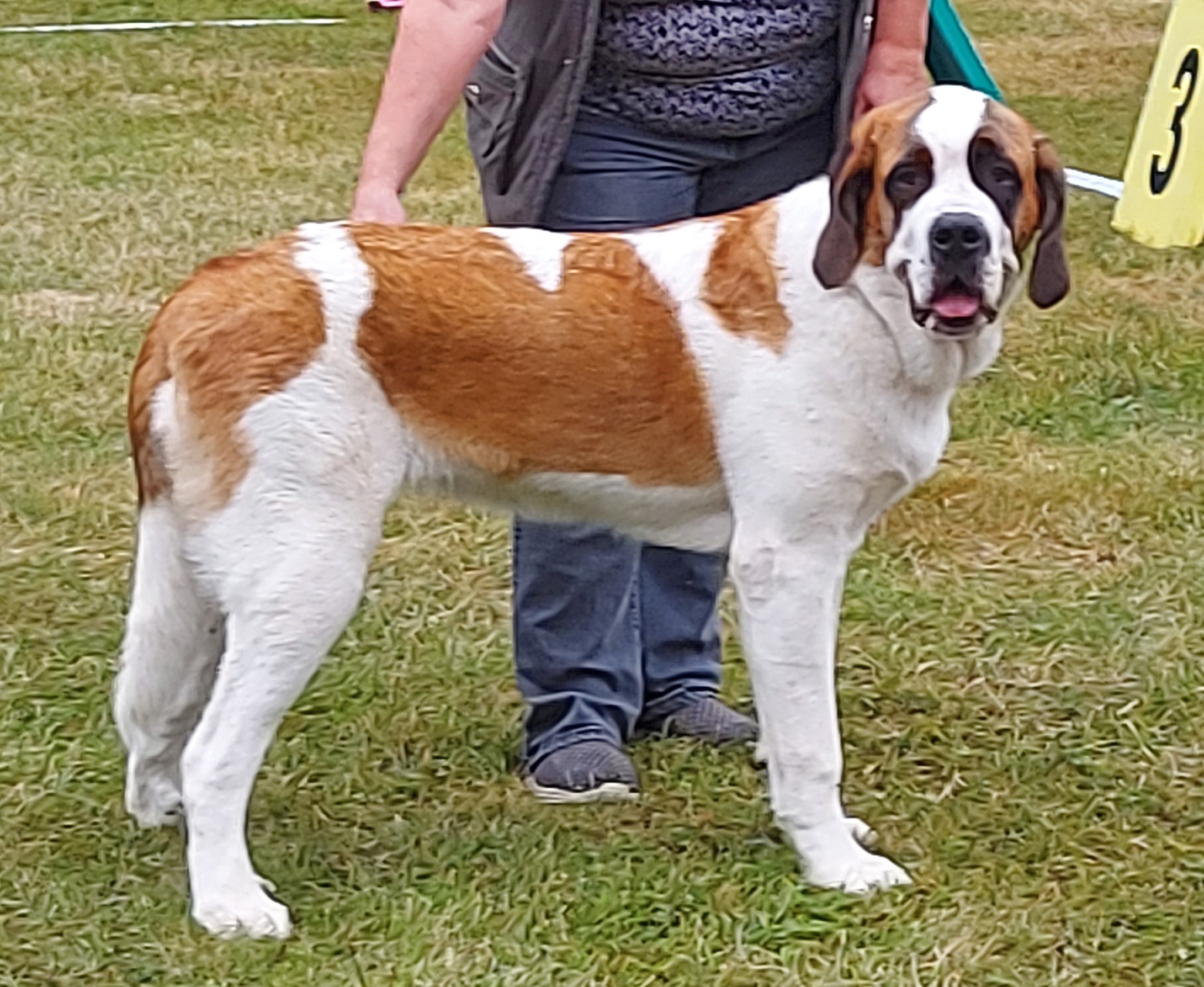

Do you have a better photo of a Saint Bernard in the American show ring? If you have a show photo you’d let us use, email it to [email protected] — tell us the dog’s name and the show, and it may be featured here. Please only send photos you took yourself or have the photographer’s permission to share, and tell us the photographer’s name.
1. Breed at a glance
Working Group; AKC-recognized since 1885
Dogs 27½ in min, 140–180 lb; bitches 25½ in min, 120–140 lb
Shorthaired or longhaired; white with red or red with white, brindle patches with white markings
8–10 years (AKC)
Gentle, patient, calm, famously good-natured; a giant that thinks it is a lap dog
Saint Bernard Club of America
2. History: the hospice dogs of the Great St. Bernard Pass
The Saint Bernard’s story begins at the hospice on the Great St. Bernard Pass, founded around 1050 by Bernard of Menthon on the high Alpine route between Switzerland and Italy. Dogs were kept at the hospice from about 1707, and in the early 1800s they became famous as rescue dogs: Barry, who worked at the hospice in the early 1800s, is documented to have located and assisted in the rescue of more than forty people lost in the snow. The dogs worked in the passes until 1955, and more than a dozen were still kept at the hospice until 2005; the Barry Foundation in Martigny, Switzerland, preserves the breed’s Alpine heritage today.
The name “Saint Bernard” became official in 1880, when the Swiss Kennel Club adopted it. The long-haired variety came from Newfoundland crosses in the 1800s, and the dogs were not bred outside the hospice until 1855. In America the breed was among the earliest recognized: the AKC recognized the Saint Bernard in 1885, and the Saint Bernard Club of America was formed on February 22, 1888, reorganized on December 30, 1897, and again on March 1, 1932, and has been a continuous AKC member club since 1898.
The breed’s popular image — the barrel around the neck — is a 19th-century artist’s invention, not a hospice practice: no rescue dog ever carried a brandy keg. What the dogs really carried was their own size, strength, and sense of smell, and what they really did was find people buried in snow and stay with them until help arrived.
3. The standard: powerful, proportionately tall, most intelligent expression
The AKC standard was approved April 13, 1998, and effective May 31, 1998. It opens with the general appearance: “Powerful, proportionately tall figure, strong and muscular in every part, with powerful head and most intelligent expression. In dogs with a dark mask the expression appears more stern, but never ill-natured.”

Size and substance. Dogs stand at least 27½ inches at the shoulder; bitches at least 25½ inches. Females are finer and more delicate in build. The dog is massive, heavy-boned, and powerfully muscled throughout, with a neck that is high and very strong and a well-pronounced dewlap.
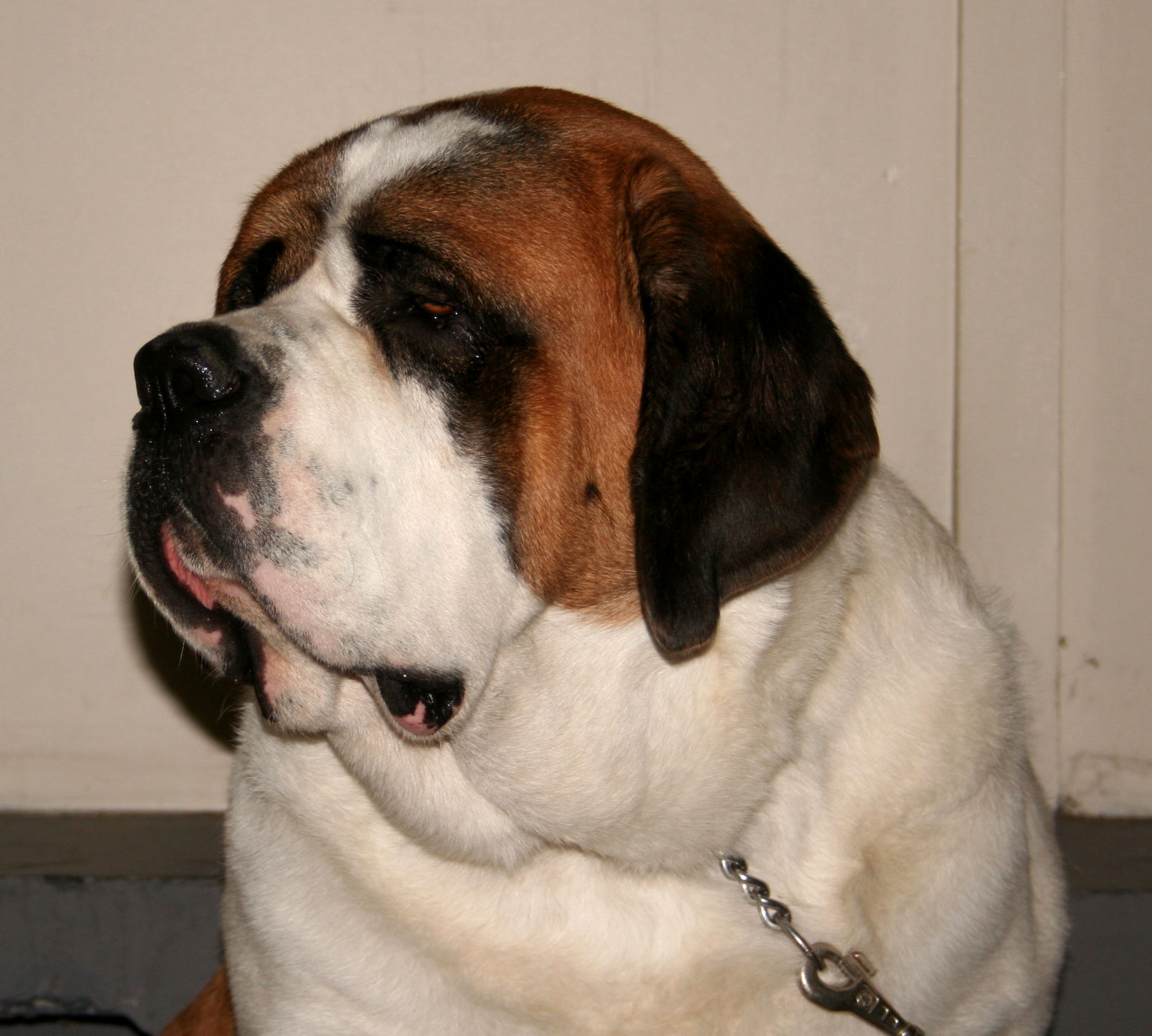
Head. The skull is massive, wide, and slightly arched, with strongly developed cheek bones and a furrow over the whole skull. The muzzle is short, does not taper, and is deeper at the root than it is long. The flews are strongly developed. The bite is scissors or even, scissors preferred; an undershot bite is not desirable and an overshot bite is a fault. The nose is very substantial, broad, with wide open nostrils, and always black. The ears are medium, set rather high, with a strongly developed burr at the base, dropping with a sharp bend and clinging to the head. The eyes are medium, dark brown, with an intelligent, friendly expression, set moderately deep; lower eyelids as a rule do not close completely.
Tail and coat. The tail is broad and powerful at the root, long and very heavy, ending in a powerful tip; in repose it hangs straight down, turning gently upward in the lower third only, and may not be carried too erect or rolled over the back. The coat comes in two varieties: the shorthaired coat is very dense, short-haired, and lying smooth, with slightly bushy thighs; the longhaired coat is medium length, plain to slightly wavy, never rolled or curly, and never shaggy. A rolled or curly coat, or a flag tail, is faulty.
Color. White with red or red with white, the red in its various shades, with brindle patches and white markings. Red and brown-yellow are of entirely equal value. The necessary markings are a white chest, white feet, a white tip of tail, a noseband, and a collar or spot on the nape; the nape spot and a blaze are very desirable. The dog is never of one color or without white. All other colors are faulty, except the favorite dark shadings on the head (the mask) and ears. The standard distinguishes mantle dogs from splash-coated dogs.
Disqualifications. The AKC standard lists none — only a list of faults to be considered, among them a swayback, a disproportionately long back, hocks too much bent, straight hindquarters, hair growing upward between the toes, elbows out, cowhocks, and weak pasterns. Do not import disqualifications from the FCI standard, which is a different standard.
4. Temperament: gentle, patient, and famously good-natured
The Saint Bernard is famously gentle and patient — a calm, good-natured giant that is devoted to its people and famously tolerant of children. The standard’s own words are the best summary: a powerful head with “most intelligent expression,” and in dogs with a dark mask an expression that “appears more stern, but never ill-natured.” Saints are steady rather than excitable, affectionate rather than aloof, and happiest lying at their people’s feet.

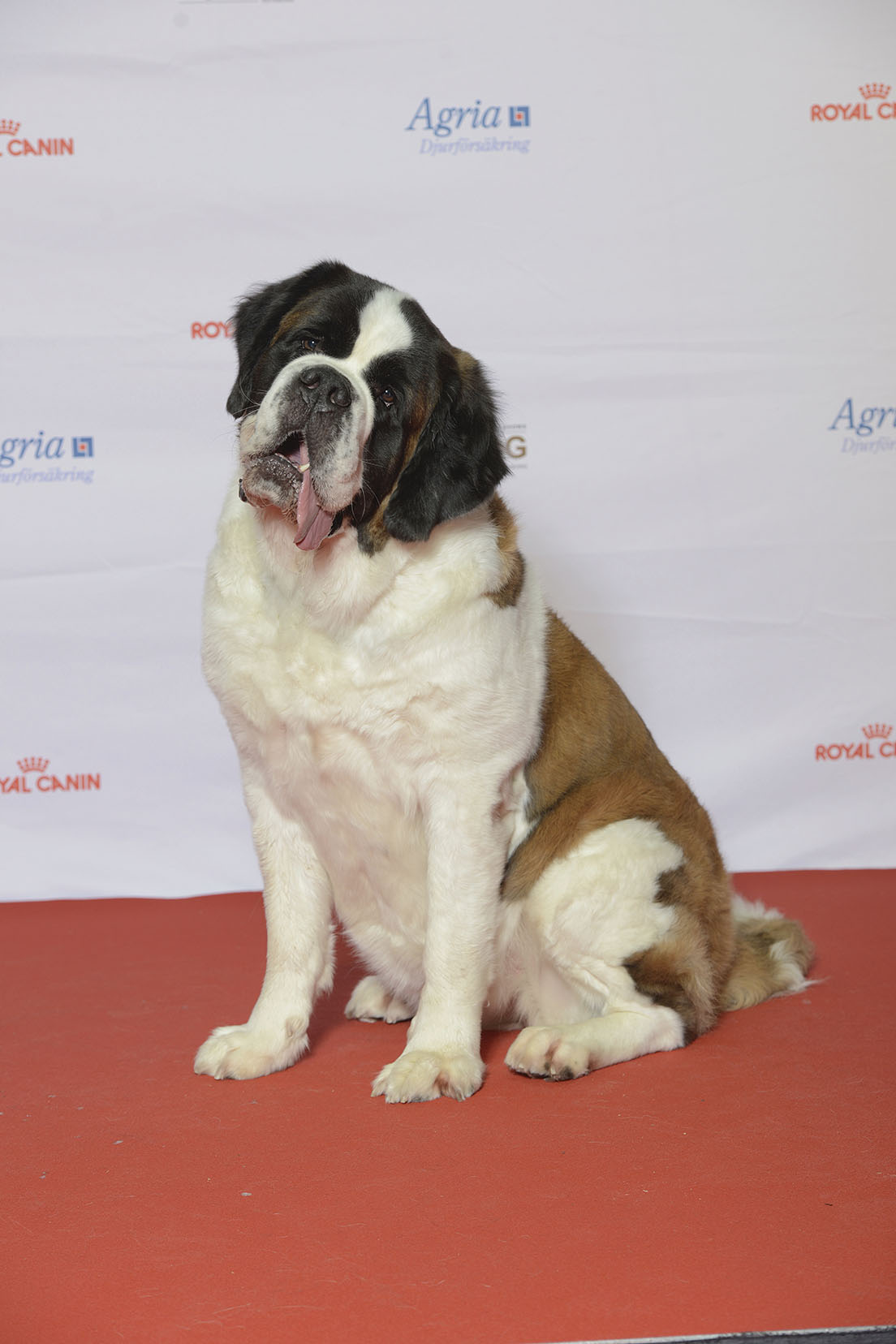
That gentleness comes with giant-breed realities. A Saint Bernard does not know its own size: it will lean on you, step on your feet, and try to sit in your lap. It needs early training and socialization, started while the dog is still small enough to manage, because a 150-pound dog that pulls on the lead or jumps up is a different problem from a 15-pound one that does. The breed is not a guard dog in the usual sense — it is too friendly for that — but its size alone is a deterrent, and it is watchful of its home.
The everyday reality is a big, calm, drooling companion that wants to be where you are. Saints do not do well left alone all day, and they do not do well in small spaces or hot climates: they were built for Alpine cold, and heat is their enemy. Give them a cool floor, a yard with room to stretch, and a family that is home, and they are content.
5. Grooming and everyday care
Grooming depends on the coat. The shorthaired variety needs a weekly brush; the longhaired variety needs more frequent brushing to keep the medium-length coat free of mats, especially behind the ears and on the feathering. Both shed heavily in spring and fall. Bathe only when the dog is dirty, check the ears, trim the nails, and brush the teeth. And keep a towel handy: the heavy flews mean drool is a daily fact of life.
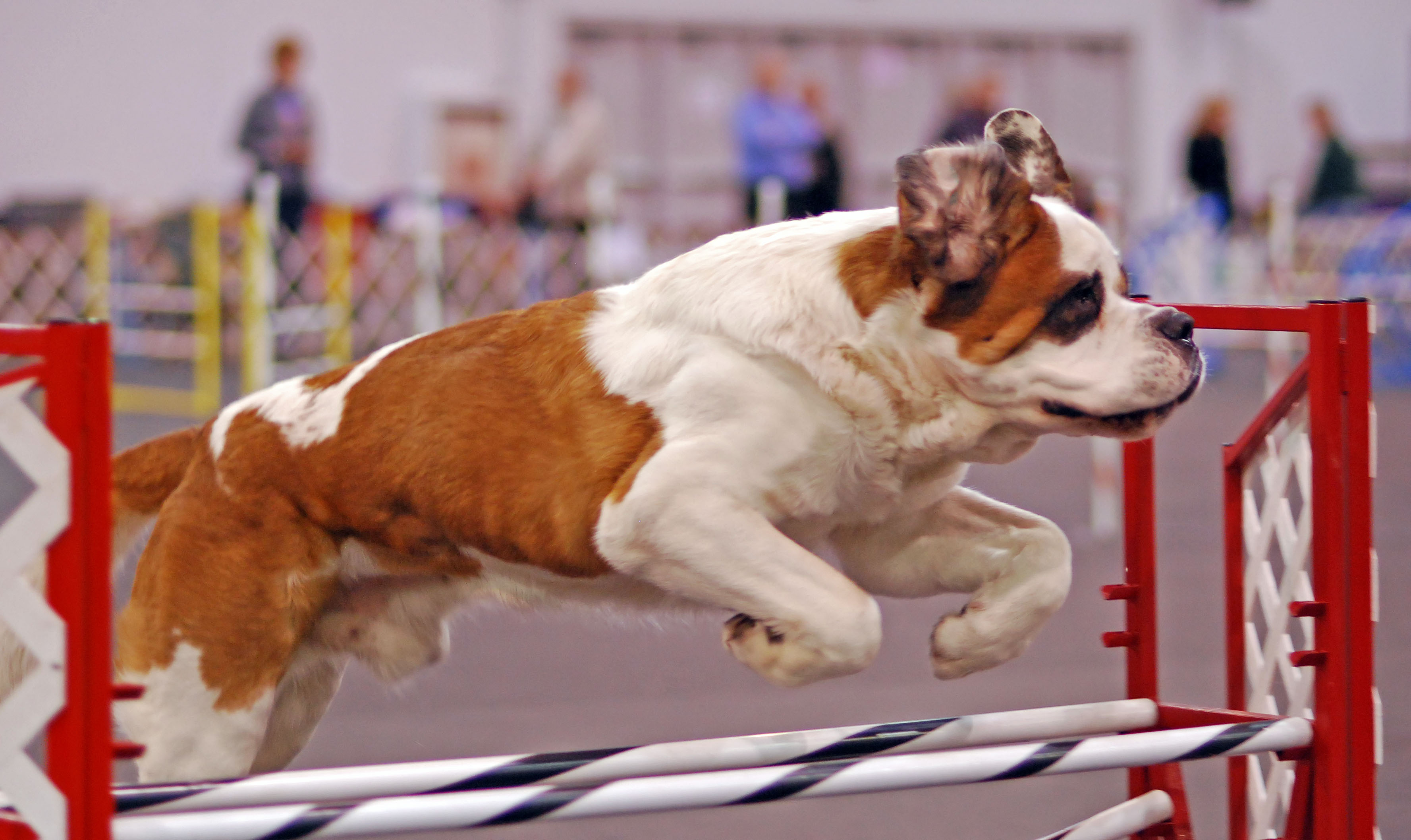
Exercise is moderate, not extreme: daily walks and play, with care in hot weather — Saints overheat easily and should be exercised in the cool of the morning or evening in summer, with shade and water always available. The breed also works: draft work and carting suit the breed’s history and build, and many Saints compete in obedience, rally, agility, and weight pull.
Feeding is a giant-breed matter: a good-quality food in measured meals, a lean weight, and no free feeding. Like other deep-chested giants, Saints are at risk for bloat (gastric dilatation-volvulus) — feed smaller meals rather than one large one, avoid vigorous exercise right after eating, and know the signs so you can act fast.
6. Health: the tests that matter
The Saint Bernard Club of America’s CHIC profile calls for five tests for breeding stock: a hip evaluation, an elbow evaluation, a cardiac exam, an ophthalmologist eye evaluation, and a degenerative myelopathy (DM) DNA test. Hips and elbows are evaluated at 24 months. A CHIC number means the tests were done and published by the OFA — it does not mean the dog passed them. Ask for the parents’ CHIC numbers and look them up yourself on the OFA database.
The tests point at the breed’s known weak spots. Hip and elbow dysplasia are the orthopedic concerns in a dog this heavy, and the weight itself is a risk factor: a Saint that carries extra pounds loads joints that are already working hard. The cardiac exam screens for heart disease, and the eye examination catches inherited eye problems. The DM DNA test screens for degenerative myelopathy, a progressive disease of the spinal cord. The AKC lists the breed’s lifespan as 8 to 10 years — short, even for a giant breed, and the single hardest fact about owning one.
7. The annual Saint Bernard specialty dog show
A specialty is the breed’s All-Star show — its Super Bowl. Once a year, the best Saint Bernards from across the country, and often from around the world, come together in one place.
The Saint Bernard Club of America holds its national specialty every year, drawing Saints from across the country for a week of conformation, obedience, rally, draft work, and weight pull. The 2026 national — the club’s 88th — ran September 26, 2026, at Peek N Peak Resort & Spa in Clymer, New York, judged by Lynn Jech, with Best of Breed going to Cornerstone’s Let’s Give’m Something To Talk About (“Esther”). The 2025 national ran September 25–26, 2025, in South Sioux City, Nebraska, and the 2024 national ran October 31–November 2, 2024, in Loveland, Colorado. The 2027 national: not yet announced.
The standard, in brief: a powerful, proportionately tall figure, strong and muscular in every part, with a powerful head and a most intelligent expression. Dogs stand at least 27½ inches at the shoulder and bitches at least 25½ inches; dogs weigh 140 to 180 pounds and bitches 120 to 140. The coat comes in two varieties, shorthaired and longhaired. The color is white with red or red with white, the red in its various shades, with brindle patches and white markings — and never of one color or without white.

The 88th annual Saint Bernard Club of America National Specialty — Saturday, September 26, 2026, at Peek N Peak Resort & Spa, 1405 Old Road, Clymer, New York, closing a national week that ran September 22–26. The national was judged by Lynn Jech. Best of Breed was GR CH BRONZE Cornerstone’s Let’s Give’m Something To Talk About (“Esther”), a bitch, and Select Bitch was CH Cornerstone’s A Little Less Talk & A Lot More Action (“Edith”).
The national week opened with two regional specialties at Peek N Peak on Tuesday, September 22: the St. Bernard Club of the Finger Lakes specialty in the morning, judged by J Terrio, with 41 dogs and 57 entries, and the Greater Washington St. Bernard Club specialty in the afternoon, judged by S K Nadalin, with 42 dogs and 63 entries.
Results (2026 national). Best of Breed: GR CH BRONZE Cornerstone’s Let’s Give’m Something To Talk About (“Esther”). Select Bitch: CH Cornerstone’s A Little Less Talk & A Lot More Action (“Edith”). Best of Opposite Sex, Winners Dog, Winners Bitch, and entry counts had not been published in an official source as of November 2026 and will be added here when they are.
The dates for the annual 2027 Saint Bernard specialty dog show had not been announced as of November 2026. The AKC’s Upcoming National Specialties list, which runs through October 2027, carries no Saint Bernard Club of America entry. This page will be updated when the club announces the 2027 national.
Past national specialties: 2025 · 2024
Saint Bernard Club of America — saintbernardclubofamerica.club
8. Regional specialties through the year: smaller regional shows
The national is the anchor, but the breed’s year also runs through regional specialties — smaller regional shows, not the national — held around the country. These are the 2026 regionals verified from club and AKC sources.
Tuesday, September 22, 2026 — Peek N Peak Resort & Spa, Clymer, New York (national week). St. Bernard Club of the Finger Lakes specialty (morning), judged by J Terrio, 41 dogs and 57 entries; Greater Washington St. Bernard Club specialty (afternoon), judged by S K Nadalin, 42 dogs and 63 entries.
Other 2026 regional specialties had not been verified from club or AKC sources as of November 7, 2026.
More regional specialties will be added here as their programs are verified — this section is built from show data, not guesswork. Browse upcoming show weekends →
9. Clubs
The Saint Bernard Club of America (SBCA), formed on February 22, 1888, and reorganized on December 30, 1897, and March 1, 1932, is the AKC parent club for the breed in the United States and has been a continuous AKC member club since 1898. It is the guardian of the breed and determines the official breed standard, runs the national specialty every year, and sanctions the breed’s performance events. The club’s 2026 officers: President Bob Sykora, Vice-President Susan Carter, Recording Secretary Pam Brandau, and Corresponding Secretary Cindy J Valko. The club’s website is at saintbernardclubofamerica.club.
Regional clubs carry the breed across the country, including the St. Bernard Club of the Finger Lakes, the Greater Washington St. Bernard Club, the Northern Illinois St. Bernard Club, the Maumee Valley St. Bernard Club, the Heart of America St. Bernard Club, the Saint Bernard Club of Greater Detroit, and the St. Bernard Club of Southern Oregon. The Saint Bernard Archive, at saintbernardarchive.com, keeps the club’s records and the breed’s show history.
10. Rescue
Saint Bernard Rescue Foundation, Inc. (SBRF), at saintrescue.org, is the rescue arm of the breed in the United States: the Saint Bernard Club of America established a National Saint Bernard Rescue Committee in 1991, and the Foundation cares for and finds homes for abandoned and neglected Saint Bernards, funds medical care and emergency rescue, and runs public education about the breed.
Regional programs work alongside it, including Saints of the West Rescue, Colorado Saint Bernard Rescue (founded in 1997, all-volunteer), Saint Bernard Rescue Washington, Greater Southwest Saint Bernard Rescue, and Sunny Saints St. Bernard Rescues. Adoption fees typically run $150 to $600 depending on the program and the dog. Expect an application, references, and a home visit — and expect an adult dog: puppies are rare in rescue, and a rescue Saint comes with a known temperament, placed by people who know exactly how much dog a Saint Bernard is.
11. Breeder vs. rescue: honest guidance
Either route starts with the same question: has this dog’s health been tested? From a breeder, ask for the CHIC numbers of both parents — the hip evaluation, the elbow evaluation, the cardiac exam, the ophthalmologist eye evaluation, and the degenerative myelopathy DNA test — and check them on the OFA database yourself, by the parents’ registered names. Ask what health issues the breeder sees in their stock, and meet at least the dam. A good breeder will ask about your space, your fencing, and whether you understand that a Saint Bernard lives 8 to 10 years and costs accordingly — and will want the dog back, by contract, if you ever cannot keep it.
From rescue, expect an adult dog whose temperament is already known, placed by a program that will match the dog to your life rather than the other way around. Budget for the same things either way: a lot of food, a lot of veterinary care for a giant breed, training while the dog is still small enough to manage, and a home that can absorb a 150-pound dog that drools. Whichever route you take, the dog that fits is a gentle, patient giant that wants to be with its people — and will be happiest lying at your feet, which is where it will be.
12. Claim this page
This page was built from public sources — the AKC standard, the parent club’s own material, AKC event records, and the rescue program’s site — and it is a starting point, not the last word. If you are with the Saint Bernard Club of America or a regional club and something here is wrong or missing, you can claim this page and set it straight: email [email protected] and tell us what needs fixing. Corrections from the people who own the breed are how this page gets better.
Sources
- AKC, Saint Bernard
- Saint Bernard Club of America, AKC Saint Bernard Standard (approved April 13, 1998, effective May 31, 1998)
- AKC, Working Group Health Testing Requirements
- AKC, Upcoming National Specialties list
- Saint Bernard Club of America
- Cornerstone Saints, Our Ladies
- 2025 SBCA National Specialty judging program (AKC)
- Saint Bernard Archive, SBCA records
- AKC Club Search and Directory, Saint Bernard Club of America
- Saint Bernard Rescue Foundation, Inc.
- Wikimedia Commons, StBernardShort2 (Canarian, CC BY-SA 4.0)
- Wikimedia Commons, Bernardyn krótkowłosy głowa 859 (Pleple2000, CC BY-SA 3.0)
- Wikimedia Commons, St Bernard Dog agility (SheltieBoy, CC BY 2.0)
- Wikimedia Commons, BIR Grupp 2- SANKT BERNHARDSHUND, LÅNGHÅRIG, Dein Hards Monday Muffin (Svenska Mässan, CC BY 2.0)