
Breed profile · Sporting Group · recognized 2000
Spinone Italiano
The Spinone Italiano is a strongly built, wiry-coated Italian gun dog — orange roan or white, with a beard, mustache, and shaggy eyebrows, and a temperament the standard describes as naturally sociable, docile, and patient. One of the oldest pointing breeds, it was recognized by the American Kennel Club in 2000 and joins the Sporting Group. The Spinone Club of America’s national specialty gathers the breed’s best in Wenatchee, Washington, on May 12, 2027.
Help us improve it. This is one of ThePetAdvisor’s breed profiles, built from public sources with generous links to the people who actually own this breed’s knowledge. If something’s off or missing, the parent club can claim the page and set it straight — see the bottom of the page.
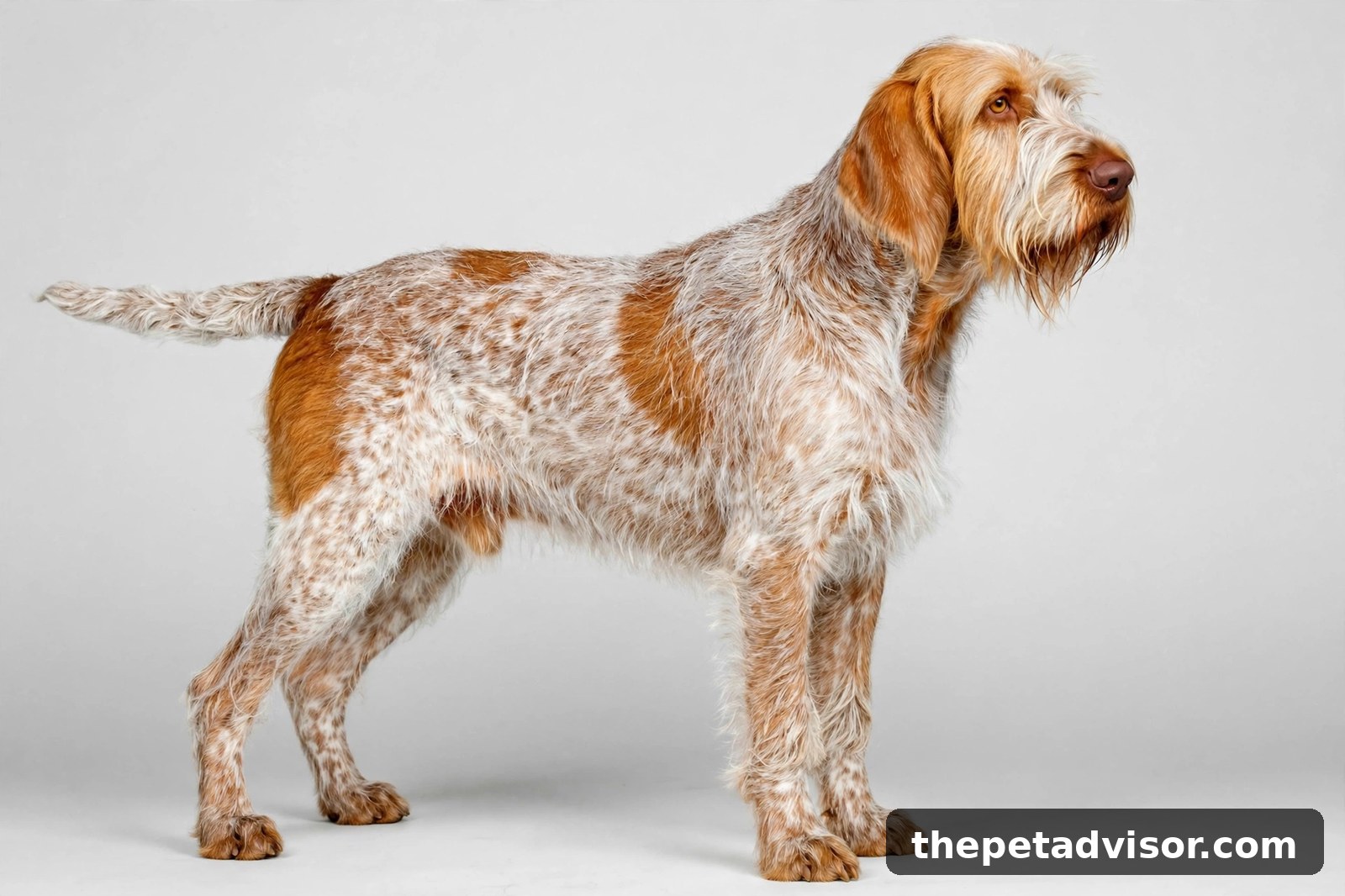
Do you have a photo of a Spinone Italiano in the American show ring? We’d love this page to lead with one. If you have a show photo you’d let us use, email it to [email protected] — tell us the dog’s name and the show, and it may be featured here. Please only send photos you took yourself or have the photographer’s permission to share, and tell us the photographer’s name. We couldn’t find a public photo of a Spinone Italiano in the American show ring that we were free to share, so the photo leading this page was made with AI. We’d much rather lead with a real one — if you’re a club member with an approved photo, we’d love to feature it.
1. Breed at a glance
At a glance:
- Group: Sporting.
- AKC recognition: 2000.
- Parent club: Spinone Club of America, founded in 1987.
- Size: males 23 to 27 inches at the withers, females 22 to 25 inches.
- Weight: in proportion to size; the AKC breed page lists 61 to 85 pounds.
- Life expectancy: 10 to 12 years.
- Coat: dense, stiff, and wiry, 1½ to 2½ inches on the body, with no undercoat.
- Color: solid white; white and orange; orange roan with or without orange markings; white with brown markings; brown roan with or without brown markings. The most desired brown is chestnut, the color of a monk’s habit. Any black in the coat is a disqualification.
- Temperament: naturally sociable, docile, and patient, and resistant to fatigue — the standard’s own words.
- Also called: the Italian Spinone.
2. History
The Spinone Italiano is among the oldest of the pointing breeds, and its shape has been recognizable for centuries. A rough-haired dog of the Spinone type appears in Italian art as early as about 1470, in Andrea Mantegna’s frescoes in the Camera degli Sposi in the Ducal Palace of Mantua. Two centuries later, Sélincourt’s Le Parfait Chasseur (1683) called the finest griffons those that came from Italy and Piedmont.
The modern breed was developed in Piedmont in the 19th century, from the rough-coated pointing dogs of northern Italy. Its name comes from the Bracco Spinoso — the “prickly pointer” — a nod to the harsh, wiry coat that sets the breed apart from its smooth-coated cousins.
The breed’s numbers were much reduced during the Second World War, when Spinoni were used by Italian partisans and many were lost. Recovery was slow and organized: the Famiglia dello Spinone was formed in 1949, and the Fédération Cynologique Internationale definitively accepted the breed in 1955 (FCI Standard No. 165, Group 7, Section 1.3, Continental Pointing Dogs, Griffon type).
In the United States the breed was shown in the AKC Miscellaneous class from 1932, was recognized by the United Kennel Club in 1995, and was recognized by the American Kennel Club in 2000, joining the Sporting Group. The Spinone Club of America, founded in 1987, is the breed’s parent club. The Spinone remains one of the rarer Sporting breeds in American registrations — a working gun dog that has never chased popularity.
3. The standard and why it's written that way
The AKC standard for the Spinone Italiano, approved February 11, 2000 and effective September 28, 2000, describes a working gun dog — and it means it. Every point below comes from the standard itself. (AKC breed standard)
- General appearance: a strongly built, vigorous dog of medium size, tending to square in build. The Spinone is a dog of substance, not elegance — built to work all day in rough country. (AKC breed standard)
- Size: males 23 to 27 inches at the withers, females 22 to 25 inches. Weight is in proportion to size; the AKC breed page lists 61 to 85 pounds. (AKC breed standard)
- Head and expression: long, with the planes of the skull and muzzle diverging, a well-developed occiput, and ochre — yellowish-brown — eyes. The nose is large, bulbous, and spongy, and the ears are triangular, hanging close to the head. (AKC breed standard)
- Coat and color: dense, stiff, flat or slightly crimped, 1½ to 2½ inches on the body, with no undercoat. Stiff hair frames the eyes and lips as eyebrows, mustache, and a tufted beard — the breed’s signature. The dog is exhibited in its natural state: no scissoring, clipping, or setting of the pattern. Colors are solid white; white and orange; orange roan with or without orange markings; white with brown markings; brown roan with or without brown markings. The most desired brown is chestnut, the color of a monk’s habit. (AKC breed standard)
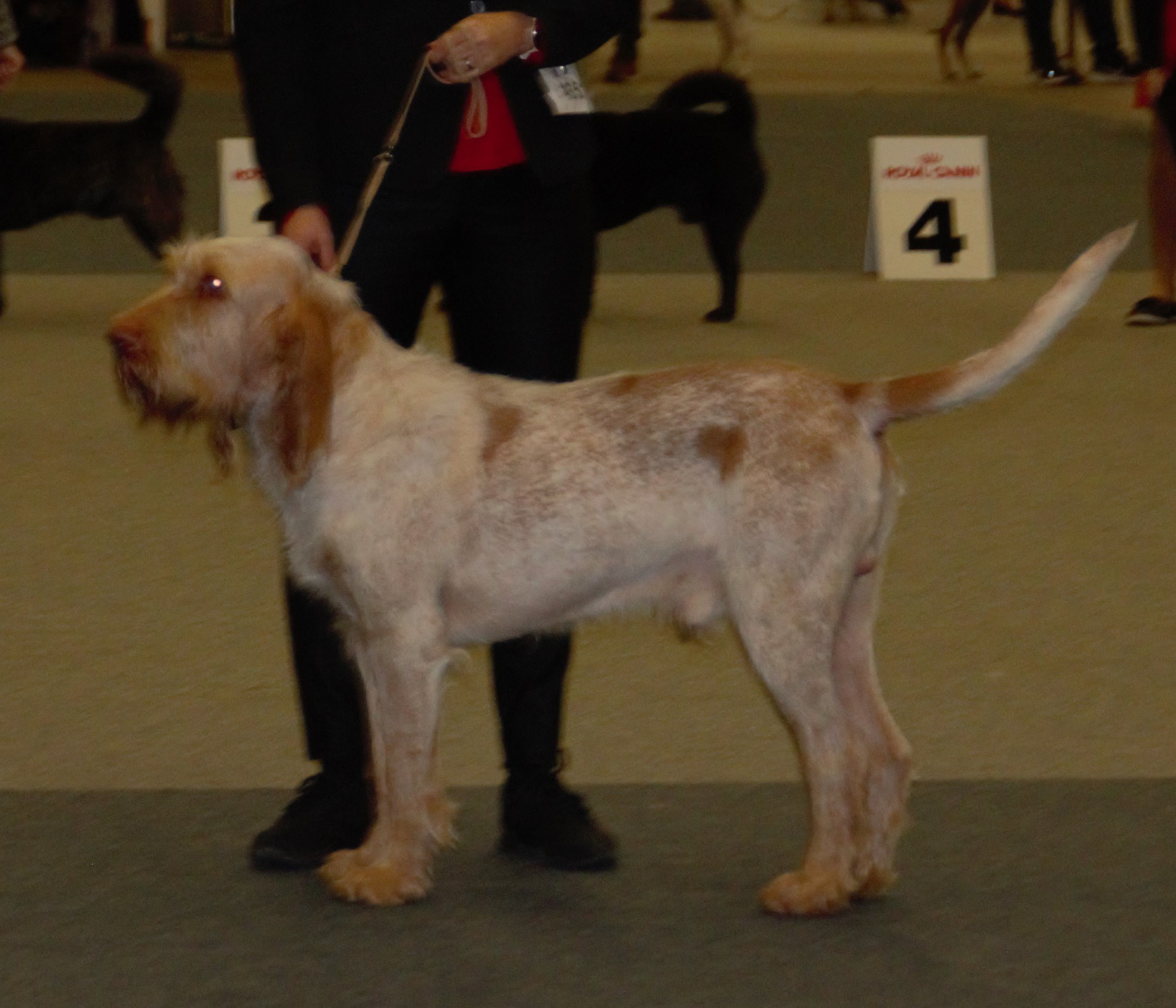
- Tail: thick at the base, carried horizontally or down, docked to 5½ to 8 inches. (AKC breed standard)
- Gait: an easy, loose trot geared for endurance, opening into an extended fast trot with an intermittent gallop while hunting. (AKC breed standard)
- Temperament, written into the standard: naturally sociable, docile, patient, and resistant to fatigue. (AKC breed standard)
- Disqualifications: walleye; wrong or incomplete nose pigment; an overshot or undershot bite; any black pigmentation; any black in the coat; and tan, tri-color, or any other color. (AKC breed standard)
- Why the standard is written this way: every point protects a working dog. The coat rules keep the dog weatherproof and honest — a Spinone is judged as it works, not as it is sculpted. The color disqualifications keep the breed unmistakable, and the temperament paragraph exists because a gun dog that cannot take the long day, or that will not live sociably in the house afterward, is no use to anyone.
4. Temperament & living with one
A Spinone is a patient dog in a hurry for nothing. The standard’s words — naturally sociable, docile, patient, resistant to fatigue — describe a dog built for the long day in the field and the quiet evening after it. In the house, Spinoni are famously easygoing: they settle near their people, lean against them, and take the household’s rhythm as their own.
That patience is not laziness. The Spinone is a versatile gun dog that points and retrieves, and it was built to keep going long after faster dogs have tired. A Spinone that works most days — field work, hunt tests, long walks, scent work, serious training — is a calm, charming house dog. One that doesn’t work is a project: bored, restless, and inventive about it.
With children, Spinoni are steady and tolerant, which is one of the breed’s main draws — but they are large, strong dogs, so play with small children should be supervised, and every Spinone needs training and socialization like any other breed. With strangers they are sociable rather than suspicious; this is not a guard dog.
Training is the breed’s quiet strength. Spinoni take training well and respond best to patient, reward-based work — short, upbeat sessions built on the relationship the dog already wants. Heavy-handed methods are wasted on a dog this steady. The beard, meanwhile, is a way of life: it collects food, water, and whatever the field offers, and it needs wiping after meals and checking after every outing.
5. Grooming
The Spinone’s wiry coat is low-maintenance by design — the standard forbids scissoring, clipping, or setting of the pattern, so there is no sculpting to keep up. A weekly brush with a slicker or pin brush lifts dead hair and keeps the coat in order; a bath only when the dog is actually dirty.
What needs attention instead:
- Beard and mustache: the stiff facial hair collects food and water. Wipe it after meals and check it after field work for burrs and debris.
- Ears: long, pendulous ears trap moisture. Check them weekly and clean as needed, especially after swimming or field work — ear infections are one of the breed’s known troubles.
- Coat: the wiry coat sheds dirt well, but dead hair should be brushed out regularly. There is no undercoat to blow and no trimming — a Spinone is shown in its natural state.
- Nails: keep them trimmed; a running dog with long nails is a dog that slips and strains.
- Teeth: brush regularly; the scissors bite the standard calls for is worth protecting.
6. Health testing
The Spinone Club of America’s health program sets the testing a responsible breeder does — and the CHIC program turns it into a checklist with numbers you can verify.
Required for a CHIC number:
- Hip dysplasia — x-ray evaluation.
- Elbow dysplasia — x-ray evaluation.
- Eyes — examination and registration.
Advocated by the club in addition:
- Cerebellar ataxia — DNA test, available from the UC Davis Veterinary Genetics Laboratory ($63). Cerebellar ataxia is autosomal recessive: signs of incoordination and loss of balance appear from about four months, and the condition is progressive and fatal — affected puppies are often euthanized before one year.
- Heart — cardiac screening.
- Thyroid — thyroid screening.
The club also watches idiopathic epilepsy — the Lena Amirian Memorial Spinone Health Fund donated $4,000 to the Kennel Club Genetic Center in Cambridge toward an idiopathic epilepsy study — along with hip and elbow dysplasia, bloat, otitis externa, entropion, and cataracts. When you talk to a breeder, ask for the OFA or CHIC numbers — and look them up on the OFA database before you put down a deposit. (Spinone Club of America, Health)
7. The annual Spinone Italiano specialty dog show
A specialty is the breed’s All-Star show — its Super Bowl. Once a year, the best Spinoni Italiani from across the country, and often from around the world, come together in one place.
The Spinone Club of America’s national specialty: the annual Spinone Italiano specialty dog show. The 2027 national: May 12, 2027, at the Wenatchee Convention Center in Wenatchee, Washington, superintendent BaRay Event Services, judge Claudio De Giuliani. The 2026 national: May 12, 2026, at Island Grove Regional Park in Greeley, Colorado, 65 dogs in the entry; Best of Breed not confirmed in an accessible official source. The 2025 national: date and venue not confirmed in an accessible official source; national judge Ms. Carolyn Adkins-Fry (UK). The 2024 national: April 24, 2024, at the Sonesta Charlotte Executive Park in Charlotte, North Carolina, 88 dogs in the entry; Best of Breed not confirmed. The 2023 national: May 24, 2023, at the Holiday Inn Weirton in Weirton, West Virginia, 79 dogs in the entry; Best of Breed not confirmed.
The 2026 National Specialty — national week May 8–14, 2026, at Island Grove Regional Park, Greeley, Colorado (501 N 14th Ave, Greeley, CO 80631; also listed as 1229 D Street). Conformation Tuesday, May 12, 2026. Entries opened Sunday, March 1, 2026, 8:00 a.m.; closed Wednesday, April 15, 2026, 12:00 p.m. AKC event number 2026571608. Superintendent: Foy Trent Dog Shows. Conformation: Ms. Irene Glen. Junior Showmanship: Mrs. Jean Pero. Sweepstakes: David Shields (Lanark, UK). Gun Dog Sweepstakes: Debra Long Gschwender. Obedience: Carole Lynn Evans. Rally: Marrin R. Sampson. Event chair: Debby Forry. National-week schedule: hunt tests May 8–10 at the Rocky Mountain Sporting Dog Club Grounds, Keenesburg, Colorado; obedience and rally May 11; Gun Dog Sweepstakes May 13; Parent Specialty Thursday, May 14, 2026 (event 2026571611, judge Mrs. Meghen Riese-Bassel, 76 dogs and 79 entries). A 4–6 Month Beginner Puppy event (2026571607) ran with the national. (Sources: AKC event search, event 2026571608; Foy Trent Dog Shows, 2026 Spinone judging program.)
Results (2026 national). Best Junior Handler: Addie Swyers. Best of Breed, Best of Opposite Sex, Winners Dog, and Winners Bitch not confirmed in an accessible official source. The judging program’s preliminary counts (80 dogs, 127 entries) differ from the AKC event search’s final conformation counts (65 dogs, 76 entries) — the AKC figures are used in the structured record. (Sources: AKC event search, event 2026571608; Foy Trent Dog Shows, 2026 Spinone judging program.)
The 2027 National Specialty: conformation Wednesday, May 12, 2027 (1 day), at the Wenatchee Convention Center, Wenatchee, Washington. Superintendent: BaRay Event Services, Inc. Conformation judge: Claudio De Giuliani. National week May 6–14, 2027: field events May 6–8 at the Snoqualmie Valley Retriever Grounds, Carnation, Washington, and May 9 at the DV Ag Services Grounds, Duvall, Washington; Wenatchee from May 10; Top 20 competition Tuesday, May 11; seminar Thursday, May 13; a second show Friday, May 14, judged by Mr. Gordon Hayburn, plus the Spinone Olympic Games. Show chairs: Rebecca Van Ess, Amy Thompson, Angela Matais, Cameron Simpson, Susie Ruth, and Elaine Bergenheier. Hunt Test Chair: Leanne Mallini. Contact: [email protected]. AKC event number, premium, entry fees, entries opening/closing, and the Wenatchee Convention Center street address not yet published as of November 7, 2026. (Sources: AKC, Upcoming National Specialties; Spinone Club of America, 2027 Schedule.)
Past national specialties: 2025 · 2024 · 2023
8. Regional specialties through the year: smaller regional shows
The national is the anchor, but the breed’s year also runs through regional specialties — smaller regional shows, not the national — held by the Spinone Club of America around the country, usually as designated specialties with all-breed shows. These are the 2026 regionals verified from club and AKC sources so far:
Three Spinone Italiano specialties verified for 2026 beyond the national itself:
- Spinone Club of America Regional Specialty — Saturday, July 4, 2026, Monroe County Fairgrounds, 3775 S Custer Rd, Monroe, Michigan: AKC event number 2026571610; entries closed Wednesday, June 17, 2026; entry limit 100. Event chair Angie Nortley. Superintendent: MB-F Inc. 22 conformation entries and 2 junior entries. Judge not confirmed in an accessible official source. (Source: AKC event search, event 2026571610.)
- Spinone Club of America Regional Specialty — Saturday, September 5, 2026, Island Grove Regional Park, 501 N 14th Ave, Greeley, Colorado: AKC event number 2026571613; entries closed Wednesday, August 19, 2026, 12:00 p.m. Event chair Susie Pool. Superintendent: Onofrio Dog Shows, L.L.C. Judge and conformation entries not confirmed in an accessible official source. (Source: AKC event search, event 2026571613.)
- Spinone Italiano specialty with the Hanover Kennel Club shows — Saturday, October 10 and Sunday, October 11, 2026: judge, entries, and results not confirmed in an accessible official source. (Source: ThePetAdvisor, All show weekends.)
Past regional specialties: 2025
More regional specialties will be added here as their programs are verified — this section is built from show data, not guesswork. Browse upcoming show weekends →
9. Clubs
The parent club is the Spinone Club of America (SCOA), founded in 1987. It runs the national specialty, maintains the breed’s rescue program, publishes the breed’s health guidance, and keeps the breed’s records. Club president (Summer 2026): Ann Bagnell. (Spinone Club of America)
Club committees include:
- Breeders Education — chair Debby Forry, [email protected].
- Hunt — chair Frank Leatherbury.
- Judges Selection — chair John Brading.
- Juniors — chair Tina Glengary Cordes.
- Preservation Bank — chair Kay McLeland, working with the AKC Purebred Preservation Bank.
- Awards — chair Becky Tevis.
Regional activity runs through the club and informal regional groups rather than separate regional parent-affiliated clubs. The Northeast Spinone group, for example, holds annual “Spinone Only” days at the Greenpoint Wildlife Management Area in Dresden, Maine.
10. Rescue
In the United States, rescue runs through the parent club: Spinone Rescue of America is the Spinone Club of America’s rescue arm. In June 2026 the club put out a call for financial support after an exceptionally expensive rehoming year — a reminder that rescue in a rare breed runs on a small number of volunteers and donations. Start with the Spinone Club of America, which can direct you to the rescue coordinator for your state.
There is also a Facebook-based Spinone rescue organisation in the United States. Overseas, two UK organisations take Spinoni in:
- Italian Spinone Club of Great Britain Rehome & Rescue — coordinator Janet Ashworth, [email protected]; the adoption donation is around £200.
- Spinone Overseas For Adoption (SOFA) — UK charity No. 1179864, [email protected]; it rehomes around 30 dogs a year from mainland Europe, and does not rehome to the United States or Canada.
Rescue Spinoni are usually adults or adolescents whose temperament is already known — a real advantage for a first-time Spinone owner, provided the home can meet the breed’s exercise and companionship needs.
11. Breeder vs rescue
From a breeder: expect a breeder who shows, hunts, or competes with their dogs, health-tests every breeding dog, and takes a puppy back for life. Ask for CHIC numbers — hips, elbows, and eyes are required — plus the cerebellar ataxia DNA test and the heart and thyroid screens the club advocates, and verify them on the OFA database. Ask how the puppies are raised in the home, what the parents hunt or compete in, and what the breeder expects of you. A breeder who won’t answer, or who has puppies always available, is a warning sign.
From rescue: expect an application, a phone interview, and often a home visit. Rescue dogs are adults or adolescents, spayed or neutered, temperament-tested, and placed by people who know the breed’s needs — which means the rescue will ask hard questions about exercise, work hours, and fencing. That scrutiny is a feature: a Spinone in the wrong home is a miserable dog.
Either way: the right question is not “breeder or rescue?” but “does this dog, and this source, fit a life with a large, bearded, deeply patient hunting dog that needs real work every day?” A Spinone that works and lives with its people is one of the great companions in the dog world. A Spinone left alone in a yard is a tragedy in slow motion.
12. Claim this page
This page is maintained by ThePetAdvisor and built from public sources — the AKC standard, the Spinone Club of America’s publications, and AKC event records. If you are an officer of the Spinone Club of America, a regional club officer, a rescue coordinator, or a breeder, and you spot an error or have a correction, we would rather hear it from you than from a search result.
Send corrections, specialty dates, or photos to [email protected] with “Spinone Italiano” in the subject line. We check every message.
Sources
- American Kennel Club, Spinone Italiano breed page
- American Kennel Club, Official Standard of the Spinone Italiano (approved February 11, 2000; effective September 28, 2000)
- Spinone Club of America
- Spinone Club of America, Health
- Spinone Club of America, 2027 Schedule
- Spinone Club of America, Judges Selection Results 2025
- Spinone Club of America, Comments from the 2025 Judges
- Spinone Club of America, Parent Club Winners from Our 2025 National
- Spinone Club of America, 2024 National Specialty recap
- AKC, Upcoming National Specialties
- AKC event search, event 2026571608 (2026 national specialty)
- Foy Trent Dog Shows, 2026 Spinone judging program
- AKC event search, event 2024571603 (2024 national specialty)
- AKC event search, event 2023571602 (2023 national specialty)
- AKC event search, event 2026571610 (2026 Monroe regional specialty)
- AKC event search, event 2026571613 (2026 Greeley regional specialty)
- AKC event search, event 2025571614 (2025 Monroe regional specialty)
- AKC event search, event 2025571604 (2025 Navasota regional specialty)
- Wikimedia Commons, Italian Spinone, male (Canarian, CC BY-SA 4.0)
- Loffredo Spinoni, Beatrice
