Breed profile · Toy Group · the lion dog
Shih Tzu
The Shih Tzu is the lion dog of the Chinese palace — a small, sturdy companion bred to sit on laps and look regal doing it, with a long flowing coat, a face full of expression, and a personality the AKC sums up in one line: where Shih Tzu go, giggles and mischief follow. The breed was recognized by the AKC in 1969 and ranked the 21st most popular breed in America in 2025. The American Shih Tzu Club is the parent club.
Help us improve it. This is one of ThePetAdvisor’s breed profiles, built from public sources with generous links to the people who actually own this breed’s knowledge. If something’s off or missing, the parent club can claim the page and set it straight — see the bottom of the page.
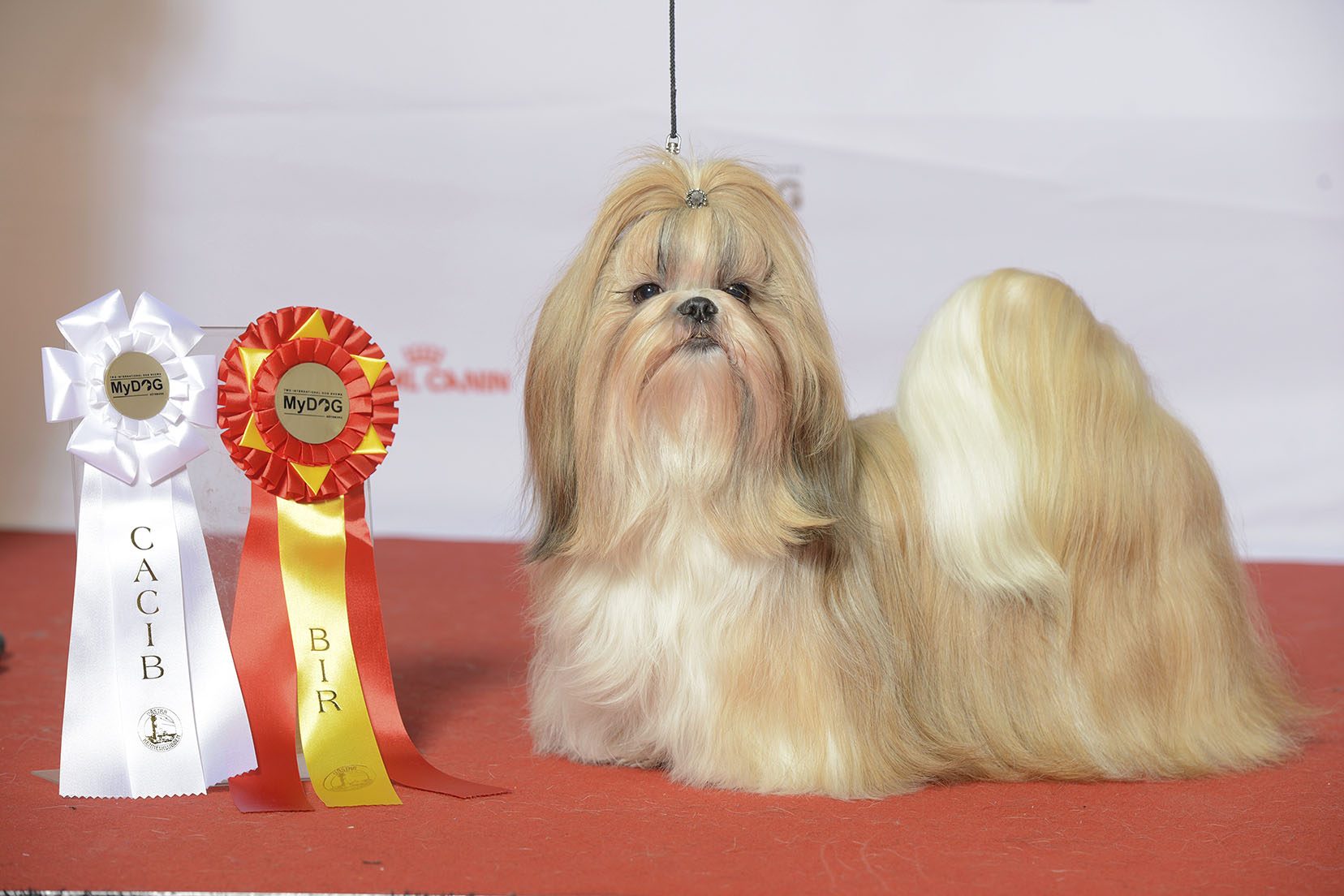

Do you have a better photo of a Shih Tzu in the American show ring? If you have a show photo you’d let us use, email it to [email protected] — tell us the dog’s name and the show, and it may be featured here. Please only send photos you took yourself or have the photographer’s permission to share, and tell us the photographer’s name.
1. Breed at a glance
Toy Group; recognized by the AKC in 1969
Ideally 9–10½ in at the withers (8–11 in allowed), 9–16 lb
Long, dense, flowing double coat; all colors and markings permissible and considered equally
10–18 years (AKC)
Affectionate, playful, outgoing, sturdy
The Shih Tzu is a toy dog in size and a palace dog in attitude: sturdy, lively, and alert, with a long flowing double coat and a head carried high. The name is the Mandarin word for lion — shīzi — because the dogs were bred to resemble the lion of traditional Oriental art. They are companions first and always, and they have been for a thousand years. (Sources: AKC, Official Standard of the Shih Tzu; AKC, Shih Tzu.)
2. History
The Shih Tzu is believed to descend from a cross between the Pekingese and the Lhasa Apso, and the dogs were favorites of the Chinese royals during the Ming Dynasty — so prized that, for years, the Chinese refused to sell, trade, or give any away. Empress Dowager Cixi kept a breeding program dedicated to them. The name says what they were bred to look like: shīzi, lion.
- First dogs in England. Lady Brownrigg, an Englishwoman living in China, brought the first two Shih Tzus to England in 1928. The Kennel Club first classified them as Apsos; a gathering of the dogs from China at Crufts in 1933 showed the Tibetan Terrier, the Apso, and the Shih Tzu were distinctly different breeds.
- Club and recognition in Britain. The Shih Tzu Club of England was founded in 1934, the first European standard was written in 1935, and the Kennel Club officially recognized the breed on May 7, 1940. In England in the 1930s the breed was nicknamed the Chrysanthemum Dog, for the way the face hair grows out in all directions.
- Coming to America. The breed reached the United States after World War II, when returning members of the U.S. military brought dogs back from Europe and Asia in the mid-1950s. The American Shih Tzu Club was formed in 1963.
- AKC recognition. The Shih Tzu was admitted to the AKC Stud Book in March 1969 and to regular show classification in the Toy Group on September 1, 1969.
- At Westminster. Shih Tzus have won the Toy Group at Westminster seven times. The modern star is “Comet,” GCHP CH Hallmark Jolei Out Of This World, who won the Toy Group in 2024 and again in 2025, and won Best in Show at the 2023 AKC National Championship. Comet also won the American Shih Tzu Club national specialty in 2023, 2024, and 2026 — three national Best of Breeds.
From palace pet to one of America's most popular toy breeds — 20th in 2024, 21st in 2025 — the Shih Tzu has kept the same job for centuries: be small, be beautiful, and be company. (Sources: Wikipedia, Shih Tzu; American Shih Tzu Club, What Is the ASTC; AKC, Meet the 2025 Westminster Group Winners.)
3. The standard and why it is written that way
The standard opens with the breed in one line: “The Shih Tzu is a sturdy, lively, alert toy dog with long flowing double coat.” Everything else follows from the palace job — the dog is meant to look proud, with a distinctively arrogant carriage, head well up, and tail curved over the back. The standard was approved May 9, 1989, and has been effective since June 29, 1989.
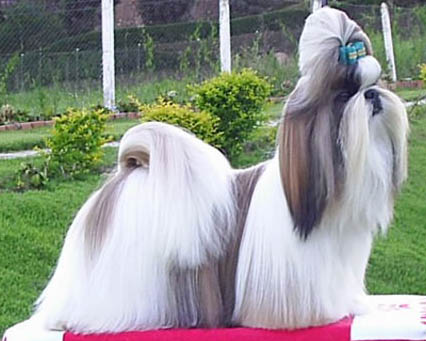

- Size. Ideally, height at the withers is 9 to 10½ inches — but not less than 8 inches nor more than 11 inches. Ideally, weight of mature dogs is 9 to 16 pounds. Even though a toy dog, the Shih Tzu must meet the same requirements of soundness and structure prescribed for all breeds.
- Head. Round, broad, wide between the eyes, its size in balance with the overall size of the dog. The eyes are large, dark, and round, set well apart and looking straight ahead. The bite is undershot — the standard requires it — and the muzzle is short, square, and unwrinkled, with a black nose except on liver- or blue-pigmented dogs.
- Coat. Luxurious, double-coated, dense, long, and flowing; a slight wave is permissible. The hair on top of the head is tied up — the topknot — and the tail is heavily coated, carried curved over the back in a plume.
- Color. All colors and markings are permissible and are to be considered equally. There is no preferred color in the AKC standard — a solid black Shih Tzu and a gold-and-white one are judged on the same terms.
- Movement. The Shih Tzu moves straight and must be shown at its own natural speed — neither raced nor strung up. The head stays up and the tail stays over the back on the move, which is what gives the breed its proud, arrogant carriage.
- Temperament in the standard. The standard's temperament line is short and exact: the Shih Tzu is proud of bearing, with a distinctively arrogant carriage. That carriage is not haughtiness — it is the head-up, tail-up outline of a dog that knows it was bred for a palace.
The color rule is the most important thing to know about the modern standard: because all colors are considered equally, no one can sell you a “rare” color as better, or mark down a color as lesser. Judge the dog, not the shade. (Sources: AKC, Official Standard of the Shih Tzu; AKC, Shih Tzu.)
4. Temperament & living with one
Shih Tzus are affectionate, playful, and outgoing — and, as the AKC puts it, where they go, giggles and mischief follow. They are sturdy little dogs with a clown streak, and they were bred for one job: to be with people.
- Company first. This is a companion breed in the fullest sense. A Shih Tzu left alone all day will be unhappy; a Shih Tzu on your lap, on the couch beside you, or following you from room to room is exactly where it wants to be.
- With children and other dogs. Usually good with children and with other dogs, especially when socialized young. They are sturdy for a toy breed, but they are still small — small children need to be taught to handle them gently.
- Exercise is modest. A couple of short walks and some play each day is enough. They are playful and will happily chase a toy around the house, but they do not need a yard or a long hike, and they should never be pushed hard in heat — the short muzzle makes breathing harder when it is hot.
- Training takes patience, not force. Shih Tzus are intelligent but can be stubborn, and house-training in particular takes consistency. They respond to food, praise, and routine; harsh methods make them shut down.
- Apartment dogs. Small, quiet by toy-breed standards, and content indoors, Shih Tzus suit apartments and small homes — as long as someone is home much of the day and the grooming gets done.
The honest summary: this is a wonderful family dog for a household that wants a small, affectionate companion and can give it company and grooming every day, and a poor fit for a household that is out all day or wants a dog that takes care of itself. (Source: AKC, Shih Tzu.)
5. Grooming
Grooming a Shih Tzu is the real work of owning one. The long, dense double coat tangles and mats easily if it is not brushed at least every two or three days — daily if it is kept in full coat — and the face needs attention every day.
Most pet owners keep the coat in a short puppy cut, which is far easier to maintain, but even a short coat needs regular brushing, and the hair on top of the head is usually tied in a topknot so it stays out of the eyes. Hair grows inside the ears and must be kept clean or ear infections follow; the corners of the eyes need wiping, since the prominent eyes water and tear-stain; nails should be trimmed regularly, and teeth brushed. A bath every few weeks keeps the coat clean, and a full show coat is a serious weekly commitment, not a casual one. (Sources: AKC, Shih Tzu; Wikipedia, Shih Tzu.)
6. Health testing
The American Shih Tzu Club's CHIC program sets the health testing a responsible breeder should do — and the results should be registered with the Orthopedic Foundation for Animals, where anyone can look them up.
- Eyes. An eye certification by a board-certified ophthalmologist (CAER), required for a CHIC number. The club's breeder guidelines call for yearly eye screening for progressive retinal atrophy, juvenile cataracts, and entropion.
- Patellas. A patella certification by the OFA, required for a CHIC number — the kneecap is checked for luxation, a slipped kneecap that is common in small breeds.
- Cardiac and hips (optional for CHIC). Cardiac testing and an OFA hip certification are optional for a CHIC number, not required. The club's breeder guidelines still recommend hip X-rays, with certification after two years of age for performance dogs.
- Renal dysplasia. The club's breeder guidelines list screening for renal dysplasia — urine specific gravity and concentration, BUN, and creatinine — though these tests are diagnostic only for severely affected dogs.
- Other tests the club lists. Von Willebrand's disease (blood test), thyroid disorders (blood test), and a bile acid test may also be recommended.
Two things worth knowing that are not on a test list: the AKC's own Toy Group health testing page lists no recommended health tests from the national breed club for the Shih Tzu — the CHIC protocol above is the parent club's own program, voted in August 2021. And the short muzzle matters every day, not just at breeding time: Shih Tzus are prone to brachycephalic breathing difficulty and heat sensitivity, prominent eyes are vulnerable to injury and ulcers, and hair growing in the ears invites infection. A CHIC number confirms the testing was done and published; it is not a guarantee of health, and it does not replace asking the breeder what they know about the health of their own lines. (Sources: American Shih Tzu Club, Shih Tzu Now Participating in CHIC; American Shih Tzu Club, Breeder Guidelines; AKC, Toy Group Health Testing Requirements.)
7. The annual Shih Tzu specialty dog show
A specialty is the breed’s All-Star show — its Super Bowl. Once a year, the best Shih Tzus from across the country, and often from around the world, come together in one place.
The American Shih Tzu Club's national specialty: one national event each year, with conformation, sweepstakes, obedience, rally, agility, and junior showmanship, usually a multi-day week in the spring. The 2026 national: Saturday, April 25, closing a national week April 21–25, at the Crowne Plaza Resort in Asheville, North Carolina, with 52 dogs and 62 entries in conformation on the national day. The 2027 national: announced for April 6–10 in Louisville, Kentucky — venue and judges not yet announced as of November 7, 2026.
The standard, in brief: a sturdy, lively, alert toy dog, 9 to 10½ inches at the shoulder and 9 to 16 pounds, with a long, flowing double coat. All colors and markings are permissible and are to be considered equally. The head is carried high, the tail curves over the back, and the bite is undershot.
The 2026 National Specialty — Saturday, April 25, 2026, at the Crowne Plaza Resort, 1 Resort Drive, Asheville, North Carolina 28806, closing a national specialty week that ran Tuesday, April 21–Saturday, April 25, 2026. Entries closed Wednesday, April 1, 2026, at 12:00 noon ET. Event Chair: Maurene Baum. Superintendent: Jim Rau Dog Shows, Ltd. The national drew 52 dogs and 62 entries (52 Ent — 26d — 26b; 52 competitors). AKC event 2026179809. (Sources: AKC event search, event 2026179809; 2026 judging program (Jim Rau Dog Shows).)
National specialty judge: Mr. James Moses — conformation. Junior showmanship judge: Ms. Kari Hill. Best Junior Handler: Evangelina Farias; Reserve Best Junior Handler: Valentina Farias. A 4-to-6-month beginner puppy competition was held Friday, April 24, 2026 (judge Ms. Kari Hill, 7 puppies), and sweepstakes the same day (judge Mrs. Lani Kroemer, 23 entries). (Sources: AKC event search, event 2026179809; 2026 judging program (Jim Rau Dog Shows).)
Results (2026 national). Best of Breed: GCHP2 Hallmark Jolei Out Of This World — the same dog won the national in 2023 and 2024, making this his third ASTC national Best of Breed. Best in Sweepstakes: DuCiel Run Run. Best of Opposite Sex, Best of Winners, Winners Dog, and Winners Bitch were not confirmed in an official source as of November 7, 2026. (Sources: Westminster Kennel Club, 2027 Westminster Invitees (national specialty winner list); Best in Sweepstakes announcement (owner, Facebook).)
The 2027 National Specialty — the 54th — is announced for April 6–10, 2027, in Louisville, Kentucky, per the American Shih Tzu Club's own announcement. The venue, judges, AKC event number, and entries had not been announced as of November 7, 2026, and the AKC's Upcoming National Specialties list carries no American Shih Tzu Club entry. They will be added here when they are announced. (Sources: American Shih Tzu Club, 54th National Specialty announcement (show chair, Facebook); AKC, Upcoming National Specialties.)
Past national specialties: 2025 · 2024 · 2023
American Shih Tzu Club — shihtzu.org
8. Regional specialties through the year: smaller regional shows
The national is the anchor, but the breed’s year also runs through regional specialties — smaller regional shows, not the national — held around the country, including the regional specialties that run with the national. These are the 2026 regionals verified from club and AKC sources so far:
Two regional Shih Tzu specialties verified for 2026, both in national specialty week at the Crowne Plaza Resort in Asheville, North Carolina:
- American Shih Tzu Club regional specialty #1 — Wednesday, April 22, 2026, Asheville, North Carolina: at the Crowne Plaza Resort (AKC event 2026179802). Judge: Mr. Jason Hoke. Entry: 54 dogs and 54 entries.
- American Shih Tzu Club regional specialty #2 — Thursday, April 23, 2026, Asheville, North Carolina: at the Crowne Plaza Resort (AKC event 2026179807). Judge: Mr. Robert Hutton. Entry: 57 dogs and 57 entries.
Past regional specialties: 2025 · 2024 · 2023
More regional specialties will be added here as their programs are verified — this section is built from show data, not guesswork. Browse upcoming show weekends →
9. Clubs
The parent club is the American Shih Tzu Club (ASTC), at shihtzu.org — formed in 1963, the club that runs the national specialty, publishes the breed's health guidance, and keeps the rescue network. The 2026 president is Michelle Jones.
Regional specialty clubs verified in club and AKC sources during this build:
- Golden Gate Shih Tzu Fanciers
- Shih Tzu Club of Southeastern Wisconsin
Regional clubs run the regional specialties listed in section 8 and are the best first contact for anyone looking for a breeder, a local event, or a rescue contact. (Sources: American Shih Tzu Club; American Shih Tzu Club, Upcoming Specialty Shows.)
10. Rescue
Shih Tzus come into rescue for ordinary reasons — an owner dies, moves, or can no longer manage the grooming — and the parent club runs a national rescue network to catch them. The American Shih Tzu Club's Rescue & Welfare Committee has volunteers across the country who identify Shih Tzus in trouble and help place them. Groups and contacts verified for this page:
- American Shih Tzu Club Rescue & Welfare Committee. Chairman Jan Sammons (Georgia), [email protected]. Regional contacts: Linda Harrington (Texas), Angela Ivester (Georgia), Rhea Mays (Illinois), and Karen Millard (Oregon). Full list at shihtzu.org/rescue_committee_contacts.
- AKC Rescue Network — Shih Tzu. The AKC lists the American Shih Tzu Club's rescue contact as Loree Levy-Schwartz (California), [email protected], (408) 892-4534. AKC Rescue Network, S breeds.
A rescue Shih Tzu is usually an adult, so you know its size, coat, and temperament before you commit — and an adult that is already used to the grooming routine is a real advantage with this breed. The club also asks that pet-quality Shih Tzus be spayed or neutered. (Sources: American Shih Tzu Club, Rescue Committee Contacts; American Shih Tzu Club, What Is the ASTC.)
11. Breeder vs. rescue: honest guidance
Both routes can end with a great dog. The honest difference is what you know going in.
- Choose a breeder if you want a puppy for showing or a specific purpose, and you want the health testing, pedigree, and early socialization that come with a careful breeding program. Ask for the CHIC health results in section 6, meet the dam if you can, and be ready to wait — good breeders have waiting lists.
- Choose rescue if you want an adult dog whose temperament, size, and coat you can see before you commit, and you are comfortable with a dog that may need grooming help and patience. Rescue is also the right route if you want to give a home to a dog that needs one.
- Either way, verify. Ask for health testing, ask what the dog's lines are known for, and meet the dog before you commit. A breeder who will not show you health results and a rescue that will not let you meet the dog are both telling you something.
A Shih Tzu is a ten-to-eighteen-year commitment to a dog that needs daily company and regular grooming. The right question is not breeder or rescue — it is whether your life has room for a small dog that wants to be with you all the time.
12. Claim this page
This page was built from public sources — the AKC standard, the parent club's own material, AKC event records, and the rescue groups' sites — and it is a starting point, not the last word. If you are with the American Shih Tzu Club or a regional club and something here is wrong or missing, you can claim this page and set it straight: email [email protected] and tell us what needs fixing. Corrections from the people who own the breed's knowledge are always welcome.
Sources
- AKC, Shih Tzu
- AKC, Official Standard of the Shih Tzu (approved May 9, 1989; effective June 29, 1989)
- AKC, Toy Group Health Testing Requirements
- Wikipedia, Shih Tzu
- American Shih Tzu Club
- American Shih Tzu Club, What Is the ASTC
- American Shih Tzu Club, Breeder Guidelines
- American Shih Tzu Club, Shih Tzu Now Participating in CHIC
- American Shih Tzu Club, Rescue Committee Contacts
- AKC, Rescue Network — S Breeds
- AKC event search, event 2026179809 (2026 national specialty)
- 2026 judging program (Jim Rau Dog Shows)
- Westminster Kennel Club, 2027 Westminster Invitees
- AKC, Meet the 2025 Westminster Group Winners
- 2025 premium list (American Shih Tzu Club)
- American Shih Tzu Club, 2024 National Specialty Results
- American Shih Tzu Club, 2023 National Specialty Results (50th Anniversary)
- Wikimedia Commons, SE UCH Yung Lo’s Heartbeat (hero photo)
- Wikimedia Commons, Shih Tzu in full show coat (stacked profile photo)