Breed profile · Herding Group · the small, quick herder from the Shetland Islands
Shetland Sheepdog
The Shetland Sheepdog — the Sheltie — is a small, alert, rough-coated, longhaired working dog from the Shetland Islands off the northern coast of Scotland: 13 to 16 inches at the shoulder, 15 to 25 pounds, wrapped in a profuse double coat with a mane and frill, a long, blunt wedge head, small ears carried three-fourths erect with the tips breaking forward, and colors of black, blue merle, and sable — golden through mahogany — marked with white and/or tan. The AKC calls it an extremely intelligent, quick, and obedient herder, and notes the strong family resemblance to its bigger cousin, the Collie — a resemblance that has fooled people since the breed first came to America.
Help us improve it. This is one of ThePetAdvisor’s breed profiles, built from public sources with generous links to the people who actually own this breed’s knowledge. If something’s off or missing, the parent club can claim the page and set it straight — see the bottom of the page.
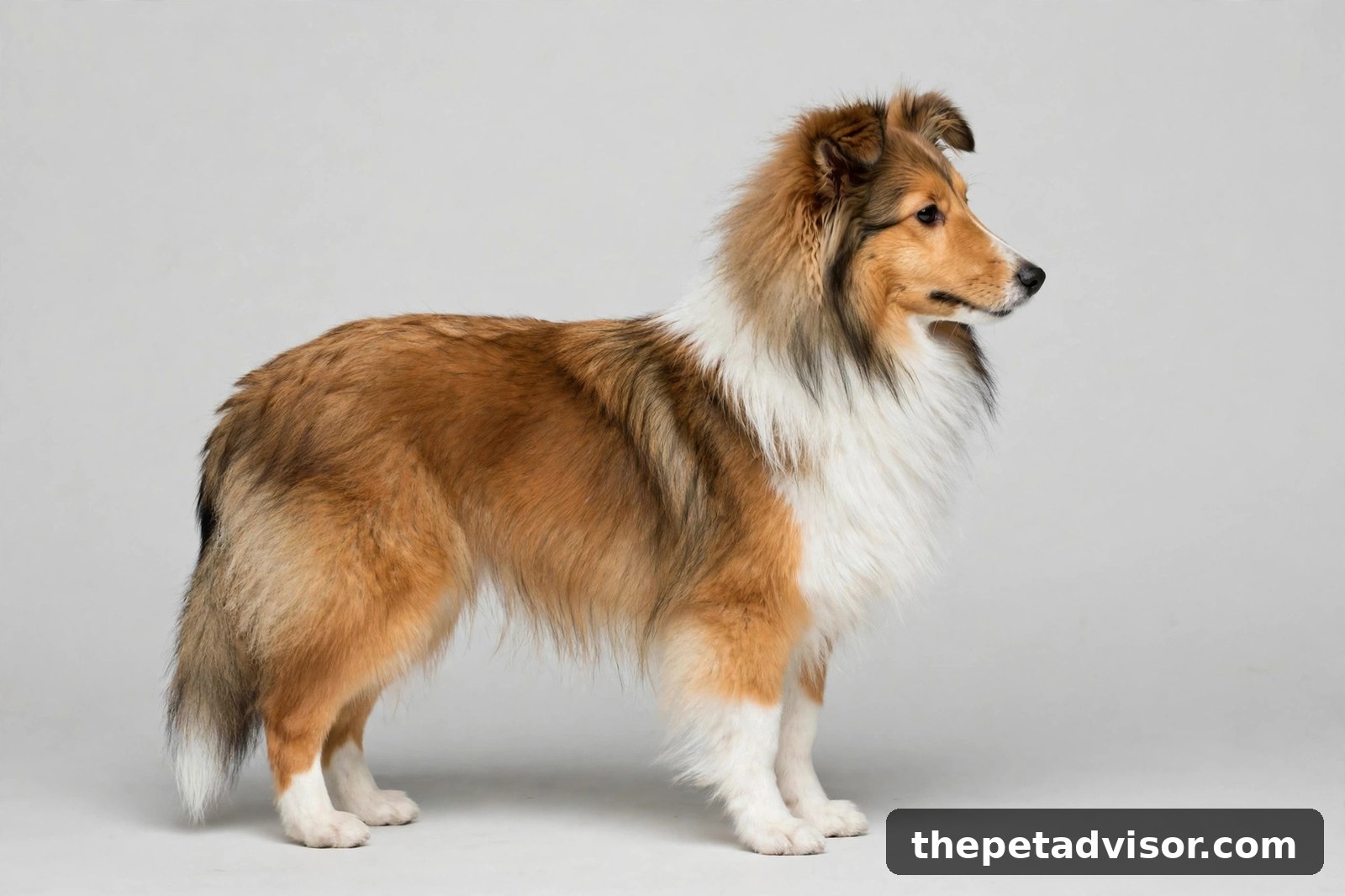
Do you have a photo of a Shetland Sheepdog in the American show ring? We’d love this page to lead with one. If you have a show photo you’d let us use, email it to [email protected] — tell us the dog’s name and the show, and it may be featured here. Please only send photos you took yourself or have the photographer’s permission to share, and tell us the photographer’s name. We couldn’t find a public photo of a Shetland Sheepdog in the American show ring that we were free to share, so the photo leading this page was made with AI. We’d much rather lead with a real one — if you’re a club member with an approved photo, we’d love to feature it.
1. Breed at a glance
Herding — recognized by the AKC in 1911
13–16 in at the shoulder (outside the range is a disqualification). Weight 15–25 lb.
Long double coat, outer coat long, straight, and harsh; undercoat short, furry, and dense. Black, blue merle, or sable, with white and/or tan.
Intensely loyal, affectionate, and responsive to its owner; reserved toward strangers, but not fearful.
12 to 14 years.
Size, coat, and temperament facts are from the AKC standard (approved May 12, 1959; reformatted July 18, 1990) and the AKC Shetland Sheepdog breed page. Weight (15 to 25 pounds) and lifespan (12 to 14 years) are from the AKC breed page.
2. History
The Sheltie comes from the Shetland Islands, a rugged cluster of islands off the northern coast of Scotland, where it worked as an all-around farm dog — herding the small, hardy Shetland sheep and cattle, and guarding the croft. The standard’s preamble traces the breed to the Border Collie of Scotland, transported to the islands and crossed with small, intelligent, longhaired breeds until it was reduced to miniature proportions, with crosses to Collies made from time to time afterward. (Sources: AKC, Shetland Sheepdog History; AKC standard.)
In the early 1900s the Sheltie came to the attention of fanciers on the British mainland. The English Kennel Club recognized it as the Shetland Collie in 1909, and after objections from Collie fanciers the name was changed to Shetland Sheepdog in 1914. The first Shetland Sheepdog registered by the American Kennel Club was “Lord Scott” in 1911, and the AKC recognized the breed the same year. (Sources: AKC, Shetland Sheepdog History; L & M Shelties, The Shetland Sheepdog.)
The American Shetland Sheepdog Association was organized at the Westminster Kennel Club show in 1929 — Fredericka Fry its first president, Catherine Coleman Moore its first secretary and the author of the first breed standard — and held its first specialty show in 1933. The parent club barred further Collie crosses from its registry, and the current standard was adopted in 1952 after seven years of discussion, then slightly revised in 1959. Today the ASSA has 767 members and more than 66 member breed clubs across the country. (Sources: AKC, Shetland Sheepdog History; American Shetland Sheepdog Association; L & M Shelties, The Shetland Sheepdog.)
3. The standard and why it’s written that way
- A small, alert, rough-coated, longhaired working dog. The standard opens with the whole dog: “The Shetland Sheepdog is a small, alert, rough-coated, longhaired working dog. He must be sound, agile and sturdy. The outline should be so symmetrical that no part appears out of proportion to the whole. Dogs should appear masculine; bitches feminine.” The preamble adds the comparison the breed can never escape: the Sheltie “bears the same relationship in size and general appearance to the Rough Collie as the Shetland Pony does to some of the larger breeds of horses.” (Source: AKC standard.)
- Size — 13 to 16 inches, and outside the range is a disqualification. “The Shetland Sheepdog should stand between 13 and 16 inches at the shoulder.” Heights below or above the range are disqualified from the show ring. The body should appear moderately long, but much of that length comes from the angulation of shoulder and hindquarter — the back itself should be comparatively short. (Source: AKC standard.)
- The head: a long, blunt wedge. The head should be refined, a long, blunt wedge tapering slightly from ears to nose, with the skull and muzzle of equal length and the top lines of skull and muzzle parallel on different planes, divided by a slight but definite stop. Expression — “alert, gentle, intelligent and questioning” — comes from the contours and chiseling of the head, the shape, set, and use of the ears, and the placement, shape, and color of the eyes. Toward strangers the eyes should show watchfulness and reserve, but no fear. (Source: AKC standard.)
- Eyes and ears. The eyes are medium size with dark, almond-shaped rims, set somewhat obliquely; color must be dark, with blue or merle eyes permissible in blue merles only. The ears are small and flexible, placed high, carried three-fourths erect, with the tips breaking forward; in repose they fold lengthwise and are thrown back into the frill. Hound, prick, bat, or twisted ears are faults. (Source: AKC standard.)
- Coat — double, long, straight, and harsh, with a mane and frill. The outer coat is long, straight, harsh hair; the undercoat is short, furry, and so dense as to give the entire coat its “standoff” quality. The mane and frill should be abundant, and particularly impressive in males; the forelegs are well feathered, the hind legs heavily so, and the hair on the tail is profuse. The hair on the face, tips of ears, and feet is smooth. Excess hair on ears, feet, and hocks may be trimmed for the show ring — but a short or flat coat, a wavy, curly, soft, or silky coat, and a smooth-coated specimen are all faults. (Source: AKC standard.)
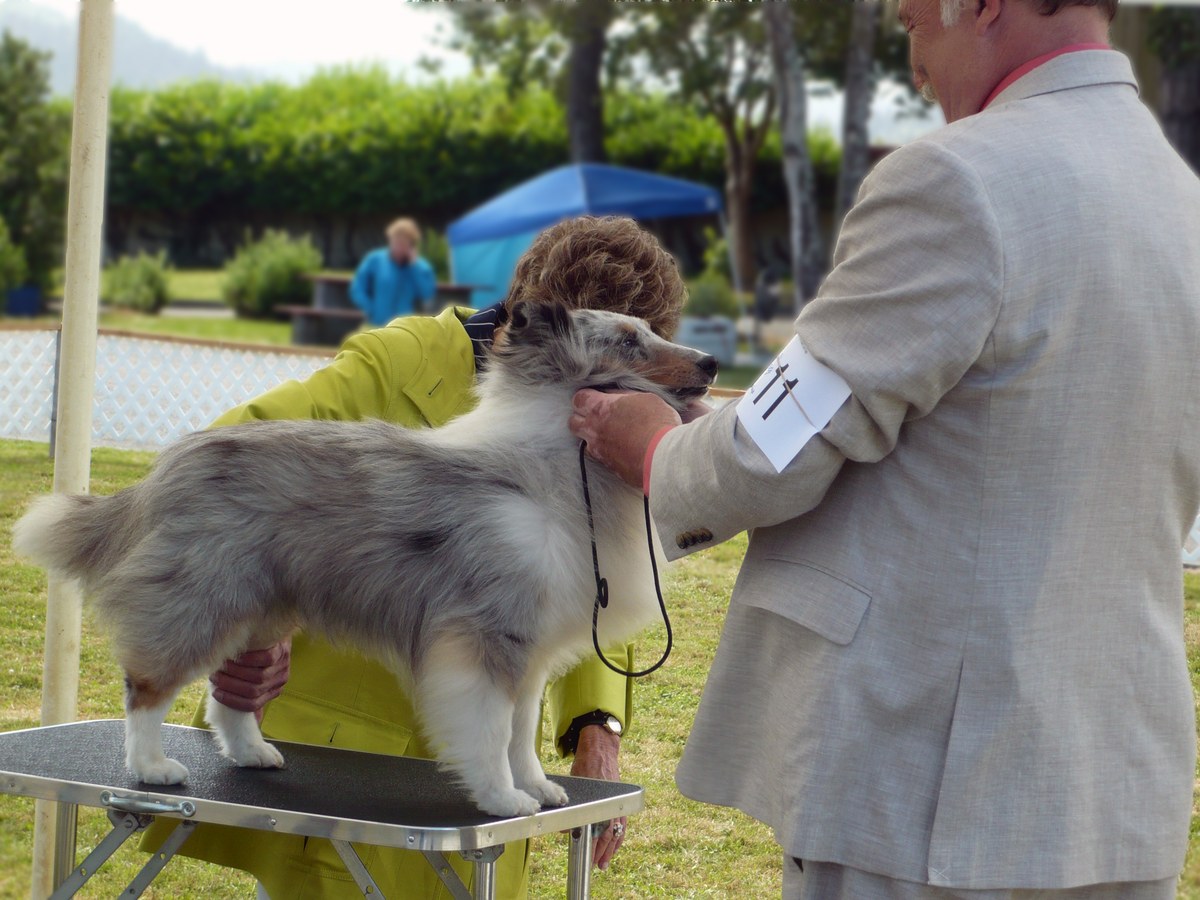
- Color — black, blue merle, and sable, with white and/or tan. Black, blue merle, and sable (ranging from golden through mahogany), marked with varying amounts of white and/or tan. Rustiness in a black or blue coat is a fault, as are washed-out colors and conspicuous white body spots; specimens with more than 50 percent white are so severely penalized as to effectively eliminate them from competition. Brindle is a disqualification. (Source: AKC standard.)
- The tail: long, to the hock. The tail should be long enough that when laid along the back edge of the hind legs the last vertebra reaches the hock joint. At rest it is carried straight down or in a slight upward curve; when the dog is alert it is normally lifted, but it should not curve forward over the back. (Source: AKC standard.)
- Gait — effortless speed and smoothness. “The trotting gait of the Shetland Sheepdog should denote effortless speed and smoothness. There should be no jerkiness, nor stiff, stilted, up-and-down movement.” The drive comes from the rear, true and straight; at a swift trot the feet come so far inward that the tracks show two parallel lines of footprints actually touching a center line. Stiff, short, choppy steps, mincing steps, a hackney lift, and pacing are all faults. (Source: AKC standard.)
- Temperament, in the standard’s own words. “The Shetland Sheepdog is intensely loyal, affectionate, and responsive to his owner. However, he may be reserved toward strangers but not to the point of showing fear or cringing in the ring.” Shyness, timidity, nervousness, stubbornness, snappiness, and ill temper are faults. (Source: AKC standard.)
4. Temperament & living with one
The AKC sums the breed up in a sentence: the Sheltie is “an extremely intelligent, quick, and obedient herder from Scotland’s remote and rugged Shetland Islands.” The parent club says the same thing in warmer terms — Shelties are known for “their sharp intelligence, deep loyalty, and lively yet gentle personalities,” and “their willingness to please and deep devotion to their family make them a joy to train and live with.” (Sources: AKC Shetland Sheepdog breed page; American Shetland Sheepdog Association.)
That devotion is watchful, not indiscriminate. The standard is explicit: the Sheltie “may be reserved toward strangers but not to the point of showing fear or cringing in the ring,” and its expression toward strangers should show “watchfulness and reserve, but no fear.” A Sheltie that is shy, timid, or nervous is faulted in the ring for the same reason it is a problem at home: this is a sensitive dog, and it reads its household. (Source: AKC standard.)
The parent club’s motto for the breed is that Shelties “do it all” — obedience, agility, and herding, therapy dog work, tracking, and junior showmanship — and it is not an exaggeration. The Sheltie is one of the most successful breeds in performance sports, and it needs the work: a bored Sheltie invents its own jobs, and the ones it invents are usually loud. Give it training, give it something to do, and it will give you everything it has. (Sources: American Shetland Sheepdog Association; AKC standard.)
5. Grooming
- At least once a week, brushing through to the skin. The profuse double coat needs a thorough brushing at least once a week — more often during shedding season — to remove loose hair before it drifts all over the house and to keep the coat from matting. Brush in sections and work through to the skin. (Sources: Savory Prime, Looking at the Shetland Sheepdog; CanineScout, Shetland Sheepdog.)
- Check the mat-prone spots. Mats form first behind the ears, under the elbow on each front leg, and in the long hair (“pants”) under the tail — check those spots every time you brush. (Sources: Savory Prime, Looking at the Shetland Sheepdog; CanineScout, Shetland Sheepdog.)
- Shedding season means daily brushing. The coat blows heavily twice a year, generally in spring and fall, when the whole undercoat releases; brush more often — daily if you can — during those weeks. (Sources: Savory Prime, Looking at the Shetland Sheepdog; OurPetCircle, Shetland Sheepdog.)
- Do not shave a Sheltie. The coat protects against sunburn and heat as well as cold, and shaving it to make grooming easier takes that protection away. The Sheltie needs a bath only occasionally, and the standard allows trimming only the excess hair on the ears, feet, and hocks for the show ring. (Sources: Savory Prime, Looking at the Shetland Sheepdog; AKC standard.)
6. Health testing
- Two tests for a CHIC number. For a CHIC number, the Shetland Sheepdog needs two evaluations: a Hip Evaluation and an Ophthalmologist Evaluation. That is the parent club’s list on the AKC’s Herding Group health-testing page. Breeders must agree to have all test results, positive or negative, published in the CHIC database. (Source: AKC Herding Group Health Testing Requirements.)
- The known inherited problems go beyond the two CHIC tests. Hip dysplasia, eye disease, dermatomyositis (Sheltie skin syndrome), von Willebrand’s disease (a bleeding disorder), degenerative myelopathy, and epilepsy are the breed’s known health problems, and MDR1 is a test for sensitivity to some drugs — ivermectin, Imodium, and some anesthetics. DNA tests exist for most of them. Ask a breeder for the parents’ results — and look them up in the OFA database yourself. (Sources: Central Indiana Shetland Sheepdog Club, Breeder Referral; UC Davis Veterinary Genetics Laboratory, Shetland Sheepdog Health Panel.)
- Eyes, every year. Both the sire and the dam should have their eyes checked yearly by a board-certified ophthalmologist — the first check can be done as young as 8 weeks, so there is no excuse for a dog of breeding age not to have been checked at least once. Thyroid screens should be available on all sires and dams. (Source: Central Indiana Shetland Sheepdog Club, Breeder Referral.)
- Collie eye anomaly, MDR1, and von Willebrand’s type III. The UC Davis Shetland Sheepdog health panel bundles the DNA tests for Collie eye anomaly (choroidal hypoplasia), degenerative myelopathy, multidrug sensitivity (MDR1), progressive retinal atrophy (Shetland Sheepdog type), and von Willebrand disease type III, the most severe form of the bleeding disorder. A Sheltie with two copies of the MDR1 mutation will show multidrug sensitivity, and some with one copy will too — tell every veterinarian who treats your dog. (Source: UC Davis Veterinary Genetics Laboratory, Shetland Sheepdog Health Panel.)
- Lifespan: 12 to 14 years. The commonly published lifespan is 12 to 14 years. (Source: AKC Shetland Sheepdog breed page.)
7. The annual Shetland Sheepdog specialty dog show
A specialty is the breed’s All-Star show — its Super Bowl. Once a year, the best Shetland Sheepdogs from across the country, and often from around the world, come together in one place.
The American Shetland Sheepdog Association’s national specialty: a seven-day national week each spring, with agility, rally, Futurity, a Top 20 competition, a regional specialty atmosphere of its own, and nearly 1,000 Shelties and fans gathering to honor the breed. The 2026 national week: March 27–April 4, at Purina Farms in Gray Summit, Missouri, with 436 dogs and 517 entries in the specialty. The 2025 national week: April 11–19, at Island Grove Regional Park in Greeley, Colorado, with 335 dogs and 411 entries. The 2027 national: March 31, at Purina Farms in Gray Summit, Missouri.
The standard, in brief: a small, alert, rough-coated, longhaired working dog, 13 to 16 inches at the shoulder, with a long, blunt wedge head, small ears carried three-fourths erect with the tips breaking forward, a profuse double coat with a mane and frill, and colors of black, blue merle, and sable — golden through mahogany — marked with white and/or tan.
The 2026 National Specialty — the 93rd Annual National Specialty, Wednesday, April 1, through Saturday, April 4, 2026, at Purina Farms, 300 Checkerboard Drive, Gray Summit, Missouri, in the middle of a national week running March 27–April 4. Entry: 436 dogs (185 dogs, 251 bitches); whole event 517 entries / 434 competitors. Entries opened Sunday, February 1, 2026; closed Wednesday, March 4, 2026. Event Chair: Sheryl Kendrick. Event Secretary: Lorraine Yu (DogZibit). The week around the national: agility Friday, March 27; rally Saturday, March 28; Futurity Monday, March 30, with the Welcome Party that evening; the Top 20 competition Tuesday, March 31; class judging Wednesday through Friday, April 1–3; Best of Breed judging Saturday, April 4, with visiting hours and a best-decorated-grooming-space contest Thursday, April 2. (Sources: AKC event search, event 2026140106; ASSA National, Conformation.)
National specialty judges: Dr. Albert P. Bianchi — Winners Dog. Mrs. Amy Massey — Best of Winners and Best of Opposite Sex. Top 20 panel: Lyn Leininger, Tracy Gensler, and Matt McMillan. Dr. A P Bianchi — Junior Showmanship. Best Junior Handler: Demery Livingston; Reserve Best Junior Handler: Tara Crowley. (Sources: ShowScene, April 15, 2026; ShowScene, June 17, 2026; AKC event search, event 2026140106.)
Results (2026 national). Best of Opposite Sex: MBISS MBIS NOHSG GCHS Laureate Ode To Joy (“Joy”), also the unanimous Top 20 winner. Winners Dog and Best of Winners: Laureate Hamilton (new champion). Best of Breed: not confirmed in an official source as of November 2026. (Sources: ShowScene, April 15, 2026; ShowScene, June 17, 2026.)
The 2027 National Specialty: a four-day event beginning Wednesday, March 31, 2027, at Purina Farms, Gray Summit, Missouri. Event Secretary: Lorraine Yu. Judges, AKC event number, entries, and closing date not yet published as of November 2026. (Source: AKC Upcoming National Specialties.)
Past national specialties: 2025
American Shetland Sheepdog Association — americanshetlandsheepdogassociation.org
8. Regional specialties through the year: smaller regional shows
The national is the anchor, but the breed’s year also runs through regional specialties — smaller regional shows, not the national — held by regional Shetland Sheepdog clubs around the country. These are the 2026 regionals verified from club sources so far:
Two regional specialties verified from show reports so far for 2026, both won Best in Specialty Show by the same bitch, MBISS MBIS NOHSG GCHS Laureate Ode To Joy (“Joy”):
- Kentuckiana Shetland Sheepdog Club specialties — Thursday, March 13, and Friday, March 14, 2026: Best in Specialty Show both days: GCHS Laureate Ode To Joy. (Source: ShowScene, June 17, 2026.)
- Colonial Shetland Sheepdog Club specialty — Friday, May 29, 2026: judge Mrs. Charlotte Clem McGowan. Best in Specialty Show: GCHS Laureate Ode To Joy. (Source: ShowScene, June 17, 2026.)
More regional specialties will be added here as their programs are verified — this section is built from show data, not guesswork. Browse upcoming show weekends →
9. Clubs
- American Shetland Sheepdog Association (parent club) — the AKC parent club for the breed in the United States, founded in 1929, with 767 members and more than 66 member breed clubs throughout the country. The club held its first specialty in 1933, runs the national specialty each spring, and supports breed education, research, responsible breeding, and rescue through the ASSA Foundation. (Source: American Shetland Sheepdog Association.)
- Regional Shetland Sheepdog clubs. The parent club’s member clubs include the Kentuckiana Shetland Sheepdog Club and the Colonial Shetland Sheepdog Club, both of which held regional specialties in 2026; see section 8. The Greater St. Louis Shetland Sheepdog Club runs agility trials alongside the national week at Purina Farms.
If you are new to the breed, the national specialty itself is the better first stop than a breeder’s website: the people there have owned, shown, and worked Shelties, and they will tell you the truth about the coat, the shedding, and the barking before you fall for a puppy.
10. Rescue
- National Sheltie Rescue Association. A registered 501(c)(3) nonprofit that provides leadership, organization, communications, media, education, and support for the many individual Sheltie rescue groups that rescue, rehabilitate, and place Shetland Sheepdogs. If you need help with a Sheltie or help adopting one, it puts you in touch with the closest affiliate rescue group; look for its stamp of approval on affiliate websites, which shows the group abides by its code of ethics and is a member in good standing. (Source: National Sheltie Rescue Association.)
- National Sheltie Rescue Network. The network’s contact is Natalie Whalen, 309-824-0107, [email protected]. The parent club points people looking for a Sheltie rescue group to the National Sheltie Rescue Association’s group list. (Sources: American Shetland Sheepdog Association; National Sheltie Rescue Association, groups.)
- The ASSA Foundation. The parent club’s foundation provides financial support to the rescue operations of ASSA member clubs and their affiliates across the country, alongside its health fund, scholarships, and legislation education. (Source: American Shetland Sheepdog Association.)
- Adults and seniors. A rescued Sheltie is usually an adult, often one whose owner underestimated the coat, the shedding, and the barking, and it will arrive with its temperament visible before you commit. What you get in return is a dog whose character you can see before you commit and a lower price. Either way, be honest with yourself first: a Sheltie needs weekly brushing at minimum, training and something to do, and an owner who understands a sensitive, watchful dog rather than expecting a dog that fawns over strangers.
11. Breeder vs. rescue: honest guidance
- If you buy: start with the parent club, the American Shetland Sheepdog Association, and its member clubs — there are more than 66 of them around the country. Ask for the parents’ health results — hips and eyes at minimum, plus the DNA tests for Collie eye anomaly, MDR1, von Willebrand’s disease, and degenerative myelopathy — and look the results up in the OFA database yourself. Expect to wait for a puppy from a careful breeder: a good breeder will have the answers, will ask you as many questions as you ask them, and will take the puppy back for its whole life if you cannot keep it.
- If you rescue: a rescued Sheltie is usually an adult, often one whose owner underestimated the coat, the shedding, and the barking, and it will arrive with its temperament visible before you commit. What you get in return is a dog whose character you can see before you commit and a lower price. Either way, be honest with yourself first: a Sheltie needs weekly brushing at minimum, training and something to do, and an owner who understands a sensitive, watchful dog rather than expecting a dog that fawns over strangers. It is not a dog for a household that wants a quiet, low-maintenance pet.
- One breed, one standard — and not a miniature Collie. The Sheltie bears a strong family resemblance to the Rough Collie, and the standard itself opens by noting it — but the Sheltie is its own breed, with its own standard, its own parent club, and its own national specialty. Judge the dog in front of you against the Sheltie standard, not against a Collie.
12. Claim this page
This page belongs to the breed, and the people who know the breed best are the American Shetland Sheepdog Association and its members. If you are with the parent club — or you are a breeder, a judge, a handler, or a rescue volunteer who spotted something wrong, missing, or out of date — this page is yours to set straight. Tell us what needs fixing and where the correction is documented, and we will fix it and credit the source. Contact the site through the About page, and mention “Shetland Sheepdog breed profile.”
Sources
- AKC Shetland Sheepdog breed page — akc.org/dog-breeds/shetland-sheepdog
- AKC, Shetland Sheepdog History — akc.org/expert-advice/dog-breeds/shetland-sheepdog-history
- AKC Official Standard of the Shetland Sheepdog (approved May 12, 1959; reformatted July 18, 1990) — images.akc.org/pdf/breeds/standards/ShetlandSheepdog.pdf
- AKC Herding Group Health Testing Requirements — akc.org/breeder-programs/breed-health-testing-requirements/herding-group-health-testing-requirements
- American Shetland Sheepdog Association — americanshetlandsheepdogassociation.org
- ASSA National, Conformation (2026 national week) — assanational.com/conformation
- AKC Upcoming National Specialties — apps.akc.org/apps/events/conformation/national_specialties.cfm
- 2026 National Specialty, AKC event search, event 2026140106 — apps.akc.org/apps/events/search/index_results.cfm
- 2026 rally, AKC event search, event 2026140105 — apps.akc.org/apps/events/search/index_results.cfm
- 2025 National Specialty, AKC event search, event 2025140106 — apps.akc.org/apps/events/search/index_results.cfm
- 2025 premium list — apps.akc.org/apps/eventplans/eventsearch/blocks/dsp_generate_pdf.cfm
- ShowScene, April 15, 2026 (2026 national results) — mailchi.mp/show-scene.ca/april152026
- ShowScene, June 17, 2026 (Top 20, Best of Opposite Sex, regional specialties) — us10.campaign-archive.com
- Central Indiana Shetland Sheepdog Club, Breeder Referral (health problems, eye and thyroid testing) — cissc.net/breeder-referral
- UC Davis Veterinary Genetics Laboratory, Shetland Sheepdog Health Panel — vgl.ucdavis.edu/panel/shetland-sheepdog-health-panel
- National Sheltie Rescue Association — nationalsheltierescueassociation.org
- National Sheltie Rescue Association, groups — nationalsheltierescueassociation.org/groups.html
- L & M Shelties, The Shetland Sheepdog (standard and history) — landmshelties.com/the-shetland-sheepdog
- Savory Prime, Looking at the Shetland Sheepdog (grooming) — savoryprimepet.com/looking-at-the-shetland-sheepdog
- CanineScout, Shetland Sheepdog (grooming) — caninescout.com/breed/shetland-sheepdog
- OurPetCircle, Shetland Sheepdog (shedding seasons) — ourpetcircle.com/sg/singapore/own-a-dog/breeds/shetland-sheepdog
- Ellin Beltz, Shetland Sheepdog at Dog Show (Lost Coast, 2014), public domain via Wikimedia Commons — commons.wikimedia.org/wiki/File:Shetland_Sheepdog_at_Dog_Show.jpg
