
Breed profile · Terrier Group · the Diehard
Scottish Terrier
The Scottish Terrier — the Scottie, the “Diehard” — is a small, compact, short-legged dog of big personality: independent, confident, and dignified, with a long bearded head, a hard wiry coat, and a stubborn streak as wide as its native Highlands. Bred to go to ground after foxes and badgers, it is a dog that makes its own decisions, bonds fiercely to its own people, and keeps strangers at arm’s length. The AKC recognized the breed in 1885, and the Scottish Terrier Club of America, founded in 1900, is the parent club — holding two national specialties a year, a rotating national each winter and the October national at Montgomery.
Help us improve it. This is one of ThePetAdvisor’s breed profiles, built from public sources with generous links to the people who actually own this breed’s knowledge. If something’s off or missing, the parent club can claim the page and set it straight — see the bottom of the page.
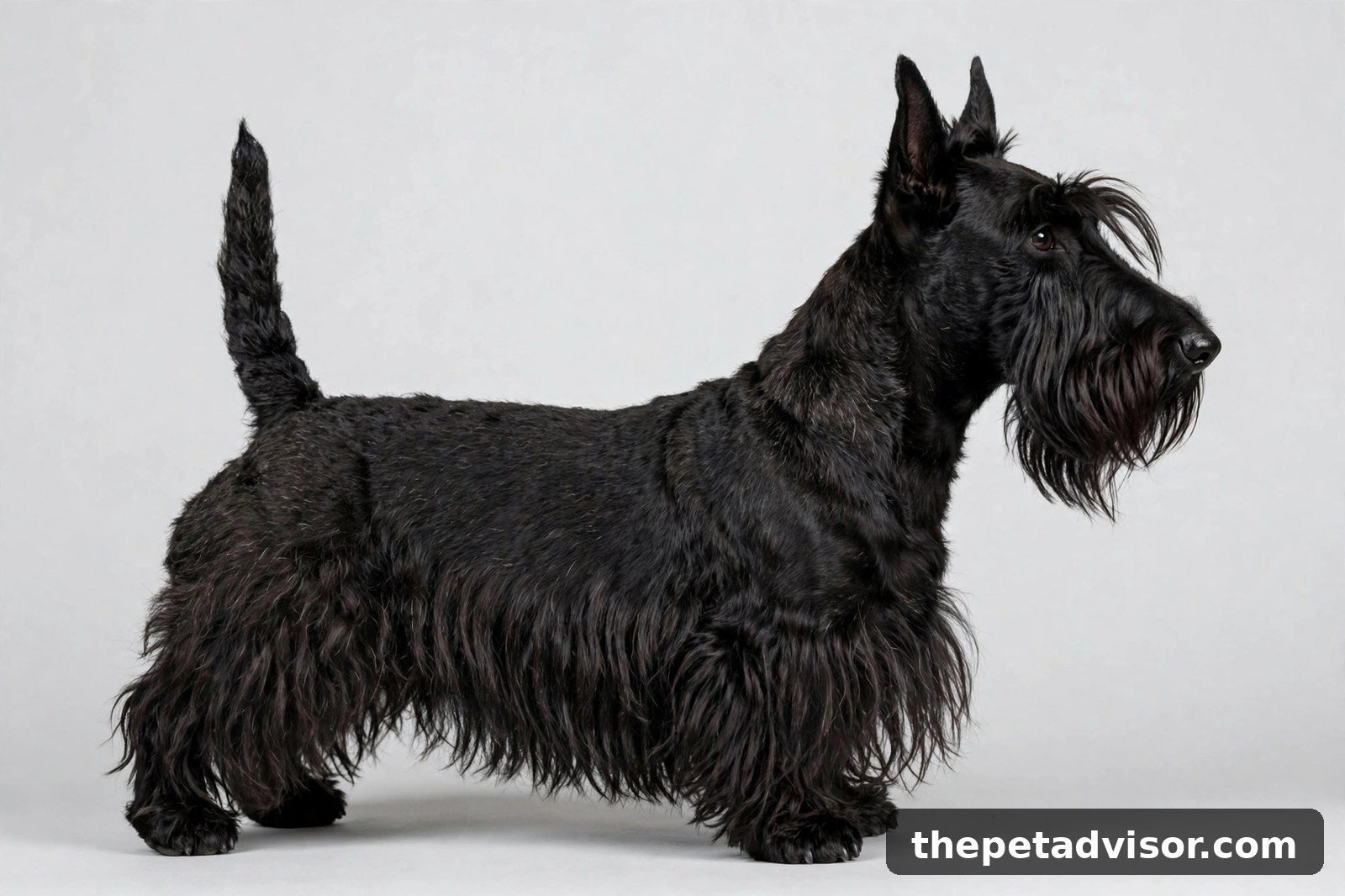
Do you have a photo of a Scottish Terrier in the American show ring? We’d love this page to lead with one. If you have a show photo you’d let us use, email it to [email protected] — tell us the dog’s name and the show, and it may be featured here. Please only send photos you took yourself or have the photographer’s permission to share, and tell us the photographer’s name. We couldn’t find a public photo of a Scottish Terrier in the American show ring that we were free to share, so the photo leading this page was made with AI. We’d much rather lead with a real one — if you’re a club member with an approved photo, we’d love to feature it.
1. Breed at a glance
Terrier Group; recognized by the AKC in 1885
About 10 in at the withers; back about 11 in; dogs 19–22 lb, bitches 18–21 lb
Broken coat: hard, wiry outer coat with a soft, dense undercoat; black, wheaten, or brindle of any color
11–13 years
Alert, spirited, stable, steadygoing, determined, thoughtful
The Scottish Terrier is a small, compact, short-legged, sturdily built dog of good bone and substance, with a long head, a hard wiry weather-resistant coat, and a thick-set, cobby body hung between short, heavy legs. The silhouette is unmistakable: a long rectangular head with a beard and bushy brows, small prick ears, a level topline, a skirt of longer coat, and a tail carried erect. Underneath it is a dog bred to work alone underground after vermin — bold, confident, and dignified, with what the AKC calls a “vivid personality” and an almost-human character. (Sources: AKC, Scottish Terrier; AKC, Official Standard of the Scottish Terrier.)
2. History
The Scottish Terrier comes from the rocky Highlands of Scotland, where small, short-legged terriers were bred to go to ground after foxes, badgers, and rats — work that demands a dog brave enough to face quarry underground, alone, with no handler to help.
- Many names, one dog. While fanciers sorted out the Scottish terriers in the late 19th century, the breed was known as the Highland, the Cairn, the Diehard, and most often the Aberdeen Terrier, after the city where the dogs were abundant. The first Scottish Terrier class at a show was in Birmingham in 1860; the first entry in the Kennel Club Stud Book appears in 1880; the first standard was drawn up in 1880; the Scottish Terrier Club of England was formed in 1882 and the Scottish Terrier Club of Scotland in 1888. Nearly all present-day Scotties descend from Ch. Allister, whelped in 1885.
- Coming to America. John Naylor imported the first Scottish Terriers to America in 1883, and in 1885 he registered Prince Charlie as the first Scottish Terrier in the AKC stud book. The breed’s first AKC champion was Ch. Tiree, and the Scottish Terrier Club of America was founded on October 1, 1900 — Dr. Fayette Ewing of St. Louis is credited with helping to establish it. The first STCA specialty was held in May 1910, won by Ch. Walescott Invader.
- The “Diehard.” The nickname comes from the breed’s terrier persistence — a Scottie does not quit. Legend ties it to the Earl of Dumbarton, whose pack of Scottish Terriers was so brave they were called “Diehards,” a name his regiment, the Royal Scots, took up as well.
- Famous Scotties. The breed had its heyday in the 1930s, when it was one of America’s most popular dogs. The most famous Scottie of all was Fala, President Franklin D. Roosevelt’s Scottish Terrier, said to have received more fan mail than most presidents. Humphrey Bogart, Charles Lindbergh, and Shirley Temple all kept Scotties.
- At Westminster. Scottish Terriers have won Best in Show at Westminster eight times — the first in 1911, with Ch. Tickle Em Jock, and the most recent in 2010, with Ch. Roundtown Mercedes Of Maryscot, known as Sadie. Only the Wire Fox Terrier has won more.
From a vermin hunter in the Scottish Highlands to a president’s companion and one of Westminster’s winningest breeds, the Scottie has kept the same character throughout: small, sturdy, stubborn, and impossible to ignore. (Sources: AKC, Scottish Terrier History: From Rugged Hunter to 1930s Fad; AKC Archives, Scottish Terrier Club of America records; AKC, 15 Fun Facts About Westminster’s Winningest Breeds.)
3. The standard and why it is written that way
The standard describes a dog built to go to ground, and every part of it follows from that job. The Scottish Terrier is a small, compact, short-legged, sturdily built dog of good bone and substance, with a long head, a hard wiry weather-resistant coat, and a thick-set, cobby body hung between short, heavy legs — “power in a small package.”
- Size. Height at the withers for either sex should be about 10 inches, and the length of back from withers to set-on of tail approximately 11 inches. A well-balanced dog should weigh from 19 to 22 pounds and a bitch from 18 to 21 pounds. The principal objective is symmetry and balance without exaggeration: equal consideration is given to height, weight, length of back, and length of head.
- Head. The head is long in proportion to the size of the dog, and in profile the skull and muzzle should give the appearance of two parallel planes. The muzzle is approximately equal to the length of skull, well filled in under the eye, and should fill an average man’s hand. The nose is black, regardless of coat color. The teeth are large and evenly spaced, with a scissor or level bite, the former preferred. The eyes are small, bright, and piercing, almond-shaped rather than round, and dark brown or nearly black, the darker the better. The ears are small, prick, set well up on the skull, and pointed — but never cut.
- Coat. The Scottish Terrier should have a broken coat: a hard, wiry outer coat with a soft, dense undercoat. The coat is trimmed and blended into the furnishings to give a distinct Scottish Terrier outline, and the dog should be presented with sufficient coat that its texture and density can be determined. The longer coat on the beard, legs, and lower body may be slightly softer than the body coat, but should not be or appear fluffy.
- Color. Black, wheaten, or brindle of any color. Many black and brindle dogs have sprinklings of white or silver hairs in their coats, which are normal and not to be penalized. White can be allowed only on the chest and chin, and that to a slight extent only.
- Tail. The tail is about seven inches long and never cut. It is set on high and carried erectly, either vertical or with a slight curve forward, but not over the back — thick at the base, tapering gradually to a point, and covered with short, hard hair.
- Gait. The gait is very characteristic of the breed: it is not the square trot of the long-legged breeds. In reaching out, the forelegs incline slightly inward because of the deep, broad forechest, and movement should be free, agile, and coordinated, with powerful drive from the rear and good reach in front. When the dog is in motion, the back should remain firm and level.
- Temperament in the standard. The Scottish Terrier should be alert and spirited but also stable and steadygoing — a determined and thoughtful dog whose “heads up, tails up” attitude in the ring should convey both fire and control. While loving and gentle with people, he can be aggressive with other dogs, and he should exude ruggedness and power, living up to his nickname, the “Diehard.”
- No disqualifications. The AKC standard has no disqualifications section: faults are penalized, not disqualifying. The penalty list includes a soft or curly coat; round, protruding, or light eyes; overshot or undershot jaws; obviously oversize or undersize dogs; shyness or timidity; upright shoulders; lack of reach or drive; stiff or stilted movement; lack of bone and substance; a low-set tail; lack of pigment in the nose; a coarse head; and failure to show with head and tail up. The standard closes with a line no judge is meant to forget: no judge should put to Winners or Best of Breed any Scottish Terrier not showing real terrier character in the ring.
The most important thing to know about the modern standard is what it does not do: it never disqualifies a dog for color, and it never crops or docks anything — the ears are prick and never cut, and the tail is never cut. A Scottie is judged on substance, outline, coat, and terrier character, in that order of stubbornness. (Source: AKC, Official Standard of the Scottish Terrier, approved October 12, 1993, effective November 30, 1993.)
4. Temperament & living with one
Scottish Terriers are independent, confident companions of high spirits, with a dignified, almost-human character — the AKC’s words — and they live up to every one of them. They bond hard to their people and want to be where the action is, but strictly on their own terms.
- Independent to the bone. Scotties were bred to work underground without a handler, making their own decisions, and they never stopped. They are fiercely independent and full of energy, with a stubborn streak that makes them a somewhat difficult dog to train — they will do what you ask when they decide it is worth doing, and not before.
- One person’s dog. Scotties form strong bonds with their family and often attach most deeply to one member of it. The devotion is real and lasting, but it is not demonstrative: a Scottie shows love by staying close and watching over you, not by fawning.
- Aloof with strangers, sharp with other dogs. Scotties can be aloof toward strangers, which makes them strong watchdogs, and they may be aggressive toward other dogs if they are not properly socialized. Early and thorough socialization — people, places, sounds, other dogs — is not optional with this breed.
- Best with older children. Being a small breed with a big personality, Scottish Terriers do best in a home with older, responsible children who understand that a dog has limits. They do not suffer rough handling gladly, and they are happiest as the sole dog of the household.
- Prey drive is real. This is a vermin hunter: rats, squirrels, and anything small that runs are quarry, not playmates. A secure yard and a leash on walks are the rule, and small pets in the house need careful introductions — or a different home.
- Training takes patience, not force. Scotties are intelligent but stubborn, and they are sensitive to correction: consistent, patient, reward-based training works, and heavy-handed methods backfire. Short, interesting sessions beat long drills, and a Scottie that is bored will simply stop listening.
The honest summary: this is a wonderful companion for an owner who respects an independent dog and will train it with patience, and a poor fit for a household that wants a dog to obey instantly and love everyone on sight. (Sources: AKC, Scottish Terrier; AKC, Is the Scottish Terrier Right for Your Lifestyle?; AKC, Official Standard of the Scottish Terrier.)
5. Grooming
Grooming a Scottish Terrier is straightforward, but it is not optional: the long furnishings mat if they are ignored. The wiry double coat sheds lightly, so the work is brushing, not sweeping up hair. A pin brush through the beard, skirt, and leg furnishings, followed by a coarse-toothed comb to catch small knots, keeps the coat tangle-free, and the beard should be brushed forward and trimmed to keep it manageable.
Show dogs are hand-stripped — the dead outer coat is plucked out by hand so the harsh, wiry texture grows back true — and a Scottie that is going to be shown should never be clipped, because clipping softens the coat over time and can dull the color. For a pet, clipping is the practical choice, and most pet owners clip the body short while leaving the beard, brows, skirt, and leg furnishings longer. Bath only when the dog is dirty: over-bathing softens the outer coat and invites mats. Plan on a full groom every four to six weeks, with ears checked and cleaned, nails trimmed, and teeth brushed in between. (Sources: Sharda’s Dog World, Scottish Terrier Grooming Guide; Transgroom, Head over Tails: Scottish Terrier Grooming Explained.)
6. Health testing
The Scottish Terrier Club of America’s CHIC program sets the health testing a responsible breeder should do — and the results should be registered with the Orthopedic Foundation for Animals, where anyone can look them up. The current requirements were approved by the STCA Board of Directors on February 11, 2024, and took effect January 1, 2025.
- Von Willebrand’s disease type III. A DNA-based test from an approved lab — the Scottish Terrier type of the bleeding disorder — with results registered with OFA.
- Patellar luxation. A veterinary evaluation of the kneecaps, using the OFA form, with results registered with OFA.
- Craniomandibular osteopathy (CMO). A DNA-based test from an approved lab, with results registered with OFA. CMO was made a required test in the 2025 update.
- One elective. Choose one of: an autoimmune thyroiditis evaluation from an approved lab; an ACVO eye examination; a radiographic evaluation for Legg-Calve-Perthes disease; a serum bile acid evaluation; or a kidney screen (urine protein-to-creatinine ratio) — all with results registered with OFA.
- Permanent identification. A microchip or tattoo is required for a CHIC number.
Also worth asking about: bladder cancer. Scottish Terriers carry the highest risk of transitional cell carcinoma (TCC), the most common bladder cancer, of any breed — about one in seventeen Scotties over the age of nine is predicted to develop it — so watch for urinary signs such as blood in the urine, frequent urination, or difficulty urinating, and tell your veterinarian about the breed risk. Scottie cramp is the breed’s other namesake condition: an inherited movement disorder that shows up as a stiff, lock-legged gait when the dog is stressed or over-excited. Episodes are not painful, they pass once the dog calms down, and they do not affect the dog’s quality of life. A CHIC number confirms the testing was done and published; it is not a guarantee of health, and it does not replace asking the breeder what they know about the health of their own lines. (Sources: Scottish Terrier Club of America, Health Statement (CHIC Requirements); Scottish Terrier Club of America, Health; Scottish Terrier Club of Chicago, Health Issues.)
7. The annual Scottish Terrier specialty dog show
A specialty is the breed’s All-Star show — its Super Bowl. The Scottish Terrier Club of America holds two national specialties a year: the October national at Montgomery and the National Rotating Specialty, which moves to a different city each year.
The club calls it the national rotating specialty — the same kind of event other clubs call a roving, floating, or traveling national.
Every breed has one show a year that matters most: the parent club’s national specialty — and the Scottish Terrier Club of America holds two a year: a rotating national each winter, hosted in turn by one of four regional groups — rotating since 1991 — and the October national at Montgomery, held each October in Pennsylvania as part of the Montgomery weekend cluster.
The most recent national specialty was Sunday, October 4, 2026, at the Montgomery County Kennel Club show in Macungie, Pennsylvania, judged by Dr. Francisco J. Martinez Coloma of Spain, closing National Specialty Week, September 28 – October 4, 2026. (Sources: Scottish Terrier Club of America, MONTY WEEK 2026; AKC event search, event 2026006701.)
The rotating national
The year’s other national specialty, the rotating national, was February 26–28, 2026, at Purina Farms, Gray Summit, Missouri, hosted by the Heart of America Scottish Terrier Club. Conformation was Saturday, February 28. The rotating national has moved among four regional groups since 1991. (Sources: Scottish Terrier Club of America, January 2026 WrapUp; AKC event search, event 2026084112.)
The October 2027 Montgomery national had not been announced as of November 2026; dates and judges to be announced.
The rotating national
The 2027 rotating national specialty had not been announced as of November 2026.
Full Montgomery weekend guide →
8. Regional specialties through the year: smaller regional shows
The national is the anchor, but the breed’s year also runs through regional specialties — smaller regional shows, not the national — held by regional Scottish Terrier clubs around the country. These are the 2026 regionals verified from club sources so far:
No regional specialties announced yet for 2026.
More regional specialties will be added here as their programs are verified — this section is built from show data, not guesswork. Browse upcoming show weekends →
9. Clubs
The parent club is the Scottish Terrier Club of America (STCA), at stca.biz — founded October 1, 1900, and the parent club ever since. The STCA runs both national specialties, publishes the breed’s health guidance, and funds health research through its Health Trust Fund, a not-for-profit 501(c)(3) organization dedicated to the health and quality of life of the Scottish Terrier. The club counts more than 1,000 members across 20 regional clubs spanning the United States.
Regional clubs verified in the AKC club search index during this build:
- Scottish Terrier Club of Greater Washington, D.C.
- Scottish Terrier Club of Tampa Bay
- Heart of America Scottish Terrier Club — host of the 2026 rotating national specialty at Purina Farms, Gray Summit, Missouri
Regional clubs run the regional specialties and are the best first contact for anyone looking for a breeder, a grooming workshop, a health clinic, or a local event. The STCA website lists the full roster of regional clubs. (Sources: Scottish Terrier Club of America; Scottish Terrier Club of America, club flier; AKC, Club Search Index.)
10. Rescue
Scotties come into rescue when an owner’s life changes — a move, an illness, a death in the family — or when a buyer discovers that an independent, stubborn terrier was not the easy pet they expected. Breed-specific rescue groups take these dogs in, foster them, and place them with people who understand what the breed needs. The parent club’s rescue network is the first place to look:
- Scottish Terrier Club of America Rescue. The parent club coordinates rescue through its regional clubs and a national rescue coordinator; rescue information is on the STCA website. stca.biz
- AKC Rescue Network. The AKC’s breed rescue listing for Scottish Terriers, pointing to the STCA rescue contacts. akc.org/akc-rescue-network/akc-rescue-network-s-breeds/
- Scottish Terrier Rescue of the Southeast. Dedicated to the rescue and re-homing of Scottish Terriers in North Carolina, South Carolina, and Georgia; dogs are fostered and given full veterinary care before placement. scottiesoutheast.org
- Scottie Kingdom Rescue, Inc. Serving the Dallas, Texas area; adopted dogs receive a full veterinary exam, vaccinations, spay/neuter, dental cleaning as needed, and microchipping.
- Scottish Terrier Club of Greater New York Rescue. The New York regional club’s rescue program.
Most of these groups place dogs on an application with references, and many will transport within their region. A rescue Scottie is usually an adult, so you know its size, temperament, and tolerance for other dogs before you commit — a real advantage with a breed this independent. Ask what the dog’s health history is, and whether it has been tested for von Willebrand’s disease: a rescue that cannot tell you anything about bleeding risk is a rescue to question. (Sources: Scottish Terrier Club of America, club flier; AKC, Rescue Network S Breeds; Scottish Terrier Rescue of the Southeast, What We Do.)
11. Breeder vs. rescue: honest guidance
Both routes can end with a great dog. The honest difference is what you know going in — and with a Scottie, what you know about the bleeding disorder and the temperament matters more than usual.
- Choose a breeder if you want a puppy for showing, performance, or a specific purpose, and you want the health testing, pedigree, and early socialization that come with a careful breeding program. Ask for the CHIC health results in section 6 — especially the von Willebrand’s and CMO DNA tests — meet the dam if you can, and be ready to wait: good breeders have waiting lists.
- Choose rescue if you want an adult dog whose temperament, tolerance for other dogs, and energy level you can see before you commit, and you are comfortable with a dog that may need training and patience. Rescue is also the right route if you want to give a home to a dog that needs one.
- Either way, verify. Ask for health testing, ask what the dog’s lines are known for, and meet the dog before you commit. A breeder who will not show you health results and a rescue that will not let you meet the dog are both telling you something.
A Scottish Terrier is an eleven-to-thirteen-year commitment to a small, stubborn, fiercely loyal dog that makes its own decisions and loves its own people on its own terms. The right question is not breeder or rescue — it is whether your life has room for a dog that will not be talked into liking strangers any faster than it wants to.
12. Claim this page
This page was built from public sources — the AKC standard, the parent club’s own material, AKC event records, and the rescue groups’ sites — and it is a starting point, not the last word. If you are with the Scottish Terrier Club of America or a regional club and something here is wrong or missing, you can claim this page and set it straight: email [email protected] and tell us what needs fixing. Corrections from the people who own the breed’s knowledge are always welcome.
Sources
- AKC, Scottish Terrier
- AKC, Official Standard of the Scottish Terrier
- Scottish Terrier Club of America, Health Statement (CHIC Requirements)
- Scottish Terrier Club of America, Health
- Scottish Terrier Club of America
- AKC, Scottish Terrier History: From Rugged Hunter to 1930s Fad
- AKC, 15 Fun Facts About Westminster’s Winningest Breeds
- AKC, Is the Scottish Terrier Right for Your Lifestyle?
- AKC Archives, Scottish Terrier Club of America records
- Scottish Terrier Club of America, club flier
- Scottish Terrier Club of Chicago, Health Issues
- Sharda’s Dog World, Scottish Terrier Grooming Guide
- Transgroom, Head over Tails: Scottish Terrier Grooming Explained
- AKC, Rescue Network S Breeds
- Scottish Terrier Rescue of the Southeast, What We Do
- AKC, Club Search Index (regional clubs)