
Breed profile · Working Group · Siberia’s smiling sled dog
Samoyed
The Samoyed is Siberia’s smiling sled dog: a substantial but graceful white dog, 19 to 23½ inches at the shoulder and 35 to 65 pounds, with a thick double coat built for Arctic cold, dark eyes, and the famous “Sammy smile” — upturned mouth corners that keep the dog from drooling — a dog bred to herd reindeer, pull sleds, and sleep in the family tent, and still happiest in the middle of its people.
Help us improve it. This is one of ThePetAdvisor’s breed profiles, built from public sources with generous links to the people who actually own this breed’s knowledge. If something’s off or missing, the parent club can claim the page and set it straight — see the bottom of the page.
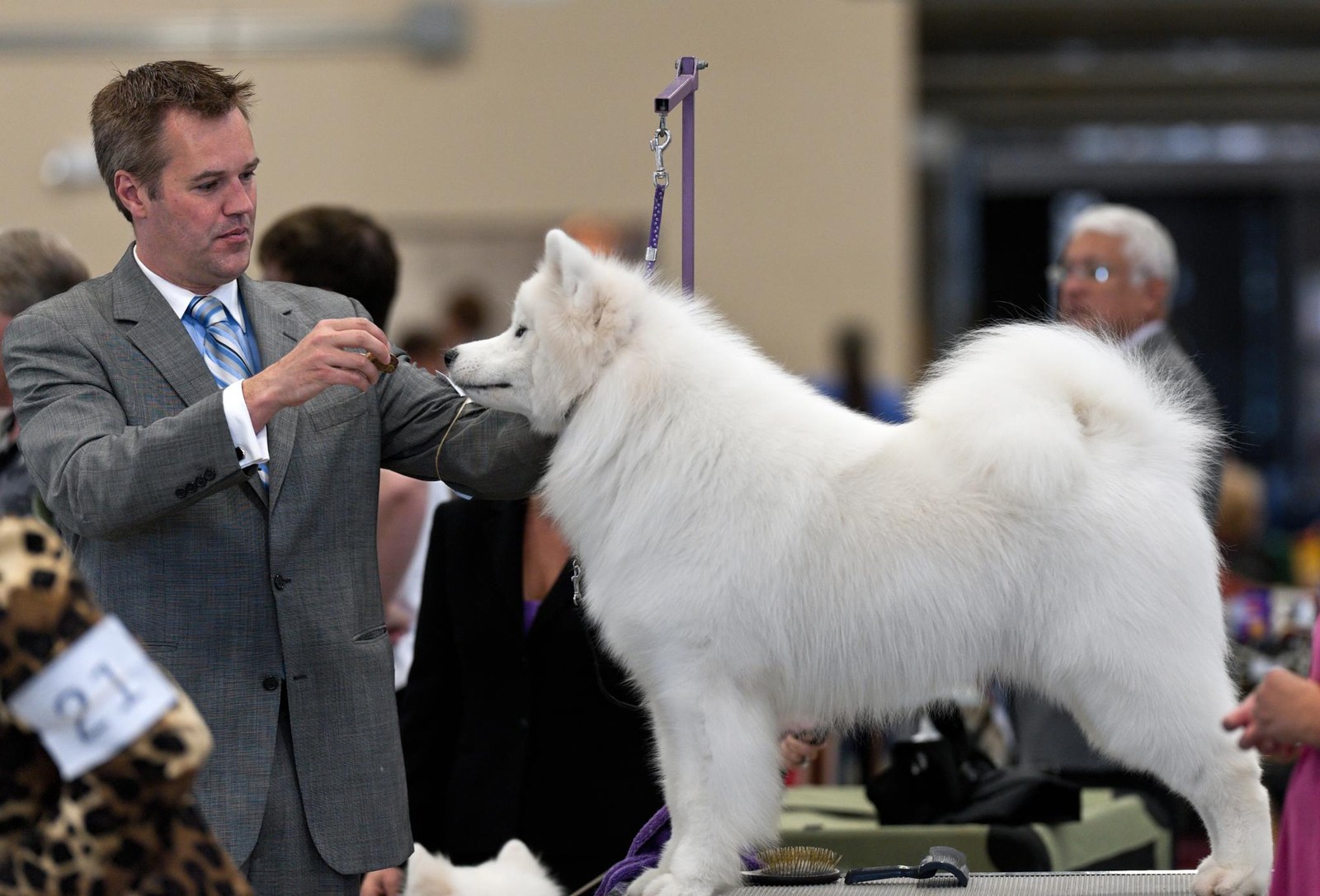

Do you have a better photo of a Samoyed in the American show ring? If you have a show photo you’d let us use, email it to [email protected] — tell us the dog’s name and the show, and it may be featured here. Please only send photos you took yourself or have the photographer’s permission to share, and tell us the photographer’s name.
1. Breed at a glance
Working — recognized by the AKC in 1906
Dogs 21–23½ in, bitches 19–21 in at the shoulder. Weight 45–65 lb (dogs), 35–50 lb (bitches).
Thick double coat. Pure white, white and biscuit, cream, or all biscuit.
Intelligent, gentle, loyal, adaptable, alert. Friendly but conservative.
High. Needs daily exercise and company — a social dog that hates being left alone.
Size, coat, and temperament facts are from the AKC standard. Lifespan (12 to 14 years) is the AKC’s figure (AKC Samoyed breed page).
2. History
The Samoyed traces its roots to the Samoyede peoples of northern Siberia, where the dogs were bred to herd reindeer and pull sleds, and were tightly integrated into human society — sleeping in the family tents at night. One of the “14 ancient breeds” most genetically similar to wolves, the modern Samoyed remains exceptionally social, loyal, and vocal, with a howl in which a distant — but not too distant — echo of the wolf can still be heard. The correct pronunciation is Sam-a-YED, accent on the last syllable; the dogs are also affectionately known as Sammies. (Source: Samoyed Club of America, The Samoyed.)
The breed reached the West in 1889, when the British zoologist Ernest Kilburn-Scott spent three months with the Samoyede people and brought a puppy home to England. Queen Alexandra of England became a devoted supporter, and her dogs appear in many kennels in Britain and the United States today. The first Samoyeds reached the United States in 1904, brought by the Princesse de Montglyon with four dogs, and Moustan of Argenteau became the first Samoyed registered with the AKC in 1906 — the year the AKC recognized the breed. His son became the first American champion Samoyed of record in 1907. (Sources: AKC Samoyed breed page; The New Complete Samoyed.)
The Samoyed Club of America was organized and chartered on February 14, 1923, and has been the AKC parent club for the breed since 1923; the first official American standard was adopted May 15, 1923. The breed was originally written “Samoyede” in both England and America; the final “e” was dropped by the English in 1923 and by the AKC in 1947. (Sources: AKC Samoyed breed page; McMagic Samoyeds, About the Samoyed.)
3. The standard and why it’s written that way
- Substantial but graceful. The AKC sums the breed up in a sentence: “a substantial but graceful dog standing anywhere from 19 to a bit over 23 inches at the shoulder. Powerful, tireless, with a thick all-white coat impervious to cold.” The standard adds the balance rule: “The Samoyed should never be so heavy as to appear clumsy nor so light as to appear racy. The weight should be in proportion to the height.” (Sources: AKC Samoyed breed page; AKC standard.)
- Size — one size, no miniature. “Males: 21 to 23½ inches; females: 19 to 21 inches at the withers. An oversized or undersized Samoyed is to be penalized according to the extent of the deviation.” Males in this height range weigh 45 to 65 pounds, females 35 to 50 pounds. (Source: AKC standard.)
- A double coat, quality over quantity. “The Samoyed is double coated. The body should be well covered with an undercoat of soft, short, thick, close wool with longer and harsh hair growing through it to form the outer coat, which stands straight out from the body and should be free from curl.” The illustrated standard adds: “The quality should be weather resistant and considered more than quantity. A droopy coat is undesirable.” (Source: AKC standard.)
- Color — white, cream, or biscuit only. “Samoyeds should be pure white, white and biscuit, cream, or all biscuit. Any other colors disqualify.” (Source: AKC standard.)
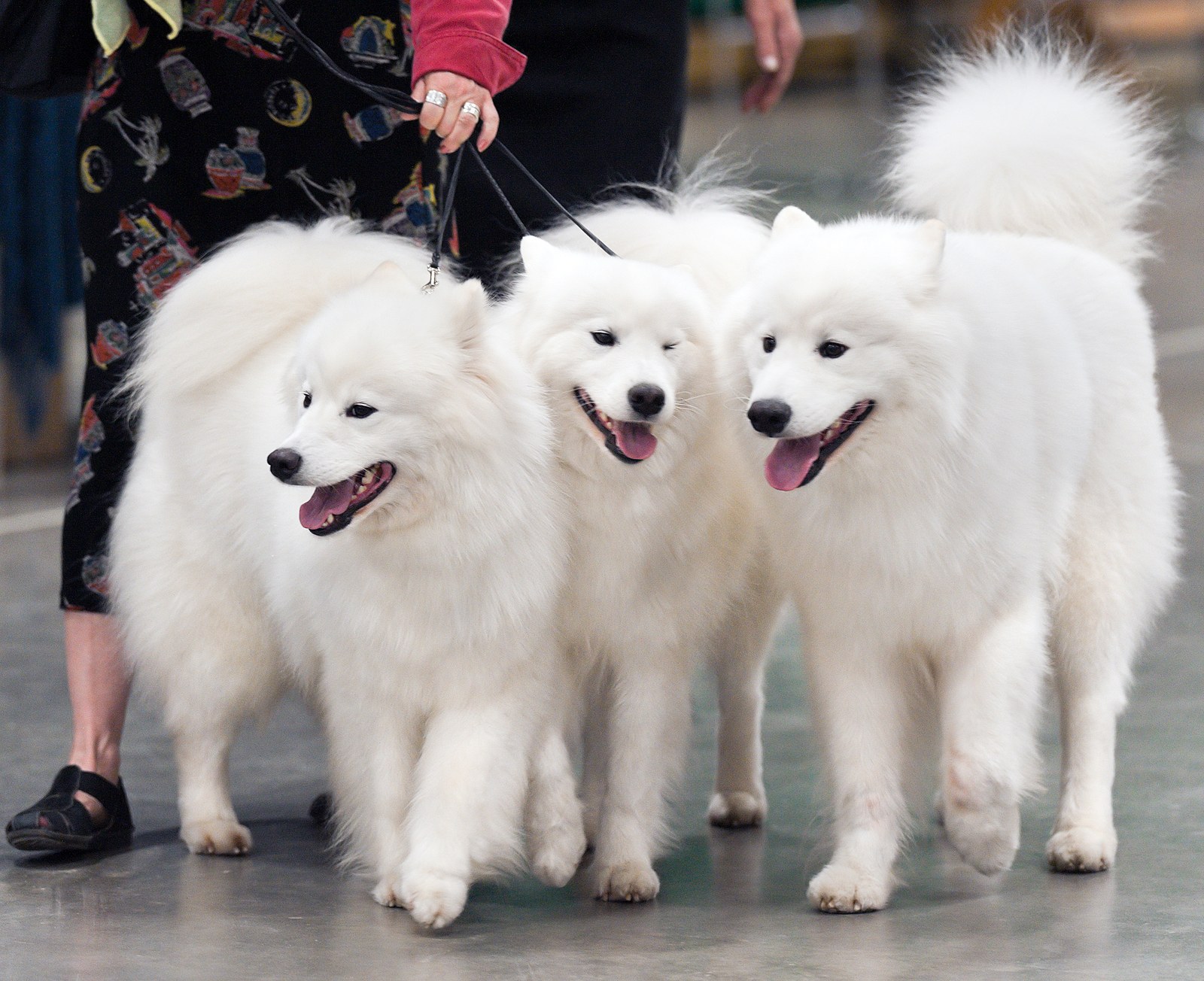
- The Sammy smile, with a job to do. The upturned corners of the mouth give the breed its famous “Sammy smile,” and the AKC notes the smile has a practical function: the upturned corners keep the dog from drooling — in Arctic cold, drool would freeze into icicles on the face. (Sources: AKC Samoyed breed page; Hill’s, Samoyed.)
- Disposition, in the standard’s own words. “Intelligent, gentle, loyal, adaptable, alert, full of action, eager to serve, friendly but conservative, not distrustful or shy, not overly aggressive. Unprovoked aggressiveness to be severely penalized.” (Source: AKC standard.)
- Disqualifications — two, and only two. “Any color other than pure white, cream, biscuit, or white and biscuit. Blue eyes.” (Source: AKC standard.)
4. Temperament & living with one
The parent club’s summary is the whole breed in a paragraph: a dog known for its striking white coat and friendly disposition, exceptionally social, loyal, and vocal, with a howl in which a distant echo of the wolf can still be heard. The AKC adds the working half of the picture: powerful, tireless, with a thick all-white coat impervious to cold — a dog that is perfectly beautiful but highly functional. A Samoyed was bred to work alongside people all day and sleep among them at night, and it still wants to be in the middle of its people, not out in the yard alone. (Sources: Samoyed Club of America, The Samoyed; AKC Samoyed breed page.)
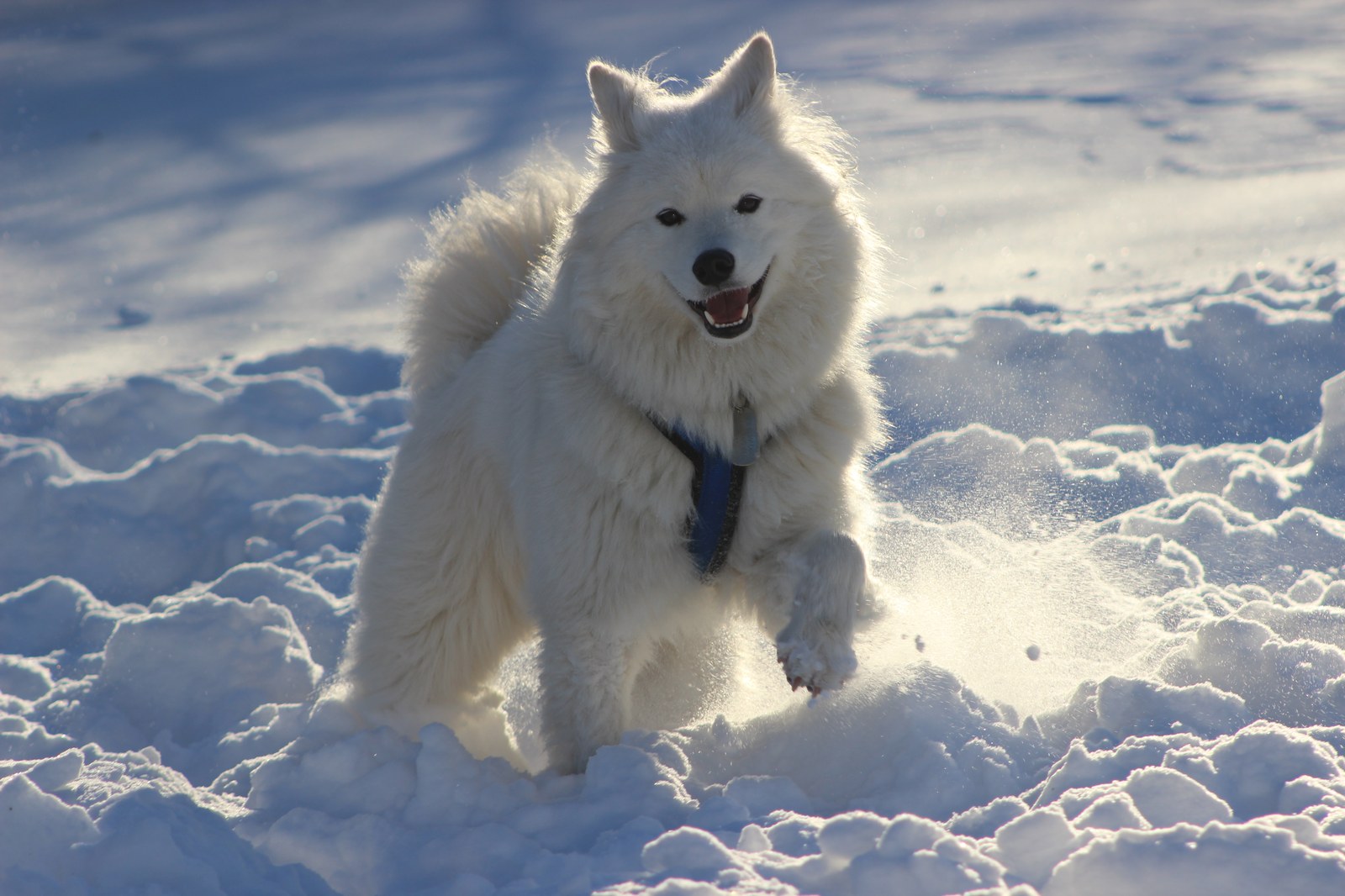
What that means in practice is a loud, social, high-energy companion. Samoyeds bark and howl, and they will tell you about the mail carrier, the squirrel, and their feelings in general. They need daily exercise and something to do with their brains — sports they enjoy include agility, obedience, rally, herding instinct work, weight pull, and pack hiking — and they do best with positive reinforcement and a job, not with harsh corrections. A bored Samoyed left alone in a yard is an unhappy Samoyed, and an unhappy Samoyed is a loud one. (Sources: Samoyed Club of America, The Samoyed; Hill’s, Samoyed.)
5. Grooming
- Two coats, one yearly blow. The magnificent white, cream, or biscuit coat has two layers: a dense, woolly undercoat, typically shed out once a year, and a coarser silver-tipped outer coat of long, straight guard hairs. Grooming this coat — a significant undertaking — occupies a prominent place in Samoyed care and lore. Expect heavy shedding, a daily brush during the yearly blow, and a weekly brush the rest of the year. (Source: Samoyed Club of America, The Samoyed.)
- Odorless, and it stands out. The coat is odorless, the outer coat coarse and long with silver-tipped guard hairs, and both coats should stand out from the body — a drooping coat is not typical of the breed. (Source: Samoyed Club of America, Appearance.)
- Not hypoallergenic. The heavy shedding and the yearly blow mean Samoyeds are not a hypoallergenic breed. Some allergic people tolerate them, some don’t, and there is no safe way to know without spending time around them. (Sources: Samoyed Club of America, The Samoyed; AKC Samoyed breed page.)
6. Health testing
- Five tests for a CHIC number. The Samoyed Club of America participates in the AKC’s Canine Health Information Center program. The parent club’s recommended tests for the breed are a hip evaluation, a cardiac exam, an ophthalmologist evaluation, and two DNA tests: Retinal Dysplasia/Oculoskeletal Dysplasia 2 (RD/OSD2) and Progressive Retinal Atrophy, X-Linked 1 (XLPRA1). Breeders must agree to have all test results, positive or negative, published in the CHIC database. (Source: AKC Working Group health testing requirements.)
- Eyes first. The eye is the breed’s watch list. Retinal dysplasia affects the development of the retina and can lead to vision problems or blindness, and progressive retinal atrophy is a degeneration of the retina that, in the worst cases, leads to blindness in old age. The RD/OSD2 and XLPRA1 DNA tests cover the two known inherited eye diseases in the breed, and the yearly ophthalmologist exam catches the rest — cataracts and glaucoma among them. Ask for the parents’ eye results as well as their DNA results, and look them up in the OFA database yourself. (Sources: AKC Working Group health testing requirements; Eskimoyed Samoyeds, Health.)
- Hips, heart, and the rest of the watch list. Hip dysplasia is the orthopedic disease to ask about, and the cardiac exam screens for the heart conditions that affect the breed. Diabetes is also reported in the breed. None of this is a reason not to own a Samoyed. All of it is a reason to buy from a breeder who tests: ask for the parents’ CHIC numbers and look the results up in the OFA database yourself, rather than taking a breeder’s word for it. Lifespan is 12 to 14 years. (Sources: AKC Working Group health testing requirements; Dog Breed Health, Samoyed; AKC Samoyed breed page.)
7. The annual Samoyed specialty dog show
A specialty is the breed’s All-Star show — its Super Bowl. Once a year, the best Samoyeds from across the country, and often from around the world, come together in one place.
The Samoyed Club of America’s national specialty: a full week at the MeadowView Conference Resort & Convention Center in Kingsport, Tennessee, with the conformation specialty at its center and Futurity, sweepstakes, obedience, rally, agility, Barn Hunt, FastCAT, weight pull, the Top 20, and the annual meeting and banquet around it. The 2026 week: October 4–10, with conformation October 6–10.
The 94th National Specialty — Saturday to Saturday, October 4–10, 2026, at the MeadowView Conference Resort & Convention Center, 1901 Meadowview Parkway, Kingsport, Tennessee. Conformation days: Tuesday, October 6 (Futurity, Working Sweepstakes, obedience, rally), Wednesday, October 7 (Sweepstakes and Veteran Sweepstakes), Thursday, October 8 (dog classes, Parade of Title Holders, 4–6 Month Beginner Puppy), Friday, October 9 (bitch classes, Top 20), Saturday, October 10 (intersex, juniors, Best of Breed). The Sunday, October 4 regional specialty (TN Classic) at the start of the week, with agility, Barn Hunt, and FastCAT at Eastman Park at Horse Creek. Entry: 312 Samoyeds (134 dogs, 178 bitches); 344 entries and 311 competitors across the national conformation event. Show Chair: Diana Hauser. Superintendent: Onofrio Dog Shows. (Sources: 2026 SCA National Specialty; 2026 SCA National Specialty premium list; AKC event search, event 2026202709.)
National specialty judges: Mr. Joe Deleo — intersex, Best Puppy in Puppy Classes, Best Bred-By-Exhibitor, Best Veteran, and Best Working. Ms. Tamiko Lynch — dogs, veteran dogs, stud dog, working dog, brace, and team. Mrs. Janet D. Cherne — bitches, veteran bitches, brood bitch, and working bitch. Mr. Adam P. Conn — Junior Showmanship and Pee Wee. Ms. Deanna Salter — Futurity. Ms. Pat Griffin — Sweepstakes and Veteran Sweepstakes. Ms. Donna Dannen — Working Sweepstakes. Ms. Tina Leininger — 4–6 Month Beginner Puppy. Mr. Richard H. Mullen — obedience. Ms. Leslye Pinnell — rally. (Sources: 2026 SCA National Specialty premium list; AKC event search, event 2026202709.)
Results (official, AKC event 2026202709). Best of Breed: GCHB CH Hylea Ode To Joi CA BCAT (bitch, owners L. Roark, E. Kuivinen, M. Levine). Best of Opposite Sex: GCHB CH Doubletake N Wintersong Roll For Initiative! (dog, owners D. Cummings, B. Burke, K. Cummings). Select Dog: GCHG CH Vanderbilt’s Lucky Day (owners J. Schuler, D. Schuler, J. Elford, B. Elford). Select Bitch: GCHB CH Pebbles Run Betty White With Moore Mcmagic (owner A. Kiell Green). Best of Winners and Winners Dog: Limelight On Such A Winter’s Day RN FDC DCAT THD CGC (dog, owners T. Hauck, S. Havran, G. Cashen). Winners Bitch: Vanderbilt’s Striking Reflection (owners T. Parry, J. Parry, J. Elford, B. Elford). Reserve Winners Dog: Articcross Alioth’s Glorious Purpose BN RE HT BCAT CGCA CGCU TKN FITS (owners K. Smith, J. Rydstrand). Reserve Winners Bitch: Snowbright ’N Vanderbilt’s Premier Producktion (owners R. Fealko, W. Fealko). Best Owner-Handled: GCHS CH Delmar Dreams’ Lovely Meter Maid (bitch, owners S. Hoover, A. Sandusky, M. Sandusky). Best Junior Handler: Savannah Martin; Reserve Best Junior Handler: Brielle Bolena. (Source: AKC event search, event 2026202709.)
Elements of the Standard: Best Male Head — MBIS MBISS GCHG CH Snowbright’s Fast Track to Stardom (owner Rachel Fealko). Best Female Head — Allusion and Painted Hills Stuck in the Permafrost (owner Shannon Herbert). Best Male Coat — CH Kalabria’s Sugar Maple at Diamond (owner Merrilee D’Antonio). Best Female Coat — GCh. O’blako’s And DzLedgendary Seawitch Slayer (owner Pam Freudig). (Source: SCA 2026 Elements of the Standard winners.)
The 2027 national specialty: September 20–25, 2027, at the Monument and DoubleTree Inn, Rapid City, South Dakota. Room rate $164, pet fee $50 for the whole stay, four dogs per room. (Source: Samoyed Club of America, SCA National.)
2026 SCA National Specialty — Samoyed Club of America
8. Regional specialties through the year: smaller regional shows
The national is the anchor, but the breed’s year also runs through regional specialties held by the Samoyed Club of America’s regional clubs — the Minuteman Samoyed Club, the Greater Milwaukee Samoyed Fanciers, the Samoyed Club of San Diego, the Buckeye Samoyed Club, the Greater Pittsburgh Samoyed Club, and the Samoyed Association of Madison. These are the 2027 regionals verified from club sources so far:
No regional specialties announced yet for 2027.
More regional specialties will be added here as their programs are verified — this section is built from show data, not guesswork. Browse upcoming show weekends →
9. Clubs
- Samoyed Club of America (parent club) — the AKC parent club for the breed in the United States since 1923. It runs the national specialty, held in Kingsport, Tennessee in 2026. President Kathleen Farlow, Show Chair Diana Hauser (2026). (Sources: Samoyed Club of America, SCA National; 2026 SCA National Specialty premium list.)
- Regional specialty clubs. The breed’s regional AKC specialty clubs include the Minuteman Samoyed Club (New England), the Greater Milwaukee Samoyed Fanciers, the Samoyed Club of San Diego, the Buckeye Samoyed Club (Ohio), the Greater Pittsburgh Samoyed Club, and the Samoyed Association of Madison (Wisconsin). (Source: Samoyed Club of America, Regional Clubs.)
If you are new to the breed, the national specialty itself is the better first stop than a breeder’s website: the people there have owned, shown, and worked Samoyeds, and they will tell you the truth about the coat and the voice before you fall for a puppy.
10. Rescue
- Start with National Samoyed Rescue. National Samoyed Rescue (NSR) was founded in the mid-1990s at the urging of the Samoyed Club of America, and supports regional Samoyed rescuers across the United States — volunteers who help owners work through problems, rehome Samoyeds when every other option has been explored, and work with shelters and animal control to rehabilitate and place neglected, lost, or abandoned Samoyeds. NSR’s rescue directory lists the verified rescuer for each state (1-888-NSR-SAM3). (Source: National Samoyed Rescue.)
- Adults and seniors. An adult or senior Samoyed can be a wonderful companion, often already housetrained and past the chew-everything stage, and ready to bond with a new family. What you get in return is a dog whose temperament you can see before you commit and a lower price than a puppy. If you bought your Samoyed from a responsible breeder, contact the breeder first — most responsible breeders include a take-back clause in their contracts and want to know if the dog needs help. (Source: National Samoyed Rescue, rescue directory.)
11. Breeder vs. rescue: honest guidance
- If you buy: start with the parent club, the Samoyed Club of America. Ask for the parents’ health results — hips, cardiac exam, eye exam, and the RD/OSD2 and XLPRA1 DNA tests — and look the results up in the OFA database yourself. Expect to wait for a puppy from a careful breeder. A good breeder will have the answers, will ask you as many questions as you ask them, and will take the puppy back for its whole life if you cannot keep it.
- If you rescue: a rescued Samoyed is usually an adult, often one whose owner underestimated the grooming and the company the breed requires, and it will arrive with a thick coat, a loud voice, and a need for people fully formed. What you get in return is a dog whose temperament you can see before you commit and a lower price. Either way, be honest with yourself first: a Samoyed needs daily exercise, regular brushing, and an owner who is home a lot and finds the shedding and the singing charming rather than infuriating. It is not a dog for a household that wants a quiet, low-maintenance, leave-alone companion.
- No rare color worth a premium. One thing that is not what a seller tells you: there is no such thing as a rare color worth a premium. The standard names four colors only — pure white, white and biscuit, cream, and all biscuit — and any other color disqualifies, as do blue eyes. The standard also describes one size only, 21 to 23½ inches for dogs and 19 to 21 for bitches, with no miniature variety. A breeder selling a “rare” black or brown Samoyed, or a “mini Samoyed,” at a premium is selling you a label.
12. Claim this page
This page belongs to the breed, and the people who know the breed best are the Samoyed Club of America and its members. If you are with the parent club — or you are a breeder, a judge, a handler, or a rescue volunteer who spotted something wrong, missing, or out of date — this page is yours to set straight. Tell us what needs fixing and where the correction is documented, and we will fix it and credit the source. Contact the site through the About page, and mention “Samoyed breed profile.”
Sources
- AKC Samoyed breed page — akc.org/dog-breeds/samoyed
- AKC Samoyed breed standard (approved August 10, 1993) — akc.org/wp-content/uploads/2024/08/Samoyed-Illustrated-Standard.pdf
- Samoyed Club of America, The Samoyed — samoyedclubofamerica.org/the-samoyed
- Samoyed Club of America, Appearance — samoyedclubofamerica.org/the-samoyed/in-depth/appearance
- Samoyed Club of America, SCA National — samoyedclubofamerica.org/showing-performance/sca-nationals
- Samoyed Club of America, Regional Clubs — samoyedclubofamerica.org/about-the-samoyed-club-of-america/regional-clubs
- 2026 SCA National Specialty — sca2026.com
- 2026 SCA National Specialty premium list — thepetadvisor.com/assets/premiums/2026/samoyed-club-of-america-national-2026.pdf
- 2026 National Specialty, AKC event search, event 2026202709 (official results) — apps.akc.org/apps/events/search/index_results.cfm
- 2026 Sunday regional specialty, AKC event search, event 2026202712 — apps.akc.org/apps/events/search/index_results.cfm
- SCA 2026 Elements of the Standard winners — sca2026.com/wp-content/uploads/2026/10/2026-elements-of-the-standard-winners.pdf
- AKC Working Group health testing requirements — akc.org/breeder-programs/breed-health-testing-requirements/working-group-health-testing-requirements
- National Samoyed Rescue — samoyedrescue.org
- National Samoyed Rescue, rescue directory — samoyedrescue.org/rescue_org.html
- Hill’s, Samoyed (lifespan, Sammy smile) — hillspet.ca/en-ca/dog-care/dog-breeds/samoyed
- McMagic Samoyeds, About the Samoyed (SCA chartered February 14, 1923) — mcmagicsamoyeds.com/about-the-samoyed
- Dog Breed Health, Samoyed (diabetes reported) — dogbreedhealth.com/samoyed