
Breed profile · Hound Group · the ancient sighthound of the desert
Saluki
The Saluki is the oldest of the sighthounds — a hunting hound of the Fertile Crescent, the royal dog of Egypt, and a breed whose standard has barely changed since it was written down in 1927. It is a dog of striking grace and symmetry: long and narrow in the head, deep-chested, tucked up, and built to kill gazelle over deep sand or rocky mountains at a speed few dogs can match. In the house it is the opposite of what it is in the field — gentle, dignified, quiet, and devoted. The AKC recognized the breed in 1927, the Saluki Club of America is the parent club, and the 2027 national is the breed’s centennial national.
Two varieties, one breed: the feathered and the smooth Saluki are varieties of a single breed, judged by the same standard — the smooth variety has the same points with no feathering. This page covers the breed as one — there is no separate page for either variety.
Help us improve it. This is one of ThePetAdvisor’s breed profiles, built from public sources with generous links to the people who actually own this breed’s knowledge. If something’s off or missing, the parent club can claim the page and set it straight — see the bottom of the page.
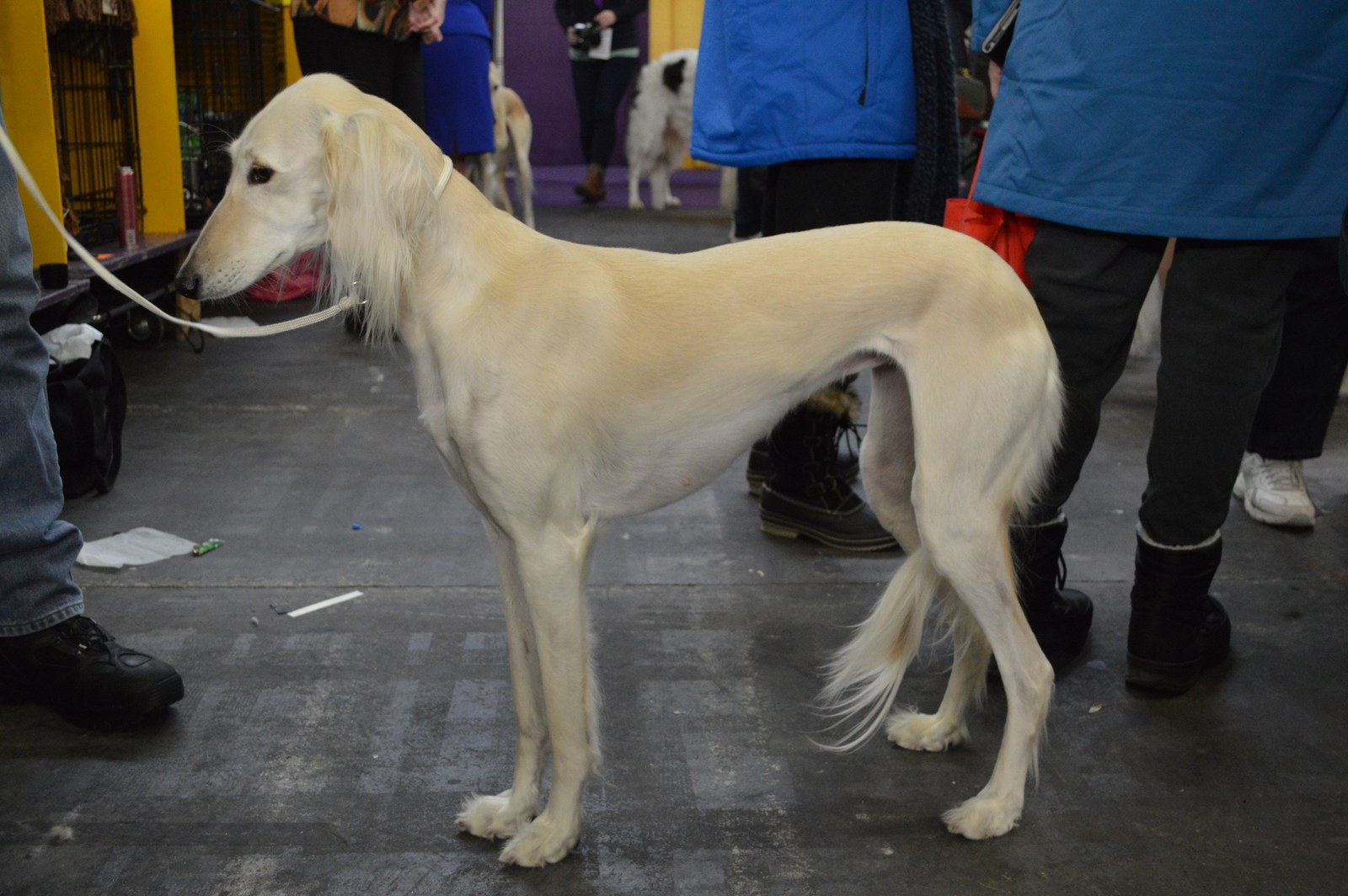

Do you have a better photo of a Saluki in the American show ring? If you have a show photo you’d let us use, email it to [email protected] — tell us the dog’s name and the show, and it may be featured here. Please only send photos you took yourself or have the photographer’s permission to share, and tell us the photographer’s name.
1. Breed at a glance
Hound Group; recognized by the AKC in 1927
Dogs 23–28 in at the shoulder; bitches considerably smaller; weight roughly 40–65 lb
Two varieties: feathered (silky feathering on ears, legs, thighs, tail) and smooth (no feathering); white, cream, fawn, golden, red, grizzle and tan, tricolor, black and tan
12–14 years
Gentle, dignified, loyal, independent, reserved with strangers
The first thing to understand about the Saluki is that it is two dogs in one body: a hunter and a companion, and the standard is written for both. In the field it is a coursing hound — swift, enduring, and independent enough to hunt at a distance from its handler. In the house it is quiet, sensitive, and devoted, a dog that wants to be near its people without making a fuss about it. The standard’s own summary says it plainly: the whole appearance should give an impression of grace and symmetry, of great speed and endurance coupled with strength and activity. Everything else in the standard — the long narrow head, the deep narrow chest, the tucked-up loin, the feathered tail carried in a curve — is there to make that sentence true. (Sources: Saluki Club of America, Official Standard of the Saluki; AKC, Saluki.)
2. History
The Saluki is one of the oldest breeds in the world. It was bred in the Fertile Crescent, the lands of the Middle East, as a hunting hound for gazelle and other quarry — a dog that hunted by sight, at speed, over deep sand and rocky mountains, often at a great distance from its handler. The breed was the royal dog of Egypt, depicted in tombs and honored as a gift, and its name is commonly traced to Saluq, an ancient city in Yemen. What is documented is the breed’s antiquity: no other breed’s standard reaches so far back, and the Saluki’s shape — long, narrow, deep-chested, tucked up — is the shape of a dog that has been doing the same job for thousands of years. (Sources: AKC, Saluki; Saluki Club of America, Official Standard of the Saluki.)
The breed came west through Britain. The Kennel Club recognized the Saluki in 1923, the same year the first breed club was established, and the British 1923 standard was the first official European breed standard for the Saluki. The American story starts four years later: the AKC recognized the breed in 1927, and the Saluki Club of America was founded in 1927 in conjunction with recognition, submitting the American standard that year — the standard still in use today, essentially unchanged. A century later the breed is marking that anniversary: the AKC Museum of the Dog is mounting “Salukis and the Dogs of the Desert,” January 20–June 20, 2027, to celebrate 100 years of AKC recognition, and the 2027 national specialty at Purina Farms is the breed’s centennial national. (Sources: AKC, Saluki; Saluki Club of America, Official Standard of the Saluki; Saluki National, Saluki Club of America.)
The American Saluki has always been two things at once: a show dog and a working coursing hound. The parent club holds a Desert Bred Exhibition at its national every year for Salukis imported from their countries of origin — dogs registered through the Society for the Perpetuation of Desert Bred Salukis (SPDBS), which acts as the AKC import registry for country-of-origin imports and their progeny — and the national specialty week runs lure coursing, agility, and a triathlon alongside the conformation judging. That double life is the point of the breed: a Saluki that cannot course is not a Saluki, whatever it looks like standing still. (Sources: Saluki Club of America, Desert Bred; 2025 national judging program (BaRay Event Services).)
3. The standard and why it is written that way
- General appearance — grace and symmetry, speed and endurance. “The whole appearance of this breed should give an impression of grace and symmetry and of great speed and endurance coupled with strength and activity to enable it to kill gazelle or other quarry over deep sand or rocky mountains. The expression should be dignified and gentle with deep, faithful, far-seeing eyes.” The standard opens with the job because the job explains the shape: everything that follows is there to let the dog run far and fast and still come home sound. (Source: Saluki Club of America, Official Standard of the Saluki.)
- Size, proportion & substance — tall, narrow, and light. Dogs should average in height from 23 to 28 inches, and bitches may be considerably smaller, this being very typical of the breed. The body is approximately square — length from point of shoulder to point of buttock roughly equal to height at the withers — though the dog often gives the impression of being longer than it really is. Weight is roughly 40 to 65 lb, and the dog should look light and leggy, never coarse or heavy. (Sources: Saluki Club of America, Official Standard of the Saluki; AKC, Saluki.)
- Head — long and narrow, with long silky ears and far-seeing eyes. Head long and narrow, skull moderately wide between the ears, not domed, stop not pronounced, the whole showing great quality. Nose black or liver. Ears long and covered with long silky hair, hanging close to the skull and mobile. Eyes dark to hazel and bright, large and oval, but not prominent. Teeth strong and level. The expression the standard asks for is dignified and gentle, with deep, faithful, far-seeing eyes — the look of a dog that hunts at a distance and watches the horizon. (Source: Saluki Club of America, Official Standard of the Saluki.)
- Neck, topline, body & tail — a long supple neck and a tail carried in a curve. Neck long, supple, and well muscled. Chest deep and moderately narrow. Back fairly broad, muscles slightly arched over the loin, with a good tuck-up underneath. Tail long, set on low and carried naturally in a curve, well feathered on the underside with long silky hair, not bushy. (Source: Saluki Club of America, Official Standard of the Saluki.)
- Forequarters & hindquarters — sloping shoulders, long straight legs, low hocks. Shoulders sloping and set well back, well muscled without being coarse. Forelegs straight and long from the elbow to the knee. Hindquarters strong, hipbones set well apart, stifle moderately bent, hocks low to the ground, showing galloping and jumping power. The hindquarters are where the speed lives: a Saluki gallops with a double-suspension gallop, and low hocks are what let it do it without breaking down. (Source: Saluki Club of America, Official Standard of the Saluki.)
- Feet — long, arched toes, feathered between. Feet of moderate length, toes long and well arched, not splayed out, but at the same time not cat-footed; the whole being strong and supple and well feathered between the toes. The foot is a working foot — long toes for grip on sand and rock, feathering for protection, and never the tight cat foot of a terrier. (Source: Saluki Club of America, Official Standard of the Saluki.)
- Coat — smooth and silky, with feathering on the feathered variety. Coat smooth and of a soft silky texture, slight feather on the legs, feather at the back of the thighs, and sometimes slight woolly feather on the thigh and shoulder. In the smooth variety the points should be the same with the exception of the coat, which has no feathering. Puppies may have slight woolly feathering on the thighs and shoulders. (Source: Saluki Club of America, Official Standard of the Saluki.)
- Color — white, cream, fawn, golden, red, grizzle and tan, tricolor, black and tan. The standard’s color list is short and specific, and every color on it is equally acceptable — a white Saluki, a red Saluki, a black-and-tan Saluki, and a tricolor are all equally correct, and no color is worth a premium. Brindle is not among the listed colors. (Source: Saluki Club of America, Official Standard of the Saluki.)
- Gait & temperament — effortless speed, and a reserved dignity. The gait is the point of the dog: light, effortless, and covering ground at a speed few breeds can match, with the double-suspension gallop of a coursing hound. The temperament the FCI standard describes is reserved with strangers, but not nervous or aggressive — dignified, intelligent, and independent. (Sources: Saluki Club of America, Official Standard of the Saluki; AKC, Saluki.)
4. Temperament & living with one
The AKC’s summary is three words: gentle, dignified, independent-minded. The FCI standard’s version is nearly the same: reserved with strangers, but not nervous or aggressive; dignified, intelligent, and independent. Both are describing a dog that was bred to hunt at a distance from its handler and make its own decisions in the field — and then come home and lie quietly at its person’s feet. (Sources: AKC, Saluki; Saluki Club of America, Official Standard of the Saluki.)
- With its own people: devoted and quietly affectionate, often bonding most strongly to one person. A Saluki leans on its people rather than doting on them — it wants to be in the same room, on the same sofa, at the foot of the same bed, without needing constant physical contact or reassurance. It is a velcro dog in a whisper, not a shout.
- With strangers: reserved and aloof rather than openly friendly. A Saluki will shy away from attention from unfamiliar people, and it is never aggressive about it — it simply keeps its distance. It is not a watchdog and will not guard the house; early and thorough socialization is what keeps that reserve from becoming timidity.
- Training: intelligent and sensitive, quick to learn and quick to be put off. A Saluki should never be trained using force or harsh methods — it notices tension and frustration and shuts down under them. It responds to gentle, consistent training and to praise, and it gets bored easily, so short sessions and variety beat drilling. It does not enjoy rough games or typical dog games such as retrieving balls.
- Exercise: a sprinter, not a jogger. A Saluki needs daily chances to run at full speed in a safely fenced area, and lure coursing is the sport it was made for. Leashed walks keep it fit; they do not satisfy it. What it does not need is a yard it can escape from — a Saluki that sees something worth chasing will chase it, and it can jump and climb better than most owners expect.
- Prey drive: the breed’s one significant management concern. The hunting instinct is triggered by the sight of any smaller animal running, so a Saluki should never be off leash outside a fenced area, and introductions to cats and small pets need care and supervision. This is not aggression — it is the job the breed was made for, still running in the dog in front of you.
- Children & other pets: good with gentle older children and generally good with other dogs, preferably other Salukis or other sighthounds. The thin skin and bony prominences that make the breed elegant also make it breakable, so young children must be taught to be gentle and rough play is out. Small pets are a separate question — see prey drive, above.
- Barking: a quiet breed. A Saluki is generally not vocal and will alert its owner to strangers without making a habit of it — one of the reasons the breed suits quiet households.
5. Grooming
Grooming a Saluki is one of the breed’s easiest parts — the coat is short, silky, and shown clean and natural, with no sculpting and no trimming the feathering into shapes. The work is mostly in the feathering, the ears, and the feet. (Source: Saluki Club of America, Official Standard of the Saluki.)
- Feathered variety: brush the feathering on the ears, legs, thighs, and tail regularly — several times a week — to keep it from tangling and matting. The feathering is the breed’s ornament, and it is also the part that picks up burrs, mud, and tangles on every run.
- Smooth variety: the smooth coat needs little more than a wipe-down and an occasional bath. It sheds lightly, has no doggy odor to speak of, and dries fast after a wet run.
- Bathing: bathe when the dog is dirty, not on a schedule. The silky coat does not hold dirt the way a double coat does, and over-bathing strips the coat’s natural softness.
- Ears: the long, feathered ears need regular checking and cleaning — the feathering traps moisture and debris, and the ear leather hangs close to the skull, so air circulation is poor. Check them after every run through long grass.
- Feet & nails: trim the nails regularly — the long, arched toes make overgrown nails obvious and uncomfortable — and check the feathering between the toes for burrs, thorns, and matting after every outing.
- Teeth: brush regularly and have the vet check the mouth at every visit. The standard asks for strong, level teeth, and a coursing hound needs them.
6. Health testing
The Saluki CHIC program was established in September 2023. The parent club’s recommended tests are an advanced cardiac echocardiogram, a DNA test for Neuronal Ceroid Lipofuscinosis type 8 (NCL8), and a DNA test for Succinic Semialdehyde Dehydrogenase Deficiency (SSADHD, also called Saluki encephalopathy). An eye exam is an elective part of the program and is worth doing. A CHIC number confirms the testing was done and published — it is not a guarantee of health. (Sources: Hayat Salukis, Saluki Health; UC Davis Veterinary Genetics Laboratory, Saluki Encephalopathy.)
- Cardiac echocardiogram — the big one. Salukis are prone to several heart problems, most often valve leakage that may or may not affect them through their lives, and also dilated cardiomyopathy, arrhythmia, and patent ductus arteriosus. Athletic hearts are common in the breed, and an echocardiogram is the best way to tell whether a murmur has an innocent cause or not. At the very least, breeding stock should have an advanced echocardiogram on file, preferably within the last year or two. (Source: Hayat Salukis, Saluki Health.)
- Neuronal Ceroid Lipofuscinosis type 8 (NCL8) DNA test. NCL8 is a progressive neurodegenerative disease caused by a mutation in the CLN8 gene. The first signs are usually seen at 10 to 18 months of age — ataxia, behavioral changes, vision loss, and seizures — and the condition is progressive; affected dogs rarely live past two years. It is autosomal recessive, so a DNA test tells a breeder whether a dog is clear, a carrier, or affected. (Sources: Hayat Salukis, Saluki Health; Genomia, NCL8 in Saluki.)
- Succinic Semialdehyde Dehydrogenase Deficiency (SSADHD) DNA test. SSADHD, also called Saluki encephalopathy, is a heritable neurological disorder caused by a missense variant in the ALDH5A1 gene. Affected puppies typically show seizures, an exaggerated gait, and abnormal behaviors such as episodes of vocalization within the first 10 weeks of life. It is autosomal recessive, so a DNA test tells a breeder whether a dog is clear, a carrier, or affected. (Source: UC Davis Veterinary Genetics Laboratory, Saluki Encephalopathy.)
- Eye exam. The eye exam by a board-certified ophthalmologist is an elective part of the Saluki CHIC program and a worthwhile test — it is usually cheap, and it screens for hereditary eye disease. (Source: Hayat Salukis, Saluki Health.)
- Also ask about thyroid. Thyroid evaluation is part of a thorough screening program for the breed. Ask whether the breeder tests for autoimmune thyroiditis and registers the results with OFA.
- Cancer is the breed’s shadow. Hemangiosarcoma and lymphoma are the causes of death in the Saluki population more frequently than most other causes, and there are no genetic tests for them. No breeder can test their way out of this risk — what a careful breeder can do is know their lines, be honest about what they have lost dogs to, and contribute to the OFA DNA repository so future researchers can find the genetic links. (Source: Hayat Salukis, Saluki Health.)
- Degenerative myelopathy carriers occur, with little disease. Salukis will sometimes test positive as carriers of the degenerative myelopathy gene, as in many breeds, but there do not seem to be many instances of Salukis succumbing to the disease. A carrier result is worth knowing about, not worth panicking over. (Source: Hayat Salukis, Saluki Health.)
7. The annual Saluki specialty dog show
A specialty is the breed’s All-Star show — its Super Bowl. Once a year, the best Salukis from across the country, and often from around the world, come together in one place.
The Saluki Club of America’s national specialty: one national event each year, a week-long gathering at Purina Farms in Gray Summit, Missouri, in early June — conformation, sweepstakes, junior showmanship, obedience, rally, lure coursing, agility, and futurity, plus a Desert Bred Exhibition. The 2026 national: June 1–6, with Best of Breed going to GCHG CH Sandstorm N Balor Dream On. The 2027 national: June 10–12 — the breed’s centennial national, 100 years after AKC recognition in 1927.
The standard, in brief: the whole appearance should give an impression of grace and symmetry, of great speed and endurance coupled with strength and activity. Dogs average 23 to 28 inches at the shoulder; bitches may be considerably smaller. Two varieties — feathered, with silky feathering on the ears, legs, thighs, and tail, and smooth, with no feathering. Colors: white, cream, fawn, golden, red, grizzle and tan, tricolor, and black and tan.
The 2026 National Specialty — Monday, June 1–Saturday, June 6, 2026, at Purina Farms, 300 Checkerboard Drive, Gray Summit, Missouri. The national week ran June 1–6, with most dogs present Thursday–Saturday; an AKC agility trial for the club was held Tuesday, June 2, at Purina Farms (AKC event 2026134007). Superintendent: Foy Trent Dog Shows. (Sources: Saluki National, Saluki Club of America; AKC event search, event 2026134007.)
Best of Breed at the 2026 national was GCHG CH Sandstorm N Balor Dream On FDC JC FCAT CGC TKN ATT FITB, bred by Kathy Morton and owned by Rachel Wilson, Kathy Morton, and Tami Bradford. The Esther Bliss Knapp Bred By Trophy for 2026 went to Sterling Avalon. The 2026 Friend of the Saluki Award went to Cheri Fehrman, founder of the Saluki Tree of Life Alliance (STOLA). (Sources: Saluki National, Saluki Club of America; Westminster Kennel Club, 2027 Westminster Invitees; Saluki Club of America, Esther Bliss Knapp Bred By Trophy.)
The 2026 national specialty judges, AKC event number, entry, and closing date were not confirmed in an official source as of November 7, 2026, and are not stated here.
Results (2026 national). Best of Breed: GCHG CH Sandstorm N Balor Dream On FDC JC FCAT CGC TKN ATT FITB. Best of Opposite Sex, Best of Winners, and the entry were not confirmed in an official source as of November 7, 2026.
The 2027 National Specialty: a three-day event on Thursday, June 10–Saturday, June 12, 2027, at Purina Farms, Gray Summit, Missouri, as part of national week, Tuesday, June 8–Saturday, June 12, 2027. Superintendent: Foy Trent Dog Shows. The 2027 national is the breed’s centennial national, marking 100 years since the AKC recognized the Saluki in 1927. Judges, AKC event number, entries, and closing date not yet published as of November 2026. (Sources: AKC Upcoming National Specialties; Saluki National, Saluki Club of America.)
Past national specialties: 2025 · 2024 · 2023
Saluki Club of America — salukiclub.org
8. Regional specialties through the year: smaller regional shows
The national is the anchor, but the breed’s year also runs through regional specialties — smaller regional shows, not the national — held around the country. These are the 2026 regionals verified from club and AKC sources so far:
Four regional Saluki specialties verified for 2026 so far:
- Saluki Club of America regional independent specialty — Friday, June 12, 2026: held with the Three Hound Group Shows, June 12–14, 2026. Judge: Mr. Stephen Wailes (breed); sweepstakes judge: Ms. Stephanie Hawkins.
- Northern Cascades Saluki Fanciers, two specialties — Friday, July 31, 2026, Auburn, Washington: at Run Wild Dog Sports & Training Center, 35612 212th Way SE (AKC events 2026271901 and 2026271902).
- Central Arizona Saluki Association, 56th and 57th specialties — Thursday, January 29, 2026: back-to-back independent specialties, with the Saluki League of Southern Arizona concurrent specialty on Friday, January 30, 2026, at the Heart of the Desert Classic.
- Saluki Club of Greater San Francisco, 60th, 61st, and 62nd specialties — Friday–Sunday, October 2–4, 2026, Turlock, California: at the Stanislaus County Fairgrounds, 900 N Broadway (AKC events 2026079101, 2026079102, and 2026079104).
Past regional specialties: 2025 · 2024
More regional specialties will be added here as their programs are verified — this section is built from show data, not guesswork. Browse upcoming show weekends →
9. Clubs
- Saluki Club of America (SCOA) (parent club) — founded in 1927, the year the AKC recognized the breed, and the AKC-recognized national breed club for the Saluki ever since. It maintains the breed standard, holds the national specialty each year at Purina Farms, runs a breeder referral network, and holds a Desert Bred Exhibition at the national for country-of-origin imports. The national specialty site is salukinational.org. (Sources: Saluki Club of America; Saluki National.)
- American Saluki Association — a national specialty club for the breed, publisher of the breed standard and breed education material. (Source: American Saluki Association, Standard.)
- Willamette Valley Saluki Club — an AKC-licensed specialty club for Oregon’s Willamette Valley, holding specialties each June in Hillsboro, Oregon. (Sources: AKC event search, event 2025290801; Willamette Valley Saluki Club.)
- Northern Cascades Saluki Fanciers — an AKC specialty club for Washington State, holding specialties in Auburn, Washington. (Source: Northern Cascades Saluki Fanciers premium list, 2026.)
- Central Arizona Saluki Association — an AKC specialty club for Arizona, holding back-to-back specialties each January at the Heart of the Desert Classic. (Source: Heart of the Desert Classic, Saluki premium list.)
- Saluki League of Southern Arizona — an AKC specialty club for southern Arizona, holding a concurrent specialty with the Central Arizona club each January. (Source: Heart of the Desert Classic, Saluki premium list.)
- Saluki Club of Greater San Francisco — an AKC specialty club for the San Francisco Bay Area, holding three specialties each October in Turlock, California. (Source: Saluki Club of Greater San Francisco premium list, 2026.)
10. Rescue
- Saluki Tree of Life Alliance (STOLA). The national Saluki rescue organization, a 501(c)(3) founded in 2000 by Cheri Fehrman. An all-volunteer nonprofit whose two purposes are education about the breed and rehoming Salukis: it saves Salukis from kill shelters, abusive situations, and natural disasters, heals their physical and emotional wounds, and places them in loving adoptive homes, working with breeders to rehome adults returned to the breeder. Adoption runs on an application with interviews and site visits, costs $495 for Salukis up to 9 years old and $395 for Salukis 9 and older, and comes with ongoing mentorship for new adopters. By 2023 STOLA had rescued about a thousand Salukis. (Sources: Saluki Tree of Life Alliance; Saluki Club of America.)
- AKC Rescue Network. The AKC’s rescue network lists Saluki rescue contacts, and the parent club is the first stop if you do not know which rescue covers your area.
- Rescued Salukis are usually adults. A rescued Saluki is usually an adult, and it will arrive with its temperament visible before you commit — including whether it is the quietly devoted kind or the more independent kind, and whether it can live with cats and small pets. A rescue is the honest first stop if you want the breed without the puppy wait, and STOLA’s mentorship means a first-time Saluki owner is not left to figure the breed out alone.
11. Breeder vs. rescue: honest guidance
- If you buy: start with the parent club, the Saluki Club of America — contact the club directly for a breeder referral — and ask for the parents’ health-test results — an advanced cardiac echocardiogram, an NCL8 DNA test, and an SSADHD DNA test — and look the results up in the OFA database yourself. Expect to wait for a puppy from a careful breeder: a good breeder will have the answers, will ask you as many questions as you ask them, and will take the puppy back for its whole life if you cannot keep it.
- If you rescue: a rescued Saluki is usually an adult, and it will arrive with its temperament visible before you commit. Be honest with yourself first: a Saluki needs a safely fenced place to run, daily companionship, and patient training from day one — not a yard it can escape from and a hope.
- Watch out for “rare color” marketing. The standard lists white, cream, fawn, golden, red, grizzle and tan, tricolor, and black and tan — no color is rare and no color is worth a premium. Brindle is not among the standard’s listed colors. A seller charging extra for a color is selling you a story, not a better dog.
- Watch out for variety marketing. Feathered and smooth are two varieties of one breed, judged by the same standard. Neither is rarer, better, or worth a premium over the other, and a “smooth” puppy from feathered parents is not a fault or a bargain — it is simply the smooth variety.
- Fence honesty: a Saluki that can see something worth chasing will chase it, and a four-foot fence is a suggestion, not a barrier, to a dog that can jump and climb. Before you buy or adopt, walk your fence line honestly. An underground or invisible fence will not hold a Saluki that has decided to run.
- Small-pet honesty: a Saluki can live happily with another Saluki and with respectful dogs, but its chase instinct is triggered by small animals running. If you have cats, rabbits, or small dogs, ask the breeder or rescue directly how the individual dog has lived with them — do not assume the breed’s gentleness with people extends to small prey animals.
- Desert-bred honesty: the parent club also recognizes desert-bred Salukis — dogs imported from their countries of origin, registered through the Society for the Perpetuation of Desert Bred Salukis (SPDBS), which acts as the AKC import registry. A desert-bred Saluki is a genuine Saluki, shown in its own exhibition at the national specialty, but it may be less socialized to American show and pet life than a kennel-bred dog. Ask what the dog’s background is before you commit.
12. Claim this page
This page belongs to the breed, and the people who know the breed best are the Saluki Club of America and its members. If you are with the parent club — or you are a breeder, a judge, a handler, or a rescue volunteer who spotted something wrong, missing, or out of date — this page is yours to set straight. Tell us what needs fixing and where the correction is documented, and we will fix it and credit the source. Contact the site through the About page, and mention “Saluki breed profile.”
Sources
- Saluki Club of America, Official Standard of the Saluki (submitted by the Saluki Club of America, 1927)
- AKC, Saluki
- AKC, Upcoming National Specialties
- Saluki National, Saluki Club of America (2027 national dates; 2026 national winner)
- Westminster Kennel Club, 2027 Westminster Invitees
- 2025 national judging program (BaRay Event Services)
- 2025 preliminary breed counts (BaRay Event Services)
- 2024 preliminary breed counts (BaRay Event Services)
- AKC event search, event 2023134005 (2023 national)
- AKC event search, event 2026134007 (2026 agility)
- Willamette Valley Saluki Club judging program, 2025
- Northern Cascades Saluki Fanciers premium list, 2026
- Heart of the Desert Classic, Saluki premium list (Central Arizona / Southern Arizona)
- Saluki Club of Greater San Francisco premium list, 2026
- Three Hound Group Shows judging program, 2026 (SCOA regional specialty)
- Saluki Club of America, Esther Bliss Knapp Bred By Trophy
- Saluki Club of America, Desert Bred
- American Saluki Association, Standard
- Hayat Salukis, Saluki Health
- UC Davis Veterinary Genetics Laboratory, Saluki Encephalopathy (SSADHD)
- Genomia, NCL8 in Saluki
- Saluki Tree of Life Alliance (STOLA)
- Wikimedia Commons, Salukis-14-GCH-Gemini Julia 01 (hero photo, CC BY 2.0, Pets Adviser)
- Furry Critter, Saluki