
Breed profile · Toy Group · the small elegant toy in smooth and long-coated varieties
Russian Toy
The Russian Toy is a small, elegant toy dog — lively and long-legged, with fine bone and lean muscle, big erect ears, and two coat varieties: smooth and long-coated. One of the smallest breeds in the Toy Group, it was a companion of the Russian aristocracy before it nearly vanished twice, and it came to full AKC recognition only in 2022.
Two coat varieties. The Russian Toy comes in two coat varieties — smooth and long-coated — judged together as one breed. The photo leading this page shows the long-coated variety: note the fringed ears and the plumed tail.
Help us improve it. This is one of ThePetAdvisor’s breed profiles, built from public sources with generous links to the people who actually own this breed’s knowledge. If something’s off or missing, the parent club can claim the page and set it straight — see the bottom of the page.
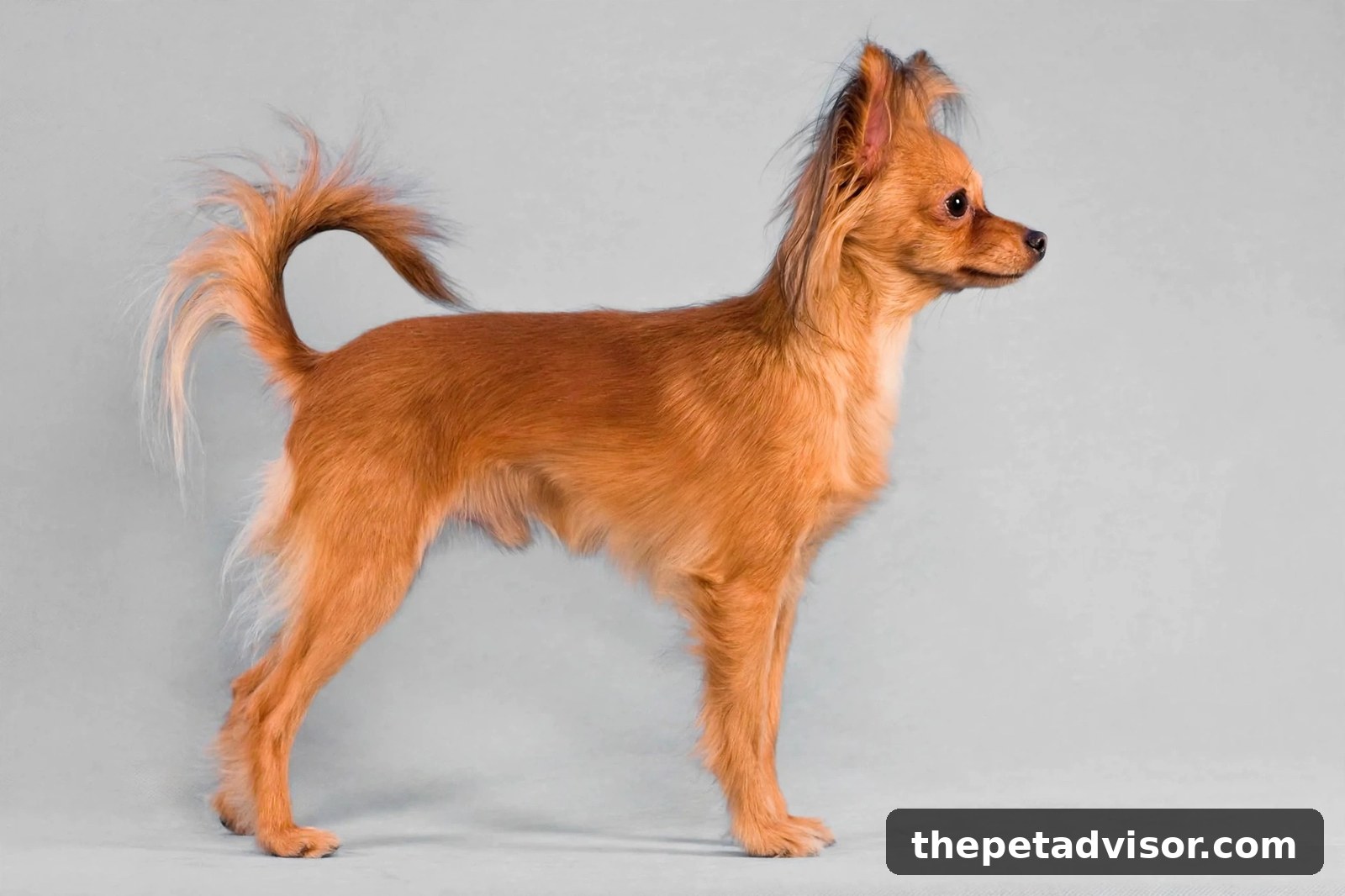
Do you have a photo of a Russian Toy in the American show ring? We’d love this page to lead with one. If you have a show photo you’d let us use, email it to [email protected] — tell us the dog’s name and the show, and it may be featured here. Please only send photos you took yourself or have the photographer’s permission to share, and tell us the photographer’s name. We couldn’t find a public photo of a Russian Toy in the American show ring that we were free to share, so the photo leading this page was made with AI. We’d much rather lead with a real one — if you’re a club member with an approved photo, we’d love to feature it.
1. Breed at a glance
The Russian Toy is a small, elegant toy dog — lively and long-legged, with fine bone and lean muscle. It is active and cheerful, keenly intelligent, and slightly aloof with strangers, neither cowardly nor aggressive. The breed comes in two coat varieties, smooth and long-coated, and it is one of the smallest breeds in the Toy Group. (AKC, Official Standard of the Russian Toy.)
- AKC group
- Toy; recognized 2022
- Size
- Height 8–11 in; weight up to 6½ lb
- Coat & color
- Two varieties — smooth and long-coated; six colors: black and tan, chocolate and tan, blue and tan, red, red sable, red brown
- Lifespan
- 12–14 years
- Temperament
- Active, cheerful, keenly intelligent, slightly aloof to strangers
- Parent club
- Russian Toy Club of America
2. History
The Russian Toy descends from the English Toy Terriers that were fashionable with the Russian aristocracy in the 18th and 19th centuries — one even belonged to Peter the Great, whose terrier Lizetta, dated 1716–1726, is on display in the Museum of Zoology in St. Petersburg. The dogs were shown in St. Petersburg as early as 1874, when eight smooth-coated dogs were entered, and the more generally accepted first reference is May 1907, when eleven were shown at an exhibition there. (Source: Wikipedia, Russkiy Toy.)
The breed nearly vanished twice: first in the 1920s, when the revolution made a toy dog of the aristocracy a liability, and again in the 1990s, when foreign breeds flooded in after the fall of the Iron Curtain. It was rebuilt by Moscow breeders — and the long-coated variety began with a single puppy, Chikki, born October 12, 1958, to two smooth-coated dogs, under breeder Yevgeniya Fominichna Zharova. Chikki became the foundation of the Moscow Long-Haired Toy Terrier. The first standard for the two varieties was written in 1966, and the Russian Kynological Federation brought both varieties together under one unified standard in 1988. (Source: Wikipedia, Russkiy Toy.)
The FCI gave the breed provisional recognition in 2006 — dropping “Terrier” from its name, so the breed became the Russkiy Toy — and definitive recognition in 2017; the Kennel Club in Britain recognized it the same year. In the United States, the Russian Toy Club of America was founded in 2008, the AKC accepted the breed into the Foundation Stock Service in August 2008, and it was approved to compete in companion events from January 1, 2010. Full AKC recognition came January 1, 2022, in the Toy Group, with eligibility from December 29, 2021. The first independent national specialty followed that June, in Richardson, Texas. (Sources: Wikipedia, Russkiy Toy; AKC, FSS News & Updates.)
3. The standard and why it is written that way
The standard’s first line is the whole breed in one sentence: a small, elegant dog, lively, long-legged, with fine bone and lean muscles — active and cheerful, with keen intelligence. The dog is square in outline, and the standard is a head, ears, and coat standard: the small head, the big erect ears, and the two coat varieties are what make a Russian Toy. (AKC, Official Standard of the Russian Toy, approved July 14, 2017, effective June 27, 2018.)
- General appearance: a small, elegant dog, lively, long-legged, with fine bone and lean muscles. Active, cheerful, keenly intelligent, slightly aloof to strangers, neither cowardly nor aggressive.
- Head — the breed’s defining feature: small, with quite large, rounded, dark, slightly prominent eyes. The ears are big, thin, set high, and erect, triangular in shape. Bite scissors.
- Size & body: height 8 to 11 inches, weight up to 6½ pounds. The body is square in outline, with a level topline. Height over 12 inches or under 7 inches is a disqualification, as is weight under 2 pounds.
- Tail: natural or docked, carried high. A docked tail is cut to leave 2 to 3 vertebrae; an undocked tail is carried sickle-shaped over the back.
- Legs & feet: long-legged and fine-boned, with small oval feet. In the long-coated variety the feet carry long, silky hair that hides the nails.
- Coat — two varieties: the smooth coat is short, close-lying, and shiny, with no undercoat and no bald patches. The long coat is 1 to 3 inches, straight or slightly wavy and close-lying; the ears are covered with thick, long fringe that hides the outer edges and tips in adults over three years, the rear legs are feathered, and the feet carry long, silky hair.
- Color: six colors only — black and tan, chocolate and tan, blue and tan, red, red sable, and red brown.
- Gait: easy, straightforward, and fast.
- Temperament (in the standard): “active and cheerful” with “keen intelligence,” “neither cowardly nor aggressive” — and slightly aloof to strangers.
Why it is written that way. The standard is written around elegance at a tiny scale: fine bone, lean muscle, long legs, and a square outline keep it a toy rather than a fragile miniature of a bigger dog. The two coat varieties exist because the long coat arose from a single smooth-coated litter in 1958 and was developed as a variety, not a separate breed — so the standard describes both coats in one document and judges them together. The big erect ears with fringe are the long coat’s signature; the smooth coat’s shine and close lie are its equivalent. The height and weight disqualifications draw a hard line at both ends: over 12 inches it is no longer a toy, under 7 inches or 2 pounds it is too fragile to be sound. And the six colors are a closed list — anything outside it is not a Russian Toy color, however it is marketed.
4. Temperament & living with one
The Russian Toy is active and cheerful, with keen intelligence — the standard’s own words — and it is a companion first, last, and always. It bonds hard to its own people and is slightly aloof with strangers: watchful rather than effusive, and never shy or snappy when it is properly socialized.
- With its own people: devoted and affectionate, and happiest where its people are — a lapdog that follows you from room to room. It is a lively, busy little dog, not a quiet ornament.
- With strangers: slightly aloof, as the standard says. It notices newcomers and takes a moment to decide about them; it is not the breed to rush a stranger for a greeting.
- Confidence: neither cowardly nor aggressive, per the standard — but it is very small, and a frightened toy dog can snap. Early socialization and gentle handling matter more than size suggests.
- Training: keenly intelligent and quick to learn. Positive, reward-based training works; harsh handling shuts a dog this small and sensitive down. The breed does well in companion events — it has been eligible for AKC companion events since 2010, a dozen years before full recognition.
- Exercise: modest. Short walks and indoor play are enough, and the dog is content in an apartment. It is fast and athletic for its size, but it is still under 6½ pounds, so watch it around small children and large dogs.
- First-dog honesty: a Russian Toy is a good first dog for a calm, attentive household, and a poor fit for a rough one. It is fragile — the bones are fine and break easily — and it is best with older, gentle children rather than small children who grab.
5. Grooming
Which coat you have decides the grooming. The smooth coat is nearly wash-and-wear; the long coat needs regular combing to keep the fringe, feathering, and foot hair from matting. Neither variety has an undercoat to strip or blow.
- Brushing: comb the long coat through a few times a week, paying attention to the fringed ears, the feathering on the rear legs, and behind the ears, where mats start. A pin brush or a comb, worked gently through the hair, is enough. The smooth coat needs only an occasional brush to remove loose hair and keep the shine.
- Ears: the long coat’s thick fringe is the breed’s signature — keep it clean and combed out, and check the ears themselves regularly. In adults over three years the fringe should hide the outer edges and tips of the ears.
- Bathing: bathe as needed, and dry the coat thoroughly; a damp long coat mats faster than a dry one.
- Feet: in the long-coated variety the feet carry long, silky hair that hides the nails — keep it combed out and trim the nails regularly, since the hair makes them easy to miss.
- Teeth & nails: the mouth is small and the teeth crowd easily, so dental care — brushing, and regular veterinary checks — matters more in a Russian Toy than in a larger dog. Retained baby teeth are common in toy breeds; ask the veterinarian about any that do not fall out on their own.
6. Health testing
The parent club’s health-testing recommendations, published by the AKC, are the starting point. Russian Toys are generally healthy dogs with a 12–14-year lifespan, and the parent club recommends three tests for breeding dogs. The breed’s real everyday risk is not disease but fragility: fine bones break, and a fall from furniture or a step on a paw can do serious damage.
- Patella Evaluation: the kneecaps. Toy breeds are prone to patellar luxation, where the kneecap slips out of place, and the parent club asks for a patella evaluation on every breeding dog.
- Cardiac Exam: the heart. A veterinary cardiac examination is a routine screen for the breed.
- Ophthalmologist Evaluation: the eyes. An examination by a board-certified veterinary ophthalmologist, screening for inherited eye disease.
- Fractures: the bones are fine and delicate. A Russian Toy should not jump from furniture or be carried carelessly, and it should be supervised around larger dogs and small children.
- Dental crowding: the mouth is small and the teeth crowd easily, and retained deciduous teeth are common. Dental care — brushing, and regular veterinary checks — matters more in a Russian Toy than in a larger dog.
Ask the breeder for the parents’ patella, cardiac, and ophthalmologist results, and look them up in the OFA database yourself before you commit. (Sources: AKC, Toy Group Health Testing Requirements; OFA, CHIC Program.)
7. The annual Russian Toy specialty dog show
A specialty is the breed’s All-Star show — its Super Bowl. Once a year, the best Russian Toys from across the country, and often from around the world, come together in one place.
The Russian Toy Club of America’s national specialty: one national event each year, with conformation, sweepstakes, and junior showmanship. The 2026 national: May 28, at the Southbank Hotel Jacksonville Riverwalk in Jacksonville, Florida, with 48 competitors and 56 entries in conformation. No national specialty was held in 2025 — the club held an independent specialty and two regionals in West Bend, Wisconsin, in June instead. The 2027 national: May 26, at the Embassy Suites by Hilton East Peoria in East Peoria, Illinois.
The standard, in brief: a small, elegant, lively toy dog, square in outline, 8 to 11 inches at the withers and up to 6½ pounds, in two coat varieties — smooth and long-coated. The head is small, the eyes large, round, and dark, the ears big, thin, set high, and erect. Only six colors: black and tan, chocolate and tan, blue and tan, red, red sable, and red brown. Height over 12 inches or under 7 inches, and weight under 2 pounds, are disqualifications.
The 2026 National Specialty — Thursday, May 28, 2026, at the Southbank Hotel Jacksonville Riverwalk, 1515 Prudential Dr, Jacksonville, Florida. Entry: 56 entries / 48 competitors in conformation. Entries closed Wednesday, May 6, 2026; entries limited to 100. Event Chair: Terry Smalley, Sebring, Florida. Superintendent: Onofrio Dog Shows. A regional specialty ran the day before, Wednesday, May 27, at the same hotel. (Source: AKC event search, event 2026724204.)
National specialty judge: Mrs. A Pickett — conformation. Sweepstakes offered; the sweepstakes judge not confirmed in an official source as of November 2026. Best Junior Handler: Ellery Rusch; Reserve Best Junior Handler: Phoenix Parrow. (Source: AKC event search, event 2026724204.)
Results (2026 national). Best of Breed: GCHS Wizbang’s Judge Dredd. Winners Dog, Winners Bitch, and Best of Opposite Sex not confirmed in an official source as of November 2026. Best Junior Handler: Ellery Rusch; Reserve Best Junior Handler: Phoenix Parrow. (Best of Breed per the Westminster Kennel Club’s 2027 National Specialty Winners Invitees list; other results per AKC event search, event 2026724204.)
The 2027 National Specialty: Wednesday, May 26, 2027, one day, at the Embassy Suites by Hilton East Peoria, 100 Conference Center Dr, East Peoria, Illinois. Superintendent: Emerald Coast Dog Shows. The Maltese national specialty shares the day and the hotel. By the sequence of the club’s own awards program — the 2022 national was the first independent national specialty, 2023 the second, 2024 the third, and no national was held in 2025 — the 2027 national would be the fifth; the club has not published an edition number. Judges, entries-close date, and AKC event number not yet published as of November 2026. (Source: AKC Upcoming National Specialties.)
Past national specialties: 2024 · 2023 · 2022
Russian Toy Club of America — russiantoyclubofamerica.org
8. Regional specialties through the year: smaller regional shows
The national is the anchor, but the breed’s year also runs through regional specialties — smaller regional shows, not the national — held around the country, including the regional specialties that run with the national. These are the 2026 regionals verified from club and AKC sources so far:
Three regional Russian Toy specialties verified for 2026 so far, one with the national in Jacksonville, Florida, and two puppy specialties with the Orlando Championship Week in December:
- Russian Toy Club of America regional specialty — Wednesday, May 27, 2026, Jacksonville, Florida: at the Southbank Hotel Jacksonville Riverwalk (AKC event 2026724202), the day before the national. Judge: Mrs. S Dillin. Entry: 55 entries / 51 competitors (26d–25b). Event Chair: Terry Smalley. Superintendent: Onofrio Dog Shows. Best Junior Handler: Kaylee Hunning; Reserve Best Junior Handler: Morgan Johnson.
- Russian Toy Club of America puppy specialty — Thursday, December 10, 2026, Orlando, Florida: at the Orange County Convention Center (AKC event 2026724212), with sweepstakes and junior showmanship. Event Approved.
- Russian Toy Club of America puppy specialty — Friday, December 11, 2026, Orlando, Florida: at the Orange County Convention Center (AKC event 2026724211), with junior showmanship. Event Pended as of November 2026.
Judges for the Orlando puppy specialties not yet published as of November 2026.
Past regional specialties: 2025 · 2023
More regional specialties will be added here as their programs are verified — this section is built from show data, not guesswork. Browse upcoming show weekends →
9. Clubs
The Russian Toy Club of America is the parent club — the breed’s national organization, and the club that runs the national specialty. The club’s website is the starting point for a breeder referral and for the national specialty. (Source: Russian Toy Club of America.)
- Russian Toy Club of America (parent club) — russiantoyclubofamerica.org. National specialty, breeder referral, rescue resources.
- Russkiy Toy Dog Club of America — the breed’s UKC parent club in the United States; it holds its own national specialty under UKC.
- Russian Toy Club of Texas — a regional club on the AKC club list.
- AKC Marketplace — marketplace.akc.org/puppies/russian-toy — for puppies from AKC-registered breeders. The parent club’s breeder referral is the better first step.
10. Rescue
There is no standalone national Russian Toy rescue organization. The parent club is the starting point: the Russian Toy Club of America provides rescue contacts and guidance for Russian Toys needing placement in the United States.
- Russian Toy Club of America Rescue Resources — the parent club’s rescue contacts and guidance: russiantoyclubofamerica.org. Start here if a Russian Toy needs a new home, or if you are looking to adopt one.
- AKC Rescue Network — the AKC’s rescue directory also lists Russian Toy rescue contacts: akc.org/akc-rescue-network.
Rescue dogs are almost always adults, and their temperaments are already visible — which is an advantage in a breed this devoted to its people. A rescue will want to know your home, your schedule, and your other animals before it places a dog with you. That is the process working, not a delay.
11. Breeder vs. rescue: honest guidance
The honest version, before you decide:
- “Teacup” Russian Toys do not exist. The standard calls for a dog up to 6½ pounds, and weight under 2 pounds is a disqualification. Anyone selling a “teacup” Russian Toy is selling a very small dog at a premium price, not a variety, and a dog bred to be extra small is more likely to carry extra health problems.
- Color is a closed list. Only six colors are in the standard — black and tan, chocolate and tan, blue and tan, red, red sable, and red brown. A breeder advertising a “rare” color outside that list is selling a fault, not a rarity.
- Ask for the three health tests. Patella, cardiac, and ophthalmologist — and look the parents up in the OFA database yourself. A breeder who has done the tests will be glad to show them; a breeder who has not will change the subject.
- Be honest about fragility. Fine bones break. A Russian Toy should not be jumping off furniture, and it needs supervision around larger dogs and small children. The grooming is part of the decision too: the long coat needs regular combing, and even the smooth coat needs nail and dental care.
- Decide which coat you want. Smooth and long-coated are one breed, judged together — but they live differently. The long coat’s fringed ears and feathered legs need combing several times a week; the smooth coat is nearly wash-and-wear.
- Rescue adults are a real option. The parent club provides rescue contacts and guidance, and an adult’s temperament is already visible — which matters in a breed that bonds this hard to its people.
12. Claim this page
Do you own a Russian Toy? Have a photo from a national specialty or a regional specialty, or a correction to something on this page? Russian Toy Club of America members, breeders, and exhibitors — and anyone with a standard-conforming dog — can help this page get better. See the photo note under the photo above for how to send a picture, or contact us with a correction.
Sources
- AKC, Official Standard of the Russian Toy (PDF) — images.akc.org/pdf/breeds/standards/Russian_Toy_Dog.pdf
- AKC, Toy Group Health Testing Requirements — akc.org/breeder-programs/breed-health-testing-requirements/toy-group-health-testing-requirements
- AKC, Foundation Stock Service News & Updates — akc.org/breeder-programs/foundation-stock-service-program/fss-news-updates
- Russian Toy Club of America — russiantoyclubofamerica.org
- Wikipedia, Russkiy Toy — en.wikipedia.org/wiki/Russkiy_Toy
- AKC event search, event 2026724204 (2026 national specialty) — apps.akc.org event search
- AKC, Upcoming National Specialties — apps.akc.org/apps/events/conformation/national_specialties.cfm
- AKC event search, event 2022724201 (2022 national specialty) — apps.akc.org event search