
Breed profile · Terrier Group · the short-legged Jack Russell
Russell Terrier
The Russell Terrier is the short-legged Jack Russell — a 10-to-12-inch working terrier bred by the Reverend John Russell for going to ground after foxes, and still built for it: rectangular, spannable, and full of life. The American Russell Terrier Club runs the national specialty every year at the Montgomery County Kennel Club show, and the 2026 national ran October 4 in Macungie, Pennsylvania.
Help us improve it. This is one of ThePetAdvisor’s breed profiles, built from public sources with generous links to the people who actually own this breed’s knowledge. If something’s off or missing, the parent club can claim the page and set it straight — see the bottom of the page.
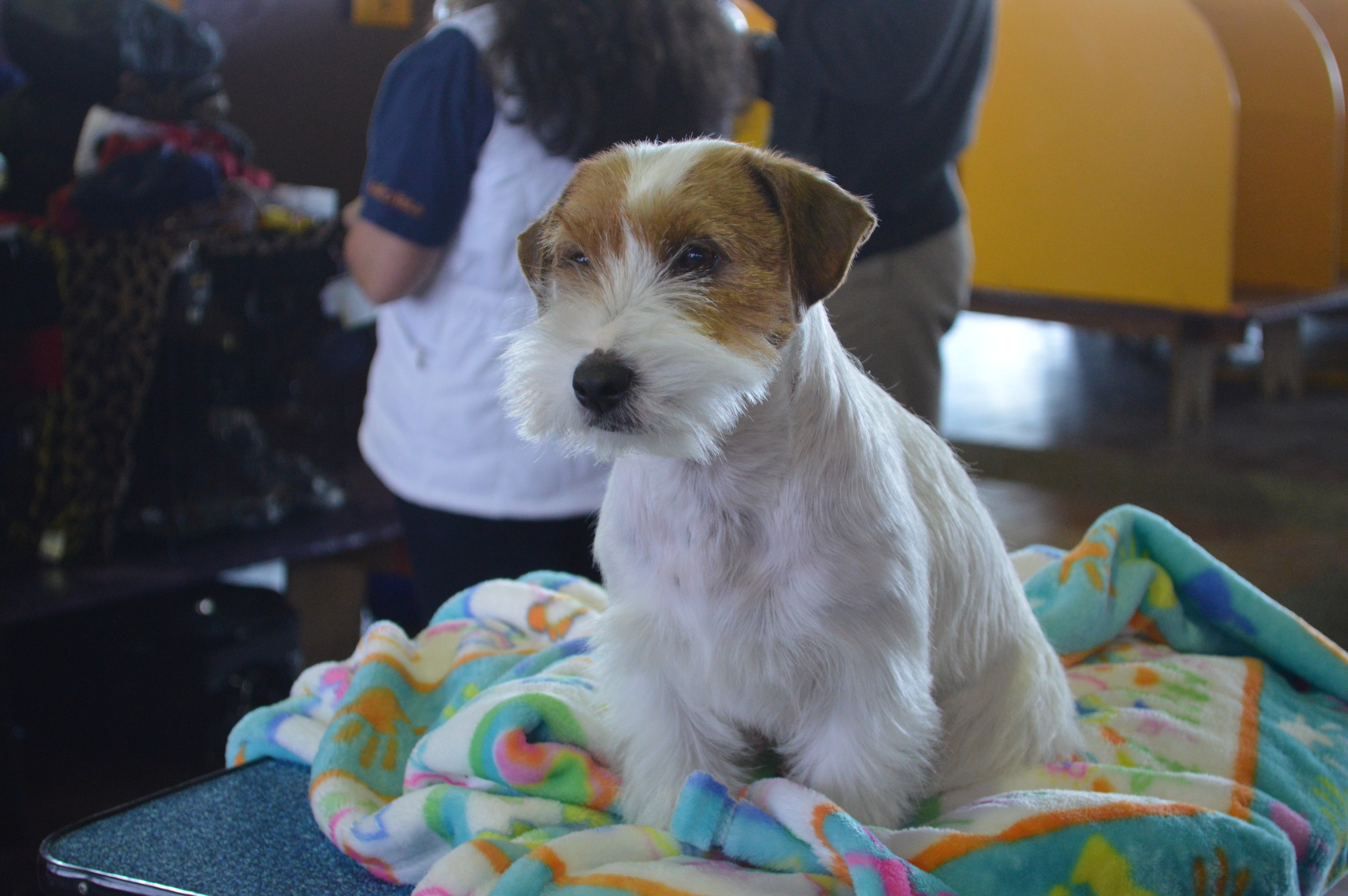

Do you have a better photo of a Russell Terrier in the American show ring? If you have a show photo you’d let us use, email it to [email protected] — tell us the dog’s name and the show, and it may be featured here. Please only send photos you took yourself or have the photographer’s permission to share, and tell us the photographer’s name.
1. Breed at a glance
Terrier Group; AKC-recognized since 2012
10–12 in, 9–15 lb
Smooth, broken, or rough; predominantly white with tan and/or black markings
12–14 years (AKC)
Upbeat, lively, inquisitive, friendly; a tireless working terrier
American Russell Terrier Club
2. History: the sporting parson’s short-legged terrier
The Russell Terrier is named for the Reverend John Russell of Devon, England (1795–1883), the 19th-century hunting parson who bred small white terriers to bolt foxes from their earths. The shorter-legged strain — the dog that could follow a fox into a tight tunnel — developed separately from the taller Parson type, and its modern standard is based on the Australian Jack Russell Terrier standard of 1983, approved by the Australian National Kennel Council in 1991 and recognized by the FCI in 2003.
In the United States the short-legged type found its home in the American Russell Terrier Club, founded in 1995 as the English Jack Russell Terrier Club by JoAnn Stoll — the first American registry to maintain the Russell Terrier as a breed separate from the Parson. The United Kennel Club recognized the breed on January 1, 2001; the AKC accepted it into the Foundation Stock Service on December 8, 2004; it entered the Miscellaneous Class on January 1, 2010; and it was granted full AKC recognition on June 1, 2012, becoming eligible in the Terrier Group on June 27, 2012. The taller type had been recognized by the AKC as the Jack Russell Terrier in 1997 and renamed the Parson Russell Terrier on April 1, 2003. The Jack Russell Terrier Club of America, founded in 1976, maintains its own independent registry and recognizes neither AKC classification as the same as its breed.
The breed’s biggest recent moments belong to two dogs. GCH CH Goldsand’s Columbus won Best of Breed and second in the Terrier Group at the 2013 AKC National Championship, and the club’s Columbus Trophy carries his name. GCH CH Goldsand’s Billie Jean CA — the dog in the photo above — won Best of Breed at the 2015 AKC National Championship.
3. The standard: rectangular, spannable, built to go to ground
The AKC standard was approved in May 2009 and effective January 1, 2010. It describes a “strong, active, lithe” working terrier, “predominately white-bodied,” with “a flexible body of moderate length and rectangular profile” — a dog built to work below ground, with no one part exaggerated over another.
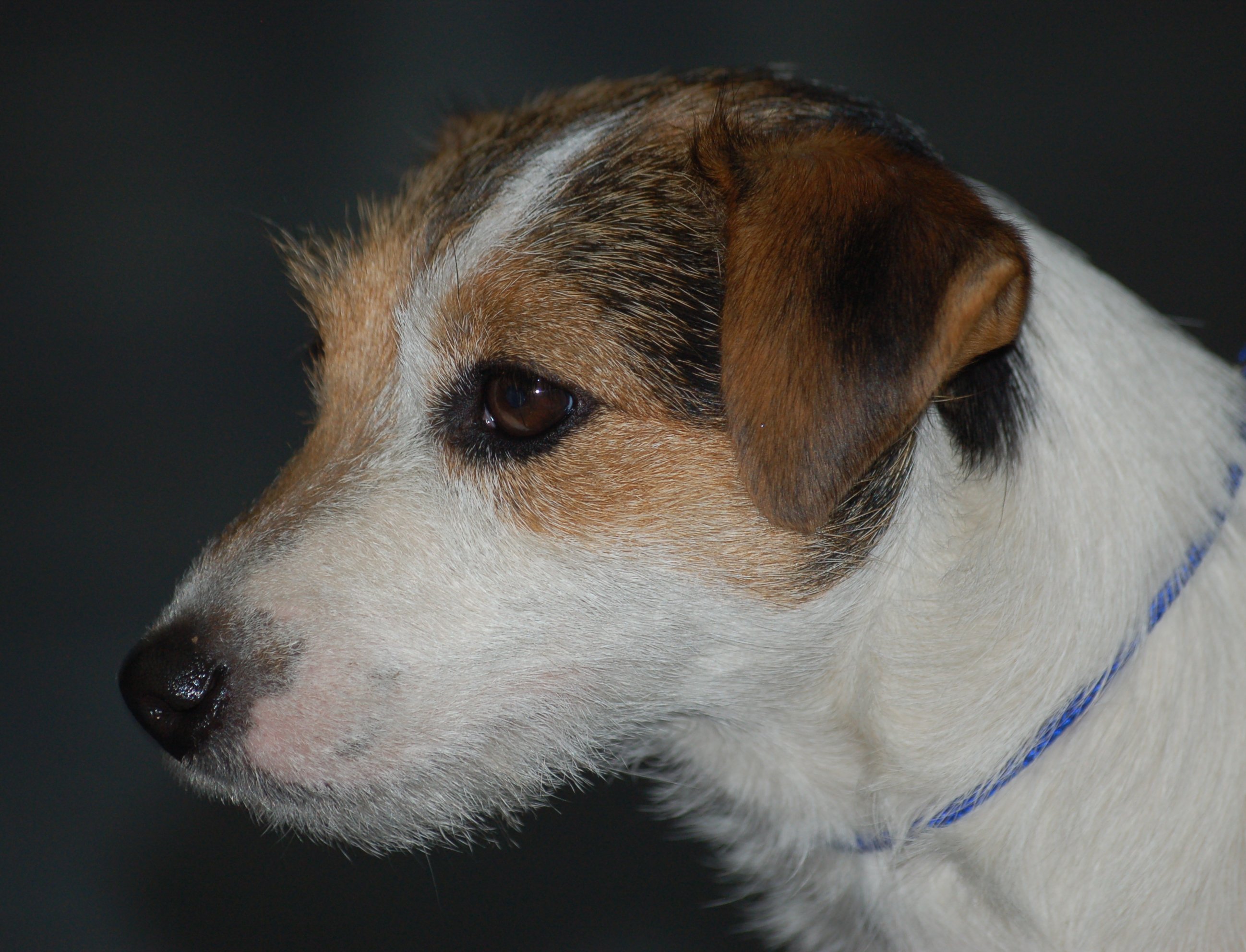

Size. Ten to twelve inches at the withers, both sexes, with substance and weight proportionate to height — neither too coarse nor too refined. The body is proportioned marginally longer than tall, a distinct rectangle when measured from the point of shoulder to the point of buttocks against the height from the withers to the ground. When viewed in profile, the midline of the dog is at the elbow and the bottom of the brisket.
Chest. The small, oval, compressible chest is the hallmark of the breed and its single most important attribute: it must be small enough to be spanned by average-sized hands, about 14 to 15 inches at the top, so the dog can work efficiently below ground. The chest must never fall below the elbow.
Head. The skull is flat and of moderate width, tapering to a wide muzzle with very strong jaws; the stop is well defined. The nose is black and fully pigmented. The ears are small, V-shaped button or dropped ears, carried close to the head, the points even with the corner of the eye. The eyes are dark and almond-shaped, with a keen expression of alertness, and the eyelid rims are fully pigmented black. The bite is a scissor bite with comparatively large teeth; a level bite is acceptable.
Coat and color. The coat may be smooth, broken, or rough, and must be weatherproof: every coat type has an undercoat and a harsh outer coat. The terrier is shown in its natural coat with minimal grooming, and sculpted furnishings are severely penalized. White is predominate, with black and/or tan markings; tan can vary from lemon to mahogany, and ticking is acceptable. The dog must remain at least 51% white.
Tail. Docking is optional. If docked, the tip of the tail should customarily be level with the top of the ears.
Disqualifications. There are six: height under 10 inches or over 12 inches; prick or semi-prick ears; blue eye or eyes; overshot, undershot, or wry mouth; a nose any color other than black, or not fully pigmented; and less than 51% white, brindle coloring, or any other color than those listed. Any hint of achondroplasia is a severe fault.
4. Temperament: upbeat, lively, and always working
The AKC sums the breed up as “upbeat, lively, inquisitive, and friendly,” and the standard adds the detail: “an alert, lively, active, keen terrier with a very intelligent expression,” “playful, curious, loyal and affectionate,” and “full of life,” moving “with confidence that matches his keen expression.” Sparring is not acceptable.
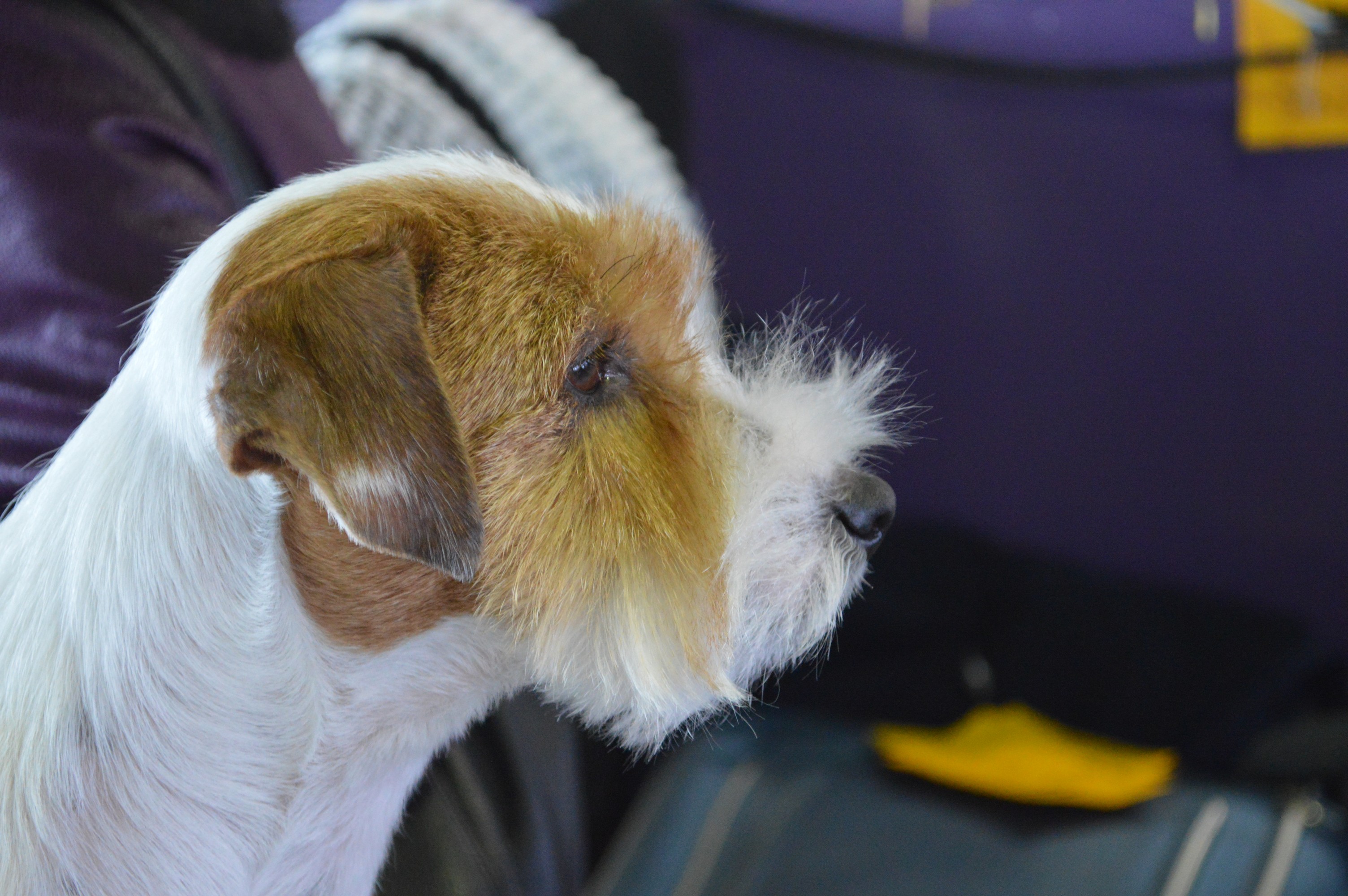

A Russell Terrier bonds hard to its people and is famously entertaining — clever, funny, and always in motion. But it is a working terrier first: it was bred to hunt, and it still hunts. It will dig, chase squirrels and cats, and bark at anything that moves, and it needs a job every day — earthdog tests, barn hunt, agility, or long walks with training built in. A Russell with work is a happy, affectionate house dog; one with nothing to do is a demolition crew in a ten-inch body.
The everyday reality is a small dog with a very large personality: confident, fearless, and stubborn, with a prey drive that does not switch off. It needs a fenced yard, a patient owner who trains with consistency, and an outlet for its energy. It is not a dog for a sedentary household, and it is not a dog that tolerates being left alone all day.
5. Grooming and everyday care
Grooming depends on the coat. Smooth coats need little more than a weekly brush; broken and rough coats need regular brushing and, for the rough coat, hand-stripping to keep the harsh, weatherproof texture — clipping softens it. The breed is shown in its natural coat with minimal grooming. Bathe only when the dog is dirty, check the ears, trim the nails, and brush the teeth.
Exercise is the hard part, and it is non-negotiable: daily vigorous exercise plus a job — earthdog tests, barn hunt, agility, or nose work are ideal, plus training. A Russell Terrier that gets real exercise and mental work is a calm, pleasant house dog; one that gets a walk around the block will dig up the yard and bark at the neighbors. A fenced yard is close to essential: a Russell off lead will chase whatever moves, and it will go under or through a fence to get to it.
Feeding is straightforward: a good-quality food, measured meals, and a lean weight at 9 to 15 pounds. A small dog eats little, so treats add up fast — count them.
6. Health: the tests that matter
The American Russell Terrier Club’s CHIC profile calls for four tests for breeding stock: a patella evaluation, an ophthalmologist eye evaluation, a BAER hearing test, and a primary lens luxation (PLL) DNA test. A CHIC number means the tests were done and published by the OFA — it does not mean the dog passed them. Ask for the parents’ CHIC numbers and look them up yourself on the OFA database.
The tests point at the breed’s known weak spots. The BAER test screens for congenital deafness, a risk in a predominantly white breed. The PLL DNA test screens for primary lens luxation, an inherited eye disease in which the lens dislocates; the ophthalmologist examination catches other eye problems. Patellar luxation — a slipping kneecap — is the orthopedic concern in a small, active terrier. The AKC lists the breed’s lifespan as 12 to 14 years.
7. The annual Russell Terrier specialty dog show
A specialty is the breed’s All-Star show — its Super Bowl. Once a year, the best Russell Terriers from across the country, and often from around the world, come together in one place.
The American Russell Terrier Club holds its national specialty every year as a designated specialty inside the Montgomery County Kennel Club’s terrier-only show at Macungie Memorial Park in Macungie, Pennsylvania — the terrier world’s big October weekend, where more than twenty parent clubs hold their nationals side by side. The 2026 national ran October 4, 2026, judged by Todd Clyde, with James R. Dickson judging the sweepstakes. The 2025 and 2024 nationals ran at the same show, on October 5, 2025, and October 6, 2024. The 2027 national: not yet announced.
The standard, in brief: a strong, active, lithe working terrier, 10 to 12 inches at the withers, with a flexible body of moderate length and a rectangular profile — marginally longer than tall — and a small, oval, compressible chest that average-sized hands can span, built for work below ground. The coat is smooth, broken, or rough, predominantly white (at least 51%) with tan and/or black markings. The temperament is alert, lively, active, and keen — playful, curious, loyal, and affectionate.
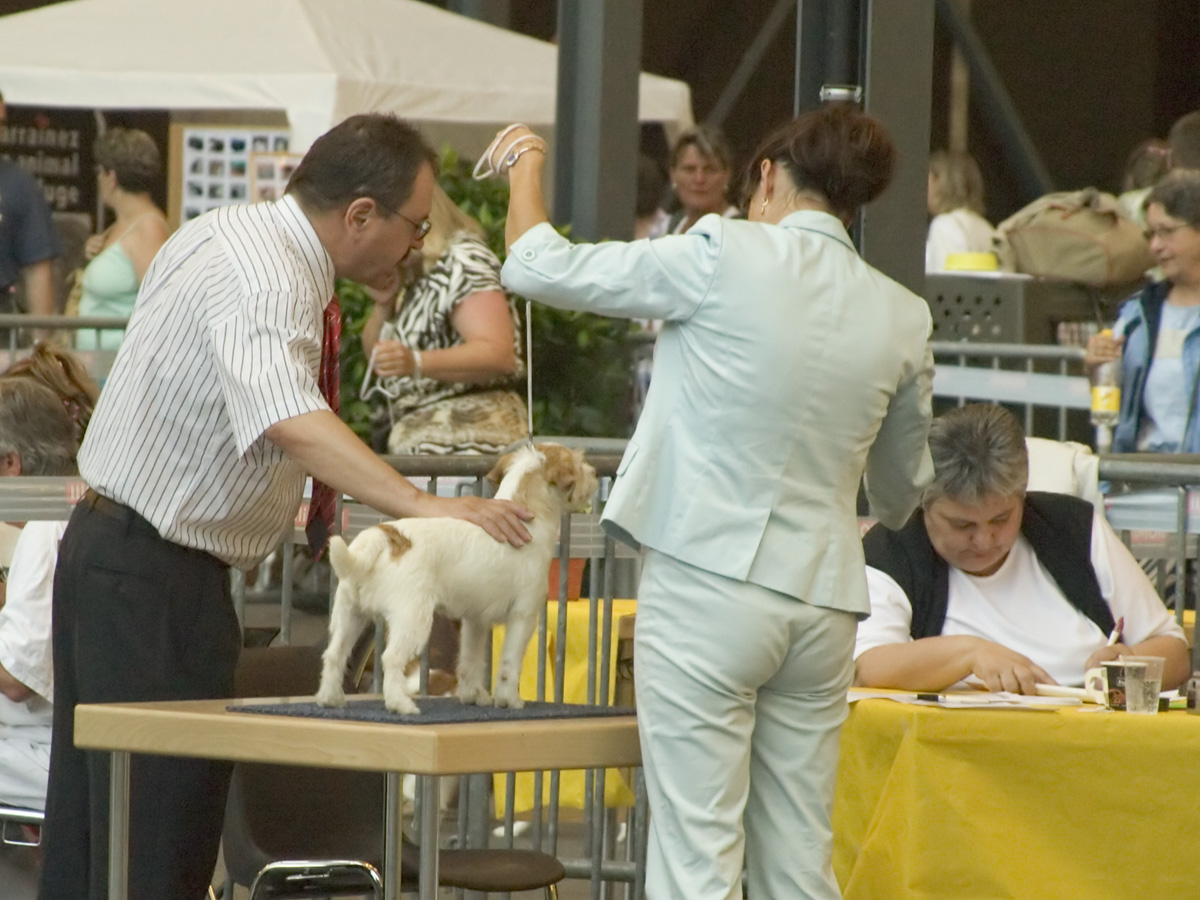

The 2026 ARTC National Specialty — Sunday, October 4, 2026, held as the American Russell Terrier Club’s designated specialty within the Montgomery County Kennel Club’s terrier-only show at Macungie Memorial Park, Route 100, Macungie, Pennsylvania (host event 2026006701; ARTC designated specialty event 2026683605). The regular and non-regular classes, junior showmanship, and Best of Breed were judged by Todd Clyde; James R. Dickson judged the puppy and veteran sweepstakes. Entries closed at noon on Wednesday, September 16, 2026. ARTC Event Chair: Sandra Wolfskill. Superintendent: MB-F, Inc.
The Montgomery show is the terrier world’s big October weekend: the ARTC national ran alongside the national specialties of more than twenty other terrier parent clubs, with the Terrier Group judged in the afternoon. The show drew 1,203 entries and 1,046 competitors across the Terrier Group; Best in Show went to the Norfolk Terrier GCHS CH Yarrow Venerie Rambling Man.
Results (2026 national). Best of Breed and the other top winners had not been published in an official source as of November 2026 and will be added here when they are.
The dates for the annual 2027 Russell Terrier specialty dog show had not been announced as of November 2026. The AKC’s Upcoming National Specialties list, which runs through October 2027, carries no American Russell Terrier Club entry. This page will be updated when the club announces the 2027 national.
Past national specialties: 2025 · 2024
American Russell Terrier Club — theartc.com
8. Regional specialties through the year: smaller regional shows
The national is the anchor, but the breed’s year also runs through regional specialties — smaller regional shows, not the national — held around the country. These are the 2026 regionals verified from club and AKC sources.
No regional specialty beyond the national itself was verified from club or AKC sources as of November 7, 2026. A specialty at Enumclaw, Washington, on August 15, 2026, judged only Parson Russell Terriers and is not a Russell Terrier regional.
More regional specialties will be added here as their programs are verified — this section is built from show data, not guesswork. Browse upcoming show weekends →
9. Clubs
The American Russell Terrier Club (ARTC), founded in 1995 as the English Jack Russell Terrier Club, is the AKC parent club for the breed in the United States. It is the guardian of the breed and determines the official breed conformation standard, runs the national specialty every year, and sanctions earthdog events. The club’s 2026 officers: President Shirley Miyahara, Vice-President Sharon Lofley, Treasurer Mark Ulrich, and Secretary Sandra Wolfskill. The club’s website is at theartc.com.
Do not confuse the ARTC with the other clubs in the Jack Russell world. The Parson Russell Terrier Association of America is the parent club for the taller Parson Russell Terrier, and the Jack Russell Terrier Club of America, founded in 1976, maintains its own independent registry and recognizes neither AKC breed as the same as its Jack Russell Terrier.
10. Rescue
Jacks Galore, Inc., a family-run Jack Russell rescue coordinator based in Washington, Massachusetts, is a 501(c)(3) that pulls Jack Russell Terriers from shelters, places them in foster homes, and matches them with adopters, at jacksgalore.org. Russell Rescue, Inc. is a national network of volunteers that rehomes unwanted, displaced, or abandoned Jack Russell Terriers through foster homes across the country.
Expect an application, references, and a home visit — and expect an adult dog: puppies are rare in rescue. A rescue Russell comes with a known temperament, placed by people who know the breed extremely well and want the dog in a home prepared for a Jack Russell, not just any home.
11. Breeder vs. rescue: honest guidance
Either route starts with the same question: has this dog’s health been tested? From a breeder, ask for the CHIC numbers of both parents — the patella evaluation, the ophthalmologist eye evaluation, the BAER hearing test, and the primary lens luxation DNA test — and check them on the OFA database yourself, by the parents’ registered names. Ask what health issues the breeder sees in their stock, and meet at least the dam. A good breeder will ask how much exercise and work you can give a terrier that was built to go to ground — and will want to know you have a fenced yard.
From rescue, expect an adult dog whose temperament is already known, placed by a program that will match the dog to your life rather than the other way around. Budget for the same things either way: training, exercise, a job for the dog to do, and a vet who knows the breed’s health risks. Whichever route you take, the dog that fits is a small, rectangular, endlessly lively terrier that wants work — and will be happiest doing exactly that, with you.
12. Claim this page
This page was built from public sources — the AKC standard, the parent club’s own material, AKC event records, and the rescue program’s site — and it is a starting point, not the last word. If you are with the American Russell Terrier Club or a regional club and something here is wrong or missing, you can claim this page and set it straight: email [email protected] and tell us what needs fixing. Corrections from the people who own the breed are how this page gets better.
Sources
- AKC, Russell Terrier
- American Russell Terrier Club, AKC Russell Terrier Breed Standard (approved May 2009, effective January 1, 2010)
- AKC, Terrier Group Health Testing Requirements
- AKC, Upcoming National Specialties list
- Montgomery County Kennel Club, 2026 premium
- American Russell Terrier Club
- American Russell Terrier Club, 2025 ARTC National at MCKC
- American Russell Terrier Club, 2024 ARTC National
- AKC Club Search and Directory, American Russell Terrier Club
- AKC, FSS News & Updates (Russell Terrier recognition, 2012)
- AKC event record, Montgomery County Kennel Club 2026 (event 2026006701)
- AKC, 2013 AKC National Championship Russell Terrier breed results
- AKC, 2015 AKC National Championship Russell Terrier breed results
- Jacks Galore, Inc.
- Wikimedia Commons, Russell Terrier-11-GCH-Goldsand's Billy Jean 03 (Pets Adviser, CC BY 2.0)
- Wikimedia Commons, Russell Terrier-11-GCH-Goldsand's Billy Jean 02 (Pets Adviser, CC BY 2.0)
- Wikimedia Commons, Jack russell terrier głowa LM (Lilly M, CC BY-SA 2.5)
- Wikimedia Commons, 06070855 show (Alephalpha, CC BY-SA 3.0)