
Breed profile · Working Group · the butcher’s drover, the guardian at the door
Rottweiler
The Rottweiler is a medium large, robust and powerful dog, black with clearly defined rust markings, with a calm confidence that reads as aloofness to strangers and devotion to its own people. The AKC standard states it plainly — “a medium large, robust and powerful dog, black with clearly defined rust markings” — and then spends the rest of its length explaining exactly where those rust markings go, because the markings are the breed’s signature. The AKC recognized the breed in 1931, and the American Rottweiler Club, the parent club, was formed in 1973.
Help us improve it. This is one of ThePetAdvisor’s breed profiles, built from public sources with generous links to the people who actually own this breed’s knowledge. If something’s off or missing, the parent club can claim the page and set it straight — see the bottom of the page.
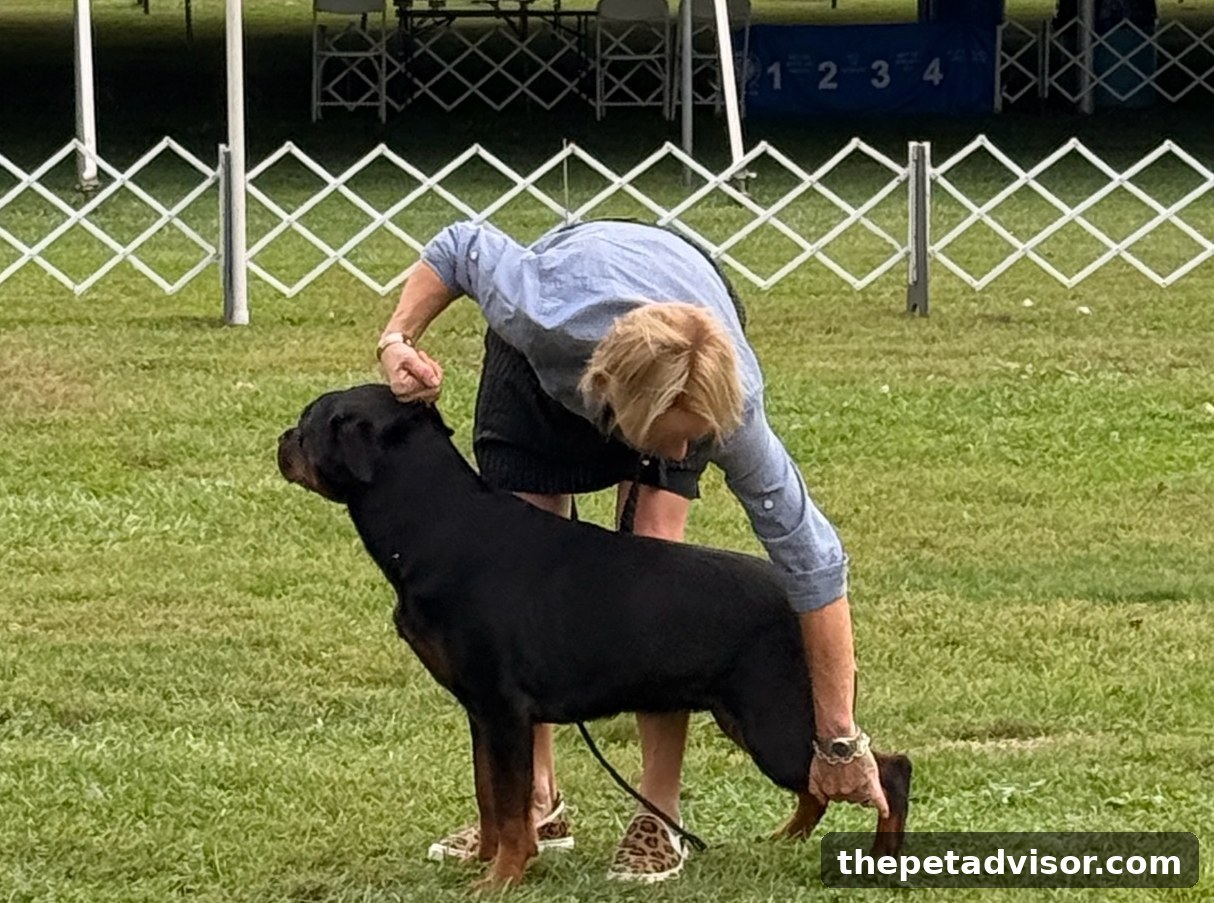
Do you have a better photo of a Rottweiler in the American show ring? If you have a show photo you’d let us use, email it to [email protected] — tell us the dog’s name and the show, and it may be featured here. Please only send photos you took yourself or have the photographer’s permission to share, and tell us the photographer’s name.
1. Breed at a glance
Working — recognized by the AKC in 1931
Dogs 24–27 in, bitches 22–25 in at the shoulder, the mid-range preferred. Commonly about 80–135 lb; the standard sets height only
Short, dense, straight double coat; always black with rust to mahogany markings
9–10 years
Calm, confident, and courageous; loyal and devoted to its own people; reserved and aloof with strangers
American Rottweiler Club, formed 1973
A Rottweiler is a working dog in the full sense: strong, trainable, and serious about its job, whether that job is guarding, herding, or holding down the couch next to you. It is not a dog that trains itself — the calm confidence the standard asks for comes from early socialization and consistent training, and the breed’s power means an untrained Rottweiler is a problem in a way an untrained small dog is not. Bought or rescued, it is a commitment measured in years of work, not just years of company.
2. History
The Rottweiler descends from the drover dogs that marched with the Roman legions, driving and guarding cattle on the long moves across Europe. When the legions withdrew, dogs stayed behind around Rottweil, in what is now Germany, where butchers used them to drive cattle to market and to guard the day’s takings — the butcher’s dog, the Rottweiler Metzgerhund. The work shaped the dog: strong enough to move cattle, steady enough to wait by a cart, and watchful enough to guard it. (Sources: Britannica, Rottweiler; Furry Critter Network, Rottweiler breed guide.)
The first German standard was written in 1901, and the German parent club, the Allgemeiner Deutscher Rottweiler-Klub (ADRK), took up the breed’s keeping. Rottweilers reached the United States in the late 1920s, and the AKC recognized the breed in 1931. The American Rottweiler Club, the AKC parent club, was formed in 1973. The breed’s popularity rose sharply from the 1970s, as the dog moved from the cattle yard into police and service work and into family homes — a move that made the standard’s insistence on calm, confident temperament matter more, not less. (Sources: American Rottweiler Club, About; Britannica, Rottweiler.)
3. The standard and why it is written that way
- General appearance — medium large, robust, and powerful. “The ideal Rottweiler is a medium large, robust and powerful dog, black with clearly defined rust markings.” That one sentence carries the whole breed: the size, the power, and the color rule. The standard was approved May 8, 1990, and effective June 28, 1990. (Source: AKC Official Standard of the Rottweiler, via The Rottweiler Chronicle.)
- Size & proportion — slightly longer than tall. Dogs 24 to 27 inches at the shoulder, bitches 22 to 25 inches, the mid-range preferred. The body is slightly longer than tall, the ideal height to length 9 to 10. Undersized or oversized dogs, and lack of proportion, are serious faults. (Source: AKC Official Standard of the Rottweiler.)
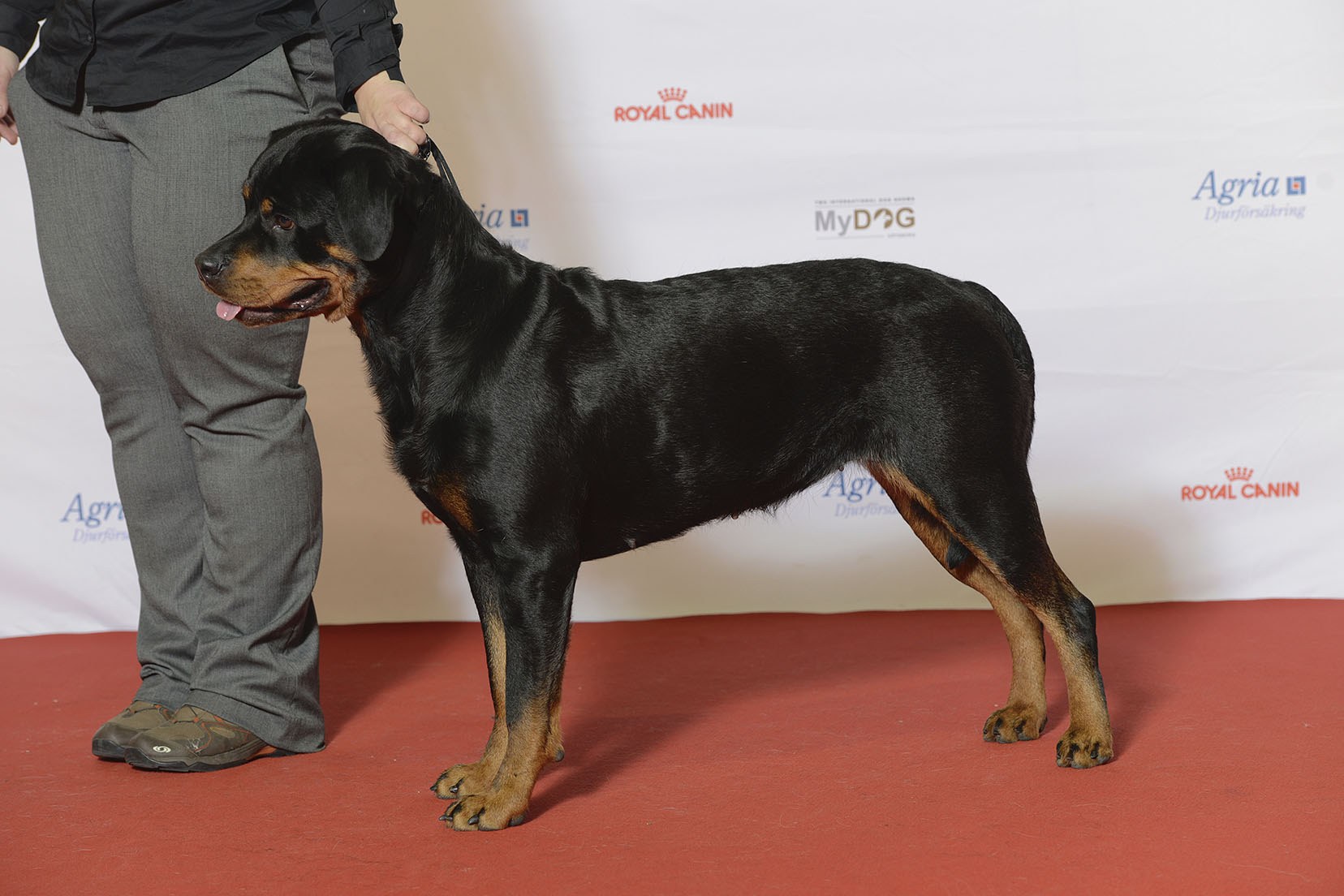
- Color & markings — always black, with rust to mahogany. The markings are specified place by place: a spot over each eye; on the cheeks; a strip around each side of the muzzle, but not on the bridge of the nose; on the throat; a triangular mark on both sides of the prosternum; on the forelegs from carpus to toes; on the inside of the rear legs; under the tail; and black penciling on the toes. The markings must be clearly defined and must not exceed 10 percent of the body color. The undercoat is gray, tan, or black. (Source: AKC Official Standard of the Rottweiler.)
- Why the markings are policed so hard. Straw-colored, excessive, insufficient, or sooty markings are serious faults, and any white marking anywhere is a serious fault — a few rust or white hairs do not count as a marking. The defined rust is the breed’s signature, and the standard treats a washed-out or misplaced marking as a failure of type, not a cosmetic quibble. (Source: AKC Official Standard of the Rottweiler.)
- Head, body & movement — built for the work. A broad head with well-developed cheeks and dark, almond-shaped eyes; a strong, deep body with a level topline; and movement that is powerful, agile, and purposeful. The standard’s proportions — the 9 to 10 ratio, the mid-range height — describe a dog built to move cattle all day, not a dog built to pose. (Source: American Rottweiler Club Judges Education Breed Study, approved April 15, 2026.)
- Disqualifications — the hard lines. Entropion or ectropion; overshot, undershot, or wry mouth; two or more missing teeth; unilateral or cryptorchid males; a long coat; any base color other than black; the absence of all markings; and a dog that attacks a person in the ring. A long coat or a non-black base color is not a fault to be weighed — it is out. (Source: AKC Official Standard of the Rottweiler.)
- Why it is written that way. Every clause in the standard points back to the cattle yard: power and proportion for driving stock, a coat that sheds weather, markings that identify the dog at a glance, and a temperament — calm, confident, courageous — that lets a powerful guardian think before it acts. The disqualifications protect function and safety: a dog that cannot see, cannot bite correctly, or attacks a person in the ring cannot do the job the breed was kept for.

4. Temperament & living with one
The standard’s temperament paragraph is the shortest and most quoted part of the breed: calm, confident, and courageous, with a self-assured aloofness that does not lend itself to immediate, indiscriminate friendships. A Rottweiler is loyal, good-natured, and devoted to its own people — and reserved with everyone else. That reserve is the point: a guardian that made friends with every stranger would be useless, and a guardian that feared every stranger would be dangerous. (Sources: AKC Official Standard of the Rottweiler; Bully Max, Rottweiler temperament.)
- With its own people: devoted and steady, a dog that follows its family and settles where they settle. Rottweilers bond hard and do best as house dogs, not kennel dogs left outside on their own.
- With strangers: reserved and watchful. Early and ongoing socialization — meeting new people, places, and situations while young, and keeping it up for life — is what turns that watchfulness into the standard’s calm confidence instead of suspicion.
- Training: highly trainable, and it needs the work. The breed’s heritage is herding, guarding, carting, and police and service work; a Rottweiler with no job invents one. Consistent, fair training and a real task — obedience, tracking, rally, carting, or a daily job around the house — keep the dog’s mind busy and its manners straight.
- Exercise: a powerful working dog needs daily exercise and mental work: long walks, training sessions, and play with a purpose. A bored Rottweiler is a destructive Rottweiler, and a strong one at that.
- First-dog honesty: this is a lot of dog for a first-time owner. The size, the strength, and the guardian instinct all demand an owner who trains from day one and keeps training. If that sounds like a burden rather than a pleasure, a smaller or softer breed is the honest choice.
5. Grooming
The Rottweiler’s coat is wash-and-wear: short, dense, and straight, with a medium undercoat, and no clipping or trimming. Brush once a week to pull out dead hair, bathe only when the dog is actually dirty, and keep up the routine parts — nails, ears, and teeth — the same as any breed. (Sources: Purina Canada, Rottweiler breed guide; Furry Critter Network, Rottweiler breed guide.)
- Shedding: moderate year-round, heavier twice a year when the undercoat blows. A weekly brush keeps it manageable; a rubber curry or slicker takes the dead coat out in minutes.
- Bathing: as needed, not on a schedule — the coat sheds dirt well and over-bathing strips the oils that keep it weatherproof.
- Nails, ears & teeth: trim nails every few weeks, check ears after baths and swimming, and brush teeth regularly. None of it is breed-specific; all of it matters more in a 100-pound dog that leans on you.
6. Health testing
The American Rottweiler Club’s Mandatory Practices, effective October 15, 2019, set the health testing a breeder must do before breeding. A CHIC number requires every result to be released publicly, pass or fail, and the dog to carry permanent identification (microchip or tattoo). The five requirements:
- Hips — OFA Hip Certification, Excellent, Good, or Fair. X-rays at 24 months or older, recorded with the Orthopedic Foundation for Animals.
- Elbows — OFA Elbow Certification. X-rayed at 24 months or older and recorded with OFA, results released whether they pass or fail; the club strongly recommends breeding only normal to normal.
- Cardiac — “Normal” at 24 months or older. Recorded with OFA; a board-certified cardiologist and an echocardiogram are strongly recommended. The screen is for subaortic and subvalvular aortic stenosis (SAS), a heart defect seen in the breed.
- Eyes — CAER exam at 24 months or older. An eye exam by an ACVO board-certified ophthalmologist, with an OFA CAER number.
- JLPP — DNA test for all breeding stock. Juvenile Laryngeal Paralysis and Polyneuropathy is a fatal inherited disease of young Rottweilers; results are recorded with OFA, and two carriers must never be bred together.
Beyond the five, the conditions Rottweiler owners most often meet are osteosarcoma (bone cancer), cruciate ligament injuries, and degenerative myelopathy, which appears on many breed health panels as LEMP. Ask any breeder for the parents’ five CHIC results and look them up in the OFA database yourself before you commit. (Sources: American Rottweiler Club Mandatory Practices, effective October 15, 2019; LiveCub, Rottweiler health questions; North Carolina Rottweiler Rescue, breed reference.)
7. The annual Rottweiler specialty dog show
A specialty is the breed’s All-Star show — its Super Bowl. Once a year, the best Rottweilers from across the country, and often from around the world, come together in one place.
The American Rottweiler Club’s national specialty: one national event each year, with conformation, obedience, rally, tracking, agility, sweepstakes, a Sieger show, and junior showmanship. The 2026 national: June 11–12, at the Purina Farms Events Center in Gray Summit, Missouri, with 131 competitors and 153 entries in conformation. The 2025 national: June 25–27, at the Roberts Centre in Wilmington, Ohio, with 145 dogs and 151 entries. The 2027 national: June 14–20, at the Purina Farms Event Center in Gray Summit, Missouri.
The standard, in brief: a medium large, robust and powerful dog, black with clearly defined rust markings. Dogs 24 to 27 inches at the shoulder, bitches 22 to 25 inches, the mid-range preferred. Body slightly longer than tall, the ideal height to length 9 to 10. Markings rust to mahogany, clearly defined, in specified places; markings not to exceed 10 percent of body color.
The 2026 National Specialty — the 45th Annual National Specialty Show, national week Saturday, June 6, through Sunday, June 14, 2026, at the Purina Farms Events Center, 300 Checkerboard Drive, Gray Summit, Missouri. Conformation Thursday–Friday, June 11–12, 2026: dog classes Thursday, bitch classes and Best of Breed Friday, with junior showmanship, the 4–6 Month Beginner Puppy Competition, and the National Owner-Handled Series. Sweepstakes and Veteran Sweepstakes Wednesday, June 10. The Region VII Specialty Tuesday, June 9. Obedience, rally, tracking, agility, and the National Sieger Show across the week. Entry: 153 entries / 131 competitors (67 dogs, 64 bitches) in conformation. Entries opened Wednesday, April 1, 2026, at noon, and closed Wednesday, May 13, 2026, at noon PDT. Event Chair: Robert Galusha. Superintendent: BaRay Event Services, Inc. (Sources: 2026 premium list; AKC event search, event 2026201612.)
National specialty judges: Ms. Cathleen A. Rubens — dog classes Thursday; junior showmanship, intersex, Best Puppy from Regular Classes, Best Bred By Exhibitor, and NOHS Best of Breed Friday. Ms. Kimberly Cardona — 4–6 Month Beginner Puppy, bitch classes, Stud Dog, and Brood Bitch Thursday. Pamela Grant — Sweepstakes Dogs, Veteran Bitches, and Best in Veteran Sweepstakes Wednesday. Jill Kessler-Miller — Sweepstakes Bitches, Best in Sweepstakes, and Veteran Dogs Wednesday. The 16th National Sieger Show: Sunday, June 14, judged by Rüdiger Schmidt (ADRK–Germany) and Robert Galusha (USA), with the Region VII Sieger Show Saturday, June 13. (Sources: 2026 premium list; AKC event search, event 2026201612; American Rottweiler Club, Sieger.)
Results (2026 national). Best of Breed, Best of Opposite Sex, Winners Dog, and Winners Bitch not confirmed in an official source as of November 2026. Best Junior Handler: Josiah Garmer; Reserve Best Junior Handler: Kaylen Foreman. (Source: AKC event search, event 2026201612.)
The 2027 National Specialty: June 14–20, 2027, at the Purina Farms Event Center, 300 Checkerboard Loop, Gray Summit, Missouri, per the American Rottweiler Club specialty page. Schedule of events: not yet posted. AKC event number, judges, entries, and closing date not yet published as of November 2026. Note: the AKC Upcoming National Specialties list does not yet include the American Rottweiler Club 2027 national as of November 7, 2026. (Sources: American Rottweiler Club, National Specialty 2027; AKC Upcoming National Specialties.)
Past national specialties: 2025
American Rottweiler Club — amrottclub.org
8. Regional specialties through the year: smaller regional shows
The national is the anchor, but the breed’s year also runs through regional specialties — smaller regional shows, not the national — held by regional Rottweiler clubs around the country. These are the 2026 regionals verified from club sources so far:
Two regional Rottweiler specialties verified for 2026 so far:
- Region VII Specialty — Tuesday, June 9, 2026, Gray Summit, Missouri: at the Purina Farms Events Center, 300 Checkerboard Drive, during national week, with NOHS, Sweepstakes, and Junior Showmanship. Judge: Doreen Luhrs — 4–6 Month Beginner Puppy, dog classes, bitch classes, junior showmanship, intersex, Best Puppy, Best Bred By Exhibitor, NOHS Best of Breed, Stud Dog, and Brood Bitch. Puppy & Veteran Sweepstakes judge: Katie Maess. (Source: 2026 premium list; AKC events 2026201610 and 2026201611.)
- Medallion Rottweiler Club Back-2-Back Specialties — October 7–9, 2026, St. Charles, Illinois: the 72nd and 73rd Annual Specialties and the 63rd and 64th Independent Specialty Shows, at the Kane County Fairgrounds. (Source: Medallion Rottweiler Club.)
Past regional specialties: 2025
More regional specialties will be added here as their programs are verified — this section is built from show data, not guesswork. Browse upcoming show weekends →
9. Clubs
- American Rottweiler Club (ARC) (parent club) — the AKC-recognized national breed club for the Rottweiler, formed in 1973. It maintains the breed standard, holds the national specialty each year, sets the mandatory health testing practices for breeders, runs judges education, and keeps the list of local and area Rottweiler clubs across the country. (Sources: American Rottweiler Club, About; ARC Local & Area Rottweiler Clubs list, January 27, 2025.)
- Medallion Rottweiler Club — the Illinois club behind the Back-2-Back Specialties, the 72nd and 73rd Annual Specialties in October 2026. See section 8.
- Greater Cincinnati Rottweiler Club — the host club for the 2025 Region II Specialty during national week in Wilmington, Ohio. See sections 7 and 8.
- Northstar Rottweiler Club — the Minnesota club, one of the ARC’s local clubs. See the ARC local club list.
- Colonial Rottweiler Club — the Florida club, one of the ARC’s local clubs. See the ARC local club list.
10. Rescue
- American Rottweiler Club rescue. The parent club is the first stop if you do not know which group covers your area — it can point you to the rescue working in your region. (Source: AKC Rescue Network, R Breeds.)
- Southern States Rescued Rottweilers (SSRR). A 501(c)(3) nonprofit saving Rottweilers across fourteen southern states — Alabama, Arkansas, Florida, Georgia, Kentucky, Louisiana, Maryland, Mississippi, North Carolina, Oklahoma, South Carolina, Tennessee, Texas, and Virginia — including a dedicated Place of Hope program for senior dogs. (Sources: AKC Rescue Network, R Breeds; Southern States Rescued Rottweilers, Place of Hope.)
- MidAmerica Rottweiler Rescue (MARR). Serving Iowa, Illinois, Nebraska, Kansas, Missouri, Oklahoma, and Wisconsin, from P.O. Box 342544, West Milwaukee, Wisconsin. (Source: AKC Rescue Network, R Breeds.)
- Gulfstream Guardian Angels Rottweiler Rescue (GGARR). A Florida rescue and adoption organization that evaluates and places Rottweilers in loving homes. (Sources: AKC Rescue Network, R Breeds; GGARR, About Us.)
- Rottweiler Hearts Rescue and Rotten Rottie Rescue. Two more breed rescues on the AKC Rescue Network’s Rottweiler list — Rottweiler Hearts Rescue ([email protected]) and Rotten Rottie Rescue of Gilbert, Arizona. (Source: AKC Rescue Network, R Breeds.)
11. Breeder vs. rescue: honest guidance
- If you buy: start with the parent club, the American Rottweiler Club, and its breeder referral. Ask for the parents’ five CHIC results — hips, elbows, cardiac, eyes, and the JLPP DNA test — and look the results up in the OFA database yourself. Expect to wait for a puppy from a careful breeder: a good breeder will have the answers, will ask you as many questions as you ask them, and will take the puppy back for its whole life if you cannot keep it.
- If you rescue: a rescued Rottweiler is usually an adult, and it will arrive with its temperament visible before you commit. What you get in return is a dog whose character you can see before you commit and a lower price. Either way, be honest with yourself first: a Rottweiler needs daily exercise and mental work, early and ongoing socialization, and an owner who trains from day one and keeps training — not a yard and a hope.
- Watch out for “rare” colors. The standard recognizes one base color only — black, with rust to mahogany markings. Any base color other than black is a disqualification, and any white marking anywhere is a serious fault. A seller’s “rare” label on a blue, red, white, or otherwise off-color Rottweiler is a sales description, not a mark of quality or health. Judge the dog in front of you against the standard — the black coat, the clearly defined rust in its specified places, the calm confidence — not against a listing’s adjectives.
12. Claim this page
This page belongs to the breed, and the people who know the breed best are the American Rottweiler Club and its members. If you are with the parent club — or you are a breeder, a judge, a handler, or a rescue volunteer who spotted something wrong, missing, or out of date — this page is yours to set straight. Tell us what needs fixing and where the correction is documented, and we will fix it and credit the source. Contact the site through the About page, and mention “Rottweiler breed profile.”
Sources
- AKC Rottweiler breed page — akc.org/dog-breeds/rottweiler
- AKC Official Standard of the Rottweiler (approved May 8, 1990; effective June 28, 1990), via The Rottweiler Chronicle — therottweilerchronicle.com/standard.htm
- American Rottweiler Club Judges Education Breed Study (approved April 15, 2026) — readkong.com/page/the-rottweiler-4142822
- American Rottweiler Club — amrottclub.org
- American Rottweiler Club, About the American Rottweiler Club — amrottclub.org/about-the-american-rottweiler-club
- American Rottweiler Club, National Specialty 2027 — amrottclub.org/specialty
- American Rottweiler Club, Salutes our Past Specialty Winners (published October 2025) — amrottclub.org (PDF)
- American Rottweiler Club Mandatory Practices (effective October 15, 2019) — nighthawkrottweiler.com (PDF)
- American Rottweiler Club, Local & Area Rottweiler Clubs list (January 27, 2025) — amrottclub.org (PDF)
- 2026 premium list, American Rottweiler Club National Specialty (BaRay) — baray-production-storage (PDF)
- 2025 judging program, American Rottweiler Club National Specialty (BaRay) — baray-production-storage (PDF)
- 2025 breed counts, American Rottweiler Club National Specialty (BaRay) — baray-production-storage (PDF)
- AKC event search, event 2026201612 (2026 national) — apps.akc.org
- AKC event search, event 2025201628 (2025 national) — apps.akc.org
- AKC Upcoming National Specialties — apps.akc.org
- AKC Rescue Network, R Breeds — akc.org/akc-rescue-network-r-breeds
- Southern States Rescued Rottweilers — southernstatesrescuedrottweilers.org
- Gulfstream Guardian Angels Rottweiler Rescue, About Us — ggarr.org/about
- Britannica, Rottweiler — britannica.com/animal/Rottweiler
- Purina Canada, Rottweiler breed guide — purina.ca/dogs/dog-breeds/rottweiler
- Furry Critter Network, Rottweiler breed guide — furrycritter.com
- Bully Max, Rottweiler temperament — shop.bullymax.com
- LiveCub, Rottweiler health questions — livecub.com
- North Carolina Rottweiler Rescue, breed reference — ncrottierescue.net/html/reference.html
- Svenska Mässan, Askelons Idun at MyDOG, Wikimedia Commons (CC BY 2.0) — commons.wikimedia.org