
Breed profile · Hound Group · the ridged lion hound
Rhodesian Ridgeback
The Rhodesian Ridgeback is a strong, muscular, athletic hound with a ridge of hair running down its back — the breed’s hallmark, and the reason for its name. Bred in southern Africa to track and bay lions, it is dignified and even-tempered, devoted to its own people and reserved with strangers. The AKC recognized the breed in 1955, and the Rhodesian Ridgeback Club of the United States, founded in 1957, runs the national specialty every fall.
Help us improve it. This is one of ThePetAdvisor’s breed profiles, built from public sources with generous links to the people who actually own this breed’s knowledge. If something’s off or missing, the parent club can claim the page and set it straight — see the bottom of the page.
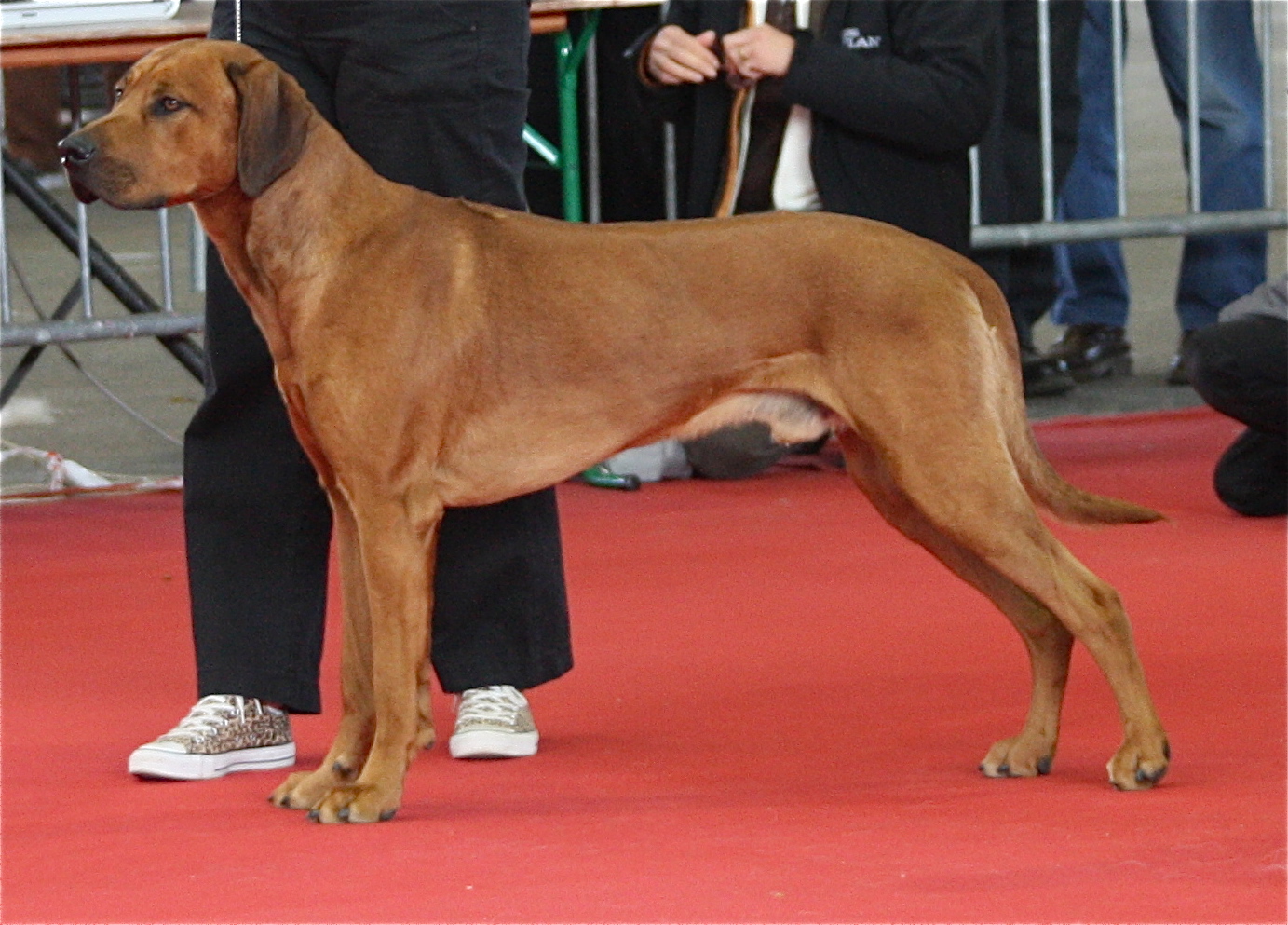

Do you have a better photo of a Rhodesian Ridgeback in the American show ring? If you have a show photo you’d let us use, email it to [email protected] — tell us the dog’s name and the show, and it may be featured here. Please only send photos you took yourself or have the photographer’s permission to share, and tell us the photographer’s name.
1. Breed at a glance
Hound Group; AKC-recognized since 1955
Dogs 25–27 in, 85 lb; bitches 24–26 in, 70 lb
Short, dense, sleek, glossy; light wheaten to red wheaten
10–12 years (AKC)
Dignified, even-tempered, devoted, reserved with strangers
Rhodesian Ridgeback Club of the United States, founded 1957
2. History: the lion hound of southern Africa
The Ridgeback’s story starts with the Khoikhoi people of southern Africa, who kept ridged dogs long before Europeans arrived. When European settlers brought their own hounds to the Cape in the seventeenth and eighteenth centuries, the two lines crossed, and the ridged dogs that resulted were tough, heat-tolerant, and fearless enough to work the big game country. In 1879, the Reverend Charles Helm brought two ridged bitches to the Hope Fountain mission near Bulawayo, in what is now Zimbabwe — and the breed’s modern history dates from there.
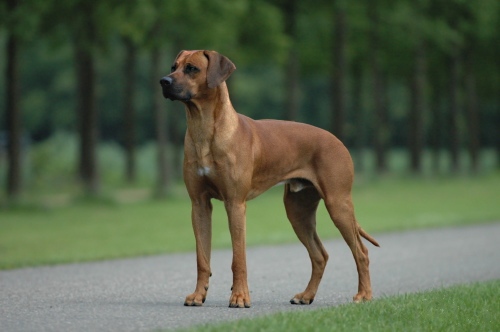

The man who made the breed was Cornelius van Rooyen of Bulawayo, who bred the lion dogs in the late nineteenth century. His dogs tracked lions and held them at bay while the hunter closed in — they bayed, and never made contact, working the lion the way a matador works a bull. The AKC makes the point explicitly: Ridgebacks tracked and held lions at bay; they were not dogs expected to kill lions. The first breed standard was drafted in 1922 at Bulawayo by F. R. Barnes, working from the Dalmatian standard, and the South African Kennel Union approved it in 1927, the year the breed took the name Rhodesian Ridgeback — before that it was called the Rhodesian Lion Dog.
The breed reached Britain in 1954 and the United States a few years earlier: six Ridgebacks were brought from South Africa in 1950 for breeding, and the American Kennel Club recognized the breed in 1955 as its 112th breed, in the Hound Group. The first Ridgeback registered with the AKC was named Tchaika. The Rhodesian Ridgeback Club of the United States was founded in 1957 and has been an AKC member club since 1971, maintaining the standard, running the national specialty, and coordinating the breed’s health work in America.
3. The standard: the ridge is the breed
The AKC standard was approved on January 12, 2010, and effective March 31, 2010. It opens with the ridge: “The peculiarity of this breed is the ridge on the back. The ridge must be regarded as the characteristic feature of the breed.” The general appearance is “a strong, muscular and active hound, symmetrical and balanced in outline,” a mature dog “handsome, upstanding and athletic,” capable of great endurance with a fair amount of speed. Size is dogs 25 to 27 inches, bitches 24 to 26 inches, with desirable weights of 85 pounds for dogs and 70 for bitches.

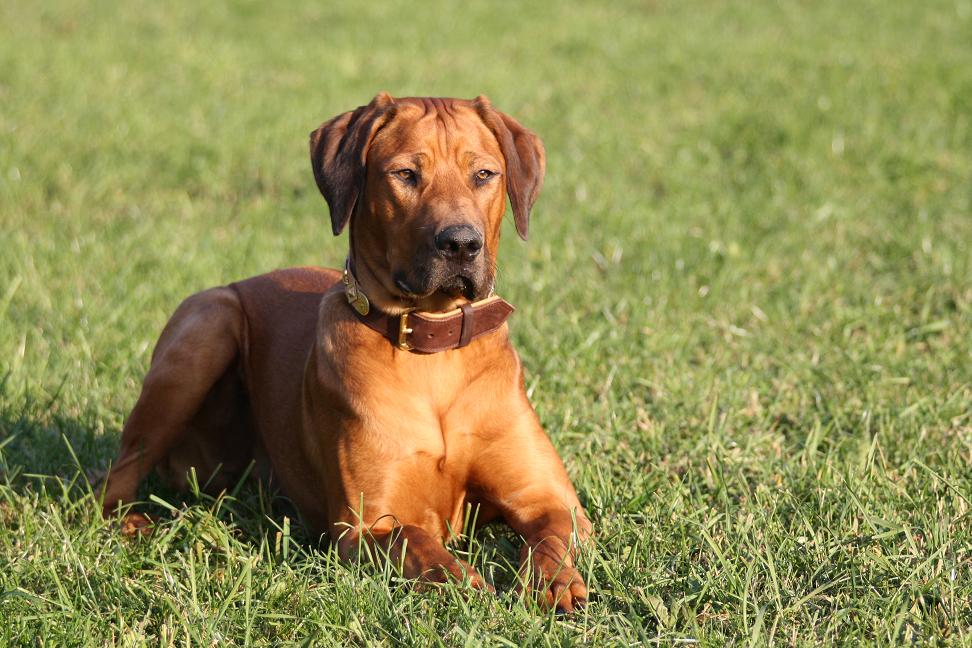
Head. Fair length, the skull flat and rather broad between the ears, free from wrinkles when in repose, the stop reasonably well defined. The eyes are moderately well apart, round, bright and sparkling, their color harmonizing with the color of the dog. The ears are set rather high, of medium size, rather wide at the base and tapering to a rounded point, carried close to the head. The muzzle is long, deep, and powerful, with clean, closely fitting lips. Clear-faced and masked dogs are equally correct. The nose is black, brown, or liver, in keeping with the color of the dog; no other colored nose is permissible. The bite is level and strong, with scissors bite preferred.
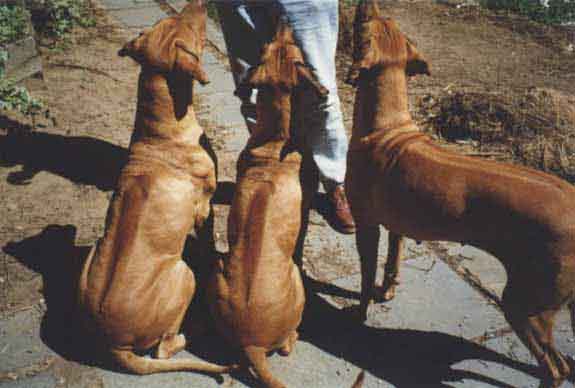
The ridge. The hallmark of the breed, formed by the hair growing in the opposite direction to the rest of the coat. It should be clearly defined, tapering, and symmetrical, starting immediately behind the shoulders and continuing to a point between the prominence of the hips, and it should contain two identical crowns (whorls) directly opposite each other. The lower edge of the crowns should not extend further down the ridge than one-third of the ridge. Disqualification: ridgelessness. Serious fault: one crown or more than two crowns.
Body, coat, color, and gait. The neck is fairly long, strong, and free from throatiness. The chest is very deep and capacious, the back powerful and firm, the tail strong at the insertion and carried with a slight curve upwards, never curled or gay. The forelegs are perfectly straight, strong, and heavy in bone; the hindquarters are clean and well defined, with hocks well down. The coat is short and dense, sleek and glossy, neither woolly nor silky. Color is light wheaten to red wheaten, with a little white on the chest and toes permissible. At the trot the back is held level and the stride is efficient, long, free, and unrestricted; at the chase, the Ridgeback demonstrates great coursing ability and endurance. In temperament the standard’s sentence is the whole pitch: “Of even, dignified temperament, the Ridgeback is devoted and affectionate to his master, reserved with strangers.”
4. Temperament: dignified, devoted, and reserved
The standard’s temperament sentence is the whole pitch: dignified, even-tempered, devoted and affectionate to its master, reserved with strangers. Ridgebacks are loyal to a fault with their own people and famously steady in the house — calm, clean, and quiet for a dog of their size. With strangers they are watchful and aloof rather than effusive, which is the breed’s nature, not a flaw to train out of them. They make good watchdogs without being aggressive by nature.

That steadiness comes with a strong, independent will. Ridgebacks are intelligent and learn fast, but they were bred to think for themselves a long way from the hunter, so training works best with consistency, patience, and reward — not with force, which a Ridgeback will simply refuse. Early, thorough socialization is essential: a Ridgeback that meets a wide range of people, dogs, and situations as a puppy grows into the confident, discriminating adult the standard describes, while one that does not can grow suspicious.
In the house, expect a dog that wants to be where you are and makes its feelings known quietly rather than noisily. Ridgebacks are generally good with children in the family, best with older children who can handle a big, strong dog, and they usually get along with other dogs when raised and socialized with them — though their prey drive and coursing instinct mean small animals and off-leash squirrels are a different matter. Give them a job, a long walk, and a place beside their people, and they give back a loyalty that is hard to match.
5. Grooming and everyday care
The short, dense coat is low-maintenance: a weekly brushing with a rubber curry or hound glove keeps the steady shedding in check and the coat glossy, and a bath is needed only when the dog is actually dirty. The real grooming jobs are the nails, which grow fast on an active dog and need regular trimming, the ears, which should be checked and cleaned, and the teeth, which should be brushed: Ridgebacks are deep-chested and athletic, and dental care matters over a 10- to 12-year life.
Exercise is not optional. This is an endurance breed built to trot all day, and it needs vigorous daily exercise — long walks or runs, hiking, and ideally a dog sport such as lure coursing, where the breed’s coursing ability and speed really show. A Ridgeback that only gets a short walk around the block will find its own entertainment, and it will not be the entertainment you would choose. Plan on an hour or more of real activity a day, plus training and mental work, and a securely fenced yard: the coursing instinct is strong, and a Ridgeback that spots something to chase will go.
Feeding is straightforward: a good-quality food, measured meals, and a lean weight. Extra weight makes the joints work harder and the breathing worse, and a Ridgeback that is allowed to get fat is a Ridgeback heading for the vet. Because the breed is deep-chested, feed smaller meals rather than one large one, and avoid vigorous exercise right after eating — bloat (gastric dilatation-volvulus) is a risk in this build, and it is an emergency when it happens.
6. Health: the tests that matter
The Rhodesian Ridgeback Club of the United States takes part in the Canine Health Information Center (CHIC) program run by the Orthopedic Foundation for Animals, and the club’s code of ethics names the screenings its members are expected to do. Four tests are required for a CHIC number: a hip evaluation (OFA or PennHIP, with a PennHIP score of 0.30 or below accepted as a final screening), an elbow evaluation (OFA), a complete thyroid panel from an OFA-approved laboratory, and an eye examination (OFA Companion Animal Eye Registry, repeated annually). Strongly recommended on top of those are a cardiac certification (OFA or cardiologist evaluation), and DNA testing is encouraged for the autosomal recessive conditions degenerative myelopathy (DM), juvenile myoclonic epilepsy (JME), and early-onset adult deafness (EOAD). A CHIC number means the tests were done and published by the OFA — it does not mean the dog passed them.
Dermoid sinus is the breed’s signature condition and the one every Ridgeback buyer should understand. It is a congenital skin tract along the midline of the back, linked to the same mutation that produces the ridge: during development, the neural tube fails to separate completely from the skin, leaving a hollow tube that can run deep toward the spinal cord, fill with hair and debris, and become infected. Responsible breeders examine every puppy at birth for it, and an affected puppy needs the tract surgically removed and should be spayed or neutered so the defect is not passed on. Ask the breeder who examined each puppy, what was found, and whether the findings are documented by a veterinarian.
Other issues to watch are hip and elbow dysplasia, hypothyroidism from autoimmune thyroiditis, eye disease including cataracts, deafness, degenerative myelopathy, and bloat (gastric dilatation-volvulus). The AKC lists the breed’s lifespan as 10 to 12 years. The breed is generally healthy for a large dog, and the testing above is how responsible breeders keep it that way.
7. The annual Rhodesian Ridgeback specialty dog show
A specialty is the breed’s All-Star show — its Super Bowl. Once a year, the best Rhodesian Ridgebacks from across the country, and often from around the world, come together in one place.
The Rhodesian Ridgeback Club of the United States’ national specialty: one national event each year, usually a multi-day week in the fall, with regional specialties, sweepstakes, obedience, rally, agility, lure coursing, and junior showmanship alongside the conformation show. The 2026 national: October 10–17 in Topeka, Kansas, with 314 dogs and 337 entries in conformation. The 2027 national: October 10–16 in Wilmington, Ohio.
The standard, in brief: a strong, muscular and active hound, 25 to 27 inches at the shoulder for dogs and 24 to 26 for bitches, with a short, dense, sleek, glossy coat in light wheaten to red wheaten — and the ridge on the back, formed by hair growing in the opposite direction to the rest of the coat, with two identical crowns. In temperament it is dignified and even-tempered, devoted and affectionate to its master, and reserved with strangers.
The 94th National Specialty — Saturday, October 10–Saturday, October 17, 2026, at the Hotel Topeka at City Center, 1717 SW Topeka Boulevard, Topeka, Kansas 66612. The national conformation ran Wednesday, October 14 through Friday, October 16, with Best of Breed judged Friday, October 16. Entries closed at 5:00 p.m. EDT on Wednesday, September 2, 2026. Event Chair: Lynn Miller. Event Secretary: Diana Komarek. Superintendent: Jim Rau Dog Shows, Ltd. The national drew 314 dogs and 337 entries in conformation.
The week ran the full Ridgeback program: obedience and rally, sweepstakes, the 4–6 Month Beginner Puppy competition, junior showmanship, stud dog, brood bitch, and brace classes, the Top 25 on Thursday, October 15, and lure coursing on Saturday, October 17, at Jacomo State Park. The judging program listed 353 dogs and 501 entries for the whole week.
Results (2026 national). Best of Breed: GCH CH Rivercity’s Wrapped In Dreams, a bitch, owned by Judith & James Chapman, Linda Hellinge, and Lauren Hay-Lavitt, bred by Howie Bailiff, Crystal Bailiff, Troy L. Abney, and Judith Chapman. Best of Opposite Sex: GCHP CH Camelot’s Godfather BCAT. Best Junior Handler: Peyton Pasquini; Reserve Best Junior Handler: Hunter Olson. Reserve Winners Dog: Azize’s Lionhearted Berkut. Winners Dog, Winners Bitch, and Best of Winners are unconfirmed.
The 95th National Specialty is announced for Sunday, October 10–Saturday, October 16, 2027, at the Roberts Centre, Wilmington, Ohio. Conformation judge: Theresa Lyons. Sweepstakes judge: Liz Demry. Specialty Committee: Dawn Gibas, chair, and Teresa West-Holmes, co-chair. This page will be updated when the club publishes the premium list and judging program.
Past national specialties: 2025 · 2024
Rhodesian Ridgeback Club of the United States — rrcus.org
8. Regional specialties through the year: smaller regional shows
The national is the anchor, but the breed’s year also runs through regional specialties — smaller regional shows, not the national — held around the country, including the regional specialties that run with the national. These are the 2026 regionals verified from club and AKC sources.
Regional Rhodesian Ridgeback specialties verified for 2026:
- San Diego Rhodesian Ridgeback Club Regional Specialty — Friday, January 2, 2026, Indio, California: (AKC event 2026609301). Held at the Empire Equestrian Park and Polo Field with the Kennel Club of Palm Springs cluster. Judge: Mr. Raymond Yurick. 81 Ridgebacks in competition. Best in Specialty Show: GCHP CH Camelot’s Godfather BCAT, handled by David Bueno.
Other 2026 regional specialties had not been verified from club or AKC sources as of November 7, 2026.
The 2027 regionals announced so far:
Regional Rhodesian Ridgeback specialties announced for 2027, from the RRCUS regional and supported show calendar:
- San Diego Rhodesian Ridgeback Club Regional Specialty — Friday, January 8, 2027, Indio, California: Empire Equestrian Park and Polo Field, with the Kennel Club of Palm Springs cluster. Conformation judge: Grace M. Fritz. Sweepstakes and Best Ridge judge: Belinda Seitz. Entries close Wednesday, December 23, 2026. Superintendent: Jack Bradshaw.
- Arizona Rhodesian Ridgeback Club Regional Specialty — Thursday, February 4, 2027, Phoenix, Arizona: two specialties, morning and afternoon, with the Sahuaro State Kennel Club.
- Northwest Rhodesian Ridgeback Club Regional Specialty — Saturday, July 24, 2027, Graham, Washington: with the Tacoma Kennel Club.
More regional specialties will be added here as their programs are verified — this section is built from show data, not guesswork. Browse upcoming show weekends →
9. Clubs
The Rhodesian Ridgeback Club of the United States, Inc. (RRCUS), founded in 1957, is the AKC parent club for the breed in the United States, and an AKC member club since 1971. It maintains the official standard, promotes responsible breeding through its code of ethics, coordinates breed-specific health research, runs the national specialty, and supports rescue. The club’s officers for 2026 are President Erin Coogan, First Vice-President Denise Eberhard, Second Vice-President Tammy Lynch, Recording Secretary Tonia Toben, Corresponding Secretary Susan Ohanesian ([email protected]; 8200A Bulls Ferry Road #3, North Bergen, NJ 07047; 201-881-9598), Treasurer Kathy Lordier, and AKC Delegate Mary Lynne Elliot.
Regional clubs run the regional specialties that fill the breed’s year — the San Diego Rhodesian Ridgeback Club (Indio, California), the Arizona Rhodesian Ridgeback Club (Phoenix), the Northwest Rhodesian Ridgeback Club (Tacoma, Washington), the Greater Valley Forge Rhodesian Ridgeback Club, the Sunshine State Rhodesian Ridgeback Club, and the Chesapeake Bay Area Rhodesian Ridgeback Club among them. The club’s regional and supported show calendar, published on its website, lists the regional specialties and supported entries through the year.
10. Rescue
The breed’s rescue work is centered on Rhodesian Ridgeback Rescue, Inc. (RRRI), an all-volunteer 501(c)(3) that is the official rescue program for the AKC- and CKC-recognized national breed clubs in the United States and Canada, as well as most local and regional Ridgeback clubs in both countries. It operates throughout the United States and Canada. Contact: [email protected]; website: ridgebackrescue.org. The parent club also maintains a rescue page at rrcus.org, and the AKC Rescue Network lists the club’s rescue contacts.
Expect an application, a home visit, and a careful match — reputable groups vet adopters as thoroughly as they vet the dogs. A rescue Ridgeback is usually an adolescent or adult whose personality is already known, which is a real advantage if you want to know what you are getting: how it is with children, with other dogs, and with strangers. Ask about hips, thyroid, and any history of dermoid sinus surgery before you commit, and budget for the vet care an older or surrendered dog may need.
11. Breeder vs. rescue: honest guidance
Either route starts with the same question: has this dog’s health been tested? From a breeder, ask for the CHIC numbers of both parents — the hip evaluation, the elbow evaluation, the thyroid panel, and the eye examination — and check them on the OFA database yourself, by the parents’ registered names. Ask who examined the puppies for dermoid sinus at birth, and ask what health issues the breeder sees in their stock: a responsible breeder tests, and will talk about the breed’s faults as readily as its virtues. Meet at least the dam, and be honest with yourself about the exercise: this is a 70- to 85-pound athlete that needs a real daily outlet, not a dog that will be content with a short walk.
From rescue, expect an adolescent or adult dog whose personality is already known, placed by a group that has vetted the dog and will tell you what it is actually like in a home. Budget for the same things either way: joint care, thyroid care, and the possibility of bloat, which is a risk in any deep-chested breed. Whichever route you take, the dog that fits is a dignified, athletic, loyal companion that wants a job, a long walk, and a place beside its people — and will hold the fort while you are gone.
12. Claim this page
This page was built from public sources — the AKC standard, the parent club’s own material, AKC event records, and the rescue group’s site — and it is a starting point, not the last word. If you are with the Rhodesian Ridgeback Club of the United States or a regional club and something here is wrong or missing, you can claim this page and set it straight: email [email protected] and tell us what needs fixing. Corrections from the people who own the breed are how this page gets better.
Sources
- AKC, Rhodesian Ridgeback
- AKC, Official Standard of the Rhodesian Ridgeback (approved January 12, 2010; effective March 31, 2010)
- AKC, The Rhodesian Ridgeback Once Hunted Lions
- Rhodesian Ridgeback Club of the United States
- Rhodesian Ridgeback Club of the United States, National Specialty
- Rhodesian Ridgeback Club of the United States, National Specialty Winners
- Rhodesian Ridgeback Club of the United States, Overall Results
- Rhodesian Ridgeback Club of the United States, Regional & Supported Show Calendar
- Rhodesian Ridgeback Club of the United States, Code of Ethics
- RRCUS 2026 National Specialty conformation catalog (submitted results)
- RRCUS 2026 National Specialty information packet (Rau)
- RRCUS 2026 National Specialty judging program (Rau)
- AKC event search, RRCUS National Specialty 2026 (event 2026194515)
- AKC event search, RRCUS National Specialty 2025 (event 2025194516)
- AKC event search, RRCUS National Specialty 2024
- AKC event search, San Diego Rhodesian Ridgeback Club Regional Specialty 2026 (event 2026609301)
- AKC Club Search and Directory, Rhodesian Ridgeback Club of the United States
- Rhodesian Ridgeback Rescue, Inc.
- AKC, Upcoming National Specialties list
- Dogzibit, 2027 San Diego Rhodesian Ridgeback Club specialty