
Breed profile · Herding Group · the indefatigable little herder of the Pyrenees
Pyrenean Shepherd
The Pyrenean Shepherd is a small, sinewy, lean, lively dog whose sparkling personality and quicksilver intelligence are reflected in the vibrant expression of his unique triangular head and windswept face — the AKC standard’s own opening line, and the whole breed in one sentence. A superb athlete and an ardent herder of all kinds of livestock, the Pyr Shep comes in two varieties, rough-faced and smooth-faced, born in the same litters. The AKC recognized the breed in 2009, in the Herding Group, and the Pyrenean Shepherd Club of America is the parent club.
Help us improve it. This is one of ThePetAdvisor’s breed profiles, built from public sources with generous links to the people who actually own this breed’s knowledge. If something’s off or missing, the parent club can claim the page and set it straight — see the bottom of the page.
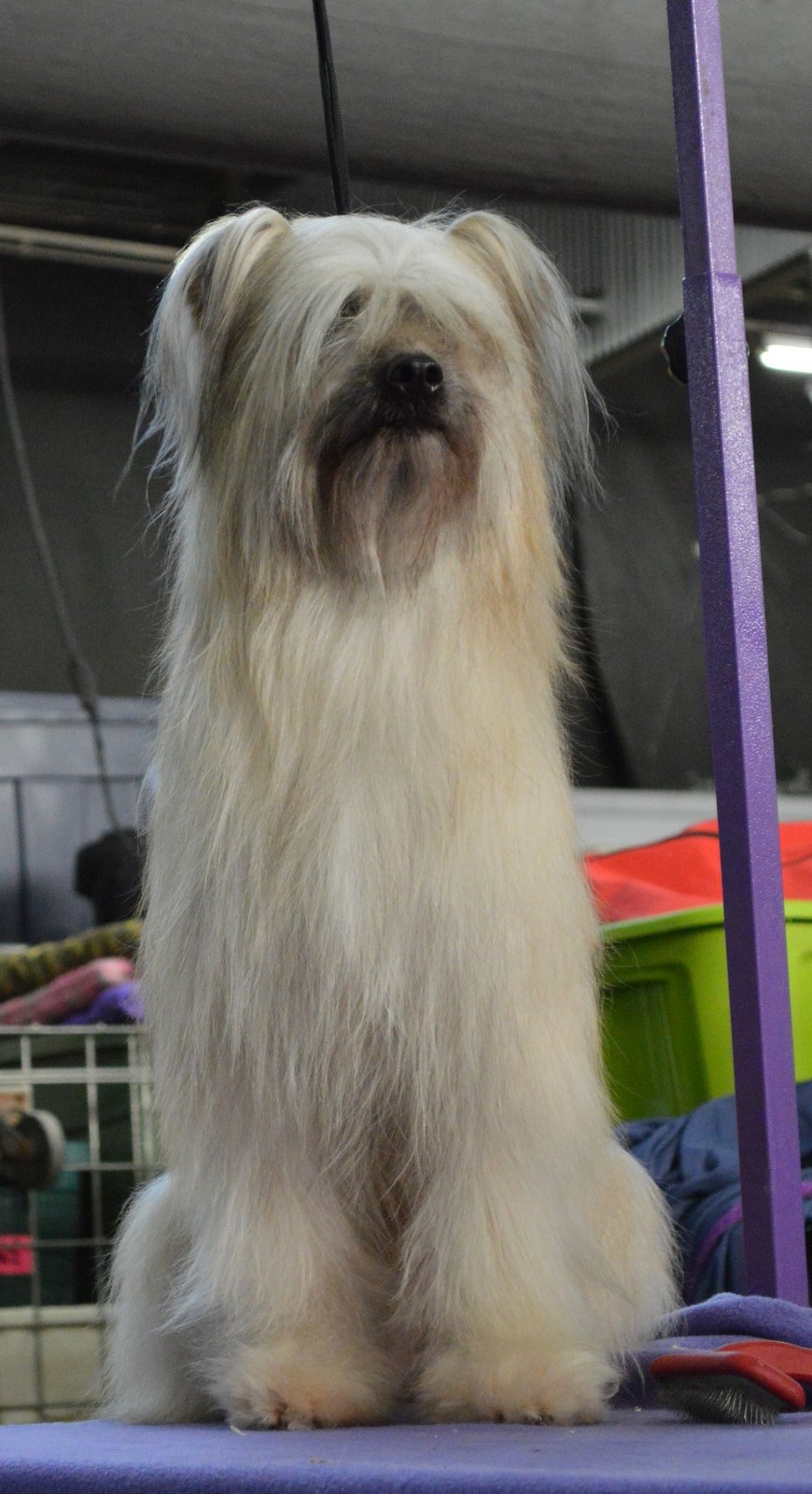

Do you have a better photo of a Pyrenean Shepherd in the American show ring? If you have a show photo you’d let us use, email it to [email protected] — tell us the dog’s name and the show, and it may be featured here. Please only send photos you took yourself or have the photographer’s permission to share, and tell us the photographer’s name.
1. Breed at a glance
The Pyrenean Shepherd — the Pyr Shep, the Berger des Pyrénées — is a small herding dog built like a working athlete: light-boned, sinewy, and always on alert. It is one of the oldest French herding breeds, and one of the longest-lived. (AKC, Pyrenean Shepherd.)
- AKC group
- Herding; recognized 2009 (160th breed; Foundation Stock Service 2004)
- Size
- Rough-faced males 15½–18½ in, females 15–18 in; smooth-faced males 15½–21 in, females 15½–20½ in; the standard sets no weight, typically 15–30 lb
- Coat & color
- Two varieties: rough-faced (long or demi-long, harsh coat) and smooth-faced (short, fine face hair); fawn, grey, merle, brindle, black, black with white up to 30%
- Lifespan
- 15–17 years
- Temperament
- Energetic, devoted, alert, intelligent, mischievous; bonds intensely to one person; distrustful of strangers
- Parent club
- Pyrenean Shepherd Club of America
2. History
The Pyrenean Shepherd is an ancient herding dog of the Pyrenees mountains of France, where dogs of this type have worked the flocks for centuries. The Pyr Shep worked alongside the Great Pyrenees: the big white guardian watched for predators while the little shepherd moved the sheep — and, the AKC notes, two Pyr Sheps could handle up to a thousand sheep. The breed is among the oldest French herding breeds, and its partnership with the Great Pyrenees is the oldest working team in the mountains. (Sources: AKC, Pyrenean Shepherd; WebMD, Pyrenean Shepherds: What to Know.)
The breed came to the wider world’s attention in the First World War, when the French army used Pyrenean Shepherds as couriers and search-and-rescue dogs — their speed, agility, and sense of terrain made them well suited to the work, and many of them died doing it. After the war, soldiers who had seen their work praised them, and French fanciers formed the first breed club, the Réunion des Amateurs de Chiens Pyrénéens. The French Kennel Club recognized the breed in 1926, and the FCI gave definitive acceptance on January 28, 1955, in Group 1, Section 1, with France holding custodianship; the FCI carries two standards, 141 for the long-haired variety and 138 for the smooth-faced. (Sources: WebMD, Pyrenean Shepherds: What to Know; DogZone, Pyrenean Sheepdog; Furry Critter, Berger des Pyrenees.)
In the United States, Pyr Sheps came over with Pyrenean flocks in the nineteenth century, and were later used as contract herders by the Western Range Association from the 1940s into the early 1970s. The Pyrenean Shepherd Club of America was formed in 1987; the breed entered the AKC Foundation Stock Service in 2004 and received full AKC recognition on January 1, 2009, in the Herding Group, as the 160th breed. The UK Kennel Club lists the two varieties as separate breeds — Pyrenean Sheepdog Long Haired, and Smooth Faced on the Imported Breed Register since April 1, 2021. (Sources: Petful, Pyrenean Shepherd Breed Profile; Furry Critter, Berger des Pyrenees.)
3. The standard and why it is written that way
The standard’s first line is the whole breed in one sentence: a small, sinewy, lean, lively dog whose sparkling personality and quicksilver intelligence are reflected in the vibrant expression of his unique triangular head and windswept face. A superb athlete, his beautiful, flowing gait “shaves the earth.” Uncoiffed, light-boned and built as a horizontal rectangle, his high energy and intelligent, cunning, mischievous attitude show that he is always on alert, suspicious, ready for action. (AKC, Official Standard of the Pyrenean Shepherd, approved April 11, 2006, effective January 1, 2007.)
- Head — the breed’s defining feature: generally triangular in shape, rather small in proportion to the size of the dog, well filled-in under the eyes, with the top skull nearly flat. Expression intelligent, alert, and cunning, even a little mischievous. Eyes almond-shaped, open, and very expressive, dark brown in color; partially or completely blue eyes are acceptable only in merles, and eye rims are black no matter what color the coat. Both cropped and uncropped ears are equally acceptable; natural ears are semi-prick or rose. The muzzle is straight and slightly shorter than the skull; in smooth-faced dogs it is slightly longer and more pointed, with short, fine muzzle hair, while in rough-faced dogs the hair on the end of the muzzle and chin must be naturally short and it lengthens as the muzzle widens toward the skull — the characteristic windswept appearance. Nose black. A scissors bite is strongly preferred; an even bite is admissible.
- Size & body: rough-faced males 15½ to 18½ inches at the withers, females 15 to 18 inches; smooth-faced males 15½ to 21 inches, females 15½ to 20½ inches. Weight: an absolute minimum is required — just enough flesh to cover the bones, and the ribs should be readily felt. In rough-faced dogs the body is clearly long in proportion to the height, whereas smooth-faced dogs appear much more square. The dog in good working condition is lightly boned and sinewy, correctly proportioned and well balanced, and must never appear overdone. The tail may be docked, natural bob, or naturally long — all are equally acceptable.
- Coat: quality is more important than abundance. Rough-faced: long or demi-long hair, almost flat or slightly wavy, harsh in texture — halfway between the hair of a goat and the wool of a sheep — with minimal undercoat; the long-haired coat may cord, especially on the elbows, croup, and thighs, but never on the head. Smooth-faced: fine and soft, attaining a maximum length of no more than 3 inches for the ruff and culottes, 2 inches along the back. The breed is uncoiffed and unscissored: no ribbon shall be awarded to a dog whose coat has been scissored, especially on the face, except for neatening of the feet.
- Color: various shades of fawn from tan to copper, with or without a mixture of black hairs; grey, ranging from charcoal to silver to pearl grey; merles of diverse tones; brindle; black; black with white markings not exceeding 30 percent of the body surface. A little white is acceptable on the chest, head, and feet. Faults: too many white patches or white patches that are too big; black with tan points. Disqualification: a white coat covering 50 percent or more of the body.
- Gait: the trot — the little shepherd’s favorite gait — must be solid and vigorous. At the jog trot the head is carried rather high; as the stride lengthens the head lowers to become level with the backline. The feet barely leave the ground. He “shaves the earth.”
- Temperament (in the standard): not merely a header or a drover — a versatile herder to his very soul, with the intelligent initiative to adapt to all manner of changing circumstances. He has the tendency to become passionately attached to his owner to the complete exclusion of all others, and is astonishingly sensitive to his owner’s moods. As a companion, he is very active and enthusiastic and insists upon being involved in the day’s activities, whatever they may be. He is very affectionate with the members of his immediate family, but is distrustful of strangers.
- Disqualifications: under the minimum height, or exceeding the maximum height by more than ½ inch; missing pigment on the eye rims; blue eyes in a dog of coat color other than merle; a nose other than black; an overshot or undershot bite; a white coat covering 50 percent or more of the body.
Why it is written that way. The standard is a head standard first: the triangular head and the windswept face are the breed, and the face is a test a judge can see from across the ring — the muzzle hair must be short at the end and lengthen toward the skull, and the eyes must stay readily visible, not veiled by hair. The no-scissoring rule exists because a trimmed face would fake the windswept look; the breed is meant to look uncoiffed. The two varieties share one standard with different size ranges because they are born in the same litters — splitting them would split litters. The weight rule (minimum flesh, ribs felt) keeps it a working athlete rather than a padded show dog, and the color disqualification draws the line at a mostly-white dog.
4. Temperament & living with one
Enthusiastic, mischievous, and whip-smart, the Pyrenean Shepherd is an indefatigable herder — and it brings the herder home with it. Everything in the standard’s temperament paragraph is something you will live with: the passionate attachment, the sensitivity to your moods, the distrust of strangers, and the insistence on being involved in the day’s activities, whatever they may be.
- With its own person: passionately attached, to the complete exclusion of all others, and astonishingly sensitive to its owner’s moods. This is a dog that reads you all day and wants to be where you are.
- With strangers: naturally distrustful, not hostile. A Pyr Shep that has not been introduced will keep its distance, and it does not warm up on a schedule — heavy early socialization is not optional.
- Training: intelligent, quick, and cunning, with a powerful herding instinct that shows from the youngest age. It needs a job and mental work, and it excels at agility, obedience, and herding. Harsh handling backfires on a dog this sensitive; the dog shuts down or pushes back.
- Exercise: high stamina and high energy. Rigorous daily exercise plus mental work is the baseline — a bored Pyr Shep invents its own work, and the invention is usually herding something you did not want herded.
- Alone time: does not do well left alone or confined for long stretches. The parent club’s Code of Ethics says the breed is not suited to a kennel environment and that its dogs need individual attention every day.
- First-dog honesty: a poor fit for a casual or first-time home, and a strong fit for an active, experienced owner who wants a working partner. Best with older children who respect a sensitive dog, and with a fenced outlet for all that energy.
5. Grooming
Coat quality is more important than abundance, and the coat is easier to keep than it looks — there is minimal undercoat. The work is regular brushing and leaving the face alone.
- Rough-faced: brush the long or demi-long coat through regularly, paying attention to the elbows, croup, and thighs, where the long coat may cord. Keep the face natural — never scissor the muzzle or cheeks — and keep the hair from veiling the eyes.
- Smooth-faced: the short, fine coat needs little: a quick weekly brush is enough. The ruff and culottes are the longest parts, at most 3 inches.
- Feet: neatening the feet is the one place the standard allows trimming. The pads are dark, the nails hard and dark; trim the nails regularly and clear the feathering between the toes if it picks up debris.
- Face & ears: keep the face clean, especially around the muzzle and the eyes. The ears are semi-prick or rose and sit on top of the head — check them regularly and keep them clean and dry.
- Bathing: bathe as needed, and dry the coat thoroughly; a damp long coat mats faster than a dry one.
6. Health testing
The parent club’s health-testing recommendations, published by the AKC and the OFA, are the starting point. Pyrenean Shepherds are generally healthy dogs with a 15–17-year lifespan, and the breed’s CHIC requirements are short — three tests — which reflects a generally sound, rare breed rather than a breed with no risks at all.
- Hip Evaluation (CHIC): hip dysplasia screening, OFA or PennHIP. OFA radiographs are done at 24 months of age or older.
- Patella Evaluation (CHIC): the kneecaps. Patellar luxation, where the kneecap slips out of place, is the thing this test screens for.
- Ophthalmologist Evaluation (CHIC): the eyes. An annual CAER examination by a board-certified veterinary ophthalmologist (ACVO), screening for progressive retinal atrophy, cataracts, Collie eye anomaly, and other hereditary eye disease.
- Beyond CHIC: many breeders also run DNA tests for MDR1 drug sensitivity (common in herding breeds), prcd-PRA, and Collie eye anomaly, plus a cardiac evaluation. These are not CHIC requirements for the breed, but they are the tests a thorough breeder will have done.
Ask the breeder for the parents’ patella, hip, and eye results, and look them up in the OFA database yourself before you commit. (Sources: AKC, Herding Group Health Testing Requirements; OFA, CHIC Program; Pyrenean Shepherd Club of America, Code of Ethics.)
7. The annual Pyrenean Shepherd specialty dog show
A specialty is the breed’s All-Star show — its Super Bowl. Once a year, the best Pyrenean Shepherds from across the country, and often from around the world, come together in one place.
The Pyrenean Shepherd Club of America’s national specialty: one national event each year, with conformation, sweepstakes, and junior showmanship. The 2026 national: April 11, at the Georgia National Fairgrounds & Agricenter in Perry, Georgia, with 27 competitors and 33 entries in conformation. The 2025 national: May 24, at the Western NC Agricultural Center in Fletcher, North Carolina, with 32 competitors and 33 entries. The 2027 national: May 29, at the Western NC Agricultural Center in Fletcher, North Carolina.
The standard, in brief: a small, sinewy, lean, lively dog whose sparkling personality and quicksilver intelligence are reflected in the vibrant expression of his unique triangular head and windswept face. Two varieties — rough-faced and smooth-faced — born in the same litters. Rough-faced males 15½–18½ inches, females 15–18 inches; smooth-faced males 15½–21 inches, females 15½–20½ inches. Colors: fawn, grey, merle, brindle, black, and black with white markings not exceeding 30 percent; white covering 50 percent or more of the body is a disqualification.
The 2026 National Specialty — Saturday, April 11, 2026, at the Georgia National Fairgrounds & Agricenter, 401 Larry Walker Parkway, Perry, Georgia. Entry: 33 entries / 27 competitors in conformation. Entries closed March 25, 2026; entries limited to 100. Event Chair: Cindy Wilmoth. Superintendent: Onofrio Dog Shows. A designated specialty ran the day before, Friday, April 10, at the same site, hosted by the Valdosta Kennel Club. (Source: AKC event search, event 2026677205.)
National specialty judge: Mrs. Chantal Reilhac (France) — conformation and 4–6 Month Beginner Puppy. Junior showmanship judge: Mrs. E Indorato. Sweepstakes offered; the sweepstakes judge not confirmed in an official source as of November 2026. Best Junior Handler: Rozlyn Myers; Reserve Best Junior Handler: Elizabeth Skaggs. (Source: AKC event search, event 2026677205.)
Results (2026 national). Best of Breed: GCH CH La Brise Rpk3 Lightening Strikes Twice (dog). Best of Opposite Sex: GCHB CH Pierrette Bleue De La Vallee Du Mouton RN CA DCAT (bitch) — also Best Owner-Handled. Winners Dog and Best of Winners: La Brise Don’T Mess With Texas TKN; Winners Bitch: MACH Tempete Bleue Du Merle Bleu De L’Autan MXB MJB OF FCAT DJ DDB CGCA TKP FTI. Select Dog: CH La Brise Abelion The Sun God; Select Bitch: GCH CH La Rochelle Oo La La RN FCAT ACT2 CGC TKN. Reserve Winners Dog: Troumouse Soun De Matte Du Pla D’Adet; Reserve Winners Bitch: Echo Ridge’s Virginia Is For Lovers. Best Junior Handler: Rozlyn Myers; Reserve Best Junior Handler: Elizabeth Skaggs. (Source: AKC event search, event 2026677205.)
The 2027 National Specialty: Saturday, May 29, 2027, one day, at the Western NC Agricultural Center, 1301 Fanning Bridge Rd, Fletcher, North Carolina. Entries close Wednesday, May 12, 2027. Event Chair: Cindy Wilmoth. Superintendent: MB-F Inc. A 4–6 Month Beginner Puppy competition runs the same day (AKC event 2027677203). Judges for the 2027 national not yet published as of November 2026; the AKC record shows the panel as pending. (Sources: AKC event search, event 2027677202; AKC Upcoming National Specialties.)
Past national specialties: 2025 · 2024 · 2023
Pyrenean Shepherd Club of America — pyrshepclub.org
8. Regional specialties through the year: smaller regional shows
The national is the anchor, but the breed’s year also runs through regional specialties — smaller regional shows, not the national — held around the country, including the regional specialties that run with the national. These are the 2026 regionals verified from club and AKC sources so far:
Two designated Pyrenean Shepherd specialties verified for 2026, one with the national week in Perry, Georgia, and one with the Orlando cluster in December:
- Designated specialty — Friday, April 10, 2026, Perry, Georgia: at the Georgia National Fairgrounds & Agricenter (AKC event 2026677204), hosted by the Valdosta Kennel Club, the day before the national. Superintendent: Onofrio Dog Shows. Event Chair: Cindy Wilmoth. Entries closed March 25, 2026. Judge not confirmed in an official source as of November 2026.
- Designated specialty — Friday, December 11, 2026, Orlando, Florida: at the Orange County Convention Center N/S Bldg, 9899 International Drive (AKC event 2026677208), hosted by the Sunshine State Herding Group Association. Superintendent: MB-F Inc. Event Chair: Cindy Wilmoth. Entries closed November 11, 2026. Judge: Regina Lee Bryant, per the host club’s AKC event record.
Past regional specialties: 2025 · 2024 · 2023
More regional specialties will be added here as their programs are verified — this section is built from show data, not guesswork. Browse upcoming show weekends →
9. Clubs
The Pyrenean Shepherd Club of America is the parent club — the breed’s national organization, and the club that runs the national specialty. Its stated object is to protect and preserve in Pyrenean Shepherds in America the unique qualities of type and temperament traditionally valued in the French Pyrenees, to promote the standard, and to encourage quality breeding. The club keeps a breeder referral list, runs the annual Merit Evaluation program with the national specialty, and publishes a Code of Ethics; its bylaws encourage the organization of regional clubs where there are enough fanciers to support them. (Sources: Pyrenean Shepherd Club of America; PSCA Constitution & Bylaws.)
- Pyrenean Shepherd Club of America (parent club) — pyrshepclub.org. National specialty, breeder referral, Merit Evaluations, Code of Ethics.
- AKC Marketplace — marketplace.akc.org/puppies/pyrenean-shepherd — for puppies from AKC-registered breeders. The parent club’s breeder referral is the better first step.
- Regional clubs: no PSCA-affiliated regional club was verified as of November 2026; the club’s bylaws encourage forming one where there are enough fanciers.
10. Rescue
There is no separate national Pyrenean Shepherd rescue in the United States that we could verify as of November 2026. Start with the parent club — the PSCA Code of Ethics requires members to take responsibility for all the dogs they produce, which includes taking a dog back when a home fails.
- Pyrenean Shepherd Club of America — contact the club directly: pyrshepclub.org. Members are expected to take back dogs they bred, and the club is the first place a Pyr Shep in need is likely to be known.
- AKC Rescue Network — the AKC’s rescue directory also lists Pyrenean Shepherd rescue contacts: akc.org/akc-rescue-network.
- United Kingdom: the Pyrenean Sheepdog Club of Great Britain runs a breed rescue for UK dogs: pyreneansheepdogclub.com.
Rescue dogs are almost always adults, and their temperaments are already visible — which is an advantage in a breed that bonds to one person and is reserved with strangers. A rescue will want to know your home, your schedule, and your other animals before it places a dog with you. That is the process working, not a delay.
11. Breeder vs. rescue: honest guidance
The honest version, before you decide:
- “Rare variety” is nonsense. Rough-faced and smooth-faced are born in the same litters — neither is rare, and a premium price for one variety is a markup, not a variety.
- Color is not a rarity. White covering 50 percent or more of the body is a disqualification, and black with tan points is a fault. A “rare” mostly-white or black-and-tan Pyr Shep is a dog that cannot be shown, sold as a rarity.
- No scissored faces. The standard bars a ribbon for a scissored dog, especially on the face. A breeder who trims faces is working against the standard, not with it.
- Ask for the three CHIC tests. Patella, hip, and eye — and look the parents up in the OFA database yourself. A breeder who has done the tests will be glad to show them; a breeder who has not will change the subject.
- Be honest about the energy. This is not a casual first dog. It needs a job, rigorous daily exercise and mental work, and heavy early socialization. A bored Pyr Shep invents its own work, and you will not like the invention.
- Rescue adults are a real option. Via the parent club and the AKC Rescue Network, and an adult’s temperament is already visible — which matters in a breed that bonds to one person and is reserved with strangers.
12. Claim this page
Do you own a Pyrenean Shepherd? Have a photo from a national specialty or a regional specialty, or a correction to something on this page? Pyrenean Shepherd Club of America members, breeders, and exhibitors — and anyone with a standard-conforming dog — can help this page get better. See the photo note under the photo above for how to send a picture, or contact us with a correction.
Sources
- AKC, Official Standard of the Pyrenean Shepherd (PDF) — images.akc.org/pdf/breeds/standards/PyreneanShepherd.pdf
- AKC, Pyrenean Shepherd breed page — www.akc.org/dog-breeds/pyrenean-shepherd
- AKC, Herding Group Health Testing Requirements — www.akc.org/breeder-programs/breed-health-testing-requirements/herding-group-health-testing-requirements
- AKC, Upcoming National Specialties — www.apps.akc.org/apps/events/conformation/national_specialties.cfm
- AKC event search, event 2027677202 (2027 national) — www.apps.akc.org/apps/events/search/index_results.cfm
- AKC event search, event 2026677205 (2026 national) — www.apps.akc.org/apps/events/search/index_results.cfm
- AKC event search, event 2025677203 (2025 national) — www.apps.akc.org/apps/events/search/index_results.cfm
- AKC event search, event 2024677210 (2024 national) — www.apps.akc.org/apps/events/search/index_results.cfm
- AKC event search, event 2023677209 (2023 national) — www.apps.akc.org/apps/events/search/index_results.cfm
- AKC event search, event 2026677204 (2026 Perry designated specialty) — www.apps.akc.org/apps/events/search/index_results.cfm
- AKC event search, event 2026677208 (2026 Orlando designated specialty) — www.apps.akc.org/apps/events/search/index_results.cfm
- Pyrenean Shepherd Club of America — www.pyrshepclub.org
- Pyrenean Shepherd Club of America, Code of Ethics (2016) — pyrshepclub.org/uploads/b/e1f11a10-7def-11ec-aeff-8b609da5aead/PSCA-Code-of-Ethics-2016_Nzg4ND.pdf
- Pyrenean Shepherd Club of America, Constitution & Bylaws (2015) — pyrshepclub.org/uploads/b/e1f11a10-7def-11ec-aeff-8b609da5aead/PSCA-Constitution-Bylaws-FINAL-ver-2015_NjIzNT.pdf
- Pyrenean Shepherd Club of America, Merit Evaluation entry and rules (2025) — pyrshepclub.org/uploads/b/e1f11a10-7def-11ec-aeff-8b609da5aead/ME Entry and Rules - 2025 PDF_NDQ0Mz.pdf
- AKC Gazette, Pyrenean Shepherd column (June 2009) — pyrshepclub.org/uploads/b/e1f11a10-7def-11ec-aeff-8b609da5aead/AKC-Gazette-Column-2009-06.pdf
- Echo Ridge Kennel, news (2025 national results) — www.echoridgekennel.com/news/category/all
- Chaparral / Amblecroft, Pyrenean Shepherd results (2024 national) — www.amblecroft.ca/pyrresults.html
- OFA, CHIC Program — ofa.org/chic-programs
- WebMD, Pyrenean Shepherds: What to Know — www.webmd.com/pets/dogs/what-to-know-about-pyrenean-shepherds
- Petful, Pyrenean Shepherd Breed Profile — www.petful.com/dog-breeds/breed-profile-pyrenean-shepherd
- Furry Critter, Berger des Pyrenees — www.furrycritter.com/pages/descriptions/dogs/b/berger_des_pyrenees.htm
- DogZone, Pyrenean Sheepdog — www.dogzone.com/breeds/pyrenean-sheepdog
- BreedTracker, Breeding Pyrenean Shepherd (CHIC requirements) — www.breedtracker.com/breeds/herding/pyrenean-shepherd
- Wikimedia Commons, File:Pyrenean Shepherd-10-GCH-La Brise Louis Quatorze 06 (16558803176).jpg (hero photo) — commons.wikimedia.org/wiki/File:Pyrenean_Shepherd-10-GCH-La_Brise_Louis_Quatorze_06_(16558803176).jpg