
Breed profile · Toy Group · the square, cobby companion
Pug
The Pug is a square, cobby toy dog of 14 to 18 pounds, built on the standard's Latin tag — multum in parvo, much in little. It is one of the oldest breeds known, with roots in China two thousand years ago, and its job has never changed: keeping people company. The AKC recognized the breed in 1885, and the Pug Dog Club of America, founded in 1931, runs the national specialty every fall.
Help us improve it. This is one of ThePetAdvisor’s breed profiles, built from public sources with generous links to the people who actually own this breed’s knowledge. If something’s off or missing, the parent club can claim the page and set it straight — see the bottom of the page.
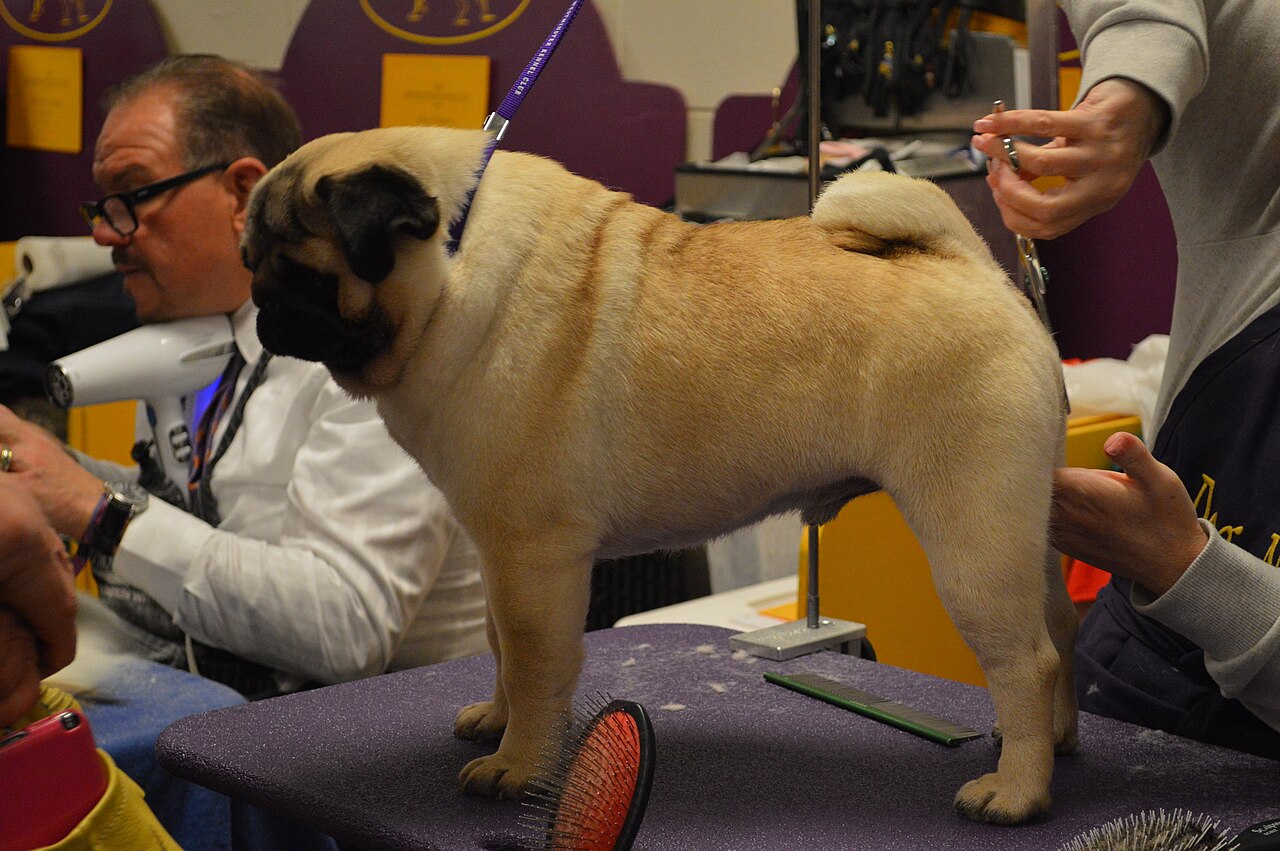

Do you have a better photo of a Pug in the American show ring? If you have a show photo you’d let us use, email it to [email protected] — tell us the dog’s name and the show, and it may be featured here. Please only send photos you took yourself or have the photographer’s permission to share, and tell us the photographer’s name.
1. Breed at a glance
Toy Group; AKC-recognized since 1885
14–18 lb desirable; 10–13 in tall
Fine, smooth, soft, short, glossy; fawn or black
12–15 years (AKC)
Even-tempered, playful, charming, dignified, outgoing, loving
Pug Dog Club of America, Inc., founded 1931
2. History: two thousand years of keeping company
Some breeds have seen their purpose change over the years. The Pug is not among them. It is an ancient breed, with roots dating back to 400 B.C., and most historians agree it originated in China, where Pugs were bred as companions for the wealthy. They kept Tibetan Buddhist monks company in their monasteries, and they received royal treatment as companions to Chinese emperors and their families, who valued them so much they kept guards and servants to protect and care for them. Chinese breeders shaped the forehead wrinkles on purpose, aiming for a pattern that resembled the Chinese character for “prince” (王).
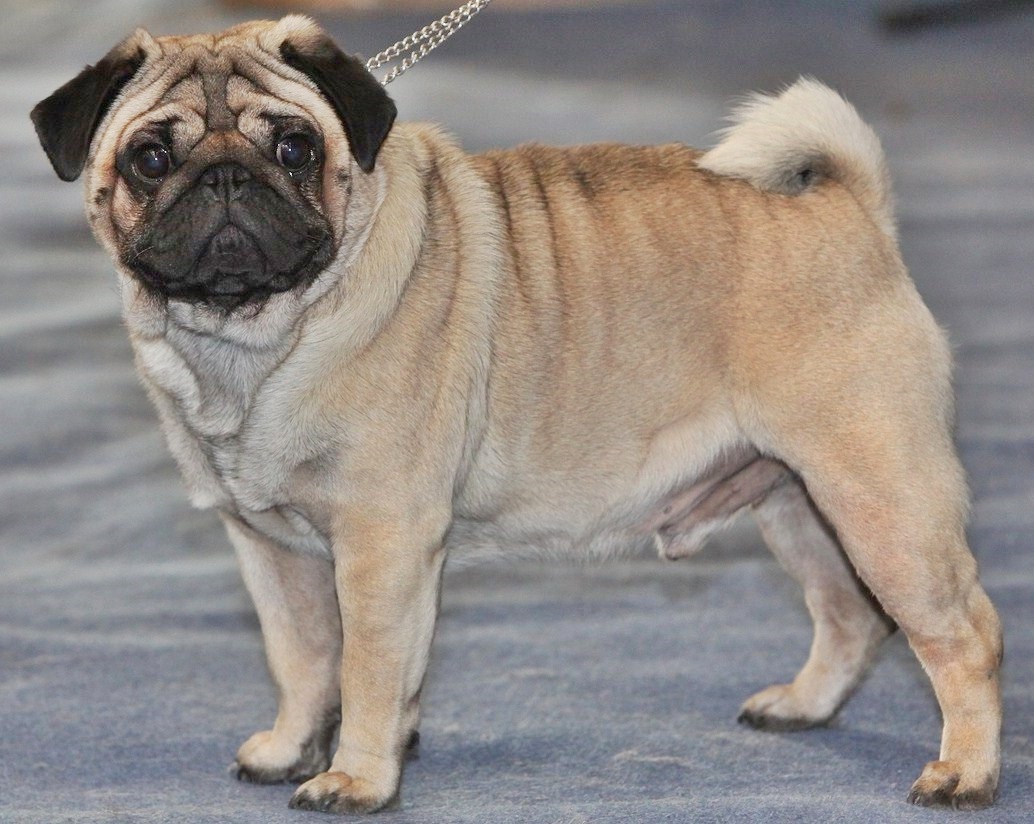

The breed’s name is a small mystery of its own. The most popular theory is that it came from marmoset monkeys, also known as Pug monkeys — popular pets in the early 1700s, with faces very similar to the Pug’s. Other theories trace it to the Latin word pugnus, meaning “fist.” From China the Pug’s popularity spread to Japan and Russia and ultimately to Europe, where the dogs ensconced themselves in royal palaces and the homes of the upper class. The aunt of Catherine the Great of Russia even took some of her Pugs to church with her. Queen Victoria loved Pugs, and Prince William the Silent of Holland owed his life to his brave little Pug. Renowned European artists such as Goya, William Hogarth, and Reinagle included them in their paintings. After the Catholic Church forbade Catholics from becoming Freemasons, a group of Catholics formed a covert society called the Order of the Pug in 1740, choosing the Pug as their symbol because Pugs are loyal and trustworthy — members had to wear a dog collar and scratch at the door to be initiated.
The Pug Club, founded in England in 1883, is one of the oldest single-breed clubs in existence. The American Kennel Club recognized the Pug in 1885, making it one of the earliest breeds in the AKC stud book, and Pugs had been introduced to the United States after the Civil War. The Pug Dog Club of America was founded in 1931 and serves as the AKC parent club, maintaining the standard, promoting health research, and running the national specialty. The breed’s famous owners run from Harriet Beecher Stowe, who had two Pugs named Punch and Missy, to the designer Valentino, whose Pug Oliver lent his name to a clothing line. Through it all, the Pug has kept doing the one job it was bred for, with the charm and loyalty only a Pug possesses.
3. The standard: multum in parvo
The AKC standard was approved on April 8, 2008, and effective June 3, 2008. It opens with the breed’s Latin tag: symmetry and general appearance are decidedly square and cobby, and “a lean, leggy Pug and a dog with short legs and a long body are equally objectionable.” The standard’s shorthand for the whole dog is multum in parvo — much in little: compactness of form, well knit proportions, and hardness of developed muscle. Weight of 14 to 18 pounds is desirable, dog or bitch, and the proportion is square.
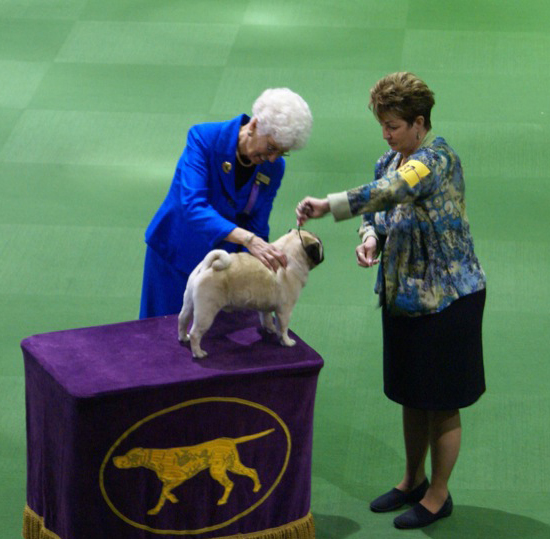

Head. Large, massive, round — not apple-headed, with no indentation of the skull. The eyes are dark, very large, bold and prominent, globular, soft and solicitous, very lustrous, and “when excited, full of fire.” The ears are thin, small, and soft, like black velvet; there are two kinds, “rose” and “button,” with preference to the button. The wrinkles are large and deep. The muzzle is short, blunt, and square, not upfaced, and the bite is very slightly undershot.
Body, tail, coat, and color. The neck is slightly arched, strong, and thick, with enough length to carry the head proudly. The back is short and level from withers to high tail set, and the body is short and cobby, wide in the chest, and well ribbed up. The tail is curled as tightly as possible over the hip, and a double curl is perfection. The forelegs are very strong, straight, and of moderate length, set well under; the hindquarters are strong and powerful, with a moderate bend of stifle and short hocks perpendicular to the ground. The coat is fine, smooth, soft, short, and glossy, neither hard nor woolly. Color is fawn or black — any other color is a disqualification. The fawn should be decided enough to make the contrast complete between the color and the trace and mask: the mask should be black, and the trace is a black line extending from occiput to tail.
Gait and temperament. The forelegs are carried well forward, the rear action is strong and free, and a slight roll of the hindquarters typifies the gait — “free, self-assured, and jaunty.” In temperament the Pug is an “even-tempered breed, exhibiting stability, playfulness, great charm, dignity, and an outgoing, loving disposition.”
4. Temperament: even-tempered, playful, and dignified
The standard’s temperament sentence is the whole pitch: even-tempered, stable, playful, charming, dignified, outgoing, and loving. Pugs were bred to please the people they live with, and their adaptability is the reason they have thrived in palaces, monasteries, and city apartments alike — small size, a sturdy frame, and minimal exercise requirements made them ideally suited as household pets, and they still are.
In the house, expect a dog that wants to be where you are and makes its feelings known: playful and clownish, but with a streak of dignity, and stubborn enough that training works best in short, fun sessions with food rewards. Pugs are generally good with children and with other dogs, and they are famously tolerant — but they are also heat-sensitive and noisy by design, snorting and snoring their way through life. Give them company, moderation, and shade, and they give back more affection per pound than almost any breed.
5. Grooming and everyday care
The short, fine coat is low-maintenance: a regular brushing keeps the steady shedding in check and the coat glossy. The real grooming job is the face — the deep forehead wrinkles need regular cleaning, since moisture and debris collect in the folds and can turn into irritation or infection if they are left alone. The ears are thin and velvety and should be checked and cleaned, the black nails trimmed regularly, and the teeth brushed: the short muzzle crowds the teeth, so dental care matters more than it does in a longer-faced breed.
Exercise is moderate: daily walks and play are enough, and the Pug’s sturdy little body is tougher than it looks. The limit is heat, not energy — the short muzzle means a Pug cannot cool itself as efficiently as a longer-nosed dog, so never exercise hard on a hot, humid day, and watch for labored breathing. Keep the dog lean, too: extra weight makes the breathing worse and the knees work harder, and a Pug that is allowed to get fat is a Pug heading for the vet.
6. Health: the tests that matter
The Pug Dog Club of America takes part in the Canine Health Information Center (CHIC) program run by the Orthopedic Foundation for Animals, and the club’s health recommendations — approved by the club’s officers and board and voted in by the membership — name four required tests for a CHIC number: screening for Pug Dog Encephalitis (PDE), also known as necrotizing meningoencephalitis (NME); a hip dysplasia evaluation; a patellar luxation evaluation; and an eye examination. Second-tier tests, recommended but not required for CHIC registration, are pyruvate kinase deficiency DNA testing, bile acids, and an elbow dysplasia evaluation. A CHIC number means the tests were done and published by the OFA — it does not mean the dog passed them.
PDE is the breed’s most devastating inherited condition: a fatal inflammatory disease of the brain that typically strikes young adult dogs, most often between two and three years of age. Affected dogs develop seizures, circling behavior, blindness, and progressive neurological deterioration, usually dying or requiring euthanasia within days to weeks of symptom onset. It affects about 1.2% of Pugs. Research funded by the Pug Dog Club of America and the AKC Canine Health Foundation produced a DNA test, run through labs such as UC Davis, that identifies dogs carrying the genetic markers associated with elevated PDE risk — and the test is a required part of CHIC certification, so breeders can avoid producing the highest-risk genotype.
Breathing deserves its own conversation. Pugs are brachycephalic, and brachycephalic obstructive airway syndrome (BOAS) is the breed’s defining health challenge. The Respiratory Function Grading Scheme, developed at the University of Cambridge and introduced to the United States through the OFA in 2023, grades a dog’s breathing before and after a short exercise test on a scale of 0 to 3; grades 0 and I are considered clinically unaffected, while grades II and III indicate clinically affected dogs. Ask for the parents’ RFG grades and prefer 0 or 1. Other issues to watch are patellar luxation, hip dysplasia, eye disease including pigmentary keratopathy and cataracts, hemivertebrae of the spine, tracheal hypoplasia, and pyruvate kinase deficiency. The AKC lists the breed’s lifespan as 12 to 15 years.
7. The annual Pug specialty dog show
A specialty is the breed’s All-Star show — its Super Bowl. Once a year, the best Pugs from across the country, and often from around the world, come together in one place.
The Pug Dog Club of America’s national specialty: one national event each year, usually a multi-day week in the fall, with regional specialties, sweepstakes, obedience, rally, agility, and junior showmanship alongside the conformation show. The 2026 national: November 2–7 in Topeka, Kansas, with 100 dogs and 103 entries in conformation. The 2027 national: not yet announced as of November 7, 2026.
The standard, in brief: a square, cobby toy dog of 14–18 pounds, with a large, massive, round head, dark, very large, bold and prominent eyes, a short, blunt, square muzzle, a tightly curled tail, and a fine, smooth, short, glossy coat in fawn or black. In temperament it is even-tempered, exhibiting stability, playfulness, great charm, dignity, and an outgoing, loving disposition.
The 2026 National Specialty — Monday, November 2–Saturday, November 7, 2026, at the Hotel Topeka At City Center, 1717 SW Topeka Boulevard, Topeka, Kansas 66612, under the theme “Follow The Yellow Brick Road.” The national conformation runs Friday, November 6 through Saturday, November 7, with the 4–6 Month Beginner Puppy show and junior showmanship. Entries closed at noon PDT on Wednesday, October 14, 2026. Event Chair and Secretary: Karen Burgess. Superintendent: Baray Event Services.
The week ran the full Pug program: the two regional specialties on Monday and Tuesday, regional and national sweepstakes and veteran sweepstakes on Wednesday and Thursday, Pug-only agility on Wednesday, national obedience and rally on Thursday, and the national conformation on Friday and Saturday, with the 2025 annual awards dinner on Saturday evening and a showcase afterparty on Friday. The national drew 100 dogs and 103 entries in conformation.
Results (2026 national). Best of Breed and all other top winners are unconfirmed — the national conformation runs November 6–7, 2026, and results had not been published in an official source as of November 7, 2026. Best Junior Handler is unconfirmed. Mr. Timothy Catterson judged the national in place of Mr. Eugene Blake, who withdrew for health reasons.
The dates for the annual 2027 Pug specialty dog show had not been announced as of November 2026. The AKC’s Upcoming National Specialties list, which runs through October 2027, carries no Pug Dog Club of America entry. This page will be updated when the club announces the 2027 national.
Past national specialties: 2025 · 2024
Pug Dog Club of America — pugdogclubofamerica.com
8. Regional specialties through the year: smaller regional shows
The national is the anchor, but the breed’s year also runs through regional specialties — smaller regional shows, not the national — held around the country, including the regional specialties that run with the national. These are the 2026 regionals verified from club and AKC sources.
Regional Pug specialties verified for 2026, run with the national week at the Hotel Topeka At City Center in Topeka, Kansas:
- PDCA Regional Specialty #1 — Monday, November 2, 2026, Topeka, Kansas: (AKC event 2026077907). Judge: Mr. Patrick McManus. 74 entries in conformation (73 dogs). Best of Breed unconfirmed.
- PDCA Regional Specialty #2 — Tuesday, November 3, 2026, Topeka, Kansas: Judge: Mr. David Fitzpatrick. 79 entries in conformation (78 dogs). Best of Breed unconfirmed.
Past regional specialties: 2025 · 2024
More regional specialties will be added here as their programs are verified — this section is built from show data, not guesswork. Browse upcoming show weekends →
9. Clubs
The Pug Dog Club of America, Inc., founded in 1931, is the AKC parent club for the breed in the United States. It maintains the official standard, promotes responsible breeding through its code of ethics, coordinates breed-specific health research in partnership with the AKC Canine Health Foundation, runs the national specialty, and supports rescue. The club’s officers for 2026 are President Jane Boatman Blackerby, Vice-President Robert Gravel, Corresponding Secretary Susan Davis ([email protected]; 13255 Major Brown Drive, Sperryville, VA 22740-1746), Recording Secretary Candace Fernandez, Treasurer Judi Basto, and AKC Delegate Michelle Anderson.
Chapter and regional clubs run the regional specialties that fill the breed’s year — the Columbia River Pug Fanciers, for example, hosted the two chapter club specialties that ran with the 2024 national in Spokane Valley. The club also runs the Pug Dog Club of America Health Foundation, which funds research and education on the breed’s health challenges, with particular attention to brachycephalic obstructive airway syndrome, Pug Dog encephalitis, and eye conditions. Across the Atlantic, the Pug Club, founded in England in 1883, is one of the oldest single-breed clubs in existence.
10. Rescue
The Pug Dog Club of America runs a rescue network with regional branches across the country — the AKC Rescue Network lists the club's rescue contact as Jason Huff, 812-454-4953. Beyond the parent club, the breed is served by a long list of regional groups, all listed on the AKC Rescue Network:
- Alabama Pug Rescue and Adoption, Inc. — Pam Mayes, [email protected]
- Green Mountain Pug Rescue (Vermont)
- Michigan Pug Rescue “Pug Luv”
- Orlando Pug Rescue & Adoption, Inc. (Florida)
- Pug Rescue of North Carolina, Inc.
- PugSavers (Northern California)
- Pugs ’N Pals of Southern California
- Delaware Valley Pug Rescue — Tom and Roberta Storer, P.O. Box 861, Avondale, PA 19311
- Pug Lovers Rescue — June Larson, P.O. Box 37343, Rock Hill, SC 29732; (803) 980-7729; [email protected]
- Mid-Atlantic Pug Rescue — serving Maryland, Virginia, West Virginia, Tennessee, North Carolina, and South Carolina; a 501(c)(3) that places nearly 150 Pugs a year
- Pug Rescue of Sacramento — serving Northern California; [email protected]
- DFW Pug Rescue Club, Inc. (Texas)
- Pug Rescue of New England, Inc.
- Arizona Pug Adoption & Rescue Network (APARN)
- Seattle Pug Rescue — Sherry Vadheim
- Pug Nation Rescue of Los Angeles — a registered 501(c)(3) in Gardena, California
- Pug Rescue of San Diego County — an all-volunteer 501(c)(3) in existence since 1991
Expect an application, a home visit, and a careful match — reputable groups vet adopters as thoroughly as they vet the dogs. A rescue Pug is usually an adolescent or adult whose personality is already known, which is a real advantage if you want to know what you are getting. Ask about breathing, eyes, and knees before you commit, and budget for the vet care an older or surrendered dog may need.
11. Breeder vs. rescue: honest guidance
Either route starts with the same question: has this dog’s health been tested? From a breeder, ask for the CHIC numbers of both parents — the PDE DNA test, the hip evaluation, the patellar evaluation, and the eye examination — and check them on the OFA database yourself, by the parents’ registered names. Ask for the parents’ breathing grades too, and ask what health issues the breeder sees in their stock: the parent club itself tells buyers to ask exactly that. A responsible breeder tests, and will talk about the breed’s faults as readily as its virtues.
From rescue, expect an adolescent or adult dog whose personality is already known, placed by a group that has vetted the dog and will tell you what it is actually like in a home. Budget for the same things either way: breathing care, eye care, weight control, and the possibility of knee trouble down the line. Whichever route you take, the dog that fits is a sturdy little clown that wants to be where you are, snorts when it is happy, and needs shade, water, and a sense of humor.
12. Claim this page
This page was built from public sources — the AKC standard, the parent club’s own material, AKC event records, and the rescue groups’ sites — and it is a starting point, not the last word. If you are with the Pug Dog Club of America or a regional club and something here is wrong or missing, you can claim this page and set it straight: email [email protected] and tell us what needs fixing. Corrections from the people who own the breed are how this page gets better.
Sources
- AKC, Pug
- AKC, Official Standard of the Pug (approved April 8, 2008; effective June 3, 2008)
- AKC, Pug History: Where the Breed Originated
- Pug Dog Club of America
- Pug Dog Club of America, Officers and Directors
- Pug Dog Club of America, 2026 National Specialty
- Pug Dog Club of America, national specialty schedule
- Pug Dog Club of America, Health Recommendations (CHIC) — January 5, 2016
- AKC Rescue Network, P Breeds (Pug rescue organizations)
- PDCA 2026 National Specialty judging program (Baray)
- PDCA 2026 National Specialty premium list (Baray)
- AKC event search, PDCA Regional Specialty #1 2026 (event 2026077907)
- AKC event search, PDCA National Specialty 2025 (event 2025077907)
- AKC event search, PDCA Regional Specialty #1 2025 (event 2025077909)
- AKC event search, PDCA Regional Specialty #2 2025 (event 2025077911)
- AKC event search, PDCA National Specialty 2024 (event 2024077907)
- Canine Chronicle, Pug Dog Club of America National — Saturday, October 11, 2025
- Canine Chronicle, Pug Dog Club Of America Regional #2 — Wednesday, October 8, 2025
- Canine Chronicle, Pug Dog Club of America — Saturday, September 7, 2024
- AKC, Upcoming National Specialties list