
Breed profile · Working Group · Portugal’s seafaring working dog
Portuguese Water Dog
The Portuguese Water Dog is Portugal’s seafaring working dog: a robust, medium-sized swimmer, 17 to 23 inches at the shoulder and 35 to 60 pounds, with a profuse single coat — curly or wavy — in black, white, or brown, and webbed feet built for a full day’s work in and out of the water — a dog that herded fish into nets, retrieved lost tackle, and carried messages between boats, and still wants a job and a swim every day.
Help us improve it. This is one of ThePetAdvisor’s breed profiles, built from public sources with generous links to the people who actually own this breed’s knowledge. If something’s off or missing, the parent club can claim the page and set it straight — see the bottom of the page.
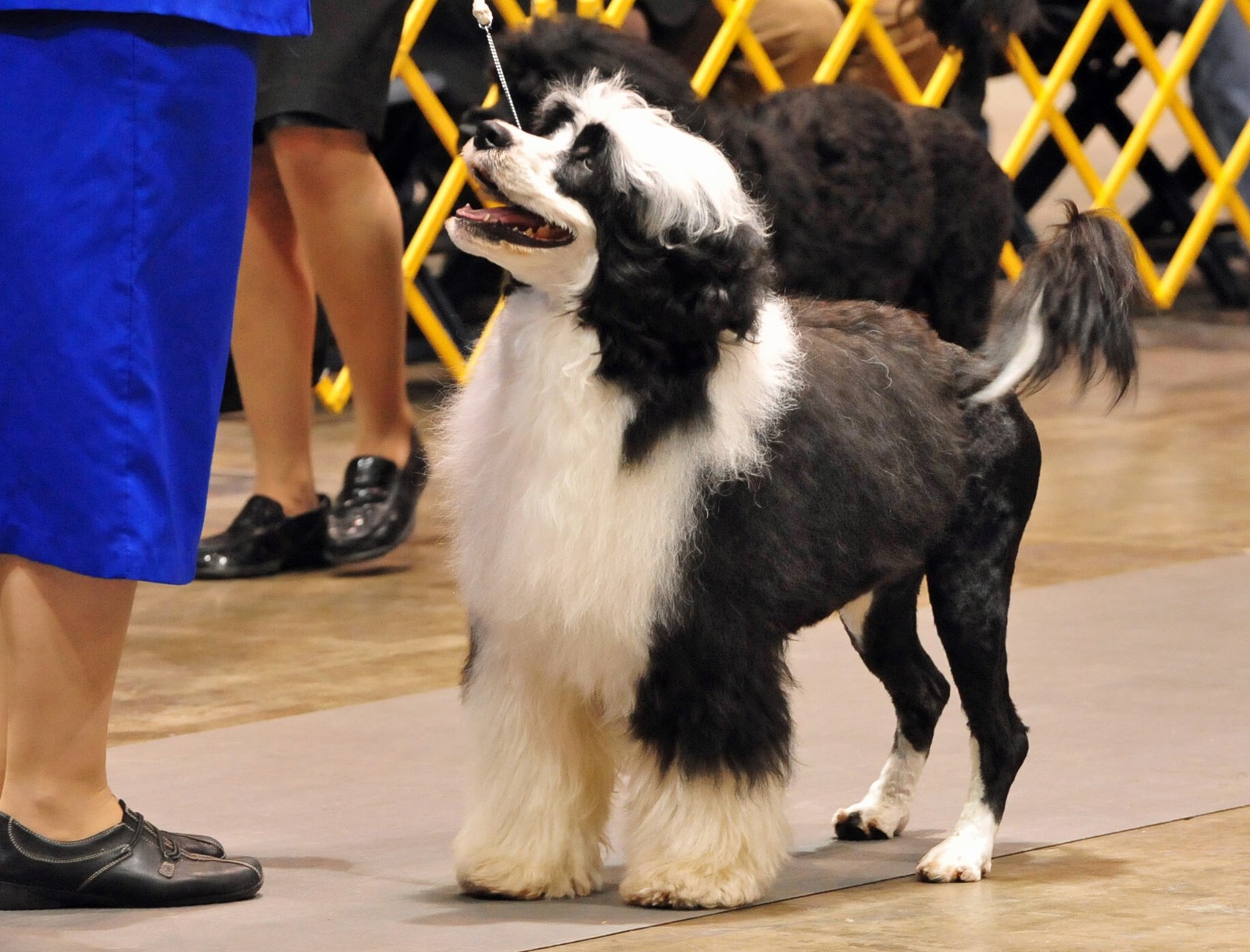

Do you have a better photo of a Portuguese Water Dog in the American show ring? If you have a show photo you’d let us use, email it to [email protected] — tell us the dog’s name and the show, and it may be featured here. Please only send photos you took yourself or have the photographer’s permission to share, and tell us the photographer’s name.
1. Breed at a glance
Working — recognized by the AKC in 1983
Males 20–23 in, females 17–21 in at the shoulder. Weight 42–60 lb (males), 35–50 lb (females).
Profuse single coat, no undercoat. Curly or wavy; black, white, or brown, or combinations of black or brown with white.
Spirited, self-willed, brave, exceptionally intelligent. Adventurous, athletic, affectionate.
High. A working water dog that needs daily exercise, swimming, and a job.
Size, coat, and temperament facts are from the AKC standard. Lifespan (11 to 13 years) is the AKC’s figure (AKC Portuguese Water Dog breed page).
2. History
The Portuguese Water Dog comes from the Algarve, on the coast of Portugal, where for centuries it worked the fishing boats — a dog the fishermen prized as both companion and guard dog. It lived on the working boats, where it was taught to herd fish into nets, retrieve lost tackle or broken nets, and act as a courier from ship to ship, or ship to shore. In Portugal the breed is called Cão de Água — dog of the water — and it is also known there as the Portuguese Fishing Dog. (Source: Portuguese Water Dog Club of America, History of the Breed.)
The breed nearly vanished as fishing modernized and the working boats no longer needed a dog aboard. In the 1930s the wealthy Portuguese businessman Vasco Bensaude took up its cause, gathering the surviving working dogs and breeding the first modern litter in 1937 — the beginning of the modern Portuguese Water Dog. (Sources: Portuguese Water Dog Club of America, History of the Breed; History of the Portuguese Water Dog.)
In the United States the breed’s story starts small: in 1972 sixteen owners and friends gathered in New Canaan, Connecticut, to form the Portuguese Water Dog Club of America, when there were only 12 known Portuguese Water Dogs in the country. The AKC admitted the breed to the Miscellaneous class on June 3, 1981; three months later came its first obedience champion, Spindrift Kedge. The breed was accepted for registration in the AKC stud books effective August 1, 1983, with 182 dogs registered, and became eligible to compete in the show ring as a member of the Working Group effective January 1, 1984. (Sources: Portuguese Water Dog Club of America, History of the Breed; DogTime, Portuguese Water Dog.)
The breed’s most famous modern ambassador was Bo, the Obama family’s Portuguese Water Dog, who moved into the White House in 2009 and made the Portie a household name. (Source: Canine Journal, Portuguese Water Dog.)
3. The standard and why it’s written that way
- Robust, medium, built for a full day’s work. The standard opens with the job: “Known for centuries along Portugal’s coast, this seafaring breed was prized by fishermen for a spirited, yet obedient nature, and a robust, medium build that allowed for a full day’s work in and out of the water.” And the summary: “The Portuguese Water Dog is a swimmer and diver of exceptional ability and stamina, who aided his master at sea by retrieving broken nets, herding schools of fish, and carrying messages between boats and to shore. He is a loyal companion and alert guard.” (Source: AKC standard.)
- Size — one size, measured at the withers. “Height at the withers — Males, 20 to 23 inches. The ideal is 22 inches. Females, 17 to 21 inches. The ideal is 19 inches. Weight — For males, 42 to 60 pounds; for females, 35 to 50 pounds.” Proportion: “Off square; slightly longer than tall when measured from prosternum to rearmost point of the buttocks, and from withers to ground.” Substance: “Strong, substantial bone; well developed, neither refined nor coarse, and a solidly built, muscular body.” (Source: AKC standard.)
- A big head, and eyes that mean it. “An essential characteristic; distinctively large, well proportioned and with exceptional breadth of topskull. Expression — Steady, penetrating, and attentive.” Eyes are medium, set well apart and a bit obliquely, black or various tones of brown, with darker eyes preferred. Ears are set well above the line of the eye, the leather heart shaped and thin, held nicely against the head. The nose is broad with well-flared nostrils, fully pigmented. Bite: scissors or level. (Source: AKC standard.)
- Coat — profuse, single, curly or wavy. “A profuse, thickly planted coat of strong, healthy hair, covering the whole body evenly, except where the forearm meets the brisket and in the groin area, where it is thinner. No undercoat, mane or ruff. There are two varieties of coat: Curly — Compact, cylindrical curls, somewhat lusterless. The hair on the ears is sometimes wavy. Wavy — Falling gently in waves, not curls, and with a slight sheen. No preference will be given to coat type, either curly or wavy.” (Source: AKC standard.)
- Clip — lion or retriever, and nothing else. “Two clips are acceptable: Lion Clip — As soon as the coat grows long, the middle part and hindquarters, as well as the muzzle, are clipped. The hair at the end of the tail is left at full length. Retriever Clip – In order to give a natural appearance and a smooth unbroken line, the entire coat is scissored or clipped to follow the outline of the dog, leaving a short blanket of coat no longer than one inch in length. The hair at the end of the tail is left at full length. No discrimination will be made against the correct presentation of a dog in either Lion Clip or Retriever Clip.” (Source: AKC standard.)
- Color — black, white, brown, and their combinations. “Black, white, and various tones of brown; also combinations of black or brown with white. A white coat does not imply albinism provided nose, mouth, and eyelids are black. In animals with black, white, or black and white coats, the skin is decidedly bluish.” (Source: AKC standard.)
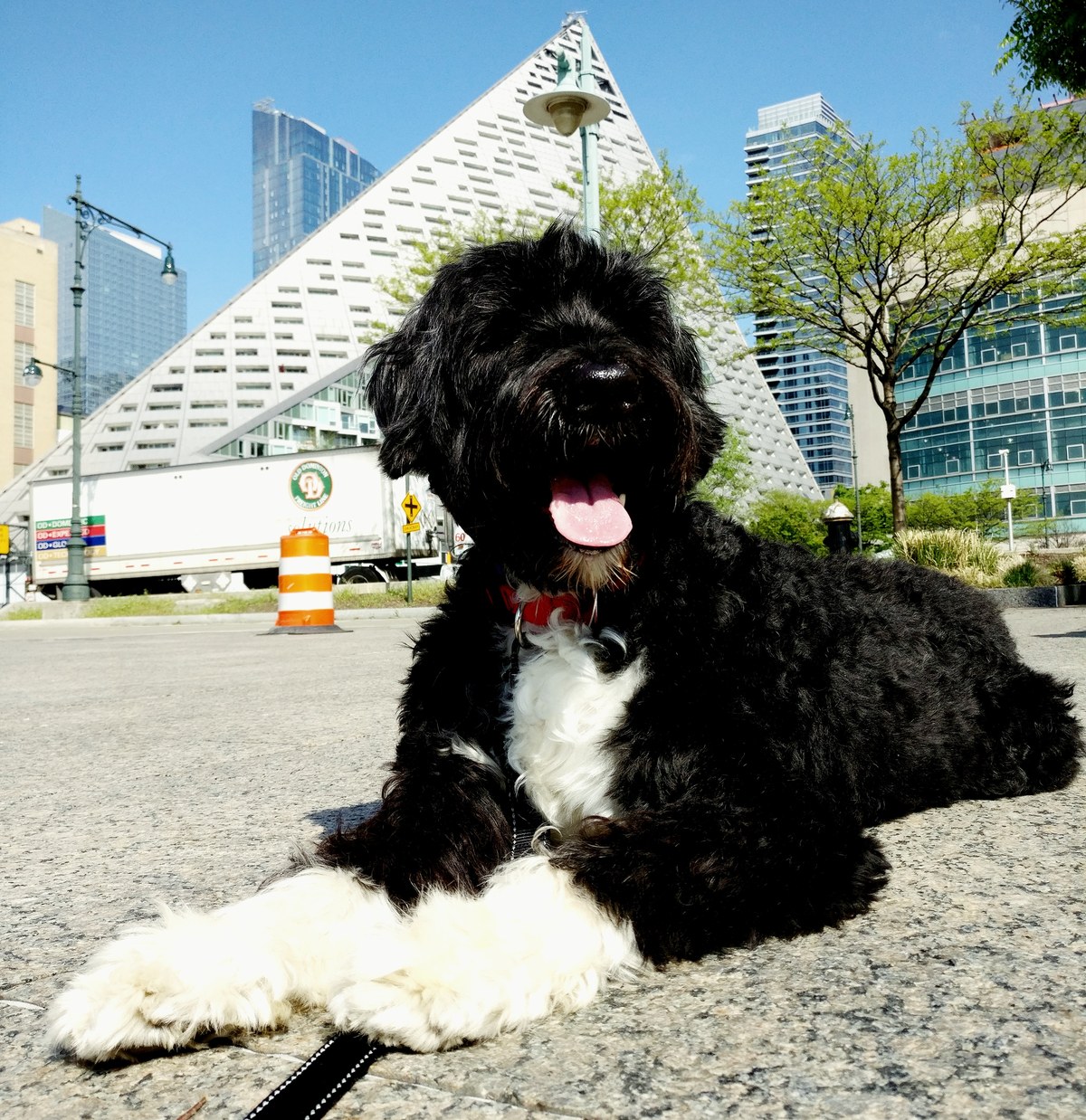

- Tail and feet — a rudder and webbed toes. The tail is not docked: “thick at the base and tapering; set on slightly below the line of the back; should not reach below the hock. When the dog is attentive the tail is held in a ring, the front of which should not reach forward of the loin. The tail is of great help when swimming and diving.” The feet are round and rather flat, and “webbing between the toes is of soft skin, well covered with hair, and reaches the toe tips.” (Source: AKC standard.)
- Gait and temperament, in the standard’s own words. Gait: “Short, lively steps when walking. The trot is a forward striding, well balanced movement.” Temperament: “An animal of spirited disposition, self-willed, brave, and very resistant to fatigue. A dog of exceptional intelligence and a loyal companion, it obeys its master with facility and apparent pleasure. It is obedient with those who look after it or with those for whom it works.” (Source: AKC standard.)
- Major faults, in one place. “Temperament — Shy, vicious, or unsound behavior. Head — Unimpressive; small in overall size; narrow in topskull; snipey in muzzle. Substance — Light or refined in bone; lacking in muscle. Coat — Sparse; naturally short, close-lying hair, partially or over all; wispy or wiry in texture; brittle; double-coated. Tail — Other than as described. Extremely low set. Heavy or droopy in action. Pigment — Any deviation from described pigmentation; other than black or various tones of brown eye color; pink or partial pigmentation in nose, lips, eyes, or eye rims. Bite — Overshot or undershot.” (Source: AKC standard.)
4. Temperament & living with one
The AKC’s summary is three words: “adventurous, athletic, and affectionate.” The standard adds the working half of the picture: spirited, self-willed, brave, very resistant to fatigue, and exceptionally intelligent — a dog that obeyed its fisherman master with facility and apparent pleasure, and still wants a person to work for and a job to do. A Portuguese Water Dog was bred to work alongside people all day, in and out of the water, and it still wants to be in the middle of its people, not out in the yard alone. (Sources: AKC Portuguese Water Dog breed page; AKC standard.)
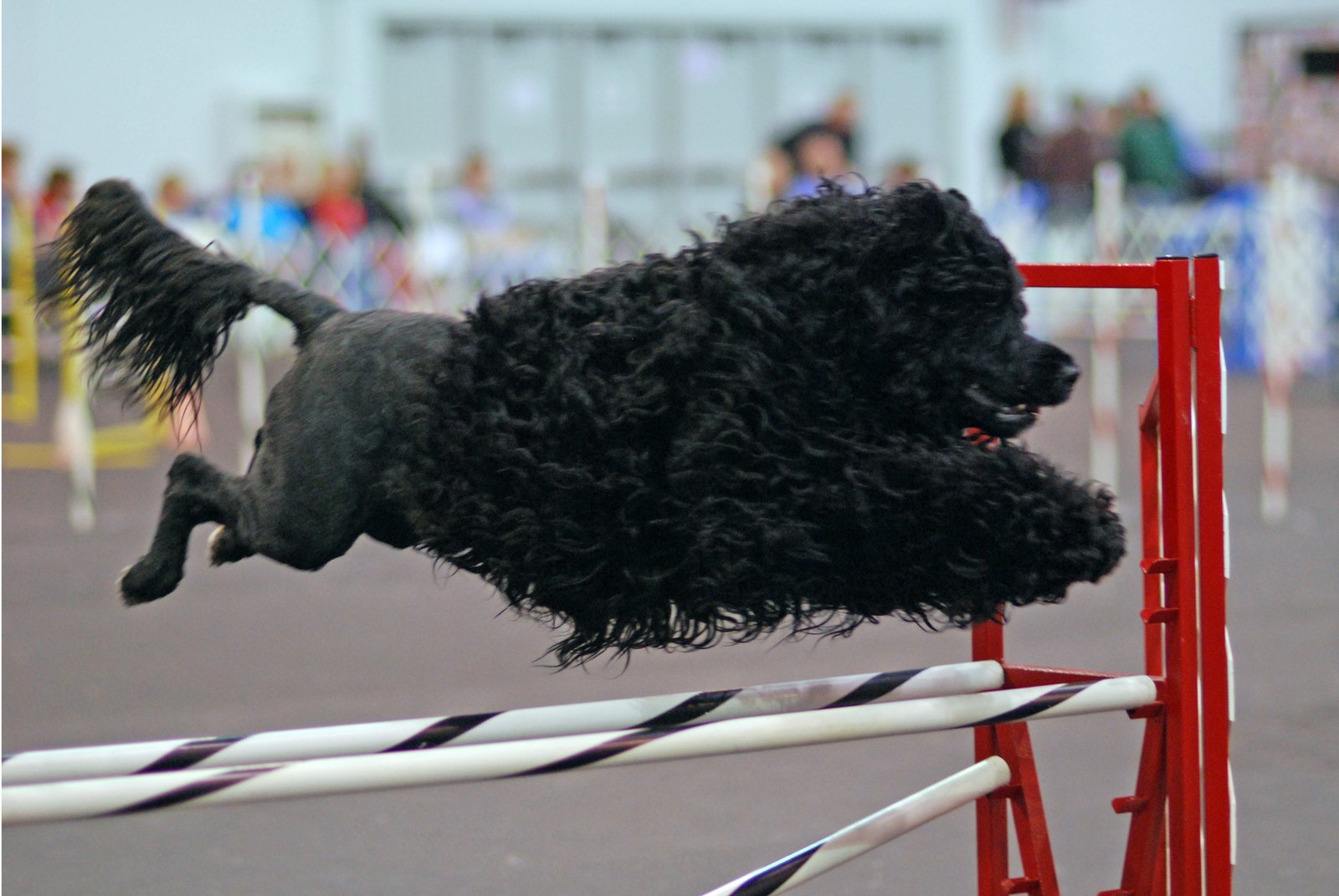

What that means in practice is a loud, clever, busy companion that needs a swim and a task every day. Porties excel at the work they were built for — water trials, dock diving, and swimming — and at the sports that use the same brain and body: agility, obedience, rally, tracking, and scent work. They are quick learners and eager to please, but the self-willed streak is real: training works best with positive reinforcement, patience, and a sense of humor, not with harsh corrections. A bored Portie left alone in a yard is an unhappy Portie, and an unhappy Portie is an inventive one that opens cupboards, redesigns the garden, and rearranges the house. Keep the weight off, too: a working dog that swims and runs hard earns its food, and a Portie that only watches the water from the couch does not. (Sources: AKC Portuguese Water Dog breed page; Portuguese Water Dog Club of America, History of the Breed.)
5. Grooming
- A profuse coat that needs a comb, not a clipper shortcut. The single coat — no undercoat — grows continuously and mats if it is left alone, so a Portie needs regular brushing and combing down to the skin, not just a skim over the top. The two show clips, lion and retriever, are both correct, and at home the same choice applies: a shorter retriever clip is easier to keep, a longer lion clip needs more combing. Either way the coat is maintained, not shaved down to stop the shedding — cutting it short does not change the dog, and it spoils the waterproof coat the breed was built with. (Source: AKC standard.)
- Water-dog aftercare. A dog that swims every day needs drying off after every swim, and the ears need attention: the heart-shaped ears are held nicely against the head, which keeps them warm and damp after water work. Dry the ears, check them regularly, and keep the nails trimmed — the webbed feet do the swimming, and long nails do not help. (Sources: AKC standard; AKC Portuguese Water Dog breed page.)
- Not hypoallergenic. The single coat sheds lightly, and the breed is often sold as hypoallergenic — it is not. No dog is truly hypoallergenic, and some allergic people tolerate Porties while others do not. There is no safe way to know without spending time around them. (Source: AKC Portuguese Water Dog breed page.)
6. Health testing
- Seven tests for a responsible breeding. The Portuguese Water Dog Club of America’s minimum health testing criteria for breeders consist of seven items, all completed before breeding: an OFA hip certification at 2 years of age or older with a passing score (fair, good, or excellent) on both sire and dam; a current yearly eye certification on both parents, up to 10 years of age; and DNA tests for prcd-PRA, early-onset PRA (EOPRA), microphthalmia syndrome (MO), GM-1 gangliosidosis, and juvenile dilated cardiomyopathy (JDCM), with at least one parent testing normal (non-carrier) on each DNA test. The club recommends all clearances be completed, current, and entered in its Health & Litter Database before breeding. (Source: Portuguese Water Dog Club of America, Health Statement.)
- GM-1 and JDCM — the two to ask about first. GM-1 gangliosidosis is a fatal inherited storage disease: a missing enzyme lets waste build up in the brain, and symptoms — loss of coordination and tremors — usually appear in puppies around six months of age. Juvenile dilated cardiomyopathy strikes the heart muscle in puppies between six weeks and seven months of age and causes sudden heart failure, with no known cure. Both are recessive, so both can be prevented by testing the parents: at least one parent normal on each test means no affected puppies. (Sources: Portuguese Water Dog Club of America, Health Statement; Houndsy, Managing Portuguese Water Dog Health Problems.)
- PRA, early-onset PRA, and microphthalmia. Progressive retinal atrophy is a degenerative disease of the retina that usually begins with night blindness and can end in blindness; the early-onset form appears in young dogs, and microphthalmia syndrome affects the development of the eye itself. All three have DNA tests, and the yearly eye examination catches the rest of what the DNA tests do not cover. Ask for the DNA results and the current eye certification, not just one of them. (Source: Portuguese Water Dog Club of America, Health Statement.)
- Hips, elbows, and the everyday risks. Hip dysplasia is the orthopedic disease to ask about, screened by OFA evaluation at 2 years or older, and the club also notes OFA elbow evaluation as additional testing a breeder may do. The everyday risks are the working ones: a dog that swims and jumps hard needs its weight kept in check and its ears dried after water work. None of this is a reason not to own a Portuguese Water Dog. All of it is a reason to buy from a breeder who tests: ask for the parents’ results and look them up in the OFA database yourself, rather than taking a breeder’s word for it. Lifespan is 11 to 13 years. (Sources: Portuguese Water Dog Club of America, Health Statement; AKC Portuguese Water Dog breed page.)
7. The annual Portuguese Water Dog specialty dog show
A specialty is the breed’s All-Star show — its Super Bowl. Once a year, the best Portuguese Water Dogs from across the country, and often from around the world, come together in one place.
The Portuguese Water Dog Club of America’s national specialty: a full week at the World Equestrian Center in Ocala, Florida, with the conformation specialty at its center and water trials, agility, scent work, obedience, rally, FastCAT, tracking, sweepstakes, the Top 20, and the annual meeting and awards banquet around it. The 2026 week: October 2–9, with conformation October 7–9.
The 34th National Specialty — Friday to Friday, October 2–9, 2026, at the World Equestrian Center, 1750 NW 80th Ave., Ocala, Florida. Hosted by the United Sunshine State Portuguese Water Dog Club. Specialty show Monday, October 5–Friday, October 9; conformation Wednesday, October 7 (dog classes), Thursday, October 8 (4–6 Month Beginner Puppy and bitch classes), Friday, October 9 (Junior Showmanship and Best of Breed). Also water trials October 2–4, FastCAT, tracking, agility, scent work, obedience and rally trials, Sweepstakes and the Top 20 on Tuesday, October 6, and the United Sunshine State independent regional specialty on Sunday, October 4. Entry: 141 Portuguese Water Dogs (63 dogs, 78 bitches); 158 entries and 139 competitors across the national conformation event. Event Chair: Margaret DeFore. Superintendent: Executive Dog Shows, LLC. (Sources: 2026 PWDCA National Specialty premium list; AKC event search, event 2026285102.)
National specialty judges: Mr. Vincent P. Chianese — all regular classes and Best of Breed. Mrs. Angela Pickett — stud dog, brood bitch, brace, team, and the 4–6 Month Beginner Puppy competition. Mr. Marcelo E. Veras — Puppy & Veteran Sweepstakes and Junior Showmanship. Mr. Jeffrey Kern and Mrs. Nancy Grimm — obedience and rally (split assignments across the two trials). (Source: 2026 PWDCA National Specialty premium list.)
Results (official, AKC event 2026285102). Best of Breed: GCHS CH Bedlam Silver Tallulah (bitch, owners D. Corr, T. Pecora). Best of Opposite Sex: GCHG CH Shooting Star & Seaworthy’s Finest Hour (dog, owners Z. Crump, N. Vencill). Select Dog: CH Sweet Water Seas N Hibiskiss Put Me In Coach BCAT SWN (owners A. Ellery, J. Ellery). Select Bitch: CH Riptide’s Moonlight Opus FDC CA DCAT CGC TKN ATT (owners M. Geltzer, J. Fahr, S. Baxter). Best of Winners and Winners Dog: Casa Hoya’s Give Me The Shivers CGC (owner I. Griffioen-van Beek). Winners Bitch: Claircreek Aye Calypso (owner D. Gottdenker). Reserve Winners Dog: Searidge On The Town (owner J. Reilly). Reserve Winners Bitch: Odyseas Miss Americana (owner M. Thomas). Best Owner-Handled: GCHP CH Laserene’s Steel Magnolia Gunsmoke At High Noon CGC ATT (owners D. Frederick, T. Strain). Best Junior Handler: Julia Williams; Reserve Best Junior Handler: MacKenzie Moore. (Source: AKC event search, event 2026285102.)
The 2027 national specialty dates had not been announced as of November 2026.
2026 PWDCA National Specialty — Portuguese Water Dog Club of America
8. Regional specialties through the year: smaller regional shows
The national is the anchor, but the breed’s year also runs through regional specialties held by the Portuguese Water Dog Club of America’s regional clubs — the Portuguese Water Dog Club of Northern California, the Nutmeg Portuguese Water Dog Club, the Mayflower Portuguese Water Dog Club, the Rio Salgado Portuguese Water Dog Club of Arizona, the United Sunshine State Portuguese Water Dog Club, the Pacific Northwest Portuguese Water Dog Club, the Portuguese Water Dog Club of Greater Chicagoland, and the Portuguese Water Dog Club of the Twin Cities. These are the 2027 regionals verified from club sources so far:
No regional specialties announced yet for 2027.
More regional specialties will be added here as their programs are verified — this section is built from show data, not guesswork. Browse upcoming show weekends →
9. Clubs
- Portuguese Water Dog Club of America (parent club) — the AKC parent club for the breed in the United States, formed in 1972. It runs the national specialty, held at the World Equestrian Center in Ocala, Florida in 2026 and hosted by the United Sunshine State Portuguese Water Dog Club, with Margaret DeFore as event chair. (Sources: Portuguese Water Dog Club of America, History of the Breed; 2026 PWDCA National Specialty premium list; AKC event search, event 2026285102.)
- Regional clubs. The parent club sanctions 17 active regional clubs across the United States, including the Portuguese Water Dog Club of Northern California, the Nutmeg Portuguese Water Dog Club, the Mayflower Portuguese Water Dog Club, the Rio Salgado Portuguese Water Dog Club of Arizona, the United Sunshine State Portuguese Water Dog Club, the Pacific Northwest Portuguese Water Dog Club, the Portuguese Water Dog Club of Greater Chicagoland, the Portuguese Water Dog Club of the Twin Cities, the Keystone PWD Club, and the DelMarVa PWD Club. Two verified 2026 regionals: the United Sunshine State independent regional specialty on Sunday, October 4, 2026, at the World Equestrian Center in Ocala, and the Portuguese Water Dog Club of Northern California’s 24th annual regional specialty on Friday, November 6, 2026, in Napa, California. (Sources: PWDCA Courier, Volume 1 2024, Regional Clubs; 2026 PWDCA National Specialty premium list; 2026 Portuguese Water Dog Club of Northern California premium list.)
If you are new to the breed, the national specialty itself is the better first stop than a breeder’s website: the people there have owned, shown, and worked Porties, and they will tell you the truth about the energy, the grooming, and the swimming before you fall for a puppy.
10. Rescue
- Start with PWDCA Rescue, Inc. The Portuguese Water Dog Club of America Rescue, Inc. runs the breed’s Rescue and Relocation Program: evaluation and placement of Portuguese Water Dogs given up by their owners, abandoned, or found. It is a non-stock 501(c)(3) charitable corporation, led by PWDCA volunteers and regional clubs, with volunteers covering every state — regional rescue representatives and foster families. Between 2016 and 2022 it placed 90 Portuguese Water Dogs and assisted over 100 PWDCA breeders and owners in placing theirs. It also counsels owners having trouble with their dogs, so rescue is not needed. (Sources: PWDCA Rescue, About PWDCA Rescue; Rio Salgado Portuguese Water Dog Club, Portuguese Water Dog Rescue.)
- What a rescue Portie is usually like. Most Portuguese Water Dogs come into rescue as adults, often because an owner underestimated the energy, the grooming, and the company the breed requires — a working water dog kept as a quiet house pet is a frustrated one. A rescue Portie usually arrives housetrained and past the puppy stage, with its temperament visible before you commit. If you bought your Portuguese Water Dog from a breeder, contact the breeder first — most responsible breeders include a take-back clause and want to know if the dog needs help. (Source: PWDCA Rescue, About PWDCA Rescue.)
11. Breeder vs. rescue: honest guidance
- If you buy: start with the parent club, the Portuguese Water Dog Club of America, and its breeder list. Ask for the parents’ health results — the seven PWDCA minimum tests: OFA hips, a current yearly eye certification, and the prcd-PRA, early-onset PRA, microphthalmia syndrome, GM-1, and JDCM DNA tests — and look the results up in the OFA database yourself. Expect to wait for a puppy from a careful breeder. A good breeder will have the answers, will ask you as many questions as you ask them, and will take the puppy back for its whole life if you cannot keep it.
- If you rescue: a rescued Portie is usually an adult, often one whose owner underestimated the swimming, the grooming, and the sheer busy-ness the breed brings into a house, and it will arrive with a working dog’s brain and a love of water fully formed. What you get in return is a dog whose temperament you can see before you commit and a lower price. Either way, be honest with yourself first: a Portuguese Water Dog needs daily exercise, regular brushing, a swim whenever it can get one, and an owner who is home a lot and finds the wet-dog enthusiasm charming rather than infuriating. It is not a dog for a household that wants a quiet, low-maintenance, leave-alone companion.
- No rare color worth a premium. One thing that is not what a seller tells you: there is no such thing as a rare color worth a premium. The standard names three colors only — black, white, and various tones of brown, with combinations of black or brown with white — and a parti-color dog is just as correct as a solid one. The standard also describes one size only, 20 to 23 inches for males and 17 to 21 for females, with no miniature variety, and no dog is truly hypoallergenic. A breeder selling a “rare” color, a “hypoallergenic” Portie, or a “mini” Portuguese Water Dog at a premium is selling you a label.
12. Claim this page
This page belongs to the breed, and the people who know the breed best are the Portuguese Water Dog Club of America and its members. If you are with the parent club — or you are a breeder, a judge, a handler, or a rescue volunteer who spotted something wrong, missing, or out of date — this page is yours to set straight. Tell us what needs fixing and where the correction is documented, and we will fix it and credit the source. Contact the site through the About page, and mention “Portuguese Water Dog breed profile.”
Sources
- AKC Portuguese Water Dog breed page — akc.org/dog-breeds/portuguese-water-dog
- AKC Portuguese Water Dog breed standard (approved January 15, 1991; effective February 27, 1991) — images.akc.org/pdf/breeds/standards/PortugueseWaterDog.pdf
- Portuguese Water Dog Club of America, History of the Breed — pwdca.org/site_page.cfm
- Portuguese Water Dog Club of America, Health Statement — akc.org/wp-content/uploads/2021/01/Portuguese-Water-Dog-Health-Statement.pdf
- Portuguese Water Dog Club of America Rescue, About PWDCA Rescue — pwdcarescue.org/about-us.asp
- PWDCA Courier, Volume 1 2024, Regional Clubs — anyflip.com/oaizb/hbku/basic/51-76
- 2026 PWDCA National Specialty premium list — pwdcans.org/wp-content/uploads/PL_PWDCA_2026NationalandRegional.pdf
- 2026 National Specialty, AKC event search, event 2026285102 (official results) — apps.akc.org/apps/events/search/index_results.cfm
- 2026 National Specialty Fetch, AKC event search, event 2026285125 — apps.akc.org/apps/events/search/index_results.cfm
- AKC Upcoming National Specialties list — apps.akc.org/apps/events/conformation/national_specialties.cfm
- 2026 Portuguese Water Dog Club of Northern California premium list — thepetadvisor.com/assets/premiums/2026/portuguese-water-dog-club-northern-california-2026.pdf
- History of the Portuguese Water Dog — dummies.com/article/history-of-the-portuguese-water-dog-196852
- DogTime, Portuguese Water Dog — dogtime.com/dog-breeds/portuguese-water-dog
- Canine Journal, Portuguese Water Dog (Bo, the Obama family dog) — caninejournal.com/portuguese-water-dog
- Houndsy, Managing Portuguese Water Dog Health Problems (GM-1, JDCM) — houndsy.com/blogs/modern-tails/understanding-portuguese-water-dog-health-problems
- Show-ring hero photo: State Farm, CC BY 2.0, via Wikimedia Commons — commons.wikimedia.org/wiki/File:A_Portuguese_Water_Dog.jpg
- Agility photo: Ron Armstrong, CC BY 2.0, via Wikimedia Commons — commons.wikimedia.org/wiki/File:Portuguese_Water_Dog_agility.jpg
- New York City photo: Katieskalka, CC BY-SA 4.0, via Wikimedia Commons — commons.wikimedia.org/wiki/File:Portuguese_Water_Dog_in_NYC.jpg