
Breed profile · Toy Group · the fox-faced toy spitz
Pomeranian
The Pomeranian is the smallest of the spitz breeds: a compact, short-backed, active toy dog, 3 to 7 pounds with an ideal show weight of 4 to 6, 6 to 7 inches at the shoulder, wrapped in a profuse double coat with a frill over the chest and shoulders and a plumed tail carried flat over the back — a foxlike face, small high-set erect ears, and the extrovert’s temperament the standard sums up as great intelligence and a vivacious spirit.
Help us improve it. This is one of ThePetAdvisor’s breed profiles, built from public sources with generous links to the people who actually own this breed’s knowledge. If something’s off or missing, the parent club can claim the page and set it straight — see the bottom of the page.
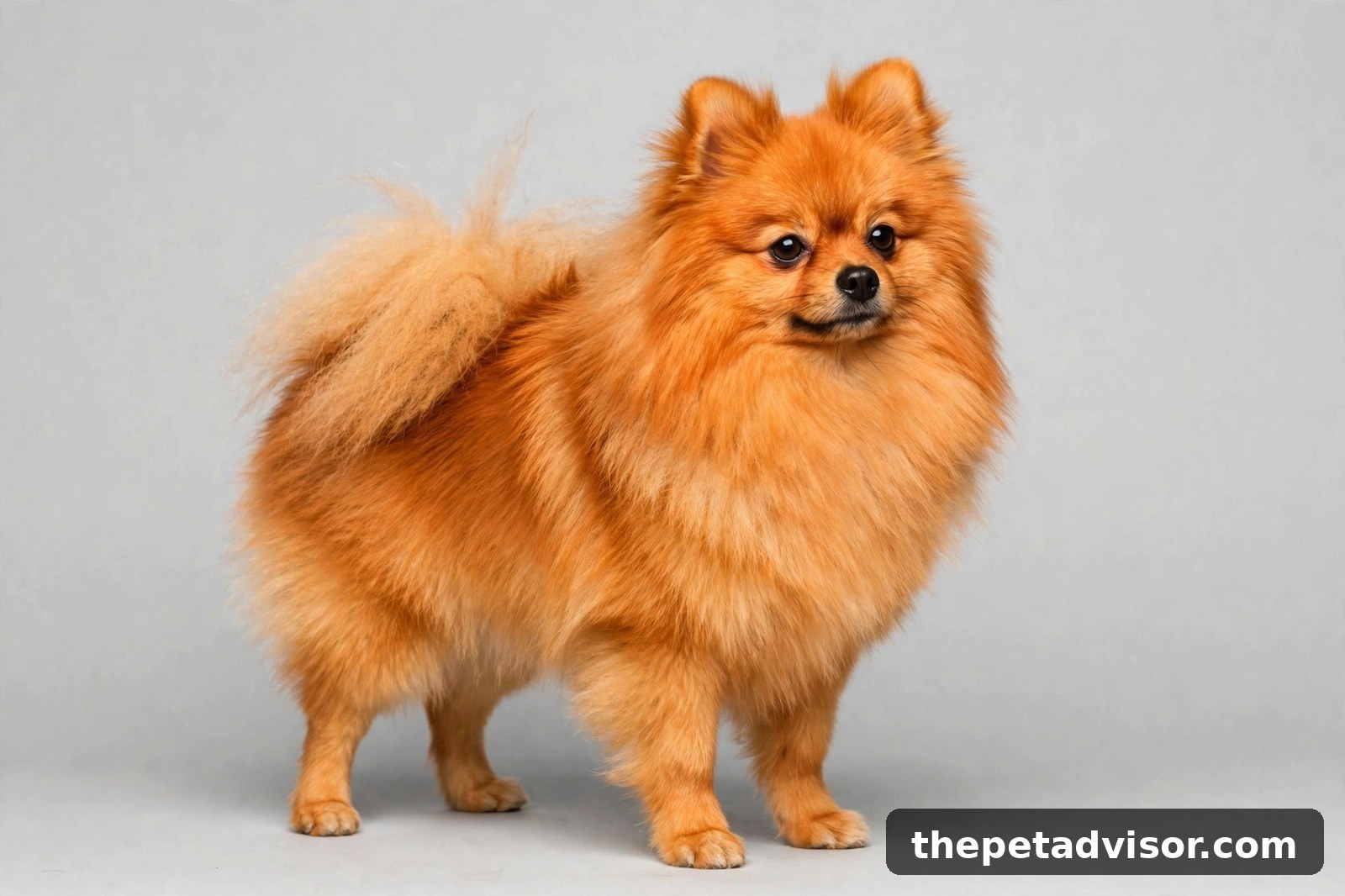
Do you have a photo of a Pomeranian in the American show ring? We’d love this page to lead with one. If you have a show photo you’d let us use, email it to [email protected] — tell us the dog’s name and the show, and it may be featured here. Please only send photos you took yourself or have the photographer’s permission to share, and tell us the photographer’s name. We couldn’t find a public photo of a Pomeranian in the American show ring that we were free to share, so the photo leading this page was made with AI. We’d much rather lead with a real one — if you’re a club member with an approved photo, we’d love to feature it.
1. Breed at a glance
Toy — shown in the Miscellaneous Class as far back as 1892; regular classification in 1900
3–7 lb, ideal 4–6 lb for show. Height 6–7 in at the shoulder.
Profuse double coat — soft dense undercoat with a profuse harsh-textured outer coat; frill over the chest and shoulders; plumed tail carried flat on the back.
An extrovert, exhibiting great intelligence and a vivacious spirit. AKC: inquisitive, lively, bold.
12 to 16 years.
Size, coat, and temperament facts are from the AKC standard (approved July 12, 2011; effective August 31, 2011). Lifespan (12 to 16 years) is from the AKC Pomeranian breed page.
2. History
The Pomeranian descends from the larger spitz-type sled dogs of the Arctic — the Nordic stock the standard still names — and takes its name from Pomerania, the historic region on the Baltic coast of Germany and Poland. The early dogs were far bigger than the toy dog of today: when the Kennel Club (England) formed in 1873, the first Pomeranians shown weighed nearly 18 pounds. In 1888 a Pomeranian named Marco, 12 pounds, was sent from Florence, Italy, to Queen Victoria, who also imported a 7.5-pound white female named Gena. The breed kept shrinking from there toward the toy dog of today. (Source: American Pomeranian Club, History.)
Pomeranians were shown in the United States in the Miscellaneous Class as far back as 1892, and moved to regular classification in 1900 at New York — the year the American Pomeranian Club was formed. (The AKC’s breed page dates recognition to 1888, in the Miscellaneous Class.) The American Pomeranian Club was accepted as an AKC Member Club and designated the Parent Club in 1909. The club held its first specialty in 1911, with an entry of 262 Pomeranians — a bigger entry than the 202 entries at the 2026 national in Louisville — and the first Best of Breed winner was Ch. Banner Prince Charming. (Sources: American Pomeranian Club, History; AKC Pomeranian breed page.)
The Pomeranian’s job changed completely as it shrank: from a sled and herding spitz of the north to a companion dog — and the standard still describes it as a compact, short-backed, active toy dog of Nordic descent, a reminder of the working dog inside the toy coat. (Source: AKC standard.)
3. The standard and why it’s written that way
- A compact, short-backed, active toy dog of Nordic descent. The standard opens with the whole dog: “A compact, short-backed, active toy dog of Nordic descent.” Everything that follows — the size, the coat, the carriage — is that sentence made specific. (Source: AKC standard.)
- Size — 3 to 7 pounds, ideal 4 to 6 for show. “Weight — 3 to 7 pounds, ideal weight for show specimens is 4 to 6 pounds.” Height runs 6 to 7 inches at the shoulder. A Pomeranian is a small dog by every measure, and the standard’s ideal is a dog you can lift with one hand. (Source: AKC standard.)
- The head: foxlike, wedge-shaped, and alert. “The Pomeranian has a foxlike expression.” The head is wedge-shaped, the muzzle rather short and straight, the nose black (self-colored in brown, beaver, and blue), and the ears small, high-set, and erect. The eyes are dark, bright, and medium-sized, set well apart. The whole head should look like a fox’s — sharp, bright, and always watching. (Source: AKC standard.)
- Coat — profuse, harsh, and standing off the body. “The Pomeranian is a double-coated breed. The undercoat is soft and dense. The outer-coat is long, straight, glistening and harsh in texture. A thick undercoat will give body to the coat and support the outer coat.” The coat forms a frill over the chest and shoulders and a plume on the tail, which is “heavily plumed, set high and lying flat on the back.” The dog is shown in its full coat — the profusion is the point. (Source: AKC standard.)
- Color — almost two dozen colors and patterns, orange or red most commonly. The standard allows all colors, patterns, and variations, and the breed comes in almost two dozen of them — orange and red are the most common, with cream, black, white, blue, brown, and parti-colors among the rest. (Sources: AKC standard; AKC Pomeranian breed page.)
- Temperament, in the standard’s own words. “The Pomeranian is an extrovert, exhibiting great intelligence and a vivacious spirit.” That is the whole temperament section — one sentence, and it is the sentence every Pomeranian owner recognizes. (Source: AKC standard.)
4. Temperament & living with one
The AKC sums the breed up in three words: inquisitive, lively, bold. The standard says the same thing in a sentence: “an extrovert, exhibiting great intelligence and a vivacious spirit.” A Pomeranian is a big dog’s confidence in a 4-to-6-pound body — alert, curious, and convinced the house revolves around it. That confidence is the charm and the work: it needs early socialization and consistent training, and it is known for barking — a Pomeranian announces visitors, squirrels, and anything else it considers newsworthy. (Sources: AKC Pomeranian breed page; AKC standard.)
The Pomeranian’s size makes it an apartment dog in square footage, but not in energy: it needs daily walks and play, and it does best with owners who give it something to do — training, tricks, or a dog sport — rather than treating it as a lap ornament. It is fragile for its confidence, so it does best with older children who handle a small dog gently, and it needs watching around larger dogs and high furniture. What it gives back is a loyal, lively companion that follows its person from room to room. (Source: AKC Pomeranian breed page.)
5. Grooming
- Brush down to the skin once a week — pin brush and slicker. The AKC’s grooming guidance is to brush the coat down to the skin once a week with a pin brush and a slicker brush, so the dense undercoat never mats underneath the profuse outer coat. (Source: AKC Pomeranian breed page.)
- Line brushing two to three times a week keeps the coat mat-free. Working through the coat in sections — line brushing — two to three times a week catches tangles before they become mats, especially behind the ears, under the legs, and in the frill. (Source: pomeranian.org (Denise Leo).)
- The coat blow, twice a year, needs daily brushing. The Pomeranian sheds its undercoat in spring and autumn, and during the blow the daily brush is not optional — it is the difference between a coat and a mat. Puppies go through the same thing in miniature at about 4 to 8 months, the “puppy uglies,” when the puppy coat gives way to the adult coat. (Sources: AKC Pomeranian breed page; pomeranian.org (Denise Leo).)
- Never shave the double coat. Shaving a Pomeranian’s double coat risks coat damage and the hair-loss condition known as alopecia X (black skin disease), and the coat may never grow back the same. A pet trim for neatness is one thing; a shave is another. (Source: pomeranian.org (Denise Leo).)
- A full groom every four to six weeks if you do not do it at home. Nails kept short and teeth brushed in the same session are part of the same routine — the grooming appointment is the time to check ears, eyes, and skin as well. (Source: AKC Pomeranian breed page.)
6. Health testing
- Three tests for a CHIC number. For a CHIC number, the Pomeranian needs three evaluations: a Patella Evaluation, a Cardiac Exam, and an Ophthalmologist Evaluation by a board-certified veterinary ophthalmologist (ACVO). That is the parent club’s list on the AKC’s Toy Group health-testing page. Breeders must agree to have all test results, positive or negative, published in the CHIC database. (Sources: AKC Toy Group Health Testing Requirements; American Pomeranian Club health statement.)
- The parent club’s health statement. The American Pomeranian Club’s health statement sets out the club’s testing recommendations for breeding stock. Ask a breeder for the parents’ patella, cardiac, and eye results — and look them up in the OFA database yourself. (Source: American Pomeranian Club health statement.)
- The watch list: patellas, thyroid, trachea, heart, seizures, and alopecia X. Health problems seen in the breed include luxating patellas, hypothyroidism, collapsing trachea, congestive heart failure, and seizures, plus alopecia X (black skin disease), the coat-loss condition that is also a reason never to shave the double coat. None of this is a reason not to own a Pomeranian. All of it is a reason to buy from a breeder who tests. (Sources: AKC Pomeranian breed page; American Pomeranian Club health statement.)
- Lifespan: 12 to 16 years. The commonly published lifespan is 12 to 16 years — a long life for a dog, and a long commitment to a groomer’s calendar. (Source: AKC Pomeranian breed page.)
7. The annual Pomeranian specialty dog show
A specialty is the breed’s All-Star show — its Super Bowl. Once a year, the best Pomeranians from across the country, and often from around the world, come together in one place.
The American Pomeranian Club’s national specialty: a three-day show in March, with conformation at its center and puppy and veteran sweepstakes, junior showmanship, and a Parade of Title Holders around it. The 2026 show: Monday, March 9 – Wednesday, March 11, at the Crowne Plaza Hotel Louisville in Louisville, Kentucky, with 118 dogs and 202 entries in the specialty. The 2025 show: Monday, March 10 – Wednesday, March 12, at the same hotel, with 115 dogs and 194 entries. The 2027 show: Monday, March 8 – Wednesday, March 10, at the Hyatt Regency Houston West in Houston, Texas.
The standard, in brief: a compact, short-backed, active toy dog of Nordic descent, 3 to 7 pounds (ideal 4 to 6 for show), 6 to 7 inches at the shoulder, with the foxlike expression, the wedge-shaped head, the small high-set erect ears, the plumed tail lying flat on the back, and the profuse double coat — orange or red most commonly — with the frill over chest and shoulders.
The 2026 National Specialty — a three-day show, Monday, March 9 – Wednesday, March 11, 2026, at the Crowne Plaza Hotel Louisville, 830 Phillips Lane, Louisville, Kentucky. Entry: 202 entries (118 dogs, 84 bitches); whole event 233 entries / 201 competitors. Entries closed Wednesday, February 18, 2026. Event Chair: Roxie R. Campbell. Superintendent: MB-F Inc. The week around the national: parent-club scent-work trials March 6–8 in Shepherdsville, Kentucky, parent-club agility March 26–29 in Fort Wayne, Indiana, and supported entries at the Kentuckiana Cluster March 12–15 at the Kentucky Exposition Center. (Sources: AKC event search, event 2026058810; AKC Upcoming National Specialties.)
National specialty judges: C D Heartz — regular and non-regular classes. Dr. G Sisneros — Junior Showmanship. Sweepstakes judge: not named in an official source as of November 2026. (Source: AKC event search, event 2026058810.)
Results (AKC event search, event 2026058810). Best of Breed: CH Sun Poms Good Luck (dog), Z Pan. Best of Opposite Sex: CH Unusual Premiera Poland (bitch), B Borkowska-Grochala. Select Dog: CH Poms Just Do It, C Zhi. Select Bitch: GCH CH Tauro Ausra, J Januskauskaite-Plunge / T Plunge. Best of Winners and Winners Bitch: Tauro Kennel Jp Faleme. Best Owner-Handled: CH Poms Just Do It. Winners Dog: PRINCE KING JAMES VON SSP. Reserve Winners Dog: Cimarosas Edge Of Glory. Reserve Winners Bitch: Kimmilove Peach, M Kim. Best Junior Handler: Zayla Zaner. Reserve Best Junior Handler: Alani Fowler. (Source: AKC event search, event 2026058810.)
The 2027 National Specialty: a three-day show, Monday, March 8 – Wednesday, March 10, 2027, at the Hyatt Regency Houston West, 13210 Katy Freeway, Houston, Texas. Entries close Wednesday, February 17, 2027. Entry fees $40.00 / $25.00. Event Chair: Roxie R. Campbell. Event Secretary: Lyn Sheridan. Superintendent: MB-F Inc. Conformation judge: Sharon Masnick (Hemingway, SC). Junior Showmanship judge: Sharon Masnick (all classes). Sweepstakes judge: not yet published as of November 2026. (Sources: AKC Upcoming National Specialties; AKC event search, event 2027058806.)
Past national specialties: 2025
American Pomeranian Club — ampomclub.org
8. Regional specialties through the year: smaller regional shows
The national is the anchor, but the breed’s year also runs through regional specialties — smaller regional shows, not the national — held by regional Pomeranian clubs around the country. These are the 2026 regionals verified from club sources so far:
- Pomeranian Club of Greater Houston specialty, Hyatt Regency Houston West, Houston, TX — Thursday, August 20, 2026: the Greater Houston specialty, at the same hotel as the 2027 national. Conformation judge S Masnick (Sharon Masnick). Entry: 22 entries (10 dogs, 12 bitches); whole event 26 entries / 22 competitors. Entries opened Monday, June 15, 2026, at 8:00 a.m., and closed Wednesday, July 29, 2026, at noon, with a 100-entry limit. Event Chair: Roxie R. Campbell. Event Secretary: Cullen Leck (Vagabond Dog Shows). Best of Breed: GCH CH Cimarosas Edge Of Glory (dog), Y Goto / B Borkowska-Grochala. Best of Opposite Sex: GCH CH Vesper’s Vive La Vie (bitch), C Wong. Best of Winners and Winners Bitch: Shining Star’s Perfect Storm At Majestic’S, A Rister / W Duran. (Sources: AKC event search, event 2026137001; Greater Houston premium list (Vagabond Dog Shows).)
Past regional specialties: 2025
More regional specialties will be added here as their programs are verified — this section is built from show data, not guesswork. Browse upcoming show weekends →
9. Clubs
- American Pomeranian Club, Inc. (parent club) — the AKC parent club for the breed in the United States. It was formed in 1900, accepted as an AKC Member Club and designated the Parent Club in 1909, and held its first specialty in 1911 with an entry of 262 Pomeranians. It runs the national specialty, held in Louisville, Kentucky in 2025 and 2026 and scheduled for Houston, Texas in 2027. President Cathy Driggers (2026); First Vice President Carlene Gilstrap; Second Vice President Pat Barnett. (Sources: American Pomeranian Club; American Pomeranian Club, History.)
- Regional Pomeranian clubs. Regional clubs around the country include the Pomeranian Club of Greater Houston, the Bay Colony Pomeranian Club, the Pomeranian Club of Central Indiana, the Pomeranian Club of Greater Baltimore, the Pomeranian Club of Michigan, the Puget Sound Pomeranian Club, the Great Lakes Pomeranian Club, the Central Arkansas Pomeranian Club, the City of Angels Pomeranian Club, the Columbia Pomeranian Club, and the Pomeranian Club of Hawaii. The Greater Houston club’s August 2026 specialty is in section 8.
If you are new to the breed, the national specialty itself is the better first stop than a breeder’s website: the people there have owned, shown, and worked Pomeranians, and they will tell you the truth about the barking, the grooming, and the confidence before you fall for a puppy.
10. Rescue
- OC Pom Rescue. OC Pom Rescue is a volunteer foster network in Orange County, California, established in February 2020, placing Pomeranians across Southern California. (Source: OC Pom Rescue.)
- Second Chance Pomeranians. A Pomeranian rescue based in South Texas. (Source: AKC Rescue Network, P breeds.)
- Pomeranian Club of Michigan Rescue — retired. The Michigan club’s rescue is no longer taking new dogs, but it will always take back a dog it adopted out. Contact is Barb at [email protected]. If you adopted a Pomeranian through the Michigan club’s rescue and can no longer keep it, that is the first call to make.
- The parent club’s Rescue Advisory Committee. The American Pomeranian Club has a Rescue Advisory Committee for breed rescue questions. The AKC Rescue Network’s P-breeds page shows no Pomeranian rescue organization listed as of November 2026 — start with the groups above or the parent club. (Sources: American Pomeranian Club; AKC Rescue Network, P breeds.)
- Adults and seniors. A rescued Pomeranian is usually an adult, often one whose owner underestimated the barking, the grooming, and the confidence a 4-pound dog brings into a house, and it will arrive with its temperament and coat visible before you commit. What you get in return is a dog whose character you can see before you commit and a lower price. Either way, be honest with yourself first: a Pomeranian needs daily brushing, daily activity, and an owner who finds a small, loud, opinionated dog charming rather than tiring.
11. Breeder vs. rescue: honest guidance
- If you buy: start with the parent club, the American Pomeranian Club, and its breeder list. Ask for the parents’ health results — patella, cardiac, and eyes — and look the results up in the OFA database yourself. Expect to wait for a puppy from a careful breeder: this is a popular breed, and a good breeder will have the answers, will ask you as many questions as you ask them, and will take the puppy back for its whole life if you cannot keep it.
- If you rescue: a rescued Pomeranian is usually an adult, often one whose owner underestimated the barking, the grooming, and the confidence, and it will arrive with its temperament visible before you commit. What you get in return is a dog whose character you can see before you commit and a lower price. Either way, be honest with yourself first: a Pomeranian needs daily brushing, daily activity, and an owner who finds a small, loud, opinionated dog charming rather than tiring. It is not a dog for a household that wants a quiet, decorative, or low-maintenance pet.
- One standard — no “teacup” variety. The Pomeranian is shown under one standard, 3 to 7 pounds, and there is no teacup, miniature, or toy variety of Pomeranian. A breeder selling a “teacup” Pomeranian at a premium is selling a label, not a variety — and often a dog bred below the standard’s weight.
12. Claim this page
This page belongs to the breed, and the people who know the breed best are the American Pomeranian Club and its members. If you are with the parent club — or you are a breeder, a judge, a handler, or a rescue volunteer who spotted something wrong, missing, or out of date — this page is yours to set straight. Tell us what needs fixing and where the correction is documented, and we will fix it and credit the source. Contact the site through the About page, and mention “Pomeranian breed profile.”
Sources
- AKC Pomeranian breed page — akc.org/dog-breeds/pomeranian
- AKC Official Standard of the Pomeranian (approved July 12, 2011; effective August 31, 2011) — images.akc.org/pdf/breeds/standards/Pomeranian.pdf
- AKC Toy Group Health Testing Requirements — akc.org/breeder-programs/breed-health-testing-requirements/toy-group-health-testing-requirements
- American Pomeranian Club health statement — cdn.akc.org/Marketplace/Health-Statement/Pomeranian.pdf
- American Pomeranian Club, History — ampomclub.org/history
- American Pomeranian Club — ampomclub.org
- AKC Upcoming National Specialties — apps.akc.org/apps/events/conformation/national_specialties.cfm
- 2026 National Specialty, AKC event search, event 2026058810 — apps.akc.org/apps/events/search/index_results.cfm
- 2025 National Specialty, AKC event search, event 2025058816 — apps.akc.org/apps/events/search/index_results.cfm
- 2027 National Specialty, AKC event search, event 2027058806 — apps.akc.org/apps/events/search/index_results.cfm
- American Pomeranian Club Nationals 2025 (pomeranian.org) — pomeranian.org/blog/american-pomeranian-club-nationals-2025
- 2026 Greater Houston specialty, AKC event search, event 2026137001 — apps.akc.org/apps/events/search/index_results.cfm
- 2026 Greater Houston premium list (Vagabond Dog Shows) — vagabonddogshows.com/s/GHPC-PL.pdf
- 2025 Orlando parent-club specialty, AKC event search, event 2025058836 — apps.akc.org/apps/events/search/index_results.cfm
- American Pomeranian Club YouTube channel (2026 national videos) — youtube.com/channel/UC2B7-_05T3EF6ExinOWEt_w
- OC Pom Rescue — ocpomrescue.com
- AKC Rescue Network, P breeds — akc.org/akc-rescue-network/rescue-network-p-breeds
- pomeranian.org (Denise Leo) — grooming — pomeranian.org