
Breed profile · Herding Group · Wales’s low-set cattle herder
Pembroke Welsh Corgi
The Pembroke Welsh Corgi is Wales’s low-set cattle herder: a strong, sturdily built little dog, 10 to 12 inches at the shoulder and no more than 30 pounds, with a foxy head, big upright ears, and a medium-length double coat — a dog bred to drive cattle by nipping at heels and ducking under kicks, and still happiest with a job to do and people to be with.
Help us improve it. This is one of ThePetAdvisor’s breed profiles, built from public sources with generous links to the people who actually own this breed’s knowledge. If something’s off or missing, the parent club can claim the page and set it straight — see the bottom of the page.
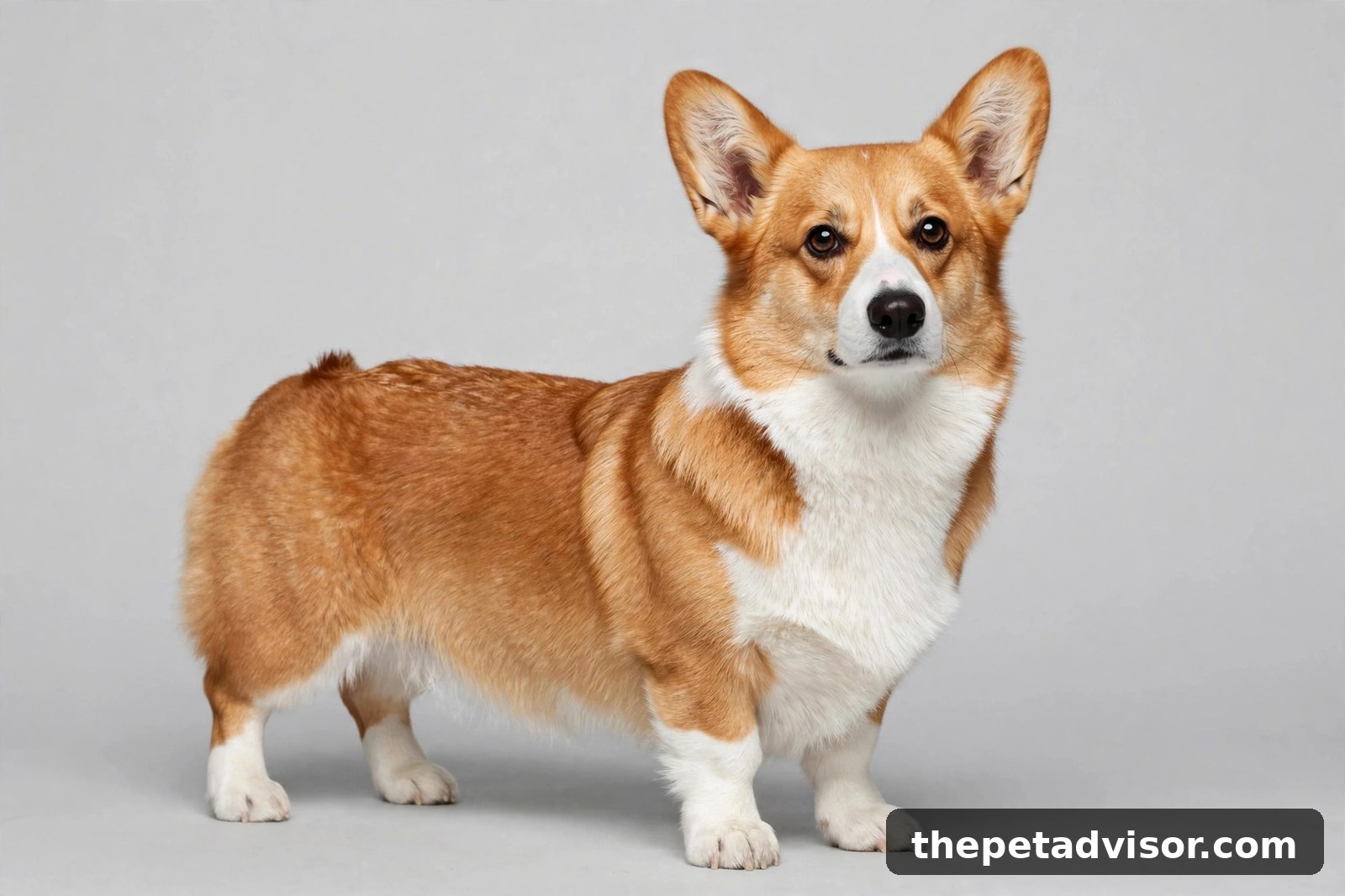
Do you have a photo of a Pembroke Welsh Corgi in the American show ring? We’d love this page to lead with one. If you have a show photo you’d let us use, email it to [email protected] — tell us the dog’s name and the show, and it may be featured here. Please only send photos you took yourself or have the photographer’s permission to share, and tell us the photographer’s name. We couldn’t find a public photo of a Pembroke Welsh Corgi in the American show ring that we were free to share, so the photo leading this page was made with AI. We’d much rather lead with a real one — if you’re a club member with an approved photo, we’d love to feature it.
1. Breed at a glance
Herding — recognized by the AKC as a separate breed from the Cardigan in 1934
10–12 in at the shoulder. Weight no more than 30 lb (dogs), 28 lb (bitches).
Medium-length double coat. Red, sable, fawn, or black and tan, with or without white markings.
Bold but kindly, intelligent, alert. Never shy nor vicious.
High. A working herder that needs daily exercise, a job, and company.
Size, coat, and temperament facts are from the AKC standard. Lifespan (12 to 13 years) is the AKC’s figure (AKC Pembroke Welsh Corgi breed page).
2. History
The Pembroke is a cattle dog of Pembrokeshire, in southwestern Wales, built low so it could nip at a cow’s heels and duck under the kick that followed. The two Corgi varieties were first recognized in the 1920s by the Kennel Club in Britain; the Corgi Club was formed in 1925, and in 1934 the Kennel Club recognized the Pembroke and the Cardigan as separate breeds. The next year the American Kennel Club did the same. (Source: Pembroke Welsh Corgi Club of America, Brief History.)
The first Pembrokes reached the United States in the early 1930s — Mrs. Lewis Roesler imported the first in 1933, and Little Madam became the first Pembroke registered with the AKC. The Pembroke Welsh Corgi Club of America held its first meeting on February 12, 1936, in conjunction with the Westminster dog show, and was admitted as an AKC member club the following year; its first specialty followed shortly after. (Sources: Pembroke Welsh Corgi Club of America, Brief History; AKC Library, Pembroke Welsh Corgi Club of America collection.)
No breed history skips the royal connection: in 1933 the Duke of York — later King George VI — gave his daughters a Pembroke named Dookie, and on her 18th birthday Princess Elizabeth received Susan, the foundation of the royal line. Queen Elizabeth II went on to own more than 30 Corgis in her lifetime. In the 1950s the PWCCA asked the Queen to join the American club as an honorary member; delighted, she declined on protocol. (Sources: Pembroke Welsh Corgi Club of America, Brief History; AKC Library, Pembroke Welsh Corgi Club of America collection.)
3. The standard and why it’s written that way
- Substance and stamina in a small space. The AKC sums the breed up in a sentence: “Low-set, strong, sturdily built and active, giving an impression of substance and stamina in a small space. Should not be so low and heavy-boned as to appear coarse or overdone, nor so light-boned as to appear racy.” And the standard adds the priority order: “Correct type, including general balance and outline, attractiveness of headpiece, intelligent outlook and correct temperament is of primary importance. Movement is especially important, particularly as viewed from the side.” (Source: AKC standard.)
- Size — low, long, and measured. “Height (from ground to highest point on withers) should be 10 to 12 inches. Weight is in proportion to size, not exceeding 30 pounds for dogs and 28 pounds for bitches. In show condition, the preferred medium-sized dog of correct bone and substance will weigh approximately 27 pounds, with bitches approximately 25 pounds.” The proportions rule: “Moderately long and low. The distance from the withers to the base of the tail should be approximately 40 percent greater than the distance from the withers to the ground.” (Source: AKC standard.)
- A foxy head and the ear triangle. “The head should be foxy in shape and appearance.” Ears are “erect, firm, and of medium size, tapering slightly to a rounded point” — and “a line drawn from the nose tip through the eyes to the ear tips, and across, should form an approximate equilateral triangle.” Eyes are oval, medium, “variations of brown in harmony with coat color,” with dark rims. (Source: AKC standard.)
- Tail — docked as short as possible. “Docked as short as possible without being indented. Occasionally a puppy is born with a natural dock, which if sufficiently short, is acceptable. A tail up to two inches in length is allowed, but if carried high tends to spoil the contour of the topline.” (Source: AKC standard.)
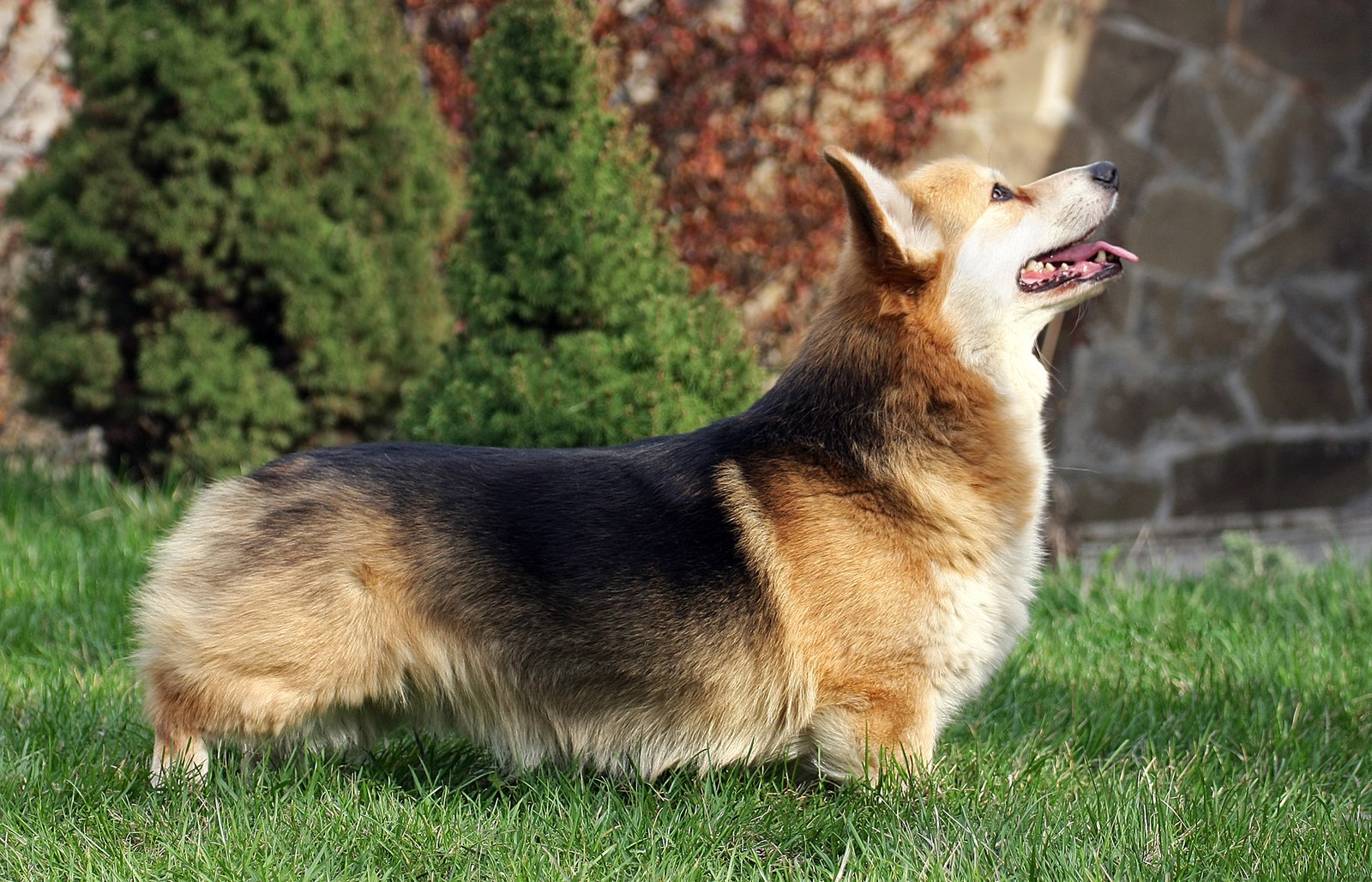

- Coat — medium, double, and shown natural. “Medium length; short, thick, weather-resistant undercoat with a coarser, longer outer coat.” The coat “is preferably straight, but some waviness is permitted” — and “the Corgi should be shown in its natural condition, with no trimming permitted except to tidy the feet, and, if desired, remove the whiskers.” A coat “of extreme length with exaggerated feathering” — a fluffy — is a very serious fault. (Source: AKC standard.)
- Color — four self colors, and three very serious faults. “The outer coat is to be of self colors in red, sable, fawn, black and tan with or without white markings. White is acceptable on legs, chest, neck (either in part or as a collar), muzzle, underparts and as a narrow blaze on head.” Very serious faults: whitelies (body color white, with red or dark markings), bluies (colored portions of the coat with a distinct bluish or smoky cast), and mismarks (white on the back between withers and tail, on the sides between elbows and back of hindquarters, or on the ears; black with white markings and no tan present). (Source: AKC standard.)
- Gait — free and smooth, built for the work. “Free and smooth. Forelegs should reach well forward without too much lift, in unison with the driving action of the hind legs.” Short, choppy movement, rolling, or a high-stepping gait are incorrect: “This is a herding dog, which must have the agility, freedom of movement, and endurance to do the work for which he was developed.” (Source: AKC standard.)
- Very serious faults, in one place. “A dog must be very seriously penalized for the following faults, regardless of whatever desirable qualities the dog may present: oversized or undersized; button, rose or drop ears; overshot or undershot bite; fluffies, whitelies, mismarks or bluies.” (Source: AKC standard.)
- Temperament, in the standard’s own words. “Outlook bold, but kindly. Never shy or vicious. The judge shall dismiss from the ring any Pembroke Welsh Corgi that is excessively shy.” (Source: AKC standard.)
4. Temperament & living with one
The AKC’s summary is the whole breed in a sentence: “Among the most agreeable of all small housedogs, the Pembroke Welsh Corgi is a strong, athletic, and lively little herder who is affectionate and companionable without being needy.” The standard adds the working half of the picture: bold but kindly, never shy nor vicious — a dog that drove cattle by barking and nipping at heels, and still believes the household runs better with its supervision. A Pembroke was bred to work alongside people all day, and it still wants to be in the middle of its people, not out in the yard alone. (Sources: AKC Pembroke Welsh Corgi breed page; AKC standard.)
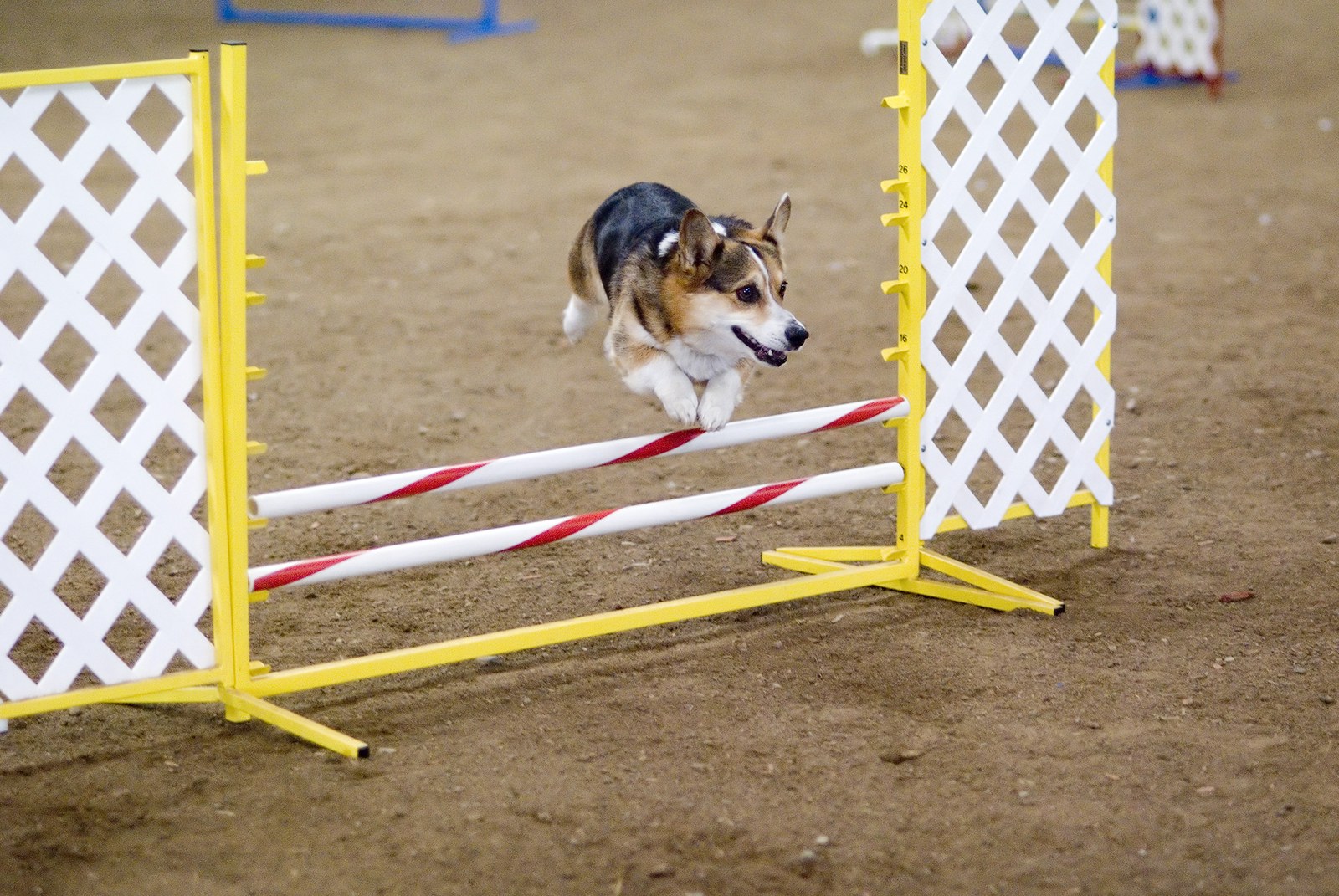

What that means in practice is a loud, clever, busy companion. Pembrokes bark — at the mail carrier, the squirrel, and their feelings in general — and the herding instinct does not switch off indoors: expect attempts to herd children and other pets back into the group. They need daily exercise and something to do with their brains — herding, agility, obedience, rally, and FastCAT are all sports the breed enjoys — and they do best with positive reinforcement and a job, not with harsh corrections. A bored Pembroke left alone in a yard is an unhappy Pembroke, and an unhappy Pembroke is a loud one that rearranges the furniture. Keep the weight off, too: a long back on short legs carries every extra pound, and the standard’s preferred weights — about 27 pounds for a dog, 25 for a bitch — are the target, not the starting point. (Sources: AKC Pembroke Welsh Corgi breed page; AKC standard.)
5. Grooming
- Two coats, one seasonal blow. The medium-length double coat has a short, thick, weather-resistant undercoat and a coarser, longer outer coat. The standard calls it a shedding coat outright, and a seasonal lack of undercoat “should not be too severely penalized, providing the hair is glossy, healthy and well groomed.” Expect heavy shedding, a daily brush during the seasonal blow, and a weekly brush the rest of the year. (Source: AKC standard.)
- Shown natural, kept natural. The Corgi is shown in its natural condition, with no trimming except to tidy the feet — and, if desired, remove the whiskers. At home that means a brush-through, nails, and a bath when dirty, not a clipper cut: cutting the double coat down does not stop the shedding, and it spoils the weather-resistant coat the breed was built with. (Source: AKC standard.)
- Not hypoallergenic. The heavy shedding and the seasonal blow mean Pembrokes are not a hypoallergenic breed. Some allergic people tolerate them, some don’t, and there is no safe way to know without spending time around them. (Sources: AKC standard; AKC Pembroke Welsh Corgi breed page.)
6. Health testing
- Two tests for a CHIC number. The Pembroke Welsh Corgi Club of America participates in the AKC’s Canine Health Information Center program. The OFA-CHIC requirements for the breed are a hip dysplasia evaluation and an ACVO eye exam — and breeders must agree to have all test results, positive or negative, published in the CHIC database. (Source: Embark, Genetic Health Tests for Pembroke Welsh Corgis.)
- Degenerative myelopathy — the breed’s watch list. DM is a progressive degeneration of the spinal cord, the dog equivalent of ALS, causing painless hind-limb weakness that usually starts after age 8 and advances over one to three years. A DNA test for the SOD1 mutation exists, and the breed carries the mutation at high frequency. The marker itself was isolated with research the PWCCA helped fund through the AKC Canine Health Foundation — work that crossed over into ALS research in people. A two-copy result is a risk result, not a diagnosis: most at-risk dogs never develop the disease, but no responsible breeder skips the test. (Sources: Embark, Genetic Health Tests for Pembroke Welsh Corgis; Jimanie Pembroke Welsh Corgis, Why AKC.)
- Von Willebrand’s disease type 1 and exercise-induced collapse. The DNA tests responsible Pembroke breeders run, alongside DM, are von Willebrand disease type 1 — a bleeding disorder — and exercise-induced collapse. Ask for all three DNA results, not just DM, and look them up in the OFA database yourself. (Source: Embark, Genetic Health Tests for Pembroke Welsh Corgis.)
- Hips, eyes, weight, and the back. Hip dysplasia is the orthopedic disease to ask about, screened by OFA or PennHIP evaluation, and the yearly eye exam catches cataracts and progressive retinal atrophy among the rest. The long back is the everyday risk: intervertebral disc disease follows the chondrodystrophic build, and extra weight loads it, so the 27- and 25-pound preferred weights are a health target as well as a show target. None of this is a reason not to own a Pembroke. All of it is a reason to buy from a breeder who tests: ask for the parents’ CHIC numbers and look the results up in the OFA database yourself, rather than taking a breeder’s word for it. Lifespan is 12 to 13 years. (Sources: Embark, Genetic Health Tests for Pembroke Welsh Corgis; AKC Pembroke Welsh Corgi breed page; AKC standard.)
7. The annual Pembroke Welsh Corgi specialty dog show
A specialty is the breed’s All-Star show — its Super Bowl. Once a year, the best Pembroke Welsh Corgis from across the country, and often from around the world, come together in one place.
The Pembroke Welsh Corgi Club of America’s national specialty: a full week at Purina Farms in Gray Summit, Missouri, with the conformation specialty at its center and herding, agility, obedience, rally, FastCAT, sweepstakes, and the annual meeting and banquet around it. The 2026 week: October 3–10, with conformation October 6–10.
The 90th National Specialty — Saturday to Saturday, October 3–10, 2026, at the Purina Events Center, Purina Farms, 300 Checkerboard Drive, Gray Summit, Missouri. Also the 50th Independent Specialty, with the 50th Obedience Trial, the 20th Rally Trial, and the 1st 4–6 Month Beginner Puppy Competition. Conformation: Tuesday, October 6 (obedience, rally, FastCAT day 1, 4–6 Month Beginner Puppy), Wednesday, October 7 (Puppy & Veteran Sweepstakes, FastCAT day 2), Thursday, October 8 (dog classes), Friday, October 9 (bitch classes, stud dog & brood bitch), Saturday, October 10 (Pee Wee, Junior Showmanship, Best of Breed, Best Puppy, Best Bred-By-Exhibitor, Best Veteran). Herding trials October 3–4, agility trial October 5. Entry: 258 Pembrokes (117 dogs, 141 bitches); 310 entries and 256 competitors across the national conformation event. Show Chair: Larry Adams. Superintendent: Foy Trent Dog Shows. (Sources: 2026 PWCCA National Specialty; 2026 PWCCA National Specialty premium list; AKC event search, event 2026070910.)
National specialty judges: Dr. Donald Sturz, Jr. — intersex, Best of Breed, Best Puppy, Best Bred-By-Exhibitor, Best Veteran, Junior Showmanship, Pee Wee, and all dog classes. Mari Fleming Carroll — all bitch classes, stud dog, and brood bitch. Russell Allen (Westmorland) — Puppy & Veteran Sweepstakes. Tammie Sommerson-Wilcox (Jareaux) — 4–6 Month Beginner Puppy. Samantha Williams — obedience. Chrisne Ward — rally. Kelly Fonkalsrud — herding trials; Tracy Parciak — herding tests. Mary Mullen — agility. (Source: 2026 PWCCA National Specialty premium list.)
Results (official, AKC event 2026070910). Best of Breed: GCHP CH Coventry Fashion Forward BCAT CGC TKA (bitch, owners A. De Bard, B. Shelton, S. Leyerly, D. Salow). Best of Opposite Sex: Linincorgi Limelite Two Great Tastes (dog, owners A. Tavares, Y. Lininger, M. Mullin). Select Dog: GCHB CH Pinemeade War Emblem (owners T. Hansen, S. Stone). Select Bitch: CH Linincorgi Thick As Thieves At Limelite (owners A. Tavares, Y. Lininger). Best of Winners and Winners Dog: Linincorgi Limelite Two Great Tastes. Winners Bitch: Sandfox Orange Spice (owners M. Junker, N. Junker). Reserve Winners Dog: Elfame Flipper Noggin Dude At Croswynd CD BN (owners P. Yohe, E. Woodman, K. Yohe). Reserve Winners Bitch: Coventry Return To Paradise (owners E. Kekua, D. Kekua, B. Shelton, B. Williams). Best Junior Handler: Adleigh Davis; Reserve Best Junior Handler: Teagan McGowan. (Source: AKC event search, event 2026070910.)
The 2027 national specialty dates had not been announced as of November 2026.
2026 PWCCA National Specialty — Pembroke Welsh Corgi Club of America
8. Regional specialties through the year: smaller regional shows
The national is the anchor, but the breed’s year also runs through regional specialties held by the Pembroke Welsh Corgi Club of America’s regional clubs — the Golden Gate Pembroke Welsh Corgi Fanciers, the Pembroke Welsh Corgi Club of Southern California, the Lakeshore Pembroke Welsh Corgi Club, the Cascade Pembroke Welsh Corgi Club, the Pembroke Welsh Corgi Club of the Potomac, and the Columbia River Pembroke Welsh Corgi Club. These are the 2027 regionals verified from club sources so far:
No regional specialties announced yet for 2027.
More regional specialties will be added here as their programs are verified — this section is built from show data, not guesswork. Browse upcoming show weekends →
9. Clubs
- Pembroke Welsh Corgi Club of America (parent club) — the AKC parent club for the breed in the United States since 1937. It runs the national specialty, held at Purina Farms, Gray Summit, Missouri in 2026. President Sarah Fitzell, Show Chair Larry Adams (2026). (Sources: Pembroke Welsh Corgi Club of America, Brief History; 2026 PWCCA National Specialty premium list.)
- Regional affiliate clubs. The breed’s PWCCA-affiliated regional clubs include the Golden Gate Pembroke Welsh Corgi Fanciers, the Pembroke Welsh Corgi Club of Southern California, the Lakeshore Pembroke Welsh Corgi Club, the Cascade Pembroke Welsh Corgi Club, the Pembroke Welsh Corgi Club of the Potomac, the Pembroke Welsh Corgi Club of Greater Atlanta, the Columbia River Pembroke Welsh Corgi Club, the Pembroke Welsh Corgi Club of the Garden State, the Pembroke Welsh Corgi Club of the Rockies, and the Pembroke Welsh Corgi Club of the Western Reserve. (Sources: Corgi-L, Pembroke Clubs; Pembroke Welsh Corgi Club of America, Regional Affiliate Clubs.)
If you are new to the breed, the national specialty itself is the better first stop than a breeder’s website: the people there have owned, shown, and worked Pembrokes, and they will tell you the truth about the shedding and the voice before you fall for a puppy.
10. Rescue
- Start with the regional clubs’ rescue committees. The Pembroke Welsh Corgi Club of America does not rescue any dogs itself; it provides assistance to its affiliated regional clubs’ Rescue Committees, and those committees place the dogs. To adopt, contact the rescue committee in your area — the parent club’s rescue page points you to the committee nearest you — or, if no rescue serves your area, the PWCCA National Rescue Chairman, Mary Day, at 360-456-1226. (Source: Pembroke Welsh Corgi Club of America, Pembroke Welsh Corgi Rescue.)
- What a rescue Corgi is usually like. Most Pembrokes come into rescue for lack of attention, training, or a change in the family situation, and the majority are two years of age or older. All rescue Corgis are spayed or neutered with shots current before placement, and each dog is placed in a temporary home first so temperament can be evaluated and the match made carefully. Many adopted Corgis go on to succeed in obedience, agility, herding, and therapy work. (Source: Pembroke Welsh Corgi Club of America, Pembroke Welsh Corgi Rescue.)
If you bought your Pembroke from a breeder, contact the breeder first — all members of the PWCCA must assist you when they are the breeder. A dog with a history of biting is not accepted into rescue.
11. Breeder vs. rescue: honest guidance
- If you buy: start with the parent club, the Pembroke Welsh Corgi Club of America, and its breeder directory. Ask for the parents’ health results — hip evaluation, eye exam, and the degenerative myelopathy, von Willebrand disease type 1, and exercise-induced collapse DNA tests — and look the results up in the OFA database yourself. Expect to wait for a puppy from a careful breeder. A good breeder will have the answers, will ask you as many questions as you ask them, and will take the puppy back for its whole life if you cannot keep it.
- If you rescue: a rescued Pembroke is usually an adult, often one whose owner underestimated the shedding, the voice, and the company the breed requires, and it will arrive with a thick coat, a loud opinion, and a need for people fully formed. What you get in return is a dog whose temperament you can see before you commit and a lower price. Either way, be honest with yourself first: a Pembroke needs daily exercise, regular brushing, and an owner who is home a lot and finds the shedding and the herding commentary charming rather than infuriating. It is not a dog for a household that wants a quiet, low-maintenance, leave-alone companion.
- No rare color worth a premium. One thing that is not what a seller tells you: there is no such thing as a rare color worth a premium. The standard names four colors only — red, sable, fawn, and black and tan, with or without white markings — and whitelies, bluies, and mismarks are very serious faults, as is the long “fluffy” coat. Blue merle is a Cardigan color, not a Pembroke color. The standard also describes one size only, 10 to 12 inches at the shoulder, with no miniature variety. A breeder selling a “rare” blue merle, fluffy, or “mini” Pembroke at a premium is selling you a label.
12. Claim this page
This page belongs to the breed, and the people who know the breed best are the Pembroke Welsh Corgi Club of America and its members. If you are with the parent club — or you are a breeder, a judge, a handler, or a rescue volunteer who spotted something wrong, missing, or out of date — this page is yours to set straight. Tell us what needs fixing and where the correction is documented, and we will fix it and credit the source. Contact the site through the About page, and mention “Pembroke Welsh Corgi breed profile.”
Sources
- AKC Pembroke Welsh Corgi breed page — akc.org/dog-breeds/pembroke-welsh-corgi
- AKC Pembroke Welsh Corgi breed standard (approved June 13, 1972; reformatted January 28, 1993) — images.akc.org/pdf/breeds/standards/PembrokeWelshCorgi.pdf
- Pembroke Welsh Corgi Club of America, Official AKC Breed Standard — pwcca.org/Official-AKC-Breed-Standard
- Pembroke Welsh Corgi Club of America, Brief History — pwcca.org/Brief-History
- AKC Library, Pembroke Welsh Corgi Club of America collection — akc.libraryhost.com/repositories/2/resources/49
- Pembroke Welsh Corgi Club of America, PWCCA National Specialty — pwcca.org/pwcca-national-specialty
- 2026 PWCCA National Specialty premium list — foytrentdogshows.com/forms/PLs/PL2026/PL_2026_Pembroke.pdf
- 2026 National Specialty, AKC event search, event 2026070910 (official results) — apps.akc.org/apps/events/search/index_results.cfm
- 2026 National Specialty Sweepstakes, AKC event search, event 2026070913 — apps.akc.org/apps/events/search/index_results.cfm
- Pembroke Welsh Corgi Club of America, Regional Affiliate Clubs — pwcca.org/Regional-Affiliate-Clubs
- Pembroke Welsh Corgi Club of America, Pembroke Welsh Corgi Rescue — pwcca.org/Pembroke-Welsh-Corgi-Rescue
- Corgi-L, Pembroke Clubs — corgi-l.org/pembroke-clubs
- Embark, Genetic Health Tests for Pembroke Welsh Corgis — embarkvet.com/blogs/resources/genetic-health-testing-for-pembroke-welsh-corgis
- AKC Upcoming National Specialties list — apps.akc.org/apps/events/conformation/national_specialties.cfm
- Tricolor Pembroke profile photo: Marsiyanka, CC BY-SA 3.0, via Wikimedia Commons — commons.wikimedia.org/wiki/File:Pembroke_Welsh_Corgi.jpg
- Pembroke agility photo: Ron Armstrong, CC BY 2.0, via Wikimedia Commons — commons.wikimedia.org/wiki/File:Pembroke_Welsh_Corgi_agility.jpg