
Breed profile · Toy Group · the butterfly-eared toy spaniel
Papillon
The Papillon is a small, friendly, elegant toy dog of fine-boned structure — 8 to 11 inches at the shoulder, with a long, silky, flowing coat and ears like the spread wings of a butterfly. It is a spaniel by ancestry and a toy by size, and the AKC’s own summary is short: happy, alert, and friendly, a “doggy dog” in a refined package. The AKC recognized the breed in 1915, and the Papillon Club of America is the parent club.
Papillons come in two ear varieties — the erect-eared Papillon and the drop-eared Phalène — shown together as one breed in the United States. The dog leading this page is an erect-eared Papillon.
Help us improve it. This is one of ThePetAdvisor’s breed profiles, built from public sources with generous links to the people who actually own this breed’s knowledge. If something’s off or missing, the parent club can claim the page and set it straight — see the bottom of the page.
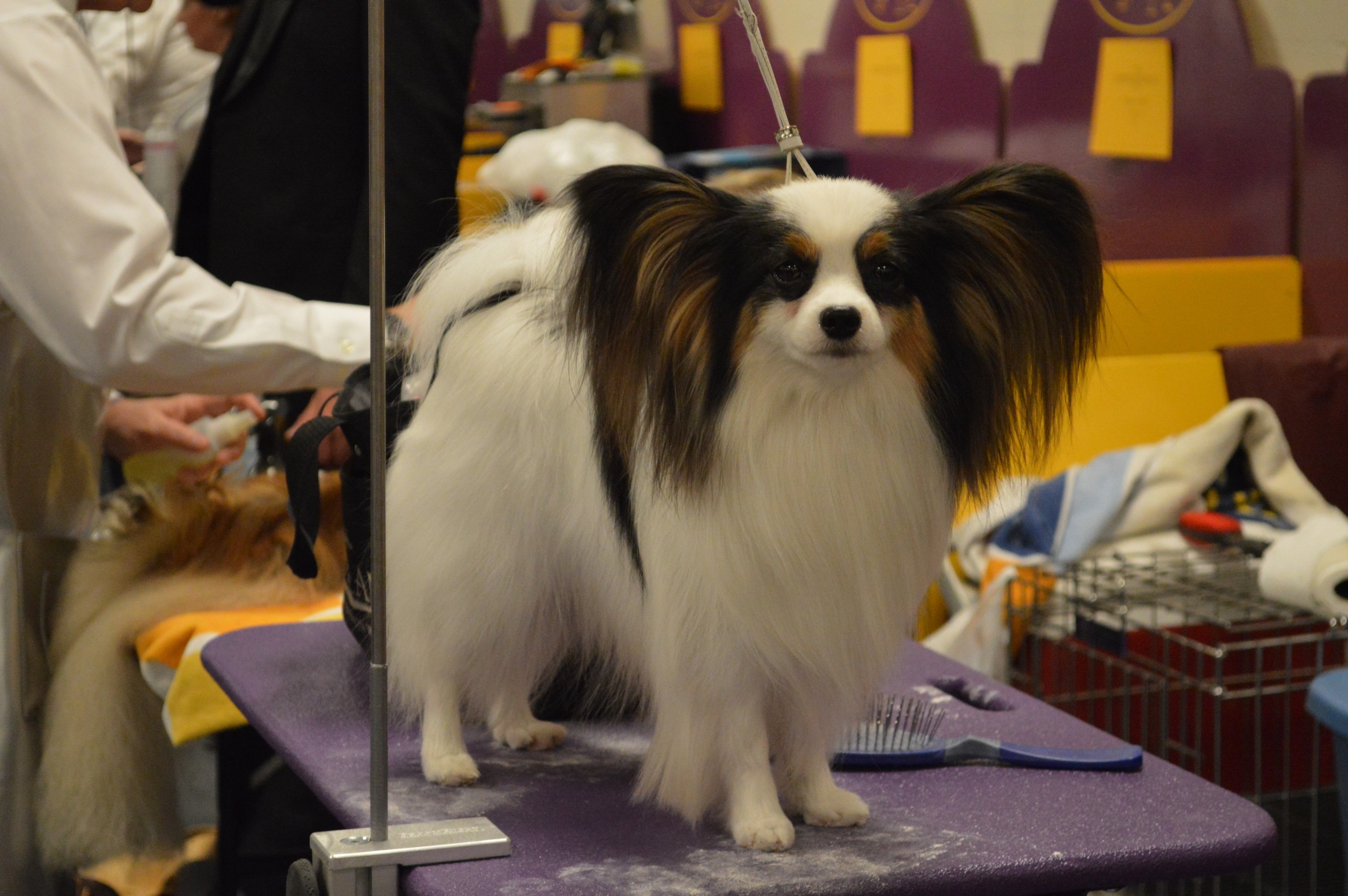

Do you have a better photo of a Papillon in the American show ring? If you have a show photo you’d let us use, email it to [email protected] — tell us the dog’s name and the show, and it may be featured here. Please only send photos you took yourself or have the photographer’s permission to share, and tell us the photographer’s name.
1. Breed at a glance
Toy Group; recognized by the AKC in 1915
Height 8–11 in at the shoulder; over 12 in is a disqualification; weight in proportion to height, typically 5–10 lb
Long, fine, silky, flowing, single coat with no undercoat; always parti-color or white with patches of any color
14–16 years
Happy, alert, and friendly; neither shy nor aggressive
Papillon Club of America, founded 1935, the AKC parent club
A Papillon is a toy dog that never got the message it is supposed to be ornamental — the AKC calls the breed happy, alert, and friendly, and then adds that despite its refined appearance the Pap is truly a “doggy dog,” blessed with a hardy constitution. It is the oldest of the toy spaniels, a lapdog of European royal courts that still works: Papillons are among the most successful toy breeds in obedience and agility, and they learn fast, move fast, and notice everything. The whole breed is built around one thing: the ears. Large, heavily fringed, carried erect like the spread wings of a butterfly — papillon is French for butterfly — or carried completely dropped, in which case the dog is a Phalène, French for moth. (Sources: AKC, Papillon; The Papillon Club of America.)
2. History
The Papillon is the modern representative of the Continental Toy Spaniel, the Epagneul Nain Continental — one of the oldest toy breeds in Europe, traced through the paintings of the Old Masters as far back as the 13th century and the earliest years of the 16th. Small spaniels resembling the modern Papillon appear in Italian and Spanish paintings from the 1500s onward, including Titian’s, and the dogs they painted came to be called Titian Spaniels; in those days they were known as dwarf spaniels, or toy spaniels. Louis XIV of France was said to import them from Spain, and they were the favored companions of the French court — Madame de Pompadour owned two, Inez and Mimi, and Marie Antoinette is said to have walked to the guillotine clutching her small dog under her arm, a story that has become one of the breed’s most enduring pieces of lore. The portraits, it is worth noting, show drop-eared dogs: the Phalène, not the erect-eared Papillon. (Sources: Road’s End Papillons, History of the Papillon-Phalene Dog, excerpts from “Brief History of the Papillon” by Rachel D. Kemmerer, 1963 Papillon Handbook; AKC, Papillon.)
The erect ear only became fashionable toward the end of the 19th century, and with it came the name: papillon, French for butterfly, for the erect-eared dog whose fringed ears fan out like wings, and phalène, French for moth, for the drop-eared dog whose ears fall like folded wings. The breed was introduced into Great Britain in 1905, the AKC registered its first Papillon in 1915, and the Papillon Club of America was founded in 1935, holding the first United States specialty show in 1936. (Sources: Road’s End Papillons, History of the Papillon-Phalene Dog; AKC, Papillon.)
The modern Papillon kept the court lapdog’s looks and recovered the spaniel’s working brain. It is a small dog with a long memory for training and a real appetite for work — the breed competes at the top of the toy breeds in obedience, rally, and agility, and the parent club’s national specialty week runs agility trials, obedience and rally trials, and scent work alongside the conformation show. A Papillon that gets a job, even a small one, is a happier Papillon than one that only gets carried. (Sources: AKC, Papillon; Papillon Club of America, 2026 National Specialty premium list.)
3. The standard and why it is written that way
- General appearance — a small, friendly, elegant toy dog. “The Papillon is a small, friendly, elegant toy dog of fine-boned structure, light, dainty and of lively action; distinguished from other breeds by its beautiful butterfly-like ears.” The standard was approved June 10, 1991, and effective July 31, 1991. (Source: AKC Papillon Breed Standard, reproduced at Road’s End Papillons.)
- Size — 8 to 11 inches, and not a cobby dog. Height at the withers, 8 to 11 inches. Fault: over 11 inches. Disqualification: over 12 inches. The body must be slightly longer than the height at the withers — it is not a cobby dog — and weight is in proportion to height. Substance: of fine-boned structure. (Source: AKC Papillon Breed Standard, reproduced at Road’s End Papillons.)
- Head — small, with a fine muzzle and a black nose. The head is small; the skull is of medium width and slightly rounded between the ears, with a well-defined stop where the muzzle joins the skull. The muzzle is fine, abruptly thinner than the head, tapering to the nose, about one-third the length of the head from tip of nose to occiput. The nose is black, small, rounded, and slightly flat on top — a nose that is not black is severely penalized. Lips tight, thin, and black; the tongue must not be visible when the jaws are closed. Teeth must meet in a scissors bite; overshot or undershot is a fault. Eyes dark, round, not bulging, of medium size and alert in expression, with black eye rims. (Source: AKC Papillon Breed Standard, reproduced at Road’s End Papillons.)
- Ears — the outstanding feature of the breed. The ears of either the erect or drop type should be large with rounded tips, and set on the sides and toward the back of the head. Ears of the erect type are carried obliquely and move like the spread wings of a butterfly — when alert, each ear forms an angle of approximately 45 degrees to the head, and the leather should be of sufficient strength to maintain the erect position. Ears of the drop type, known as the Phalène, are similar to the erect type but are carried drooping and must be completely down. Faults: ears small, pointed, set too high; one ear up, or ears partly down. (Source: AKC Papillon Breed Standard, reproduced at Road’s End Papillons.)
- Body, legs & tail — level, fine-boned, and plumed. Neck of medium length; the backline is straight and level. The chest is of medium depth with ribs well sprung, and the belly is tucked up. The tail is long, set high, and carried well arched over the body, covered with a long, flowing plume that may hang to either side. Shoulders well developed and laid back; forelegs slender, fine-boned, and straight; hind legs slender, fine-boned, well angulated, and parallel when viewed from behind. Front and hind feet thin and elongated, hare-like, pointing neither in nor out. (Source: AKC Papillon Breed Standard, reproduced at Road’s End Papillons.)
- Coat — abundant, long, fine, and silky, with no undercoat. “Abundant, long, fine, silky, flowing, straight with resilient quality, flat on back and sides of body. A profuse frill on chest. There is no undercoat.” Hair is short and close on the skull, muzzle, front of forelegs, and from hind feet to hocks; ears well fringed, with the inside covered with silken hair of medium length; backs of the forelegs feathered, hind legs covered to the hocks with abundant breeches; the tail covered with a long, flowing plume. (Source: AKC Papillon Breed Standard, reproduced at Road’s End Papillons.)
- Color — always parti-color or white with patches of any color. “Always parti-color or white with patches of any color(s). On the head, color(s) other than white must cover both ears, back and front, and extend without interruption from the ears over both eyes. A clearly defined white blaze and noseband are preferred to a solidly marked head. Symmetry of facial markings is desirable. The size, shape, placement, and presence or absence of patches of color on the body are without importance. Among the colors there is no preference, provided nose, eye rims and lips are well pigmented black.” Severely penalized: color other than white not covering both ears, back and front, or not extending from the ears over both eyes. (Source: AKC Papillon Breed Standard, reproduced at Road’s End Papillons.)
- Disqualifications — the hard lines. Height over 12 inches. An all white dog or a dog with no white. (Source: AKC Papillon Breed Standard, reproduced at Road’s End Papillons.)
- Why it is written that way. Every clause in the standard points back to the ears and the face: the ears must be large and fringed because the butterfly silhouette is the breed, and the head-color rule exists so the butterfly face reads at a glance — color over both ears and both eyes, with a white blaze down the middle, is what makes a Papillon look like a Papillon from across the ring. The color rule is deliberately loose everywhere else: patches on the body are “without importance” and no color is preferred, because the breed was never bred for a color. And the 12-inch disqualification is the breed’s other anchor: without it, the toy spaniel drifts back toward the larger spaniels it came from, and the dog on the lap stops being a Papillon at all.
4. Temperament & living with one
The AKC’s summary is short: happy, alert, and friendly, neither shy nor aggressive — and the standard says the same in its last line. The parent club’s breeders add the part the standard leaves out: a Papillon is bright, busy, and opinionated, a spaniel that happens to be small. (Sources: AKC, Papillon; AKC Papillon Breed Standard, reproduced at Road’s End Papillons.)
- With its own people: devoted and intensely bonded, often to one person above all. A Papillon leans on its people, follows them from room to room, and expects to be part of whatever is happening — on a lap, in a bag, or at the foot of the bed.
- With strangers: alert and watchful rather than shy. The breed is quick to announce a visitor, and early socialization is what turns that wariness into confidence instead of fear or snapping. The spaniel in the breed means a dog with opinions about who belongs in the house.
- Training: bright and quick to learn — and famously quick to get bored. A Papillon responds to fair, consistent training and to praise, and it notices inconsistency at once. It is one of the most trainable toy breeds, which is why it shows up at the top of obedience and agility results far out of proportion to its size — and why a Papillon with nothing to learn will invent its own curriculum.
- Exercise: small but not sedentary. A Papillon needs daily walks and play, and it is quick and agile for its size — it was built to be a companion that went everywhere, not to sit still. What it does not need is a yard: it is an indoor dog that goes out, not an outdoor dog that comes in, and it chills easily in cold weather.
- Barking: the alertness has a volume knob. A Papillon will tell you about the mail carrier, the neighbor’s cat, and the leaf that moved. Training a quiet cue early is not optional if you have neighbors.
- First-dog honesty: this is a lot of personality — and a lot of grooming — for a first-time owner. The confidence, the barking, and the busyness all demand an owner who trains from day one and keeps training, and who brushes regularly or keeps the coat sensibly short. If that sounds like a burden rather than a pleasure, a quieter breed is the honest choice.
5. Grooming
The Papillon’s coat is a single coat with no undercoat — long, fine, silky, and flowing — which is why it falls straight and mats when it is dirty, and why it needs regular attention. (Source: AKC Papillon Breed Standard, reproduced at Road’s End Papillons.)
- Regular brushing: brush through the coat a few times a week to keep tangles away, paying attention behind the ears, under the legs, and in the breeches, where mats form first. Work mats out gently with your fingers first and then a wide-tooth comb, always from the ends of the hair toward the body, with a little detangler to save coat — never pull mats out.
- Bathing: every few weeks, more often for some dogs. First make sure all the tangles are out, then shampoo and rinse — and rinse again, because soap left in dulls the coat and can cause itching — then use a good conditioner. Cleanliness matters because dirty hair cannot grow well.
- Ears: the fringed ears need checking as part of every grooming session — debris and moisture collect in the fringe, and the ear leather should be kept clean and dry. Never use cotton swabs in the ear canal; have any unusual smell or continued scratching checked by a veterinarian.
- Teeth & nails: clean the teeth regularly — brush, pretreated pads, or gauze wrapped around a finger — because small mouths crowd teeth and dental disease follows. Trim the toenails at least every two weeks, and keep the hair on the pads of the feet clipped so the dog does not slip on slippery floors.
- The clipped option: a full flowing coat is a show coat, not a requirement for a pet. Many owners keep the coat shorter for everyday life — the honest answer for anyone who will not brush several times a week.
6. Health testing
The parent club’s CHIC requirements, as published by the AKC, are a patella evaluation, a cardiac exam, and an ophthalmologist evaluation. A CHIC number requires the breed-specific results to be released publicly, pass or fail. The lists:
- Patella evaluation — the big one. Patellar luxation — slipping kneecaps — is the most common joint problem in the breed, and the OFA evaluation grades it from normal to Grade IV. Dogs must be at least 12 months old for an official OFA patella evaluation. (Sources: AKC, Toy Group Health Testing Requirements: Papillon; Sablewings Papillons, Papillon Health Testing.)
- Cardiac exam. A cardiac evaluation screens for congenital and progressive heart problems. (Source: AKC, Toy Group Health Testing Requirements: Papillon.)
- Ophthalmologist evaluation. The eye exam by a board-certified ACVO ophthalmologist screens for hereditary eye disease, including cataracts and progressive retinal atrophy. Eye clearances are renewed regularly, because some eye diseases develop later in life. (Sources: AKC, Toy Group Health Testing Requirements: Papillon; Sablewings Papillons, Papillon Health Testing.)
- Genetic tests to ask about: DNA tests exist for progressive retinal atrophy (PRA1, caused by a mutation in the CNGB1 gene), neuroaxonal dystrophy (NAD), von Willebrand disease type 1, and Factor VII deficiency. PRA1 is the Papillon’s own form of progressive retinal atrophy, a degenerative eye disorder that causes blindness over time; the parent club’s genetics work identified the PRA1 gene, with help from longtime member Leona Domino, to whom the 2026 national specialty was dedicated. (Sources: Sablewings Papillons, Papillon Health Testing; Papillon Club of America, 2026 National Specialty premium list.)
- Other conditions to ask about: the breed’s small size brings its own risks — a dropped or stepped-on Papillon is an emergency, and very small puppies are prone to hypoglycemia — and Papillons are prone to dental crowding in their small mouths, so dental care matters more in a Papillon than in most breeds. An open fontanel, a soft spot on the top of the skull that does not close, is also a condition Papillon owners should know by name and ask a breeder about.
Ask any breeder for the parents’ results for the patella evaluation, the cardiac exam, and the eye exam, plus the PRA1 and NAD DNA results, and look them up in the OFA database yourself before you commit. The breed’s 14-to-16-year lifespan is a long one for any dog, and the testing exists so that those years are healthy ones.
7. The annual Papillon specialty dog show
A specialty is the breed’s All-Star show — its Super Bowl. Once a year, the best Papillons from across the country, and often from around the world, come together in one place.
The Papillon Club of America’s national specialty: one national event each year, with conformation, sweepstakes, and junior showmanship — and a full week of companion events around it, from obedience and rally to agility and scent work. The 2026 national: May 22–23, at the Embassy Suites by Hilton Norman Hotel & Conference Center in Norman, Oklahoma, with 172 competitors and 193 entries in conformation. The 2025 national: May 23–24, at the Mirabeau Park Hotel & Convention Center in Spokane Valley, Washington, with 118 competitors and 126 entries. The 2027 national: May 28–29, at the Embassy Suites by Hilton Raleigh Durham in Cary, North Carolina.
The standard, in brief: a small, friendly, elegant toy dog of fine-boned structure, distinguished by its beautiful butterfly-like ears. Height 8 to 11 inches at the withers; over 12 inches is a disqualification. Always parti-color or white with patches of any color — an all-white dog, or a dog with no white at all, is disqualified. The ears may be erect, carried obliquely like the spread wings of a butterfly, or completely dropped — the drop-eared variety is the Phalène.
The 2026 National Specialty — Friday, May 22 – Saturday, May 23, 2026, at the Embassy Suites by Hilton Norman Hotel & Conference Center, 2501 Conference Drive, Norman, Oklahoma. Entry: 193 entries / 172 competitors in conformation. Entries opened March 18, 2026; entries closed April 22, 2026. Event Chair: Nicholas Forbes, Eloy, Arizona. Event Secretary: Lorraine Yu, DogZibit. The 2026 national was dedicated to Leona Domino of Domino’s Papillons. (Sources: AKC event search, event 2026208311; Papillon Club of America, 2026 National Specialty premium list.)
National specialty judge: Mr. Glenn Robb — conformation. Junior showmanship judge: Ms. Melanee Clark; Best Junior Handler: Faith Swenson; Reserve Best Junior Handler: Kyslee Jaworski. Puppy and veteran sweepstakes judge: Ms. Yvonne Weber (Thursday, May 21). 4–6 Month Beginner Puppy judge: Ms. Melanee Clark. (Sources: AKC event search, event 2026208311; Papillon Club of America, 2026 National Specialty premium list.)
Results (2026 national). Best of Breed: GCHP Riesa N Passionpaps Locked And Loaded (dog). Best of Opposite Sex, Winners Dog, Winners Bitch, and select awards not confirmed in an official source as of November 2026. (Source: Papillon Club of America, Past National Specialty Winners.)
The 2027 National Specialty: Friday, May 28 – Saturday, May 29, 2027, two days, at the Embassy Suites by Hilton Raleigh Durham, in Cary, North Carolina. Superintendent / Event Secretary: Susan Gordon. AKC event number, judges, entries, and closing date not yet published as of November 2026. (Source: AKC Upcoming National Specialties.)
Past national specialties: 2025 · 2024 · 2023
Papillon Club of America — papillonclub.org
8. Regional specialties through the year: smaller regional shows
The national is the anchor, but the breed’s year also runs through regional specialties — smaller regional shows, not the national — held around the country, including the regional specialties that run with the national. These are the 2026 regionals verified from club and AKC sources so far:
Five regional Papillon specialties verified for 2026 so far, including the two parent-club regionals and the concurrent Alamo specialty that run with the national in Norman, Oklahoma, and the Greater Chicagoland club’s two July specialties in Belvidere, Illinois:
- Papillon Club of America regional specialty #1 — Tuesday, May 19, 2026, Norman, Oklahoma: at the Embassy Suites by Hilton Norman Hotel & Conference Center (AKC event 2026208307). Judge: Mr. Fred Bassett. Entry: 147 entries / 132 competitors. Entries closed April 22, 2026. Event Chair: Nicholas Forbes. Event Secretary: Lorraine Yu, DogZibit.
- Papillon Club of America regional specialty #2 — Wednesday, May 20, 2026, Norman, Oklahoma: at the Embassy Suites by Hilton Norman Hotel & Conference Center (AKC event 2026208308). Judge: Mr. Dale Martenson (per the premium list; the AKC event record names no judge). Entry: 147 entries / 122 competitors. Entries closed April 22, 2026.
- Alamo Papillon Society concurrent specialty — Wednesday, May 20, 2026, Norman, Oklahoma: at the Embassy Suites by Hilton Norman Hotel & Conference Center (AKC event 2026494704), the afternoon event the same day as the parent club’s second regional. Judges: Ms. Melanee Clark and Ms. Angel Pickett (both named in the premium list). Entry: 145 entries / 126 competitors. Entries closed May 1, 2026. Event Chair: Holly Williams, San Antonio, Texas. Event Secretary: Lorraine Yu, DogZibit.
- Greater Chicagoland Papillon Club specialty — Saturday, July 4, 2026, Belvidere, Illinois: at the Boone County Fairgrounds, 8791 Route 76 (AKC event 2026056401). Judge: Mr. W Wornall. Entry: 31 entries / 29 competitors. Best Junior Handler: Samantha Rasl Diaz. Entries closed June 17, 2026. Event Chair: Carol Wilber, Kankakee, Illinois.
- Greater Chicagoland Papillon Club specialty — Sunday, July 5, 2026, Belvidere, Illinois: at the Boone County Fairgrounds (AKC event 2026056402). Judge: W Anderson. Entry: 29 entries / 26 competitors. Best Junior Handler: Samantha Rasl Diaz. Entries closed June 17, 2026. Event Chair: Carol Wilber.
Past regional specialties: 2025
More regional specialties will be added here as their programs are verified — this section is built from show data, not guesswork. Browse upcoming show weekends →
9. Clubs
- Papillon Club of America (PCA) (parent club) — the AKC-recognized national breed club for the Papillon, founded in 1935, and the only Papillon club the AKC recognizes as the parent club. It maintains the breed standard, holds the national specialty each year, runs the club’s genetics and health programs, and publishes the club’s national specialty premium lists. (Source: The Papillon Club of America.)
- PCA member clubs. Local and regional Papillon clubs across the country hold the regional specialties in section 8, including the Greater Chicagoland Papillon Club and the Alamo Papillon Society, both verified in the AKC event records for 2026. (Sources: AKC event records in section 8.)
- AKC Marketplace and breeder referral. The AKC’s club directory lists each club’s breeder-referral and rescue contacts, and the PCA is the first stop for anyone looking for a puppy from a breeder who works under the club’s code. (Source: The Papillon Club of America.)
10. Rescue
- Papillon Haven Rescue. The national all-volunteer Papillon rescue, established in 2003, with volunteers across the United States. Its rescued Papillons and Papillon mixes live in foster homes and are spayed or neutered and fully vetted before placement, and adoptions run on an application with veterinary and personal references and a home visit. (Sources: Papillon Haven Rescue; AKC Rescue Network, P Breeds.)
- Papillon 911 Rescue and Adoption, Inc. A breed rescue that focuses largely on Papillons coming out of puppy mills, placing dogs across the country with most foster homes in the southeast. Adoptions require an application, veterinary and personal references, and a home visit. (Sources: Papillon 911 Rescue and Adoption; AKC Rescue Network, P Breeds.)
- PapAdopters & Placement Service. The AKC Rescue Network’s Papillon rescue contact ([email protected], 248-231-5076), placing Papillons in need of new homes. (Source: AKC Rescue Network, P Breeds.)
- Papillon Pals Rescue. A Jacksonville, Florida rescue listed by the AKC Rescue Network, adopting within about 250 miles of the city. (Source: AKC Rescue Network, P Breeds.)
- Papillon Rescue of the North East (PRONE). A 501(c)(3) all-volunteer rescue founded in 2012 in Sandown, New Hampshire, covering Papillons and Pomeranians in the northeast. (Source: PRONE, Adopt-a-Pet.)
- AKC Rescue Network. The AKC’s rescue network lists Papillon rescue organizations under its P breeds page, and the parent club is the first stop if you do not know which contact covers your area. (Source: AKC Rescue Network, P Breeds.)
11. Breeder vs. rescue: honest guidance
- If you buy: start with the parent club, the Papillon Club of America — contact the club directly for a breeder referral — and ask for the parents’ health-test results — patella evaluation, cardiac exam, and ophthalmologist evaluation, plus the PRA1 and NAD DNA results — and look the results up in the OFA database yourself. Expect to wait for a puppy from a careful breeder: a good breeder will have the answers, will ask you as many questions as you ask them, and will take the puppy back for its whole life if you cannot keep it.
- If you rescue: a rescued Papillon is usually an adult, and it will arrive with its temperament visible before you commit. What you get in return is a dog whose character you can see before you commit and a lower price. Either way, be honest with yourself first: a Papillon needs regular grooming, patient house-training, daily training, and an owner who socializes from day one — not a purse and a hope.
- Watch out for “teacup” marketing. There is no teacup variety — the standard describes one Papillon, 8 to 11 inches at the shoulder, with no weight figure at all. A seller’s “teacup” label is a sales description, not a variety and not a mark of quality or health; the tiniest dogs carry the most risk, not the most value. Judge the dog in front of you against the standard — the butterfly ears, the white blaze, the fine-boned elegance — not against a listing’s adjectives.
- Watch out for “rare color” marketing. The standard allows any color with white, with no preference among colors — there is no rare color worth a premium. The only hard color lines are the disqualifications: an all-white dog, or a dog with no white at all. A seller charging extra for a color is selling you a story, not a better dog.
- Small-dog honesty: a Papillon is not a toy and not a starter pet for small children. The size that makes the breed portable also makes it fragile, and the bright, alert temperament that makes it charming also makes it vocal and busy. If that sounds like a burden rather than a pleasure, a sturdier breed is the honest choice.
12. Claim this page
This page belongs to the breed, and the people who know the breed best are the Papillon Club of America and its members. If you are with the parent club — or you are a breeder, a judge, a handler, or a rescue volunteer who spotted something wrong, missing, or out of date — this page is yours to set straight. Tell us what needs fixing and where the correction is documented, and we will fix it and credit the source. Contact the site through the About page, and mention “Papillon breed profile.”
Sources
- AKC, Papillon breed page — akc.org/dog-breeds/papillon
- AKC Papillon Breed Standard, reproduced at Road’s End Papillons — roadsendpapillons.com
- AKC, Toy Group Health Testing Requirements: Papillon — akc.org
- AKC Upcoming National Specialties — apps.akc.org
- AKC event search, event 2026208311 (2026 national) — apps.akc.org
- AKC event search, event 2026208307 (2026 regional #1) — apps.akc.org
- AKC event search, event 2026208308 (2026 regional #2) — apps.akc.org
- AKC event search, event 2026494704 (2026 Alamo concurrent specialty) — apps.akc.org
- AKC event search, event 2026056401 (Greater Chicagoland, July 4, 2026) — apps.akc.org
- AKC event search, event 2026056402 (Greater Chicagoland, July 5, 2026) — apps.akc.org
- AKC event search, event 2025208313 (2025 national) — apps.akc.org
- AKC event search, event 2025208310 (2025 regional #1) — apps.akc.org
- AKC event search, event 2025208311 (2025 regional #2) — apps.akc.org
- AKC event search, event 2024208309 (2024 national) — apps.akc.org
- AKC Rescue Network, P Breeds — akc.org/akc-rescue-network-p-breeds
- The Papillon Club of America — papillonclub.org
- Papillon Club of America, 2026 National Specialty premium list — papillonclub.org (PDF)
- Papillon Club of America, 2025 National Specialty premium list — apps.akc.org (PDF)
- Papillon Club of America, Past National Specialty Winners — papillonclub.org (PDF)
- Road’s End Papillons, History of the Papillon-Phalene Dog (excerpts from “Brief History of the Papillon” by Rachel D. Kemmerer, 1963 Papillon Handbook) — roadsendpapillons.com
- Sablewings Papillons, Papillon Health Testing — sablewings.com
- Papillon Haven Rescue — paphaven.org
- Papillon 911 Rescue and Adoption — pap911rescue.org
- PRONE — Papillon Rescue of the North East, Adopt-a-Pet — adoptapet.com
- Pets Adviser, GCH Involo The King Of Pop at the 2015 Westminster Kennel Club Dog Show, Wikimedia Commons (CC BY 2.0) — commons.wikimedia.org