
Breed profile · Herding Group · the shaggy drover’s dog
Old English Sheepdog
The Old English Sheepdog is the archetypical shaggy dog: a big, square, profusely coated drover from the southwest of England, 21 to 22 inches and up at the shoulder and 60 to 100 pounds, with a grey-and-white coat that falls over its eyes, a bear-like rolling gait, and a mellow, agreeable nature — a working dog in a mop of a coat, one that needs brushing as much as it needs a job.
Help us improve it. This is one of ThePetAdvisor’s breed profiles, built from public sources with generous links to the people who actually own this breed’s knowledge. If something’s off or missing, the parent club can claim the page and set it straight — see the bottom of the page.
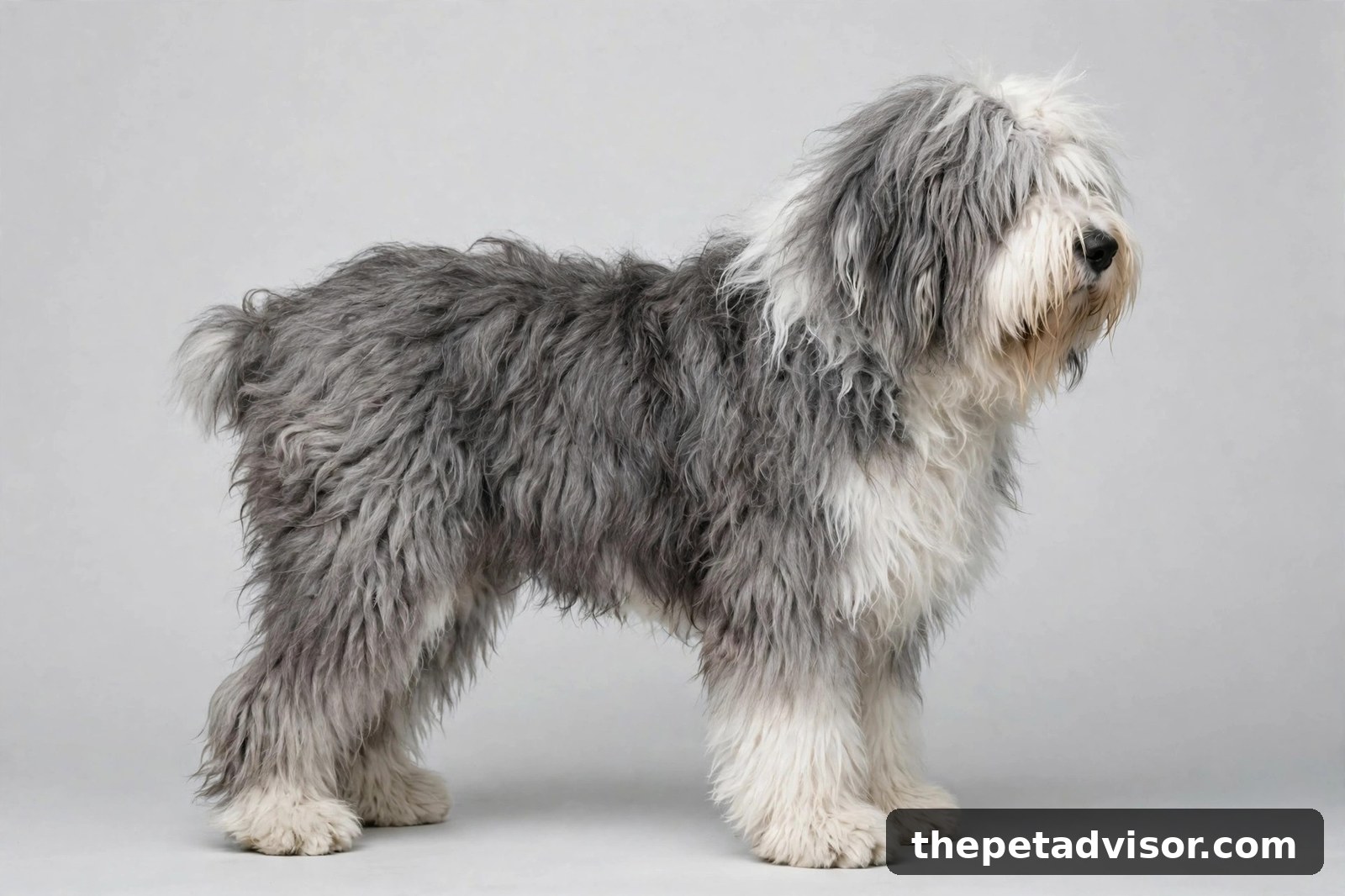
Do you have a photo of an Old English Sheepdog in the American show ring? We’d love this page to lead with one. If you have a show photo you’d let us use, email it to [email protected] — tell us the dog’s name and the show, and it may be featured here. Please only send photos you took yourself or have the photographer’s permission to share, and tell us the photographer’s name. We couldn’t find a public photo of an Old English Sheepdog in the American show ring that we were free to share, so the photo leading this page was made with AI. We’d much rather lead with a real one — if you’re a club member with an approved photo, we’d love to feature it.
1. Breed at a glance
Herding — recognized by the AKC in 1888
Dogs 22 in and up, bitches 21 in and up at the shoulder. Weight 60 to 100 lb.
Profuse, shaggy double coat. Any shade of gray, grizzle, blue, or blue merle, with or without white markings.
Adaptable, intelligent, even disposition. No sign of aggression, shyness, or nervousness.
10 to 12 years.
Size, coat, and temperament facts are from the AKC standard. Weight (60 to 100 pounds) and lifespan (10 to 12 years) are the breed’s commonly published figures (AKC Old English Sheepdog breed page; Wikipedia, Old English Sheepdog).
2. History
The Old English Sheepdog comes from the drovers’ dogs of the southwest of England. In the early 19th century a bobtailed drovers’ dog, called the Smithfield or Cotswold Cor, was noticed in the southwestern counties, and most fanciers agree the Bearded Collie was among the original stock used in developing today’s breed. The dog was at first called the “Shepherd’s Dog” and was exhibited for the first time at a show in Birmingham, England, in 1873 — three entries, and the judge felt the quality so poor that he offered only a second placing. (Source: Wikipedia, Old English Sheepdog.)
The breed was exported to the United States in the 1880s, and the AKC recognized it in 1888. The Old English Sheepdog Club of America was founded in 1904 by English breeder Henry Arthur Tilley, and earned AKC recognition as the parent club one year later, in 1905. (Sources: Wikipedia, Old English Sheepdog; OESCA Illustrated Standard.)
The breed has won Best in Show at Westminster twice: Ch. Slumber in 1914 and Ch. Sir Lancelot of Barvan in 1975. Bugaboo’s Picture Perfect was Reserve Best in Show in 2013, and at the 2026 Westminster Kennel Club Dog Show, GCHB CH Bugaboo’s Give Me Smore’ — “Graham” — won the Herding Group. (Sources: Wikipedia, Old English Sheepdog; Westminster Kennel Club, Old English Sheepdog breed results.)
3. The standard and why it’s written that way
- Strong, compact, square, balanced. The standard opens with the whole dog: “A strong, compact, square, balanced dog. Taking him all around, he is profusely, but not excessively coated, thickset, muscular and able-bodied. These qualities, combined with his agility, fit him for the demanding tasks required of a shepherd’s or drover’s dog. Therefore, soundness is of the greatest importance.” (Source: AKC standard.)
- Size — type before size. “Type, character and balance are of greater importance and are on no account to be sacrificed to size alone.” Height, measured from the top of the withers to the ground: dogs 22 inches and upward, bitches 21 inches and upward. Length, from point of shoulder to point of ischium, is practically the same as the height. “Absolutely free from legginess or weaselness.” (Source: AKC standard.)
- The topline is the tell. “Stands lower at the withers than at the loin with no indication of softness or weakness. Attention is particularly called to this topline as it is a distinguishing characteristic of the breed.” The body is rather short and very compact, broader at the rump than at the shoulders, with a very stout, gently arched loin. (Source: AKC standard.)
- Head and eyes. The eyes are brown, blue, or one of each: if brown, very dark is preferred; if blue, a pearl, china, or wall-eye is considered typical; an amber or yellow eye is most objectionable. The nose is always black, large, and capacious. The teeth are strong, large, and evenly placed, and the bite is level or tight scissors. “Attention is particularly called to the above properties as a long, narrow head or snipy muzzle is a deformity.” (Source: AKC standard.)
- Coat — profuse, hard, shaggy. “Profuse, but not so excessive as to give the impression of the dog being overly fat, and of a good hard texture; not straight, but shaggy and free from curl. Quality and texture of coat to be considered above mere profuseness. Softness or flatness of coat to be considered a fault.” The undercoat is a waterproof pile when not removed by grooming or season. “Neither the natural outline nor the natural texture of the coat may be changed by any artificial means except that the feet and rear may be trimmed for cleanliness.” (Source: AKC standard.)
- Color — the grey family only. “Any shade of gray, grizzle, blue or blue merle with or without white markings or in reverse. Any shade of brown or fawn to be considered distinctly objectionable and not to be encouraged.” (Source: AKC standard.)
- Tail and gait. The tail is “docked close to the body, when not naturally bob tailed.” Gait: “When trotting, movement is free and powerful, seemingly effortless, with good reach and drive, and covering maximum ground with minimum steps. Very elastic at a gallop. May amble or pace at slower speeds.” Temperament: “An adaptable, intelligent dog of even disposition, with no sign of aggression, shyness or nervousness.” (Source: AKC standard.)
4. Temperament & living with one
The AKC sums the breed up in a sentence: the Old English Sheepdog is “the archetypical shaggy dog, famous for his profuse coat and peak-a-boo hairdo, a distinctive bear-like gait, and a mellow, agreeable nature” and “a big, agile dog who enjoys exploring and a good romp.” That is the drover’s dog in a pet’s life: bred to manage sheep and cattle and drive them to market, it is a working dog that needs exercise, training, and something to do, and it is at its best with an owner who gives it all three. (Sources: AKC Old English Sheepdog breed page; Wikipedia, Old English Sheepdog.)
What that means in practice is a large, strong, intelligent dog under a coat that hides its eyes and a fair amount of its intentions. Puppies are born black and white, and it is only after the puppy coat has been shed that the more common grey or silver shaggy hair appears. The breed is famous well beyond the show ring: it has been the Dulux paint mascot — the “Dulux dog” — since a 1961 advertising campaign, and it starred in Disney’s The Shaggy Dog films. (Source: Wikipedia, Old English Sheepdog.)
5. Grooming
- Brush thoroughly, and often. The coat is profuse and shaggy over a waterproof undercoat, and it mats if it is neglected — regular, thorough brushing down to the skin is the routine, not an occasional chore. The hair over the eyes is part of the look; keep it clean and out of the food and water bowls as best you can. (Source: AKC standard.)
- The shaved option is real — even at the national. The 2026 national specialty offered Shaved Coat dog and bitch classes, and the standard permits trimming the feet and rear for cleanliness — a shorter clip is a legitimate choice for a pet, even though it gives up the show silhouette. (Sources: 2026 OESCA National Specialty premium list; AKC standard.)
- Not a wash-and-go breed. Bathing and drying a heavy double coat takes real time, and so does keeping the beard and the hair around the eyes clean. Budget for that time, or for a groomer who knows the breed — and expect the puppy coat change, from black and white to grey or silver, to be the messiest year of all. (Sources: Wikipedia, Old English Sheepdog; AKC standard.)
6. Health testing
- Five tests for a CHIC number. The Old English Sheepdog Club of America participates in the AKC’s Canine Health Information Center program. For an Old English Sheepdog to earn a CHIC number, it must have a hip evaluation (OFA or PennHIP, not before 2 years of age), an eye examination by a boarded ACVO ophthalmologist (recommended each year until 5, thereafter every 2 years, results registered with OFA), an autoimmune thyroiditis evaluation from an approved laboratory (recommended annually up to 5 years of age, and every 2 years thereafter), an EIC (Exercise Induced Collapse) DNA test (required as of August 1, 2016), and an MDR1 multiple drug sensitivity DNA test (required as of 2026). Breeders must agree to have all test results, positive or negative, published in the CHIC database. (Source: OESCA, Health Registries (CHIC).)
- Optional but recommended. OESCA also recommends cardiac screening, BAER (hearing) testing for congenital deafness, a cerebellar degeneration DNA test, and a primary ciliary dyskinesia (PCD) DNA test. (Source: OESCA, Health Registries (CHIC).)
- Hip dysplasia heads the watch list. An American study of dogs at veterinary teaching hospitals found hip dysplasia in 11.1% of Old English Sheepdogs examined, against 3.52% overall; another American study of over a million hip evaluations in dogs over 2 years of age found a prevalence of 17.8% in the breed. None of this is a reason not to own an Old English Sheepdog. All of it is a reason to buy from a breeder who tests: ask for the parents’ CHIC numbers and look the results up in the OFA database yourself, rather than taking a breeder’s word for it. (Source: Wikipedia, Old English Sheepdog.)
- Bloat, thyroid, deafness, and drug sensitivity. The breed is predisposed to gastric dilatation-volvulus (bloat), with an odds ratio of 4.8 in one review of cases; autoimmune thyroiditis is common enough to be a core CHIC screening target; deafness is screened by BAER testing; and the breed is one of the more commonly affected by the MDR1 gene mutation, which makes common drugs such as doramectin and ivermectin cause neurotoxicity at volumes that are otherwise safe. Lifespan is 10 to 12 years; a 2024 UK study found a life expectancy of 12.1 years for the breed. (Sources: Wikipedia, Old English Sheepdog; OESCA, Health Registries (CHIC).)
7. The annual Old English Sheepdog specialty dog show
A specialty is the breed’s All-Star show — its Super Bowl. Once a year, the best Old English Sheepdogs from across the country, and often from around the world, come together in one place.
The Old English Sheepdog Club of America’s national specialty: a full week at the Founders Inn and Spa in Virginia Beach, Virginia, with the conformation specialty at its center and herding, agility, obedience, rally, sweepstakes, and the annual meeting and banquet around it. The 2026 week: October 3–9, with conformation October 8–9.
National Specialty week: Saturday to Friday, October 3–9, 2026, at the Founders Inn and Spa, 5641 Indian River Road, Virginia Beach, Virginia — herding and Farm Dog on Saturday, October 3, at Not Quite Right Farm, Pittsboro, North Carolina; agility on Sunday, October 4, and obedience and rally on Monday, October 5, at Merrimac Dog Training Club, Hampton, Virginia; three regional specialties on Tuesday, October 6 (two shows), and Wednesday, October 7; then the national specialty itself on Thursday, October 8 (Puppy and Veteran Sweepstakes, dog classes, Shaved Coat Dogs, Herding Titled Dogs) and Friday, October 9 (bitch classes, Shaved Coat Bitches, Herding Titled Bitches, Best of Breed). Entry: 70 dogs (33 dogs, 37 bitches); 75 entries and 70 competitors across the event. Show Chair: Cheryl Tavares. Superintendent: MB-F, Inc. (Sources: 2026 OESCA National Specialty premium list; AKC event search, event 2026200810.)
National specialty judges: Mrs. Jane Collen — all regular classes and Best of Breed (provisional/permit judge). Ms. Marilyn Marshall — Sweepstakes and Veteran Sweepstakes. Ms. Sally J. Carr — Junior Showmanship and the 4 & Under 6 Months Puppy Competition. Best Junior Handler: Leela Werner. (Sources: 2026 OESCA National Specialty premium list; AKC event search, event 2026200810.)
Results (official, parent club). Best of Breed: Achtung Baby of Reality Dream ATT FDC CGC CGCA CGCU TKN (“Wonka,” of Fort Worth, Texas; owners Gigi Goesling, Alain LaBous, and Michele Parker; breeder Alain Labous and Valerie Labous). (Sources: OESCA, Past National Specialty Winners; Old English Sheepdog Club of America.)
Results note. Best of Breed is confirmed by the parent club; Best of Opposite Sex, Winners Dog, and Winners Bitch had not been published in an official source as of November 7, 2026, and will be added here when they are.
The 2027 national specialty is announced for Wilmington, Ohio; the dates had not been announced as of November 2026.
Old English Sheepdog Club of America
8. Regional specialties through the year: smaller regional shows
The national is the anchor, but the breed’s year also runs through regional specialties held by the Old English Sheepdog Club of America’s regional clubs — the Old English Sheepdog Club of Greater Seattle, the Old English Sheepdog Club of Southeastern Wisconsin, the Old English Sheepdog Club of Southern California, the Old English Sheepdog League of Northern California, the Twin Cities Old English Sheepdog Club, the Twin Colonies Old English Sheepdog Club of Northern New Jersey, the Greater Pittsburgh Old English Sheepdog Club, the Greater Portland Old English Sheepdog Club, and the Chicagoland Old English Sheepdog Club. These are the 2027 regionals verified from club sources so far:
No regional specialties announced yet for 2027.
More regional specialties will be added here as their programs are verified — this section is built from show data, not guesswork. Browse upcoming show weekends →
9. Clubs
- Old English Sheepdog Club of America (parent club) — the AKC parent club for the breed in the United States, founded in 1904. It runs the national specialty, held in Virginia Beach, Virginia in 2026. President Sally Carr, Show Chair Cheryl Tavares (2026), AKC delegate Wendi Freedman.
- Regional specialty clubs. The breed’s regional AKC specialty clubs are the Old English Sheepdog Club of Greater Seattle, the Old English Sheepdog Club of Southeastern Wisconsin, the Old English Sheepdog Club of Southern California, the Old English Sheepdog League of Northern California, the Twin Cities Old English Sheepdog Club, the Twin Colonies Old English Sheepdog Club of Northern New Jersey, the Greater Pittsburgh Old English Sheepdog Club, the Greater Portland Old English Sheepdog Club, and the Chicagoland Old English Sheepdog Club. (Sources: AKC club search; 2026 OESCA National Specialty premium list.)
If you are new to the breed, the national specialty itself is the better first stop than a breeder’s website: the people there have owned, shown, and worked Old English Sheepdogs, and they will tell you the truth about the coat before you fall for a puppy.
10. Rescue
- Start with the parent club’s rescue contact. The AKC Rescue Network lists the Old English Sheepdog Club of America’s rescue contact (Jeanne Conkright, Montgomery, Texas) for Old English Sheepdogs needing a new home. (Source: AKC Rescue Network, O breeds.)
- New England Old English Sheepdog Rescue. New England Old English Sheepdog Rescue (NEOESR) is the largest Old English Sheepdog rescue group in the nation: established in 1994, it has helped more than 2,000 Old English Sheepdogs find new homes. Every dog is fostered in a private home — NEOESR operates no kennel — and adoption runs through an application to its placement team. (Sources: NEOESR, About Us; NEOESR.)
- In the Southeast. The Old English Sheepdog Rescue Network of the Southeast is the not-for-profit rescue for unwanted Old English Sheepdogs in the southeastern United States, with foster-to-adopt available. (Source: Old English Sheepdog Rescue Network of the Southeast.)
- Adults and seniors. An adult or senior Old English Sheepdog can be a wonderful companion, often already housetrained and past the worst of the puppy coat change, and ready to bond with a new family. Rescue groups publish available dogs on their sites and run an application-based adoption process, matching the dog’s temperament and needs to the household. If you bought your Old English Sheepdog from a responsible breeder, contact the breeder first — most responsible breeders include a take-back clause in their contracts and want to know if the dog needs help.
11. Breeder vs. rescue: honest guidance
- If you buy: start with the parent club, the Old English Sheepdog Club of America, and its breeder directory — only breeders who have signed the club’s Code of Ethics are listed. Ask for the parents’ CHIC numbers — hips, eyes, thyroid, EIC, and MDR1 — and look the results up in the OFA database yourself. A good breeder will have the answers, will ask you as many questions as you ask them, and will take the puppy back for its whole life if you cannot keep it.
- If you rescue: a rescued Old English Sheepdog is usually an adult, often one whose owner underestimated the coat and the size, and it will arrive with a full-grown appetite for exercise and attention. What you get in return is a dog whose temperament and coat you can see before you commit and a lower price. Either way, be honest with yourself first: an Old English Sheepdog needs regular thorough brushing, daily exercise, and an owner who finds a shaggy, bear-like housemate charming rather than exasperating. It is not a dog for a household that wants a wash-and-go companion.
- No rare color worth a premium. One thing that is not what a seller tells you: there is no such thing as a rare color worth a premium. The standard names one color family only — any shade of gray, grizzle, blue, or blue merle, with or without white markings — and any shade of brown or fawn is “distinctly objectionable and not to be encouraged.” The standard also describes one size only, 22 inches and up for dogs and 21 inches and up for bitches, with no miniature variety. A breeder selling a “rare” brown or fawn Old English Sheepdog, or a “mini” one, at a premium is selling you a label.
12. Claim this page
This page belongs to the breed, and the people who know the breed best are the Old English Sheepdog Club of America and its members. If you are with the parent club — or you are a breeder, a judge, a handler, or a rescue volunteer who spotted something wrong, missing, or out of date — this page is yours to set straight. Tell us what needs fixing and where the correction is documented, and we will fix it and credit the source. Contact the site through the About page, and mention “Old English Sheepdog breed profile.”
Sources
- AKC Old English Sheepdog breed page — akc.org/dog-breeds/old-english-sheepdog
- AKC Old English Sheepdog breed standard (approved February 10, 1990) — images.akc.org/pdf/breeds/standards/OldEnglishSheepdog.pdf
- Old English Sheepdog Club of America — oldenglishsheepdogclubofamerica.org
- OESCA, Health Registries (CHIC) — oldenglishsheepdogclubofamerica.org/about-us/health-registries
- OESCA, Past National Specialty Winners — oldenglishsheepdogclubofamerica.org/general-info/national-specialty-winners
- 2026 OESCA National Specialty premium list — thepetadvisor.com/assets/premiums/2026-specialties/old-english-sheepdog-club-national-2026-premium.pdf
- 2026 National Specialty, AKC event search, event 2026200810 (official results) — apps.akc.org/apps/events/search/index_results.cfm
- OESCA 2027 National, Wilmington, Ohio — oescanational.com
- AKC Upcoming National Specialties — apps.akc.org/apps/events/conformation/national_specialties.cfm
- Wikipedia, Old English Sheepdog (history, Westminster wins, health studies, Dulux dog) — en.wikipedia.org/wiki/Old_English_Sheepdog
- OESCA Illustrated Standard (club founded 1904 by Henry Arthur Tilley) — 1library.net/document/y91epkwq-nov-approved-bod-oesca.html
- Westminster Kennel Club, Old English Sheepdog breed results — westminsterkennelclub.org/results-breed
- AKC Rescue Network, O breeds (OESCA rescue contact) — akc.org/akc-rescue-network/rescue-network-o-breeds
- New England Old English Sheepdog Rescue — neoesr.org
- Old English Sheepdog Rescue Network of the Southeast — oesrescuenetwork.org
- AKC club search (Old English Sheepdog specialty clubs) — apps.akc.org/apps/club_search/search/index.cfm?clubs=O