
Breed profile · Sporting Group · the smallest of the retrievers
Nova Scotia Duck Tolling Retriever
The Nova Scotia Duck Tolling Retriever is the smallest of the AKC’s retrievers — a medium-sized red gundog from Nova Scotia that lures ducks within gunshot range by playing along the shoreline, then retrieves them from icy water. The Nova Scotia Duck Tolling Retriever Club (USA) runs the national specialty every year, and the 2026 national ran September 14–19 at Yellowstone Dog Sports in Roberts, Montana.
Help us improve it. This is one of ThePetAdvisor’s breed profiles, built from public sources with generous links to the people who actually own this breed’s knowledge. If something’s off or missing, the parent club can claim the page and set it straight — see the bottom of the page.
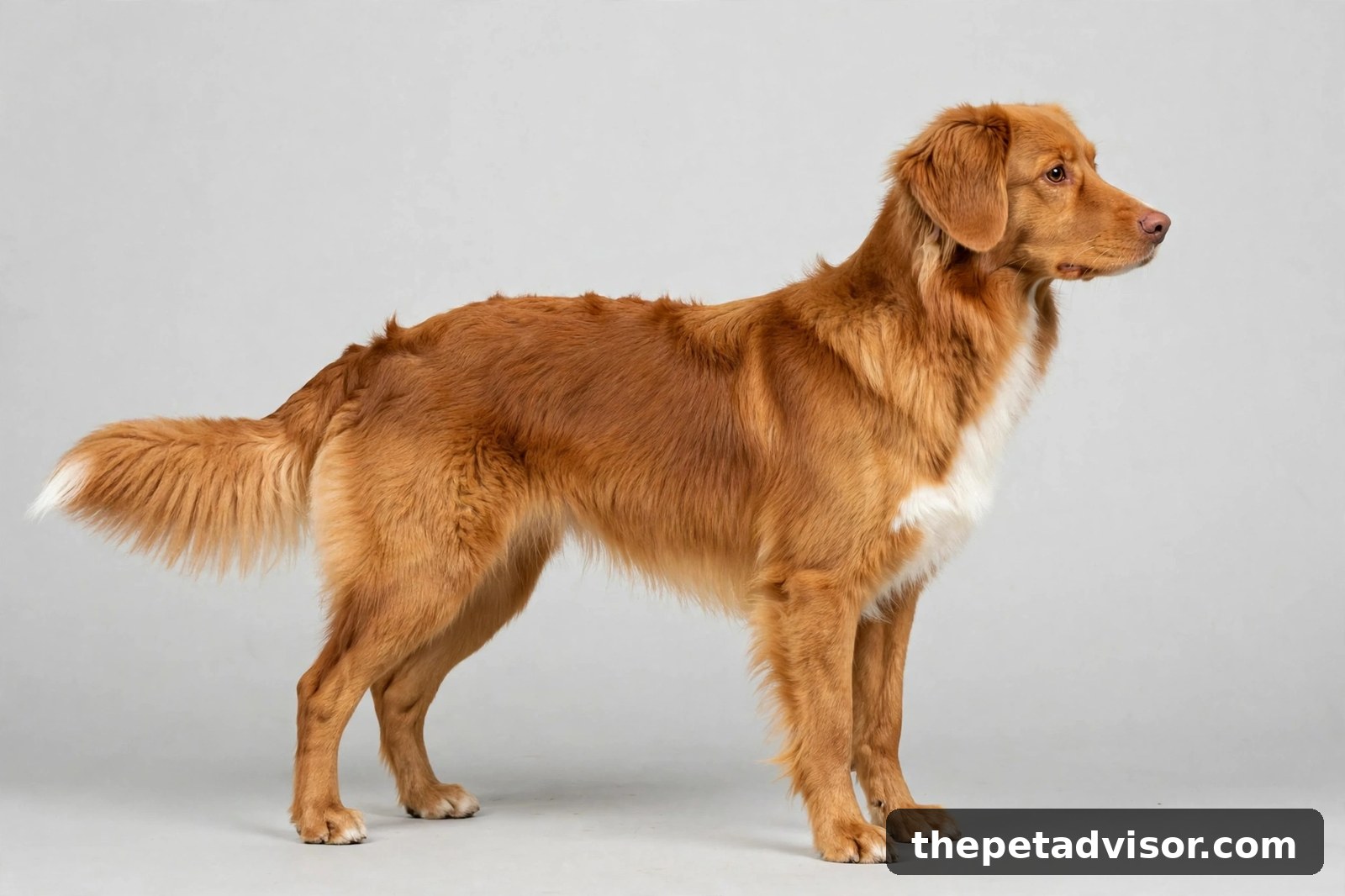
Do you have a photo of a Nova Scotia Duck Tolling Retriever in the American show ring? We’d love this page to lead with one. If you have a show photo you’d let us use, email it to [email protected] — tell us the dog’s name and the show, and it may be featured here. Please only send photos you took yourself or have the photographer’s permission to share, and tell us the photographer’s name. We couldn’t find a public photo of a Nova Scotia Duck Tolling Retriever in the American show ring that we were free to share, so the photo leading this page was made with AI. We’d much rather lead with a real one — if you’re a club member with an approved photo, we’d love to feature it.
1. Breed at a glance
Sporting Group; AKC-recognized since 2003
17–21 in, 35–50 lb
Water-repellent double coat; any shade of red, with white markings
12–14 years (AKC)
Highly intelligent, alert, outgoing, ready for action
Nova Scotia Duck Tolling Retriever Club (USA)
2. History: the little red decoy dog
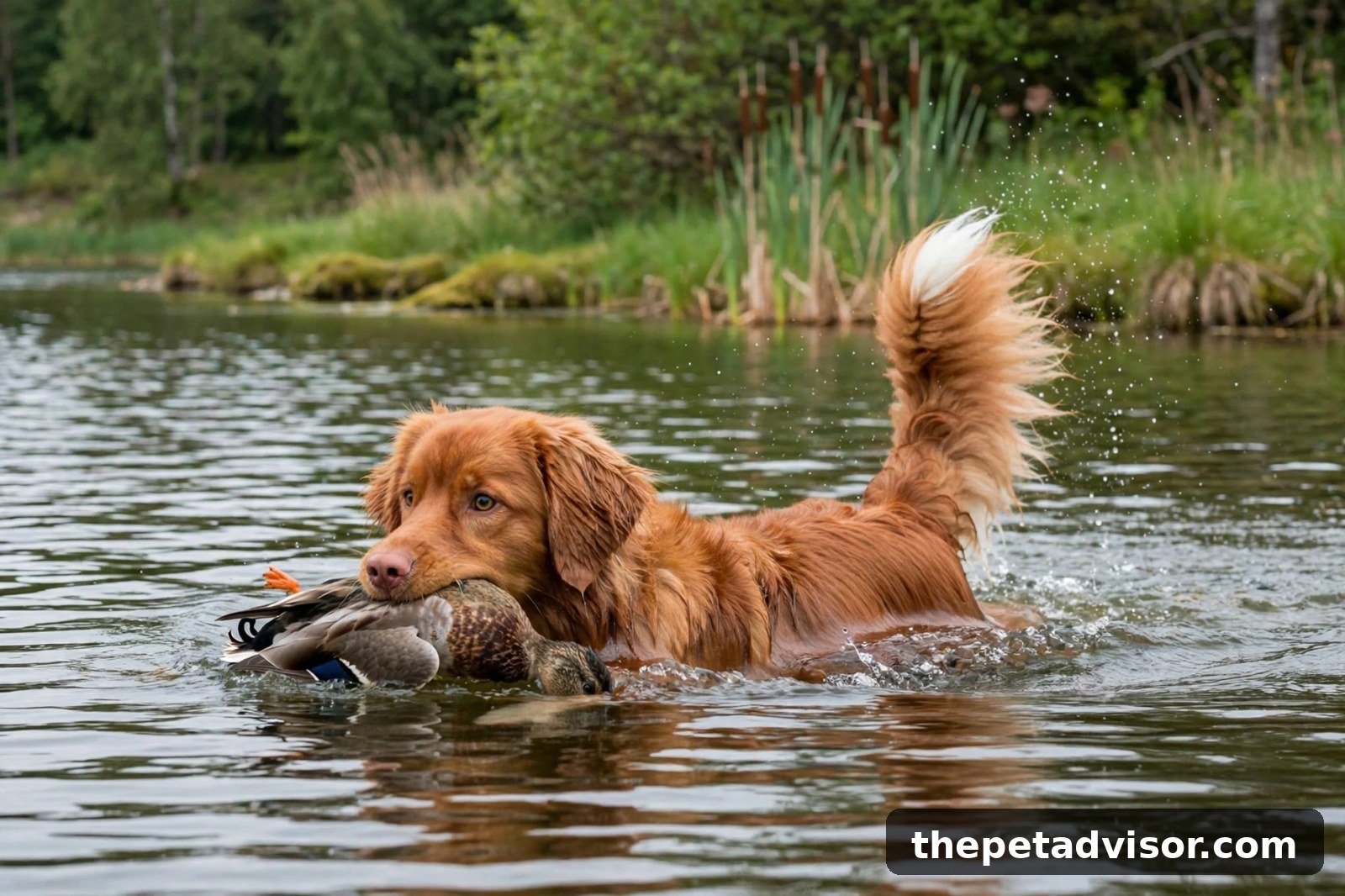
The Nova Scotia Duck Tolling Retriever was developed in the early 19th century in the Little River District of Yarmouth County, Nova Scotia, to toll, lure, and retrieve waterfowl. It was originally known as the Little River Duck Dog, or Yarmouth Toller. The method is the breed’s namesake: the dog’s playful action retrieving a stick or ball along the shoreline arouses the curiosity of the ducks offshore; they are lured within gunshot range, and the dog is then sent out to retrieve the dead or wounded birds.
The Canadian Kennel Club recognized the breed in 1945, and in 1955 the Toller was named the official provincial dog of Nova Scotia. The breed nearly vanished all the same: in 1973 it was reported to be “presently in danger of extinction as a pure breed,” less than 30 years before AKC recognition. The United Kennel Club recognized the breed on January 1, 1987, in the Gun Dog Group.
In the United States the breed found its home in the Nova Scotia Duck Tolling Retriever Club (USA), formed in October 1984. Under a special arrangement with the Canadian Kennel Club dated March 21, 1986, the club was permitted to maintain its own American registry, with a promise to apply for AKC recognition by 1997. The club held its first Independent Specialty in 1989. The AKC accepted the breed into the Miscellaneous Class on June 11, 2001, and the AKC Board, at its January 2003 meeting, approved the breed as eligible to compete in the Sporting Group at all events held on or after July 1, 2003 — the 150th breed admitted to the AKC registry, and the breed with the longest name in the AKC Stud Book, at 35 characters and spaces.
The breed’s biggest recent moments belong to one dog. GCHB CH Roaneden’s Shorelander (“Luca”), breeder/owner/handler Christine and Rob Jones of Roaneden, was the first Toller ever to place in the Sporting Group at Westminster — third in the Sporting Group at the 150th Westminster Kennel Club Dog Show in February 2025 — and won Best of Breed at Westminster in 2023 and 2025. He was also the first Toller ever to place in the group at the AKC National Championship, in Orlando in December 2022. Roaneden credits Luca with five Best of Breed wins at Westminster, and calls him Canada’s top winning Toller of all time.
3. The standard: the smallest of the retrievers
The AKC standard was approved June 11, 2001, and effective September 1, 2001. It describes a dog “developed in the early 19th century to toll, lure, and retrieve waterfowl” — a “medium sized, powerful, compact, balanced dog” that “is the smallest of the retrievers.” The attitude and bearing “suggest strength with a high degree of agility,” and the dog is “alert, determined, and quick, with a keen desire to work and please.” Many Tollers have a slightly sad or worried expression when they are not working; the moment retrieving is indicated, they set themselves for springy action with an expression of intense concentration and excitement.
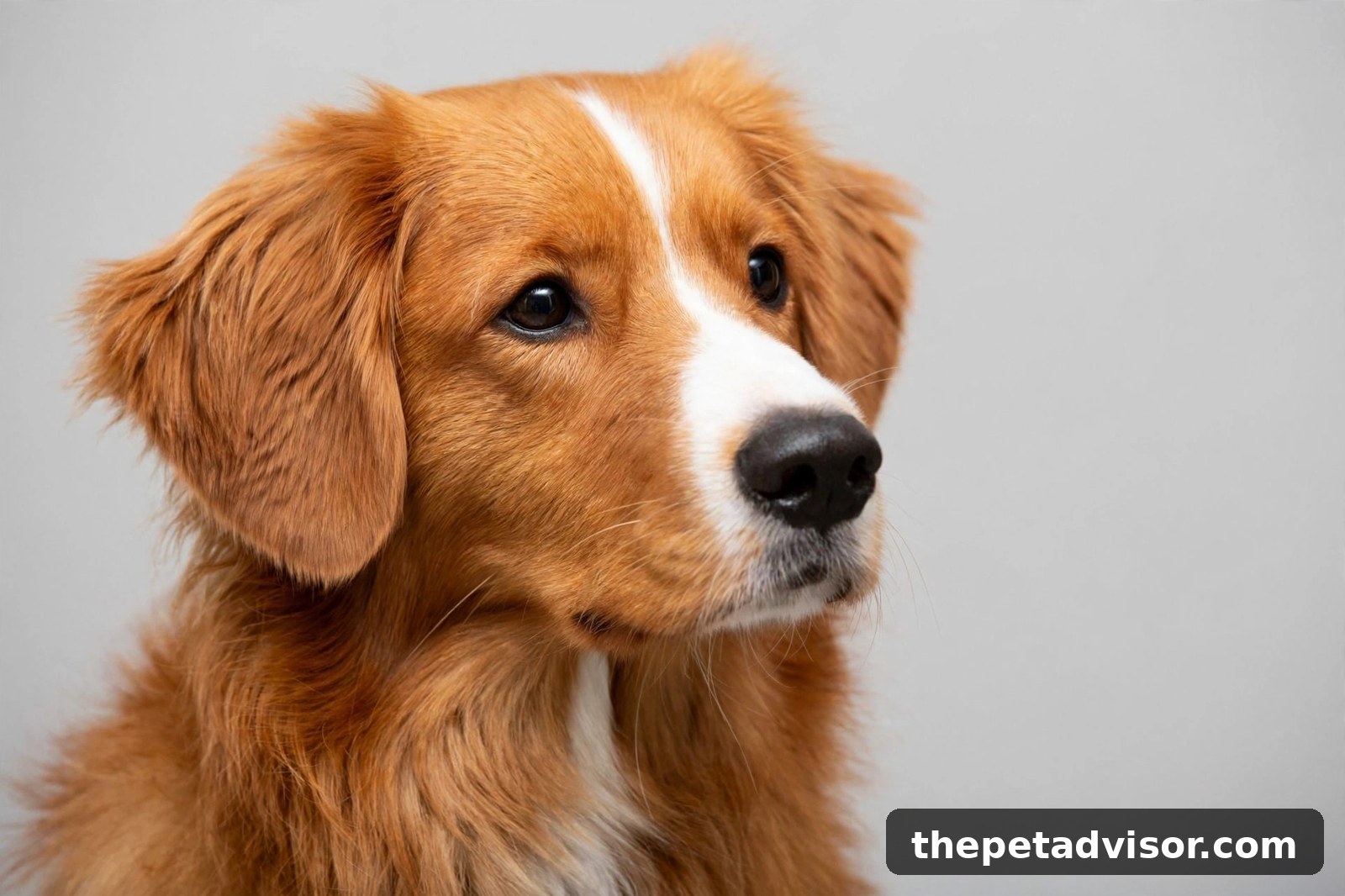
Size. Males 18 to 21 inches at the withers, the ideal 19 inches; females 17 to 20 inches, the ideal 18 inches. Bone is medium, and weight is in proportion to height and bone — the AKC lists 35 to 50 pounds. The length should be slightly longer than height, in a ratio of 10 to 9, but should not give the impression of a long back.
Head. The head is clean-cut and slightly wedge-shaped, with a broad skull only slightly rounded. The eyes are set well apart, slightly oblique and almond in shape, with the color blending with the coat or darker; large round eyes are a fault. The ears are high set, triangular with rounded tips, set well back on the skull, framing the face, and carried in a drop fashion. The nose is fairly broad with the nostrils well open, and the color should blend with that of the coat, or be black; a bright pink nose is a fault. The bite is tight scissors, and full dentition is required.
Tail. The tail follows the natural very slight slope of the croup, is broad at the base, and is luxuriant and well feathered, with the last vertebra reaching at least to the hock. It may be carried below the level of the back except when the dog is alert, when it is held high in a curve, though never touching the body. A tail too short, kinked, or curled over touching the back is a fault.
Coat and color. The Toller was bred to retrieve from icy waters and must have a water-repellent double coat of medium length and softness, with a soft dense undercoat; the coat may have a slight wave on the back, but is otherwise straight. Seasonal shedding is to be expected, and while neatening of the feet, ears, and hocks for the show ring is permitted, the Toller should always appear natural, never sculpted. The color is any shade of red, ranging from a golden red through dark coppery red, with lighter featherings on the underside of the tail, pantaloons, and body. White markings are usually at least one of the tip of the tail, the feet (not extending above the pasterns), the chest, and a blaze; a dog of otherwise high quality is not to be penalized for lack of white.
Disqualifications. There are six: butterfly nose; undershot bite; wry mouth; overshot by more than one-eighth inch; rear dewclaws; a brown coat, black areas in the coat, or buff (buff is bleached, faded, or silvery); and white on the shoulders, around the ears, back of the neck, or across the flanks.
4. Temperament: intelligent, alert, and ready for action
The standard calls the Toller “highly intelligent, alert, outgoing, and ready for action, though not to the point of nervousness or hyperactivity,” and adds that he is “affectionate and loving with family members and is good with children, showing patience.” Some individuals may display reserved behavior in new situations, but this is not to be confused with shyness — shyness in adult classes should be penalized. The breed’s “strong retrieving desire coupled with his love of water, endurance and intense birdiness, is essential for his role as a tolling retriever.”
A Toller bonds hard to its people and is famously intense about its work — clever, driven, and always in motion. But it is a working retriever first: it was bred to toll and retrieve all day, and it still wants to. It needs a job every day — retrieving, swimming, field work, agility, or long walks with training built in. A Toller with work is a happy, affectionate house dog; one with nothing to do will invent its own work, usually at the expense of the yard and the neighbors’ patience.
The everyday reality is a medium-sized dog with a very large engine: alert, determined, and quick, with a retrieving drive that does not switch off. It needs a fenced yard, a patient owner who trains with consistency, and water to work in whenever possible. It is not a dog for a sedentary household, and it is not a dog that tolerates being left alone all day.
5. Grooming and everyday care
Grooming is straightforward but regular. The water-repellent double coat sheds seasonally, so brush weekly to keep dead hair down and bathe only when the dog is dirty. Check the drop ears, trim the nails, and brush the teeth. For the show ring, neatening of the feet, ears, and hocks is permitted — but the Toller should always appear natural, never sculpted, and overcoated specimens are faulted.
Exercise is the hard part, and it is non-negotiable: daily vigorous exercise plus a job — retrieving and swimming are ideal, with field work, agility, or nose work as good seconds, plus training. The AKC puts the energy level plainly: play fetch with a tireless Toller until your right arm falls off, and he will ask you to throw left-handed. A fenced yard is close to essential, and access to water makes a real difference to this breed’s happiness.
Feeding is straightforward: a good-quality food, measured meals, and a lean weight at 35 to 50 pounds. A medium-sized dog that works hard eats more than it looks like it should — measure the food, count the treats, and keep the dog lean.
6. Health: the tests that matter
The Nova Scotia Duck Tolling Retriever Club (USA)’s CHIC profile calls for seven tests for breeding stock: a hip evaluation, a cardiac exam, an ophthalmologist eye evaluation, a cleft palate and syndactyly (CP1, CLPS) DNA test, a progressive retinal atrophy, prcd (PRA-prcd) DNA test, a juvenile Addison’s disease (JADD) DNA test, and a buff genetic test DNA test. A CHIC number means the tests were done and published by the OFA — it does not mean the dog passed them. Ask for the parents’ CHIC numbers and look them up yourself on the OFA database.
The tests point at the breed’s known weak spots. The DNA tests screen for inherited conditions the breed community tracks closely: cleft palate and syndactyly, progressive retinal atrophy, juvenile Addison’s disease, and the buff coat fault, which is a disqualification. Breeders also commonly test for Collie eye anomaly, congenital deafness, and degenerative myelopathy, and autoimmune conditions — Addison’s disease and hypothyroidism — are a known breed concern. The AKC lists the breed’s lifespan as 12 to 14 years.
7. The annual Nova Scotia Duck Tolling Retriever specialty dog show
A specialty is the breed’s All-Star show — its Super Bowl. Once a year, the best Nova Scotia Duck Tolling Retrievers from across the country, and often from around the world, come together in one place.
The Nova Scotia Duck Tolling Retriever Club (USA) holds its national specialty every year, and the 2026 national ran September 14–19, 2026, at Yellowstone Dog Sports in Roberts, Montana — a full week of scent work, obedience, conformation, field, and the club’s Tumbleweed and Blaze versatility awards. Best of Breed was GCHB CH Roaneden’s Shorelander (“Luca”), the kennel’s third consecutive American national specialty win. The 2025 national ran September 5–6, 2025, at Purina Farms in Gray Summit, Missouri, where 200 Tollers were entered — the largest national in breed history — and the 2024 national ran October 17–19, 2024, at All Dogs Sports Park in Lodi, California. The 2027 national: not yet announced.
The standard, in brief: a medium-sized, powerful, compact, balanced dog — the smallest of the retrievers — 17 to 21 inches at the withers, slightly longer than tall in a 10-to-9 ratio, with a water-repellent double coat in any shade of red from golden red through dark coppery red, white markings usually on the tail tip, feet, chest, or blaze, and a heavily feathered tail held high in constant motion while working. The temperament is highly intelligent, alert, outgoing, and ready for action — affectionate with family and good with children.
The 2026 NSDTRC (USA) National Specialty — national week September 14–19, 2026, at Yellowstone Dog Sports, 7753 Hwy 212, Roberts, Montana. Scent work opened the week on Monday, September 14 (event 2026608612; judges Deborah Killpack and Steve Detata); the board met on Wednesday, September 15, and the general meeting ran September 16; obedience ran Thursday, September 17 (event 2026608615; judge C L Evans; 47 entries, 39 competitors), with a bingo night and taco-bar dinner that evening, and the Big Sky BBQ and awards closed the week on Saturday, September 19. Event Chair: Terri Krause. Event Secretary: Catherine LeCours (Executive Dog Shows). Official photographer: Sweet Az Productions.
Best of Breed was GCHB CH Roaneden’s Shorelander (“Luca”), breeder/owner/handler Christine and Rob Jones of Roaneden — the kennel’s third consecutive American national specialty win and tenth national specialty win overall. The week also carried the Tumbleweed Award, for versatility across at least three of conformation, field, obedience, rally, agility, scent work, and the Rock the Dock fundraiser, and the Blaze Award for the highest-scoring Master scent work dog.
Results (2026 national). Best of Breed: GCHB CH Roaneden’s Shorelander. The conformation date within the week, the conformation judge, the entry counts, and the other top winners had not been published in an official source as of November 2026 and will be added here when they are.
The dates for the annual 2027 Nova Scotia Duck Tolling Retriever specialty dog show had not been announced as of November 2026. The AKC’s Upcoming National Specialties list, which runs through October 2027, carries no Nova Scotia Duck Tolling Retriever Club (USA) entry. The club’s board was considering an application to hold the 2027 national in Virginia, and the 2027 national judge was chosen by member vote — but neither the location nor the judge had been announced. This page will be updated when the club announces the 2027 national.
Past national specialties: 2025 · 2024
Nova Scotia Duck Tolling Retriever Club (USA) — nationals.nsdtrc-usa.org
8. Regional specialties through the year: smaller regional shows
The national is the anchor, but the breed’s year also runs through regional specialties — smaller regional shows, not the national — held around the country. These are the 2026 regionals verified from club and AKC sources.
- Sunflower Classic, Hutchinson, Kansas — Saturday, June 6, 2026. Specialty at the Kansas State Fairgrounds (event 2026608601; 41 Tollers). Best of Breed: GCHS CH Foxbrooke’s The Mountains Are Calling CGC. Best of Winners and Winners Dog: Mystic’s Knock Your Socks Off. Best of Opposite Sex: CH Wildgrass Grit N Glitter CD RA WCI. Winners Bitch: Redvine’s Love Letters To Shireway. The Sunflower Classic returns June 4–6, 2027.
- Backyard Classic, West Bend, Wisconsin — June 26–28, 2026. Concurrent specialty, 66 entries; sweepstakes 42 entries; juniors 5 entries. Field: 38 entries, 34 dogs started, 16 passed (5 WCX passes). The 2027 Backyard Classic runs July 2–4, 2027, in West Bend.
- Liberty specialty, Ludwigs Corner, Pennsylvania — Saturday, June 13, 2026. Held with the Bryn Mawr Kennel Club at the Ludwigs Corner Horse Show Association Grounds; 911 dogs and 954 entries across the all-breed show.
The Texas Toller Two Step, April 17–19, 2026, ran field tests and fellowship rather than a conformation specialty. A concurrent specialty for June 4–5, 2027, with the Salina and Wichita Kennel Clubs, was approved by the board.
More regional specialties will be added here as their programs are verified — this section is built from show data, not guesswork. Browse upcoming show weekends →
9. Clubs
The Nova Scotia Duck Tolling Retriever Club (USA), formed in October 1984, is the AKC parent club for the breed in the United States. It is the guardian of the breed and determines the official breed conformation standard, runs the national specialty every year, sanctions field tests, and runs the breed’s rescue program. The club’s secretary in 2026 is Terri Krause; Shelby Westmoreland was elected to take the secretary’s role from November 1, 2026. The club’s website is at nsdtrc-usa.org, and the national specialty site is at nationals.nsdtrc-usa.org.
The breed’s country-of-origin club is the Nova Scotia Duck Tolling Retriever Club of Canada, which maintains the breed’s registry in Canada, where the breed was recognized by the Canadian Kennel Club in 1945.
10. Rescue
The Nova Scotia Duck Tolling Retriever Club (USA) runs its own rescue program, coordinated by Janis Dibert, who has worked in the program for 22 years. There were no adoptions in the past year; the program’s current work is two long-term fosters — “Gavin,” fostered by Linda Sullivan with the club paying his medical costs, and “Lauger,” a 12-year-old rescued from a neglect case by Paul Kartes and now also with Linda Sullivan, with the club pledging continued medical support.
Most applicants seek young dogs under five and have often never met a Toller — the coordinator gives each one a “Toller 101” lesson, since many arrive expecting a small Golden Retriever. Expect an application and a match process, and expect an adult dog: puppies are rare in rescue. A rescue Toller comes with a known temperament, placed by people who know the breed extremely well and want the dog in a home prepared for a Toller, not just any home.
11. Breeder vs. rescue: honest guidance
Either route starts with the same question: has this dog’s health been tested? From a breeder, ask for the CHIC numbers of both parents — the hip evaluation, the cardiac exam, the ophthalmologist eye evaluation, and the four DNA tests (cleft palate and syndactyly, PRA-prcd, juvenile Addison’s disease, and buff) — and check them on the OFA database yourself, by the parents’ registered names. Ask what health issues the breeder sees in their stock, and meet at least the dam. A good breeder will ask how much exercise and work you can give a retriever that was built to toll and retrieve all day — and will want to know you have water nearby and a fenced yard.
From rescue, expect an adult dog whose temperament is already known, placed by a program that will match the dog to your life rather than the other way around. Budget for the same things either way: training, exercise, a job for the dog to do, and a vet who knows the breed’s health risks. Whichever route you take, the dog that fits is a medium-sized, red, endlessly energetic retriever that wants work — and will be happiest doing exactly that, with you.
12. Claim this page
This page was built from public sources — the AKC standard, the parent club’s own material, AKC event records, and the rescue program’s records — and it is a starting point, not the last word. If you are with the Nova Scotia Duck Tolling Retriever Club (USA) or a regional club and something here is wrong or missing, you can claim this page and set it straight: email [email protected] and tell us what needs fixing. Corrections from the people who own the breed are how this page gets better.
Sources
- AKC, Nova Scotia Duck Tolling Retriever
- Nova Scotia Duck Tolling Retriever Club of New England, AKC NSDTR Standard
- Symphony Tollers, Breed Standard (approved June 11, 2001; effective September 1, 2001)
- AKC, Sporting Group Health Testing Requirements
- AKC, Upcoming National Specialties list
- AKC, Nova Scotia Duck Tolling Retriever History: Where the Breed Originated
- Furry Critter Network, Toller — Complete Breed Guide
- Nova Scotia Duck Tolling Retriever Club (USA)
- Nova Scotia Duck Tolling Retriever Club (USA), National Specialty
- Nova Scotia Duck Tolling Retriever Club (USA), 2026 board meeting agenda (Yellowstone Dog Sports, Roberts, MT)
- Nova Scotia Duck Tolling Retriever Club (USA), 2024 national specialty premium
- Canadian Dog Fancier, CDF Weekly (Maui wins the 2025 American National Specialty)
- Roaneden
- Roaneden, About
- Westminster Kennel Club, Nova Scotia Duck Tolling Retriever breed results
- AKC event record, NSDTRC (USA) obedience 2026 (event 2026608615)
- AKC event record, NSDTRC (USA) rally 2025 (event 2025608613)