
Breed profile · Working Group · the gentle giant
Newfoundland
The Newfoundland is the gentle giant of the Working Group — a massive, sweet-dispositioned working dog from the island of Newfoundland, bred to haul fishermen’s nets, pull carts, and rescue people from the water. Webbed feet, a water-resistant double coat, and a temperament the standard calls the most important single characteristic of the breed: sweet, patient, and devoted. The AKC recognized the breed in 1886, among its earliest breeds, and the Newfoundland Club of America, founded in 1930, runs the national specialty every spring.
Help us improve it. This is one of ThePetAdvisor’s breed profiles, built from public sources with generous links to the people who actually own this breed’s knowledge. If something’s off or missing, the parent club can claim the page and set it straight — see the bottom of the page.

Do you have a better photo of a Newfoundland in the American show ring? If you have a show photo you’d let us use, email it to [email protected] — tell us the dog’s name and the show, and it may be featured here. Please only send photos you took yourself or have the photographer’s permission to share, and tell us the photographer’s name.
1. Breed at a glance
Working Group; AKC-recognized since 1886
Dogs 28 in, 130–150 lb; bitches 26 in, 100–120 lb
Heavy double, water-resistant; black, brown, gray, or white and black (Landseer)
9–10 years (AKC)
Sweet, patient, devoted; famously gentle with children
Newfoundland Club of America, founded 1930
2. History: the fishermen’s dog
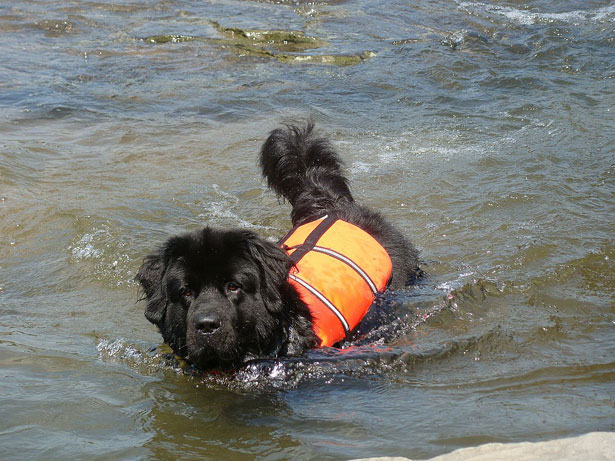
The Newfoundland comes from the island of Newfoundland, off Canada’s east coast, where it worked alongside fishermen for centuries: hauling nets, pulling carts and firewood, carrying lines between boats, and pulling people from the water. The webbed feet, the heavy water-resistant double coat, the great strength, and the calm under pressure are all working tools, shaped by cold water and hard use. The breed’s water-rescue instinct is the real thing — Newfoundlands are still trained and tested in water rescue today, and the parent club runs water tests and draft tests as part of the breed’s working program.

The breed reached the United States early. Seaman, the Newfoundland who traveled with Meriwether Lewis on the Lewis and Clark expedition of 1804–1806, is the most famous early American Newfoundland — a working dog on a working journey, and a reminder of how long the breed has been at Americans’ sides. The American Kennel Club recognized the breed in 1886, among its earliest breeds, and the Newfoundland Club of America was founded in 1930 to preserve, protect, and promote it.
Only two Newfoundlands have ever won Best in Show at the Westminster Kennel Club Dog Show: Ch. Seaward’s Blackbeard in 1984, and Ch. Darbydale’s All Rise Pouch Cove — “Josh” — in 2004, who went on to win his 46th Best in Show that night. Today the breed is a beloved family companion and a fixture of the Working Group, with more than 20 regional clubs across the United States under the parent club.
3. The standard: massive, strong, and sweet
The AKC standard was approved on May 8, 1990, and effective June 28, 1990. It opens with the general appearance: “The Newfoundland is a sweet-dispositioned dog that acts neither dull nor ill-tempered. He is a devoted companion.” And the sentence that governs the whole breed: “Sweetness of temperament is the most important single characteristic of the breed.” Size is dogs 28 inches at the withers and 130 to 150 pounds, bitches 26 inches and 100 to 120 pounds. The dog is massive, heavily boned, and powerful, with a broad head, a short square muzzle, and small dark-brown eyes that are, in the standard’s words, “deeply set and spaced wide apart.”
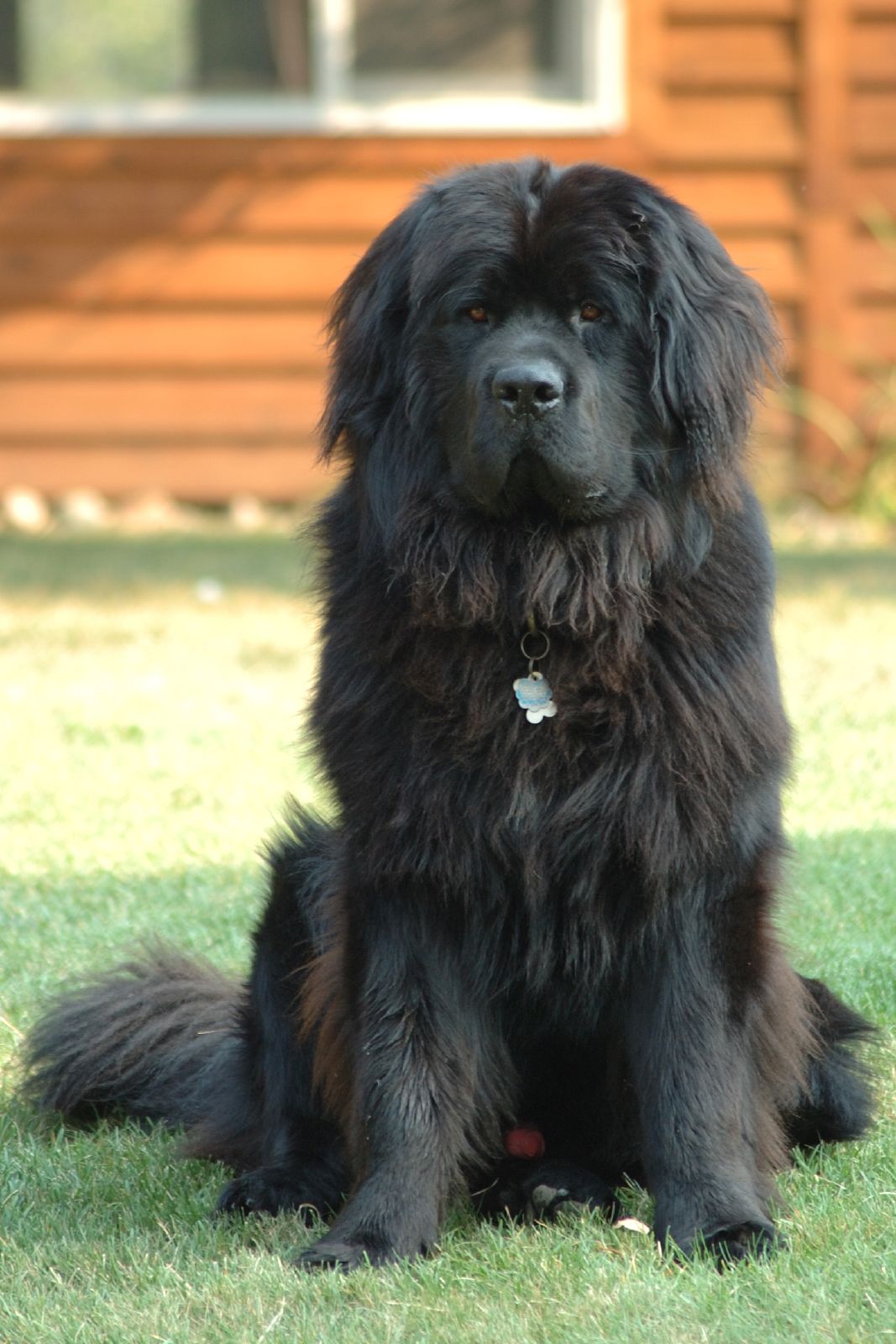

Head and body. The head is massive, with a broad skull, a slightly arched crown, and a well-developed occipital bone. The muzzle is short, square, and clean-cut, with a large black nose on a black dog and a brown nose on a brown dog. The ears are relatively small and triangular, with rounded tips, reaching to the inner corner of the eye when drawn forward. The bite is scissors or level. The neck is strong and well set on the shoulders; the topline is level from the withers to the croup; the chest is deep and broad. The feet are large and webbed — a working feature, not a quirk. The tail is strong, broad at the base, and carried straight out or down, never curled over the back. Movement is free and powerful, with good reach and drive; in the show ring the Newfoundland is gaited at a moderate speed, and the standard asks for a dog that moves with ease and power, not flash.
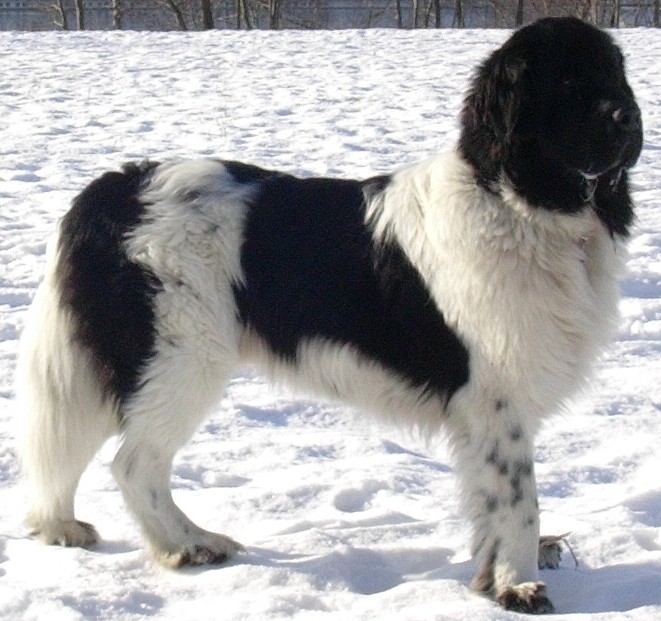
Coat and color. The coat is double: a coarse, flat, water-resistant outer coat and a dense, soft undercoat, the whole coat heavy enough to turn water. Color is black, brown, gray, or white and black — the Landseer, a white base coat with black markings, the head typically solid black with a separate black saddle and black on the rump extending onto a white tail. Solid colors may carry white on the chin, chest, toes, and tip of the tail. Any color or combination of colors not specifically described in the standard is a disqualification. The Landseer is named for the artist Sir Edwin Henry Landseer, who painted the white-and-black dogs; in FCI countries the Landseer is a separate breed, while in AKC countries it is a color variety of the Newfoundland.
4. Temperament: the gentle giant
The standard’s temperament sentence is the whole pitch: sweetness of temperament is the most important single characteristic of the breed. Newfoundlands are calm, patient, and devoted — famously tolerant of children, steady in the house, and gentle in a way that seems out of proportion to their size. They are not guard dogs in the sharp sense: a Newfoundland will stand between its people and trouble, but it does so with a calm confidence rather than with aggression, and the breed is known for thinking before it acts.
That calm is the breed’s charm and its training challenge in equal measure. Newfoundlands are intelligent and willing, and they learn fast — but a 130-pound dog that has not been taught to walk on a loose lead, to wait at a door, or to keep all four feet on the floor is a 130-pound problem. Early, thorough training and socialization are essential: a Newfoundland that meets a wide range of people, dogs, and situations as a puppy grows into the steady, discriminating adult the standard describes. They are generally good with other dogs and with children in the family, best with children who can handle a very large dog, and they are famous for their patience — the breed has been called the gentle giant for good reason.
In the house, expect a dog that wants to be where you are and makes its feelings known quietly rather than noisily — a lean against your leg, a head on your knee, and a presence that fills a room without demanding it. They drool, they shed, and they track water through the house after every drink. Give them a job, a swim, a long walk, and a place beside their people, and they give back a loyalty that is hard to match — calmly, and for as long as they have.
5. Grooming and everyday care
The heavy double coat is the main grooming job: a weekly brushing with a slicker or undercoat rake keeps the steady shedding in check and the coat from matting, and during the spring and fall coat blows, a bath and a good blow-dry help move the undercoat out. The ears should be checked and cleaned regularly, the nails trimmed, and the teeth brushed over a 9- to 10-year life. Drool is a fact of the breed — keep a towel by the door and one by the water bowl.
Exercise is moderate but not optional. This is a powerful working dog that needs daily walks and play, plus training and mental work — and, whenever possible, a swim. Newfoundlands were made for water, and a chance to swim is the best exercise a Newfoundland can get. A securely fenced yard is essential: the prey drive is low, but a Newfoundland that decides to go visiting will go, and a 140-pound dog is hard to stop. Off-leash freedom is earned slowly, and most Newfoundland owners walk on lead for life.
Feeding is straightforward but scaled to a giant dog: a good-quality food, measured meals, and a lean weight. Extra weight makes the joints and the heart work harder, and a Newfoundland that is allowed to get fat is a Newfoundland heading for the vet. Like all deep-chested giant breeds, Newfoundlands are at risk of bloat: a swollen, painful abdomen and unproductive retching is an emergency and a rush to the vet, day or night. Because the breed is large and the coat is thick, watch the weight under the fur — you should be able to feel the ribs without pressing hard.
6. Health: the tests that matter
The Newfoundland Club of America takes part in the Canine Health Information Center (CHIC) program run by the Orthopedic Foundation for Animals, and four tests are required for a CHIC number: hip and elbow radiographs to the OFA, a DNA test for cystinuria, and a heart evaluation — auscultation or echocardiogram — by a board-certified cardiologist. The club also recommends an eye examination by a board-certified veterinary ophthalmologist, a patellar evaluation, and a thyroid blood test. A CHIC number means the tests were done and published by the OFA — it does not mean the dog passed them.
The heart is the breed’s main health story. Newfoundlands are prone to subaortic stenosis, a narrowing below the aortic valve, and to dilated cardiomyopathy, a weakening of the heart muscle — the two cardiac concerns the CHIC heart evaluation exists to catch. Other issues to watch are hip and elbow dysplasia — the two orthopedic tests in the CHIC panel — and cystinuria, a metabolic condition that causes kidney and bladder stones and for which a DNA test is available. Bloat is the emergency every giant-breed owner should know. The AKC lists the breed’s lifespan as 9 to 10 years — short, even for a giant breed, and the reason the testing above matters so much.
7. The annual Newfoundland specialty dog show
A specialty is the breed’s All-Star show — its Super Bowl. Once a year, the best Newfoundlands from across the country, and often from around the world, come together in one place.
The Newfoundland Club of America’s national specialty is a full week, usually in May, built around the conformation show and the breed’s working life: draft tests, water work, obedience and rally, sweepstakes, junior showmanship, and the Top 20/10 showcase. The 2026 national: May 4–10 in Warwick, Rhode Island. The 2027 national: May 15–22 at The Resort at Mt. Hood in Welches, Oregon.
The standard, in brief: a giant working dog — dogs 28 inches at the shoulder and 130 to 150 pounds, bitches 26 inches and 100 to 120 pounds — with a heavy double coat in black, brown, gray, or white and black, the Landseer. Sweetness of temperament is, in the standard’s own words, the most important single characteristic of the breed.
The 2026 National Specialty — Monday, May 4–Sunday, May 10, 2026, at the Crowne Plaza Hotel, 801 Greenwich Avenue, Warwick, Rhode Island 02886. The conformation specialty ran Thursday, May 7–Saturday, May 9 (AKC event 2026194317), with entries closing at noon Eastern Time on Wednesday, April 22, 2026. Event Chair: Sheri Russell. Superintendent: MB-F Inc.
The week ran the full Newfoundland program: the Top 20/10 showcase at the Thursday-evening Yacht Club Lawn Party, draft tests, obedience and rally trials, puppy and veteran sweepstakes, junior showmanship, the 4–6 Month Beginner Puppy competition, the Living Legends parade, the Working Team Relay, and the inaugural Fashion Show.
Results (2026 national). Best of Breed — 17 GCHB CH Bowater’s Love Your Flashy Ways At Annisquam Light. Best of Opposite Sex and Best of Winners — 212 Bowater Evenkeel Heir Apparent. AKC Select Dog — 63 GCHS CH Pouch Cove’s Southwind Jefferson Still Lives At KS. AKC Select Bitch — 196 CH Kodiak Acres The Downeaster CGC TKN FITB. NCA Select Dogs — 129 GCHS CH Dreamhaven’s Sum It Up With Old Bay, 173 GCH CH Tempest I Came To Dance At Kodiak Acres, 91 GCH CH Sugar-Mtn’s Saddle Up For The Ride, and 69 CH Recurve’s Be Unstoppable. NCA Select Bitches — 76 GCHG CH Chateaunewf’s Harmonic Convergence, 152 GCH CH Brandywine Sweet As Tupelo, 8 GCHG CH Timberknolls Queen Of The Court For Seaworthy, and 130 GCHS CH Top Shelf’s Viral Vodka. Best Owner Handled — 35 CH Nakiska’s Beyond The Map STR TKN VHMP. Best Junior Handler — Brynn Moores (age 8); Reserve Best Junior Handler — Lillian Werra (age 11). Best in Sweepstakes — 77 Chateaunewf & Winslet’s Oh My Goodness Gruner; Best of Opposite Sex in sweepstakes — 176 Recurve’s Bowater N Evenkeel Night Crossing. Best Veteran Dog — GCHS CH Oukays Forever Louder Than Words Paramount ’N’ Bowater; Best Veteran Bitch — 94 GCHB CH Tempest’s Truly Madly Deeply Pouch Cove CD BN. Winners Dog was not named in the Saturday results email or the sources checked.
The annual 2027 Newfoundland specialty dog show is announced for Friday, May 15–Saturday, May 22, 2027, at The Resort at Mt. Hood, Welches, Oregon, under the theme “Adventure Awaits.” Hosted by the Newfoundland Club of America and sponsored by the Newfoundland Club of Northern California, the Newfoundland Club of Seattle, and the Pacific Northwest Newfoundland Club. The week runs the National Specialty conformation, a Regional Specialty, sweepstakes, Beginner Puppy, Pee-Wee Handlers, Juniors, obedience, and rally, plus the inaugural NCA National Specialty Art Show on Wednesday, May 19, 2027, in partnership with the AKC Museum of the Dog, and a CHIC Showcase on Friday, May 21.
The judging panel announced by the club: sweepstakes, Julie Siefert; Beginner Puppy and Pee-Wee Handlers, Greg Szynskie; obedience, Richard Lewis; rally, Marina Pavlosky; conformation classes, Denise Castonguay; Juniors and Best of Breed, Sioux Forsyth-Green. Regional specialty: conformation classes and Best of Breed, John Dewing; obedience, Marina Pavlosky; rally, Richard Lewis. The 2027 national had not yet appeared on the AKC’s Upcoming National Specialties list as of November 2026, which runs through October 2027; the dates and venue here are the club’s own announcement.
Past national specialties: 2025 · 2024
Newfoundland Club of America — ncanewfs.org
8. Regional specialties through the year: smaller regional shows
The national is the anchor, but the breed’s year also runs through regional specialties — smaller regional shows, not the national — held around the country, including the regional specialties that run with the national. These are the 2026 regionals verified from club and AKC sources.
Regional Newfoundland specialties verified for 2026:
- Newfoundland Club of America Parent Specialty — Friday, January 2, 2026, Indio, California: Empire Equestrian Park and Polo Field. Judge: G L Andersen. 31 dogs and 39 entries. Best Junior Handler: Lorelei Binnendyk-Payne; Reserve Best Junior Handler: Hailey Gurzenda. (AKC event 2026194301.)
- Newfoundland Club of America designated specialties — Saturday, October 31–Sunday, November 1, 2026, Springfield, Missouri: Missouri Entertainment & Events Center, held with the Tri-State Kennel Club. (AKC events 2026194356/57.)
- Newfoundland Club of America Regional Specialty — Friday, November 6, 2026, Napa, California: Napa Valley Exposition, held with the Wine Country Kennel Club. Entries closed Wednesday, October 21, 2026. Judge unconfirmed.
Other 2026 regional specialties had not been verified from club or AKC sources as of November 7, 2026.
More regional specialties will be added here as their programs are verified — this section is built from show data, not guesswork. Browse upcoming show weekends →
9. Clubs
The Newfoundland Club of America, Inc. (NCA), founded in 1930, is the AKC parent club for the breed in the United States. It maintains the official standard, promotes responsible breeding through its code of ethics, coordinates breed-specific health research through the Newfoundland Health Challenge, runs the national specialty, and supports rescue through the NCA National Rescue Network. The club’s officers for 2026 are President Mary Bylone, First Vice-President Mary Lou Cuddy, Second Vice-President Leah Schlagel, Treasurer Mary L. Price, Corresponding Secretary Lynn Kitch, Recording Secretary Steve Britton, and AKC Delegate Julie Poulin Siefert.
More than 20 regional clubs run the regional specialties and the working life of the breed — water tests, draft tests, and fun days around the country. The club also publishes Newf Tide, its quarterly magazine, and the daily Ebb & Flow news emails that carry the national specialty’s results and announcements.
10. Rescue
The main breed-specific rescue is the NCA National Rescue Network, the coordinated rescue arm of the Newfoundland Club of America Charitable Trust, which provides a safety net for Newfoundlands in need across the United States through volunteer foster homes and more than 20 regional clubs. Contact: ncarescue.org; Rescue Chair: Mary L. Price. The network keeps a waiting list of pre-screened adoptive homes, and placements are subject to a placement agreement that requires the dog to be spayed or neutered and not used for breeding. The AKC Rescue Network also lists Newfoundland rescue contacts.
A rescue Newfoundland is usually an adolescent or adult whose personality is already known, which is a real advantage with a giant breed: you will know how it is with children, with other dogs, and in a home before you commit. Expect an application, references, and a home visit. Ask about hips, elbows, heart, and any history of bloat before you commit, and budget for the vet care a giant, older, or surrendered dog may need. A rescue Newf still needs the same things a puppy does: training, a securely fenced yard, and a household ready for 130 pounds of devoted dog.
11. Breeder vs. rescue: honest guidance
Either route starts with the same question: has this dog’s health been tested? From a breeder, ask for the CHIC numbers of both parents — the hip and elbow radiographs, the cystinuria DNA test, and the cardiologist’s heart evaluation — and check them on the OFA database yourself, by the parents’ registered names. Ask about eye, patella, and thyroid testing too, and ask what health issues the breeder sees in their stock: a responsible breeder tests, and will talk about the breed’s faults as readily as its virtues. Meet at least the dam, and be honest with yourself about the size: this is a dog that will lean on you, drool on you, and take up the whole sofa.
From rescue, expect an adolescent or adult dog whose personality is already known, placed by a network that has vetted the dog and will tell you what it is actually like in a home. Budget for the same things either way: joint and heart care, grooming, food for a giant dog, and vet bills sized to a giant dog. Whichever route you take, the dog that fits is a sweet, patient, devoted companion that wants a place beside its people — preferably in the water, and definitely close by.
12. Claim this page
This page was built from public sources — the AKC standard, the parent club’s own material, AKC event records, and the rescue network’s site — and it is a starting point, not the last word. If you are with the Newfoundland Club of America or a regional club and something here is wrong or missing, you can claim this page and set it straight: email [email protected] and tell us what needs fixing. Corrections from the people who own the breed are how this page gets better.
Sources
- AKC, Newfoundland
- AKC, Official Standard of the Newfoundland (approved May 8, 1990; effective June 28, 1990)
- Newfoundland Club of America, Health Statement (CHIC requirements: hips, elbows, cystinuria DNA, cardiologist heart evaluation)
- Newfoundland Club of America
- Newfoundland Club of America, National Rescue Network
- AKC event search, NCA National Specialty, May 7–9, 2026 (event 2026194317)
- AKC event search, NCA National Specialty, May 1–3, 2025 (event 2025194317)
- Newfoundland Club of America, “Fair Winds & Following Seas — Until We Meet Again” (Ebb & Flow, May 10, 2026; 2026 national Saturday results)
- Newfoundland Club of America, May 2026 e-Notes (2026 national recap; 2027 national announcement and judging panel)
- AKC, Upcoming National Specialties list
- Racket, “Newfoundland Glory” (May 2024, Duluth)
- Wikipedia, List of Best in Show winners of the Westminster Kennel Club Dog Show (Seaward’s Blackbeard 1984; Darbydale’s All Rise Pouch Cove 2004)
- Wikimedia Commons, young Landseer Newfoundland male (Günter Rott, CC BY-SA 3.0)
- Wikimedia Commons, Newfoundland dog Smoky (DanDee Shots, CC BY 2.0)
- Wikimedia Commons, Newfoundland river rescue unit’s dog in action (Bobby Mikul, CC0)