Breed profile · Terrier Group · the smallest Schnauzer
Miniature Schnauzer
The Miniature Schnauzer is the smallest of the three Schnauzer breeds — a sturdy, square little terrier with a wiry coat, a full beard, and bushy eyebrows, built down from the Standard Schnauzer to be a farm ratter and watchdog. It is alert and spirited, yet obedient to command, friendly and intelligent and willing to please, and it has been one of America's most popular breeds for decades. The breed came to the United States in 1924, the AKC recognized it in 1926, and the American Miniature Schnauzer Club is the parent club.
Help us improve it. This is one of ThePetAdvisor’s breed profiles, built from public sources with generous links to the people who actually own this breed’s knowledge. If something’s off or missing, the parent club can claim the page and set it straight — see the bottom of the page.
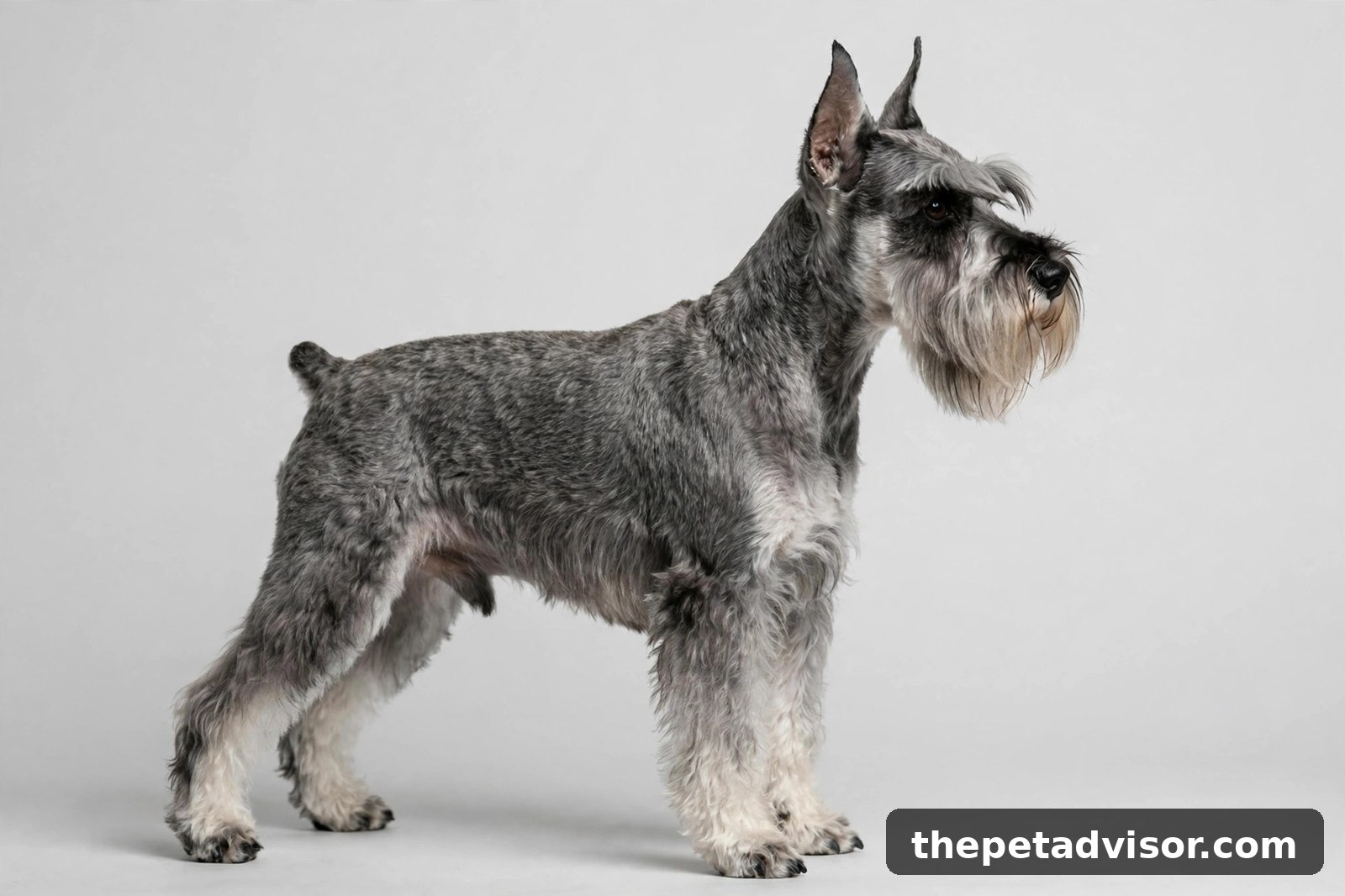
Do you have a photo of a Miniature Schnauzer in the American show ring? We’d love this page to lead with one. If you have a show photo you’d let us use, email it to [email protected] — tell us the dog’s name and the show, and it may be featured here. Please only send photos you took yourself or have the photographer’s permission to share, and tell us the photographer’s name. We couldn’t find a public photo of a Miniature Schnauzer in the American show ring that we were free to share, so the photo leading this page was made with AI. We’d much rather lead with a real one — if you’re a club member with an approved photo, we’d love to feature it.
1. Breed at a glance
Terrier Group; recognized by the AKC in 1926
12–14 in at the withers; 11–20 lb
Hard, wiry double coat; salt & pepper, black & silver, or solid black
12–15 years
Alert, spirited, obedient, friendly, intelligent, willing to please
The Miniature Schnauzer is a robust, active dog of terrier type, resembling its larger cousin the Standard Schnauzer in general appearance — nearly square in proportion, sturdily built with plenty of bone, and without any suggestion of toyishness. The trademark is the head: strong and rectangular, with thick whiskers that accentuate its shape, bushy eyebrows, and a full beard. The coat is double, with a hard, wiry outer coat and a close undercoat, in salt and pepper, black and silver, or solid black. Underneath it all is a farm dog: a ratter and watchdog that is alert, spirited, and devoted to its people. (Sources: AKC, Miniature Schnauzer; American Miniature Schnauzer Club, Official Standard.)
2. History
The Miniature Schnauzer was made in Germany in the late 19th century, bred down from the Standard Schnauzer into a smaller, more compact dog for ratting on the farm — small enough to pursue vermin into tight spaces, yet assertive enough to guard the property. The Standard Schnauzer was itself a medium-sized farm dog, equally suited to ratting, herding, and guarding, and farmers wanted a more compact model of the same dog.
- Foundation crosses. The exact mix is not documented, but the breed was most likely developed from the smallest Standard Schnauzers crossed with one or more smaller breeds such as the Affenpinscher and the Miniature Poodle. The first recorded Miniature Schnauzer was a black female named Findel, registered in 1888, and the first exhibition was held in 1899.
- AKC recognition. Four Miniature Schnauzers were imported to the United States in 1924, and the AKC accepted registration of the breed in 1926. The breed was first shown in the Working Group, then moved to the Terrier Group in 1927, where it has stayed ever since. The American Miniature Schnauzer Club was formed in 1933, from the older Wire-Haired Pinscher Club of America, and has been the breed's parent club since.
- Popularity. The Miniature Schnauzer has been one of America's most popular breeds for decades — ranked 17th most popular in the United States as of 2022 — helped by its portable size, its low-shedding coat, and its outgoing personality.
- At Westminster. No Miniature Schnauzer has yet won Best in Show at Westminster. The Schnauzer family has won it twice, but both times in the larger varieties: the Standard Schnauzer in 1997 and the Giant Schnauzer in 2025.
From a German farm ratter to one of America's favorite small companions, the Miniature Schnauzer kept the working dog inside the companion: sturdy, alert, and always ready to tell you what it thinks. (Sources: Wikipedia, Miniature Schnauzer; Wikipedia, List of Best in Show winners of the Westminster Kennel Club Dog Show; AKC, Miniature Schnauzer.)
3. The standard and why it is written that way
The standard describes a dog built for farm work, and every part of it follows from that job. The Miniature Schnauzer is a robust, active dog of terrier type, resembling its larger cousin the Standard Schnauzer in general appearance, and of an alert, active disposition — nearly square, sturdily built, with plenty of bone and no suggestion of toyishness.
- Size. From 12 to 14 inches at the withers, for dogs and bitches alike. The overall length from chest to buttock appears to equal the height at the withers, and the backline is straight, declining slightly from the withers to the base of the tail. Dogs or bitches under 12 inches or over 14 inches are disqualified.
- Coat. Double, with a hard, wiry outer coat and a close undercoat. The head, neck, ears, chest, tail, and body coat must be plucked, and in show condition the body coat should be long enough to determine texture. The furnishings are fairly thick but not silky; a coat too soft or too smooth and slick is a fault.
- Color. The allowed colors are salt and pepper, black and silver, and solid black, all with uniform skin pigmentation and a solid black nose. In salt and pepper dogs the banded black-and-white hairs predominate, fading to light gray or silver white in the eyebrows, whiskers, cheeks, under throat, inside ears, across chest, under tail, and leg furnishings. Black and silver follows the same pattern with the salt and pepper section black. Black is the only solid color allowed, and a small white spot on the chest is permitted.
- Ears and tail. When cropped, the ears are identical in shape and length with pointed tips, set high and carried perpendicularly at the inner edges. When uncropped, the ears are small and V-shaped, folding close to the skull. The tail is set high and carried erect, docked only long enough to be clearly visible over the backline when the dog is in proper length of coat — and the standard is blunt about it: a properly presented Miniature Schnauzer will have a docked tail, and all others should be severely penalized.
- Head. Strong and rectangular, its width diminishing slightly from ears to eyes and again to the tip of the nose, with a flat, fairly long topskull, a slight stop, and a muzzle at least as long as the topskull, ending in a moderately blunt manner with thick whiskers that accentuate the rectangular shape. The eyes are small, dark brown, and deep-set, oval in appearance and keen in expression. The teeth meet in a scissors bite.
- Disqualifications. Dogs or bitches under 12 inches or over 14 inches; dogs not of an allowed color, or white striping, patching, or spotting on the colored areas of the dog, except for the small white spot permitted on the chest of the black; any irregular or connecting blaze or white mark in the throat-to-chest fade area, which counts as a white patch on the body; and a nose any color other than solid black.
- White Miniature Schnauzers. White is a fourth color recognized internationally by the FCI, but it is not an allowed color under the AKC standard and a white dog is disqualified. White Miniature Schnauzers cannot be shown in AKC conformation.
- Movement and temperament in the standard. The trot is the gait at which movement is judged: forelegs with good reach, hind legs with strong drive and good pickup of hocks, feet turning neither inward nor outward. The typical Miniature Schnauzer is alert and spirited, yet obedient to command — friendly, intelligent, and willing to please, and never overaggressive or timid.
The most important thing to know about the modern standard is the tail: the American Miniature Schnauzer is presented docked, and the standard says so in plain language. A dog shown with a full tail is not the American presentation, even though the ears may be cropped or natural. (Sources: American Miniature Schnauzer Club, Official Standard; Wikipedia, Miniature Schnauzer.)
4. Temperament & living with one
Miniature Schnauzers are alert and spirited, yet obedient to command — the standard's own words — and they live up to every one of them. They are friendly, intelligent, and willing to please, and they bond hard to their people, following them from room to room and wanting to be where the action is.
- A watchdog that talks. This is a farm watchdog by design, with keen hearing and a readiness to announce anything unusual. Barking is the breed's most common complaint, and it is not a training failure — it is the job the dog was bred for. Teach a quiet cue early, and give the dog enough to do, or the barking fills the empty hours.
- Highly trainable — and a little stubborn. The breed learns fast and loves to work, but it has opinions of its own. Short, upbeat, reward-based sessions work best; drilling and harsh methods backfire with a dog this sensitive and this sure of itself.
- Exercise is not optional. Plan on an hour or so of active exercise a day, plus training and mental work. A Miniature Schnauzer that does not get enough work will find its own — usually by barking, digging, or getting into things it should not.
- With children and other dogs. Usually good with children and with other dogs when socialized young. They are sturdy and playful rather than fragile, but they can be bossy with other dogs, and their terrier confidence means early socialization matters.
- Not a dog to leave alone all day. Miniature Schnauzers attach closely to their people and do best in a home where someone is around much of the day. Left alone for long stretches they get bored and lonely, and a bored watchdog barks.
The honest summary: this is a wonderful family dog for an owner who will train and socialize it, give it real work every day, and accept the barking that comes with a watchdog — and a poor fit for a quiet household that wants a dog to lie around. (Sources: AKC, Miniature Schnauzer; American Miniature Schnauzer Club, Official Standard.)
5. Grooming
Grooming a Miniature Schnauzer is a real commitment, and it is the price of the low-shedding coat. The double coat — hard, wiry outer coat over a close undercoat — needs regular brushing and combing, and the beard, eyebrows, and leg furnishings need attention between grooms: the beard picks up food and water and should be wiped and combed often.
For the show ring the body coat is maintained by hand-stripping or rolling the coat, which preserves the harsh, weather-resistant texture; for pet dogs clipping is lower-maintenance and far more common, though it softens the coat over time. Most pet Miniature Schnauzers see a professional groomer about every six to eight weeks. Nails should be trimmed regularly, teeth brushed, and ears checked and cleaned — and the coat checked for burrs and ticks after outdoor work. Shedding is minimal, but the coat is not maintenance-free: skip the grooming and the furnishings mat. (Sources: AKC, Miniature Schnauzer; Heavenly Miniature Schnauzers, Showing a Schnauzer.)
6. Health testing
The American Miniature Schnauzer Club's CHIC program sets the health testing a responsible breeder should do — and the results should be registered with the Orthopedic Foundation for Animals, where anyone can look them up.
- Eyes. An eye exam by a board-certified veterinary ophthalmologist (ACVO/CAER exam), registered with OFA.
- Cardiac. A cardiac evaluation, registered with OFA — the breed is overrepresented for congenital heart defects, including sick sinus syndrome and cardiomyopathy.
Also worth asking about are the DNA tests the parent club recommends on top of the two required exams: myotonia congenita (a muscle disorder caused by a CLCN1 gene mutation), Mycobacterium avium complex (MAC), and progressive retinal atrophy type B (PRA type B, HIVEP3). Other conditions to ask a breeder about include cataracts and other eye disease, hyperlipidemia and pancreatitis, portosystemic liver shunts, urinary stones, and dental disease. A CHIC number confirms the testing was done and published; it is not a guarantee of health, and it does not replace asking the breeder what they know about the health of their own lines. (Sources: Embark, Health Tests for Miniature Schnauzers (OFA-CHIC requirements); PuppyReports, Miniature Schnauzer Health Testing Requirements; All About Creatures, Miniature Schnauzer Care Guide.)
7. The annual Miniature Schnauzer specialty dog show
A specialty is the breed’s All-Star show — its Super Bowl. The American Miniature Schnauzer Club holds two national specialties a year: the October national at Montgomery and the Roving National Specialty, which moves to a different city each year.
The club calls it the roving national specialty — the same kind of event other clubs call a floating, rotating, or traveling national.
Every breed has one show a year that matters most: the parent club’s national specialty — and the American Miniature Schnauzer Club holds two a year: a roving national, held at a different show around the country each year, and the October national at Montgomery, held each October in Pennsylvania as part of the Montgomery weekend cluster.
The most recent national specialty was Sunday, October 4, 2026, at the Montgomery County Kennel Club show, Macungie Memorial Park, Macungie, Pennsylvania. Conformation judge Mr. Mark Francis Jaeger; sweepstakes judge Ms. Donna L. Hills. (Sources: American Miniature Schnauzer Club, specialties; Montgomery County KC premium list.)
The roving national
The year’s other national specialty, the roving national, was Saturday, January 3, 2026, at the Empire Equestrian Park and Polo Field, Indio, California (listed as Palm Springs). Conformation judge Kirsty Sanders; sweepstakes judge Shirley Fry. Superintendent: Jack Bradshaw Dog Shows. AKC event 2026057102. (Sources: American Miniature Schnauzer Club, roving specialty; AKC event search, event 2026057102.)
The 2027 National Specialty is Saturday, October 10, 2027, at Macungie Memorial Park, Macungie, Pennsylvania. Conformation judge John Constantine; sweepstakes judge Patricia Bond. (Source: American Miniature Schnauzer Club, events.)
The roving national
The 2027 Roving National Specialty is Saturday, March 13, 2027, at the Kentucky Fair & Exposition Center, Louisville, Kentucky. Conformation judge David Kirkland; sweepstakes judge Beth Santure. Superintendent: MB-F. (Source: American Miniature Schnauzer Club, roving specialty in Louisville.)
Full Montgomery weekend guide →
8. Regional specialties through the year: smaller regional shows
The national is the anchor, but the breed’s year also runs through regional specialties — smaller regional shows, not the national — held by regional Miniature Schnauzer clubs around the country. These are the 2026 regionals verified from club sources so far:
No regional specialties announced yet for 2026.
More regional specialties will be added here as their programs are verified — this section is built from show data, not guesswork. Browse upcoming show weekends →
9. Clubs
The parent club is the American Miniature Schnauzer Club (AMSC), at amsc.us — formed in 1933, the club that runs the national specialties, publishes the breed standard and health guidance, and keeps the rescue program. The club's specialties page is the source for national specialty dates and judges.
Regional specialty clubs verified in AMSC event listings during this build:
- Mount Vernon Miniature Schnauzer Club
- Cactus State Miniature Schnauzer Club
- Greater Columbus Miniature Schnauzer Club
- Portland Miniature Schnauzer Club
- Miniature Schnauzer Club of Northern California
- Miniature Schnauzer Club of Southern California
- Miniature Schnauzer Club of Michigan
- Central Florida Miniature Schnauzer Club
- Twin Cities Miniature Schnauzer Club
- Gateway Miniature Schnauzer Club
Regional clubs run the regional specialties listed in section 8 and are the best first contact for anyone looking for a breeder, a training contact, or a local event. (Sources: American Miniature Schnauzer Club; American Miniature Schnauzer Club, Events.)
10. Rescue
Miniature Schnauzers come into rescue when their barking, energy, or grooming needs outrun their owner's life — a busy little watchdog does not settle into a home that cannot exercise and groom it. Breed-specific rescue groups take these dogs in, foster them, and place them with people who understand what the breed needs. The parent club's rescue program is the first place to look:
- AMSC Rescue Program. The American Miniature Schnauzer Club's rescue program, which supports recognized rescue groups around the country and refers adopters to the group nearest them. Rescue Chair: Kelly M. Radcliffe ([email protected]). amsc.us/referral/rescue/
- New Jersey Schnauzer Rescue Network. Recognized by the AMSC rescue program and following its rescue guidelines; serving the northeastern United States (New Jersey, Pennsylvania, New York, Connecticut, and Delaware), with nearly 2,000 Miniature Schnauzers and Schnauzer mixes placed into permanent homes. njsrn.org
- Schnauzer Love Rescue, Inc. A 501(c)(3) nonprofit devoted to finding homes for Miniature Schnauzers, with foster homes across a six-state area in the Southeast.
- Colorado Miniature Schnauzer Rescue. Serving Colorado and the surrounding region.
- AKC Rescue Network. The AKC's breed rescue listing for Miniature Schnauzers, pointing to the AMSC rescue program. akc.org/akc-rescue-network/rescue-network-m-breeds/
Most of these groups place dogs on an application with references, and many will transport within their region. A rescue Miniature Schnauzer is usually an adult, so you know its size, temperament, and barking level before you commit — a real advantage with a breed this vocal. Ask what the dog's health history is, and whether it has had an eye exam: a rescue that cannot tell you anything about the eyes is a rescue to question. (Sources: American Miniature Schnauzer Club, The AMSC Rescue Program; New Jersey Schnauzer Rescue Network, Why NJSRN?; AKC, Rescue Network M Breeds.)
11. Breeder vs. rescue: honest guidance
Both routes can end with a great dog. The honest difference is what you know going in — and with a Miniature Schnauzer, what you know about the eyes, the heart, and the barking matters more than usual.
- Choose a breeder if you want a puppy for showing, performance, or a specific purpose, and you want the health testing, pedigree, and early socialization that come with a careful breeding program. Ask for the CHIC health results in section 6, meet the dam if you can, and be ready to wait — good breeders have waiting lists.
- Choose rescue if you want an adult dog whose temperament, barking level, and grooming needs you can see before you commit, and you are comfortable with a dog that may need training and patience. Rescue is also the right route if you want to give a home to a dog that needs one.
- Either way, verify. Ask for health testing, ask what the dog's lines are known for, and meet the dog before you commit. A breeder who will not show you health results and a rescue that will not let you meet the dog are both telling you something.
A Miniature Schnauzer is a twelve-to-fifteen-year commitment to a small, sturdy, vocal dog that needs real exercise, real training, and regular grooming. The right question is not breeder or rescue — it is whether your life has room for a dog that was bred to notice everything and tell you about it.
12. Claim this page
This page was built from public sources — the AKC standard, the parent club's own material, AKC event records, and the rescue groups' sites — and it is a starting point, not the last word. If you are with the American Miniature Schnauzer Club or a regional club and something here is wrong or missing, you can claim this page and set it straight: email [email protected] and tell us what needs fixing. Corrections from the people who own the breed's knowledge are always welcome.
Sources
- AKC, Miniature Schnauzer
- American Miniature Schnauzer Club, Official Standard of the Miniature Schnauzer
- American Miniature Schnauzer Club
- American Miniature Schnauzer Club, Events (2027 national, Oct 10, 2027)
- American Miniature Schnauzer Club, Specialties
- American Miniature Schnauzer Club, Roving Specialty in Palm Springs
- American Miniature Schnauzer Club, Roving Specialty in Louisville, Mar 13, 2027
- Embark, Health Tests for Miniature Schnauzers (OFA-CHIC requirements)
- PuppyReports, Miniature Schnauzer Health Testing Requirements
- All About Creatures, Miniature Schnauzer Care Guide
- Heavenly Miniature Schnauzers, Showing a Schnauzer
- American Miniature Schnauzer Club, The AMSC Rescue Program
- New Jersey Schnauzer Rescue Network, Why NJSRN?
- AKC, Rescue Network M Breeds
- AKC event search, event 2026057102 (2026 roving specialty)
- Wikipedia, Miniature Schnauzer
- Wikipedia, List of Best in Show winners of the Westminster Kennel Club Dog Show