
Breed profile · Toy Group · the King of Toys
Miniature Pinscher
The Miniature Pinscher is a proud, fearless, fun-loving toy breed — the “King of Toys” — a leggy little dog with a lustrous coat, a compact wedge-shaped body, and a high-stepping hackney gait. Its year turns on the annual Miniature Pinscher specialty dog show: the 2026 national was held May 28, 2026, in Murfreesboro, Tennessee, and the 2027 national is set for May 4, 2027, in Eureka, Missouri.
Help us improve it. This is one of ThePetAdvisor’s breed profiles, built from public sources with generous links to the people who actually own this breed’s knowledge. If something’s off or missing, the parent club can claim the page and set it straight — see the bottom of the page.
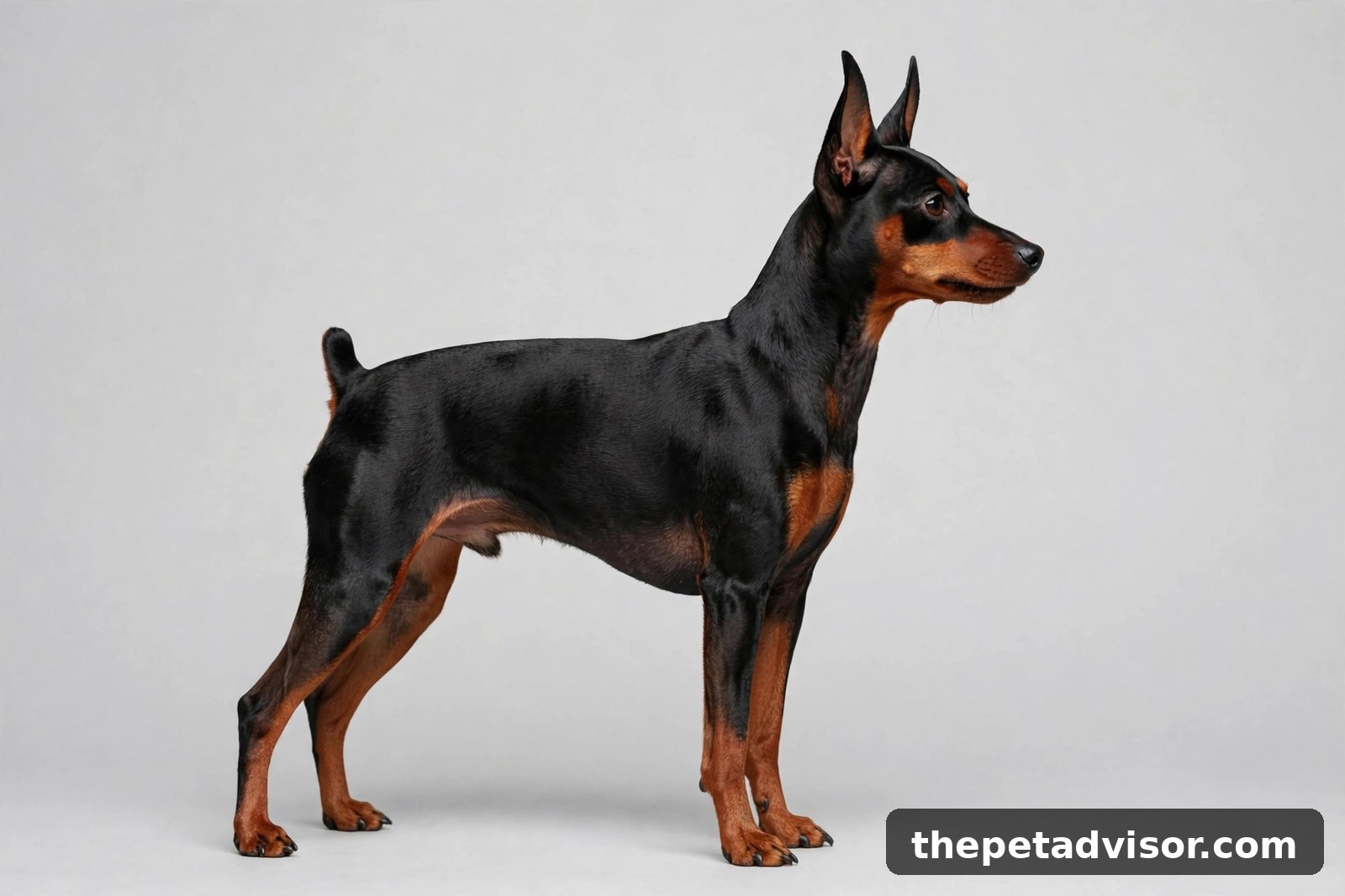
Do you have a photo of a Miniature Pinscher in the American show ring? We’d love this page to lead with one. If you have a show photo you’d let us use, email it to [email protected] — tell us the dog’s name and the show, and it may be featured here. Please only send photos you took yourself or have the photographer’s permission to share, and tell us the photographer’s name. We couldn’t find a public photo of a Miniature Pinscher in the American show ring that we were free to share, so the photo leading this page was made with AI. We’d much rather lead with a real one — if you’re a club member with an approved photo, we’d love to feature it.
1. Breed at a glance
Group: Toy. AKC recognition: 1925. Life expectancy: 12–16 years.
- Size: 10 to 12½ inches at the shoulder, 11 to 11½ inches preferred; about 8 to 10 pounds. Males are as long as they are tall; females may be slightly longer.
- Coat: smooth, hard, and short, straight and lustrous, lying close to the body. Solid clear red, stag red, black with sharply defined rust-red markings, or chocolate with rust-red markings.
- Hallmark: the hackney gait — a high-stepping, reaching, free and easy movement with the front foot bending at the wrist — and a proud, fearless, self-possessed presence. The AKC calls the breed the “King of Toys.”
- Temperament: fearless animation, complete self-possession, and spirited presence — a bold, busy little dog that acts much bigger than it is.
- Not a miniature Doberman: the Miniature Pinscher is an older, separate German breed — a farm and household ratter — not a scaled-down Doberman Pinscher.
2. History
The Miniature Pinscher is a German farm dog — a ratter of the farmhouse and stable, bred small enough to work indoors and sturdy enough to earn its keep. The breed’s German club, the Pinscher-Schnauzer-Klub, was founded in 1895, and the Min Pin was already an established breed in Germany by the time the first dogs reached America in the early 1900s.
The breed is not a miniature Doberman, and the parent club says so plainly: the Miniature Pinscher is an older, separate breed, not a scaled-down copy of the Doberman Pinscher. The resemblance is a family likeness, not a miniature version.
The first Miniature Pinschers were registered with the American Kennel Club in 1925, listed at first as a Terrier — a ratter by trade — and reclassified to the Toy Group in 1930. The Miniature Pinscher Club of America (MPCA) was founded in 1929 and has been an AKC Member Club since 1930. The standard in force today was approved July 8, 1980.
The breed’s show record runs deep: the MPCA’s list of national Best of Breed winners reaches back to 1958, and the modern era belongs to the big-winning dogs of the Marlex and Kimro lines. GCHG CH Rexroth Kimro Valentina won Best of Breed at the 2025 national and was America’s number-one Miniature Pinscher, number-one Toy bitch, and number-three Toy dog overall in 2025; she went on to win Best of Breed at Westminster in February 2026. Three months later, GCH Cheristar’s Doin! Dallas @ Copperspur won Best of Breed at the 2026 national.
3. The standard and why it’s written that way
The standard describes a dog that is “structurally a well balanced, sturdy, compact, short-coupled, smooth-coated dog” — naturally well groomed, proud, vigorous, and alert. Every line of it traces back to the breed’s work as a German farm ratter, refined into a toy that carries itself like a much bigger dog.
- General appearance. Well balanced, sturdy, compact, and short-coupled, with a smooth coat. The dog is naturally well groomed, proud, vigorous, and alert — the standard’s first sentence is a temperament note as much as a shape note.
- Size. 10 to 12½ inches at the shoulder, with 11 to 11½ inches desired. Under 10 inches or over 12½ inches is a disqualification. A male’s length equals his height at the withers; a female may be slightly longer.
- Head. In correct proportion to the body — tapering and narrow, with a strong muzzle and a scissors bite. The eyes are full, slightly oval, clear, bright, and dark, even to a true black. The ears are set high and stand erect from base to tip, and may be cropped or uncropped. The nose is black, except on chocolates, where it is self-colored.
- Body and tail. Compact and slightly wedge-shaped, muscular, with a well-developed forechest and a level or slightly sloping topline. The tail is set high, held erect, and docked in proportion to the size of the dog.
- Coat and color. Smooth, hard, and short, straight and lustrous, lying close to the body. Four colors only: solid clear red; stag red (red with an intermingling of black hairs); black with sharply defined rust-red markings; and chocolate with rust-red markings. Any other color is a disqualification — as is a thumb mark (a patch of black hair surrounded by rust on the front of the foreleg) or white exceeding ½ inch in its longest dimension.
- Gait. The forelegs and hind legs move parallel, and the hackney-like action is a high-stepping, reaching, free and easy gait in which the front leg moves straight forward and the foot bends at the wrist. The dog drives smoothly and strongly from the rear, with head and tail carried high.
- Temperament. Fearless animation, complete self-possession, and spirited presence — the standard repeats those words twice, in the general appearance and again as the temperament section, because the attitude is the breed.
Why it is written that way: the size limits and the disqualifications keep the Min Pin a toy and keep its colors crisp — a ratter small enough for the farmhouse, with no room for the oversized, the off-color, or the muddy-marked. The hackney gait and the carried-high head and tail are the showy half of the breed: a working dog that moves like it owns the ring.
4. Temperament & living with one
A Miniature Pinscher is a big dog’s attitude in a ten-pound body — the AKC calls the breed proud, fearless, and fun-loving, “a true personality dog.” Min Pins are bold, busy, and quick: alert watchdogs that notice everything, energetic playmates that stay playful well into adulthood, and spirited companions that expect to be in the middle of whatever is happening.
Energy and exercise. This is a high-energy toy breed, not a lap decoration. A Min Pin needs daily exercise and something to do — walks, play, and training games — or it will invent its own entertainment, usually at your furniture’s expense. A securely fenced yard helps, but it is not a substitute for time with its people.
Training and boundaries. Min Pins are smart and stubborn in equal measure, and they test boundaries. Early socialization and consistent, positive training matter more with this breed than with most toys: a Min Pin that learns the rules young is a delight, and one that does not will run the household. Teach children to handle the dog gently and to respect it when it walks away — a small, bold dog that feels cornered will object.
With family and strangers. Min Pins are devoted to their own people and can be wary or sharp with strangers — the watchdog half of the ratter heritage. They generally do best with older, dog-savvy children; small children should always be supervised with a dog this small and this quick to react. With other dogs, early socialization helps; the breed’s fearless streak means it will not back down from a much larger dog.
At home. A Min Pin is an apartment-sized dog with a house-sized personality: it adapts to small spaces as long as it gets exercise and attention, and it does not thrive left alone for long hours. Expect barking at the doorbell and at anything unfamiliar outside — that is the job the breed was built for.
5. Grooming
The Miniature Pinscher coat is about as low-maintenance as a dog coat gets. The smooth, hard, short coat needs only a weekly brush-out with a soft brush or hound glove to remove loose hair and keep its lustre, and a bath only when the dog is actually dirty.
- Brushing. Once a week is enough for most Min Pins. The coat sheds lightly year-round — more in spring and fall — but a short coat means the shedding is easy to manage.
- Baths as needed. A Min Pin rarely needs a bath unless it has rolled in something. When you do bathe, use a mild dog shampoo and dry the dog thoroughly — a small, short-coated dog chills easily.
- Nails, ears, and teeth. Trim the nails regularly; the small, catlike feet show overgrown nails quickly. Check the ears weekly and clean as needed. Brush the teeth — dental disease is one of the breed’s common health concerns, and small mouths crowd teeth together.
- Cold weather. A short-coated ten-pound dog feels the cold. A coat or sweater for winter walks is practical, not decorative.
6. Health testing
The Miniature Pinscher Club of America’s CHIC (Canine Health Information Center) requirement for the breed is a patella evaluation, plus two elective tests chosen from thyroid, cardiac, eye, Legg-Calvé-Perthes, and MPS VI testing. A CHIC number means the tests were done and the results are public on the OFA website — ask any breeder for the parents’ CHIC numbers and verify them yourself.
Required test:
- Patella evaluation — OFA. Patellar luxation, a slipping kneecap, is the breed’s most common orthopedic problem, graded I to IV.
Elective tests (two required):
- Thyroid evaluation — OFA.
- Cardiac evaluation — OFA.
- Eye examination by a board-certified ACVO ophthalmologist (CAER), registered with OFA. Eye problems in the breed include progressive retinal atrophy and cataracts.
- Legg-Calvé-Perthes evaluation — OFA. The disease affects the hip joint in young dogs.
- MPS VI DNA test — mucopolysaccharidosis VI is DNA-testable in the breed.
Other concerns to ask a breeder about: heart defects, including mitral valve disease; epilepsy; and dental disease. The breed typically lives 12 to 16 years, and a breeder who health-tests is the single best predictor of a long, sound life.
7. The annual Miniature Pinscher specialty dog show
A specialty is the breed’s All-Star show — its Super Bowl. Once a year, the best Miniature Pinschers from across the country, and often from around the world, come together in one place.
The Miniature Pinscher Club of America’s national specialty: the annual Miniature Pinscher specialty dog show. The 2027 national: May 4, 2027, at the Holiday Inn Six Flags in Eureka, Missouri, judged by Cledith Wakefield. The 2026 national: May 28, 2026, at the DoubleTree by Hilton in Murfreesboro, Tennessee, judged by Dale Martenson. Best of Breed: GCH Cheristar’s Doin! Dallas @ Copperspur. The 2025 national: May 8, 2025, at the Holiday Inn Portland-Airport in Portland, Oregon, judged by Ed Dzuik, 81 dogs in the entry. Best of Breed: GCHG CH Rexroth Kimro Valentina. The 2024 national: June 12–13, 2024, at the Embassy Suites Norman Hotel and Conference Center in Norman, Oklahoma, judged by Dr. A. A. Alvarez, 61 entries. Best of Breed: Marlex Rock Steady. The 2023 national: in Orlando, Florida. Best of Breed: GCH CH Marlex Miss Marvel.
The 2026 National Specialty — national week Tuesday, May 26 – Thursday, May 28, 2026, at the DoubleTree by Hilton, 1850 Old Fort Parkway, Murfreesboro, TN 37129 (room $139/night, $50 pet fee). Conformation Thursday, May 28, 2026. Entries closed Wednesday, May 6, 2026. Conformation and Junior Showmanship judge: Dale Martenson. Futurity/Maturity judge: Jacob Waters. Sweepstakes judge: Vivian Hogan. Obedience/Rally judge: Cheryl Tisdale. MPCA Regional Specialty 1 judge: Karen Clausing; Regional Specialty 2 judge: David Fitzpatrick. (Sources: MPCA, 2026 National Specialty marked catalog and judging program; MPCA, Pinscher Patter, Winter/Spring 2025.)
Results (2026 national). Best of Breed: GCH Cheristar’s Doin! Dallas @ Copperspur. Best of Opposite Sex, Winners Dog, Winners Bitch, Best Junior Handler, sweepstakes/futurity/maturity winners, Top 20 winner, and entry counts not confirmed in an accessible official source — the marked catalog’s Best of Breed, Best of Opposite Sex, Best of Winners, and Best Junior Handler lines are blank, and its entry summary numbers are ambiguous. (Sources: Westminster Kennel Club, 2027 Westminster invitees (National Specialty Winners); MPCA, 2026 National Specialty marked catalog and judging program.)
The 2027 National Specialty: national week Sunday, May 2 – Wednesday, May 5, 2027, at the Holiday Inn Six Flags, 4901 Six Flags Road, Eureka, MO 63025. Conformation Tuesday, May 4, 2027 (1 day). Superintendent: Lorraine Yu. Conformation judge: Mr. Cledith Wakefield. Junior Showmanship judge: Ms. Andrea Albin. Sweepstakes judge (May 3): Ms. Bonnie Foster. Futurity/Maturity judge (May 2): to be determined. Obedience/Rally judge (May 6): James Comunale. MPCA Regional Specialty 1 (May 2): Dr. Geno Sisneros; Regional Specialty 2 (May 5): Mr. Daryl Vice. Scent Work (May 5): Natalie McManus. Rotation: 2027 Central Zone. Nearest airport: St. Louis Lambert International (28 mi). Room rate to be announced; $35 one-time dog fee, limit 6 dogs. AKC event number, premium, entry fees, and entries opening/closing not yet published as of November 7, 2026. (Sources: AKC, Upcoming National Specialties; MPCA, National Specialty.)
Past national specialties: 2025 · 2024 · 2023
Miniature Pinscher Club of America — National Specialty
8. Regional specialties through the year: smaller regional shows
The national is the anchor, but the breed’s year also runs through regional specialties — smaller regional shows, not the national — held by the parent club’s regional clubs around the country, usually as designated specialties with all-breed shows. These are the 2026 regionals verified from club and AKC sources so far:
Two MPCA regional specialties verified for 2026, both held during national week (May 26–28, 2026) at the DoubleTree by Hilton, Murfreesboro, Tennessee:
- MPCA Regional Specialty 1 — national week, May 26–28, 2026, Murfreesboro, Tennessee: Judge Karen Clausing. Exact day within national week not confirmed in an accessible official source. (Source: MPCA, 2026 National Specialty marked catalog and judging program.)
- MPCA Regional Specialty 2 — national week, May 26–28, 2026, Murfreesboro, Tennessee: Judge David Fitzpatrick. Exact day within national week not confirmed in an accessible official source. (Source: MPCA, 2026 National Specialty marked catalog and judging program.)
The 2027 regionals announced so far:
- MPCA Regional Specialty 1 — Sunday, May 2, 2027, Eureka, Missouri: at the Holiday Inn Six Flags, 4901 Six Flags Road, during national week. Judge Dr. Geno Sisneros. (Source: MPCA, National Specialty.)
- MPCA Regional Specialty 2 — Wednesday, May 5, 2027, Eureka, Missouri: at the Holiday Inn Six Flags, 4901 Six Flags Road, during national week. Judge Mr. Daryl Vice. (Source: MPCA, National Specialty.)
Past regional specialties: 2025
More regional specialties will be added here as their programs are verified — this section is built from show data, not guesswork. Browse upcoming show weekends →
9. Clubs
The parent club is the Miniature Pinscher Club of America, Inc. (MPCA), founded in 1929 and an AKC Member Club since 1930 — minpin.org. The club runs the annual national specialty, publishes the Pinscher Patter twice a year, and holds a Judges’ Breed Study Group Seminar at each national. Its officers (2025) include President Gretchen Hofheins-Wackerfuss, Secretary Shelley Erdman, and AKC Delegate Joanne Wilds-Snell.
Regional clubs affiliated with the parent club include (from the AKC club directory):
- Empire Miniature Pinscher Club of Greater New York
- Pacific Northwest Miniature Pinscher Club
- Miniature Pinscher Club of Greater Twin Cities
- Miniature Pinscher Club of Northern California
- Miniature Pinscher Club of Greater Houston, Texas
- Miniature Pinscher Club of Greater Los Angeles
- Miniature Pinscher Club of Greater Phoenix, Inc.
- Miniature Pinscher Club of Greater Tucson, Inc.
- Motor City Miniature Pinscher Club
- Badgerland Miniature Pinscher Club
- Dallas Miniature Pinscher Club
10. Rescue
If a Miniature Pinscher comes into your life through rescue, it will usually be an adult whose temperament is already known — and that is a real advantage with a bold, quick little breed. Two routes lead to a rescue Min Pin: the parent club’s own rescue, and the breed’s national rescue organization.
- MPCA National Rescue: the parent club’s rescue program. National Rescue chair: Lisa Cleary — [email protected].
- Internet Miniature Pinscher Service (IMPS): minpinrescue.org, 877-MINPIN1. Formed in July 1998, IMPS is the largest single-breed rescue service in America, with about 500 volunteers across the United States and Canada and more than 20,000 Miniature Pinschers rescued. The country is divided into regions, each with a regional coordinator. Every dog placed through IMPS is spayed or neutered before placement and evaluated by a breed representative for temperament and training needs.
Adoption through IMPS starts with an application on minpinrescue.org, followed by an interview, a veterinary reference check, and a home visit. The adoption fee varies with the dog — it reimburses the veterinary costs of getting the dog ready for adoption, and in some cases travel — and is typically a few hundred dollars. IMPS also takes in Min Pin mixes, not only classic black-and-rust dogs.
11. Breeder vs rescue
From a breeder: expect the parents’ CHIC health tests (a patella evaluation plus two electives from thyroid, cardiac, eye, Legg-Calvé-Perthes, and MPS VI), with OFA/CHIC numbers you can verify on the OFA website; a health guarantee; a take-back commitment for the life of the dog; and questions about your home, your schedule, and your experience with bold little breeds. Puppies should be raised in the home and socialized early. Red flags: no health testing, no take-back, puppies always available, or a breeder who will not show you the parents’ test records.
From rescue: expect an adult dog whose temperament is already known — a real advantage with a breed this bold and quick — and an adoption process that asks about your home, your schedule, and your vet, with a home visit before placement. The dog will come spayed or neutered, vaccinated, and evaluated for temperament and training needs. A rescue Min Pin may need patience and consistent boundaries while it settles in; the payoff is a devoted little dog that chose you back.
Either route, the question to ask is the same: who stands behind this dog if things go wrong? A breeder with a take-back and a rescue with a foster network both answer it. A seller with neither does not.
12. Claim this page
Are you the Miniature Pinscher Club of America, a regional club, or a breeder or rescue listed here? This page is maintained from public sources — if a date, a judge, or a result is wrong, or a link is out of date, tell us and we will fix it. Clubs and breeders who would like their events, health clinics, or rescue work featured can reach us at the same address.
Sources
- American Kennel Club — Miniature Pinscher breed page (Toy Group; recognized 1925; “King of Toys”)
- American Kennel Club — Official Standard of the Miniature Pinscher (approved July 8, 1980; reformatted February 21, 1990)
- American Kennel Club — Upcoming National Specialties (2027 Miniature Pinscher national: May 4, 2027, Eureka, Missouri; superintendent Lorraine Yu)
- Miniature Pinscher Club of America — National Specialty (2027 judges, venue, and national-week schedule)
- Miniature Pinscher Club of America — National Specialty Winners (Best of Breed winners back to 1958; 2023 Best of Breed)
- Miniature Pinscher Club of America — 2026 National Specialty marked catalog and judging program (national week May 26–28, 2026; judges; entries closed May 6, 2026)
- Miniature Pinscher Club of America — Pinscher Patter, Winter/Spring 2025 (2025 and 2026 national-week schedules; club officers; rescue chair)
- BaRay Event Services — 2025 MPCA National Specialty preliminary breed counts (conformation May 8, 2025: 81 dogs, 82 entries; regional counts)
- American Kennel Club event search — 2024 MPCA National Specialty results (June 12–13, 2024, Norman, Oklahoma; judge Dr. A. A. Alvarez; 61 entries)
- Westminster Kennel Club — 2027 Westminster invitees (National Specialty Winners: 2026 Best of Breed GCH Cheristar’s Doin! Dallas @ Copperspur)
- ShowScene — GCHG CH Rexroth Kimro Valentina, 2025 national Best of Breed and Top 20 winner (America’s #1 Miniature Pinscher, #1 Toy Bitch, #3 Toy Overall in 2025)
- Petful — Miniature Pinscher breed profile (MPCA 2024 CHIC statement: patella evaluation plus two electives; lifespan 12–16 years)
- Petco — Miniature Pinscher breed guide (8–10 pounds; life expectancy 12–16 years; first registered with the AKC in 1925)
- Internet Miniature Pinscher Service (IMPS) — minpinrescue.org (formed July 1998; largest single-breed rescue service in America; 877-MINPIN1)
- Wikipedia — Internet Miniature Pinscher Service (founded 1998 by Petie Hoving Durand; 20,000+ dogs rescued; 500 volunteers)
- American Kennel Club — Club Search and Directory (Miniature Pinscher regional clubs)
- Miniature Pinscher Club of America — minpin.org (parent club, founded 1929; AKC Member Club since 1930)