Breed profile · Herding Group · the small herder with a big dog’s work ethic
Miniature American Shepherd
The Miniature American Shepherd — the MAS, or Mini American — is a small herding dog with the look and the drive of the Australian Shepherd in a body about half the size: 14 to 18 inches at the shoulder, 20 to 40 pounds, and a work ethic that fills a ranch. Developed in California from small dogs of Australian Shepherd type, it became the AKC’s 186th breed on July 1, 2015. It is a working dog first and a companion second, and it is at its best with a job to do.
Not a small Australian Shepherd: the Miniature American Shepherd is a separate, smaller breed — not a variety of the Australian Shepherd, and not a “Mini Aussie” or “Toy Aussie,” names the AKC does not recognize. This page covers the Miniature American Shepherd only.
Help us improve it. This is one of ThePetAdvisor’s breed profiles, built from public sources with generous links to the people who actually own this breed’s knowledge. If something’s off or missing, the parent club can claim the page and set it straight — see the bottom of the page.
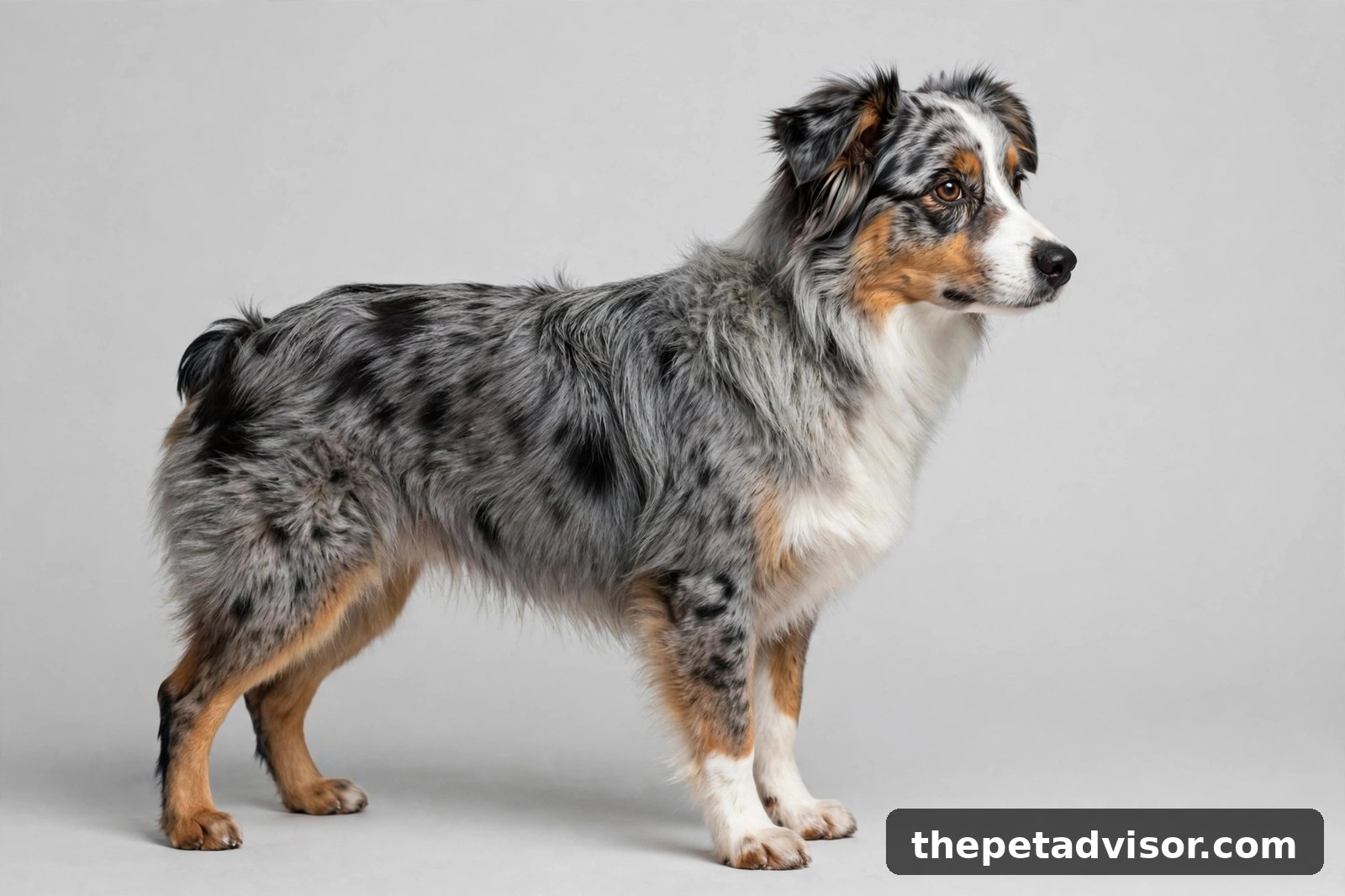
Do you have a photo of a Miniature American Shepherd in the American show ring? We’d love this page to lead with one. If you have a show photo you’d let us use, email it to [email protected] — tell us the dog’s name and the show, and it may be featured here. Please only send photos you took yourself or have the photographer’s permission to share, and tell us the photographer’s name. We couldn’t find a public photo of a Miniature American Shepherd in the American show ring that we were free to share, so the photo leading this page was made with AI. We’d much rather lead with a real one — if you’re a club member with an approved photo, we’d love to feature it.
1. Breed at a glance
Herding — recognized by the AKC July 1, 2015; the AKC’s 186th breed
Dogs 14–18 in, bitches 13–17 in at the withers; about 20–40 lb. Small, slightly longer than tall.
Medium-length double coat, straight to wavy, weather resistant. Black, blue merle, red (liver), or red merle, with or without white markings and/or tan (copper) points.
Intelligent, primarily a working dog of strong herding and guardian instincts; protective, good natured, devoted and loyal. May be reserved with strangers, but not shy.
12 to 13 years
Miniature American Shepherd Club of the USA (MASCUSA), founded 1990; AKC parent club since 2011
2. History
- California, the late 1960s — small dogs believed to be Australian Shepherds. The breed began with small, unregistered dogs of Australian Shepherd type on the California rodeo circuit. In 1962, Sandy Travis’s 11-inch dog “Puppy” worked cattle at a rodeo in Torrance; in 1980, Doris Cordova’s 13-inch “Spike” was registered with the National Stock Dog Registry as a Miniature Australian Shepherd. (Source: AKC, Miniature American Shepherd history.)
- 1990 — the parent club forms. The Miniature American Shepherd Club of the USA (MASCUSA) was formed in 1990 and incorporated in 1993. In 2011 it was selected as the AKC parent club for the breed.
- A new name. After Australian Shepherd breeders objected to “Miniature Australian Shepherd,” the breed passed through the name North American Shepherd before becoming the Miniature American Shepherd.
- AKC recognition, 2015. The breed entered the AKC Foundation Stock Service in May 2011 and was fully recognized on July 1, 2015, in the Herding Group — the AKC’s 186th breed. The United Kennel Club recognized the breed January 1, 2015, and the FCI accepted it provisionally in September 2019 (FCI Standard No. 367).
- A working dog first. The standard calls the Miniature American Shepherd “intelligent, primarily a working dog of strong herding and guardian instincts.” The breed still works stock and competes in herding, agility, obedience, rally, and scent work — every one of them on the program at the national specialty.
3. The standard and why it’s written that way
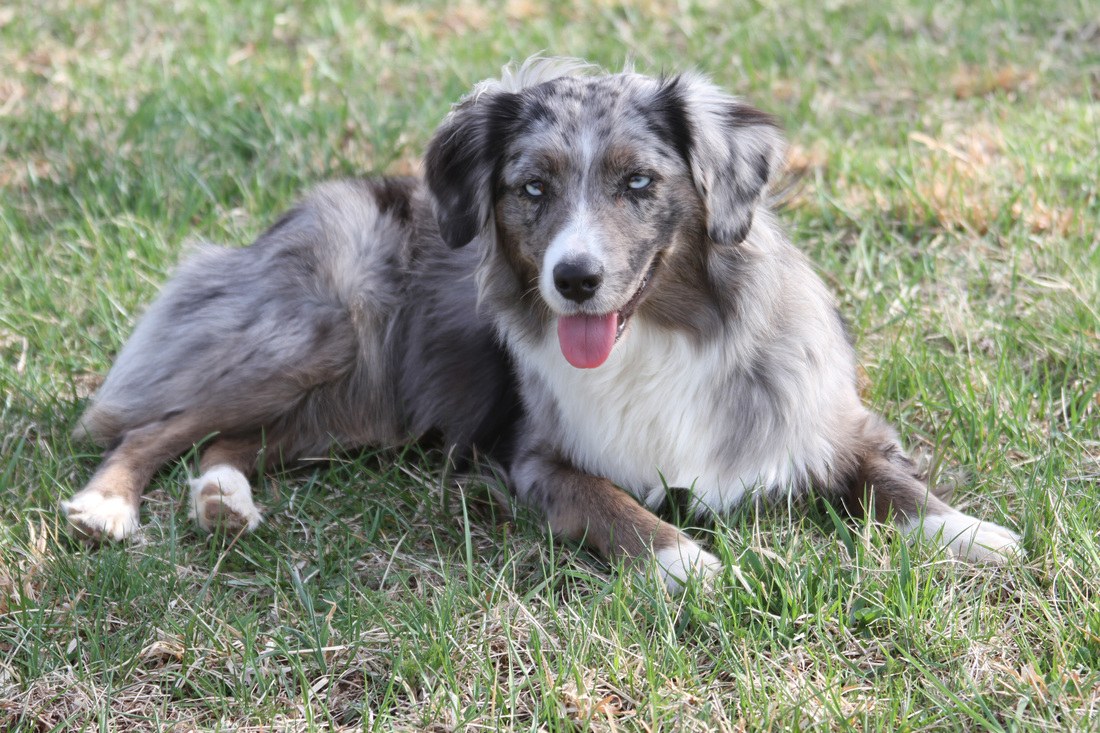
- General appearance — a small herding dog, slightly longer than tall. “The Miniature American Shepherd is a small size herding dog that originated in the United States. He is slightly longer than tall with bone that is moderate and in proportion to body size and height without extremes. Movement is smooth, easy, and balanced.” (Source: AKC standard.)
- Size — dogs 14 to 18 inches, bitches 13 to 17 inches. “Height for dogs is 14 inches up to and including 18 inches at the top of the withers. Height for bitches is 13 inches up to and including 17 inches at the top of withers.” Dogs outside the range are disqualified, and the minimum heights do not apply to dogs under six months. Weight is about 20 to 40 pounds. (Sources: AKC standard; AKC breed page.)
- Head — clean-cut and dry, with a watchful expression. Eyes are almond-shaped and set obliquely; brown, blue, hazel, amber, or any combination, including flecks and marbling. Ears are triangular, of moderate size, set high on the head; at full attention they break forward and over, or to the side as a rose ear. Prick ears and ears that hang with no lift are a severe fault. The muzzle is equal in length to the crown, tapering gradually to a rounded tip. (Source: AKC standard.)
- Coat — medium length and coarseness, straight to wavy. “Moderation is the overall impression of the coat. Hair is of medium texture, straight to wavy, weather resistant, and of medium length.” There is a moderate mane and frill, more pronounced in dogs than in bitches. Hair may be trimmed on the ears, feet, back of hocks, pasterns, and tail; otherwise the dog is shown in a natural coat, and untrimmed whiskers are preferred. Non-typical coats are a severe fault. (Source: AKC standard.)
- Color — black, blue merle, red (liver), red merle. “With no order of preference, the recognized colors are black, blue merle, red (liver) and red merle.” White markings, when present, do not dominate, and are restricted to the muzzle, cheeks, crown, blaze, neck, chest, belly, and legs. Disqualifications: any color other than the recognized colors, and white body splashes — a conspicuous, isolated white spot or patch between the withers and tail, on the back, or on the sides between the elbows and the back of the hindquarters. (Source: AKC standard.)
- Tail — docked or naturally bobbed. “A docked or natural bobtail is preferred. A docked tail is straight, not to exceed three (3) inches.” An undocked tail at rest may hang in a slight curve. (Source: AKC standard.)
- Gait — smooth, free, and easy. “Smooth, free, and easy; exhibiting agility of movement with a well-balanced, ground-covering stride.” The dog is examined on the table. (Source: AKC standard.)
- Why it is written that way. The standard is written to keep the Miniature American Shepherd a small, moderate working herder: no extremes of size, bone, or coat; a height disqualification that keeps the breed small; color and white-marking rules that hold the four recognized colors and the classic herding-dog pattern; ear and tail wording that preserves the breed’s working look. Everything in it points back to a dog that can work stock all day and then come home and lie by the fire.
4. Temperament & living with one
- Protective, good natured, devoted and loyal. The standard sums the breed up in four words, and the AKC’s three-word version is good-natured, intelligent, and devoted. With its family the Miniature American Shepherd is a loyal companion and a biddable worker, watchful and attentive.
- Reserved with strangers, not shy. The standard is explicit: the dog may be reserved or watchful with strangers, but it does not exhibit shyness. Early, steady socialization matters — a MAS that meets the world young grows into a confident adult; one that does not can turn reserved into suspicious.
- A working dog that needs a job. This is an intelligent, energetic, easily trained herder with strong herding and guardian instincts. It needs daily exercise and mental work — herding, agility, obedience, rally, scent work, or serious trick training. A MAS with nothing to do will invent work, usually herding children, other pets, or the vacuum cleaner.
- Velcro with a brain. The breed bonds hard to its people and wants to be where they are. That devotion makes it highly trainable and a natural for dog sports, and it also means the dog does not do well left alone for long stretches day after day.
- Voice and motion. Herding dogs notice movement and comment on it. Expect a dog that alerts to visitors and new things in the yard, and that needs training to settle when the excitement is over.
5. Grooming
- Weekly brushing. The medium-length double coat needs a thorough brush once a week — a pin brush or slicker through the mane, frill, and breeches, where mats start. Shedding is moderate most of the year and heavier in seasonal coat blows.
- Baths as needed. The coat is weather resistant; bathe when the dog is dirty, not on a schedule, and dry the undercoat thoroughly.
- Trim only where the standard allows. Hair may be trimmed on the ears, feet, back of hocks, pasterns, and tail; otherwise the dog is shown in a natural coat, and untrimmed whiskers are preferred. A pet MAS needs no more than tidy feet and ears.
- Nails, teeth, ears. Keep nails short and strong, brush teeth regularly, and check ears — the semi-erect ear still traps moisture after swimming or baths.
6. Health testing
- Required — the parent club’s six tests. For OFA/CHIC, AKC Breeder of Merit, and Bred with H.E.A.R.T., MASCUSA requires a hip dysplasia radiograph (OFA, PennHIP, or FCI), an annual ACVO eye exam, and DNA tests for PRA-prcd, MDR1 (Multiple Drug Sensitivity), HSF4 hereditary cataracts (Australian Shepherd type), and NAD neuroaxonal dystrophy (Miniature American Shepherd type). (Sources: MASCUSA breed health; AKC Parent Club Health Statement, board-approved revisions May 6, 2026.)
- Recommended on top. Elbow dysplasia radiographs, patellar luxation, dentition, and DNA for CEA, DM, CDDY/CDPA, HUU, and CMR1 are optional but recommended by the parent club.
- NAD — test before you breed. Neuroaxonal dystrophy is a serious, progressive neurological disease of the breed. The DNA test identifies carriers, and the parent club’s program exists so that no puppy is ever born affected.
- Eyes every year. The annual ACVO eye exam is required, not optional: hereditary cataracts (HSF4) and progressive retinal atrophy (PRA-prcd) are both in the required DNA panel, and the eye exam catches what DNA cannot.
- Ask for the results. A breeder should hand you the OFA numbers and the DNA panel for both parents without being asked twice. Verify the results in the OFA database yourself — “health tested” without paperwork is a claim, not a test.
7. The annual Miniature American Shepherd specialty dog show
A specialty is the breed’s All-Star show — its Super Bowl. Once a year, the best Miniature American Shepherds from across the country, and often from around the world, come together in one place.
The Miniature American Shepherd Club of the USA’s national specialty: one national event each year, with conformation, obedience, rally, agility, herding, scent work, futurity, sweepstakes, and a Top 10/Top 20 competition. The 2026 national: May 23, at Purina Farms in Gray Summit, Missouri, with 161 competitors and 200 entries in conformation. The 2025 national: April 8, at the National Equestrian Center in Lake Saint Louis, Missouri — moved from Purina Farms after the March 2025 tornado — with 103 competitors and 155 entries. The 2024 national: June 17, at Purina Farms in Gray Summit, Missouri, with 100 competitors and 129 entries. The 2027 national: May 29, at Purina Farms in Gray Summit, Missouri.
The standard, in brief: a small herding dog, slightly longer than tall, with moderate bone. Males 14 to 18 inches at the withers, females 13 to 17 inches. Medium-length double coat, straight to wavy, weather resistant. Colors: black, blue merle, red (liver), red merle, with or without white and/or tan (copper) markings. Eyes brown, blue, hazel, amber, or any combination, including flecks and marbling. Tail docked or naturally bobbed, a docked tail not to exceed three inches.
The 2026 National Specialty — national week Saturday, May 16, through Saturday, May 23, 2026, at Purina Farms, 200 Checkerboard Drive, Gray Summit, Missouri. The National Specialty conformation show ran Saturday, May 23, 2026, judge Mrs. Rhonda Silveira. Entry: 200 entries / 161 competitors (76 dogs, 86 bitches). Entries opened Friday, March 27, 2026, and closed Friday, April 17, 2026, at 5:00 p.m. CT. Event Chair: Tina Winston. Event Secretary: Lorraine Yu (DogZibit). Host hotel: PineMark Hotel, 866 South Outer Road, St. Clair, Missouri. (Sources: MASCUSA 2026 Nationals; 2026 premium list; AKC event search, event 2026701942.)
The week around the national: herding Friday–Saturday, May 16–17 (Kelly Fonkalsrud, Jenn Patton); agility Monday–Tuesday, May 18–19 (Mary Mullen, Rick Mullen); scent work Monday–Tuesday, May 18–19; rally and obedience Wednesday–Thursday, May 20–21 (James Comunale, Lora Seale); futurity Thursday, May 21 (Katie Trippe); sweepstakes Friday, May 22 (Cheryl Hass, Andrea Hass); Top 10/Top 20 Friday, May 22; conformation also ran Wednesday, May 20 (Ann Yuhasz, Lisa Waldo, Kimberly Moshlak, Bonnie Money) and Thursday, May 21 (Linda Robey) ahead of the Saturday national; Beginners Puppy (4–6 months) Saturday, May 23 (Pam Ireland). (Sources: MASCUSA 2026 Nationals; 2026 conformation results.)
Results (2026 national). Best of Breed: GCH Summerwind Light It Up at Brinton Hall. Best of Opposite Sex: GCHG Legacy Ridge Lil Hot Shot @ Peaceful Acres. Best of Winners and Winners Bitch: Blue Elk’s Flawlessly Winning Colors. Winners Dog: Flawlessly Monument. Select Dog: GCH CH Wiggle Rump Here for a Good Time GCG TKN. Select Bitch: CH Chandrea Crown’s Southern Belle. Best Junior Handler: Renee Tarantelli; Reserve: Olivia Harshbarger. (Source: MASCUSA 2026 conformation results.)
The 2027 National Specialty: national week Friday, May 22, through Saturday, May 29, 2027, at Purina Farms, 200 Checkerboard Drive, Gray Summit, Missouri. National conformation Saturday, May 29, 2027, 9:30 a.m., Great Hall, judge Mr. Albert Bianchi, per the MASCUSA 2027 nationals page and the AKC Upcoming National Specialties list. AKC event number, entries, and closing date not yet published as of November 2026. (Sources: MASCUSA 2027 Nationals; AKC Upcoming National Specialties.)
The 2027 week: herding Friday–Saturday, May 22–23 (Marian Pott, Brian Wistrom); agility Monday–Tuesday, May 24–25 (Bonnie McDonald, Joel Basa); scent work Monday–Tuesday, May 24–25 (Liz McLeod, Melanie Herbst, Kimberly Melton); futurity Wednesday, May 26 (judge not listed); rally Wednesday, May 26 (Barbara Wedekind Selton) and Thursday, May 27 (Patricia Nevins); obedience Wednesday, May 26 (Patricia Nevins) and Thursday, May 27 (Barbara Wedekind Selton); sweepstakes Wednesday, May 26 (Jeff Margeson); conformation Thursday, May 27 (Butch Shulman) and Friday, May 28 (judge to be announced); Top 10/Top 20 Friday, May 28; Gala Friday, May 28, 5:30 p.m., Founders Room. Host hotel: PineMark Hotel, 866 South Outer Road, St. Clair, Missouri. (Source: MASCUSA 2027 Nationals.)
Past national specialties: 2025 · 2024 · 2023
Miniature American Shepherd Club of the USA — mascusa.org
8. Regional specialties through the year: smaller regional shows
The national is the anchor, but the breed’s year also runs through regional specialties — smaller regional shows, not the national — held by regional Miniature American Shepherd clubs around the country. These are the 2026 regionals verified from club and AKC sources so far:
Six regional Miniature American Shepherd specialties verified for 2026 so far:
- Miniature American Shepherd Club of the USA parent specialty — Friday, January 2, 2026, Indio, California: judge Mr. R L Bryant, 34 entries (27 competitors: 9 dogs, 18 bitches), at Empire Equestrian Park and Polo Field, Avenue 51 and Monroe Street. Entries closed Wednesday, December 17, 2025, with entries limited to 100. Best Junior Handler: Kyra Lively; Reserve: Julia Hanson. Event 2026701901. (Source: AKC event search, event 2026701901.)
- Miniature American Shepherd Club of the USA concurrent specialty — Saturday, January 31, 2026, Heart of the Desert Classic: judge Mrs. Diane Landstrom — regular and non-regular classes and Beginners Puppy; Mrs. Nancy R. Griego — sweepstakes. Entries limited to 100. Wild West Miniature American Shepherd Club sweepstakes rosette. (Source: 2026 Heart of the Desert Classic premium list.)
- Miniature American Shepherd Club of the USA specialty — Saturday, April 25, 2026, Yakima, Washington: the judging program lists 48 Miniature American Shepherds in conformation. The judge was not confirmed from the program as of November 7, 2026. (Source: BaRay Event Services judging program.)
- Southeastern Miniature American Shepherd Club specialty — Wednesday, May 20, 2026, Purina Farms, Gray Summit, Missouri (national week): judge Mrs. Ann F. Yuhasz, 170 entries (143 competitors: 69 dogs, 74 bitches). Event 2026701971. (Source: AKC event search, event 2026701971.)
- Great Lakes Miniature American Shepherd Club specialty — Thursday, May 21, 2026, Purina Farms, Gray Summit, Missouri (national week): judge Ms. Linda Robey, 192 entries (164 competitors: 81 dogs, 83 bitches). Event 2026701926. (Source: AKC event search, event 2026701926.)
- Miniature American Shepherd Club of the USA designated specialty — Saturday, August 22, 2026, Owensboro, Kentucky: judge Ms. B L Money, 42 entries (36 competitors: 18 dogs, 18 bitches), at the Owensboro Convention Center, 501 West 2nd Street, River Valley Cluster. Entries closed Wednesday, August 5, 2026, with entries limited to 100. Event 2026701983. (Source: AKC event search, event 2026701983.)
More regional specialties will be added here as their programs are verified — this section is built from show data, not guesswork. Browse upcoming show weekends →
9. Clubs
- Miniature American Shepherd Club of the USA (MASCUSA). The AKC parent club, founded in 1990, incorporated in 1993, and selected as the AKC parent club in 2011. It runs the national specialty, breeder referral, rescue, and the breed health program, at mascusa.org.
- Regional clubs. The Great Lakes Miniature American Shepherd Club, the Southeastern Miniature American Shepherd Club, the Pacific Northwest Miniature American Shepherd Club, and the Wild West Miniature American Shepherd Club hold regional specialties around the country, and the United Miniature American Shepherd Club of Indiana is a UKC club.
- Not ASCA. The Australian Shepherd Club of America (ASCA) is the Australian Shepherd’s registry and club, with its own national specialty — it is not the Miniature American Shepherd’s club. The MAS parent club is MASCUSA.
10. Rescue
- MASCUSA Rescue. The parent club runs rescue at mascusa.org/rescue, with a National Rescue Coordinator (Dawn Knapp) and regional rescue support in seven regions. Members’ dogs are surrendered back to their breeders first; the club also supports responsible rescues by region, and volunteers patrol Petfinder for Miniature American Shepherds in need.
- How adoption works. Dogs are vaccinated, spayed or neutered, and microchipped before placement. Adopters complete an application, provide references, and sign an adoption agreement with a fee; the agreement includes a return-to-rescue clause, so a dog that cannot stay comes back to rescue rather than going to a shelter.
- Regional rescue. The Pacific Northwest Miniature American Shepherd Club’s rescue page lists Herd U Need A Home (Bend, Oregon), Double J Dog Ranch, Herding Dog Rescue of Wyoming, and Australian Shepherds Furever among the rescues that take in Miniature American Shepherds.
- If you find a MAS in need. Contact MASCUSA Rescue through the parent club’s rescue page, or the regional club nearest the dog. Do not buy a dog out of a bad situation and rehome it yourself — the club’s rescue network exists for exactly that.
11. Breeder vs. rescue: honest guidance
- If you buy: start with the parent club, the Miniature American Shepherd Club of the USA, and its breeder referral. Ask for the parents’ health results by name — the six required tests (hips, annual eye exam, PRA-prcd, MDR1, HSF4, and NAD) — and verify them in the OFA database. A breeder who tests is the baseline, not a bonus.
- Meet the breeder and the dam. Expect the breeder to ask you as many questions as you ask them: a good breeder places puppies by temperament and energy level, and will want to know what work and exercise the dog will get.
- Be honest about the energy. A Miniature American Shepherd is a high-energy working dog, not a casual low-exercise choice. If your days do not include real exercise and training, this is the wrong breed — and a good breeder will tell you so.
- If you rescue: an adult MAS can be a great fit, and rescue can tell you the dog’s real temperament. Ask about herding drive, energy level, and how the dog is with strangers — the breed’s reserved-with-strangers streak is real, and a rescue dog that has not been socialized needs a patient, experienced home.
- Watch the names. Avoid breeders marketing “Mini Aussies” or “Toy Aussies.” Those names are not AKC-recognized; a breeder selling under them is not selling an AKC Miniature American Shepherd, and is usually not breeding to the standard or health-testing to the parent club’s requirements.
12. Claim this page
This page belongs to the breed, and the people who know the breed best are the Miniature American Shepherd Club of the USA and its members. If you are with the parent club — or you are a breeder, a judge, a handler, or a rescue volunteer who spotted something wrong, missing, or out of date — this page is yours to set straight. Tell us what needs fixing and where the correction is documented, and we will fix it and credit the source. Contact the site through the About page, and mention “Miniature American Shepherd breed profile.”
Sources
- AKC Miniature American Shepherd breed page — akc.org/dog-breeds/miniature-american-shepherd
- AKC Official Standard of the Miniature American Shepherd (effective June 27, 2012) — images.akc.org/pdf/breeds/standards/MiniatureAmericanShepherd.pdf
- AKC, Miniature American Shepherd history — akc.org/expert-advice/dog-breeds/miniature-american-shepherd-history
- AKC Upcoming National Specialties — apps.akc.org/apps/events/conformation/national_specialties.cfm
- MASCUSA 2027 Nationals — mascusa.org/events/nationals/2027
- MASCUSA 2026 Nationals — mascusa.org/events/nationals/2026
- MASCUSA 2026 conformation results — mascusa-nationals-2026-results-conformation.pdf
- MASCUSA 2026 premium list — mascusa-nationals-2026-premium.pdf
- MASCUSA 2025 Nationals — mascusa.org/events/nationals/2025
- MASCUSA 2025 conformation results — mascusa-nationals-2025-results-conformation.pdf
- MASCUSA 2024 Nationals — mascusa.org/events/nationals/2024
- MASCUSA 2023 Nationals — mascusa.org/events/nationals/2023
- MASCUSA breed health — mascusa.org/breed/health
- AKC Parent Club Health Statement (MASCUSA), board-approved revisions May 6, 2026 — akc-parent-club-health-statement.pdf
- MASCUSA Rescue — mascusa.org/rescue
- AKC Herding Group health testing requirements — akc.org/breeder-programs/breed-health-testing-requirements/herding-group-health-testing-requirements
- FCI Standard No. 367, Miniature American Shepherd — dev.fci.be/Nomenclature/Standards/367g01-en.pdf
- AKC event search, 2026 national (event 2026701942) — AKC event search, event 2026701942
- AKC event search, 2025 national (event 2025701941) — AKC event search, event 2025701941
- AKC event search, 2024 national (event 2024701972) — AKC event search, event 2024701972
- AKC event search, 2023 national (event 2023701943) — AKC event search, event 2023701943
- AKC event search, Indio specialty (event 2026701901) — AKC event search, event 2026701901
- AKC event search, Southeastern specialty (event 2026701971) — AKC event search, event 2026701971
- AKC event search, Great Lakes specialty (event 2026701926) — AKC event search, event 2026701926
- AKC event search, Owensboro specialty (event 2026701983) — AKC event search, event 2026701983
- Blue merle Miniature American Shepherd lying in grass — Lextergrace, CC BY-SA 4.0, via Wikimedia Commons — commons.wikimedia.org/wiki/File:Blue_Merle_Miniature_American_Shepherd_in_Grass.jpg
