
Breed profile · Terrier Group (Standard) · Toy Group (Toy) · the black-and-tan ratter from Manchester
Manchester Terrier
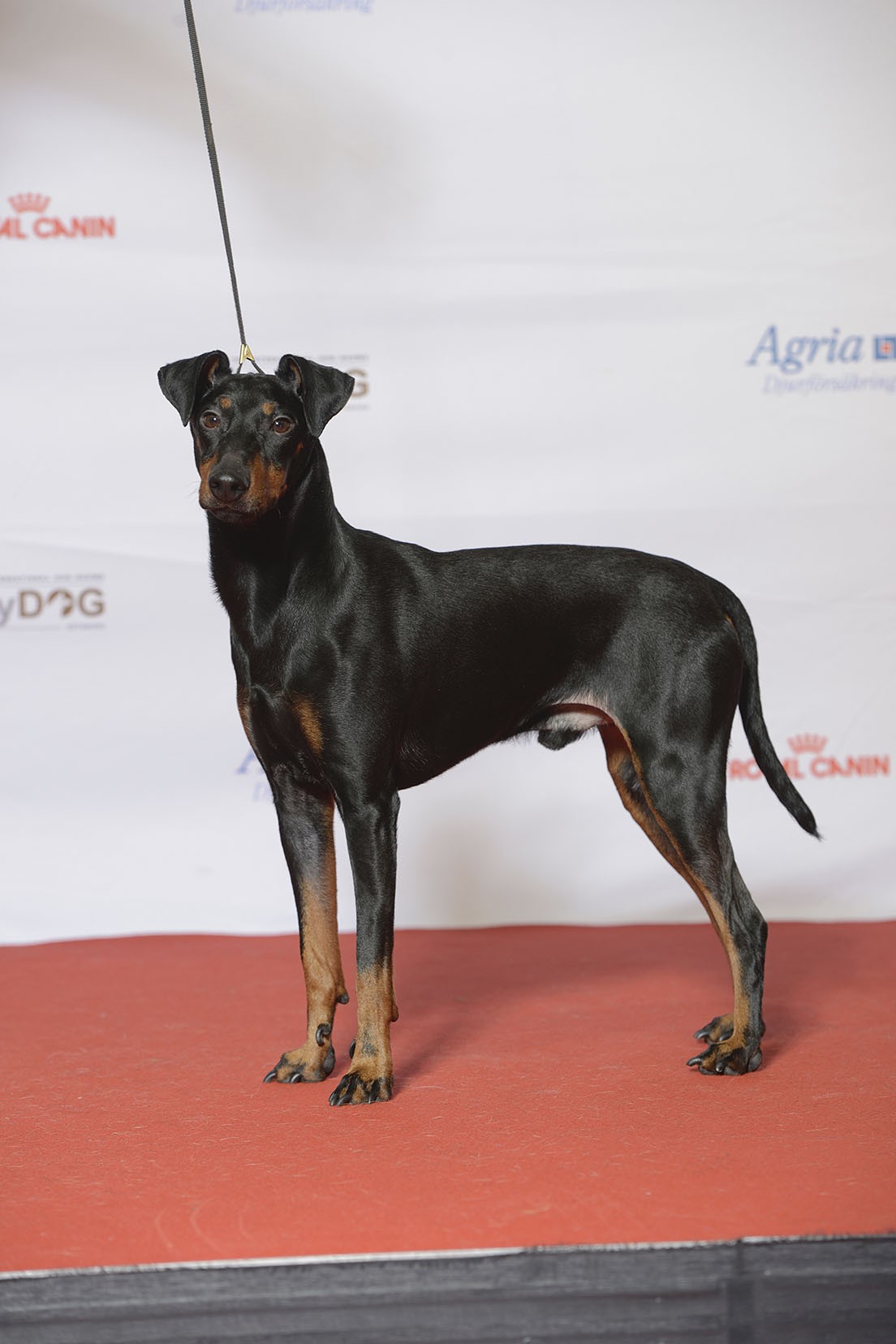
The Manchester Terrier is a small, black, short-coated dog with distinctive rich mahogany markings and a taper-style tail — a ratter built for speed, with the drive of a terrier and the outline of a Whippet. It comes in two varieties of one breed: the Standard, 15 to 16 inches at the shoulder, showing in the Terrier Group; and the Toy, 10 to 12 inches and never over 12 pounds, showing in the Toy Group. The AKC recognized the breed in 1887, and the American Manchester Terrier Club is the parent club for both varieties.
One breed, two varieties: the Standard Manchester Terrier shows in the Terrier Group and the Toy Manchester Terrier shows in the Toy Group. They share one standard except for size and ears, and this page covers both.
Help us improve it. This is one of ThePetAdvisor’s breed profiles, built from public sources with generous links to the people who actually own this breed’s knowledge. If something’s off or missing, the parent club can claim the page and set it straight — see the bottom of the page.

Do you have a better photo of a Manchester Terrier in the American show ring? If you have a show photo you’d let us use, email it to [email protected] — tell us the dog’s name and the show, and it may be featured here. Please only send photos you took yourself or have the photographer’s permission to share, and tell us the photographer’s name.
1. Breed at a glance
Terrier (Standard variety) — Toy (Toy variety); one breed, two varieties, recognized by the AKC in 1887
Standard 15–16 in at the shoulder, 12–22 lb; Toy 10–12 in, not over 12 lb. Body slightly longer than tall
Short, smooth, tight coat; black with rich mahogany markings only — any other color is a disqualification
15–17 years
Spirited, bright, and keenly observant; devoted yet discerning; loyal to its own people, reserved with strangers
American Manchester Terrier Club, for both varieties
A Manchester Terrier is a small dog with a big job description: it was bred to kill rats in the mills and inns of industrial Manchester and to course rabbits on the side, and it still carries both instincts — the terrier’s tenacity and the sighthound’s speed. That makes it a lively, clever companion that needs a job and a person, not a yard and a hope. It is also a rare breed, well down the AKC registration lists, so most people meet their first Manchester at a dog show, not on the street.
2. History
The Manchester Terrier descends from the old Black and Tan Terrier, a rough-coated ratter with a near-legendary reputation for killing rats in the overcrowded, rat-infested cities of 19th-century England. Dogs of this type are described as early as the 16th century — John Caius writes of one in De Canibus Britannicis — and by the early 1800s the sport of rat-baiting, in which a terrier was timed killing rats in a pit, had become popular alongside rabbit coursing. In an effort to produce a dog that could excel at both, the Manchester breeder John Hulme crossed a Black and Tan Terrier with a Whippet. The cross was repeated, a definite type was established, and by 1860 Manchester had become the breed centre for these new terriers, and the name Manchester Terrier stuck. (Sources: Wikipedia, Manchester Terrier; Furry Critter Network, Manchester Terrier History.)
One famous account from the rat-pit days holds that a 5-pound Toy named Tiny killed 300 rats in under 55 minutes — a story that says as much about the breed’s fame as a ratter as about any one dog. When rat-killing was driven out of the pits, the little black-and-tan dogs found work in the dining halls and public inns that replaced them, each inn keeping kennels for the dogs that cleared its rats after the taprooms closed. (Source: Northwest Nature and History, The Gentleman’s Terrier.)
The breed crossed the Atlantic early. The first Black and Tan Terrier was registered in the AKC stud book in 1886, and the following year “Lever” (AKC #7585) became the first AKC-recognized Manchester Terrier — 1887 is the breed’s recognition year. The Manchester Terrier Club of America, for the Standard variety, was recognized in 1923; the smaller dogs were registered separately as the Toy Black and Tan Terrier, renamed the Toy Manchester in 1934, with their own club, the American Toy Manchester Terrier Club, in 1938. In 1959 the AKC grouped the two as one breed with two varieties — the Standard in the Terrier Group and the Toy in the Toy Group — and the clubs eventually merged into the American Manchester Terrier Club, the parent club for both varieties today. (Sources: Bruning, Manchester Terrier breed history; Furry Critter Network, American Toy Manchester Terrier; AKC, Manchester Terrier (Toy).)
3. The standard and why it is written that way
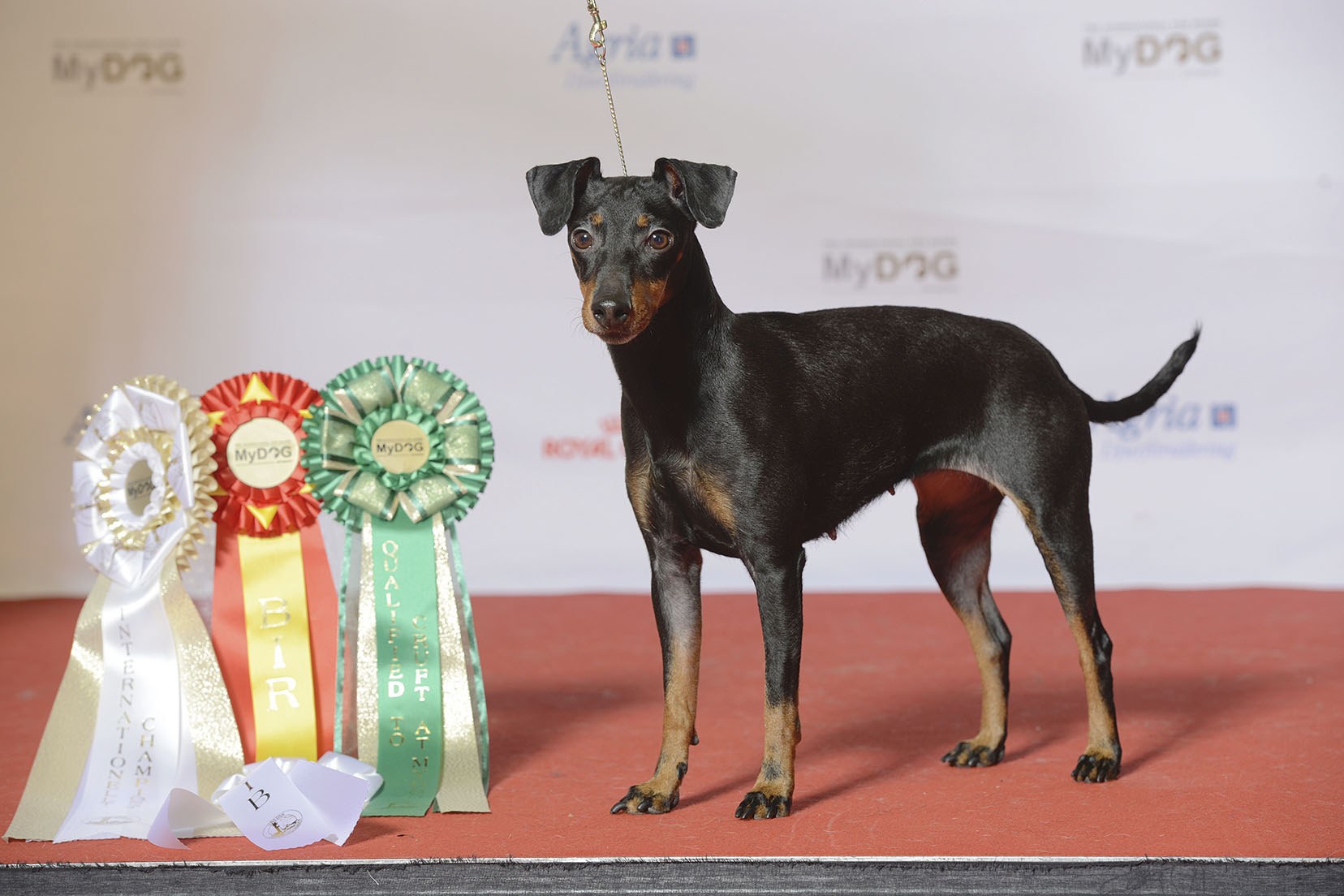
- General appearance — small, black, and short-coated. “A small, black, short-coated dog with distinctive rich mahogany markings.” That one sentence carries the whole breed: the size, the coat, and the color rule. The tail is taper-style — moderately short, tapering to a point — and the body is slightly longer than tall, the height slightly less than the length. (Sources: Furry Critter Network, Manchester Terrier breed guide; American Manchester Terrier Club, Breed Seminar.)
- Size & proportion — two varieties, one outline. Standard: 15 to 16 inches at the shoulder, 12 to 22 pounds. Toy: 10 to 12 inches, not exceeding 12 pounds. The two varieties share the same standard except for size and ears, and the outline is the same in both: a sleek, athletic dog built for speed and agility rather than brute strength, with clean lines and a tight coat. (Sources: American Manchester Terrier Club, Breed Seminar; Furry Critter Network, Manchester Terrier breed guide.)
- Color & markings — black and tan, and nothing else. The coat is black with rich mahogany markings in their specified places. Any color other than black and tan is a disqualification — the color rule is the breed’s signature, and the standard treats a wrong-colored dog as out, not as a fault to be weighed. (Source: Furry Critter Network, Manchester Terrier breed guide.)
- Ears — the one difference besides size. The Toy variety has naturally erect ears only. The Standard variety permits naturally erect, cropped, or button ears. That ear rule is the only place the two varieties’ standards part company. (Source: MetLife Pet Insurance, Manchester Terrier breed spotlight.)
- Temperament in the standard — keenly observant, devoted, and discerning. The standard’s own words for the breed’s character: keenly observant, devoted yet discerning. It is a dog that watches before it acts, and once it has decided you are its person, it is yours. (Source: Furry Critter Network, Manchester Terrier breed guide.)
- Disqualifications — the hard lines. Any color other than black and tan, and a Standard variety dog over 22 pounds. A wrong color or an oversized Standard is not a fault to be weighed — it is out. (Source: American Manchester Terrier Club, Breed Seminar.)
- Why it is written that way. Every clause in the standard points back to the rat pit and the hedgerow: the Whippet cross gave the sleek outline and the speed, the short tight coat sheds dirt and shows the markings, and the black-and-tan pattern identifies the dog at a glance. The size limits are what keep the two varieties honest — a Standard that creeps over 22 pounds and a Toy that creeps over 12 are no longer the dogs the standard describes, and the disqualifications say so plainly.

4. Temperament & living with one
The standard’s temperament paragraph is the shortest and most quoted part of the breed: keenly observant, devoted, and discerning. A Manchester is spirited, bright, and alert, with a terrier’s independence and a sighthound’s love of a chase — and it is loyal and devoted to its own people, and reserved with everyone else. That reserve is the point: a watchful little guardian that made friends with every stranger would be useless, and one that feared every stranger would be miserable. (Sources: Furry Critter Network, Manchester Terrier breed guide; Healthy Paws, Manchester Terrier Dog Breed Guide.)
- With its own people: loyal, loving, and devoted, a dog that wants to be involved in whatever its family is doing. Manchesters bond hard and do best as house dogs, not kennel dogs left outside on their own.
- With strangers: reserved and watchful, and a good watchdog — alert to unusual sounds and quick to sound off. Early and ongoing socialization is what turns that watchfulness into the standard’s calm discernment instead of suspicion.
- Training: intelligent and eager to learn, and quick to pick up commands and tricks — but with a terrier’s independent streak and a tendency to be somewhat stubborn, so it benefits from consistent, positive-reinforcement training. It likes to please its handler and learns quickly when the work is fair.
- Exercise: a high-energy dog with a strong prey drive and a love of a good chase. It needs daily walks, play, and training with a purpose — agility, rally, or a ball in the yard — and a securely fenced place to run, because a Manchester off lead will follow a squirrel without a second thought. A bored Manchester left alone too long can turn destructive and excessively vocal.
- First-dog honesty: this is a lot of terrier for a first-time owner. The energy, the prey drive, and the independent streak all demand an owner who trains from day one and keeps training. If that sounds like a burden rather than a pleasure, a softer breed is the honest choice.
5. Grooming
The Manchester’s coat is wash-and-wear: short, smooth, and tight, with minimal shedding and low grooming needs. Brush once a week to pull out dead hair, bathe only when the dog is actually dirty, and keep up the routine parts — nails, ears, and teeth — the same as any breed. (Sources: Basepaws, Manchester Terrier (Standard); Healthy Paws, Manchester Terrier Dog Breed Guide.)
- Shedding: minimal year-round. A weekly brush keeps it manageable; a rubber curry or hound glove takes the dead coat out in minutes.
- Bathing: as needed, not on a schedule — the coat sheds dirt well and over-bathing strips the oils that keep it weatherproof.
- Nails, ears & teeth: trim nails every few weeks, check ears after baths and swimming, and brush teeth regularly. None of it is breed-specific; all of it matters more in a dog that spends its life leaning on you.
6. Health testing
The parent club’s recommended health tests differ by variety, and the American Kennel Club publishes both lists. A CHIC number requires the breed-specific results to be released publicly, pass or fail. The lists:
- Standard variety — cardiac exam, ophthalmologist evaluation, thyroid evaluation, and von Willebrand Disease I DNA test. The cardiac exam screens the heart; the ophthalmologist evaluation is the eye exam; the thyroid evaluation screens thyroid disease; and the vWD I DNA test screens for von Willebrand’s disease type 1, a bleeding disorder. (Source: AKC, Terrier Group Health Testing Requirements.)
- Toy variety — thyroid evaluation, Legg-Calve-Perthes radiographic evaluation, Juvenile Dilated Cardiomyopathy DNA test, von Willebrand Disease I DNA test, and Xanthinuria Type II DNA test. Legg-Calve-Perthes is a hip-joint disease of small dogs; JDCM is an inherited heart disease of young Toy Manchesters, autosomal recessive and associated with a variant in the ABCC9 gene; xanthinuria type II is an inherited metabolic condition. (Source: AKC, Toy Group Health Testing Requirements.)
- BAER hearing testing — new in 2026. In June 2026 the American Manchester Terrier Club’s Health Committee recommended that BAER (brainstem auditory evoked response) testing be added as a required test for Standards to receive an OFA CHIC certification, and as a recommended test for Toys. The recommendation was approved unanimously by the club’s board and submitted to OFA for review and acceptance — so ask any breeder whether the parents carry BAER results as well as the tests above. (Source: American Manchester Terrier Club, Health (via Maximal Dog).)
- Other conditions to ask about: patellar luxation, cataracts, and thyroid disease, all of which turn up in the breed’s health literature. (Sources: Furry Critter Network, Manchester Terrier breed guide; American Manchester Terrier Club, Health (via Maximal Dog).)
Ask any breeder for the parents’ results for the variety and look them up in the OFA database yourself before you commit. The breed’s 15-to-17-year lifespan is a long one, and the testing exists so that those years are healthy ones.
7. The annual Manchester Terrier specialty dog show
A specialty is the breed’s All-Star show — its Super Bowl. Once a year, the best Manchester Terriers from across the country, and often from around the world, come together in one place.
The American Manchester Terrier Club’s national specialty: one national event each year, with conformation for both varieties, sweepstakes, junior showmanship, and the 4–6 Month Beginner Puppy Competition. The 2026 national: April 10–11, at the Pennsylvania Farm Show Complex in Harrisburg, Pennsylvania, with 98 competitors and 107 entries in conformation. The 2025 national: May 29, at the Lodi Grape Festival Grounds in Lodi, California, with 92 competitors and 101 entries. The 2027 national: July 10, at the MeadowView Conference Resort and Convention Center in Kingsport, Tennessee.
The standard, in brief: a small, black, short-coated dog with distinctive rich mahogany markings and a taper-style tail. Standard variety 15 to 16 inches at the shoulder, 12 to 22 pounds; Toy variety 10 to 12 inches, not exceeding 12 pounds. One standard for both varieties except size and ears — Toy ears naturally erect only; Standard ears naturally erect, cropped, or button. Any color other than black and tan a disqualification; Standard over 22 pounds a disqualification.
The 2026 National Specialty — national-week events Wednesday, April 8, through Sunday, April 12, 2026, at the Pennsylvania Farm Show Complex, 2300 N Cameron St, Harrisburg, Pennsylvania, as part of the Harrisburg cluster (Harrisburg Kennel Club, Lebanon County Kennel Club, and Mason & Dixon Kennel Club). Conformation for the national itself Friday–Saturday, April 10–11, 2026, with the 4–6 Month Beginner Puppy Competition on Thursday, April 9. Entry: 107 entries / 98 competitors — Standard 50 entries (20 dogs, 30 bitches); Toy 48 entries (25 dogs, 23 bitches). Entries closed March 25, 2026. Event Chair: Linda Sansom, Harrisburg, Pennsylvania. Superintendent: Jim Rau Dog Shows, Ltd. (Sources: AKC event search, event 2026058607; Harrisburg cluster premium list (Jim Rau Dog Shows).)
National specialty judges: A Kelly — conformation, both varieties. S Thibodeaux — junior showmanship. (Source: AKC event search, event 2026058607.)
Results (2026 national). Best of Breed: GCH CH Medley’s Tea Time At The Waldorf Asstoria (Standard Manchester Terrier). Best of Opposite Sex: GCHB CH Sunkissed Flying Spur Via Burmack (Toy Manchester Terrier). Best Junior Handler: Brianna Hutchins (Toy); Reserve Best Junior Handler: Gideon Towell (Toy). Winners Dog and Winners Bitch not confirmed in an official source as of November 2026. (Source: AKC event search, event 2026058607.)
The 2027 National Specialty: July 10, 2027, one day, at the MeadowView Conference Resort and Convention Center in Kingsport, Tennessee, per the AKC Upcoming National Specialties list. The American Manchester Terrier Club calls it the “Stand Alone Nationals & Specialty Extravaganza.” Show secretary/superintendent contact (AKC listing): Christine Allen. AKC event number, judges, entries, closing date, host club details, and the national-week schedule not yet published as of November 2026. (Sources: AKC Upcoming National Specialties; American Manchester Terrier Club.)
Past national specialties: 2025
American Manchester Terrier Club — americanmanchester.org
8. Regional specialties through the year: smaller regional shows
The national is the anchor, but the breed’s year also runs through regional specialties — smaller regional shows, not the national — held by the American Manchester Terrier Club’s districts and by regional Manchester Terrier clubs around the country. These are the 2026 regionals verified from club and AKC sources so far:
Eight regional Manchester Terrier specialties verified for 2026 so far — judges for the 2026 regionals not yet verified in an official source:
- AMTC District 1 Specialty — Wednesday, April 8, 2026, Harrisburg, Pennsylvania: at the Pennsylvania Farm Show Complex, with Harrisburg Kennel Club, opening national week.
- AMTC District 2 Specialty — Thursday, April 9, 2026, Harrisburg, Pennsylvania: at the Pennsylvania Farm Show Complex, with Lebanon County Kennel Club.
- AMTC District 1 Specialty — Friday, April 10, 2026, Harrisburg, Pennsylvania: at the Pennsylvania Farm Show Complex, with Lebanon County Kennel Club, on the first day of the national; also listed as a designated specialty (AKC event 2026058603).
- Delaware Valley Manchester Terrier Club specialty — Saturday, April 11, 2026, Harrisburg, Pennsylvania: at the Pennsylvania Farm Show Complex, with Harrisburg Kennel Club; and Sunday, April 12, 2026, with Mason & Dixon Kennel Club, with puppy & veteran sweepstakes.
- AMTC specialty — Friday, May 29, 2026, Lodi, California: at the Lodi Grape Festival Grounds (AKC event 2026058606). Event Chair: Christina Caridis.
- AMTC specialty — Saturday, May 23, 2026, Bloomington, Illinois: at the Interstate Center, 2301 West Market, with Corn Belt Kennel Club (AKC event 2026058605). Event Chair: Bev Leidner.
- AMTC District 4 Specialty — Saturday, June 6, 2026, Woodland, California: at the Yolo County Fairgrounds, during the Woofstock cluster (Contra Costa County Kennel Club), with sweepstakes on Saturday. Show Chair: Mike Texter.
- AMTC puppy specialty — Friday, December 11, 2026, Orlando, Florida: with junior showmanship (AKC event 2026058629), during Orlando championship week.
Past regional specialties: 2025
More regional specialties will be added here as their programs are verified — this section is built from show data, not guesswork. Browse upcoming show weekends →
9. Clubs
- American Manchester Terrier Club (AMTC) (parent club) — the AKC-recognized national breed club for the Manchester Terrier of both sizes. It maintains the breed standard, holds the national specialty each year, coordinates health research and rescue, publishes a newsletter, and keeps a breeder referral directory that distinguishes breeders working with the Standard variety, the Toy variety, or both. (Sources: American Manchester Terrier Club; Furry Critter Network, American Toy Manchester Terrier; AKC, Manchester Terrier (Toy).)
- AMTC districts. The club is organized in five districts; District 1 covers the Northeast — Connecticut, Delaware, District of Columbia, Illinois, Indiana, Maine, Maryland, Massachusetts, Michigan, New Hampshire, New Jersey, New York, Ohio, Pennsylvania, Rhode Island, Vermont, and Wisconsin — and the districts hold the regional specialties in section 8. (Source: American Manchester Terrier Club, Officers.)
- Delaware Valley Manchester Terrier Club — the regional club behind the specialties held during national week in Harrisburg, Pennsylvania. See section 8.
- Canadian Manchester Terrier Club — the breed’s club in Canada, which runs its own rescue program and works with the AMTC. (Source: Canadian Manchester Terrier Club, Rescue.)
10. Rescue
- American Manchester Terrier Club rescue. The parent club runs the breed’s rescue for both varieties, and is the first stop if you do not know which contact covers your area. The AKC Rescue Network lists Michelle Barlak ([email protected]), the club’s Eastern U.S. rescue contact, and Tammi Myers ([email protected]). (Sources: AKC Rescue Network, M Breeds; American Manchester Terrier Club, Officers.)
- Relatively few Manchesters need rescue. The breed is rare, and the club’s code of ethics requires member breeders to take back any dog they bred, at any point in its life, or place it in AMTC rescue — so the dogs that do come into rescue usually arrive through the club, not through a shelter. (Sources: Canadian Manchester Terrier Club, Rescue; American Manchester Terrier Club, Membership Application & Code of Ethics.)
- Seattle Purebred Dog Rescue. A regional purebred rescue that keeps a Manchester Terrier page and takes the breed when one turns up in the Pacific Northwest. (Source: Seattle Purebred Dog Rescue, Manchester Terrier.)
- Canadian Manchester Terrier Club rescue. The breed’s club in Canada runs a rescue program of its own, and points American inquirers to the American Manchester Terrier Club’s rescue page and the Manchester Terrier Rescue Facebook page. (Source: Canadian Manchester Terrier Club, Rescue.)
11. Breeder vs. rescue: honest guidance
- If you buy: start with the parent club, the American Manchester Terrier Club, and its breeder referral, which distinguishes breeders working with the Standard variety, the Toy variety, or both. Ask for the parents’ health-test results for the variety — cardiac, eye, and thyroid exams plus the vWD I DNA test for Standards; thyroid, Legg-Calve-Perthes, JDCM DNA, vWD I DNA, and xanthinuria type II DNA for Toys — and look the results up in the OFA database yourself. Expect to wait for a puppy from a careful breeder: a good breeder will have the answers, will ask you as many questions as you ask them, and will take the puppy back for its whole life if you cannot keep it — the club’s code of ethics requires it.
- If you rescue: a rescued Manchester is usually an adult, and it will arrive with its temperament visible before you commit. What you get in return is a dog whose character you can see before you commit and a lower price. Either way, be honest with yourself first: a Manchester needs daily exercise and mental work, a securely fenced place to run, and an owner who trains from day one and keeps training — not a yard and a hope.
- Watch out for “rare” colors. The standard recognizes one color only — black with rich mahogany markings, and any other color is a disqualification. A seller’s “rare” label on a blue, red, white, or otherwise off-color Manchester is a sales description, not a mark of quality or health. Judge the dog in front of you against the standard — the black coat, the mahogany in its proper places, the keen, observant expression — not against a listing’s adjectives.
12. Claim this page
This page belongs to the breed, and the people who know the breed best are the American Manchester Terrier Club and its members. If you are with the parent club — or you are a breeder, a judge, a handler, or a rescue volunteer who spotted something wrong, missing, or out of date — this page is yours to set straight. Tell us what needs fixing and where the correction is documented, and we will fix it and credit the source. Contact the site through the About page, and mention “Manchester Terrier breed profile.”
Sources
- AKC, Manchester Terrier (Standard) breed page — akc.org/dog-breeds/manchester-terrier-standard
- AKC, Manchester Terrier (Toy) breed page — akc.org/dog-breeds/manchester-terrier-toy
- AKC, Terrier Group Health Testing Requirements — akc.org
- AKC, Toy Group Health Testing Requirements — akc.org
- AKC Upcoming National Specialties — apps.akc.org
- AKC event search, event 2026058607 (2026 national) — apps.akc.org
- AKC event search, event 2025058624 (2025 national) — apps.akc.org
- AKC event search, event 2025058620 (June 6, 2025 Vallejo morning) — apps.akc.org
- AKC Rescue Network, M Breeds — akc.org/akc-rescue-network-m-breeds
- American Manchester Terrier Club — americanmanchester.org
- American Manchester Terrier Club, Breed Seminar — americanmanchester.org (PDF)
- American Manchester Terrier Club, November 2024 Newsletter — americanmanchester.org (PDF)
- American Manchester Terrier Club, Officers — americanmanchester.org
- American Manchester Terrier Club, Membership Application & Code of Ethics — americanmanchesterterrier.org (PDF)
- American Manchester Terrier Club, Health (via Maximal Dog) — maximaldog.com/health
- 2026 Harrisburg cluster premium list (Jim Rau Dog Shows) — raudogshows.com (PDF)
- 2026 Woofstock premium list — ccckennelclub.com (PDF)
- Wikipedia, Manchester Terrier — en.wikipedia.org/wiki/Manchester_Terrier
- Furry Critter Network, Manchester Terrier breed guide — furrycritter.com
- Furry Critter Network, Manchester Terrier History — furrycritter.com
- Furry Critter Network, American Toy Manchester Terrier — furrycritter.com
- Northwest Nature and History, The Gentleman’s Terrier — northwestnatureandhistory.co.uk
- Bruning, Manchester Terrier breed history — bruning.com
- Basepaws, Manchester Terrier (Standard) — basepaws.com
- Healthy Paws, Manchester Terrier Dog Breed Guide — healthypawspetinsurance.com
- MetLife Pet Insurance, Manchester Terrier breed spotlight — metlifepetinsurance.com
- Seattle Purebred Dog Rescue, Manchester Terrier — spdrdogs.org/manchester-terrier
- Canadian Manchester Terrier Club, Rescue — canadamt.com/rescue.html
- Svenska Mässan, X-Pected Dine Mites at MyDOG, Sweden, January 2016, Wikimedia Commons (CC BY 2.0) — commons.wikimedia.org
- Svenska Mässan, NORD UCH Tsar-Ping’s Roller Coaster Sigyn at MyDOG, Wikimedia Commons (CC BY 2.0) — commons.wikimedia.org