
Breed profile · Toy Group · the ancient white toy companion with the long silky coat
Maltese
The Maltese is a toy dog covered head to foot with long, silky, white hair — gentle-mannered and affectionate, eager and sprightly, and vigorous for its size. One of the world’s oldest companion breeds, the “Ye Ancient Dogge of Malta” kept by Roman aristocrats and Renaissance ladies, it debuted at the first Westminster Kennel Club Dog Show in 1877 as the Maltese Lion Dog, and the AKC recognized the breed in 1888. The American Maltese Association is the parent club.
Help us improve it. This is one of ThePetAdvisor’s breed profiles, built from public sources with generous links to the people who actually own this breed’s knowledge. If something’s off or missing, the parent club can claim the page and set it straight — see the bottom of the page.
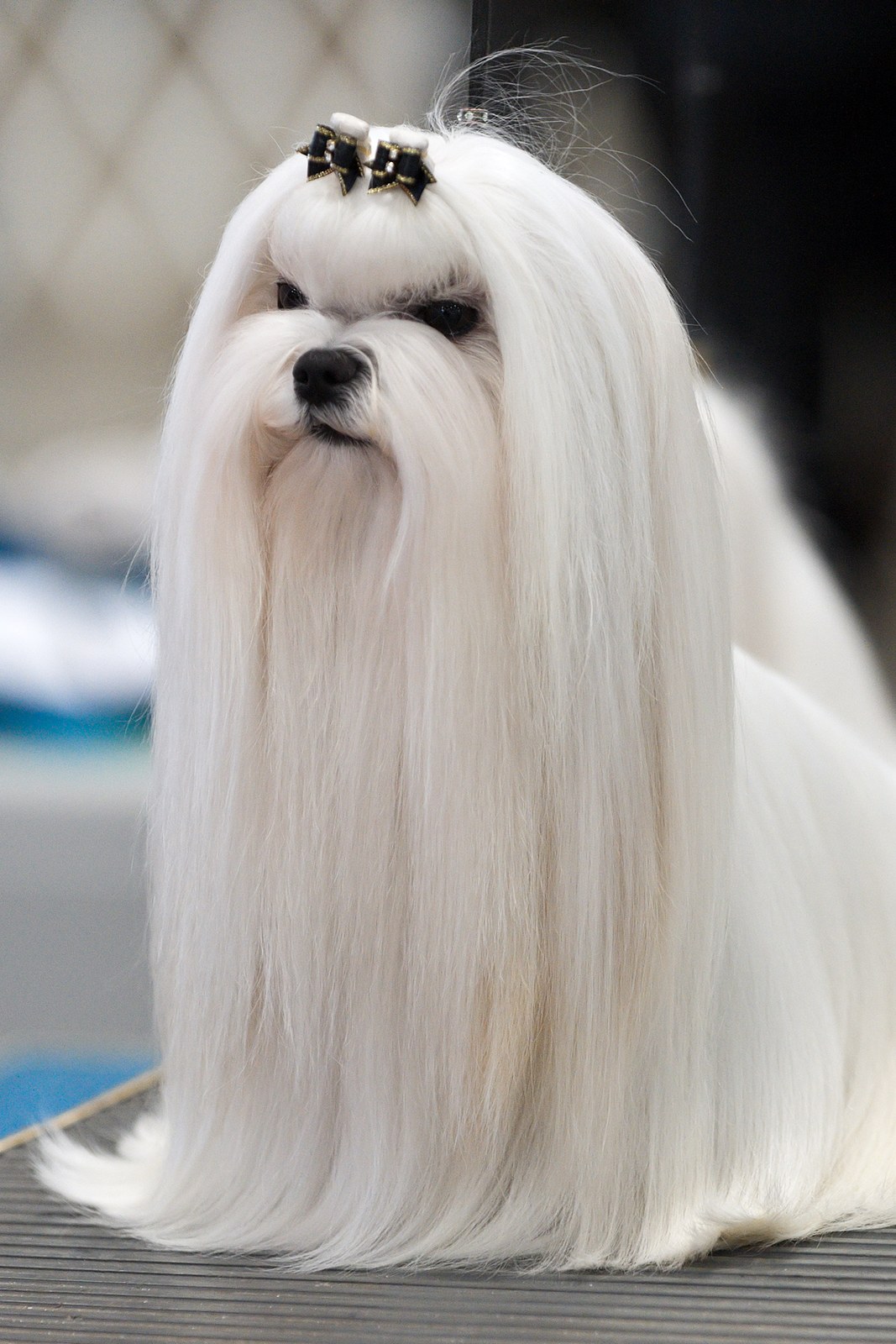

Do you have a better photo of a Maltese in the American show ring? If you have a show photo you’d let us use, email it to [email protected] — tell us the dog’s name and the show, and it may be featured here. Please only send photos you took yourself or have the photographer’s permission to share, and tell us the photographer’s name.
1. Breed at a glance
The Maltese is a small toy companion of long, silky, white coat and an unmistakably aristocratic bearing — a lapdog by design, and one of the oldest companion breeds in the world. It is gentle-mannered and affectionate, eager and sprightly, and vigorous for its size. (AKC, Maltese.)
- AKC group
- Toy; recognized 1888
- Size
- Height 7–9 in; weight under 7 lb, 4 to 6 lb preferred
- Coat & color
- Single coat, no undercoat; long, flat, silky, almost to the ground; pure white
- Lifespan
- 12–15 years
- Temperament
- Gentle-mannered, affectionate, lively, playful, fearless for its size
- Parent club
- American Maltese Association
2. History
The Maltese is one of the world’s oldest companion breeds, with roots running back more than 2,000 years. The AKC calls it the “Ye Ancient Dogge of Malta,” and the little white lapdog the Greeks called the Melitaie Dog appears on ceramics from the Greek Golden Age. Aristotle called the breed “perfectly proportioned,” and the Phoenicians likely introduced it to Malta. (Source: AKC, Maltese History: Where the Breed Originated.)
Roman aristocrats kept the Maltese as the “Roman Ladies’ Dog,” a symbol of loyalty — and the legend says St. Paul was presented with a Maltese by Publius after his shipwreck on Malta. The breed survived the Dark Ages partly by way of China, and was refined with crosses that included the Tibetan Terrier. By the Renaissance it was the “Comforter Dog,” kept in bed as a hot-water bottle and to draw fleas. The legends pile up from there: a Maltese beneath Mary Queen of Scots’ petticoats when she was beheaded in 1587, Marie Antoinette’s Maltese in 1793, and Napoleon, who conquered Malta in 1798 and is said to have selected the finest Maltese as a gift for Josephine. (Source: AKC, Maltese History: Where the Breed Originated.)
In the United States, the breed debuted at the first Westminster Kennel Club Dog Show in 1877 as the Maltese Lion Dog, and the AKC recognized it in 1888. The standard’s square proportions are the breeder’s rule of thumb: as breeder Sarah Lawrence put it, the point of the withers to the base of the tail should be exactly equal to the point of the withers to the ground. And the temperament has not changed in two thousand years — “The Maltese does not know it is a little dog,” Lawrence said. “They think they’re Great Danes.” The AKC Gazette’s Annette Feldblum put it more bluntly: the breed “definitely has a Napoleon complex.” (Sources: AKC, Maltese History: Where the Breed Originated; Westminster Kennel Club, Toy Group records.)
3. The standard and why it is written that way
The standard’s first line is the whole breed in one sentence: a toy dog covered head to foot with long, silky, white hair, gentle-mannered and affectionate, eager and sprightly, vigorous for its size. The dog is compact and square, with a level topline and a long-haired plume of a tail carried gracefully over the back. (AKC, Official Standard of the Maltese, approved March 10, 1964.)
- Head — the breed’s defining feature: medium length, with a slightly rounded skull and a moderate stop. Drop ears, low set and heavily feathered, hanging close to the head. Eyes very dark and round, with black rims. Muzzle medium length, fine, tapering, not snipy; nose black. Bite even, edge-to-edge or scissors.
- Size & body: weight under 7 pounds, 4 to 6 pounds preferred, with overall quality favored over size. Height from withers to ground equals length from withers to root of tail, giving the square outline. Neck of sufficient length for high head carriage; shoulders sloping; topline level; ribs well sprung; chest fairly deep.
- Tail: a long-haired plume carried gracefully over the back, its tip lying to the side over the quarter.
- Legs & feet: fine-boned and feathered; feet small and round, with black toe pads.
- Coat: single, with no undercoat; hangs long, flat, and silky almost to the ground. The hair on the head may be tied up in a topknot or left hanging. Kinkiness, curliness, or a woolly texture is objectionable.
- Color: pure white. Light tan or lemon on the ears is permissible but not desirable.
- Gait: jaunty, smooth, and flowing.
- Temperament (in the standard): “For all his diminutive size, the Maltese seems to be without fear. His trust and affectionate responsiveness are very appealing. He is among the gentlest mannered of all little dogs, yet he is lively and playful as well as vigorous.”
Why it is written that way. The standard is a coat and head standard, and it says so in its own terms: the dog is covered head to foot with long, silky, white hair, and the head is a set of measurable parts — a slightly rounded skull, very dark round eyes with black rims, a black nose, a fine tapering muzzle. The single coat with no undercoat is what makes the hair hang flat and silky instead of standing out, and the ban on kinkiness, curliness, and woolly texture is what keeps it a Maltese coat rather than a generic white one. The square outline and the under-7-pound weight keep it a toy, not a small spaniel. And the temperament paragraph is unusually specific for a standard — fearless, trusting, affectionate, gentle, lively, playful, vigorous — because the temperament is the point of the breed: it has been a companion, and only a companion, for two thousand years.
4. Temperament & living with one
The Maltese is among the gentlest mannered of all little dogs, yet lively and playful as well as vigorous — the standard’s own words, and the dog lives up to them. It is trusting and affectionately responsive, and for all its diminutive size, it seems to be without fear.
- With its own people: devoted and affectionate, and happiest as a lapdog and a companion. The breed was kept by Roman aristocrats and Renaissance ladies for exactly this — company, and warmth, and a dog that wants to be where you are.
- With strangers: friendly rather than reserved, but small and easily startled by rough handling. It is a dog that expects to be treated gently, and it notices when it is not.
- Confidence: the famous Napoleon complex. “The Maltese does not know it is a little dog,” as breeder Sarah Lawrence put it. “They think they’re Great Danes.” A Maltese will take on a much larger dog without a second thought, which is charming until it is not — keep it on a leash around big dogs it does not know.
- Training: eager and sprightly, and quick to learn. Gentle, positive training works; harsh handling shuts the dog down. The same trust that makes the standard call its affectionate responsiveness “very appealing” is the trust you live with at home.
- Exercise: modest. Short walks and play indoors are enough, and the dog is content in an apartment. It is a vigorous little dog for its size, not a fragile ornament — but it is still under 7 pounds, so watch it around small children and large dogs.
- First-dog honesty: a Maltese is a good first dog for a calm, attentive household, and a poor fit for a rough one. It is fragile, it does not like being handled roughly, and it is best with older, gentle children rather than small children who grab.
5. Grooming
The coat is single, with no undercoat, and it hangs long, flat, and silky almost to the ground — and single is the operative word. There is no undercoat to strip or blow, so the coat is easier to keep than it looks, but long hair that reaches the ground mats easily if it is left alone, and a white coat shows every speck of dirt.
- Brushing: brush the coat through daily if it is kept long, paying attention to the feathered ears, the armpits, and behind the ears, where mats start. A pin brush or a comb, worked gently through the hair, is enough — the coat is silky, not woolly, and it does not need to be thinned or stripped. Many pet owners keep the dog in a shorter clip, which is far less work.
- Topknot: the hair on the head may be tied up in a topknot or left hanging. A topknot keeps the hair out of the eyes; if it is left hanging, keep it clean and out of the food bowl.
- Bathing: bathe as needed, and dry the coat thoroughly; a damp long coat mats faster than a dry one.
- Face & eyes: keep the face clean, especially around the muzzle and the eyes. Tear staining — reddish-brown marks below the eyes — is a fact of life in a white-coated breed; wipe the face daily and see a veterinarian if the staining is sudden or heavy, as it can signal an eye or dental problem.
- Teeth & nails: the mouth is small and the teeth crowd easily, so dental care — brushing, and regular veterinary checks — matters more in a Maltese than in a larger dog. Trim the nails regularly.
6. Health testing
The parent club’s health-testing recommendations, published by the AKC and the OFA, are the starting point. Maltese are generally healthy dogs with a 12–15-year lifespan, and the breed has three tests the parent club requires for CHIC registration. Note that no eye exam is listed for the Maltese on the AKC’s Toy Group page — the three tests are patella, cardiac, and serum bile acids.
- Patella Evaluation (CHIC): the kneecaps. Toy breeds are prone to patellar luxation, where the kneecap slips out of place, and the parent club asks for a patella evaluation — OFA registration from 12 months of age — on every breeding dog.
- Cardiac Exam (CHIC): the heart. A veterinary cardiac examination is a routine screen for the breed, and a murmur is the most common thing a vet will find.
- Serum Bile Acids (CHIC): the liver. A blood test that screens for liver shunt, a condition in which blood bypasses the liver. It is a one-time test on a blood sample, and the parent club asks for it on every breeding dog.
- Dental crowding: the mouth is small and the teeth crowd easily, so dental care — brushing, and regular veterinary checks — matters more in a Maltese than in a larger dog.
- Tear staining: reddish-brown staining below the eyes is common in a white-coated breed. It is usually a cosmetic and grooming matter, but sudden or heavy staining is worth a veterinary check, as it can signal an eye or dental problem.
- Heat: the Maltese is not a flat-faced breed, so heat is less of a risk than in a short-muzzled toy — but it is still a small dog under 7 pounds, and it should never be left in a hot car.
Ask the breeder for the parents’ patella, cardiac, and serum bile acids results, and look them up in the OFA database yourself before you commit. (Sources: AKC, Toy Group Health Testing Requirements; OFA, CHIC Program.)
7. The annual Maltese specialty dog show
A specialty is the breed’s All-Star show — its Super Bowl. Once a year, the best Maltese from across the country, and often from around the world, come together in one place.
The American Maltese Association’s national specialty: one national event each year, with conformation, sweepstakes, and junior showmanship. The 2026 national: May 28, at the Southbank Hotel Jacksonville Riverwalk in Jacksonville, Florida, with 49 competitors and 58 entries in conformation. The 2025 national: June 12, at the Alexis Park Hotel in Las Vegas, Nevada, with 52 competitors and 67 entries. The 2027 national: May 26, at the Embassy Suites by Hilton East Peoria in East Peoria, Illinois.
The standard, in brief: a toy dog covered head to foot with long, silky, white hair, gentle-mannered and affectionate, eager and sprightly. Weight under 7 pounds, 4 to 6 pounds preferred, with overall quality favored over size. Color pure white; light tan or lemon on the ears is permissible but not desirable.
The 2026 National Specialty — the 61st — Thursday, May 28, 2026, at the Southbank Hotel Jacksonville Riverwalk, 1515 Prudential Dr, Jacksonville, Florida. Entry: 58 entries / 49 competitors in conformation — 20 dogs and 29 bitches. Entries closed Wednesday, May 6, 2026. Event Chair: Ms. Sandy Bingham-Porter. Superintendent: Onofrio Dog Shows. The national closed a four-day national week at the same hotel: two parent specialties on Tuesday, May 26, and obedience and rally on Wednesday, May 27. (Sources: AKC event search, event 2026016506; Westminster Kennel Club, 2027 Westminster Invitees.)
National specialty judge: C A Herbel — conformation and junior showmanship. Best Junior Handler: Morgan Johnson; Reserve Best Junior Handler: Olivia Moore. (Source: AKC event search, event 2026016506.)
Results (2026 national). Best of Breed: GCHS Ta-Jon’s Made From Scratch. Best of Opposite Sex, Winners Dog, Winners Bitch, and the select awards not confirmed in an official source as of November 2026. (Source: Westminster Kennel Club, 2027 Westminster Invitees.)
The 2027 National Specialty: Wednesday, May 26, 2027, one day, at the Embassy Suites by Hilton East Peoria, 100 Conference Center Dr, East Peoria, Illinois. Superintendent: Emerald Coast Dog Shows. Judges, the entries-close date, and the AKC event number not yet published as of November 2026. The Russian Toy national is the same day at the same hotel — a shared national week, as in 2026. (Source: AKC Upcoming National Specialties.)
Past national specialties: 2025 · 2024 · 2023
American Maltese Association — americanmaltese.org
8. Regional specialties through the year: smaller regional shows
The national is the anchor, but the breed’s year also runs through regional specialties — smaller regional shows, not the national — held around the country, including the regional specialties that run with the national. These are the 2026 regionals verified from club and AKC sources so far:
Six regional Maltese specialties verified for 2026 so far, four in the national week in Jacksonville, Florida, plus two in Orlando in December:
- American Maltese Association parent specialty #1 (morning) — Tuesday, May 26, 2026, Jacksonville, Florida: at the Southbank Hotel Jacksonville Riverwalk (AKC event 2026016504), two days before the national. Judge: Ms. J M Allen. Entry: 47 entries / 41 competitors — 18 dogs and 23 bitches. Event Chair: Robert Wichert. Best Junior Handler: Olivia Moore.
- American Maltese Association parent specialty #2 (afternoon) — Tuesday, May 26, 2026, Jacksonville, Florida: at the Southbank Hotel Jacksonville Riverwalk (AKC event 2026016505), two days before the national. Judge: Mrs. A Pickett. Entry: 50 entries / 46 competitors — 19 dogs and 27 bitches. Event Chair: Pamela Armstrong. Best Junior Handler: Olivia Moore.
- American Maltese Association obedience — Wednesday, May 27, 2026, Jacksonville, Florida: at the Southbank Hotel Jacksonville Riverwalk (AKC event 2026016502), the day before the national.
- American Maltese Association rally — Wednesday, May 27, 2026, Jacksonville, Florida: at the Southbank Hotel Jacksonville Riverwalk (AKC event 2026016503), the day before the national.
- American Maltese Association puppy specialty — Friday, December 11, 2026, Orlando, Florida: (AKC event 2026016507), listed as Event Pended as of November 2026.
- Maltese Club of Greater Miami specialty — Friday, December 11, 2026, Orlando, Florida: (AKC event 2026437901), listed as Event Pended as of November 2026.
Past regional specialties: 2025 · 2024 · 2023
More regional specialties will be added here as their programs are verified — this section is built from show data, not guesswork. Browse upcoming show weekends →
9. Clubs
The American Maltese Association is the parent club — the breed’s national organization, and the club that runs the national specialty. The club’s website is the starting point for a breeder referral and for the national specialty. (Source: American Maltese Association.)
- American Maltese Association (parent club) — americanmaltese.org. National specialty, breeder referral.
- Maltese Club of Greater Miami, Inc. — the regional club in Florida, an AKC-licensed specialty and obedience club (constitution 1989) that holds its specialty with the Orlando show week in December. malteseclubofgreatermiami.com.
- Evergreen Maltese Club — a regional club on the AKC club list; it sponsored the parent specialty at the 50th Annual national specialty week in Lombard, Illinois, in 2015.
- AKC Marketplace — marketplace.akc.org/puppies/maltese — for puppies from AKC-registered breeders. The parent club’s breeder referral is the better first step.
10. Rescue
Most Maltese in rescue are adults, and most come through a breed-only, foster-based rescue rather than a shelter. The national breed rescue was formed by the parent club itself, and it has been placing Maltese in foster homes since 1995.
- American Maltese Association Rescue (AMAR) — the national breed rescue: formed in 1995 by the American Maltese Association, a national 501(c)(3) run entirely by volunteers, foster-home based, with no sanctuary of its own. It takes owner-relinquished dogs and dogs pulled from shelters, and places them in foster homes across the country. The adoption fee is normally $350 for an adult dog, ranging from $250 to $700 by age and health. AMAR does not adopt to homes with children or grandchildren under 10, and it will not ship a rescue dog. americanmalteserescue.org. (Source: American Maltese Association Rescue.)
- AKC Rescue Network — the AKC’s rescue directory also lists Maltese rescue contacts: akc.org/akc-rescue-network.
Rescue dogs are almost always adults, and their temperaments are already visible — which is an advantage in a breed this devoted to its people. A rescue will want to know your home, your schedule, and your other animals before it places a dog with you. That is the process working, not a delay.
11. Breeder vs. rescue: honest guidance
The honest version, before you decide:
- “Teacup” Maltese do not exist. The standard calls for a dog under 7 pounds, 4 to 6 preferred, and no separate smaller variety. Anyone selling a “teacup” Maltese is selling a small dog at a premium price, not a variety, and a dog bred to be extra small is more likely to carry extra health problems.
- Color is not a rarity. Only pure white is allowed — light tan or lemon on the ears is permissible but not desirable — and any other color is a dog that cannot be shown, sold as a rarity.
- Ask for the three health tests. Patella, cardiac, and serum bile acids — and look the parents up in the OFA database yourself. A breeder who has done the tests will be glad to show them; a breeder who has not will change the subject.
- Be honest about the coat. A full show coat needs daily brushing, and even a pet clip needs regular combing, bathing, and face care. Tear staining is a fact of life in a white-coated breed. The grooming is part of the decision, not an afterthought, and it is worth choosing a groomer who is comfortable with a long-coated toy dog.
- Rescue adults are a real option. AMAR rehomes adults from foster homes across the country, and an adult’s temperament is already visible — which matters in a breed that bonds this hard to its people.
12. Claim this page
Do you own a Maltese? Have a photo from a national specialty or a regional specialty, or a correction to something on this page? American Maltese Association members, breeders, and exhibitors — and anyone with a standard-conforming dog — can help this page get better. See the photo note under the photo above for how to send a picture, or contact us with a correction.
Sources
- AKC, Official Standard of the Maltese (PDF) — cdn.akc.org/Maltese.pdf
- AKC, Maltese breed page — www.akc.org/dog-breeds/maltese
- AKC, Maltese History: Where the Breed Originated — www.akc.org/expert-advice/dog-breeds/maltese-history
- AKC, Toy Group Health Testing Requirements — www.akc.org/breeder-programs/breed-health-testing-requirements/toy-group-health-testing-requirements
- AKC, Upcoming National Specialties — www.apps.akc.org/apps/events/conformation/national_specialties.cfm
- AKC event search, event 2026016506 (2026 national) — www.apps.akc.org/apps/events/search/index_results.cfm
- AKC event search, event 2025016505 (2025 national) — www.apps.akc.org/apps/events/search/index_results.cfm
- AKC event search, event 2024016502 (2024 national) — www.apps.akc.org/apps/events/search/index_results.cfm
- AKC event search, event 2023016504 (2023 national) — www.apps.akc.org/apps/events/search/index_results.cfm
- 2024 AMA National Specialty Premium List (BaRay) — baray-production-storage.s3.us-west-2.amazonaws.com/premium_list
- Westminster Kennel Club, 2027 Westminster Invitees — www.westminsterkennelclub.org/2027-westminster-invitees
- American Maltese Association — www.americanmaltese.org
- American Maltese Association Rescue — www.americanmalteserescue.org
- Maltese Club of Greater Miami — www.malteseclubofgreatermiami.com
- Wikimedia Commons, File:1AKC Maltese Dog Show 2011.jpg (hero photo) — commons.wikimedia.org/wiki/File:1AKC_Maltese_Dog_Show_2011.jpg