
Breed profile · Working Group · the lion dog of Leonberg
Leonberger
The Leonberger is a giant, lion-maned working dog from Leonberg, Germany — bred to look like the lion on the town's crest and to be the perfect family companion, and today one of the gentlest giants in the Working Group. Its year turns on the annual Leonberger specialty dog show: the 2026 national was held May 9, 2026, in Lebanon, Oregon, and the 2027 national is set for May 1, 2027, at the MeadowView Conference Resort and Convention Center in Kingsport, Tennessee.
Help us improve it. This is one of ThePetAdvisor’s breed profiles, built from public sources with generous links to the people who actually own this breed’s knowledge. If something’s off or missing, the parent club can claim the page and set it straight — see the bottom of the page.
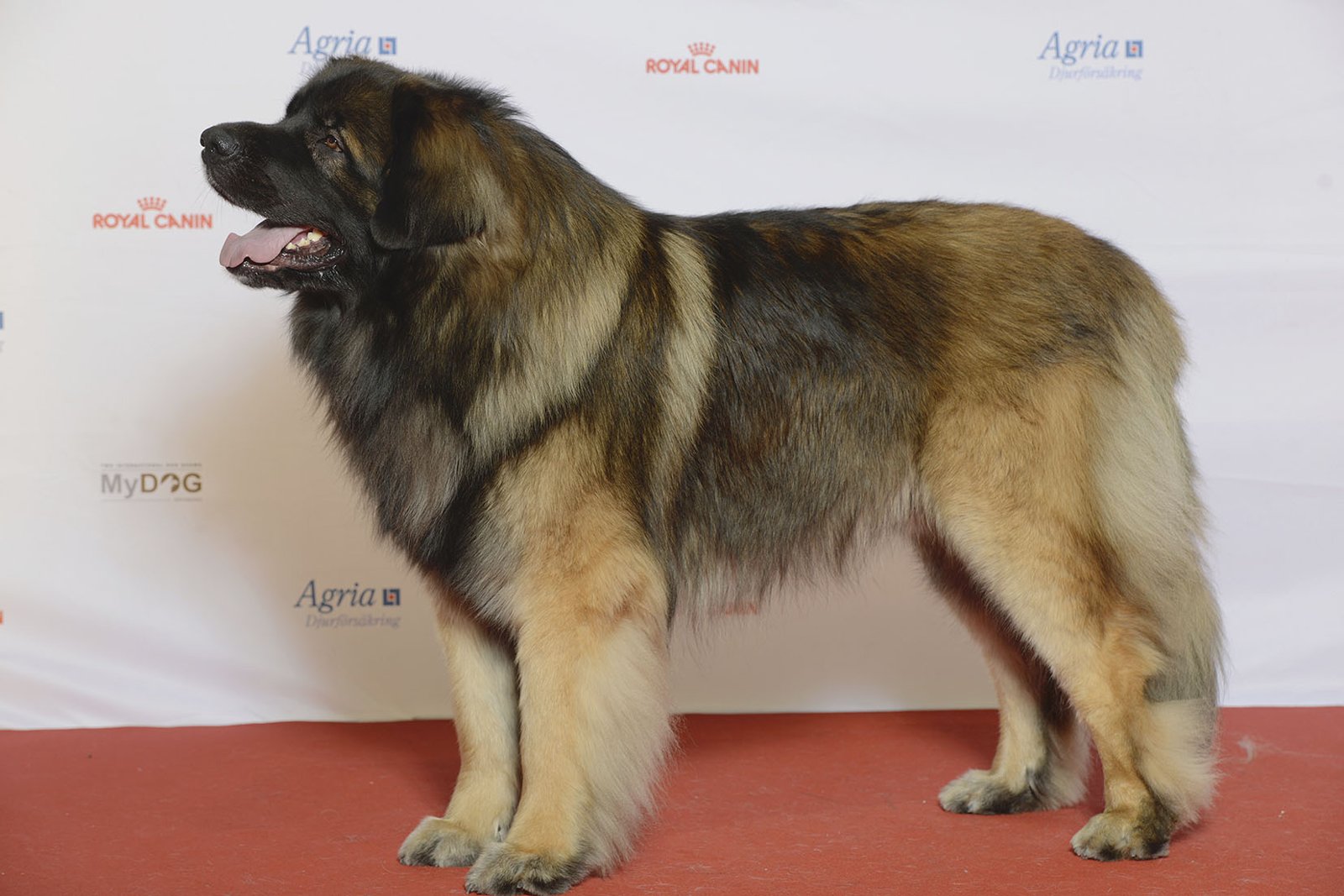

Do you have a better photo of a Leonberger in the American show ring? If you have a show photo you’d let us use, email it to [email protected] — tell us the dog’s name and the show, and it may be featured here. Please only send photos you took yourself or have the photographer’s permission to share, and tell us the photographer’s name.
1. Breed at a glance
Group: Working. AKC recognition: January 1, 2010 — the 167th breed recognized by the AKC. Life expectancy: 7–10 years.
- Size: males 28–31½ inches at the withers (30 inches preferred), females 25½–29½ inches (27½ inches preferred); males typically 120–170 pounds, females 100–135 pounds; slightly longer in body than tall, with substantial bone.
- Coat: medium-to-long, water-resistant double coat, straight with some generalized wave permitted; short fine hair on the muzzle and front of the legs; males carry a lion-like mane on the neck and chest, with feathering on the legs and breeches behind.
- Hallmark: the black mask — the face covered with a full black mask from the nose up to and over the eyes — on a lion-yellow, golden-to-red, red-brown, or sand-colored coat. A complete lack of mask is a disqualification.
- Temperament: calm, confident, sociable, and gentle — the standard calls the gentle character and even temperament of the breed “of utmost importance” for its role as a family companion.
- Best for: a family that wants a giant, affectionate dog and can handle heavy shedding, a short lifespan, and a dog that takes up a room, a car, and a budget — and a household where someone is home most of the day.
- Watch for: heavy shedding and a seasonal coat blow, a 7–10 year lifespan with cancer the leading concern, hip and elbow dysplasia, and the cost of feeding and vetting a 120–170-pound dog.
2. History
The Leonberger was made to look like a lion. In 1846, Heinrich Essig, a city councilor and dog dealer of Leonberg, Germany — a town near Stuttgart whose coat of arms bears a lion — bred the first litter of what would become the breed. Essig claimed the cross was a Landseer Newfoundland female and a “barry” male from the Great St Bernard Hospice, with the Pyrenean Mountain Dog added later; no records definitively confirm the recipe, and his claims have been disputed ever since. The aim is not in doubt: a big, lion-like dog in honor of the lion on Leonberg’s crest.
The breed was introduced to the public at the Munich Oktoberfest some years later, and spread across Europe as a companion and estate dog — a family dog first, a working dog second, with draft and water work in its heritage. The world wars nearly finished it: the breed almost disappeared during World War I and again during World War II, and the few remaining dogs were located and bred on. The darker coats and fuller black masks of the modern Leonberger developed in the latter part of the twentieth century, partly through reintroducing Newfoundland blood.
Leonbergers came to the United States in small numbers. When eight enthusiasts met in Denver, Colorado, on November 2, 1985, to found the Leonberger Club of America, only 17 Leonbergers were known to be living in the country. The club grew into the oldest and largest Leonberger breed club in the United States, and the AKC’s official parent club for the breed. The breed entered the AKC’s Foundation Stock Service in 2003 and was recognized on January 1, 2010 — the 167th breed recognized by the AKC, alongside the Icelandic Sheepdog and the Cane Corso — in the Working Group. The current standard was approved July 12, 2016, and took effect August 31, 2016.
Today the Leonberger is a family companion first, and a versatile working dog second — the breed still works in draft and carting, water work, and therapy, and the parent club’s national specialty runs a week of conformation, obedience, rally, and draft events. The 2026 national, in Lebanon, Oregon, was the 39th annual.
3. The standard and why it's written that way
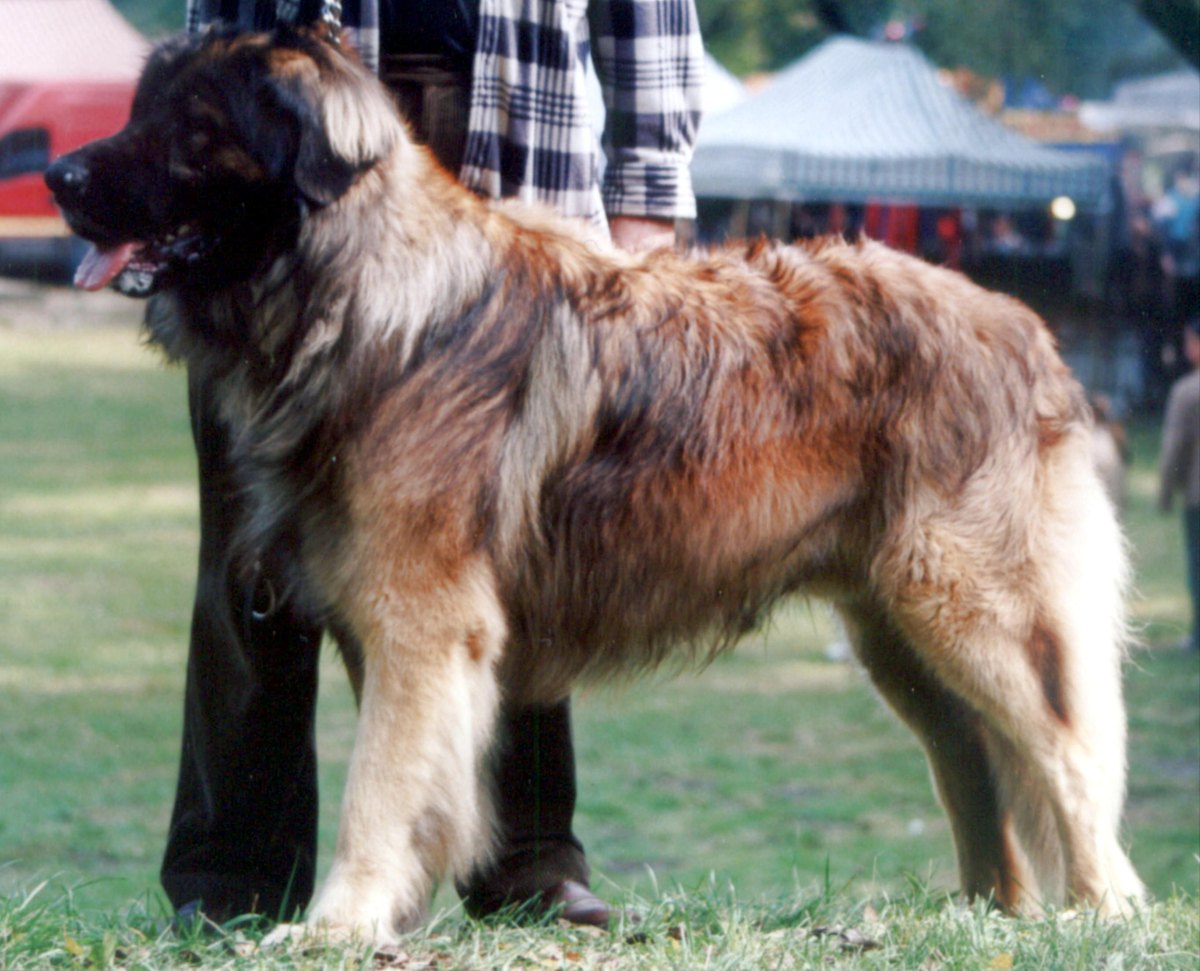
The standard describes a dog that is “large, sociable” — muscular yet elegant, with a proud head carriage, distinguished by its black mask, substantial bone, balanced build, and double coat. Males are particularly powerful and carry a lion-like mane; bitches are unmistakably feminine. The breed is dimorphic — a dog or a bitch easily discernible as such — and is shown in natural coat, with no trimming, sculpting, or other alterations except neatening the feet. What it asks for, and why:
- Size and substance. Measured at the withers, males are 28 to 31½ inches (30 inches preferred); females are 25½ to 29½ inches (27½ inches preferred). Weight is in proportion to the overall size and structure, and when proportion, substance, and balance are present, a slight deviation above standard is tolerated. Height to length of body is 9:10; the depth of chest is 50 percent of the height, and the brisket reaches to the elbow.
- Head and mask. The head, in its entirety, is deeper than it is broad, rectangular shaped, with no wrinkles; the length of muzzle to length of backskull is equal. The face is covered with a full black mask that extends from the nose up to and over the eyes — a lesser mask is acceptable, but not desirable, and a complete lack of mask is a disqualification. Dark brown eyes are preferred over light brown. The nose is always black. Complete dentition of 42 teeth meeting in a correct scissors bite; more than one missing tooth other than M3s is a disqualification.
- The double coat. The coat is medium to long and water-resistant on the body, with short fine hair on the muzzle and front of the limbs. The outer coat is medium-soft to coarse and lies flat; it is straight, with some generalized wave permitted. Mature males carry a mane, which extends over neck and chest. The undercoat is soft and dense, although it may be less so in summer months or warmer climates. There is some ear feathering and ample feathering on fore and rear legs; the tail is very well furnished. A parted or curly coat is a fault.
- Color. Coat colors are lion-yellow, golden to red and red-brown, sand-colored (cream, pale yellow) and all combinations thereof, always with a black mask. All colors may have black tips on the outer coat, but black must not be the basic color. A small, unobtrusive stripe or white patch on the chest and some white hairs on toes is tolerated. Any coat color other than those listed is a disqualification; white hair on the chest exceeding 5 inches in width, or white extending beyond the toes, is a disqualification.
- Topline and tail. The neck is muscular, well set on the shoulders, with no dewlap. The withers are set above a firm level back that flows into a gently sloping croup. The chest is broad, roomy, and deep, reaching at least to the level of the elbows. While standing relaxed, the tail hangs straight down, with the last vertebrae reaching to or below the hock; in movement it is carried no higher than the level of the back. A high tail carriage with the tail curled over the back at all times is a serious fault.
- Gait. The Leonberger has a ground-covering, even, and balanced gait. The stride is powerful, free, and fluid, with good reach and strong drive, giving the impression of effortless power. In motion, the dog maintains a level topline, and the forelegs and hind legs travel straight; as the dog’s speed increases, the legs tend to converge toward the centerline.
- Temperament in the standard. “The gentle character and even temperament of the Leonberger is of utmost importance for fulfilling their role as a family companion. The Leonberger is confident, with a steady, playful demeanor. The breed is willing to please and possesses a good capacity for learning.” Quarrelsomeness or hostility towards people or dogs in normal situations, and an unwarranted show of timidity or nervousness, are serious faults.
4. Temperament & living with one
A Leonberger is a family dog that happens to be the size of a small lion — and the temperament is the point of the breed. The standard puts it first: the gentle character and even temperament of the Leonberger is of utmost importance. The breed is calm, confident, and sociable, steady and playful, willing to please and quick to learn. A Leo is not a guard dog in the sharp sense; it is friendly yet vigilant, attentive and self-assured in all situations, and protective of its home and family without aggression.
With its own family, a Leonberger is affectionate and devoted, famously gentle with children — patient and tolerant, often forming strong bonds with younger family members. With strangers and other pets it is sociable and friendly. That gentleness is real, but so is the size: a 120-pound dog that leans on a toddler knocks the toddler over, so supervise small children and teach children to be gentle in return.
Companionship. Leonbergers were bred to be companions, and they want to be near their people and part of family activities. They do not like long periods alone and may become anxious if isolated. This is a dog for a household where someone is home most of the day, or where the dog goes along.
Training. Leos are bright, willing, and easy to train with patient, consistent, positive methods — but they are slow to mature, reaching adult size only around two to three years of age, so expect a big, goofy adolescent for a long time. Socialize early and widely, and teach a reliable recall while the dog is still small enough to manage.
Exercise. Moderate exercise suits a Leonberger: daily walks, play, and room to move, with swimming and draft or carting work as natural outlets. This is not a jogging partner and not a dog to run hard — protect growing joints from repetitive high-impact exercise while a puppy is still growing, and remember the thick coat makes the breed heat-sensitive.
The short life. The hardest part of living with a Leonberger is the lifespan: 7 to 10 years, with cancer the leading cause of death. Go in with your eyes open, buy from health-tested parents, and enjoy every year.
5. Grooming
The Leonberger coat is beautiful and it is work. A weekly brush-out with a pin brush or slicker keeps it in order; during the spring and fall coat blows, when the undercoat comes out in handfuls, brush several times a week. Check behind the ears, in the mane, and in the feathering and breeches, where mats start.
- Never shave the double coat. The undercoat insulates against heat as well as cold, and a shaved coat grows back unevenly.
- Baths as needed. The coat is water-resistant and sheds dirt as it dries, so a Leo often cleans up with a good brush-out after a muddy walk.
- Nails, ears, and teeth. Trim the nails regularly — a 120-pound dog with overgrown nails is hard on floors and on itself. Check the ears weekly and clean as needed; brush the teeth regularly.
- Show grooming. The coat is shown natural — bath, blow-dry, and brush-out, with no sculpting, scissoring, trimming of whiskers, or any other alterations whatsoever, except for neatening of the feet.
6. Health testing
The Leonberger Club of America works with the Orthopedic Foundation for Animals (OFA) on the breed’s CHIC (Canine Health Information Center) requirements. A CHIC number means the tests were done and the results are public on the OFA website — ask any breeder for the parents’ CHIC numbers and verify them yourself.
Required tests:
- Hip dysplasia evaluation — OFA radiographic hip evaluation or PennHIP, registered with OFA.
- Elbow dysplasia evaluation — OFA radiographic elbow evaluation, registered with OFA.
- Eye examination by a board-certified ACVO ophthalmologist (CAER), registered with OFA.
- Leonberger polyneuropathy (LPN1) DNA test, registered with OFA.
- Leonberger polyneuropathy (LPN2) DNA test, registered with OFA.
- Autoimmune thyroiditis evaluation from an approved laboratory, registered with OFA.
- Leukoencephalomyelopathy (LEMP) DNA test, registered with OFA.
Optional: a cardiac evaluation (standard congenital, advanced, or basic cardiac exam), registered with OFA. The parent club’s own health statement (2020–2021) calls for hips passing and the LPN2 DNA test with a Clear result.
Conditions to watch for: hip and elbow dysplasia; polyneuropathy (LPN1 and LPN2); leukoencephalomyelopathy (LEMP); eye problems including cataracts and entropion; cancer — osteosarcoma and hemangiosarcoma notably, and cancer accounts for more than half of Leonberger deaths in the Leonberger Health Foundation International survey, with an average age at death of about 8 years and 8 months; dilated cardiomyopathy and other heart disease; Addison’s disease; von Willebrand’s disease; and hypothyroidism and autoimmune thyroiditis. As with any large, deep-chested breed, bloat (gastric dilatation-volvulus) is a risk — know the signs. Life expectancy is 7–10 years.
7. The annual Leonberger specialty dog show
A specialty is the breed’s All-Star show — its Super Bowl. Once a year, the best Leonbergers from across the country, and often from around the world, come together in one place.
The Leonberger Club of America’s national specialty: the annual Leonberger specialty dog show. The 2027 national: May 1, 2027, at the MeadowView Conference Resort and Convention Center in Kingsport, Tennessee, judged by Agi M Hejja, with Russell Hornfisher judging obedience. The 2026 national: May 9, 2026, at the Best Western Premier Boulder Falls Inn in Lebanon, Oregon, judged by Dr. J Brady. Best of Breed: GCH Lowenhohle’s Golden Glitz N Glimmer. The 2025 national: May 10, 2025, at the AllStar Events Complex in Gettysburg, Pennsylvania, judged by Diane Anderson, 77 dogs in the entry. Best of Breed: Corleone Navigator At Kalizmar ‘Neville’. The 2024 national: April 13, 2024, at the Sagebrush Inn & Suites in Taos, New Mexico, judged by Andrew Ritter. Best of Breed: Whitehall’s Dazzling Diamond Solitaire. The 2023 national: April 29, 2023, at the QCCA Expo Center in Rock Island, Illinois, judged by Nancy Liebes.
The standard, in brief: a large, sociable working dog, muscular yet elegant, with a proud head carriage — distinguished by its black mask, substantial bone, balanced build, and double coat — males 28 to 31½ inches at the withers, females 25½ to 29½ inches, slightly longer in body than tall — a medium-to-long, water-resistant double coat, lion-yellow to red-brown with a black mask, males carrying a lion-like mane — confident, with a steady, playful demeanor, gentle and even-tempered above all.
The 2026 National Specialty (39th annual) — national week in Lebanon, Oregon, at the Best Western Premier Boulder Falls Inn, 505 Mullins Dr, Lebanon, OR. Conformation Saturday, May 9, 2026. AKC event 2026667910, Parent Specialty (National Specialty). Conformation judge: Dr. J Brady. Obedience judge: Mrs. C S Wray. Junior Showmanship judge: Ms. C Cameron. Entries closed Wednesday, April 15, 2026. The entry: 52 dogs, 61 entries (25 dogs – 27 bitches). Event chair: Jim Carretta. Event secretary: Karen Burgess (CAPER). Draft trials off-site at Timber Linn Park. (Sources: AKC event search, event 2026667910; Westminster Kennel Club, 2027 Westminster invitees (National Specialty Winners).)
Results (2026 national). Best of Breed: GCH Lowenhohle’s Golden Glitz N Glimmer. Best Junior Handler: Kaydence Hempel. High in Trial (obedience): CH OTCH RACH Kalahari’s Intrepid Explorer UDX3 OM3 BN RM2 RAE2 OAP ACT2 CGC TKI (J Woodruff). Best of Opposite Sex, Winners Dog, Winners Bitch, and sweepstakes/futurity winners not confirmed in an accessible official source. (Sources: Westminster Kennel Club, 2027 Westminster invitees (National Specialty Winners); AKC event search, event 2026667910.)
The 2027 National Specialty: Saturday, May 1, 2027 (1 day), at the MeadowView Conference Resort and Convention Center, 1901 Meadowview Parkway, Kingsport, Tennessee. AKC event 2027667910, Parent Specialty (indoors), with NOHS and points for reserve available. Conformation judge: Mrs. Agi M Hejja (p). Junior Showmanship judge: Mrs. Agi M Hejja (p). Obedience judge: Russell Hornfisher. Entry fees $40.00. Entries close Wednesday, April 7, 2027, at 12:00 p.m. Event chair: Jim Carretta. Event secretary: Karen Burgess ([email protected], (262) 412-0353). A 4–6 Month Beginner Puppy event the same day. Superintendent, sweepstakes, and futurity judges not yet published as of November 2026. (Sources: AKC Upcoming National Specialties; AKC event search, event 2027667910.)
Past national specialties: 2025 · 2024 · 2023
Leonberger Club of America — National Specialty
8. Regional specialties through the year: smaller regional shows
The national is the anchor, but the breed’s year also runs through regional specialties — smaller regional shows, not the national — held by the parent club’s regional clubs around the country, usually as designated specialties with all-breed shows. These are the 2026 regionals verified from club and AKC sources so far:
Four regional specialties verified for 2026 so far:
- LCA Regional Specialty — Friday, May 8, 2026, Lebanon, Oregon: at the Best Western Premier Boulder Falls Inn, 505 Mullins Dr, the day before the national. AKC event 2026667907. Judge Dr. W V Spediacci. The entry: 50 dogs, 56 entries (23 dogs – 27 bitches). Obedience judge Mrs. C S Wray. Best Junior Handler: Kaydence Hempel. High in Trial (obedience): CH OTCH RACH Kalahari’s Intrepid Explorer UDX3 OM3 BN RM2 RAE2 OAP ACT2 CGC TKI (J Woodruff). (Source: AKC event search, event 2026667907.)
- Tarheel Leonberger Club Specialty — Saturday, July 11 – Sunday, July 12, 2026, Concord, North Carolina: at the Cabarrus Arena and Events Center, 4751 Highway 49 North. AKC events 2026727101 (Saturday) and 2026727102 (Sunday). Saturday: 8 entries (3 dogs – 5 bitches), judge R V Horn; Sunday: 10 entries (4 dogs – 6 bitches), judge Mr. C de Giuliani. Entries closed Wednesday, June 24, 2026. Superintendent: MB-F Inc. (Source: AKC event search, event 2026727101.)
- Leonberger Club of the Northwest (LCNW) Regional Specialty — Saturday, August 15, 2026, Enumclaw, Washington: at Nolte State Park. Judge Linda Sebastiani (regular conformation and Best in Show). Entries closed Wednesday, July 29, 2026. An LCA-sanctioned Traditional Club Show — judged with written assessments, not an AKC event. (Source: Leonberger Club of the Northwest.)
- LCA Parent Specialty — Friday, August 28, 2026, Lexington, Kentucky: at the Kentucky Horse Park, 4089 Iron Works Pike. AKC event 2026667918. Judge D A Johnson. The entry: 14 dogs (5 dogs – 9 bitches). Entries closed Wednesday, August 12, 2026; entry limit 100. (Source: AKC event search, event 2026667918.)
Past regional specialties: 2025
More regional specialties will be added here as their programs are verified — this section is built from show data, not guesswork. Browse upcoming show weekends →
9. Clubs
The parent club is the Leonberger Club of America (LCA), founded November 2, 1985, in Denver, Colorado — leonbergerclubofamerica.com. The AKC recognizes the LCA as the breed’s official parent club; the club received an AKC EDDY Award in 2024. It has more than 1,000 members, publishes the quarterly Leo-Letter, runs the annual national specialty, and works to promote and protect the health, temperament, and original type of the Leonberger. The LCA was admitted to the International Leonberger Union in 2008.
Regional clubs affiliated with the parent club include:
- New Jersey Leonberger Club
- Great Lakes Leonberger Club
- Greater Bluegrass Leonberger Club
- Mid-Atlantic Leonberger Club of Virginia
- Tarheel Leonberger Club
- Frontier Leonberger Club of the Southwest
- Leonberger Club of the Northwest
- Northern California Leonberger Club
- Surf and Sand Leonberger Club of Southern California
- Leonberger Club of Texas
Health and research: the Leonberger Health Foundation International (LHFI) — leohealth.org — runs the breed’s health survey and research; Leonberger University and the Worldwide Independent Leonberger Database support education and pedigree research.
10. Rescue
If a Leonberger comes into your life through rescue, it will usually be an adult whose temperament is already known — and that is an advantage with a large, powerful breed. The rescues below work with the breed specifically.
- Leonberger Rescue Pals (LRPals): lrpals.org — [email protected], (866) 757-7257. A 501(c)(3) all-volunteer national organization for the rescue, rehabilitation, and re-homing of unwanted, abandoned, or abused Leonbergers and mixes, based in Lakeside, California. Adoption form at lrpals.org/adopt/adoption-form.
- Leonberger Rescue: leonberger-rescue.org.
- Leos in Need Rescue: leosinneedrescue.org.
- Leo Rescue Canada: LeoRescueCanada.com — [email protected], Brant, Ontario, for Canada.
The Leonberger Club of America supports LeoPals Rescue. A rescue Leo still needs the same things a puppy does: a secure fence, patient training, regular grooming, and an owner who understands a large, devoted dog with a short lifespan. Ask the rescue about the dog’s health history and any known conditions before adopting.
11. Breeder vs rescue
From a breeder: expect the parents’ CHIC health tests (hip and elbow evaluations, eye exam, LPN1, LPN2, and LEMP DNA tests, and thyroid evaluation), with OFA/CHIC numbers you can verify on the OFA website; a health guarantee; a take-back commitment for the life of the dog; and questions about your home, your schedule, and your experience with large breeds. Puppies should be raised in the home and socialized early. Red flags: no health testing, no take-back, puppies always available, or a breeder who will not show you the parents’ test records.
From rescue: expect an adult dog whose temperament with children and other dogs is already known — a real advantage with a 120-pound breed — and an adoption process that asks about your fence, your schedule, and your experience. The adoption fee is far below a purchase price, and the dog still needs the same fence, grooming, and patience.
Either way, a Leonberger is a 7–10 year, 100–170-pound commitment with a heavy coat, a gentle temperament, and a cancer risk that no buyer should ignore. Choose the route that fits your household — then choose the individual dog, not the idea of the breed.
12. Claim this page
Are you the Leonberger Club of America, a regional club, or a breeder or rescue listed here? This page is maintained from public sources — if a date, a judge, or a result is wrong, or a link is out of date, tell us and we will fix it. Clubs and breeders who would like their events, health clinics, or rescue work featured can reach us at the same address.
Sources
- Mid-Atlantic Leonberger Club of Virginia — Leonberger Standard (AKC standard, approved 7/12/16, effective 8/31/16)
- American Kennel Club — Leonberger (Working Group, recognized January 1, 2010)
- Leonberger Club of America — Home (parent club, founded 1985; AKC EDDY Award 2024)
- International Leonberger Union — Breeding Rules America (OFA/CHIC health screening recommendations)
- Leonberger Club of America — Health Statement for the Leonberger Breed, 2020–2021
- American Kennel Club — Upcoming National Specialties
- AKC event search — 2027 national specialty, event 2027667910
- AKC event search — 2026 national specialty, event 2026667910
- AKC event search — 2026 regional specialty, event 2026667907
- Westminster Kennel Club — 2027 Westminster invitees (National Specialty Winners)
- AKC event search — 2025 national specialty, event 2025667934
- CAPER — 2025 LCA official results
- American Kennel Club — 2024 LCA National Specialty premium list
- American Kennel Club — 2023 LCA National Specialty premium list
- International Leonberger Union — Show results (2024 national winners; 2023 conflicting report)
- AKC event search — 2026 Tarheel Leonberger Club specialty, event 2026727101
- AKC event search — 2026 LCA Parent Specialty, Lexington, event 2026667918
- AKC event search — 2025 Leonberger Club of Texas specialty, event 2025775001
- Wikimedia Commons — Leonberger at the 2014 Westminster Kennel Club Dog Show (Pets Adviser, CC BY 2.0) — hero photo
- Wikimedia Commons — Leonberger at the national dog show in Rybnik, Poland (Pleple2000, CC BY-SA 3.0) — section 3 photo

