
Breed profile · Working Group · the white guardian from Hungary
Kuvasz
The Kuvasz (pronounced KOO-vahss; plural Kuvaszok) is a large, white, Hungarian livestock guardian — a working dog of larger size, sturdily built and light on its feet, bred to decide for itself whether a stranger is a threat and to act without being told. Dogs stand 28 to 30 inches at the shoulder and weigh 100 to 115 pounds; bitches stand 26 to 28 inches and weigh 70 to 90 pounds. The AKC recognized the breed in 1931, and the Kuvasz Club of America is the parent club.
Help us improve it. This is one of ThePetAdvisor’s breed profiles, built from public sources with generous links to the people who actually own this breed’s knowledge. If something’s off or missing, the parent club can claim the page and set it straight — see the bottom of the page.
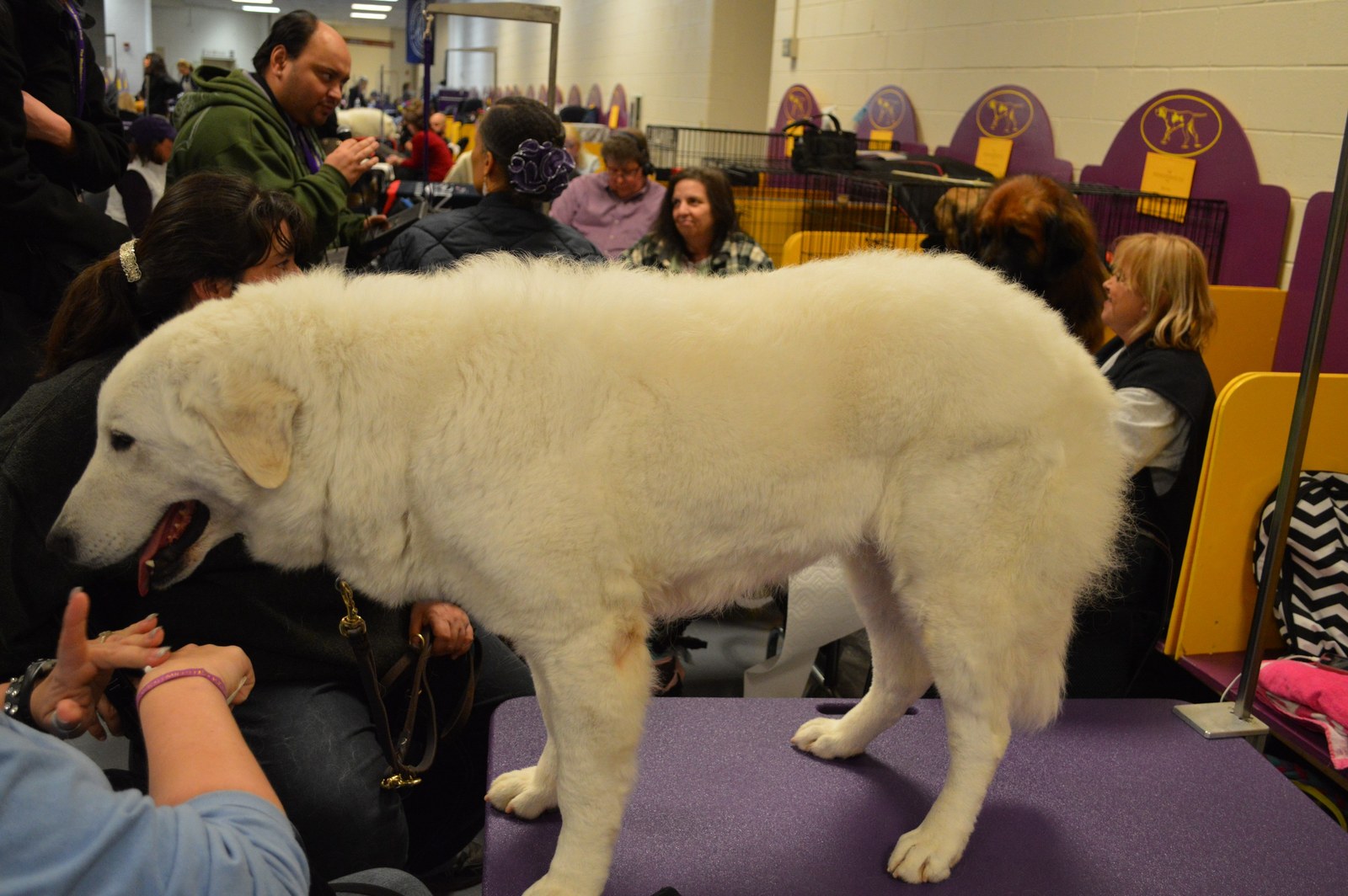

Do you have a better photo of a Kuvasz in the American show ring? If you have a show photo you’d let us use, email it to [email protected] — tell us the dog’s name and the show, and it may be featured here. Please only send photos you took yourself or have the photographer’s permission to share, and tell us the photographer’s name.
1. Breed at a glance
Working Group; recognized by the AKC in 1931
Dogs 28–30 in at the shoulder, 100–115 lb; bitches 26–28 in, 70–90 lb
Double coat, medium coarse, wavy to straight; white with no markings only
10–12 years
Spirited, keenly intelligent, determined, courageous, and curious; devoted to its own family, polite to accepted strangers, suspicious of new ones
Kuvasz Club of America, established 1966, AKC parent club since 1993
A Kuvasz is a guardian that thinks for itself. For centuries it lived with the flock on open ground, alone at night, and decided on its own whether what approached was a wolf, a bear, or a friend — and acted on that decision without waiting for instruction. That independence is still the whole dog: loyal and patient with its own family, watchful and discriminating with everyone else, and happiest with a job and a territory to look after. It is also a rare breed, well down the AKC registration lists, so most people meet their first Kuvasz at a dog show, not on the street.
2. History
The Kuvasz is an ancient guardian dog, originally used for protecting livestock such as horses, sheep, and cattle. Its origins have been traced back as far as the steppes of the Ural Mountains in Siberia, and in the late 9th century the Magyar tribes conquered the Carpathian Basin, beginning the establishment of Hungary and bringing the Kuvasz with them. There, the breed achieved its present appearance. (Source: Kuvasz Club of America, Meet the Kuvasz.)
During the reign of Matthias Corvinus, King of Hungary (1458–1490), and Hungary’s Renaissance period, Kuvaszok were used by the nobility for protection and hunting game, and King Matthias established his own breeding program. It is said that he placed trust in his Kuvaszok over his own Royal Guardsmen and kept at least a brace — two or more dogs — with him at all times, and that a gift of a Kuvasz from the King’s Royal Kennels was a special honor. Aristocratic connections aside, Kuvaszok were always first and foremost the people’s guardian. (Source: Kuvasz Club of America, Meet the Kuvasz.)
During World War II the breed was almost driven to extinction in Hungary: the large white dogs, protecting their families and farms, were a problem to invading forces, and some letters of the time suggest the dogs were hunted by occupying troops. After the war, a search of the country found fewer than 30 dogs remaining, and thanks to one factory owner who wanted Kuvaszok to guard his property, and to other dedicated breeders in Hungary and other parts of Europe, the breed was repopulated. Kuvaszok were first shown at a dog show in 1883, when Count d’Esterházy displayed two of them in Vienna; the first Hungarian standard was written in 1885, and the first Kuvasz registered in the United States appears in the stud books of August 1931. The Kuvasz Club of America was established in 1966 and was granted status as the official breed club in America by the AKC in 1993. (Source: Kuvasz Club of America, Meet the Kuvasz.)
3. The standard and why it is written that way
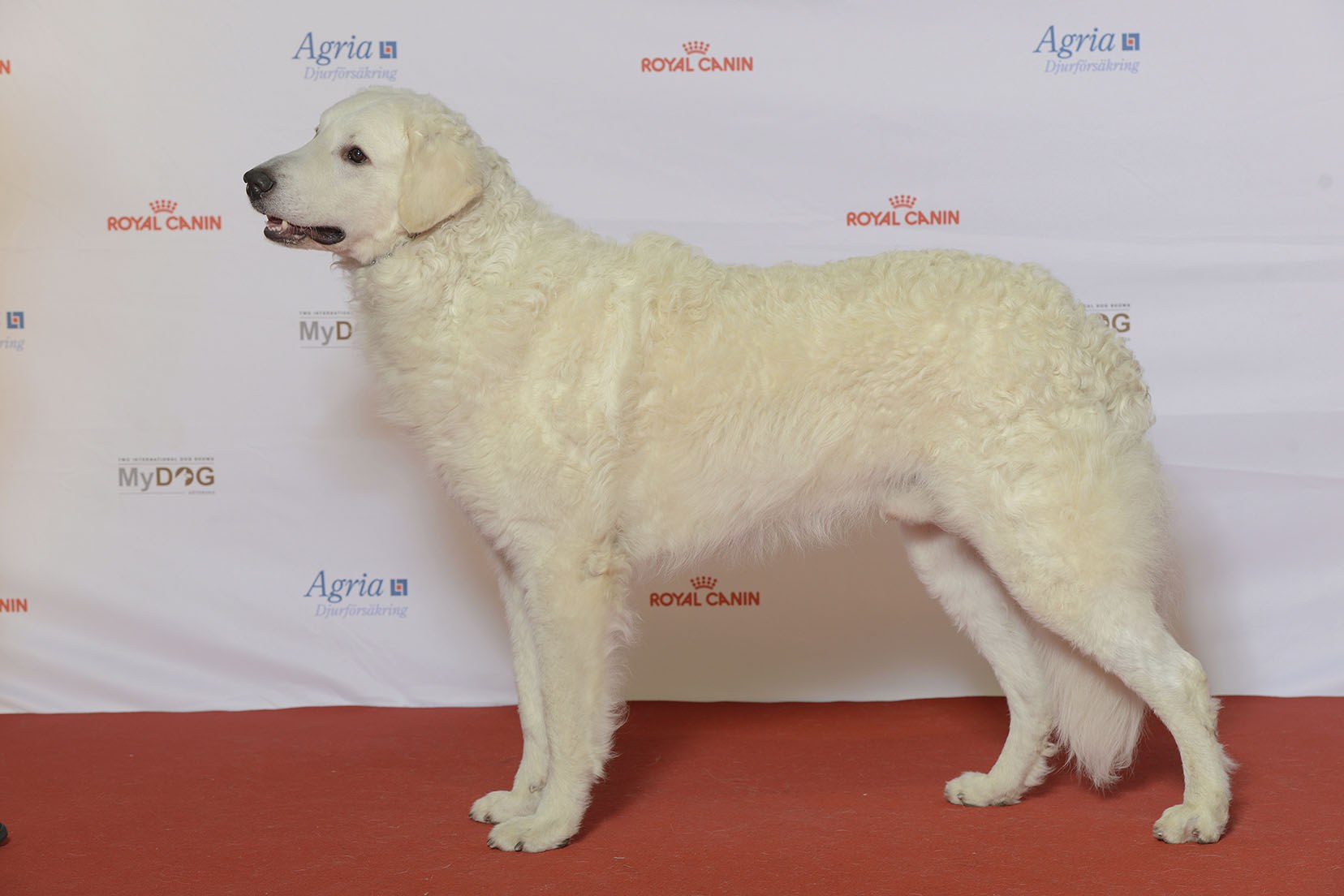
- General appearance — a working dog of larger size. “A working dog of larger size, sturdily built, well balanced, neither lanky nor cobby. White in color with no markings.” Medium boned, well muscled, without the slightest hint of bulkiness or lethargy, moving freely on strong legs. (Source: Kuvasz Club of America, Official Standard of the Kuvasz.)
- Size & proportion — tall, and built as a rectangle. Dogs 28 to 30 inches at the shoulder, about 100 to 115 pounds; bitches 26 to 28 inches, about 70 to 90 pounds. The trunk and limbs form a horizontal rectangle slightly deviated from the square. Dogs smaller than 26 inches and bitches smaller than 24 inches are disqualified. (Source: Kuvasz Club of America, Official Standard of the Kuvasz.)
- Head — the most beautiful part of the Kuvasz. The standard says so itself: head proportions are of great importance, the head being considered the most beautiful part of the breed. Almond-shaped eyes, set well apart and somewhat slanted, dark brown — the darker the better. V-shaped ears, rather thick, well set back. Nose large and black; lips black, closely covering the teeth. Scissors bite preferred, level bite acceptable. (Source: Kuvasz Club of America, Official Standard of the Kuvasz.)
- Coat & color — white, and only white. A double coat, formed by guard hair and a fine undercoat, medium coarse in texture, ranging from quite wavy to straight. The neck carries a mane that extends to and covers the chest; the backs of the thighs and the whole tail carry hair 4 to 6 inches long. Color: white. The skin is heavily pigmented — the more slate gray or black pigmentation, the better. It is natural for the Kuvasz to lose most of the long coat during hot weather, and a summer coat should not be penalized. (Source: Kuvasz Club of America, Official Standard of the Kuvasz.)
- Tail & gait — low tail, easy movement. The tail is carried low, of natural length reaching at least to the hocks; in excitement it may rise to the level of the loin. The gait is easy, free, and elastic, the feet traveling close to the ground, the head carried rather low at the level of the shoulders unless the dog is excited. (Source: Kuvasz Club of America, Official Standard of the Kuvasz.)
- Temperament in the standard — spirited, devoted, and discriminating. “A spirited dog of keen intelligence, determination, courage and curiosity. Very sensitive to praise and blame. Primarily a one-family dog. Devoted, gentle and patient without being overly demonstrative. Always ready to protect loved ones even to the point of self-sacrifice.” Polite to accepted strangers, but rather suspicious and very discriminating in making new friends. (Source: Kuvasz Club of America, Official Standard of the Kuvasz.)
- Disqualifications — the hard lines. Overshot bite; undershot bite. Dogs smaller than 26 inches; bitches smaller than 24 inches. An undersized Kuvasz or one with a wrong bite is not a fault to be weighed — it is out. (Source: Kuvasz Club of America, Official Standard of the Kuvasz.)
- Why it is written that way. Every clause in the standard points back to a night alone with the flock: the white coat let a shepherd tell guardian from wolf in low light; the size and strength were for wolves and bears, not for show; the mane and double coat were weatherproofing; and the low, easy gait was for covering rough terrain for long hours without tiring. The temperament paragraph is the job description itself — a dog that thinks, decides, and acts on its own initiative at just the right moment, without instruction.

4. Temperament & living with one
The standard’s temperament paragraph is the shortest and most quoted part of the breed, and it is also the most honest: a spirited dog of keen intelligence, determination, courage, and curiosity, very sensitive to praise and blame, primarily a one-family dog — devoted, gentle, and patient without being overly demonstrative, and always ready to protect loved ones even to the point of self-sacrifice. The AKC’s own summary is shorter still: beautiful, intelligent, independent, and profoundly loyal. (Sources: Kuvasz Club of America, Official Standard of the Kuvasz; AKC, Kuvasz.)
- With its own people: devoted, gentle, and patient, with an extremely strong instinct to protect children. A Kuvasz bonds to the whole family, though many form a special attachment to one person, and it is happiest leaning on its people rather than demanding constant contact.
- With strangers: polite to accepted strangers, but rather suspicious and very discriminating in making new friends. That suspicion is the point: a guardian that made friends with every stranger would be useless. Early and ongoing socialization is what turns that wariness into the standard’s calm discrimination instead of fear or aggression.
- Training: keenly intelligent and quick to learn — but independent by design, with an unexcelled ability to act on its own initiative at just the right moment without instruction. It responds to fair, consistent training and to praise, and it remembers blame. Heavy-handed methods backfire on a dog this sensitive and this sure of its own judgment.
- Exercise: a large, athletic dog with an untiring ability to work and cover rough terrain for long periods. It needs daily walks, play, and work with a purpose, and a securely fenced place to patrol — a Kuvasz left alone too long, or without a territory, can turn destructive and excessively vocal.
- First-dog honesty: this is a lot of guardian for a first-time owner. The size, the independence, and the protective instinct all demand an experienced owner who trains from day one and keeps training. If that sounds like a burden rather than a pleasure, a softer breed is the honest choice.
5. Grooming
The Kuvasz’s double coat is wash-and-wear for a big white dog, but it is not no-maintenance: a medium-coarse outer coat over a fine, dense undercoat, with a mane on the neck and feathering behind the legs. Brush weekly to pull out dead hair and keep the white coat clean, and expect a heavy seasonal shed — the standard itself notes that the Kuvasz naturally loses most of the long coat during hot weather. (Sources: Kuvasz Club of America, Official Standard of the Kuvasz; Hill’s, Kuvasz Dog Breed Guide.)
- Shedding: moderate year-round and heavy seasonally, when the long coat comes out. A weekly brush keeps it manageable; a slicker or pin brush takes the dead coat out before it mats behind the ears and legs.
- Bathing: as needed, not on a schedule — the coat sheds dirt well, and over-bathing strips the oils that keep it weatherproof. A white dog that works outside will need a bath after mud; a house dog often will not.
- Nails, ears & teeth: trim nails every few weeks, check ears after baths and swimming, and brush teeth regularly. None of it is breed-specific; all of it matters more in a 100-pound dog that spends its life leaning on you.
6. Health testing
The parent club’s recommended health tests, as published by the AKC, are a hip evaluation, an elbow evaluation, and a thyroid evaluation. A CHIC number requires the breed-specific results to be released publicly, pass or fail. The lists:
- Hip evaluation — the big one. Hip dysplasia is the breed’s most significant inherited concern: a developmental disease of the hip joints that shows up in the rapid growth period and is confirmed by radiograph. Dogs intended for breeding should be x-rayed when mature, and the OFA certifies hips at 24 months and older. (Sources: AKC, Working Group Health Testing Requirements; University of Prince Edward Island, Canine Inherited Disorders Database, Kuvasz; Kuvasz.info, Canine Hip Dysplasia.)
- Elbow evaluation. The elbow radiograph screens for elbow dysplasia, the same family of developmental joint disease as hip dysplasia, in a breed that carries 100 pounds on those joints for a decade. (Source: AKC, Working Group Health Testing Requirements.)
- Thyroid evaluation. The thyroid blood panel screens for thyroid disease, which turns up across the working breeds and is managed, not cured, once found. (Source: AKC, Working Group Health Testing Requirements.)
- Other conditions to ask about: dermatomyositis and ulcerative dermatosis, both of which occur with increased incidence in the breed. (Source: University of Prince Edward Island, Canine Inherited Disorders Database, Kuvasz.)
Ask any breeder for the parents’ results for all three tests and look them up in the OFA database yourself before you commit. The breed’s 10-to-12-year lifespan is a long one for a dog this size, and the testing exists so that those years are healthy ones.
7. The annual Kuvasz specialty dog show
A specialty is the breed’s All-Star show — its Super Bowl. Once a year, the best Kuvaszok from across the country, and often from around the world, come together in one place.
The Kuvasz Club of America’s national specialty: one national event each year, with conformation, sweepstakes, junior showmanship, and the 4–6 Month Beginner Puppy Competition. The 2026 national: May 30, at the Oklahoma State Fairgrounds in Oklahoma City, Oklahoma, with 20 competitors and 29 entries in conformation. The 2025 national: September 5, at the Iowa State Fairgrounds in Des Moines, Iowa, with 12 competitors and 19 entries. The 2027 national: September 23, at the Purina Farms Event Center in Gray Summit, Missouri.
The standard, in brief: a working dog of larger size, sturdily built, well balanced, neither lanky nor cobby. White in color with no markings. Dogs 28 to 30 inches at the shoulder, 100 to 115 pounds; bitches 26 to 28 inches, 70 to 90 pounds. Double coat, medium coarse, wavy to straight, with a mane on the neck. Disqualifications: overshot or undershot bite; dogs under 26 inches, bitches under 24 inches.
The 2026 National Specialty — Saturday, May 30, 2026, at the Oklahoma State Fairgrounds, 3001 General Pershing Blvd, Oklahoma City, Oklahoma. Entry: 29 entries / 20 competitors in conformation (7 dogs, 13 bitches). Entries closed May 13, 2026; entries limited to 100. Event Chair: Randy Ham, San Antonio, Texas. Superintendent: Onofrio Dog Shows, L.L.C. The 4–6 Month Beginner Puppy Competition on the same day, 1 entry / 1 competitor. (Sources: AKC event search, event 2026220201; AKC, National Specialties and Judges Breed Study Groups for 2026.)
National specialty judges: Dr. M J Woods — conformation. Mr. R Chaffin — junior showmanship (Open Intermediate). Sweepstakes offered; the sweepstakes judge not confirmed in an official source as of November 2026. (Source: AKC event search, event 2026220201.)
Results (2026 national). Best of Breed: GCHG CH Emek Hayarden Cudar (dog). Best of Opposite Sex: GCHB CH Whiterock’s Black Widow At Peachtree (bitch). Winners Dog and Best of Winners: Ederra’s Klash Of Kings. Winners Bitch: Peachtree Glacier Tattie. Select Dog: GCHB CH Telaquire Elek Shaken Not Stirred; Select Bitch: GCH CH Ederra-Glacier’s Little Miss Magic FDC CGCA CGCU ATT. Best Junior Handler: Peyton Pasquini. (Source: AKC event search, event 2026220201.)
The 2027 National Specialty: Thursday, September 23, 2027, one day, at the Purina Farms Event Center, 300 Checkerboard Ln, Gray Summit, Missouri, in conjunction with the Gateway Cluster — the club’s 35th National Specialty. National-week schedule: Thursday, September 23, National Specialty Show; Friday, September 24, Saturday, September 25, and Sunday, September 26, designated specialty shows. AKC event number, judges, entries, closing date, and host-club details not yet published as of November 2026. (Sources: AKC Upcoming National Specialties; Kuvasz Club of America, 2027 National Specialty.)
Past national specialties: 2025
Kuvasz Club of America — kuvaszclubofamerica.org
8. Regional specialties through the year: smaller regional shows
The national is the anchor, but the breed’s year also runs through regional specialties — smaller regional shows, not the national — held around the country, including the designated specialties that run with the national. These are the 2026 regionals verified from club and AKC sources so far:
Four regional Kuvasz specialties verified for 2026 so far, all designated specialties at the Oklahoma State Fairgrounds around the national — judges for the 2026 regionals not verified in an official source (designated-specialty results are recorded on the host event):
- Kuvasz Club of America designated specialty — Wednesday, May 27, 2026, Oklahoma City, Oklahoma: at the Oklahoma State Fairgrounds, with the Lawton Dog Fanciers Association (AKC event 2026220202). Event Chair: Billy Price.
- Kuvasz Club of America designated specialty — Thursday, May 28, 2026, Oklahoma City, Oklahoma: at the Oklahoma State Fairgrounds, with the Mid-Del-Tinker Kennel Club (AKC event 2026220203). Event Chair: Cindy Zelbst.
- Kuvasz Club of America designated specialty — Friday, May 29, 2026, Oklahoma City, Oklahoma: at the Oklahoma State Fairgrounds, with the Lawton Dog Fanciers Association (AKC event 2026220205). Event Chair: Billy Price.
- Kuvasz Club of America designated specialty — Sunday, May 31, 2026, Oklahoma City, Oklahoma: at the Oklahoma State Fairgrounds, with the Bartlesville Kennel Club (AKC event 2026220206). Event Chair: Randy Ham.
Past regional specialties: 2025
More regional specialties will be added here as their programs are verified — this section is built from show data, not guesswork. Browse upcoming show weekends →
9. Clubs
- Kuvasz Club of America (KCA) (parent club) — the AKC-recognized national breed club for the Kuvasz. Established in 1966 and granted status as the official breed club in America by the AKC in 1993, it maintains the breed standard, holds the national specialty each year, publishes the Kuvasz Quarterly, and keeps a breeder directory. (Sources: Kuvasz Club of America, Meet the Kuvasz; Kuvasz Club of America, Kuvasz Breeders.)
- KCA breeder directory. The club’s Find a Kuvasz pages list member breeders, and are the first stop for anyone looking for a puppy from a breeder who works under the club’s code. (Source: Kuvasz Club of America, Kuvasz Breeders.)
- Kuvasz Fanciers of America. A separate organization from the parent club — an IRS 501(c)(3) charity founded in 1985, dedicated to the preservation of the authentic Hungarian Kuvasz — which supports ethical breeder conduct, runs the breed’s national rescue, provides public education, and sponsors Kuvasz events. (Source: Adopt-a-Pet, Kuvasz Fanciers of America Rescue.)
10. Rescue
- Kuvasz Fanciers of America Rescue. The national breed-only rescue for Kuvaszok, run by Kuvasz Fanciers of America, Inc., an IRS 501(c)(3) charity founded in 1985 and dedicated to the preservation of the authentic Hungarian Kuvasz. It rescues abandoned and abused Kuvaszok across the country, with regional coordinators who match dogs to homes. Contact: PO Box 80596, Bakersfield, CA 93380; (661) 587-8141; [email protected]. (Sources: Adopt-a-Pet, Kuvasz Fanciers of America Rescue; Kuvasz Fanciers of America.)
- AKC Rescue Network. The AKC’s rescue network lists Kuvasz rescue organizations under its K breeds page, and the parent club is the first stop if you do not know which contact covers your area. (Source: AKC Rescue Network, K Breeds.)
- Relatively few Kuvaszok need rescue. The breed is rare, and most Kuvaszok live their lives as family guardians rather than passing through shelters — so the dogs that do come into rescue usually arrive through the breed’s own rescue network, not through a general shelter. A rescued Kuvasz is usually an adult, and it will arrive with its temperament visible before you commit.
11. Breeder vs. rescue: honest guidance
- If you buy: start with the parent club, the Kuvasz Club of America, and its breeder directory. Ask for the parents’ health-test results — hip, elbow, and thyroid evaluations — and look the results up in the OFA database yourself. Expect to wait for a puppy from a careful breeder: a good breeder will have the answers, will ask you as many questions as you ask them, and will take the puppy back for its whole life if you cannot keep it.
- If you rescue: a rescued Kuvasz is usually an adult, and it will arrive with its temperament visible before you commit. What you get in return is a dog whose character you can see before you commit and a lower price. Either way, be honest with yourself first: a Kuvasz needs a securely fenced place to live and work, daily exercise, and an owner who socializes and trains from day one and keeps training — not a yard and a hope, and not an apartment.
- Watch out for “rare” colors. The standard recognizes one color only — white, with no markings. A seller’s “rare” label on a black, brown, or otherwise off-color Kuvasz is a sales description, not a mark of quality or health. Judge the dog in front of you against the standard — the white coat, the black points, the keen, watchful expression — not against a listing’s adjectives.
- Guard-dog honesty: a Kuvasz is not a first dog for most people. The independence, the protective instinct, and the sheer size all demand an experienced owner who understands livestock guardians. If that sounds like a burden rather than a pleasure, a softer breed is the honest choice.
12. Claim this page
This page belongs to the breed, and the people who know the breed best are the Kuvasz Club of America and its members. If you are with the parent club — or you are a breeder, a judge, a handler, or a rescue volunteer who spotted something wrong, missing, or out of date — this page is yours to set straight. Tell us what needs fixing and where the correction is documented, and we will fix it and credit the source. Contact the site through the About page, and mention “Kuvasz breed profile.”
Sources
- AKC, Kuvasz breed page — akc.org/dog-breeds/kuvasz
- AKC, Working Group Health Testing Requirements — akc.org
- AKC Upcoming National Specialties — apps.akc.org
- AKC, National Specialties and Judges Breed Study Groups for 2026 — images.akc.org (PDF)
- AKC event search, event 2026220201 (2026 national) — apps.akc.org
- AKC event search, event 2025220202 (2025 national) — apps.akc.org
- AKC Rescue Network, K Breeds — akc.org/akc-rescue-network-k-breeds
- Kuvasz Club of America — kuvaszclubofamerica.org
- Kuvasz Club of America, Meet the Kuvasz — kuvaszclubofamerica.org
- Kuvasz Club of America, Official Standard of the Kuvasz — kuvaszclubofamerica.org (PDF)
- Kuvasz Club of America, 2027 National Specialty — kuvaszclubofamerica.org
- Kuvasz Club of America, National Specialty Winners — kuvaszclubofamerica.org
- Kuvasz Club of America, Kuvasz Breeders — kuvaszclubofamerica.org
- Combined Specialty Clubs of Greater Des Moines premium list (2025) — dmgrc.org (PDF)
- Kuvasz Fanciers of America Rescue (Adopt-a-Pet) — adoptapet.com
- University of Prince Edward Island, Canine Inherited Disorders Database, Kuvasz — cidd.discoveryspace.ca
- Kuvasz.info, Canine Hip Dysplasia — kuvasz.info
- Hill’s, Kuvasz Dog Breed Guide — hillspet.com
- Furry Critter Network, Kuvasz breed guide — furrycritter.com
- Petful, Kuvasz Breed Profile — petful.com
- Pets Adviser, GCH Aegys Set Fire To The Rain RN at Westminster 2015, Wikimedia Commons (CC BY 2.0) — commons.wikimedia.org
- Svenska Mässan, FI UCH NO UCH SE UCH WW-14 Czaruso Brian Little at MyDOG, Wikimedia Commons (CC BY 2.0) — commons.wikimedia.org