
Breed profile · Toy Group · the aristocratic toy companion with the Oriental expression
Japanese Chin
The Japanese Chin is a small, well balanced, lively, aristocratic toy dog with a distinctive Oriental expression — a large broad head, large wide-set dark eyes, a short broad muzzle, and a profuse, silky, single coat. It is light and stylish in action, with a plumed tail carried over its back, and the standard calls it a sensitive and intelligent dog whose only purpose is to serve man as a companion. The AKC recognized the breed in 1888, as the Japanese Spaniel, and the name was changed to Japanese Chin in 1977. The Japanese Chin Club of America is the parent club.
Help us improve it. This is one of ThePetAdvisor’s breed profiles, built from public sources with generous links to the people who actually own this breed’s knowledge. If something’s off or missing, the parent club can claim the page and set it straight — see the bottom of the page.
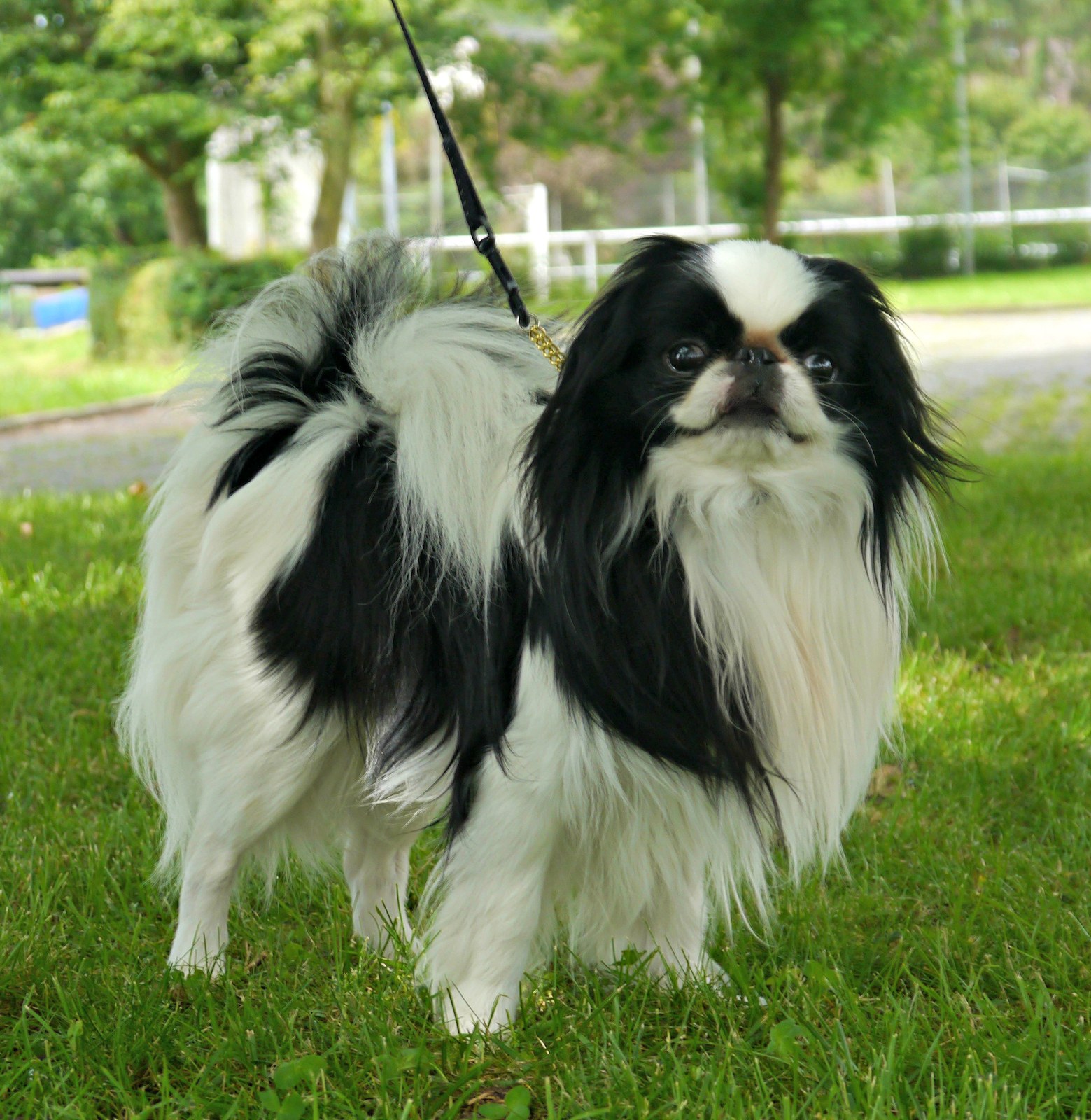

Do you have a better photo of a Japanese Chin in the American show ring? If you have a show photo you’d let us use, email it to [email protected] — tell us the dog’s name and the show, and it may be featured here. Please only send photos you took yourself or have the photographer’s permission to share, and tell us the photographer’s name.
1. Breed at a glance
The Japanese Chin is a charming toy companion of silky, profuse coat and an unmistakably aristocratic bearing. Often described as a distinctly “feline” breed, this bright and amusing lapdog is fastidious, graceful, and generally quiet. (AKC, Japanese Chin.)
- AKC group
- Toy; recognized 1888 as the Japanese Spaniel
- Size
- Ideal 8–11 in at the withers; square outline; the standard sets no weight
- Coat & color
- Profuse, silky, single coat; black and white, red and white, or black and white with tan points
- Lifespan
- 10–12 years
- Temperament
- Sensitive, intelligent, affectionate with its own people, reserved with strangers
- Parent club
- Japanese Chin Club of America
2. History
The Japanese Chin’s true origin is in China, where the breed’s history runs back at least to the fourth century. The dogs were given as gifts between imperial courts, and in Japan they became the companions of the aristocracy — kept in the homes of the nobility and prized for their beauty and temperament. The breed’s name in Japan, “chin,” is distinct from the Japanese word for dog, and the dogs were treated as a separate kind of creature altogether. (Sources: AKC, Japanese Chin: History; Top Notch Toys, A Royal Lineage.)
Japan was closed to the outside world from the early 1600s until the 1850s, and the breed stayed inside that closed world for more than two centuries. The end of the Tokugawa isolation in 1854 — the Treaty of Kanagawa — opened the door. Commodore Matthew Perry presented a pair of Chin to Queen Victoria in 1854, and the first Chin reached the West in that same year. Queen Alexandra received her first Chin in 1863, and Perry gave his pair to his daughter Caroline Perry Belmont; her husband, August Belmont Jr., later served as AKC president from 1888 to 1915. (Sources: AKC, Japanese Chin: History; Top Notch Toys, A Royal Lineage.)
In the United States, the AKC recognized the breed in 1888 as the Japanese Spaniel. The first dog registered was a dog simply called “Jap,” owned by Fred Senn of New York City — the breeder and pedigree are unknown. The breed’s official AKC name was changed to Japanese Chin in 1977, matching the name the Japanese had used for centuries. (Sources: AKC, Japanese Chin: History; National Purebred Dog Day, Japanese Chin.)
3. The standard and why it is written that way
The standard’s first line is the whole breed in one sentence: a small, well balanced, lively, aristocratic toy dog with a distinctive Oriental expression, light and stylish in action. The dog is square in outline, solidly built and compact but refined, with a profuse, silky, soft and straight coat and a plumed tail carried over the back curving to either side. (AKC, Official Standard of the Japanese Chin, approved October 11, 2011, effective November 30, 2011.)
- Head — the breed’s defining feature: a large broad head, with large wide-set eyes, a short broad muzzle, ear feathering, and evenly patterned facial markings. Eyes large, round, dark, and lustrous, set wide apart; a small amount of white in the inner corners gives the “look of astonishment” the standard names. Ears hanging, small, V-shaped, wide apart, set slightly below the crown. Skull large, broad, slightly rounded, with a deep stop. Muzzle short and broad, with well-cushioned cheeks. Nose very short, with wide open nostrils, its tip level with the middle of the eyes and upturned. The nose leather is black in black and white and in black and white with tan points, and self-colored or black in red and white. Bite wide and slightly undershot; missing or misaligned teeth are not severely penalized. The breed is very sensitive to oral examination, and the standard tells the judge to defer to the handler for examination of the teeth and bite.
- Size & body: ideal size 8 to 11 inches at the highest point of the withers; length from sternum to buttock equals the height at the withers, giving the square outline. Neck moderate in length; topline level; body moderately wide in chest with rounded ribs. Tail set high, carried arched over the back. Legs straight, fine boned; feet hare-shaped, with feathering between the toes. Dewclaw removal is optional.
- Coat: abundant, straight, single, silky, with a resilient texture that stands out from the body. A mane or ruff on the neck, shoulders, and chest; feathering on the back of the forelegs; a plume on the tail; culottes on the rump and the back of the thighs. The head and muzzle are short-haired, except for the feathered ears.
- Color: black and white, red and white, or black and white with tan points. Tan points are tan or red spots over each eye, inside the ears, on both cheeks, and at the anal vent area if the dog displays any black. Red includes all shades of red, orange, and lemon, and sable — any of those shades intermingled or overlaid with black. A clearly defined white muzzle and blaze are preferable to a solidly marked head; symmetry of facial markings is preferable; the size, shape, placement, and number of body patches are not of great importance; the white should be clear of excessive ticking. There is no preference among the allowed colors when judging. Disqualification: any color not listed.
- Gait: stylish and lively.
- Temperament (in the standard): sensitive and intelligent, whose only purpose is to serve man as a companion; responsive and affectionate with those it knows and loves, reserved with strangers or in new situations.
Why it is written that way. The standard is a head standard, and it says so in its own terms: the “Oriental expression” is not a mood, it is a set of measurable parts — a broad head, wide-set eyes, a short muzzle, ear feathering, even facial markings. The color disqualification exists because only three patterns are allowed, and a dog in any other color is not a rare Chin, it is a dog that cannot be shown. The square outline and the 8-to-11-inch ideal size keep it a toy, not a small spaniel. And the bite note — the standard telling the judge to defer to the handler for the mouth — is unusually specific, because the breed is unusually sensitive to being handled.
4. Temperament & living with one
Chin are fastidious, graceful, and generally quiet — the AKC calls them a distinctly “feline” breed. They groom themselves, they perch on the highest available seat, and they watch a room before they join it. They are affectionate with their own people and reserved with strangers or in new situations, exactly as the standard describes them.
- With its own people: responsive and affectionate, and happiest as a lapdog and a companion. The standard says its only purpose is to serve man as a companion, and the dog takes that seriously.
- With strangers: reserved, not hostile. A Chin that has not been introduced will keep its distance, and it does not warm up on a schedule.
- Training: intelligent and willing, but sensitive. Gentle, positive training works; harsh handling shuts the dog down. The same sensitivity that makes the standard tell judges to defer to the handler for the mouth is the sensitivity you live with at home.
- Exercise: modest. Short walks and play indoors are enough, and the dog is content in an apartment. The flat face means heat is a real risk — never exercise a Chin hard in heat, and never leave one in a hot car.
- First-dog honesty: a Chin is a good first dog for a calm, attentive household, and a poor fit for a rough household. It is fragile, it does not like being handled roughly, and it is best with older, gentle children rather than small children who grab.
5. Grooming
The coat is profuse, silky, single, and straight — and single is the operative word. There is no undercoat to strip or blow, so the coat is easier to keep than it looks, but the long feathering on the ears, the backs of the legs, and the tail mats easily if it is left alone.
- Brushing: brush the coat through regularly, paying attention to the mane and ruff, the feathered ears, and the culottes on the rump, where mats start. A pin brush or a comb, worked gently through the feathering, is enough — the coat is silky, not woolly, and it does not need to be thinned or stripped.
- Bathing: bathe as needed, and dry the coat thoroughly; a damp long coat mats faster than a dry one.
- Face & ears: keep the face clean, especially around the muzzle and the eyes. The ears are feathered and hang, so check them regularly and keep them clean and dry.
- Eyes: the eyes are large, round, and prominent, which makes them easy to injure. Check them daily, wipe away debris gently, and see a veterinarian promptly for any cloudiness, redness, or squinting.
- Teeth & nails: the mouth is small and the bite is slightly undershot, and missing or misaligned teeth are not severely penalized in the standard — but dental care still matters, and small mouths crowd easily. Trim the nails regularly, and trim the feathering between the toes if it picks up debris.
6. Health testing
The parent club’s health-testing recommendations, published by the AKC and the OFA, are the starting point. Japanese Chin are generally healthy dogs with a 10–12-year lifespan, and some live to 15, but the breed has four tests the parent club requires for CHIC registration, and a flat face that brings its own risks.
- Patella Evaluation (CHIC): the kneecaps. Toy breeds are prone to patellar luxation, where the kneecap slips out of place, and the parent club asks for a patella evaluation — OFA registration from 12 months of age — on every breeding dog.
- Cardiac Exam (CHIC): the heart. A veterinary cardiac examination, with murmurs graded on a scale of 1 to 6, is a routine screen for the breed, and a murmur is the most common thing a vet will find.
- Ophthalmologist Evaluation (CHIC): the eyes. An examination by a board-certified veterinary ophthalmologist (ACVO), because the breed’s large, prominent eyes are prone to injury and to inherited eye disease. The parent club lists eyes among its areas of concern.
- GM2 Gangliosidosis, Japanese Chin type (CHIC, DNA test): a fatal inherited disease of the nervous system. It is recessive, so a puppy is only affected if it inherits the gene from both parents — and a breeder who tests and never pairs two carriers cannot produce an affected puppy. The test is a one-time saliva test; the OFA kit costs $65.
- Dental crowding: the mouth is small and the bite is slightly undershot. Teeth crowd easily, so dental care — brushing, and regular veterinary checks — matters more in a Chin than in a larger dog.
- Heat and airways: the muzzle is short and broad, with a very short nose. Chin are sensitive to heat and should never be exercised hard in warm weather or left in a hot car.
Ask the breeder for the parents’ patella, cardiac, eye, and GM2 results, and look them up in the OFA database yourself before you commit. (Sources: AKC, Toy Group Health Testing Requirements; Japanese Chin Club of America, Health Testing Recommendations; OFA, CHIC Program.)
7. The annual Japanese Chin specialty dog show
A specialty is the breed’s All-Star show — its Super Bowl. Once a year, the best Japanese Chins from across the country, and often from around the world, come together in one place.
The Japanese Chin Club of America’s national specialty: one national event each year, with conformation, sweepstakes, and junior showmanship. The 2026 national: August 20, at the Hyatt Regency Houston West in Houston, Texas, with 52 competitors and 68 entries in conformation. The 2025 national: April 11, at the Wyndham Garden in Greensboro, North Carolina, with 23 competitors and 29 entries. The 2027 national: May 25, at the Embassy Suites by Hilton East Peoria in East Peoria, Illinois.
The standard, in brief: a small, well balanced, lively, aristocratic toy dog with a distinctive Oriental expression — a large broad head, large wide-set dark eyes, a short broad muzzle, and a profuse, silky, single coat. Ideal size 8 to 11 inches at the withers, with a square outline. Only three colors: black and white, red and white, or black and white with tan points — any other color is a disqualification.
The 2026 National Specialty — Thursday, August 20, 2026, at the Hyatt Regency Houston West, 13210 Katy Freeway, Houston, Texas. Entry: 68 entries / 52 competitors in conformation. Entries opened May 1, 2026; entries closed July 29, 2026. Event Chair: Burk Hughes, Little Rock, Arkansas. Event Secretary: Cullen Leck, Vagabond Dog Shows. The national ran with the parent specialty the day before and the Southern Japanese Chin Club of Texas specialty that same Wednesday morning, plus a Top 20 competition on Wednesday evening. (Sources: AKC event search, event 2026057903; 2026 JCCA National Premium List (Vagabond Dog Shows).)
National specialty judge: Mr. David Fitzpatrick — conformation, junior showmanship, and 4–6 Month Beginner Puppy. Sweepstakes judge: Mr. Burk Crancer-Hughes — puppy sweepstakes and veteran sweepstakes. (Sources: AKC event search, event 2026057903; 2026 JCCA National Premium List (Vagabond Dog Shows).)
Results (2026 national). Best of Breed: CH Touche Tennessee Whiskey (dog). Best of Opposite Sex: CH Touche Jungle Love (bitch). Winners Dog: Carousel Space Cowboy; Winners Bitch and Best of Winners: Carousel Tammi Miami. Select Dog: GCH CH Touche Impress; Select Bitch: Musashi Small Town Smoke Show. Awards of Merit: GCH CH Touche Vigilante and GCH CH Royalsilk Livin’ La Vida Loca. Best Puppy: Carousel Tammi Miami; Best Bred-By Exhibitor: Carousel Space Cowboy; Best Veteran: Kimiko’s Chip Off The Ol’ Block Royalsilk; Best Owner-Handled: Musashi Small Town Smoke Show. Best Junior Handler: Analeigha Ybarzabal Martinez; Reserve Best Junior Handler: Naydene Martinez. (Source: JCCA 2026 National Specialty Marked Catalog; Best Junior Handler per AKC event search, event 2026057903.)
The 2027 National Specialty: Tuesday, May 25, 2027, one day, at the Embassy Suites by Hilton East Peoria, 100 Conference Center Dr, East Peoria, Illinois. Entries close May 5, 2027. Event Chair: Vicki Dovellos. Superintendent: Emerald Coast Dog Shows. The parent specialty runs the day before, Monday, May 24, 2027, at the same hotel (AKC event 2027057901, entries limited to 100), with a 4–6 Month Beginner Puppy competition that day. Judges for the 2027 national week not yet published as of November 2026. (Sources: AKC event search, event 2027057902; AKC Upcoming National Specialties.)
Past national specialties: 2025 · 2024 · 2023
Japanese Chin Club of America — japanesechinclubofamerica.org
8. Regional specialties through the year: smaller regional shows
The national is the anchor, but the breed’s year also runs through regional specialties — smaller regional shows, not the national — held around the country, including the regional specialties that run with the national. These are the 2026 regionals verified from club and AKC sources so far:
Two regional Japanese Chin specialties verified for 2026 so far, both in the national week in Houston, Texas:
- Southern Japanese Chin Club of Texas specialty — Wednesday morning, August 19, 2026, Houston, Texas: at the Hyatt Regency Houston West. Judge: Chad Howard. Sweepstakes judge: Cmdr. Pamela Rhyner Hirko. AKC event number not confirmed as of November 2026.
- Japanese Chin Club of America parent specialty — Wednesday afternoon, August 19, 2026, Houston, Texas: at the Hyatt Regency Houston West (AKC event 2026057901), the day before the national. Judge: Sharon Masnick. Sweepstakes judge: Lisa Weaver-White. Entry: 63 entries / 49 competitors. Entries opened May 1, 2026; entries closed July 29, 2026; entries limited to 100. Event Chair: Burk Crancer-Hughes. Event Secretary: Cullen Leck, Vagabond Dog Shows. Best Junior Handler: Analeigha Ybarzabal Martinez; Reserve Best Junior Handler: Naydene Martinez.
The 2027 regionals announced so far:
One regional Japanese Chin specialty announced for 2027 so far, in the national week in East Peoria, Illinois:
- Japanese Chin Club of America parent specialty — Monday, May 24, 2027, East Peoria, Illinois: at the Embassy Suites by Hilton East Peoria (AKC event 2027057901), the day before the national. Entries limited to 100; entries close May 5, 2027. Event Chair: Vicki Dovellos. Superintendent: Emerald Coast Dog Shows. Judges not yet published as of November 2026.
Past regional specialties: 2025 · 2024 · 2023
More regional specialties will be added here as their programs are verified — this section is built from show data, not guesswork. Browse upcoming show weekends →
9. Clubs
The Japanese Chin Club of America is the parent club — the breed’s national organization, and the club that runs the national specialty. Its stated purpose is to encourage and promote quality in the breeding of purebred Japanese Chin and to do all in its power to protect and advance the interests of the breed by encouraging sportsmanlike competition at dog shows and other events, by education, by research, and by the support of the breed. The club publishes a quarterly newsletter, Chin Chatter, runs the annual Top 20 competition with the national specialty, and keeps the breed’s official records. (Sources: Japanese Chin Club of America; About the JCCA.)
- Japanese Chin Club of America (parent club) — japanesechinclubofamerica.org. National specialty, breeder referral, Top 20, Chin Chatter.
- Pacific Northwest Japanese Chin Club — the regional club in the Pacific Northwest; holds specialties with the national cluster in Portland.
- Southern Japanese Chin Club of Texas — the regional club in Texas; holds a specialty with the national in Houston.
- Japanese Chin Club of the Carolinas — the regional club in the Carolinas; holds specialties with the national weekend in Greensboro.
- AKC Marketplace — marketplace.akc.org/puppies/japanese-chin — for puppies from AKC-registered breeders. The parent club’s breeder referral is the better first step.
10. Rescue
Most Japanese Chin in rescue are adults, and most come through a breed-only, foster-based rescue rather than a shelter. The national breed rescue is independent of the parent club — it is run entirely by volunteers, and it takes dogs from owner relinquishments and shelters, not from breeders or puppy mills.
- Japanese Chin Care & Rescue Effort (JCCARE) — the national breed-only rescue: an all-volunteer 501(c)(3) that rehomes Japanese Chin across the United States and parts of Canada, foster-home based, with no facility of its own. It takes owner-relinquished dogs and dogs pulled from shelters, does not buy from pet stores or puppy mills, and matches dogs to homes by temperament and needs. Adoption fees generally $200–$400. japanesechinrescue.org; P.O. Box 750893, Topeka, KS 66675. (Sources: JCCARE; PetShelters.)
- Colorado Japanese Chin Rescue — a PACFA-licensed rescue in Aurora, Colorado, that takes in and rehomes Japanese Chin and their mixes. cjcrescue.com.
- AKC Rescue Network — the AKC’s rescue directory also lists Japanese Chin rescue contacts: akc.org/akc-rescue-network.
Rescue dogs are almost always adults, and their temperaments are already visible — which is an advantage in a breed this sensitive. A rescue will want to know your home, your schedule, and your other animals before it places a dog with you. That is the process working, not a delay.
11. Breeder vs. rescue: honest guidance
The honest version, before you decide:
- “Teacup” Japanese Chin do not exist. The standard has one size — ideal 8 to 11 inches — and no variety. Anyone selling a “teacup” Chin is selling a small dog at a premium price, not a variety, and a dog bred to be extra small is more likely to carry extra health problems.
- Color is not a rarity. Only three colors are allowed — black and white, red and white, or black and white with tan points — and any other color is a disqualification. A “rare” solid black, chocolate, or tricolor Chin is a dog that cannot be shown, sold as a rarity.
- Ask for the four health tests. Patella, cardiac, ACVO eye, and the GM2 DNA test — and look the parents up in the OFA database yourself. A breeder who has done the tests will be glad to show them; a breeder who has not will change the subject.
- Be honest about the flat face. A short muzzle means heat is a real risk, prominent eyes are easy to injure, and a small mouth means dental care matters. Vet bills are part of the decision, not an afterthought, and it is worth choosing a veterinarian who is comfortable with flat-faced toy dogs.
- Rescue adults are a real option. JCCARE rehomes adults across the country, and an adult’s temperament is already visible — which matters in a breed that is reserved with strangers and sensitive to handling.
12. Claim this page
Do you own a Japanese Chin? Have a photo from a national specialty or a regional specialty, or a correction to something on this page? Japanese Chin Club of America members, breeders, and exhibitors — and anyone with a standard-conforming dog — can help this page get better. See the photo note under the photo above for how to send a picture, or contact us with a correction.
Sources
- AKC, Official Standard of the Japanese Chin (PDF) — images.akc.org/pdf/breeds/standards/JapaneseChin.pdf
- AKC, Japanese Chin breed page — www.akc.org/dog-breeds/japanese-chin
- AKC, Japanese Chin: History — www.akc.org/expert-advice/dog-breeds/japanese-chin-history-japans-royal-spaniel
- AKC, Toy Group Health Testing Requirements — www.akc.org/breeder-programs/akc-breed-health-testing-requirements/toy-group-health-testing-requirements
- AKC, Upcoming National Specialties — www.apps.akc.org/apps/events/conformation/national_specialties.cfm
- AKC event search, event 2027057902 (2027 national) — www.apps.akc.org/apps/events/search/index_results.cfm
- AKC event search, event 2026057903 (2026 national) — www.apps.akc.org/apps/events/search/index_results.cfm
- AKC event search, event 2025057903 (2025 national) — www.apps.akc.org/apps/events/search/index_results.cfm
- AKC event search, event 2024057901 (2024 national) — www.apps.akc.org/apps/events/search/index_results.cfm
- AKC event search, event 2023057902 (2023 national) — www.apps.akc.org/apps/events/search/index_results.cfm
- Japanese Chin Club of America — japanesechinclubofamerica.org
- Japanese Chin Club of America, Health Testing Recommendations — japanesechinclubofamerica.org/health-testing-recommendations
- Japanese Chin Club of America, Meet Our Judges — japanesechinclubofamerica.org/national-specialty/judges
- Japanese Chin Club of America, Top 20 — japanesechinclubofamerica.org/top-20
- JCCA 2026 National Specialty Marked Catalog — japanesechinclubofamerica.org/wp-content/uploads/2026/09/Marked-Catalog-Japanese-Chin-COA-E2026057903004-national.pdf
- 2026 JCCA National Premium List (Vagabond Dog Shows) — www.vagabonddogshows.com/s/2026-Chin-National-PL.pdf
- 2025 JCCA National Weekend Premium List (MB-F) — japanesechinclubofamerica.org/wp-content/uploads/2025/04/2025-PL.pdf
- 2024 JCCA National Judging Program (BaRay) — baray-production-storage.s3.us-west-2.amazonaws.com/judging_program/vuE760cqSK61Edj9ab4sb6u0ZJaldTAnCf104tSD.pdf
- OFA, CHIC Program — ofa.org/chic-programs
- Japanese Chin Care & Rescue Effort (JCCARE) — japanesechinrescue.org
- Colorado Japanese Chin Rescue — cjcrescue.com
- Top Notch Toys, A Royal Lineage: The History of the Japanese Chin — www.topnotchtoys.com/blog/a-royal-lineage-the-fascinating-history-of-the-japanese-chin
- National Purebred Dog Day, Japanese Chin — nationalpurebreddogday.com/japanese-chin
- Adopt-a-Pet, Japanese Chin — www.adoptapet.com/dog-breeds/japanese-chin
- Wikimedia Commons, File:Chin posing.jpg (hero photo) — commons.wikimedia.org/wiki/File:Chin_posing.jpg