Breed profile · Toy Group · the smallest of the sighthounds
Italian Greyhound
The Italian Greyhound — the smallest of the sighthounds, a miniature Greyhound barely a foot tall at the shoulder — is an ancient Mediterranean companion that spent two thousand years beside Roman nobles and Renaissance royalty before the AKC began registering the breed in 1886. The Italian Greyhound Club of America runs the national specialty every year, and the 2026 national ran November 3–5 in Napa, California.
Help us improve it. This is one of ThePetAdvisor’s breed profiles, built from public sources with generous links to the people who actually own this breed’s knowledge. If something’s off or missing, the parent club can claim the page and set it straight — see the bottom of the page.
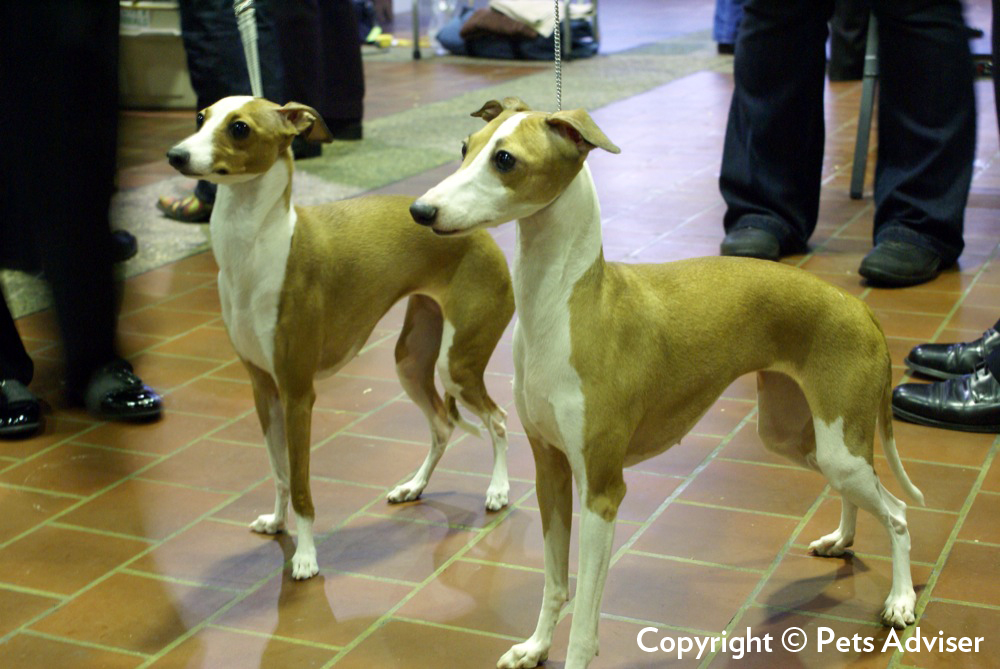

Do you have a better photo of an Italian Greyhound in the American show ring? If you have a show photo you’d let us use, email it to [email protected] — tell us the dog’s name and the show, and it may be featured here. Please only send photos you took yourself or have the photographer’s permission to share, and tell us the photographer’s name.
1. Breed at a glance
Toy Group; AKC-recognized since 1886
Ideally 13–15 in at the shoulder; 7–14 lb
Short, glossy, satin-like; any color and markings except brindle and black-and-tan markings
14–15 years (AKC)
Alert, playful, highly affectionate, sensitive
Italian Greyhound Club of America, Inc.
2. History: a two-thousand-year-old companion
The Italian Greyhound is the smallest of the sighthounds, and one of the oldest — a miniature Greyhound whose history runs back more than 2,000 years to the small sighthounds of the Mediterranean, in the lands that are now Greece and Turkey. Archaeological evidence puts these little dogs beside people during the Roman Empire, and by the Middle Ages they were the companions of European nobility, above all in Italy, where the breed took its name.
The dogs reached England in the 1600s, and the first volume of The Kennel Club Calendar and Stud Book, published in 1874, lists forty of them. The American Kennel Club began registering the breed in 1886, making the Italian Greyhound one of the AKC’s earliest breeds — but it stayed rare in the United States for a long time. The Italian Greyhound Club of America, the AKC parent club, was founded in 1954.
The breed’s modern shape is a Renaissance dog: the same elegant, fine-boned companion that appears in Renaissance art, now a house dog that still runs lure coursing and straight racing — the IGCA national specialty week still opens with lure coursing trials and an LGRA race meet.
3. The standard: a Greyhound in miniature
The AKC standard was approved on December 14, 1976. It opens with the description: “The Italian Greyhound is very similar to the Greyhound, but much smaller and more slender in all proportions and of ideal elegance and grace.”
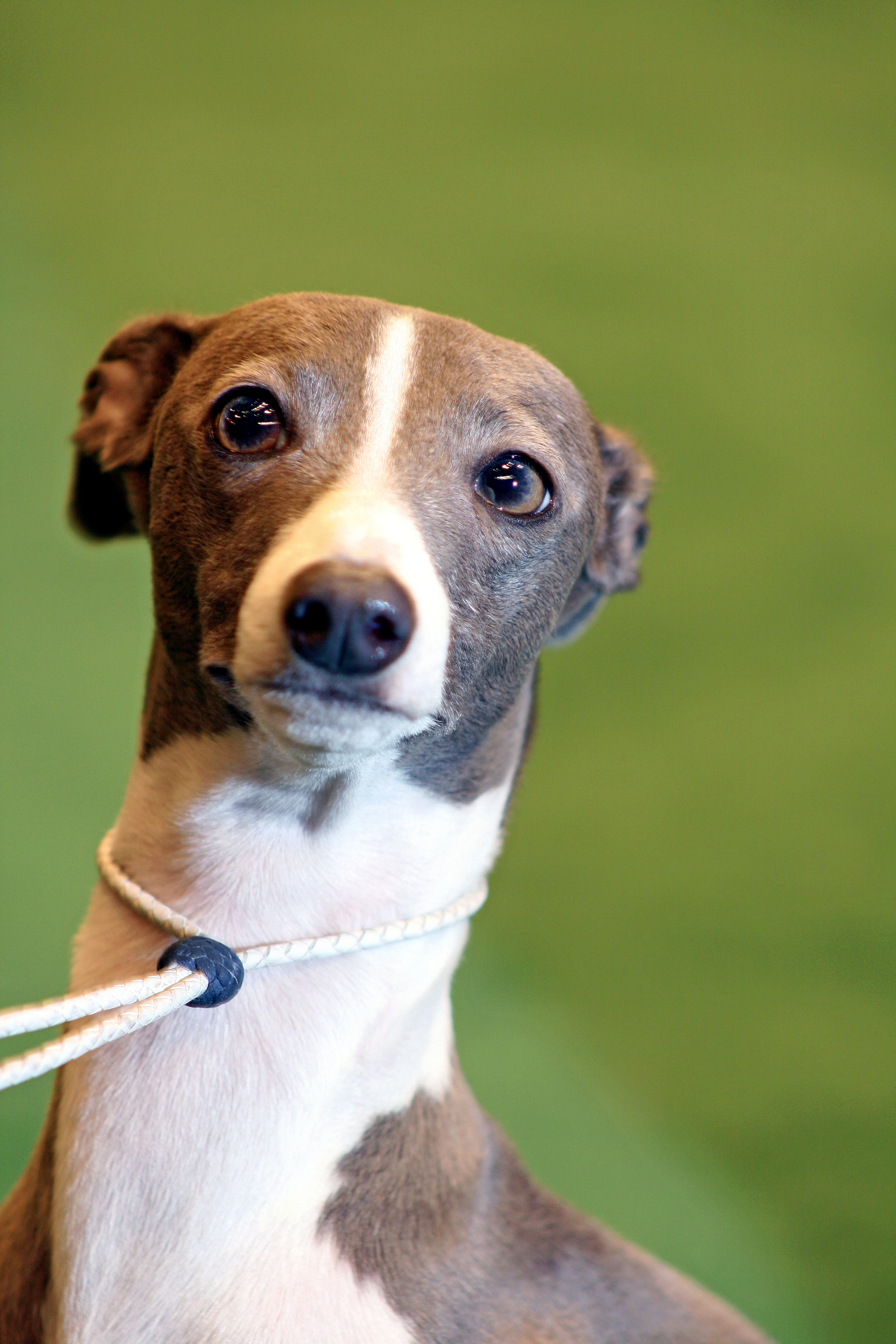

Size. Height at the withers, ideally 13 to 15 inches, and 7 to 14 pounds — the smallest of the sighthounds. The body is medium in length and short coupled, high at the withers, with the back curved and drooping at the hindquarters, the highest point of the curve at the start of the loin, and a definite tuck-up at the flanks. The neck is long, slender, and gracefully arched; the chest is deep and narrow; the feet are harefoot, with well-arched toes.
Head. The head is narrow and long, tapering to the nose, with a slight suggestion of stop and a rather long, almost flat skull. The muzzle is long and fine, the nose dark — black or brown, or in keeping with the color of the dog — and a light or partly pigmented nose is a fault. The eyes are dark, bright, intelligent, and medium in size; very light eyes are a fault. The ears are small and fine, thrown back and folded except when the dog is alerted, when they fold at right angles to the head; erect or button ears are severely penalized. The bite is scissors; a badly undershot or overshot bite is a fault.
Coat, color, and tail. The coat is short, glossy like satin, and soft to the touch, over fine, supple skin. Any color and markings are acceptable — with two hard lines, and both are disqualifications: a dog with brindle markings, and a dog with the tan markings normally found on black-and-tan dogs of other breeds. The tail is slender and tapering to a curved end, long enough to reach the hock, set low and carried low; a ring tail is a serious fault, and a gay tail is a fault.
4. Temperament: a lapdog with a coursing hound inside
The Italian Greyhound is a companion first and a sighthound second: sensitive, alert, and affectionate, a dog that bonds hard to its people and wants to be where they are — on the sofa, under a blanket, and as close as it can get. The AKC calls the breed “an alert, playful, and highly affectionate toy companion,” and then adds the other half of the dog: “at heart they are flash-and-dash coursing hounds with an instinct for pursuit.” They are gentle with children they know and grow up with, but they are small, fine-boned, and easily startled, so rough play and a loud, chaotic household are a poor fit.
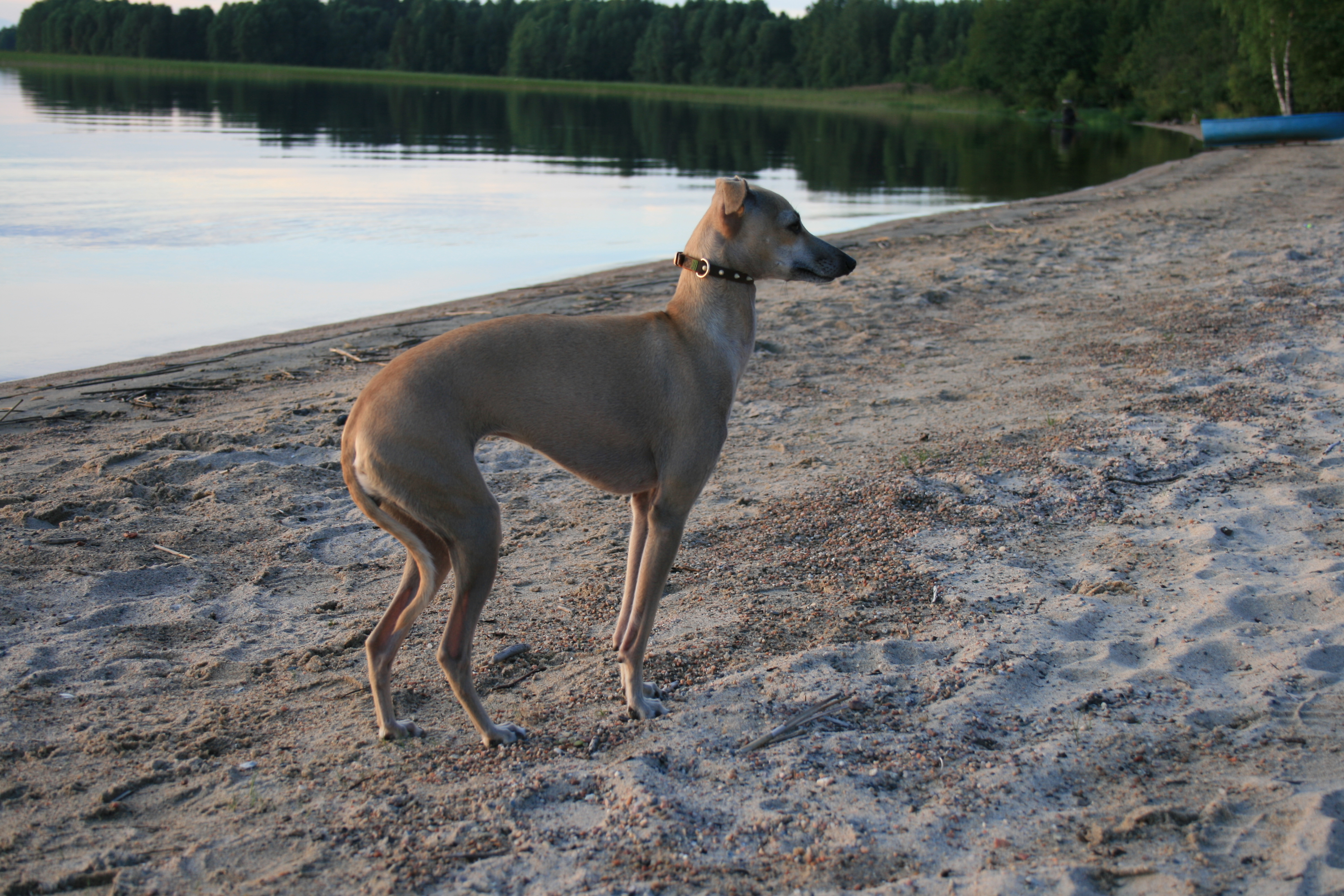

Under the lapdog is a real sighthound: Italian Greyhounds love to run, and they will chase anything that moves — a squirrel, a leaf, a plastic bag — so off-leash time belongs in a securely fenced area, never an open yard. They are quick, athletic, and clever, and they learn fast with gentle, positive training; harsh corrections shut them down. House-training takes patience — the breed is famously slow to house-train, and cold, wet weather makes it worse, because an Italian Greyhound hates being cold and wet.
The honest note is fragility: at 7 to 14 pounds with fine, slender legs, an Italian Greyhound can break a leg jumping off a sofa or a bed, and puppies are especially at risk. Ramps, steps, and supervision around furniture are part of owning the breed, not optional extras.
5. Grooming and everyday care
Grooming is the easy part: the short, glossy coat needs a weekly brush and an occasional bath, and that is about it. The harder parts are the teeth and the cold. Italian Greyhounds are prone to gum disease, so teeth need regular brushing and veterinary dental care; and with almost no body fat and a single thin coat, they feel the cold — sweaters, coats, and a warm bed are necessities in winter, not accessories.
Exercise is real but modest: a daily walk and a chance to run in a fenced area keep an Italian Greyhound happy, and the breed does well in apartments as long as it gets that outlet. What it does not do well is being left alone all day — this is a dog that was bred to be a companion, and it will be miserable, and destructive, if it is ignored.
Feeding is straightforward: a good-quality food, measured meals, and a lean weight at 7 to 14 pounds. An Italian Greyhound should look slender — ribs felt easily under the thin coat, with a visible tuck-up — and extra weight is hard on the legs and joints. Watch the treats, and keep the dog off high furniture it might jump from.
6. Health: the tests that matter
The Italian Greyhound Club of America recommends three health tests for breeding stock: a patella evaluation, an ophthalmologist evaluation, and a thyroid evaluation. A CHIC number means the tests were done and published by the OFA — it does not mean the dog passed them. Ask for the parents’ CHIC numbers and look them up yourself on the OFA database.
The tests point at the breed’s known weak spots. Luxating patellas are the most common orthopedic problem — breed health sources report about one in four Italian Greyhounds affected — and the eye exam watches for progressive retinal atrophy and other eye disease. The thyroid test watches for autoimmune thyroiditis. Other issues to know: seizure disorders, color dilution alopecia (hair loss in blue and fawn dogs), liver shunts, and von Willebrand’s disease. The AKC lists the breed’s lifespan as 14 to 15 years.
7. The annual Italian Greyhound specialty dog show
A specialty is the breed’s All-Star show — its Super Bowl. Once a year, the best Italian Greyhounds from across the country, and often from around the world, come together in one place.
The Italian Greyhound Club of America’s national specialty: one national event each year, a full specialty week built around conformation, sweepstakes, futurity, and junior showmanship, with lure coursing, racing, obedience, and rally alongside. The 2026 national ran November 3–5 in Napa, California, with the conformation specialty on Thursday, November 5, and the Top 20 Gala on Wednesday evening. The 2027 national: not yet announced.
The standard, in brief: the smallest of the sighthounds, a miniature Greyhound, ideally 13 to 15 inches at the shoulder and 7 to 14 pounds, with a short, glossy, satin-like coat in any color and markings except brindle and the tan markings of black-and-tan dogs of other breeds. The temperament is sensitive, alert, and affectionate — a companion first, and a racer and courser second.
The 2026 IGCA National Specialty — Tuesday, November 3–Thursday, November 5, 2026, at the Napa Valley Exposition, 575 Third St, Napa, California. Indoor, unbenched, show hours 7:00 am–8:00 pm. Entries opened Sunday, September 13, 2026, at noon PT and closed Wednesday, October 14, 2026, at noon PT. Event Secretary: Lisa Merki, c/o DogZibit. Show Chair: Emily White. The host hotel was the Holiday Inn Express & Suites – Napa Valley, 5001 Main St, American Canyon, California.
The week opened with lure coursing and racing at Gibson Ranch Park in Elverta — AKC and AOK9 lure coursing trials on Saturday, October 31 and Sunday, November 1, and an LGRA race meet and AOK9 sprint trial on Monday, November 2. Tuesday, November 3 brought obedience and rally, judged by Linda Hause, judges education, the IGCA members meeting, the welcome party, and a fun match judged by Ken Wall. Wednesday, November 4 was puppy and veteran sweepstakes, dual titled, and altered, all judged by Jutta Kulic, the Parade of Titleholders, the futurity judged by Rick Bowling, and the Top 20 Gala and dinner. The national specialty itself was Thursday, November 5, judged by Doug Johnson — 4–6 Month Beginner Puppy, junior showmanship, regular classes, veterans, Best of Breed, Stud Dog, Brood Bitch, and Brace — with the banquet in the evening at La Strada in American Canyon. The entry counts had not been published in an official source as of November 2026.
Results (2026 national). Best of Breed and the other top winners had not been published in an official source as of November 2026 and will be added here when they are.
The dates for the annual 2027 Italian Greyhound specialty dog show had not been announced as of November 2026. The AKC’s Upcoming National Specialties list, which runs through October 2027, carries no Italian Greyhound Club of America entry. This page will be updated when the club announces the 2027 national.
The national has moved around the country in recent years — Colorado Springs in 2024, Hot Springs, Arkansas in 2025, Napa, California in 2026 — so the 2027 location is the detail to watch for.
Past national specialties: 2025 · 2024
Italian Greyhound Club of America — italiangreyhound.org
8. Regional specialties through the year: smaller regional shows
The national is the anchor, but the breed’s year also runs through regional specialties — smaller regional shows, not the national — held around the country, including the regional specialties that run with the national. These are the 2026 regionals verified from club and AKC sources.
Regional Italian Greyhound specialties verified for 2026:
- Northern California Italian Greyhound Club Designated Specialty — Friday, November 6, 2026, Napa, California: held with the national specialty week at the Napa Valley Exposition; breed judged by Beth Sweigart, sweepstakes judged by Tim Robison.
- Valley of the Sun Italian Greyhound Club Designated Specialty — Saturday, November 7, 2026, Napa, California: held with the national specialty week at the Napa Valley Exposition; breed judged by Vandra Huber, sweepstakes judged by Shawna Swanson.
Other 2026 regional specialties had not been verified from club or AKC sources as of November 7, 2026.
More regional specialties will be added here as their programs are verified — this section is built from show data, not guesswork. Browse upcoming show weekends →
9. Clubs
The Italian Greyhound Club of America, Inc. (IGCA) is the AKC parent club for the breed in the United States, founded in 1954. It is the guardian of the breed and determines the official breed conformation standard, runs the national specialty every year, and promotes responsible breeding, education, research, and rescue. The club’s 2026 officers: President Jeff White, 1st Vice President Shawna Swanson, 2nd Vice President Tracy Moraca, Treasurer Marsha Pugh, Recording Secretary Libby Seawright, Corresponding Secretary Mary Marlowe, and AKC Delegate Jennifer Graves. The club’s website is at italiangreyhound.org.
Regional clubs around the country run the regional specialties and the local life of the breed, among them the Northern California Italian Greyhound Club and the Valley of the Sun Italian Greyhound Club, whose designated specialties ran with the 2026 national week in Napa. The breed also has a coursing and racing community of its own: the national week opens with lure coursing trials and an LGRA race meet, and Italian Greyhounds compete in AKC, ASFA, and AOK9 coursing and LGRA straight racing.
10. Rescue
The main breed-specific rescue is the Italian Greyhound Rescue Foundation (IGRF), established by the Italian Greyhound Club of America and run as a separate 501(c)(3) nonprofit. It is an all-volunteer, foster-home-based organization with rescue representatives in most states, and it takes in Italian Greyhounds in need and places them in screened homes. Every dog is spayed or neutered, brought up to date on vaccinations, and tested for heartworm and fecal parasites before adoption, and adoption fees run from $275 for dogs eight years and older to $350 for puppies — which are very rare in rescue. Contact: igrescue.com.
A rescue Italian Greyhound is usually an adult or a senior — the rescue’s adoption pages note the average age in the program is roughly eight to twelve years — whose temperament is already known, which matters with a breed this sensitive: you will know how the dog is with people, other dogs, and children before you commit. Expect an application, references, and a home visit. A rescue IG still needs the same things a puppy does: a warm bed, gentle handling, and a household that understands a small, fine-boned sighthound.
11. Breeder vs. rescue: honest guidance
Either route starts with the same question: has this dog’s health been tested? From a breeder, ask for the CHIC numbers of both parents — the patella evaluation, the eye examination, and the thyroid evaluation — and check them on the OFA database yourself, by the parents’ registered names. Ask what health issues the breeder sees in their stock, and meet at least the dam. And be honest with yourself about the fragility: this is a small, fine-boned dog, and a breeder who asks how you will keep it safe is doing you a favor.
From rescue, expect an adult or senior dog whose temperament is already known, placed by a program that will match the dog to your life rather than the other way around. Budget for the same things either way: dental care, eye and thyroid care, and a warm wardrobe — sweaters and coats are not optional for this breed. Whichever route you take, the dog that fits is a sensitive, alert, affectionate little sighthound that wants to be with its people — and will be happiest doing exactly that.
12. Claim this page
This page was built from public sources — the AKC standard, the parent club’s own material, AKC event records, and the rescue program’s site — and it is a starting point, not the last word. If you are with the Italian Greyhound Club of America or a regional club and something here is wrong or missing, you can claim this page and set it straight: email [email protected] and tell us what needs fixing. Corrections from the people who own the breed are how this page gets better.
Sources
- AKC, Italian Greyhound
- AKC, Official Standard of the Italian Greyhound (approved December 14, 1976)
- Italian Greyhound Club of America
- Italian Greyhound Club of America, National Specialty
- AKC event search, IGCA national, September 24, 2025 (event 2025176310)
- IGCA 2024 national premium
- IGCA 2024 National Judging Program
- AKC, Upcoming National Specialties list
- AKC, Toy Group Health Testing Requirements
- Italian Greyhound Rescue Foundation
- Italian Greyhound Rescue of Ohio, How to Adopt
- Petco, Italian Greyhound Breed Facts and Information
- Wikipedia, Italian Greyhound
- Wikimedia Commons, 2013 Westminster Kennel Club Dog Show — Italian Greyhound Sisters (Pets Adviser, CC BY 2.0)
- Wikimedia Commons, Italian Greyhound (Lori Branham, CC BY 2.0)
- Wikimedia Commons, Italian Greyhound Isabella (Grigur, CC BY-SA 3.0)