
Breed profile · Hound Group · recognized 1897
Irish Wolfhound
The Irish Wolfhound is the tallest of all dog breeds — a rough-coated, Greyhound-like coursing hound, dignified, courageous, and calm. The American Kennel Club recognized the breed in 1897. The Irish Wolfhound Club of America's national specialty gathers the breed's best in Macungie, Pennsylvania, in May 2027.
Help us improve it. This is one of ThePetAdvisor’s breed profiles, built from public sources with generous links to the people who actually own this breed’s knowledge. If something’s off or missing, the parent club can claim the page and set it straight — see the bottom of the page.
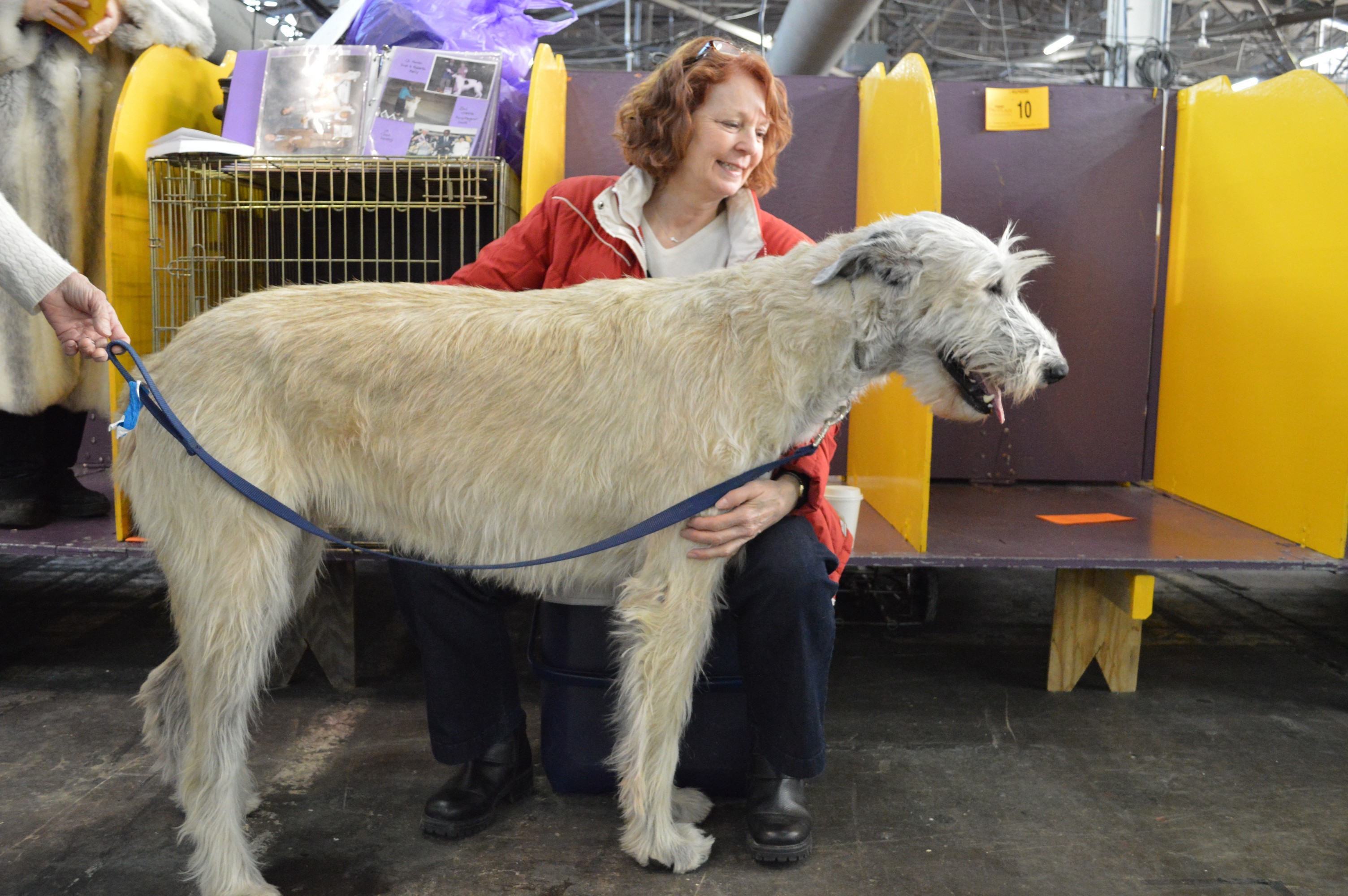
Do you have a better photo of an Irish Wolfhound in the American show ring? If you have a show photo you’d let us use, email it to [email protected] — tell us the dog’s name and the show, and it may be featured here. Please only send photos you took yourself or have the photographer’s permission to share, and tell us the photographer’s name.
1. Breed at a glance
At a glance:
- Group: Hound.
- AKC recognition: 1897. The first Irish Wolfhound registered with the American Kennel Club was Ailbe, in 1897.
- Parent club: Irish Wolfhound Club of America, officially established October 2, 1926; first president Mrs. Norwood Browning Smith.
- Size: the tallest of all dog breeds. Minimums, for hounds over 18 months: dogs 32 inches at the shoulder and 120 pounds; bitches 30 inches and 105 pounds. Anything below the minimums is debarred from competition. The standard aims to establish a race averaging 32 to 34 inches in dogs.
- Typical size: most adult males stand 34 to 35 inches and weigh 140 to 180 pounds; most bitches stand 32 to 33 inches and weigh 105 to 140 pounds.
- Life expectancy: 6 to 8 years.
- Coat: rough and hard on body, legs, and head; especially wiry and long over the eyes and under the jaw.
- Color: gray, brindle, red, black, pure white, fawn, or any other color that appears in the Deerhound.
- Temperament: dignified, courageous, and calm — the AKC's three words for the breed.
2. History
The Irish Wolfhound is one of the oldest documented dog breeds — and one of the strangest stories in the dog world, because the breed nearly vanished and had to be rebuilt. The first written account dates to 391 AD, when the Roman consul Quintus Aurelius Symmachus thanked his brother for a gift of seven Irish hounds and reported that all Rome viewed them with amazement. For centuries these great hounds hunted wolves and the now-extinct Irish elk across Ireland, and they were prized gifts between kings and nobles.
The wolves were the breed's undoing. As wolves were hunted out of Ireland — extinct there by the late 1700s — the hound that existed to hunt them lost its purpose, and by the mid-1800s the Irish Wolfhound was nearly gone. The revival began in the 1860s under Captain George Augustus Graham, a British Army officer who gathered the few remaining Irish dogs and crossed them with Scottish Deerhounds, Great Danes, and other large hounds to rebuild the breed. Graham founded the Irish Wolfhound Club in 1885 and wrote the first standard; the English Kennel Club formally accepted it in 1886. Whether the modern dog is a true descendant of the ancient hounds or Graham's reconstruction of them is still argued — either way, the dog we know is his.
America took the breed up quickly. The American Kennel Club recognized the Irish Wolfhound in 1897 — the first one registered was Ailbe, that same year — and in 1902 the breed became the regimental mascot of the Irish Guards, a ceremonial role it still holds. The Irish Wolfhound Club of America was officially established on October 2, 1926, with Mrs. Norwood Browning Smith as its first president; its first specialty was held in 1927, in conjunction with the Westminster Kennel Club in New York. No specialty was held from 1943 through 1945, while members were engaged in World War II, and the specialty resumed in 1946 at Katonah, New York. Since then the national has moved around the country, and the club's recorded specialty history runs back to that first 1927 show. The standard itself has been revised only twice since Graham wrote it: in 1947, to raise the minimum heights and weights, and in 1950, to remove the historical comparisons to the Great Dane and Deerhound. The current standard was approved September 12, 1950.
3. The standard and why it's written that way
The AKC standard for the Irish Wolfhound, approved September 12, 1950, describes the largest and tallest of the galloping hounds — and it means it. Every point below comes from the standard itself.
- General appearance: of great size and commanding appearance, remarkable in combining power and swiftness with keen sight. The largest and tallest of the galloping hounds, in general type a rough-coated, Greyhound-like breed; very muscular, strong though gracefully built; movements easy and active; head and neck carried high, the tail carried with an upward sweep with a slight curve towards the extremity. (AKC breed standard)
- Head: long, the frontal bones of the forehead very slightly raised and very little indentation between the eyes. Skull, not too broad. Muzzle, long and moderately pointed. Eyes dark. Ears, small and Greyhound-like in carriage. (AKC breed standard)
- Neck: rather long, very strong and muscular, well arched, without dewlap or loose skin about the throat. (AKC breed standard)
- Chest and back: chest very deep, breast wide. Back rather long than short. Loins arched. Belly well drawn up. (AKC breed standard)
- Tail: long and slightly curved, of moderate thickness, and well covered with hair. (AKC breed standard)
- Legs and feet: shoulders muscular, giving breadth of chest, set sloping; elbows well under, neither turned inwards nor outwards. Forearm muscular, and the whole leg strong and quite straight. Muscular thighs, second thigh long and strong as in the Greyhound, hocks well let down and turning neither in nor out. Feet moderately large and round, neither turned inwards nor outwards; toes well arched and closed; nails very strong and curved. (AKC breed standard)
- Coat: rough and hard on body, legs and head; especially wiry and long over eyes and under jaw. (AKC breed standard)
- Color: the recognized colors are gray, brindle, red, black, pure white, fawn or any other color that appears in the Deerhound. (AKC breed standard)
- Size: the minimum height and weight of dogs should be 32 inches and 120 pounds; of bitches, 30 inches and 105 pounds; these to apply only to hounds over 18 months of age. Anything below this should be debarred from competition. Great size, including height at shoulder and proportionate length of body, is the desideratum to be aimed at, and it is desired to firmly establish a race that shall average from 32 to 34 inches in dogs, showing the requisite power, activity, courage and symmetry. (AKC breed standard)
- Faults: too light or heavy a head, too highly arched frontal bone; large ears hanging flat to the face; short neck; full dewlap; too narrow or too broad a chest; sunken, hollow, or quite straight back; bent forelegs; overbent fetlocks; twisted feet; spreading toes; too curly a tail; weak hindquarters and a general want of muscle; too short in body. Lips or nose liver-colored or lacking pigmentation. The standard lists faults, not disqualifications. (AKC breed standard)
- Why the standard is written this way: everything in it serves the gallop. The great size and commanding appearance are the point, not a side effect — the standard's first listed point of merit is that the dog is typical, a rough-coated Greyhound-like breed, the tallest of the coursing hounds. The long head and dark eyes are the keen sight; the deep chest is heart and lung room; the long, straight forelegs and Greyhound-like hindquarters are the engine; the rough, hard coat is weather protection for a hound that worked in the Irish cold. And the size minimums are a hard floor, not a suggestion — a Wolfhound below them is debarred, because a small Wolfhound is not a Wolfhound at all.
4. Temperament & living with one
The Irish Wolfhound is the dog world's gentle giant, and the AKC's three words for the breed — dignified, courageous, and calm — are the breed in a sentence. A Wolfhound is not effusive. It does not bounce, demand, or perform. It leans against you, follows you from room to room, and lies at your feet for hours, content to be near its people. It is a dog that takes up an enormous amount of physical space and almost no emotional space at all.
The exercise needs are moderate for a dog this size, and that surprises people. A Wolfhound needs daily walks and room to run — a safely fenced yard where it can stretch out at a gallop — but it is not a high-energy breed indoors. A Wolfhound that has had its run is a calm, quiet house dog; one that never gets to run is a frustrated one. Never exercise a Wolfhound off-leash in open country: a sighthound that sees a deer or a rabbit is gone, and recall is not reliable against prey. Fences must be tall and secure — a Wolfhound is an athlete that can clear a surprising height.
With people, Wolfhounds are gentle and polite rather than protective. They are usually patient with children but do best with respectful, older children, and they are aloof with strangers rather than suspicious — a Wolfhound is no guard dog. Early socialization matters: a Wolfhound that meets the world as a puppy grows into a confident adult; one that doesn't can grow shy and spooky.
With other animals, the prey drive is the whole story. Cats and small animals need careful introductions and supervision, and some Wolfhounds can never be trusted loose with them. Wolfhounds are generally good with other large dogs. Training works best with gentle consistency — short, upbeat, reward-based sessions. Heavy-handed methods shut a Wolfhound down, and a shut-down Wolfhound simply stops offering anything at all. And one practical truth shapes everything about living with this breed: you will have it for six to eight years, not twelve or fifteen. Plan the home, the budget, and the heart accordingly.
5. Grooming
The coat is the easy part — for a dog this size, the grooming demands are genuinely modest. The Irish Wolfhound's rough, hard, wiry outer coat resists matting, sheds dirt reasonably well, and does not need professional grooming on a regular schedule.
What needs attention instead:
- Brushing: brush once a week with a brush and comb to remove loose hair. The coat sheds year-round, moderately, and does not blow a seasonal undercoat the way longer-coated breeds do.
- Hand-stripping: strip the dead coat by hand twice a year — pulling the dead hair out rather than cutting it — to keep the correct hard texture. For show dogs this is the traditional method; for pets it keeps the coat tidy and the shed coordinated.
- Bathing: once or twice a year is enough, unless the dog gets into something. Over-bathing strips the hard texture the standard calls for.
- Beard and brows: the long, wiry hair over the eyes and under the jaw is part of the breed's look. Keep it, keep it clean, and wipe the beard after meals and drinks — a Wolfhound's beard holds water.
- Ears: small and Greyhound-like in carriage, but check them weekly — the long coat traps moisture around them.
- Feet and nails: feet are moderately large and round, with very strong, curved nails. Keep the nails trimmed so the dog doesn't split them, and keep the hair between the pads tidy so the dog doesn't slip.
- Teeth: brush regularly; a Wolfhound's long jaw is worth protecting, and dental disease in a giant breed is expensive to treat.
6. Health testing
The Irish Wolfhound Club of America's CHIC program turns health testing into a checklist with numbers you can verify — four tests are required for a CHIC number.
Required for a CHIC number:
- Cardiac — advanced cardiac evaluation (echocardiogram) by a board-certified cardiologist. All cardiac clearances must include an echocardiogram.
- Eyes — eye examination by a board-certified veterinary ophthalmologist (CAER/ACVO).
- Hips — hip evaluation, OFA or PennHIP.
- Elbows — elbow evaluation, OFA.
Recommended in addition:
- Serum bile acids — a blood test screening for portosystemic liver shunt, recommended by the AKC for the breed.
Some conditions of concern have no screening test: osteosarcoma (bone cancer), dilated cardiomyopathy, bloat and gastric dilatation-volvulus, and pneumonia. The Irish Wolfhound Foundation funds research into the breed's biggest killers — including the genetics of osteosarcoma at the Broad Institute — and runs health-screening clinics at IWCA specialties. Ask the breeder what has appeared in their lines, how long their dogs live, and whether they take part in the foundation's studies. When you talk to a breeder, ask for the OFA or CHIC numbers — and look them up on the OFA database before you put down a deposit.
7. The annual Irish Wolfhound specialty dog show
A specialty is the breed’s All-Star show — its Super Bowl. Once a year, the best Irish Wolfhounds from across the country, and often from around the world, come together in one place.
The Irish Wolfhound Club of America’s national specialty: the annual Irish Wolfhound specialty dog show. The 2027 national: May 24–26, 2027, at Macungie Memorial Park in Macungie, Pennsylvania, Superintendent Jim Rau Dog Shows, Ltd. The 2026 national: May 18–20, 2026, at Purina Farms in Gray Summit, Missouri, 191 dogs in the entry. Best of Breed: Taliesin’s Baintighearn. The 2025 national: May 27–29, 2025, at the Cache County Fairgrounds in Logan, Utah, 133 dogs in the entry. Best of Breed: GCH Pinehurst Evita of Taryn. The 2024 national: May 20–22, 2024, at Purina Farms in Gray Summit, Missouri, 205 dogs in the entry. Best of Breed: Nightwings On Fire At Rockhart. The 2023 national: April 17–20, 2023, at Myers Park & Event Center in McKinney, Texas, 125 dogs in the entry. Best of Breed: GCH R Noble Nasch.
The 2026 National Specialty — the 96th National Specialty, national week Monday, May 18 – Thursday, May 21, 2026, at Purina Farms, 300 Checkerboard Drive, Gray Summit, MO. Conformation Monday, May 18 – Wednesday, May 20, 2026. Entries opened Monday, March 2, 2026, 12:00 p.m., and closed Monday, April 27, 2026, 12:00 p.m. AKC event number 2026192804. Event chair: David Smith; superintendent: Foy Trent Dog Shows. Conformation: Mr. Pauric Hand (191 Ent – 74d – 117b). Puppy Sweepstakes: Laurie Morris. Obedience and Rally: Loretta Lazzara (Rally event 2026192801, Monday, May 18, 2026). Junior Showmanship: Mr. T S Powers. (Sources: Irish Wolfhound Club of America, 2026 National Specialty results; AKC event search, event 2026192804.)
Results (2026 national). Best of Breed: Taliesin’s Baintighearn (bitch). Best of Opposite Sex: CH Coleraine’s Cortez Bereton. Best of Winners: Taliesin’s Baintighearn. Winners Dog: Carnasserie Lindenhall Zephyr. Best Junior Handler: Camilla Matheson; Reserve Best Junior Handler: Addilynn Demeter-Sweeney. Sweepstakes, obedience, and rally winners not confirmed in an accessible official source. (Sources: Irish Wolfhound Club of America, 2026 National Specialty results; AKC event search, event 2026192804.)
The 2027 National Specialty: conformation Monday, May 24 – Wednesday, May 26, 2027 (3 days), at Macungie Memorial Park, 50 N Poplar St, Macungie, Pennsylvania. Superintendent: Jim Rau Dog Shows, Ltd. Judges, premium, AKC event number, entry fees, entries opening/closing, event chair, and national-week dates beyond the three conformation days not yet published as of November 7, 2026. (Sources: AKC, Upcoming National Specialties; Macungie Memorial Park.)
Past national specialties: 2025 · 2024 · 2023
Irish Wolfhound Club of America
8. Regional specialties through the year: smaller regional shows
The national is the anchor, but the breed’s year also runs through regional specialties — smaller regional shows, not the national — held by the Irish Wolfhound Club of America’s member clubs around the country, usually as independent specialties or as designated specialties with all-breed shows. These are the 2026 regionals verified from club and AKC sources so far:
Five Irish Wolfhound regional specialties verified for 2026 beyond the national itself:
- Potomac Valley Irish Wolfhound Club 42nd Specialty — Sunday–Monday, March 29–30, 2026, Harford County Equestrian Center, Bel Air, Maryland: AKC event numbers 2026270401/0402/0403; entries closed Wednesday, March 4, 2026, midnight; 64 Irish Wolfhounds entered, 91 entries in all. Conformation: Mrs. Lisa Dube-Forman; Sweepstakes: Ms. Donita Osborne; Obedience and Rally: Mr. Michael Mooney. (Source: Potomac Valley Irish Wolfhound Club, 2026 judging program.)
- Irish Wolfhound Association of the Carolinas Specialty — Monday, March 9, 2026, Durham Kennel Club Grounds, Durham, North Carolina: AKC event number 2026752801; 42 Irish Wolfhounds entered, 48 entries in all. Conformation: Jacqueline Carswell; Sweepstakes: Mindy Ballinger. (Source: Irish Wolfhound Association of the Mid-South, 2026 judging program.)
- Irish Wolfhound Club of Puget Sound 50th Specialty — Friday, June 12, 2026, Westside Commons, Hillsboro, Oregon: AKC event number 2026192901; 40 Irish Wolfhounds entered, 49 entries in all. Conformation: Jocelyne Gagné; Sweepstakes: Mindy Levin. (Source: Irish Wolfhound Club of Puget Sound, 2026 judging program.)
- Northstar Irish Wolfhound Club 12th Annual Specialty Weekend — Saturday–Sunday, June 13–14, 2026: AKC event numbers 2026689201/9202; entries closed Wednesday, May 27, 2026, 12:00 noon CT. Saturday conformation: Melanie Mercer, DVM; Saturday Sweepstakes: Dawn Wiseman; Sunday conformation: Hanna Wozna-Gil. Venue not confirmed in an accessible official source. (Sources: Northstar Irish Wolfhound Club, 2026 premium list; Northstar Irish Wolfhound Club, 2026 show results.)
- Irish Wolfhound Association of Lake Erie Specialty — Sunday, August 30, 2026, Hamlin Fireman’s Field, Hamlin, New York: limited to 100 entries; a concurrent specialty with the Tonawanda Valley Kennel Club, AKC National Owner-Handled Series offered. Judges and results not confirmed in an accessible official source. (Source: Irish Wolfhound Association of Lake Erie, 2026 premium list.)
Past regional specialties: 2024
More regional specialties will be added here as their programs are verified — this section is built from show data, not guesswork. Browse upcoming show weekends →
9. Clubs
The parent club is the Irish Wolfhound Club of America (IWCA), officially established October 2, 1926, with Mrs. Norwood Browning Smith as its first president — the AKC-recognized parent club for the breed in the United States. The club runs the national specialty, publishes the magazine Harp & Hound, maintains the breeder directory and the National Rescue Directory, and, through the Irish Wolfhound Foundation, funds health research. The club celebrated its centenary in 2026, with a 100-year anniversary book to be published in spring 2027. (Irish Wolfhound Club of America)
Regional clubs include the Potomac Valley Irish Wolfhound Club, Irish Wolfhound Club of Puget Sound, Northstar Irish Wolfhound Club, Northern California Irish Wolfhound Club, Rocky Mountain Irish Wolfhound Association, Irish Wolfhound Association of the Carolinas, Irish Wolfhound Association of the Delaware Valley, Irish Wolfhound Association of the Garden State, Irish Wolfhound Association of Lake Erie, Irish Wolfhound Association of New England, Irish Wolfhound Association of the West Coast, and South Central Irish Wolfhound Club.
The club is also active in the field: lure coursing and straight racing are part of national week, with LGRA and ASFA events held alongside the conformation show, and the club's first Breeders' Cup was held at the 2026 National Specialty.
10. Rescue
The Irish Wolfhound Club of America Rescue Committee runs a National Rescue Directory of volunteers across the United States who help owners who can no longer care for their Wolfhound, and who place surrendered hounds in loving, permanent, safe homes. Volunteers check references, inspect adoptive homes, and spay or neuter when the hound's age and health allow. Start at the club's rescue page: iwclubofamerica.org/rescue.
The Irish Wolfhound Foundation, the club's 501(c)(3) founded in 2002, supports rescue with grants to the people doing the work — contact the IWCA Rescue Committee first, then the foundation's rescue fund. Regional rescue work includes the South Central Irish Wolfhound Club, rescuing purebred Wolfhounds for over 40 years, and Irish Wolfhound Rescue of the Mid South, serving North Carolina, South Carolina, Virginia, West Virginia, Georgia, and Florida.
Rescue Wolfhounds are usually adults whose temperament is already known — a real advantage with a giant breed, provided the home has room, a safely fenced yard, and a budget that fits a 140-pound dog with a short lifespan and real veterinary needs.
11. Breeder vs rescue
From a breeder: expect a breeder who shows or courses their dogs, health-tests every breeding dog, and takes a dog back for life. Ask for CHIC numbers — advanced cardiac echocardiogram, eyes, hips, and elbows are required — plus the serum bile acids test, and verify them on the OFA database. Ask how long the dogs in their lines live, what has appeared in them, and whether they support the Irish Wolfhound Foundation's health studies. A breeder who won't answer, or who has puppies always available, is a warning sign.
From rescue: expect an application, reference checks, and often a home visit. Rescue dogs are adults, spayed or neutered when age and health allow, and placed by people who know what a giant, short-lived sighthound needs — which means the rescue will ask hard questions about space, fencing, exercise, and veterinary budget. That scrutiny is a feature: a Wolfhound in a home with no room to stretch out is a miserable dog.
Either way: the right question is not “breeder or rescue?” but “does this dog, and this source, fit a life with a calm, enormous, short-lived hound that needs room, gentle handling, and a family ready to love it hard for six to eight years?” A Wolfhound that lives with its people, in a home built for its size, is one of the great companions in the dog world. A Wolfhound bought on impulse, for its looks alone, is a tragedy in slow motion.
12. Claim this page
This page is maintained by ThePetAdvisor and built from public sources — the AKC standard, the Irish Wolfhound Club of America's publications, and AKC event records. If you are an officer of the Irish Wolfhound Club of America, a regional club officer, a rescue coordinator, or a breeder, and you spot an error or have a correction, we would rather hear it from you than from a search result.
Send corrections, specialty dates, or photos to [email protected] with “Irish Wolfhound” in the subject line. We check every message.
Sources
- American Kennel Club, Irish Wolfhound breed page
- American Kennel Club, Official Standard for the Irish Wolfhound (approved September 12, 1950)
- Irish Wolfhound Club of America
- Irish Wolfhound Club of America, Specialty Results
- Irish Wolfhound Club of America, 2026 National Specialty results
- Irish Wolfhound Club of America, CHIC
- Irish Wolfhound Club of America, Health Research
- Irish Wolfhound Club of America, Irish Wolfhound Rescue
- The Irish Wolfhound Foundation, Rescue
- AKC, Upcoming National Specialties
- AKC event search, event 2026192804 (2026 national specialty)
- AKC event search, event 2025192801 (2025 national specialty)
- AKC event search, event 2024192802 (2024 national specialty)
- AKC event search, event 2023192802 (2023 national specialty)
- Irish Wolfhound Club of America, 2024 premium list (Foy Trent Dog Shows)
- Potomac Valley Irish Wolfhound Club, 2026 judging program
- Irish Wolfhound Club of Puget Sound, 2026 judging program
- Northstar Irish Wolfhound Club, 2026 premium list
- Rocky Mountain Irish Wolfhound Association, 2024 premium list
- Irish Wolfhound Association, 2024 judging program
- Macungie Memorial Park
- Federation of Irish Wolfhound Clubs, 100 years of the Irish Wolfhound Club of America 1926–2025
- Great Lakes Irish Wolfhound Association, Midwest Wolfhound, Fall 2025
- Wikimedia Commons, Kellykerry Zevia of Aerie at Westminster 2015 (Pets Adviser, CC BY 2.0)
