
Breed profile · Terrier Group · the red daredevil
Irish Terrier
The Irish Terrier is the “Daredevil” of the Emerald Isle — a bold, dashing, and courageous terrier of medium size, with a fiery red coat and a temperament to match. It is stouthearted at work and tenderhearted at home, one of the oldest terrier breeds, and a dog that has been turning heads in the show ring since the first Irish Terrier class at Westminster in 1881. The American Kennel Club recognized the breed in 1885, and the Irish Terrier Club of America is the parent club.
Help us improve it. This is one of ThePetAdvisor’s breed profiles, built from public sources with generous links to the people who actually own this breed’s knowledge. If something’s off or missing, the parent club can claim the page and set it straight — see the bottom of the page.
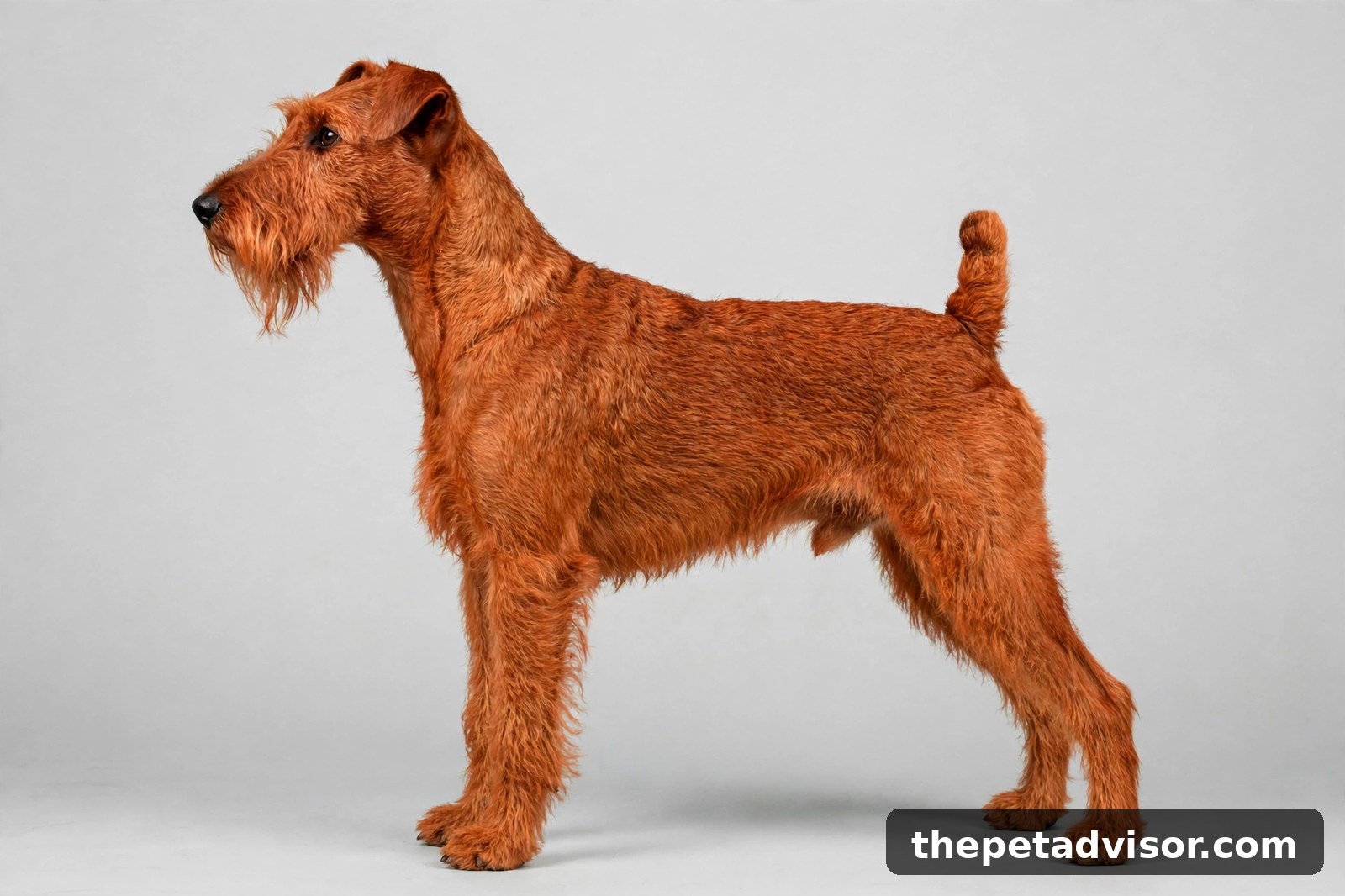
Do you have a photo of an Irish Terrier in the American show ring? We’d love this page to lead with one. If you have a show photo you’d let us use, email it to [email protected] — tell us the dog’s name and the show, and it may be featured here. Please only send photos you took yourself or have the photographer’s permission to share, and tell us the photographer’s name. We couldn’t find a public photo of an Irish Terrier in the American show ring that we were free to share, so the photo leading this page was made with AI. We’d much rather lead with a real one — if you’re a club member with an approved photo, we’d love to feature it.
1. Breed at a glance
Terrier Group; recognized by the AKC in 1885
About 18 in at the shoulder; 27 lb for dogs, 25 lb for bitches in show condition
Dense, wiry double coat; whole-colored bright red, golden red, red wheaten, or wheaten
12–14 years
Good tempered, spirited and game — the “Daredevil”
The Irish Terrier is a medium-sized dog, somewhat longer than it is tall, built on racy lines — “a balanced vital picture of symmetry, proportion, and harmony,” as the standard puts it. The coat is dense and wiry and lies close to the body, and the color is always whole-colored red in one of its shades. Underneath it all is a dog bred to work: a farm dog, vermin hunter, and guard that is game to the last breath and devoted to its own people. (Sources: AKC, Irish Terrier; AKC, Official Standard of the Irish Terrier.)
2. History
The Irish Terrier is one of the oldest terrier breeds, and its origin is not known. It is believed to have descended from the black-and-tan terrier-type dogs of Britain and Ireland, and for centuries it was the Irish farm dog: vermin hunter, guard, and all-around worker, bred for gameness rather than looks.
- First shown in Dublin, 1873. The Dublin dog show in 1873 was the first to provide a separate class for Irish Terriers. The first breed club was set up in Dublin in 1879, and the Irish Terrier was the first member of the terrier group to be recognised by the English Kennel Club as a native Irish breed. By the 1880s, Irish Terriers were the fourth most popular breed in Britain and Ireland.
- The cropping ban. In 1889 the Irish Terrier Club required that the ears remain uncropped — the first breed in the British Isles to advocate an end to ear cropping. The Kennel Club’s Rule 22, amended in 1895, barred any Irish Terrier born after December 31, 1889 from winning a prize if cropped.
- America. The first Irish Terriers were taken to the United States in the late nineteenth century. Westminster held its first class for the breed in 1881, with an entry of four; by 1891 the entry had grown to thirty. The AKC recognized the breed in 1885. The Irish Terrier Club of America was formed on December 18, 1896, by Samuel D. Parker, O. W. Donner, and H. White; its first meeting was held just before the Westminster show on February 23, 1897, and the club was recognized by the AKC in 1897.
- War dogs. During the First World War, Irish Terriers served as messenger dogs on the Western Front, carrying messages through the trenches and proving their intelligence and usefulness under fire.
- Montgomery. The Irish Terrier Club of America’s national specialty has been held at the Montgomery County Kennel Club show since 1961 — the October anchor of the breed’s year, and the reason the club also runs an annual traveling specialty for everyone who cannot come to Montgomery.
- At Westminster. No Irish Terrier has ever won Best in Show at Westminster. The Terrier Group’s wins there belong to other terriers — most often the Wire Fox Terrier, the breed that has won the top prize more than any other.
- The popularity arc. The breed’s popularity held out until about 1930, and then suddenly and inexplicably vanished. Today the Irish Terrier is only rarely seen in the ring or the home — a rare breed kept alive by a small, dedicated group of breeders and enthusiasts.
From an Irish farm dog of unknown origin, the Irish Terrier became one of the most popular breeds of the Victorian show world, a war dog, and then a rarity — and through it all, it kept the same red coat and the same reckless pluck. (Sources: Wikipedia, Irish Terrier; Irish Terrier Club of New York, History of the Irish Terrier; Irish Terrier Club of America, About the Club; Irish Terrier Club of America, Events; United Kennel Club, Irish Terrier; EasyPetMD, Irish Terrier; Irish Terrier history, KARMEX; AKC, Westminster Best in Show Winners Through the Years.)
3. The standard and why it is written that way
The standard describes a dog built for work in the field, and every part of it follows from that job. The Irish Terrier must be active, lithe, and wiry in movement, with great animation — sturdy and strong in substance and bone, but free from clumsiness, “for speed, power and endurance are most essential.”
- General appearance. “The over-all appearance of the Irish Terrier is important. In conformation he must be more than a sum of his parts. He must be all-of-a piece, a balanced vital picture of symmetry, proportion and harmony.” He must be neither “cobby” nor “cloddy,” but built on lines of speed with a graceful, racing outline.
- Size. The most desirable weight in show condition is 27 pounds for the dog and 25 pounds for the bitch. The height at the shoulder should be approximately 18 inches. The figures are a guide to breeder and judge — “weight is not the last word in judgment.”
- Head. Long, with a flat skull, rather narrow between the ears; the foreface and the skull from occiput to stop should be approximately equal in length. The eyes are dark brown, small, not prominent, “full of life, fire and intelligence” — the light or yellow eye is most objectionable. The ears are small and V-shaped, dropping forward closely toward the outside corner of the eye; a “dead” hound-like ear must be severely penalized. The nose must be black, and the teeth strong and even, neither overshot nor undershot.
- Coat. Dense and wiry in texture, rich in quality, having a broken appearance, but still lying fairly close to the body, the hairs growing so closely and strongly together that when parted with the fingers the skin is hardly visible; free of softness or silkiness. At the base of the stiff outer coat there is a growth of finer and softer hair, lighter in color, termed the undercoat. Single coats and wavy coats are undesirable; the curly and the kinky coats are most objectionable.
- Color. Whole-colored: bright red, golden red, red wheaten, or wheaten. A small patch of white on the chest, frequently encountered in all whole-colored breeds, is permissible but not desirable. White on any other part of the body is most objectionable.
- Stern. Docked, taking off about one quarter. Set on rather high, but not curled, of good strength and substance, of fair length, and well covered with harsh, rough hair.
- No disqualifications. The AKC standard carries no disqualifications section. Its hardest words are “most objectionable” — white anywhere but a small chest patch, a curly or kinky coat, cowhocks — and “severely penalized” for a dead ear. Those are faults, not disqualifications, and a judge weighs them against the whole dog.
- Movement. Both fore and hind legs should move straight forward when traveling, with plenty of bone and muscle; the stifles should not turn outward. “Cowhocks” — the hocks turned in and the feet turned out — are intolerable.
- Temperament in the standard. Good tempered, spirited and game. “There is a heedless, reckless pluck about the Irish Terrier which is characteristic, and which, coupled with the headlong dash, blind to all consequences, with which he rushes at his adversary, has earned for the breed the proud epithet of ‘Daredevil.’ He is of good temper, most affectionate, and absolutely loyal to mankind.”
The most important thing to know about the modern standard is the coat and the outline: the wiry, close-lying red coat and the racy, rectangular build are the breed, and a soft coat or a cobby body is not an Irish Terrier, whatever its color. (Sources: AKC, Official Standard of the Irish Terrier.)
4. Temperament & living with one
Irish Terriers are good tempered, spirited, and game — the standard’s own words — and they live up to every one of them. They are stouthearted at work and tenderhearted at home, and they bond hard to their people.
- The daredevil, at home. The standard’s daredevil is “tender and forebearing with those he loves,” and will guard his master, his mistress, and children “with utter contempt for danger or hurt.” Most Irish Terriers love children and tolerate rough-housing to a certain extent.
- Strong-willed. The Westminster Kennel Club’s breed notes put it plainly: “Strong-willed and sometimes stubborn, the Irish terrier is generally eager to work and learn, but patience and a sense of humor are a necessity for owners.”
- Exercise is not optional. Irish Terriers are active dogs that need and enjoy consistent mental and physical challenges, and they require large amounts of walking. Agility, tracking, scent work, and puzzle-solving all suit them. They are full of life but not hyperactive — they can relax inside the house and be roused to full activity quickly.
- With other dogs. Irish Terriers are often dominant with other dogs, and poorly socialized individuals can start fights, so early socialization is a necessity. They have strong guarding instincts which, when controlled, make them excellent watchdogs.
- Training. They enjoy training and learn fast, with food and toys working equally well as motivation, but they have less of an eagerness to please people than some other breeds. They respond best to consistent, reward-based training from a relaxed, authoritative person — as the breed’s own literature puts it, it is always best to outwit and lure. Look for a trainer with terrier experience.
The honest summary: this is a wonderful family dog for an active owner who will exercise it, socialize it, and train it with patience and humor, and a poor fit for a household that wants a dog to lie around or a dog that defers to every dog it meets. (Sources: AKC, Irish Terrier; Westminster Kennel Club, Irish Terrier; AKC, Official Standard of the Irish Terrier; Wikipedia, Irish Terrier.)
5. Grooming
Grooming an Irish Terrier is straightforward, but it is not the same as grooming most short-coated breeds — the wiry coat has its own rules.
Brush weekly with a brush and comb to remove dirt, debris, and loose hair. The coat should be hand-stripped several times a year — the dead outer coat pulled out by hand or with a non-cutting knife, never cut — to keep its correct harsh texture and weather resistance. For a pet, stripping once or twice a year is enough; show dogs are stripped more often, sometimes by “rolling” the coat a little at a time. Clipping is easier, but it softens the coat, fades the color, and destroys the weather resistance, so it is not the right choice for this breed. Bathe only when the dog is dirty: detergents strip the natural skin oils. Nails should be trimmed regularly, ears checked and cleaned, and teeth brushed. Shedding is minimal. (Sources: Westminster Kennel Club, Irish Terrier; Wikipedia, Irish Terrier.)
6. Health testing
The Irish Terrier is a healthy breed — and an unusual one in health-testing terms: the parent club has no CHIC program, and the AKC lists no recommended health tests for the breed. That is not an oversight. The parent club’s own health statement, written by Dr. Ian MacDonald in 2017, says there are only two hereditary diseases known to affect Irish Terriers, and it recommends no screening tests at all.
- No CHIC program. The AKC’s Terrier Group health testing page lists “No recommended health tests” for the Irish Terrier. There is no CHIC number to ask a breeder for — ask instead about the two diseases below and the pedigree behind the breeding.
- Hereditary footpad hyperkeratosis (HFH). A thickening and hardening of the footpads, which can result in painful calluses and cracking. It is autosomal recessive, caused by a missense variant (c.155G>C) in the FAM83G gene, and a DNA test exists, so carriers can be positively identified and affected puppies avoided. The disease is now rarely seen in North American Irish Terriers.
- Cystinuria (type III). An increase in cystine concentrations in the urine due to failure of reabsorption in the kidney. It can lead to stones that block the flow of urine, a potentially fatal condition unless treated surgically. In Irish Terriers it is testosterone-dependent, so only mature intact males are affected; dogs that are treated and neutered are expected to lead normal lives.
- No DNA test for cystinuria in this breed. The androgen-dependent form of cystinuria has no known causative variant, and the University of Bern research program working to develop a test for Irish Terriers was discontinued in February 2024, after ten years, without finding a genetic signal. Breeders monitor at-risk males with COLA urine screening instead, and check pedigrees for past problems when breeding.
- Otherwise healthy. “Irish Terriers rarely suffer from other complaints such as the hip, heart and eye problems often reported in other breeds,” the parent club’s health statement says, and the breed has a very low incidence of hip dysplasia. Life expectancy is 12–14 years; a 2024 UK study found 13.5 years for the breed.
What to ask a breeder: the HFH DNA results for both parents; what the pedigree shows about cystinuria, and how male puppies are monitored; and what the breeder knows about hypothyroidism and cataracts — an Irish Terrier Club of America health study found a greater-than-expected incidence of both. A breeder who cannot tell you anything about the footpads or the pedigree behind the breeding is a breeder to question. (Sources: AKC, Terrier Group Health Testing Requirements; Irish Terrier Club of America, Health Statement (Dr. Ian MacDonald, July 5, 2017); OMIA, Hyperkeratosis, palmoplantar, FAM83G-related; OMIA, Cystinuria, type III; LabGenVet, Hereditary Footpad Hyperkeratosis; University of Bern, Cystinuria Research in the Irish Terrier & Kromfohrländer; Wikipedia, Irish Terrier.)
7. The annual Irish Terrier specialty dog show
A specialty is the breed’s All-Star show — its Super Bowl. The Irish Terrier Club of America holds two national specialties a year: the October national at Montgomery and the Traveling Specialty, which moves to a different city each year.
The club calls it the traveling specialty — the same kind of event other clubs call a roving, floating, or rotating national.
Every breed has one show a year that matters most: the parent club’s national specialty — and the Irish Terrier Club of America holds two a year: the October national at Montgomery, held each October in Pennsylvania as part of the Montgomery weekend cluster, and an annual traveling specialty, held at a different show around the country each year.
The most recent national specialty was Sunday, October 4, 2026, at the Montgomery County Kennel Club show, Macungie Memorial Park, Macungie, Pennsylvania. (Sources: Irish Terrier Club of America, events; Montgomery County KC premium list.)
The Traveling Specialty
The year’s other specialty, the traveling specialty, was Sunday, June 14, 2026, at the Lake County Fairgrounds, Grayslake, Illinois, with the Great Lakes All Terrier Association. Conformation judge Mrs. Connie Clark; sweepstakes judge Mark Ulrich. AKC event 2026057301. (Sources: Irish Terrier Club of America, events; BaRay Grayslake Summer Cluster premium list.)
The October 2027 Montgomery national had not been announced as of November 2026; dates and judges to be announced.
The Traveling Specialty
The 2027 traveling specialty had not been announced as of November 2026.
Full Montgomery weekend guide →
8. Regional specialties through the year: smaller regional shows
The national is the anchor, but the breed’s year also runs through regional specialties — smaller regional shows, not the national — held by regional Irish Terrier clubs around the country. These are the 2026 regionals verified from club sources so far:
- Irish Terrier Club of New York — designated specialty with sweepstakes, Friday, May 1, 2026, at the Garden State All Terrier Club show, Mercer County Park, West Windsor Township, New Jersey.
- Irish Terrier Club of Chicago — designated specialty with sweepstakes, Saturday, June 13, 2026, at the Great Lakes Terrier Shows, Lake County Fairgrounds, Grayslake, Illinois (AKC event 2026139602).
- Chesapeake Irish Terrier Club — specialty, Saturday, September 19, 2026, Delaware State Fairgrounds, Harrington, Delaware. Judge Ms. M Carberry; 12 entries.
More regional specialties will be added here as their programs are verified — this section is built from show data, not guesswork. Browse upcoming show weekends →
9. Clubs
The parent club is the Irish Terrier Club of America (ITCA), at itca.info — formed on December 18, 1896, and one of the older AKC parent clubs in continuous operation. The club sponsors the national specialty and the annual traveling specialty, multiple local events, and a quarterly newsletter with show results, upcoming events, and health information, and it runs a breeder referral service.
Regional specialty clubs verified in the AKC club search index during this build:
- Irish Terrier Club of Chicago
- Irish Terrier Club of New York
- Irish Terrier Club of Northern California
- Irish Terrier Club of Southern California
- Chesapeake Irish Terrier Club
Each regional club holds an annual specialty and sponsored-entry events, and the traveling specialty is hosted each year by the ITCA together with one of the regional clubs. Regional clubs are the best first contact for anyone looking for a breeder, a training contact, or a local event. (Sources: Irish Terrier Club of America, About the Club; Irish Terrier Club of America, Events; AKC, Club Search Index.)
10. Rescue
Irish Terriers come into rescue rarely — it is a numerically small breed with a dedicated following — but when they do, the breed has its own safety net. The first place to look:
- Irish Terrier Rescue Network (ITRN). The only 501(c)3 tax-exempt nonprofit public charity dedicated to the Irish Terrier in the nation, founded in December 2010. A nationwide organization of volunteers that rescues, rehabilitates, and re-homes abandoned, neglected, and unwanted Irish Terriers regardless of pedigree or circumstance. Emergency assistance: 1-844-RED-DOGS. irishterrierrescuenetwork.org
- AKC Rescue Network. The AKC’s breed rescue listing for Irish Terriers. akc.org/akc-rescue-network/rescue-network-i-breeds/
- Irish Terrier Club of Chicago rescue. The Chicago regional club keeps members on call to help Irish Terriers in need of re-homing in its area; regional rescue contact Terri VandeZande. irishterrierclubchicago.org/rescue
A rescue Irish Terrier is usually an adult, so you know its size, coat, and temperament before you commit — a real advantage with a breed this strong-willed. Ask what the dog’s health history is, and whether its footpads have ever been checked: a rescue that cannot tell you anything about the feet is a rescue to question. (Sources: Irish Terrier Rescue Network, About ITRN; AKC, Rescue Network I Breeds.)
11. Breeder vs. rescue: honest guidance
Both routes can end with a great dog. The honest difference is what you know going in — and with an Irish Terrier, what you know about the feet and the temperament matters more than usual.
- Choose a breeder if you want a puppy for showing, performance, or a specific purpose, and you want the health testing, pedigree, and early socialization that come with a careful breeding program. Ask for the hereditary footpad hyperkeratosis DNA results in section 6, ask what the breeder knows about cystinuria in the pedigree, meet the dam if you can, and be ready to wait — good breeders of a rare breed have waiting lists.
- Choose rescue if you want an adult dog whose temperament, energy level, and attitude toward other dogs you can see before you commit, and you are comfortable with a dog that may need training and patience. Rescue is also the right route if you want to give a home to a dog that needs one.
- Either way, verify. Ask for health testing, ask what the dog’s lines are known for, and meet the dog before you commit. A breeder who will not show you health results and a rescue that will not let you meet the dog are both telling you something.
An Irish Terrier is a twelve-to-fourteen-year commitment to a bold, active dog that needs real exercise and real training every day. The right question is not breeder or rescue — it is whether your life has room for a daredevil.
12. Claim this page
This page was built from public sources — the AKC standard, the parent club’s own material, the parent club’s health statement, AKC event records, and the rescue network’s site — and it is a starting point, not the last word. If you are with the Irish Terrier Club of America or a regional club and something here is wrong or missing, you can claim this page and set it straight: email [email protected] and tell us what needs fixing. Corrections from the people who own the breed’s knowledge are always welcome.
Sources
- AKC, Irish Terrier
- AKC, Official Standard of the Irish Terrier
- AKC, Terrier Group Health Testing Requirements
- Irish Terrier Club of America, Health Statement (Dr. Ian MacDonald, July 5, 2017)
- Irish Terrier Club of America, About the Club
- Irish Terrier Club of America, Events
- Irish Terrier Club of America
- Westminster Kennel Club, Irish Terrier
- United Kennel Club, Irish Terrier
- Wikipedia, Irish Terrier
- The Free Dictionary, Irish Terrier (Wikipedia mirror)
- Irish Terrier Club of New York, History of the Irish Terrier
- OMIA, Hyperkeratosis, palmoplantar, FAM83G-related
- OMIA, Cystinuria, type III
- LabGenVet, Hereditary Footpad Hyperkeratosis
- University of Bern, Cystinuria Research in the Irish Terrier & Kromfohrländer
- Irish Terrier Rescue Network
- Irish Terrier Rescue Network, About ITRN
- AKC, Rescue Network I Breeds
- Irish Terrier Club of Chicago, Rescue
- AKC, Club Search Index (regional clubs)
- AKC, Westminster Best in Show Winners Through the Years
- Wikipedia, List of Best in Show winners of the Westminster Kennel Club Dog Show
- EasyPetMD, Irish Terrier
- Irish Terrier history, KARMEX