
Breed profile · Sporting Group · the red setter from Ireland
Irish Setter
The Irish Setter is the red flash of the Sporting Group — a swift, aristocratic bird dog in a rich mahogany coat, rollicking and sweet-natured at home and all business in the field. It was among the first nine breeds the American Kennel Club ever recognized, in 1878, and artists have called it the most beautiful of all dogs. The Irish Setter Club of America is the parent club and the host of the annual Irish Setter specialty dog show.
Help us improve it. This is one of ThePetAdvisor’s breed profiles, built from public sources with generous links to the people who actually own this breed’s knowledge. If something’s off or missing, the parent club can claim the page and set it straight — see the bottom of the page.
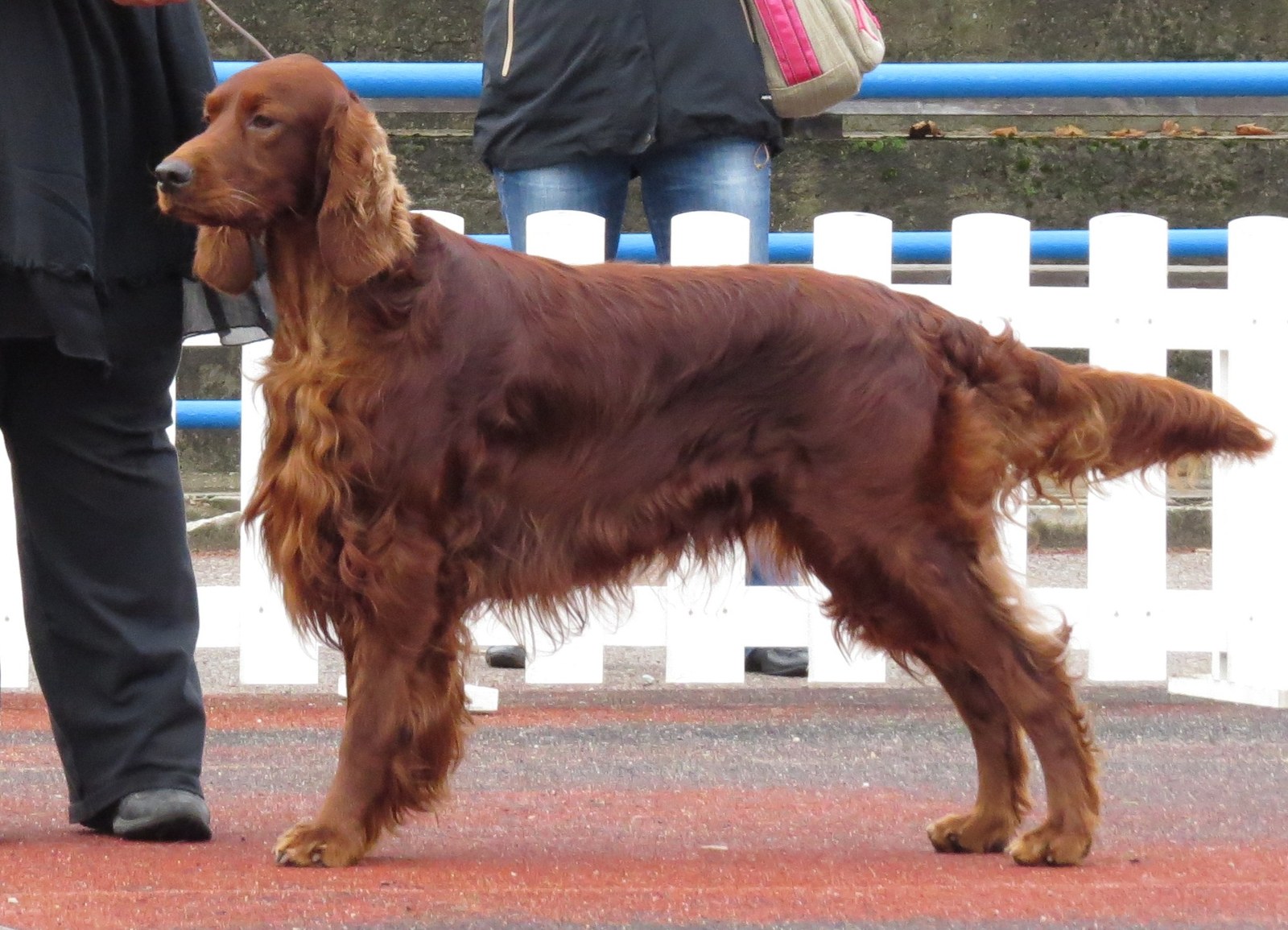
Do you have a better photo of an Irish Setter in the American show ring? If you have a show photo you’d let us use, email it to [email protected] — tell us the dog’s name and the show, and it may be featured here. Please only send photos you took yourself or have the photographer’s permission to share, and tell us the photographer’s name.
1. Breed at a glance
Sporting Group; among the first nine breeds recognized by the AKC, in 1878
Dogs 27 in, about 70 lb; bitches 25 in, about 60 lb
Straight, fine, glossy; mahogany or rich chestnut red, with no black
12–15 years
Rollicking; outgoing and stable; sweet-natured and trainable
Irish Setter Club of America, founded in 1891
An Irish Setter is a red flash in the field and a clown in the house — the AKC calls the breed a high-spirited gundog known for grace, swiftness, and a flashy red coat, famously good family dogs: sweet-tempered companions for the folks, and rollicking playmates and tennis-ball fetchers for the children. The whole breed is built around two things: the coat and the temperament. A rich red dog with long, silky feathering and a merry, outgoing nature is the silhouette that says Irish Setter at a glance — and the energy underneath it is the price of owning one. (Sources: AKC, Irish Setter; AKC, Official Standard for the Irish Setter.)
2. History
The Irish Setter took shape in Ireland in the 18th century, probably by combining English Setters, spaniels, pointers, and Gordon Setters into a bird dog that could find and “set” game birds for hunters. Early setters were often red and white; the solid red coloring became popular in Ireland in the 19th century — one nobleman reportedly refused to have any Irish Setters in his kennel that weren’t all solid red. The Irish Red Setter Club in Dublin drew up the first breed standard, approved in 1886, and the standard has largely remained the same ever since. (Sources: AKC, Facts About the Irish Setter That You May Not Know; FurLyfe, Irish Setter Dog Breed Information & Characteristics.)
The first Irish Setter imported to the United States was Elcho, who arrived in 1875 and became a star in the show ring and the field; the first Irish Setter registered by the American Kennel Club was Admiral, in 1878. The breed was among the first nine breeds the AKC ever recognized, in 1878. In the United States the breed was originally known as the Irish Red Setter, a name the Irish Setter Club of America used to distinguish it from the red-and-white setters of Ireland. The club itself was founded in 1891, one of the first breed clubs in America, and it conducts an annual National Specialty, National Field Trial, National Walking Field Trial, Hunt Test, and Gun Dog Championships. The national specialty celebrated its 50th anniversary in Lexington, Kentucky, in 2023. (Sources: DogTime, Irish Setter Dog Breed Information & Characteristics; AKC, Facts About the Irish Setter That You May Not Know; Irish Setter Club of America, About ISCA.)
The breed was one of the most popular dogs in America in the late 19th century, when solid red setters filled the show rings and the field; it has settled since into a steady, smaller fancy — 85th of the AKC’s recognized breeds by registrations in 2024. Irish Setters have graced the homes of several U.S. presidents: Franklin Delano Roosevelt owned two called Jack and Jill, Richard Nixon owned King Timahoe, and Ronald Reagan kept one on his ranch. (Sources: AKC, Most Popular Dog Breeds of 2024; AKC, Facts About the Irish Setter That You May Not Know.)
3. The standard and why it is written that way
- General appearance — an active, aristocratic bird dog. “The Irish Setter is an active, aristocratic bird dog, rich red in color, substantial yet elegant in build. Standing over two feet tall at the shoulder, the dog has a straight, fine, glossy coat, longer on ears, chest, tail and back of legs. Afield, the Irish Setter is a swift-moving hunter; at home, a sweet natured, trainable companion.” The standard adds the line that has followed the breed ever since: “At their best, the lines of the Irish Setter so satisfy in overall balance that artists have termed it the most beautiful of all dogs.” (Source: AKC, Official Standard for the Irish Setter.)
- Size — the ideal dog 27 inches, about 70 pounds. “There is no disqualification as to size. The make and fit of all parts and their overall balance in the animal are rated more important. 27 inches at the withers and a show weight of about 70 pounds is considered ideal for the dog; the bitch 25 inches, 60 pounds. Variance beyond an inch up or down is to be discouraged.” The dog is slightly longer than it is tall, with sturdy legs and plenty of bone; structure in the male reflects masculinity without coarseness, and bitches appear feminine without being slight of bone. (Source: AKC, Official Standard for the Irish Setter.)
- Coat — short and fine on the head, feathered everywhere else. The coat is short and fine on the head and forelegs, and of moderate length and flat on all other parts. Feathering is long and silky on the ears, long and fine on the back of the forelegs and thighs, with a pleasing fringe of hair on the belly and brisket extending onto the chest, and a moderately long, tapering fringe on the tail — all as straight and free as possible from curl or wave. The Irish Setter is trimmed for the show ring to emphasize the lean head and clean neck: the top third of the ears and the throat nearly to the breastbone are trimmed, and excess feathering is removed to show the natural outline of the foot — all to preserve the natural appearance of the dog. (Source: AKC, Official Standard for the Irish Setter.)
- Color — mahogany or rich chestnut red, with no black. “Mahogany or rich chestnut red with no black. A small amount of white on chest, throat or toes, or a narrow centered streak on skull is not to be penalized.” The color rule is the standard’s hardest line: the rich red coat is the breed’s identity, so black anywhere is not an Irish Setter in the ring at all — and a red-and-white dog belongs to the separate Irish Red and White Setter breed. (Source: AKC, Official Standard for the Irish Setter.)
- Head — long and lean, softly alert. The head is long and lean, its length at least double the width between the ears, with delicate chiseling along the muzzle, around and below the eyes, and along the cheeks. Expression is soft, yet alert. Eyes are somewhat almond shaped, of medium size, dark to medium brown. Ears are set well back and low, the leather thin, hanging in a neat fold close to the head and nearly long enough to reach the nose. The nose is black or chocolate; the teeth meet in a scissors bite. (Source: AKC, Official Standard for the Irish Setter.)
- Gait — big, very lively, graceful, and efficient. “At the trot the gait is big, very lively, graceful and efficient. At an extended trot the head reaches slightly forward, keeping the dog in balance. The forelegs reach well ahead as if to pull in the ground without giving the appearance of a hackney gait. The hindquarters drive smoothly and with great power.” Seen from front or rear, the legs move perpendicular to the ground, with some tendency toward a single track as speed increases. (Source: AKC, Official Standard for the Irish Setter.)
- Temperament — rollicking. “The Irish Setter has a rollicking personality. Shyness, hostility or timidity are uncharacteristic of the breed. An outgoing, stable temperament is the essence of the Irish Setter.” The temperament line is the standard’s character test in a sentence: an Irish Setter that is shy or sharp has lost the breed. (Source: AKC, Official Standard for the Irish Setter.)
- Why it is written that way. Every clause in the standard points back to a swift-moving hunter that is also a sweet-natured companion: the bone and substance are there so the dog can push through rough cover all day, the deep chest and firm topline are there so it can keep going, and the big, driving trot is the gait of a dog that covers ground. Balance is the test the standard keeps returning to — “the correct specimen always exhibits balance, whether standing or in motion,” with each part flowing into its neighbors without calling attention to itself. And the color rule is the identity line: the mahogany coat is what makes an Irish Setter an Irish Setter.
4. Temperament & living with one
The AKC’s summary is short: a high-spirited gundog known for grace, swiftness, and a flashy red coat — famously good family dogs, sweet-tempered companions for the folks and rollicking playmates for the children. The standard’s version is shorter still: a rollicking personality, outgoing and stable. The parent club’s version fills in the rest: fun loving, playful, and affectionate — mischievous and independent, intelligent and stubborn, anxious to please and yet determined to have its way if it decides to go hunting or steal a treasure from a closet or drawer. All three are describing the same dog — a working setter that became a companion and never quite gave up the job. (Sources: AKC, Irish Setter; AKC, Official Standard for the Irish Setter; Irish Setter Club of America, This is the Irish Setter.)
- With its own people: affectionate, fun loving, and devoted — it loves to be with its people and will adapt to riding in a car, preferably in a crate where it can stretch out. It is not aggressive, but it will energetically announce the arrival of all comers, and if put to the test has been known to protect its owners from harm.
- With strangers: outgoing and friendly rather than wary. Shyness, hostility, and timidity are uncharacteristic of the breed — an Irish Setter greets the world as a friend, which makes it a poor watchdog and a good ambassador.
- Training: very smart — sometimes smarter than its owner, in the parent club’s words — so training takes care and patience, love and firmness, never harshness or cruelty. Once learned, a lesson is never forgotten, which is why a puppy must be trained right the first time. The hunting instinct is strong, and the breed enjoys a fine reputation as a reliable companion in the field.
- Exercise: a lot, every day, with room to run. This is a high-energy breed that needs an area big enough to stretch its legs — an ample fenced yard or the means to walk or run the dog daily. Exercise does not mean opening the door and letting the dog run free: Irish Setters will follow their noses and cannot be guaranteed to remain within one’s property until they are well along in years, and sometimes that happy state never occurs.
- Maturity: slow, in mind and body both. An Irish Setter stays a puppy for a long time and retains some of its merry Irish character forever. It matures more slowly than other breeds — developing faster physically than mentally — so the adult dog is even-tempered and steady, but getting there takes patience.
- First-dog honesty: this is a lot of dog — and a lot of energy — for a first-time owner. The size, the exercise needs, the slow maturity, and the strong nose all demand an owner who trains from day one and keeps training, and who has the time and the ground to work a sporting dog. If that sounds like a burden rather than a pleasure, a smaller or calmer breed is the honest choice.
5. Grooming
The Irish Setter’s coat is straight, fine, and glossy, with long, silky feathering on the ears, chest, belly, legs, and tail — and feathering is the grooming job. The coat is moderate in length, not the floor-length curtain of some setters, but the feathering mats if it is ignored, and the long ears need attention too. The breed is naturally clean and fastidious and will housetrain quickly if given the chance to go out at regular intervals when young. (Sources: AKC, Official Standard for the Irish Setter; Irish Setter Club of America, This is the Irish Setter.)
- Brushing: two or three times a week, every week. Work through the feathering on the ears, chest, belly, and legs with a pin brush or slicker and then a comb, checking behind the ears and in the armpits where mats start. A setter that hunts or hikes picks up burrs and tangles that have to come out the same day.
- Bathing: every few weeks, or when the dog is dirty. A sporting dog that works in the field gets dirty; shampoo and rinse thoroughly, and dry the feathering completely, because damp feathering mats faster than dry.
- Ears: the long, well-feathered ears hang close to the head and trap moisture, so check them weekly and clean them as needed. A setter that swims or hunts in wet cover needs its ears checked after every outing.
- Feet & nails: trim the nails every two to three weeks, and keep the hair between the pads trimmed so the dog does not slip on slick floors and does not pack mud and ice between its toes in winter.
- Shedding: moderate and year-round, heavier in spring and fall. Regular brushing is what keeps the mahogany coat shining and the house habitable — there is no non-shedding version of this dog.
6. Health testing
The Irish Setter has CHIC requirements — the parent club’s checklist with the AKC and the Orthopedic Foundation for Animals, so there is a CHIC number to ask a breeder for. A dog earns a CHIC number when all the required tests are done and the results are public. The list:
- Hip evaluation. An OFA or PennHIP hip evaluation screens for hip dysplasia, the malformed hip joint that causes pain and lameness in a large, active breed. Final OFA hip certification comes at 24 months. (Source: AKC, Sporting Group Health Testing Requirements.)
- Thyroid evaluation. An OFA thyroid evaluation screens for autoimmune thyroiditis, the inherited thyroid disease that drags a dog’s energy and coat down over time. Thyroid results are renewed periodically, because the disease can develop later in life. (Source: AKC, Sporting Group Health Testing Requirements.)
- PRA-rcd1 DNA test — the big one. Progressive retinal atrophy, rod-cone dysplasia 1, is an early-onset blinding eye disease in the breed: affected pups show signs of night-blindness by about six weeks of age, and by one to two years most affected dogs are completely blind. A DNA test for rcd-1 has existed for years, identifies clear, carrier, and affected dogs at any age, and follows a simple autosomal recessive pattern — so there is no reason for a breeding dog’s rcd-1 status to be unknown. Ask for the DNA result by name: a breeder who cannot produce it has not done the breed’s most important test. (Sources: AKC, Sporting Group Health Testing Requirements; Laboklin, Irish Setter DNA bundle (CLAD + rcd1-PRA + rcd4-PRA).)
- What about CLAD and PRA-rcd4? The AKC’s CHIC list for the Irish Setter names hip, thyroid, and PRA-rcd1 only. The Kennel Club in the UK asks breeders to test for more — CLAD (canine leukocyte adhesion deficiency) and PRA-rcd4, plus hip, elbow, and eye screening — and since January 6, 2025, imported Irish Setters and litters from overseas sires are only eligible for Kennel Club registration if they are proven clear or carriers of CLAD and PRA (rcd1), or hereditarily clear. Ask a breeder what they test beyond the CHIC list, and why. (Source: The Kennel Club, Irish Setter (Breeds A–Z).)
Ask any breeder for the parents’ results for the hip evaluation, the thyroid evaluation, and the PRA-rcd1 DNA test, and look them up in the OFA database yourself before you commit. The breed’s 12-to-15-year lifespan is a long one for a dog this size, and the testing exists so that those years are healthy ones.
7. The annual Irish Setter specialty dog show
A specialty is the breed’s All-Star show — its Super Bowl. Once a year, the best Irish Setters from across the country, and often from around the world, come together in one place.
The Irish Setter Club of America’s national specialty: one national event each year, with conformation, sweepstakes, junior showmanship, obedience, rally, agility, and beginner puppy. The 2026 national: May 29–30, at the Cache County Fairgrounds in Logan, Utah, with 196 entries and 170 competitors. The 2025 national: May 15–17, at The Founders Inn in Virginia Beach, Virginia, with 155 entries and 147 competitors. The 2027 national: May 27–29, at the Washington County Fairgrounds in Lake Elmo, Minnesota. Each year, between April and June, the club holds its national specialty on a rotating basis in one of four regions of the United States designated by the club.
The standard, in brief: an active, aristocratic bird dog, rich red in color, substantial yet elegant in build, with a straight, fine, glossy coat, longer on ears, chest, tail and back of legs. The ideal dog stands 27 inches at the withers and weighs about 70 pounds; the ideal bitch, 25 inches and about 60 pounds. Color: mahogany or rich chestnut red with no black — a small amount of white on chest, throat or toes, or a narrow centered streak on the skull, is not penalized. Temperament: rollicking; shyness, hostility or timidity are uncharacteristic of the breed.
The 53rd Annual Independent National Specialty Show — national week May 23–30, 2026, with the conformation national Friday–Saturday, May 29–30, 2026, at the Cache County Fairgrounds & Event Center, 450 South 500 West, Logan, Utah. Entry: 196 entries / 170 competitors (Set-Irsh 170 Ent — 77 dogs, 93 bitches). Entries closed Wednesday, April 29, 2026. Event Chair: Debra Davis. Superintendent/secretary: Patricia Shaw. (Sources: AKC event search, event 2026158009; ISCA 2026 Specialty Premium List.)
National specialty judges: Mr. Tyron Atkinson (Australia) — Dogs, Beginner Puppy, Intersex, Brace, Team & Best of Breed; Ms. Carolyn Dison — Bitches, Stud Dog & Brood Bitch; Mrs. Patti Fanelli — Puppy Sweepstakes; Mrs. Darcy Petrof — Mature & Veteran Sweepstakes; Miss Emily Bisso — Junior Showmanship & Pee Wee; Mr. Melvin Stanley — Obedience & Rally; LaVar Griffin — Agility. National week also held the obedience trial (Wednesday, May 27, event 2026158005), the rally trial (Wednesday, May 27, event 2026158006), and the ISCA Regional Specialty (Wednesday, May 27, event 2026158022). (Sources: ISCA 2026 Specialty Premium List; AKC event search, event 2026158009.)
Results (2026 national). Best of Breed: GCH CH Northwinds There is Only One King. Owner-Handled Best of Breed: GCHG CH Jamond’s Pagani Riviera BCAT CGC TKA. Best of Opposite Sex: GCHS CH Adare Redridge Playing With Luck. Select Dog: CH Galewinns Outside the Box. Select Bitch: GCHB CH Beaubriar N Erin’s Epic Storm. Best of Winners / Winners Dog: Tramore Heights Raising The Bar. Winners Bitch: Adare Redridge Dressed For Revenge. Best Junior Handler: Adam Kucera. Best Puppy and sweepstakes winners were not confirmed in an accessible official source as of November 2026. (Sources: ISCA, National Specialty Winners by Award; AKC event search, event 2026158009.)
The 2027 National Specialty: May 27–29, 2027, three days, at the Washington County Fairgrounds in Lake Elmo, Minnesota. Show secretary: Patricia Shaw. AKC event number, judges, entries, and closing date not yet published as of November 2026. (Sources: AKC Upcoming National Specialties; Irish Setter Club of America.)
Past national specialties: 2025 · 2024 · 2023
Irish Setter Club of America — irishsetterclub.org
8. Regional specialties through the year: smaller regional shows
The national is the anchor, but the breed’s year also runs through regional specialties — smaller regional shows, not the national — held around the country, including the regional specialties that run with the national. These are the 2026 regionals verified from club and AKC sources so far:
One 2026 regional specialty verified in full from AKC event data so far — the regional held during national week — plus the specialties the parent club’s calendar lists for the rest of the year:
- ISCA Regional Specialty — Wednesday, May 27, 2026, Logan, Utah: at the Cache County Fairgrounds, held during national week and hosted by the Irish Setter Club of Southern California (AKC event 2026158022). Judge: Mr. P. Booth. Entry: 156 entries / 134 competitors. Best Junior Handler: Yuha Tamura (Reserve: Ava Cirjak).
- Irish Setter Club of Greater Tucson — Thursday, November 12, 2026 (two specialties) and Friday, November 13, 2026, Tucson, Arizona: at the Pima County Fairgrounds. Judges: Genea Jones and James A. Moses (November 12); Eva Berg (November 13).
- Irish Setter Club of Central Oklahoma — Friday, November 13, 2026, Chickasha, Oklahoma: at the Grady County Fairgrounds. Judge: W. Wornall.
- Irish Setter Club of Jacksonville — Friday, November 13 and Saturday, November 14, 2026, Ocala, Florida: at the Ocala Dog Show Grounds. Judges: Elizabeth Muthard (November 13); Charles Olvis (November 14).
- Irish Setter Club of America — Friday, December 11, 2026, Orlando, Florida: at the Orange County Convention Center. Judge: Mrs. Gwen Meyer (conformation and junior showmanship). Superintendent: Onofrio Dog Shows, LLC. Entries close November 25, 2026.
- Irish Setter Club of Las Vegas — Friday, December 11 and Saturday, December 12, 2026, North Las Vegas, Nevada: at Craig Ranch Regional Park. Judges: Jay Richardson (December 11); Leta Graham (December 12).
(Source for the November–December specialties: ISCA Specialty Show Calendar, last updated October 18, 2026. Entries and results for these shows are not yet verified.)
The 2027 regionals announced so far:
Ten 2027 regional specialties announced so far on the parent club’s specialty calendar:
- Irish Setter Club of Southern California — Friday, January 8, 2027 (two specialties), Indio, California: at Empire Equestrian Park / Empire Polo Club. Judges: Grace Fritz and Kimberly Meredith. Designated specialties follow on January 9 (Judy Taylor) and January 10 (David Kittredge).
- Multnomah Irish Setter Association — Thursday, January 22 and Saturday, January 24, 2027, Portland, Oregon: at the Portland Expo Center. Judges: Peggy Beisel-Mcilwaine (January 22); Wayne Cavanaugh (January 24). (The calendar prints 2026 for the second date, likely a typo for 2027.)
- Irish Setter Club of Arizona — Friday, February 5, 2027, Phoenix, Arizona: at the Arizona State Fairgrounds. Judge: Jill Warren.
- Irish Setter Club of Milwaukee — Friday, February 26 and Saturday, February 27, 2027, Madison, Wisconsin: at the Alliant Energy Center. Judges: Donna Ernst (February 26); Angela Pickett (February 27).
- Western Irish Setter Club — Sunday, February 28, 2027 (two specialties), Madison, Wisconsin: at the Alliant Energy Center. Judges: Aramis Josy Lim and Patricia Trotter.
- Carolina Irish Setter Club — Friday, March 12 and Saturday, March 13, 2027 (two specialties), Raleigh, North Carolina: at the North Carolina State Fairgrounds. Judges: Judy Harrington (March 12); Donald Sturz and Phil Booth (March 13).
- Eastern Irish Setter Association — Friday, March 26 and Saturday, March 27, 2027, Edison, New Jersey: at the New Jersey Convention and Exposition Center. Judges: Edward A. Fojtick (March 26); Danny D. Seymour (March 27).
- Irish Setter Club of the Pacific S.F. — Saturday, April 17, 2027, Lodi, California: at the Lodi Grape Festival Grounds. Judge: Jamie Hubbard.
- Irish Setter Club of Central California — Sunday, April 18, 2027, Lodi, California: at the Lodi Grape Festival Grounds. Judge: Ann Yuhasz.
- Irish Setter Club of Central Connecticut — Sunday, May 16, 2027 (two specialties), Vernon, Connecticut: at the Vernon Agricultural Center. Judges: Norbert Dee and Nena Dee.
(Source: ISCA Specialty Show Calendar, last updated October 18, 2026.)
More regional specialties will be added here as their programs are verified — this section is built from show data, not guesswork. Browse upcoming show weekends →
9. Clubs
- Irish Setter Club of America (ISCA) (parent club) — the AKC-recognized national breed club for the Irish Setter, founded in 1891. It maintains the breed standard, holds the national specialty each year, conducts the National Field Trial, National Walking Field Trial, Hunt Test, and Gun Dog Championships, runs a breeder referral service through its Breeder’s Directory, and runs a rescue referral service through which local clubs can gain information about how to establish a rescue service for dogs in need of placement. (Sources: Irish Setter Club of America, About ISCA; Irish Setter Club of America.)
- Regional Irish Setter clubs. Local and regional Irish Setter clubs across the country hold the regional specialties in section 8, including the Irish Setter Club of Delaware Valley, the Irish Setter Club of Greater Richmond, the Irish Setter Club of Greater St. Louis, the Irish Setter Club of Milwaukee, the Irish Setter Club of Southern California, the Irish Setter Club of Arizona, the Carolina Irish Setter Club, the Eastern Irish Setter Association, the Multnomah Irish Setter Association, and the Irish Setter Club of the Pacific S.F. (Source: ISCA Specialty Show Calendar.)
- AKC Marketplace and breeder referral. The AKC’s club directory lists each club’s breeder-referral and rescue contacts, and the ISCA is the first stop for anyone looking for a puppy from a breeder who works under the club’s code. (Source: Irish Setter Club of America, About ISCA.)
10. Rescue
- Irish Setter Rescue. The parent club’s volunteer rescue network, run by Irish Setter Club of America members with volunteers and foster homes in each state, each case coordinated through four Regional Rescue Coordinators. Rescue dogs are evaluated for health and temperament, spayed or neutered, and brought up to date on health records before placement, and the rescue takes time to match each dog to its new home rather than placing on demand. The parent club publishes a rescue volunteer list with a contact for each state. (Sources: Irish Setter Club of Seattle, Rescue; ISCA Rescue Volunteer List; Irish Setter Club of New England, Rescue.)
- Save Our Setters. An independent setter rescue that helps Irish, Gordon, and Irish Red & White Setters, taking owner surrenders and shelter dogs, fostering them, and placing them by application. (Source: Save Our Setters.)
- AKC Rescue Network. The AKC’s rescue network lists Irish Setter rescue organizations under its I breeds page, and the parent club is the first stop if you do not know which contact covers your area. (Source: AKC Rescue Network, I Breeds.)
- Irish Setters are uncommon in rescue. There are not many in rescue these days, in the parent club rescue coordinator’s words, because so many breeders are responsible — but older dogs do end up needing a new home through no fault of their own, and a rescued Irish Setter is usually an adult, which means its temperament and size are visible before you commit. A rescue is the honest first stop if you want the breed without the puppy wait — and without the long, slow maturity of an Irish Setter puppy.
11. Breeder vs. rescue: honest guidance
- If you buy: start with the parent club, the Irish Setter Club of America — contact the club directly for a breeder referral — and ask for the parents’ health-test results — the hip evaluation, the thyroid evaluation, and the PRA-rcd1 DNA test — and look the results up in the OFA database yourself. A CHIC number means all of those are done and public. Expect to wait for a puppy from a careful breeder: a good breeder will have the answers, will ask you as many questions as you ask them, and will take the puppy back for its whole life if you cannot keep it.
- If you rescue: a rescued Irish Setter is usually an adult, and it will arrive with its temperament and size visible before you commit. What you get in return is a dog whose character you can see before you commit and a lower price. Either way, be honest with yourself first: an Irish Setter needs room to run and play every day, firm and patient training from day one, and an owner who will still be exercising a big, boisterous dog when it is two years old and only just growing up — not a yard and a hope.
- Watch out for “rare color” marketing. An Irish Setter is mahogany or rich chestnut red with no black, and only that. A red-and-white dog is the Irish Red and White Setter, a separate breed — not a rare Irish Setter. A seller charging extra for a black-marked, parti-color, or otherwise off-color dog as a rare color is charging for a color the standard does not allow.
- Watch out for the field-versus-show split. Irish Setters have been bred both as field trial dogs and as show dogs, and the two lines can look and behave differently — a field-bred dog, often called a Red Setter in hunting circles, is usually lighter, shorter-coated, and higher-energy than a show-bred one. The AKC registers them all as Irish Setters. Ask any breeder what their dogs actually do — field, show, or both — and match the answer to your life, not to a photograph.
- Big-dog honesty: an Irish Setter is not a starter pet and not a dog for everyone. The size that makes the breed impressive also makes it a serious commitment — a 60-to-70-pound dog that stays puppy-like for years, needs a job and a fenced place to run, and will follow its nose out of an unfenced yard. If that sounds like a burden rather than a pleasure, a smaller or calmer breed is the honest choice.
12. Claim this page
This page belongs to the breed, and the people who know the breed best are the Irish Setter Club of America and its members. If you are with the parent club — or you are a breeder, a judge, a handler, or a rescue volunteer who spotted something wrong, missing, or out of date — this page is yours to set straight. Tell us what needs fixing and where the correction is documented, and we will fix it and credit the source. Contact the site through the About page, and mention “Irish Setter breed profile.”
Sources
- AKC, Irish Setter breed page — akc.org/dog-breeds/irish-setter
- AKC, Facts About the Irish Setter That You May Not Know — akc.org
- AKC, Official Standard for the Irish Setter — images.akc.org (PDF)
- AKC, Sporting Group Health Testing Requirements — akc.org
- AKC, Most Popular Dog Breeds of 2024 — akc.org
- AKC Upcoming National Specialties — apps.akc.org
- AKC event search, event 2026158009 (2026 national) — apps.akc.org
- AKC event search, event 2026158022 (2026 regional, Logan) — apps.akc.org
- AKC event search, event 2025158009 (2025 national) — apps.akc.org
- AKC event search, event 2024158005 (2024 national) — apps.akc.org
- AKC event search, event 2023158002 (2023 national) — apps.akc.org
- AKC Rescue Network, I Breeds — akc.org/akc-rescue-network-i-breeds
- Irish Setter Club of America — irishsetterclub.org
- Irish Setter Club of America, About ISCA — irishsetterclub.org
- Irish Setter Club of America, This is the Irish Setter — irishsetterclub.org
- ISCA 2026 Specialty Premium List — irishsetterclub.org (PDF)
- ISCA 2025 Premium List (Rau) — raudogshows.com (PDF)
- ISCA, National Specialty Winners by Award — irishsetterclub.org
- ISCA, Past National Specialty Winners — irishsetterclub.org
- ISCA Specialty Show Calendar — irishsetterclub.org
- ISCA Rescue Volunteer List — irishsetterclub.org (PDF)
- Irish Setter Club of Seattle, Rescue — irishsetterclubofseattle.com
- Irish Setter Club of New England, Rescue — iscne.org
- Save Our Setters — saveoursetters.org
- The Kennel Club, Irish Setter (Breeds A–Z) — kc-prod-web-fe.azurewebsites.net
- Laboklin, Irish Setter DNA bundle (CLAD + rcd1-PRA + rcd4-PRA) — laboklin.co.uk
- DogTime, Irish Setter Dog Breed Information & Characteristics — dogtime.com
- FurLyfe, Irish Setter Dog Breed Information & Characteristics — furlyfe.com
- Wikimedia Commons, File:Irish Setter in Tallinn 2.JPG (hero photo) — commons.wikimedia.org
