
Breed profile · Working Group · Switzerland’s oldest draft breed
Greater Swiss Mountain Dog
The Greater Swiss Mountain Dog is Switzerland’s oldest draft breed: a large, heavy-boned worker, 23.5 to 28.5 inches at the shoulder and 85 to 140 pounds, in a striking black, rust, and white tricolor — a herder, drafter, and all-around pasture dog that pulled carts, drove livestock, and guarded the farm, and still wants a job and its family close by.
Help us improve it. This is one of ThePetAdvisor’s breed profiles, built from public sources with generous links to the people who actually own this breed’s knowledge. If something’s off or missing, the parent club can claim the page and set it straight — see the bottom of the page.
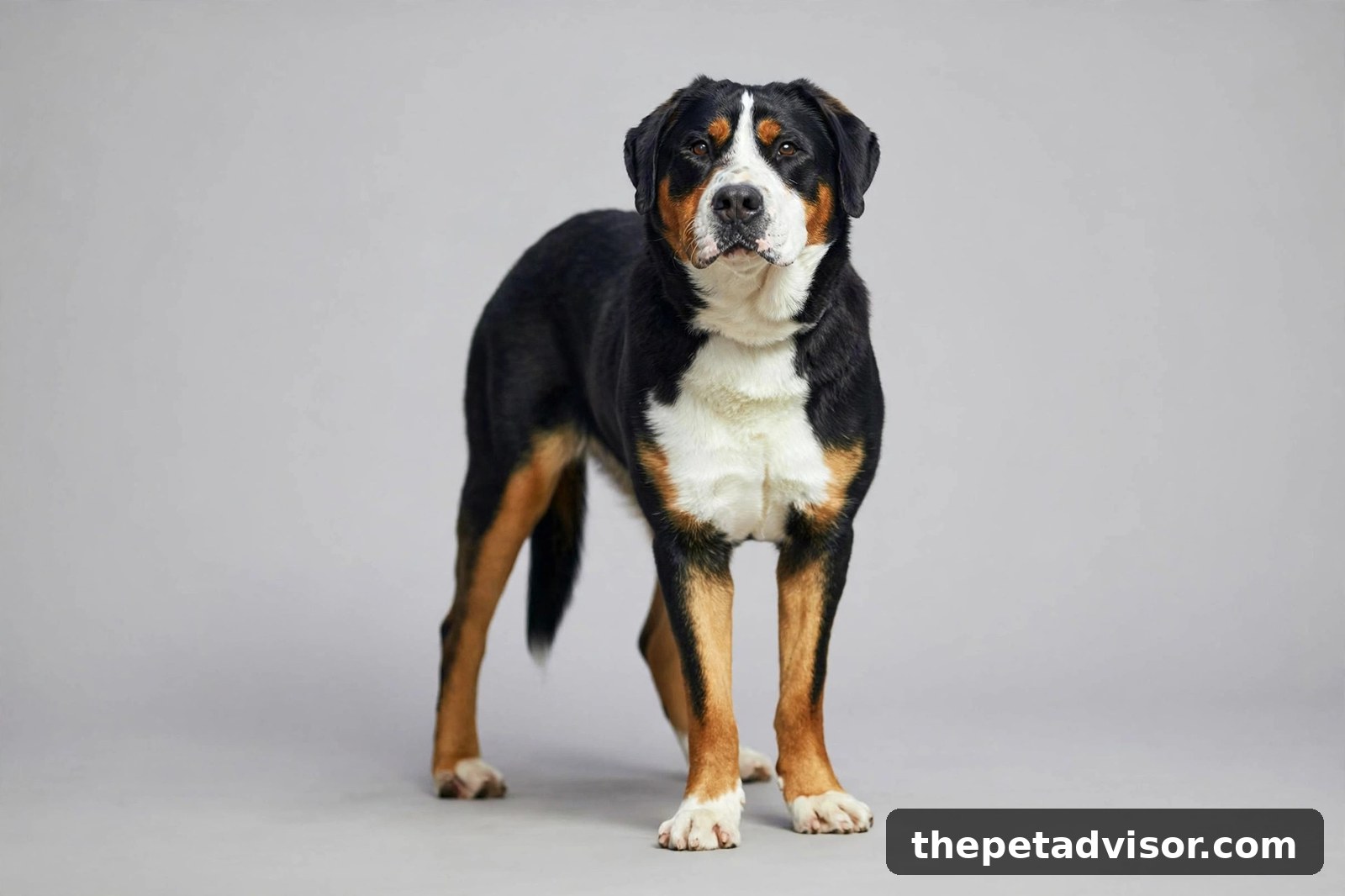
Do you have a photo of a Greater Swiss Mountain Dog in the American show ring? We’d love this page to lead with one. If you have a show photo you’d let us use, email it to [email protected] — tell us the dog’s name and the show, and it may be featured here. Please only send photos you took yourself or have the photographer’s permission to share, and tell us the photographer’s name. We couldn’t find a public photo of a Greater Swiss Mountain Dog in the American show ring that we were free to share, so the photo leading this page was made with AI. We’d much rather lead with a real one — if you’re a club member with an approved photo, we’d love to feature it.
1. Breed at a glance
Working — recognized by the AKC in July 1995 (Miscellaneous Class from 1985)
Dogs 25.5–28.5 in, bitches 23.5–27 in at the shoulder. Adults commonly 115–140 lb (dogs), 85–110 lb (bitches).
Short, dense double coat, 1-1/4 to 2 inches. Black topcoat with rich rust and white markings — tricolor only.
Bold, faithful, willing worker. Alert and vigilant. Devoted to family, watchful with strangers.
High for a giant breed. Bred to work outside all day — needs daily exercise and a job (draft, carting, hiking).
Size, coat, and temperament facts are from the AKC standard. Weight is the commonly given adult range (the standard gives height, not weight). Lifespan (8 to 11 years) is the AKC’s figure (AKC Greater Swiss Mountain Dog breed page).
2. History
The Greater Swiss Mountain Dog is considered the oldest of the Swiss breeds, and it was instrumental in the early development of both the St. Bernard and the Rottweiler. At the jubilee show marking 25 years of the Swiss Kennel Club in 1908, two dogs entered as short-haired Bernese Mountain Dogs were presented to Professor Albert Heim, who recognized them as a distinct breed; they were entered as Grosser Schweizer Sennenhund in volume 12 of the Swiss Stud Book in 1909, and the Swiss club for the breed was founded in January 1912. The FCI standard was first published February 5, 1939. (Sources: S’RENDI Greater Swiss Mountain Dogs, History; Whispering Palm’s, History.)
The breed came to America in 1968, when J. Frederick and Patricia Hoffman, with the help of Perrin G. Rademacher, imported the first Swissys — Kastor von Fryberg and Diana von Urtenenburg — after seeing the breed at a dog show in Frankfurt, Germany the year before. The Greater Swiss Mountain Dog Club of America was formed the same year. In 1983 the club held its first GSMDCA National Specialty, with a registry of 257 dogs; in 1985 the breed entered the AKC Miscellaneous Class; and in July 1995 it was granted full recognition in the AKC Working Group. (Sources: S’RENDI Greater Swiss Mountain Dogs, History; National Purebred Dog Day, The Swissy in 1968.)
The name is a translation choice. The Swiss called the breed Grosser Schweizer Sennenhund — a Senn is a seasonal alpine dairyman — and the founding members of the American club translated “Grosser” as “Greater” rather than “Great,” to differentiate the breed from others with “Great” in their names, such as the Great Dane and the Great Pyrenees. (Source: Whispering Palm’s, History.)
3. The standard and why it’s written that way
- A draft and drover breed, built to look it. The standard opens with the silhouette: “The Greater Swiss Mountain Dog is a Draft and Drover breed and should structurally appear as such. It is a striking, tri-colored, large, powerful, confident dog of sturdy appearance. It is a heavy boned and well muscled dog which, in spite of its size and weight, is agile enough to perform the all-purpose farm duties of the mountainous regions of its origin.” (Source: AKC standard.)
- Size — one size, no miniature. “Height at the highest point on the shoulder is ideally: Dogs 25½ to 28½ inches. Bitches 23½ to 27 inches. Body length to height is approximately a 10 to 9 proportion, thus appearing slightly longer than tall.” Adults commonly weigh 115 to 140 pounds for dogs and 85 to 110 pounds for bitches. (Sources: AKC standard; AKC Greater Swiss Mountain Dog breed page.)
- Head, eyes, ears. “Expression is animated and gentle. The eyes are almond shaped and brown, dark brown preferred, medium sized, neither deep set nor protruding. Blue eye or eyes is a disqualification.” The ears are medium sized, set high, triangular, gently rounded at the tip, hanging close to the head in repose. The skull is flat and broad with a slight stop; the muzzle is large, blunt and straight, and in adult dogs the nose leather is always black. The teeth meet in a scissors bite. (Source: AKC standard.)
- Body and tail. The neck is of moderate length, strong, muscular and clean. The topline is level from the withers to the croup. The chest is deep and broad, about one half the total height at the withers. The tail is thick from root to tip, tapering slightly, reaching to the hocks, and carried down in repose; when alert and in movement it may be carried higher and slightly curved upwards, but should not curl, or tilt over the back. (Source: AKC standard.)
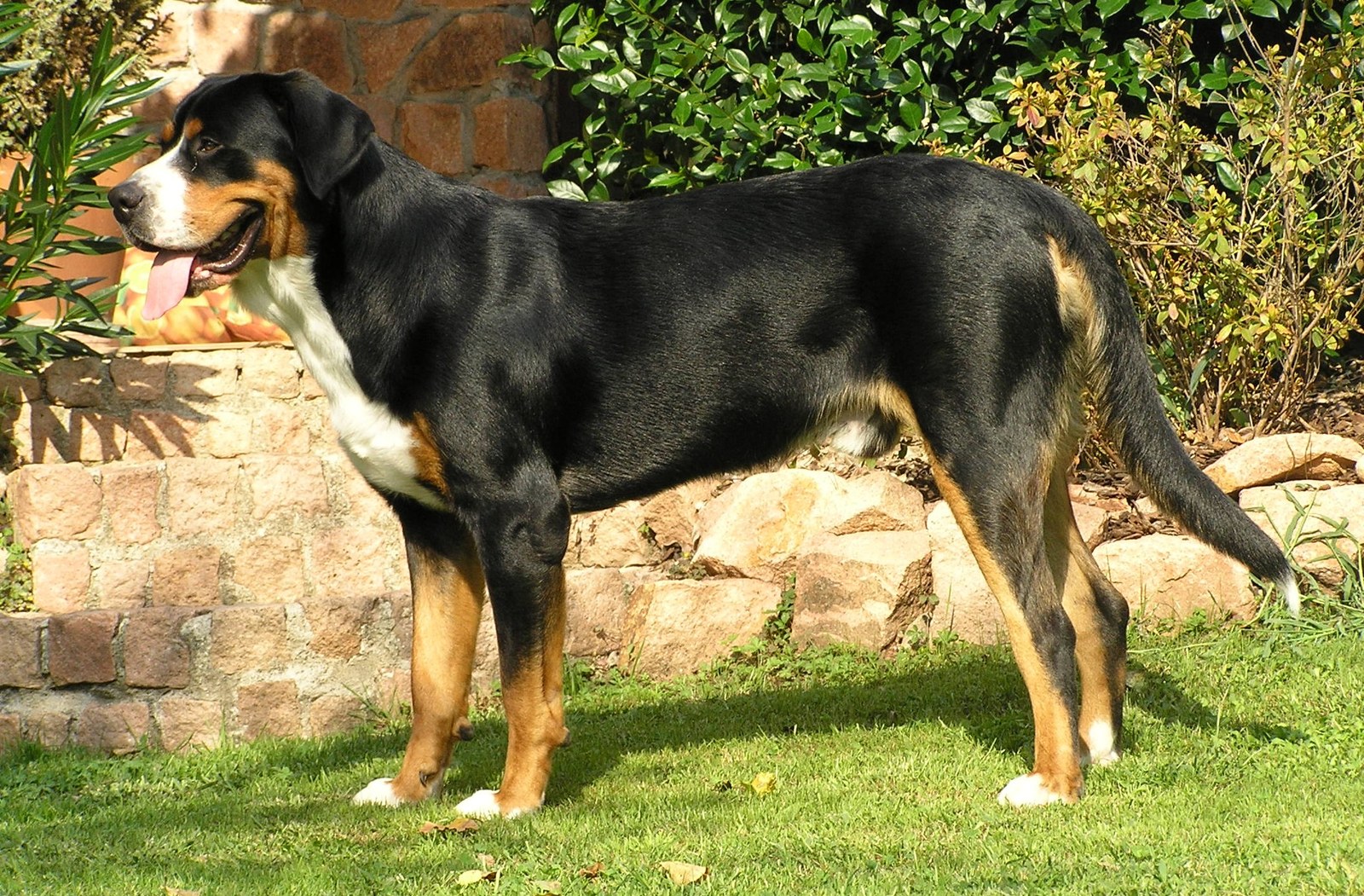
- Coat — dense, with undercoat required. “Topcoat is dense, approximately 1-1/4 to 2 inches in length. Undercoat must be present and may be thick and sometimes showing, almost always present at neck but may be present throughout. Color of undercoat ranges from the preferred dark gray to light gray to tawny. Total absence of undercoat is undesirable and should be penalized.” (Source: AKC standard.)
- One color only, and it is a disqualification to be anything else. “The topcoat is black. The markings are rich rust and white. Symmetry of markings is desired. On the head, rust typically appears over each eye, on each cheek and on the underside of the ears. On the body, rust appears on both sides of the forechest, on all four legs and underneath the tail. White markings appear typically on the head (blaze) and muzzle… Typically, white appears on the chest, running unbroken from the throat to the chest, as well as on all four feet and on the tip of the tail. White patches or collar on the neck is acceptable. Any color other than the ‘Black, Red and White’ tri-colored dog described above, such as ‘Blue/Charcoal, Red and White’ or ‘Red and White’ is considered a disqualification.” (Source: AKC standard.)
- Gait and temperament, in the standard’s own words. Gait: “Good reach in front, powerful drive in rear. Movement with a level back.” Temperament: “Bold, faithful, willing worker. Alert and vigilant. Shyness or aggressiveness shall be severely penalized.” (Source: AKC standard.)
4. Temperament & living with one
The AKC sums the breed up in a sentence: the Greater Swiss Mountain Dog is “a large, immensely strong worker famous for a dense coat of striking black, red, and white markings,” and “dependable and faithful Swissies earned their feed as herders, drafters, and all-around pasture dogs.” The standard’s temperament line is shorter and sterner: “Bold, faithful, willing worker. Alert and vigilant. Shyness or aggressiveness shall be severely penalized.” (Sources: AKC Greater Swiss Mountain Dog breed page; AKC standard.)
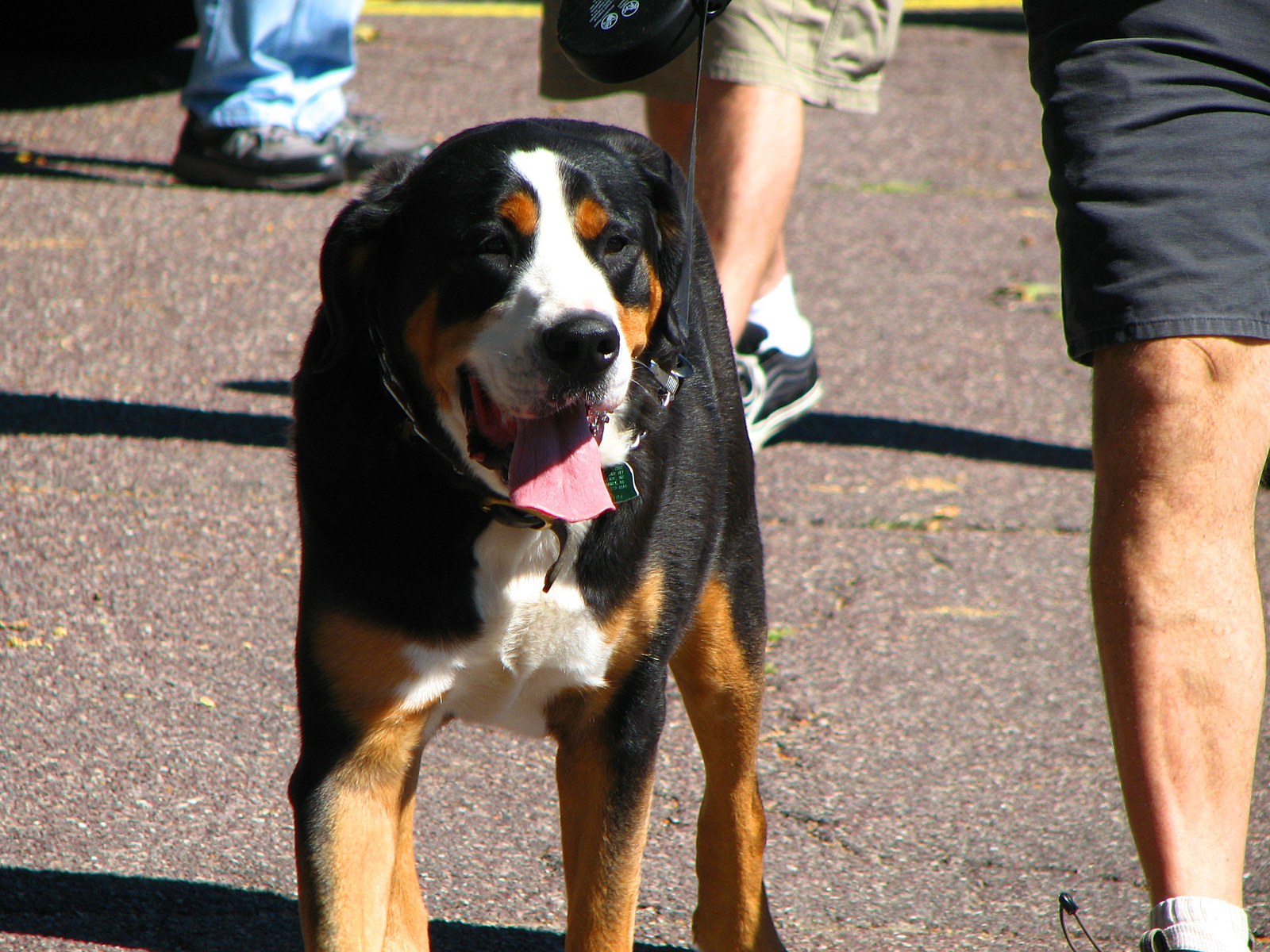
What that means in practice is a dog that is calm and good-natured at home, deeply attached to its family, and watchful with strangers — devoted, loyal, and protective without being aggressive. Swissies do not do well confined to kennel life: they want to be with their people, and they will follow family members from room to room. They mature slowly, taking two to three years to mature in mind and body, so the big puppy stage lasts a long time and early training matters more, not less. They were bred to work outside all day, so a Swissy without exercise and a job — carting, weight pull, pack hiking, draft work — is a Swissy looking for trouble to get into. (Sources: AKC Greater Swiss Mountain Dog breed page; Dog Breed Info, Greater Swiss Mountain Dog; WebMD, All About Greater Swiss Mountain Dogs.)
5. Grooming
- Weekly brushing, and a real shed. The coat is short and dense, a double coat with an undercoat that must be present, so a weekly brush and an occasional bath are enough most of the year — but the coat does shed, heaviest during the seasonal coat blows in spring and fall. The standard penalizes a total absence of undercoat, which is a reminder that the thick coat is part of the dog’s working equipment, not decoration. (Sources: AKC standard; Curex, Is the Greater Swiss Mountain Dog Hypoallergenic?.)
- Not hypoallergenic. The short coat sheds heavily year-round — the AKC rates the breed 4 out of 5 for shedding — and Greater Swiss Mountain Dogs are not hypoallergenic. There is no safe way to know whether an allergic person will tolerate one without spending time around the breed. (Source: Curex, Is the Greater Swiss Mountain Dog Hypoallergenic?, citing AKC breed-trait ratings.)
- Dry-mouthed, mostly. The standard describes the breed as dry-mouthed, with flews only slightly developed and clean lips — a Swissy drools far less than most giant breeds, though any big dog will slobber after drinking or hard exercise. Keep nails trimmed, ears checked, and teeth brushed like any large working dog. (Source: AKC standard.)
6. Health testing
- Four tests for a CHIC number. The Greater Swiss Mountain Dog Club of America participates in the AKC’s Canine Health Information Center program. The parent club’s recommended health tests are a hip evaluation, an elbow evaluation, an ophthalmologist evaluation, and a shoulder evaluation. The GSMDCA’s own breeding guidelines call for passing health clearances for hips, elbows, and eyes prior to being bred, and for never breeding a dog that has exhibited seizures. Breeders should agree to have all test results, positive or negative, published in the CHIC database. (Sources: AKC Working Group health testing requirements; GSMDCA Breeding Guidelines.)
- Hips and elbows first. Hip and elbow dysplasia are the breed’s best-known inherited problems, and they are the reason the orthopedic clearances come first. About 19% of all Swissies evaluated by the OFA since 1974 have been graded dysplastic in the hips, and OFA will not give a final hip rating until a dog is two years old. PennHIP is accepted as an alternative hip evaluation, but it evaluates hips only, not elbows or shoulders. (Sources: AEGIS Greater Swiss Mountain Dogs, Orthopedic Issues; GSMDCA Breeding Guidelines.)
- Shoulders, epilepsy, and bloat. Shoulder osteochondrosis (OCD) is the third orthopedic clearance in the CHIC panel, and the breed’s watch list also includes epilepsy and idiopathic seizure disorders, bloat, splenic torsion, and eye disease. The GSMDCA breeding guidelines list hip dysplasia, elbow dysplasia, entropion, ectropion, symptomatic distichiasis, epilepsy, and monorchidism or cryptorchidism among the heritable conditions a breeder should not knowingly reproduce, and call for disclosing bloat, OCD, and inflammatory bowel disease in related dogs. None of this is a reason not to own a Swissy. All of it is a reason to buy from a breeder who tests: ask for the parents’ CHIC numbers and look the results up in the OFA database yourself, rather than taking a breeder’s word for it. Lifespan is 8 to 11 years. (Sources: AKC Working Group health testing requirements; GSMDCA Breeding Guidelines; AKC Greater Swiss Mountain Dog breed page.)
7. The annual Greater Swiss Mountain Dog specialty dog show
A specialty is the breed’s All-Star show — its Super Bowl. Once a year, the best Greater Swiss Mountain Dogs from across the country, and often from around the world, come together in one place.
The Greater Swiss Mountain Dog Club of America’s national specialty: a full week at Expo Idaho in Garden City, Idaho, with the conformation specialty at its center and draft trials, herding, pack hikes, weight pull, scent work, obedience, rally, the Top 20, and the annual meeting and banquet around it. The 2026 week: October 4–9, with conformation October 8–9 and two designated specialties October 10–11.
National Specialty week: Sunday to Friday, October 4–9, 2026, at Expo Idaho, 5610 N Glenwood St, Garden City, Idaho — conformation indoors and outdoors, unbenched. Conformation days: Thursday, October 8 (Futurity & Maturity, 4-6 month puppy, regular classes and veterans, Top 20 judging and showcase) and Friday, October 9 (sweepstakes, junior showmanship, Best of Breed, non-regular classes, awards banquet). The rest of the week: pack hikes Sunday and Monday, draft trial and herding Tuesday, scent trial, obedience and rally trials, CGC and trick dog, puppy match, annual meeting, and weight pull Wednesday. Two designated specialties with the Idaho Capital City Kennel Club followed at the same site, Saturday and Sunday, October 10–11. Entry: 109 dogs (52 dogs, 57 bitches); 126 entries. Event Chair: Annika Schmid. Superintendent: BaRay Event Services. (Sources: 2026 National & Designated Specialties schedule; 2026 GSMDCA National Specialty premium list; AKC event search, event 2026491619.)
National specialty judges: Ms. Robin A. Hug — all conformation classes, Best of Breed, Junior Showmanship, and 4-6 Month Beginner Puppy. Mrs. Nichole Proctor — Sweepstakes and Veteran Sweepstakes. Mrs. Martha Tubman, DVM — Futurity and Maturity. Ms. Susie Osburn — all Obedience and Rally classes. (Source: 2026 GSMDCA National Specialty premium list.)
Results (official, AKC event 2026491619). Best of Breed: CH Alpenblick’s La Reina De Mesa Verde At Calypso (bitch, owners J. Mijares, A. Schmid). Best of Opposite Sex: CH Wildest Dream Rigatoni Bolognese At Ticino BCAT (dog, owners T. Stanger, T. Bailey, J. Bailey). Select Dog: GCHB CH Bugyal’s Spicy Michelada On The Rocks FDC BCAT CGCA TKN ATT VHMA. Select Bitch: CH Wtf Farms Explorers Seppi CD BN RA FDC SWA SIE SBE SHDN CGC TKN ATT. Best of Winners and Winners Bitch: Painted Mtn’s A Question Of Time (owner L. Simonsen). Winners Dog: CH RODEO’s Hot On The Trail! (owners H. Webb, J. Webb). Reserve Winners Dog: Cherished Marvelous Signs Etched Inch By Inch CGCA CGCU STR TKN. Reserve Winners Bitch: Dahlgren’s Once I Pick A Speed, Aint No Catchin Me. Best Owner-Handled: CH Alpenblick’s La Reina De Mesa Verde At Calypso. Best Junior Handler: Thaddeus Walters. (Source: AKC event search, event 2026491619.)
The 2027 national specialty: November 14–19, 2027, Meadows Event Park, Doswell, Virginia, hosted by the Chesapeake & Potomac Greater Swiss Mountain Dog Club. Show Chairs: Martha Tubman and Mary Jo Rasmussen. Judges: Mr. Jon Cole (conformation, Beginner Puppy, Junior Showmanship), Mrs. Alison Burns (sweepstakes), Mrs. Jenny Bauer (Futurity/Maturity), Ms. Renee Hoover (obedience), Mrs. Nancy Withers (rally). (Source: GSMDCA National Specialty.)
GSMDCA National Specialty — Greater Swiss Mountain Dog Club of America
8. Regional specialties through the year: smaller regional shows
The national is the anchor, but the breed’s year also runs through regional specialties held by the Greater Swiss Mountain Dog Club of America’s regional clubs — the Cascade Greater Swiss Mountain Dog Club, the Greater Swiss Mountain Dog Club of the Rockies, the Lake Shore Greater Swiss Mountain Dog Club, the Chesapeake & Potomac Greater Swiss Mountain Dog Club, and the Patriot Greater Swiss Mountain Dog Club. These are the 2027 regionals verified from club sources so far:
No regional specialties announced yet for 2027.
More regional specialties will be added here as their programs are verified — this section is built from show data, not guesswork. Browse upcoming show weekends →
9. Clubs
- Greater Swiss Mountain Dog Club of America (parent club) — the AKC parent club for the breed in the United States since 1968. It runs the national specialty, held in Garden City, Idaho in 2026. President Deanna Never, Event Chair Annika Schmid (2026).
- Regional specialty clubs. The breed’s regional AKC specialty clubs are the Cascade Greater Swiss Mountain Dog Club (Pacific Northwest — the only AKC-licensed Greater Swiss Mountain Dog club in the Pacific Northwest), the Greater Swiss Mountain Dog Club of the Rockies, the Lake Shore Greater Swiss Mountain Dog Club (northeastern Illinois and southeastern Wisconsin; hosts one AKC specialty show, sweepstakes, and obedience trial each year), the Chesapeake & Potomac Greater Swiss Mountain Dog Club (Virginia, Maryland, West Virginia, and the DC area), and the Patriot Greater Swiss Mountain Dog Club. (Sources: AKC club search; Cascade Greater Swiss Mountain Dog Club, Membership; Lake Shore Greater Swiss Mountain Dog Club, About; Chesapeake & Potomac Greater Swiss Mountain Dog Club, Membership.)
If you are new to the breed, the national specialty itself is the better first stop than a breeder’s website: the people there have owned, shown, and worked Swissies, and they will tell you the truth about the size, the exercise needs, and the slow maturity before you fall for a puppy.
10. Rescue
- Start with the Greater Swiss Mountain Dog Rescue Foundation. The Greater Swiss Mountain Dog Rescue Foundation (GSMDRF) is the breed’s dedicated rescue, a 501(c)(3) organization. It is foster-based: before taking an owner surrender, rescue contacts the breeder to see if the breeder can take the dog back, and dogs in foster care are spayed or neutered, brought up to date on shots, microchipped, and given a general physical with blood work, with any serious health issues disclosed to the adoptive home in writing. (Source: Greater Swiss Mountain Dog Rescue Foundation, Procedures.)
- Contact the breeder first. If you bought your Swissy from a responsible breeder, contact the breeder first — most responsible breeders include a take-back clause in their contracts and want to know if the dog needs help. Rescue’s first step on an owner surrender is the same call: asking the breeder whether they can take the dog back. (Source: Greater Swiss Mountain Dog Rescue Foundation, Procedures.)
- Adults and seniors. A rescued Swissy is usually an adult, often one whose owner underestimated the size, the exercise needs, or the cost of feeding and vetting a 100-plus-pound dog. What you get in return is a dog whose temperament and size you can see before you commit. A Swissy matures slowly, taking two to three years to mature in mind and body, so even a young adult rescue is still very much a work in progress. (Sources: Greater Swiss Mountain Dog Rescue Foundation, Procedures; Dog Breed Info, Greater Swiss Mountain Dog.)
11. Breeder vs. rescue: honest guidance
- If you buy: start with the parent club, the Greater Swiss Mountain Dog Club of America, and its breeder directory. Ask for the parents’ CHIC numbers — hips, elbows, eyes, and shoulders — and look the results up in the OFA database yourself. A good breeder will have the answers, will ask you as many questions as you ask them, and will take the puppy back for its whole life if you cannot keep it. Expect to wait: careful breeders do not always have puppies available, and they match puppies to homes rather than selling to the first caller.
- If you rescue: a rescued Swissy is usually an adult, often one whose owner underestimated the time, space, and expense a giant working breed requires. What you get in return is a dog whose temperament you can see before you commit and a lower price. Either way, be honest with yourself first: a Swissy needs daily exercise, a job to do, training from a young age, and an owner who can handle a 100-plus-pound dog that matures slowly and stays puppyish for two to three years. It is not a dog for a household that wants a low-energy companion or a dog that can be left alone in a kennel all day.
- No rare color worth a premium. One thing that is not what a seller tells you: there is no such thing as a rare color worth a premium. The standard names one color only — black, rust, and white tricolor — and any other color, such as blue/charcoal or red and white, is a disqualification, as is a blue eye. The standard also describes one size only, 25.5 to 28.5 inches for dogs and 23.5 to 27 inches for bitches, with no miniature variety. A breeder selling a “rare” color at a premium is selling you a label.
12. Claim this page
This page belongs to the breed, and the people who know the breed best are the Greater Swiss Mountain Dog Club of America and its members. If you are with the parent club — or you are a breeder, a judge, a handler, or a rescue volunteer who spotted something wrong, missing, or out of date — this page is yours to set straight. Tell us what needs fixing and where the correction is documented, and we will fix it and credit the source. Contact the site through the About page, and mention “Greater Swiss Mountain Dog breed profile.”
Sources
- AKC Greater Swiss Mountain Dog breed page — akc.org/dog-breeds/greater-swiss-mountain-dog
- AKC Greater Swiss Mountain Dog breed standard (approved April 8, 2003; effective May 29, 2003) — images.akc.org/pdf/breeds/standards/GreaterSwissMountainDog.pdf
- Greater Swiss Mountain Dog Club of America — gsmdca.org
- GSMDCA National Specialty (2026 and 2027) — gsmdcans.com
- 2026 GSMDCA National Specialty premium list — thepetadvisor.com/assets/premiums/2026-specialties/greater-swiss-mountain-dog-club-national-2026-premium.pdf
- 2026 National Specialty, AKC event search, event 2026491619 (official results) — apps.akc.org/apps/events/search/index_results.cfm
- AKC Working Group health testing requirements — akc.org/breeder-programs/breed-health-testing-requirements/working-group-health-testing-requirements
- GSMDCA Breeding Guidelines — gsmdca.org/wp-content/uploads/2022/12/GSMDCA-Breeder-Guidelines.pdf
- Greater Swiss Mountain Dog Rescue Foundation, Procedures — gsmdrescue.org/procedures.php
- S’RENDI Greater Swiss Mountain Dogs, History — srendigreaterswiss.com/history1.html
- National Purebred Dog Day, The Swissy in 1968 — nationalpurebreddogday.com/the-swissy-in-1968
- Whispering Palm’s, History — swissmountaindogs.com/the-breed/history
- AEGIS Greater Swiss Mountain Dogs, Orthopedic Issues — aegisgsmd.com/orthopedic-issues.html
- WebMD, All About Greater Swiss Mountain Dogs — webmd.com/pets/dogs/what-to-know-greater-swiss-mountain-dog
- Curex, Is the Greater Swiss Mountain Dog Hypoallergenic? (AKC shedding rating) — getcurex.com/pet-101/is-greater-swiss-mountain-dog-hypoallergenic
- Dog Breed Info, Greater Swiss Mountain Dog — dogbreedinfo.com/greaterswissmountain.htm