Breed profile · Working Group · the royal guardian of the Pyrenees
Great Pyrenees
The Great Pyrenees is a large, thickly coated, immensely powerful working dog, bred to stand between a flock and the wolves on snowy mountaintops — and today a mellow companion and vigilant guardian of home and family. Its year turns on the annual Great Pyrenees specialty dog show: the 2026 national was held April 17–18, 2026, in Spokane Valley, Washington, and the 2027 national is set for April 23–24, 2027, in Asheville, North Carolina.
Help us improve it. This is one of ThePetAdvisor’s breed profiles, built from public sources with generous links to the people who actually own this breed’s knowledge. If something’s off or missing, the parent club can claim the page and set it straight — see the bottom of the page.
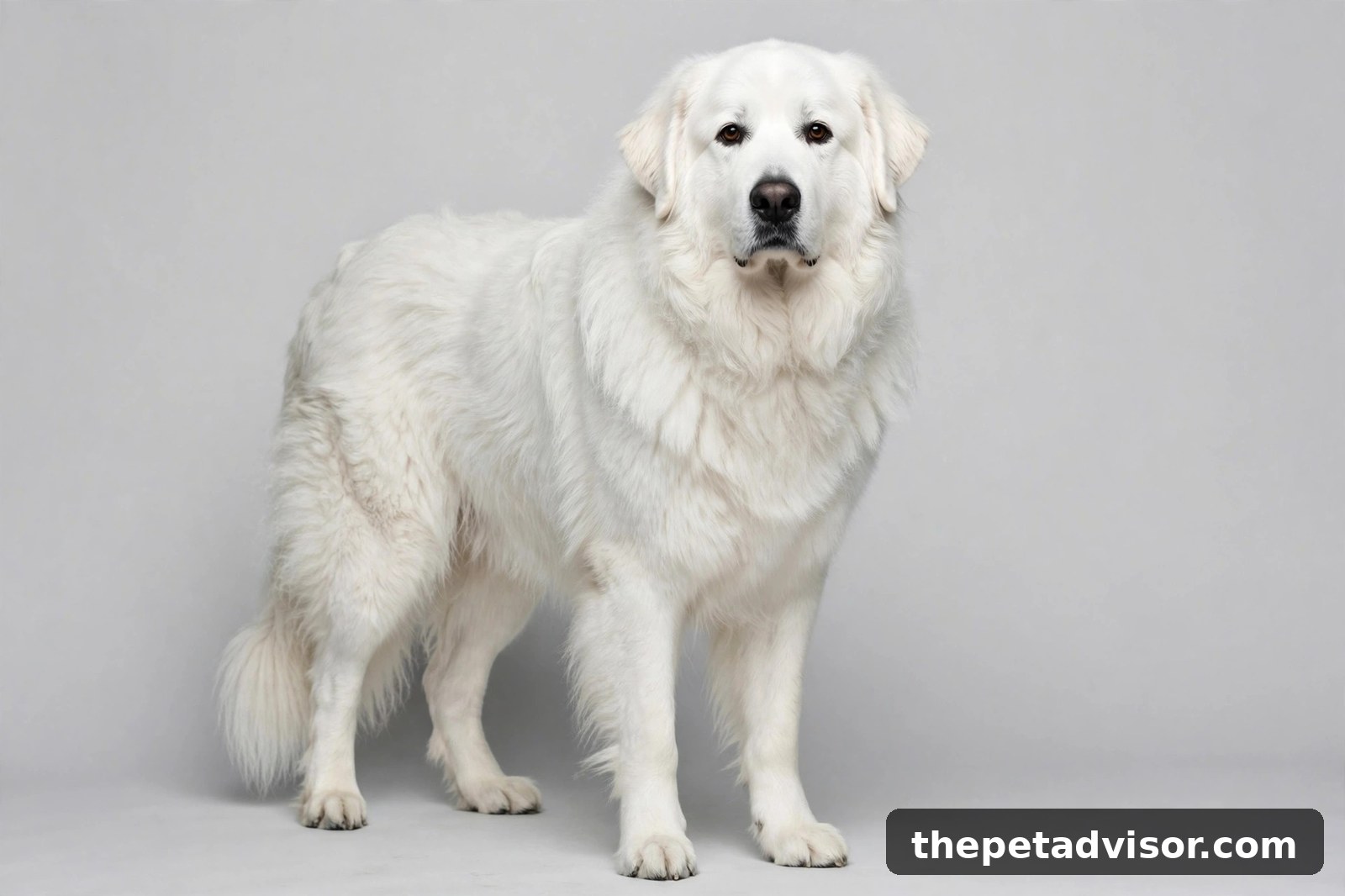
Do you have a photo of a Great Pyrenees in the American show ring? We’d love this page to lead with one. If you have a show photo you’d let us use, email it to [email protected] — tell us the dog’s name and the show, and it may be featured here. Please only send photos you took yourself or have the photographer’s permission to share, and tell us the photographer’s name. We couldn’t find a public photo of a Great Pyrenees in the American show ring that we were free to share, so the photo leading this page was made with AI. We’d much rather lead with a real one — if you’re a club member with an approved photo, we’d love to feature it.
1. Breed at a glance
Group: Working. AKC recognition: 1933. Life expectancy: 10–12 years.
- Size: dogs 27–32 inches at the withers, bitches 25–29 inches; a 27-inch dog about 100 pounds, a 25-inch bitch about 85 pounds, weight in proportion to size; slightly longer than tall.
- Coat: weather-resistant double coat, long, flat, and thick over a dense, woolly undercoat; white or white with markings of gray, badger, reddish brown, or varying shades of tan.
- Hallmark: double dewclaws on each rear leg — absence is a Fault in the standard.
- Temperament: confident, gentle, and affectionate; territorial and protective when necessary; strong-willed, independent, and somewhat reserved.
- Best for: a home with space and a secure fence, and an owner who wants a guardian — not a dog that lives to obey.
- Watch for: barking at night, roaming and patrolling, heavy seasonal shedding, and giant-breed health costs.
2. History
The Great Pyrenees is an ancient livestock guardian of the Pyrenees Mountains, the range that divides France and Spain. For centuries, Pyrs lived with flocks on steep mountain slopes, guarding sheep against wolves and bears — a job that shaped everything about the breed: the size, the white coat that lets a shepherd spot the dog among the sheep at dusk, the thick double coat against mountain weather, and the independence to decide for itself when a threat is real.
The breed was favored by French nobility and declared the Royal Dog of France in 1675 by the court of Louis XIV. In France it is the Chien de Montagne des Pyrénées — the Pyrenean Mountain Dog. The first breed standard was published in 1907 by the Pastoure Club at Lourdes, and the French standard followed in 1927.
The Marquis de Lafayette brought Great Pyrenees to America in 1824, and Basque shepherds brought them to the American West in the 19th century. Serious American breeding began with the 1931 imports of Mr. and Mrs. Francis V. Crane, who founded Basquaerie Kennels in Needham, Massachusetts; the first imports for breeding followed in 1932. The American Kennel Club recognized the breed in February 1933, with separate classification from April 1933. The Great Pyrenees Club of America was founded in 1935 as the parent club, and the first American standard was approved in 1933, revised in 1935, then unchanged for 55 years.
Today the Pyr still works as a livestock guardian on ranches and farms, and guards the family home the same way it once guarded a flock. The parent club’s national specialty has been held every year — the 2026 gathering, in Spokane Valley, Washington, was the 91st annual.
3. The standard and why it's written that way
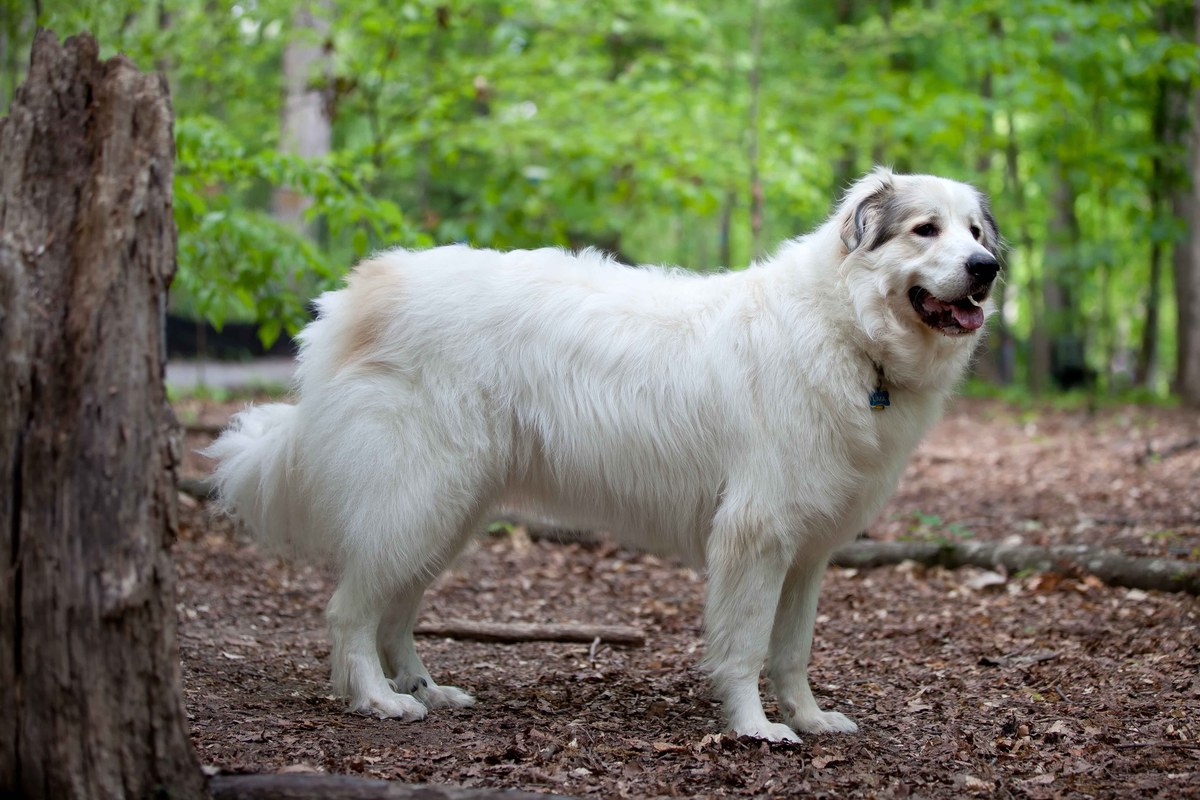
The standard describes a dog of “elegance and unsurpassed beauty” — a working guardian that must also look regal. It was approved June 12, 1990, and took effect August 1, 1990. What it asks for, and why:
- Size and substance. Dogs 27 to 32 inches at the withers, bitches 25 to 29 inches; a 27-inch dog about 100 pounds and a 25-inch bitch about 85 pounds, weight in proportion to size. The dog is slightly longer than tall — rectangular, not square — with great size and majesty, and elegance rather than bulk.
- Head and expression. A wedge-shaped head with a slightly rounded crown; an expression elegant, intelligent, and contemplative. Eyes medium-sized, almond-shaped, rich dark brown, with black rims. Ears small to medium, V-shaped with rounded tips, set at eye level and carried low, flat, and close to the head. Nose and lips black. A scissor bite is preferred, a level bite acceptable.
- The double coat. A weather-resistant double coat: a long, flat, thick outer coat of coarse hair, straight or slightly undulating, over a dense, fine, woolly undercoat. The ruff about the neck and shoulders is more pronounced in males; the tail is plumed, and the thighs carry feathering. Faults: a curly coat, and a stand-off, Samoyed-type coat.
- Color. White or white with markings of gray, badger, reddish brown, or varying shades of tan. Markings may appear on the ears, on the head (including a full face mask), on the tail, and in a few spots on the body; the undercoat may be white or shaded. Fault: outer-coat markings covering more than one-third of the body.
- Double dewclaws. Double dewclaws on each rear leg — absence is a Fault — and a single dewclaw on each foreleg. The rear feet tend to toe out slightly, which is not a fault. The dewclaws are a breed hallmark, a leftover of the mountain dog’s working life.
- Tail and topline. A strong neck of medium length with minimal dewlap; a level topline; a tail that reaches the hock, well plumed and carried low in repose, which may be carried over the back — “making the wheel” — when the dog is aroused, often with a “shepherd’s crook” tip.
- Gait. Smooth, elegant, true and straight, with power and agility; ease and efficiency of movement matter more than speed — a dog that had to patrol mountain slopes all day.
- Temperament in the standard. Confident, gentle, and affectionate; territorial and protective of flock or family when necessary; quiet composure, patient, tolerant; strong-willed, independent, and somewhat reserved, attentive, fearless, and loyal. Excessive shyness, nervousness, or aggression toward humans is an extremely serious fault; the dog may appear reserved in the show ring.
4. Temperament & living with one
A Great Pyrenees is a guardian first and a pet second. The breed was made to think for itself — to decide, alone on a mountainside at night, whether a sound is a threat — and that independence does not switch off in a living room. A Pyr is not a breed that lives to obey; it is a breed that lives to watch.
With its own family and livestock, the Pyr is gentle, patient, and affectionate. With strangers it is reserved: a stranger is assessed, not greeted. Early socialization helps, but do not expect a Pyr to become a social butterfly — reserve is in the standard.
The night shift. A Pyr’s working hours are after dark, when predators move. Expect alert barking at sounds you cannot hear, and expect it most nights. This is the single most common reason Pyrs are rehomed, and the one to be honest about before getting one: a Pyr is not a good fit for close neighbors, an apartment, or a household that needs quiet nights.
The patrol. A Pyr will walk a fence line, check the boundaries, and roam if it can. A secure fence is not optional — an unfenced Pyr will expand its territory on its own, and off-leash in open country is a risk. A Pyr that has a yard or pasture to watch is a calmer dog than one confined to a small yard with nothing to guard.
Training. Patient, consistent, and positive. Harsh methods backfire with an independent guardian — a Pyr that stops trusting you stops listening, and it does not come back easily. Short, calm sessions and clear rules work better than drilling. Socialize early and widely, and teach a reliable recall while the dog is still small enough to manage.
Exercise and heat. Moderate exercise suits a Pyr: daily walks and room to patrol. The thick double coat needs shade and water in summer — never shave it; the coat insulates against heat as well as cold. Protect growing joints from repetitive high-impact exercise while a puppy is still growing.
5. Grooming
The Great Pyrenees coat is beautiful and it is work. A weekly brush-out with a pin brush keeps it in order; during the spring and fall coat blows, when the undercoat comes out in handfuls, brush several times a week. Check behind the ears, under the collar, and in the feathering, where mats start.
- Never shave the double coat. The undercoat insulates against heat as well as cold, and a shaved coat grows back unevenly.
- Baths as needed. The white coat shows dirt — but the coat sheds dirt as it dries, so a Pyr often cleans up with a good brush-out after a muddy walk.
- The rear double dewclaws. Trim them regularly. They do not wear down naturally, they can catch and tear, and an overgrown dewclaw can grow into the pad. Check them every time you trim the other nails.
- Ears and teeth. Check the ears weekly and clean as needed; brush the teeth regularly.
- Show grooming. The coat is shown natural — bath, blow-dry, and brush-out, with no sculpting. Tidy the feet and keep the white clean; the dog does the rest.
6. Health testing
The Great Pyrenees Club of America’s health statement, approved by the club’s board on February 3, 2022, sets the CHIC (Canine Health Information Center) requirements for the breed. A CHIC number means the tests were done and the results are public on the OFA website — ask any breeder for the parents’ CHIC numbers and verify them yourself.
Two mandatory tests:
- Hip dysplasia evaluation — OFA, PennHIP, FCI, or AVA.
- Patella luxation exam — OFA.
Plus one additional test from:
- Elbow dysplasia evaluation (OFA)
- Cardiac evaluation (OFA)
- Thyroid panel (OFA)
- ACVO eye exam (OFA or CERF)
- Glanzmann’s thrombasthenia (GT) DNA test
- Shoulder OCD evaluation (OFA)
- Canine multifocal retinopathy (CMR) DNA test
- BAER hearing test (OFA)
The club also strongly recommends DNA testing for neuronal degeneration (NDG) and dwarfism (University of Minnesota) — not CHIC-eligible yet, but worth asking a breeder about.
Conditions to watch for: hip and elbow dysplasia, patellar luxation, eye disorders (entropion, cataracts, CMR), chondrodysplasia (dwarfism), neuronal degeneration, and Glanzmann’s thrombasthenia. As with any giant, deep-chested breed, bloat (gastric dilatation-volvulus) is a risk — know the signs and ask the breeder about it. Life expectancy is 10–12 years.
7. The annual Great Pyrenees specialty dog show
A specialty is the breed’s All-Star show — its Super Bowl. Once a year, the best Great Pyrenees from across the country, and often from around the world, come together in one place.
The Great Pyrenees Club of America’s national specialty: the annual Great Pyrenees specialty dog show. The 2026 national: April 17–18, 2026, at the Mirabeau Park Hotel and Convention Center in Spokane Valley, Washington, judged by Keith Savage. Best of Breed: GCHG Rivergroves Se.Faire Remarquer. Best Junior Handler: Abigail Metish. The 2027 national: April 23–24, 2027, at the Crowne Plaza Resort Asheville in Asheville, North Carolina, judged by Karen Justin. The 2025 national: May 2–3, 2025, at the Sheraton Lisle Naperville Hotel in Lisle, Illinois, judged by Dr. Patricia Princehouse, 72 dogs in the entry. The 2024 national: week of April 2, 2024, at the Crowne Plaza Asheville in Asheville, North Carolina. The 2023 national: April 23–29, 2023, at the Hilton Sacramento Arden West in Sacramento, California, hosted by the Sierra Pacific Great Pyrenees Club, more than 137 entries.
The standard, in brief: a large, immensely powerful dog of elegance and unsurpassed beauty, white or principally white, with a keen intelligence and a kindly, while regal, expression — dogs 27 to 32 inches at the withers, bitches 25 to 29 inches, a 27-inch dog about 100 pounds and a 25-inch bitch about 85 pounds, slightly longer than tall — a weather-resistant double coat, long, flat, thick, and coarse over a dense, fine, woolly undercoat, with a ruff about the neck and shoulders and a plumed tail — white or white with markings of gray, badger, reddish brown, or varying shades of tan — double dewclaws on each rear leg — confident, gentle, and affectionate, territorial and protective when necessary, strong-willed, independent, and somewhat reserved.
The 2026 National Specialty — a week of events Tuesday, April 14 – Saturday, April 18, 2026, at the Mirabeau Park Hotel & Convention Center, 1100 N Sullivan Rd, Spokane Valley, Washington. Conformation Friday, April 17 – Saturday, April 18, 2026. AKC event 2026097406, Parent Specialty (National Specialty). Conformation judge: Mr. Keith Savage. Junior Showmanship judge: Mr. Stephen Cabral. Futurity judge: Ms. Kimberly Kentopp. Puppy Sweepstakes judge: Mrs. Nancy Coombs. Veteran Sweepstakes judge: Ms. Sue Blevens. Obedience & Rally judge: Mr. Richard Lewis (AKC events 2026097405 and 2026097403). Superintendent: BaRay Event Services, Inc. Event chair: Linda Whisenhunt. Entries closed Wednesday, March 25, 2026, at 12:00 p.m. PDT. The entry: 40 dogs, 56 entries. The week also held obedience and rally on Tuesday, April 14; two GPCA regional specialties on Wednesday, April 15; and Futurity, Sweepstakes, Veteran Sweepstakes, and the Top Twenty/Puppy Invitational on Thursday, April 16. (Sources: AKC event search, event 2026097406; BaRay, 2026 GPCA National Specialty judging program.)
Results (2026 national). Best of Breed: GCHG Rivergroves Se.Faire Remarquer. Best Junior Handler: Abigail Metish; Reserve Best Junior Handler: Kamryn Forman. Best of Opposite Sex, Winners Dog, and Winners Bitch not confirmed in an accessible official source. (Sources: Westminster Kennel Club, 2027 Westminster invitees (National Specialty Winners); AKC event search, event 2026097406.)
The 2027 National Specialty: a week of events Tuesday, April 20 – Saturday, April 24, 2027, at the Crowne Plaza Resort Asheville, 1 Resort Drive, Asheville, North Carolina. The AKC Upcoming National Specialties list gives the national as Friday, April 23 – Saturday, April 24, 2027 (2 days). Superintendent: Jim Rau Dog Shows, Ltd. Conformation judge: Karen Justin. Junior Showmanship judge: Jean Pero. Puppy Sweepstakes judge: JoAnne Bergen. Veteran Sweepstakes judge: Brenda Weiss. Futurity judge: Mike Falatach. Obedience/Rally judge: Richard H Mullen. The week also holds the national obedience and rally trial on Tuesday, April 20 (Richard H Mullen); a GPCA regional specialty on Tuesday, April 20 (Jean Pero, no sweepstakes); and two GPCA regional specialties on Wednesday, April 21 — morning show judged by Vince Chianese (puppy and veteran sweepstakes Lauren Hull) and afternoon show judged by Dennis Gallant. Room rate $140 per night, one-time nonrefundable pet fee $75, four dogs per room maximum; ten RV spaces at $100 each. AKC event number, entries, and closing date not yet published as of November 2026. (Sources: AKC Upcoming National Specialties; Great Pyrenees Club of America, National Specialty; Great Pyrenees Club of America, Meet the Judges.)
Past national specialties: 2025 · 2024 · 2023
Great Pyrenees Club of America — 2027 national specialty
8. Regional specialties through the year: smaller regional shows
The national is the anchor, but the breed’s year also runs through regional specialties — smaller regional shows, not the national — held by the parent club’s regional clubs around the country, usually as designated specialties with all-breed shows. These are the 2026 regionals verified from club and AKC sources so far:
Four GPCA regional specialties verified for 2026 so far:
- Great Pyrenees Association of Southern California Specialty — Thursday, January 22, 2026, Ventura, California: at the Ventura County Fairgrounds & Seaside Park, 10 W Harbor Blvd. AKC event 2026113401. Judge L Whisenhunt. The entry: 7 Great Pyrenees. Entries closed Wednesday, January 7, 2026; entries limited to 100. Superintendent: Jack Bradshaw Dog Shows. (Source: AKC event search, event 2026113401.)
- GPCA Regional Specialty #1 (morning) — Wednesday, April 15, 2026, Spokane Valley, Washington: at the Mirabeau Park Hotel & Convention Center, 1100 N Sullivan Rd, held during national week. AKC event 2026097407. Judge Mr. Richard Lewis. The entry: 42 dogs, 50 entries. (Source: AKC event search, event 2026097407.)
- GPCA Regional Specialty #2 (afternoon) — Wednesday, April 15, 2026, Spokane Valley, Washington: at the Mirabeau Park Hotel & Convention Center, 1100 N Sullivan Rd, held during national week. AKC event 2026097409. Judge Karen Justin. The entry: 42 dogs, 49 entries. (Source: AKC event search, event 2026097409.)
- GPCA 45th Northwest Specialty — Friday, June 19, 2026, Hillsboro, Oregon: at the Washington County Fairgrounds, 873 NE 34th St, held with the Clackamas County Kennel Club cluster. AKC event 2026097414. Judge Mrs. C Martinez. The entry: 12 dogs, 12 entries. Entries closed Wednesday, June 3, 2026, at 12:00 p.m.; entries limited to 100. Superintendent: BaRay Event Services, Inc. (Source: AKC event search, event 2026097414.)
The 2027 regionals announced so far:
- GPCA Regional Specialties, national week — Tuesday, April 20, and Wednesday, April 21, 2027, Asheville, North Carolina: at the Crowne Plaza Resort Asheville, 1 Resort Drive. Tuesday show judged by Jean Pero (no sweepstakes); Wednesday morning show judged by Vince Chianese (puppy and veteran sweepstakes Lauren Hull); Wednesday afternoon show judged by Dennis Gallant. (Source: Great Pyrenees Club of America, Meet the Judges.)
- Sierra Pacific Great Pyrenees Club Specialty — Saturday, May 22, 2027, Granite Bay, California: at the Sierra Great Pyrenees Club Grounds, 8700 Goldenspur Dr. AKC event 2027617808. Entries close Wednesday, May 5, 2027. (Source: AKC event search, event 2027617808.)
Past regional specialties: 2025 · 2024
More regional specialties will be added here as their programs are verified — this section is built from show data, not guesswork. Browse upcoming show weekends →
9. Clubs
The parent club is the Great Pyrenees Club of America (GPCA), founded in 1935 — greatpyrenees.club. The club runs the annual national specialty, publishes the breed’s health statement, and lists regional clubs and rescue contacts.
Regional clubs affiliated with the parent club include:
- Garden State Great Pyrenees Club
- Great Pyrenees Club of Atlanta
- Great Pyrenees Club of California
- Great Pyrenees Club of Greater Chicago
- Great Pyrenees Club of Puget Sound
- Great Pyrenees Club of the Southeast
- Great Pyrenees Association of Southern California
- Grand Canyon Great Pyrenees Club
- Heart of Ohio Great Pyrenees Club
- Mile High Great Pyrenees Club
- National Capital Area Great Pyrenees Club
- North Florida Great Pyrenees Club
- North Star Great Pyrenees Club
- Penn-Dutch Great Pyrenees Club
- Pyrenean Fanciers of the Northeast
- Sierra Pacific Great Pyrenees Club
- Great Pyrenees Club of Metropolitan Milwaukee
- Columbia Cascade Great Pyrenees Club (founded 1983)
- Research Triangle Park Great Pyrenees Club (established 2014; GPCA-affiliated 2017)
10. Rescue
If a Great Pyrenees comes into your life through rescue, it will usually be an adult whose temperament is already known — and that is an advantage with a guardian breed. The rescues below work with the breed specifically.
- Great Pyrenees Club of America breed rescue: Janet Ingram, Radford, Virginia — [email protected] (the parent club’s rescue contact, listed in the AKC club directory).
- National Great Pyrenees Rescue (NGPR): nationalpyr.org — all-volunteer, founded 2006, a 501(c)(3) since 2007, with more than 10,000 dogs rescued through a national network. PO Box 86, Nanuet, NY 10954. Director: Barbara Mattson, [email protected]. As of late 2026 the owner-surrender program was closed to new intake.
- NorthStar Great Pyrenees Rescue of Minnesota: northstargreatpyrs.com — recognized by the Great Pyrenees Club of America, a 501(c)(3) based in Minneapolis. (612) 379-0010.
- Great Pyrs & Paws Rescue: a 501(c)(3) working in Texas and the Pacific Northwest, a partner of National Great Pyrenees Rescue. [email protected].
- Carolina Great Pyrenees Rescue: based in Marshville, North Carolina.
- Great Pyrenees Club of Metropolitan Milwaukee Rescue: Erina Fitzgerald, (414) 630-1170, [email protected]. Minimum adoption donation $250.
The national specialty holds a Rescue Parade — at the 2025 national it was part of the Saturday program — where rescued Pyrs are celebrated in the ring. A rescue Pyr still needs the same things a puppy does: a secure fence, patient training, regular grooming, and an owner who understands a guardian’s independence.
11. Breeder vs rescue
From a breeder: expect the parents’ CHIC health tests (hip and patella evaluations are mandatory, plus one more from the list in section 6), with OFA/CHIC numbers you can verify on the OFA website; a health guarantee; a take-back commitment for the life of the dog; and questions about your fencing, your livestock or children, and your experience with guardian breeds. Puppies should be raised in the home and socialized early. Red flags: no health testing, no take-back, puppies always available, or a breeder who will not show you the parents’ test records.
From rescue: expect an adult dog whose temperament with children, livestock, and other dogs is already known — a real advantage with a guardian breed — and an adoption process that asks about your fence and your experience. The adoption fee is far below a purchase price, and the dog still needs the same fence, grooming, and patience.
Either way, a Great Pyrenees is a 10–12 year, 85–100-plus-pound commitment with a heavy coat, a guardian’s independence, and a bark that carries at night. Choose the route that fits your household — then choose the individual dog, not the idea of the breed.
12. Claim this page
Are you the Great Pyrenees Club of America, a regional club, or a breeder or rescue listed here? This page is maintained from public sources — if a date, a judge, or a result is wrong, or a link is out of date, tell us and we will fix it. Clubs and breeders who would like their events, health clinics, or rescue work featured can reach us at the same address.
Sources
- American Kennel Club — Great Pyrenees breed page
- American Kennel Club — Official Standard for the Great Pyrenees (approved June 12, 1990; effective August 1, 1990)
- Great Pyrenees Club of America — Health Statement (CHIC requirements; approved by the GPCA Board, February 3, 2022)
- American Kennel Club — Upcoming National Specialties
- Great Pyrenees Club of America — National Specialty
- Great Pyrenees Club of America — Meet the Judges (2027 national)
- BaRay Event Services — 2026 GPCA National Specialty judging program
- BaRay Event Services — 2026 GPCA National Specialty premium list
- BaRay Event Services — 2026 GPCA National Specialty breed counts
- AKC event search — 2026 national specialty, event 2026097406
- American Kennel Club — 2025 GPCA National Specialty premium list
- BaRay Event Services — 2025 GPCA National Specialty breed counts
- AKC event search — 2025 national specialty, event 2025097407
- Westminster Kennel Club — 2027 Westminster invitees (National Specialty Winners)
- Sierra Pacific Great Pyrenees Club — January 2024 newsletter (2023 national)
- Great Pyrenees Club of America — breed history (via PyrNet)
- PyrBred — regional Great Pyrenees club links
- National Great Pyrenees Rescue
- Wikimedia Commons — Great Pyrenees Mountain Dog (HeartSpoon, CC BY-SA 3.0) — section 3 photo
- Great Pyrenees Club of Metropolitan Milwaukee — October 2025 premium list
- Great Pyrenees Club of Metropolitan Milwaukee — October 2025 judging program
