
Breed profile · Working Group · The gentle giant, the Apollo of Dogs
Great Dane
The Great Dane is the gentle giant of the dog world — the tallest breed in the ring and, by reputation, one of the sweetest: a German boar hound turned house companion, the AKC’s “Apollo of Dogs,” a dog that can look you in the eye while standing on all fours and still want nothing more than your lap.
Help us improve it. This is one of ThePetAdvisor’s breed profiles, built from public sources with generous links to the people who actually own this breed’s knowledge. If something’s off or missing, the parent club can claim the page and set it straight — see the bottom of the page.
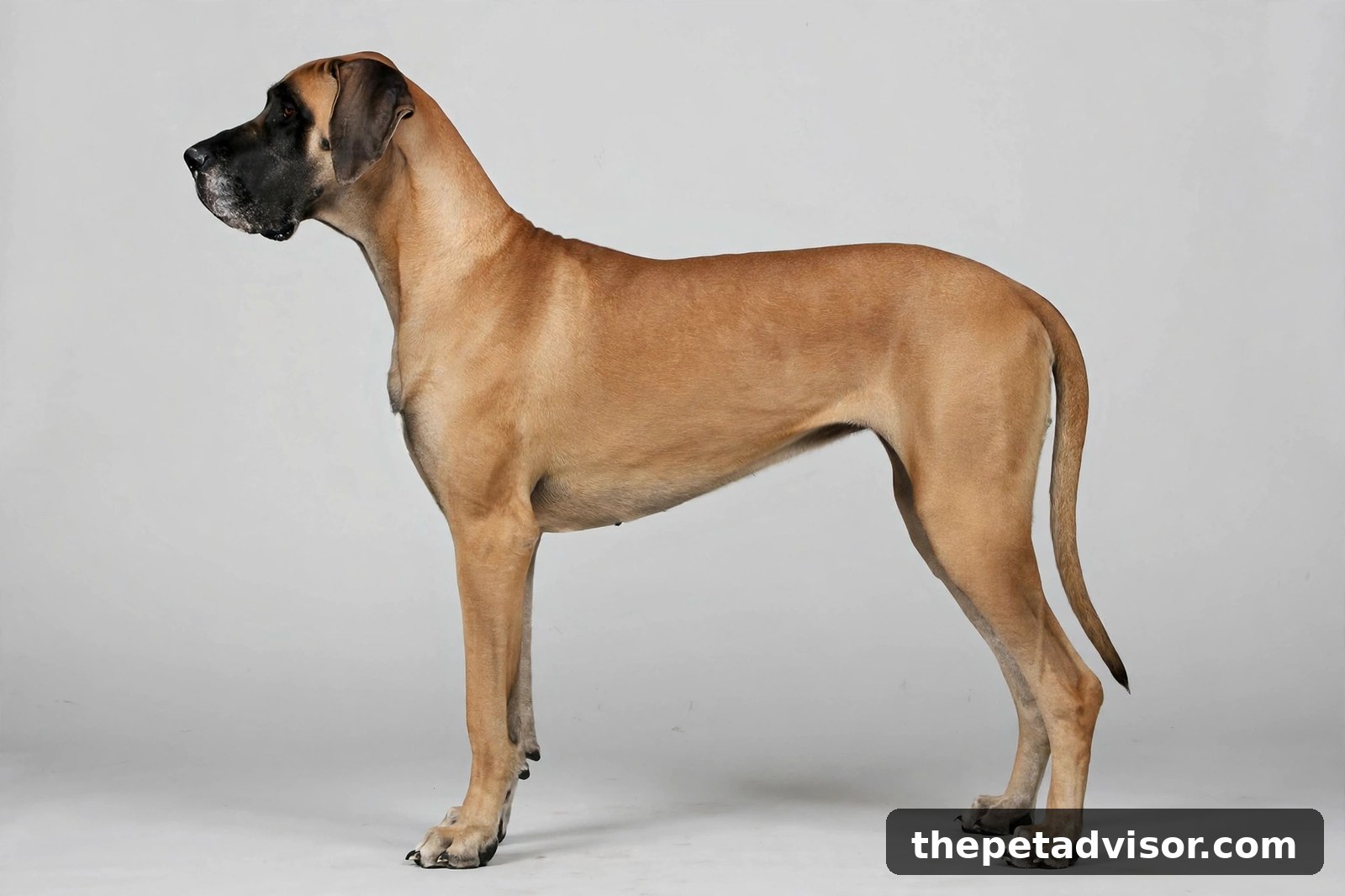
Do you have a photo of a Great Dane in the American show ring? We’d love this page to lead with one. If you have a show photo you’d let us use, email it to [email protected] — tell us the dog’s name and the show, and it may be featured here. Please only send photos you took yourself or have the photographer’s permission to share, and tell us the photographer’s name. We couldn’t find a public photo of a Great Dane in the American show ring that we were free to share, so the photo leading this page was made with AI. We’d much rather lead with a real one — if you’re a club member with an approved photo, we’d love to feature it.
1. Breed at a glance
Working — recognized by the AKC in 1887
Males 30–32 in, females 28–30 in at the shoulder. Weight 140–175 lb (males), 110–140 lb (females).
Short, thick, smooth. Seven colors: fawn, brindle, blue, black, harlequin, mantle, merle.
Spirited, courageous, never timid, always friendly and dependable.
7 to 10 years. A short life for a large dog, and the honest trade for the size.
Size, weight, and lifespan are the AKC breed-profile figures (AKC Great Dane breed page). Height minimums and colors are from the AKC standard.
2. History
The Great Dane is a German dog, whatever the name says. It descends from the hunting dogs of the Middle Ages, used to hunt bear, boar, and deer, and kept as guard dogs by German nobility. The favorites slept in their lords’ bedchambers at night — Kammerhunde, chamber dogs, outfitted with ornate collars, there to protect the sleeping princes from assassins. (Source: Wikipedia, Great Dane.)
The name changed in 1878, when a committee in Berlin renamed the Englische Dogge the Deutsche Dogge, the German mastiff. The French called it the Grand Danois, and the English translated that literally into Great Dane, even though the breed has no known connection to Denmark. In Germany it remains the Deutsche Dogge. (Source: Wikipedia, Great Dane.)
The breed reached America with German immigrants in the late nineteenth century, and the AKC recognized it in 1887. The Great Dane Club of America followed in 1889, one of the oldest parent clubs in the country. Pennsylvania named the Great Dane its official state dog in 1965 — the statute says the breed’s size, strength, beauty, intelligence, tolerance, courage, faithfulness, trustworthiness, and stability exemplify the Commonwealth — and a portrait of the state’s founder, William Penn, with his Great Dane hangs in the governor’s reception room. The most famous Dane of all never set foot in a ring: Scooby-Doo, the cowardly ghost-hunter, is a Great Dane. (Sources: Pennsylvania Statutes, 71 P.S. § 1008; Mental Floss, 10 Facts About Great Danes.)
3. The standard and why it’s written that way
- Regal, strong, elegant — and never clumsy. The standard opens with the silhouette: “The Great Dane combines, in its regal appearance, dignity, strength and elegance with great size and a powerful, well-formed, smoothly muscled body. It is one of the giant working breeds, but is unique in that its general conformation must be so well balanced that it never appears clumsy, and shall move with a long reach and powerful drive.” (Source: AKC standard.)
- Square, and tall. In the ratio between length and height, the Great Dane should be square. “The male shall not be less than 30 inches at the shoulders, but it is preferable that he be 32 inches or more, providing he is well proportioned to his height. The female shall not be less than 28 inches at the shoulders, but it is preferable that she be 30 inches or more, providing she is well proportioned to her height. Danes under minimum height must be disqualified.” (Source: AKC standard.)
- Seven colors — and the ones that disqualify. Brindle (yellow gold brindled with black cross stripes in a chevron pattern, black mask preferred), fawn (yellow gold with a black mask), blue (pure steel blue), black (glossy black), harlequin (pure white with black torn patches, merle patches normal), mantle (black and white with a solid black blanket), and merle (pale gray to dark gray merle with black torn patches). The disqualifications are Danes under minimum height, split nose, docked tail, any color other than the seven described — and merlequin, a white dog with only patches of merle. (Source: AKC standard.)
- Natural ears, or cropped. Great Danes have naturally floppy, triangular ears. In the past, when Danes were used to hunt boar, cropping made ear injuries less likely; today the practice is still common in the United States, done for tradition and appearance, but much less common in Europe, where it is banned or controlled in several countries. (Source: Wikipedia, Great Dane.)
- Temperament, in the standard’s own words. The standard calls the Dane spirited and courageous, friendly and dependable — never timid. That last phrase is the one the ring checks first, because a giant dog that is timid is a giant dog that is dangerous. (Source: AKC standard.)
4. Temperament & living with one
The AKC sums the breed up in a sentence: the easygoing Great Dane, the mighty “Apollo of Dogs,” is a total joy to live with — “but owning a dog of such imposing size, weight, and strength is a commitment not to be entered into lightly. This breed is indeed great, but not a Dane.” At home that means a dog that bonds hard to its own people and wants to be where they are, preferably leaning on them: friendly, patient, and dependable, dignified without being aloof, and playful well past puppyhood. (Sources: AKC Great Dane breed page; AKC standard.)
What that means in practice is a dog that needs training before it needs anything else. A Dane puppy grows at a frightening rate — a few months from lapdog to a dog that outweighs a grown woman — and every behavior it learns as a puppy, good or bad, it will carry at 150 pounds. Early socialization and firm, consistent handling are not optional, and neither is a plan for exercise: Danes need a good daily walk and room to stretch, but they are not a high-energy breed and are content to spend the rest of the day on the sofa, preferably on yours. They do not thrive left alone in a yard. They drool, they shed, they snore, and they eat like the giant they are — and the parent club’s guidance is blunt about the arithmetic, because “he got too big” is one of the reasons Danes end up in rescue. (Sources: Great Dane Club of America, Is a Great Dane for you; AKC Great Dane breed page.)
5. Grooming
- The easy part of owning a Dane. Grooming is the easy part. The coat is short, thick, and smooth, and a weekly brushing with a rubber curry or hound glove keeps it glossy and holds the shedding down. Baths are rarely necessary — a Dane that lives in the house stays clean, and a bath is for the day it finds mud. (Source: AKC standard.)
- The rest of the upkeep is not grooming, it is scale. Everything about a Dane costs more because there is more of it: more food, bigger crates and beds, stronger leashes, and nails the size of thumbnails that need regular trimming. The jowls drool, especially after drinking, and the ears — cropped or natural — need regular checking. None of this is hard. All of it is daily, for seven to ten years. (Source: Great Dane Club of America, Is a Great Dane for you.)
6. Health testing
- Four tests for a CHIC number. The Great Dane Club of America participates in the AKC’s Canine Health Information Center program. For a Great Dane to earn a CHIC number, it must have a hip evaluation through OFA or PennHIP, an eye clearance through OFA, a congenital cardiac evaluation through OFA, and an autoimmune thyroid evaluation through OFA from an approved laboratory. The club’s board approved the protocol in 2003 and strongly recommends a CHIC certificate for every Dane bred. Heart and thyroid testing are worth repeating every two to three years, because a clear result in a young adult does not stay clear for life. (Sources: Great Dane Club of America health statement (AKC); Great Dane Club of America, Is a Great Dane for you.)
- The watch list is bloat and the heart. Bloat, or gastric dilatation-volvulus, is the greatest killer of Great Danes, with a lifetime risk estimated around 37%; a preventive gastropexy greatly reduces deaths from it. Dilated cardiomyopathy is so common in the breed that Danes carry the nickname “the heartbreak breed.” Hip dysplasia and wobbler disease, the spinal condition that makes a fast-growing Dane weak in the legs, round out the list. None of this is a reason not to own a Dane. All of it is a reason to buy from a breeder who tests: ask for the parents’ CHIC numbers and look the results up in the OFA database yourself, rather than taking a breeder’s word for it. Lifespan is 7 to 10 years. (Sources: Wikipedia, Great Dane; Great Dane Club of America health statement (AKC).)
7. The annual Great Dane specialty dog show
A specialty is the breed’s All-Star show — its Super Bowl. Once a year, the best Great Danes from across the country, and often from around the world, come together in one place.
The Great Dane Club of America’s national specialty is the anchor of the Great Dane’s year — a full week at one resort, not a single show day, with agility, obedience, rally, and the Futurity around the conformation specialty itself, and the Top 20 competition alongside it.
The 2026 GDCA National Specialty Show: Monday to Saturday, October 19–24, 2026, at the MeadowView Conference Resort & Convention Center, 1901 Meadowview Pkwy, Kingsport, Tennessee — a full national week, hosted by the GDCA South Division, with agility trials Monday, October 19, obedience and rally trials plus the Futurity Tuesday, October 20, a second obedience and rally trial Wednesday, October 21, and conformation Thursday to Saturday, October 22–24: dog classes Thursday, bitch classes Friday, Junior Showmanship and the Intersex competition Saturday. The Great Dane Club of Middle Tennessee specialty followed Sunday, October 25, at the same venue. Entries closed at noon Central, Wednesday, September 30, 2026. Show Chair: Brian O’Donnell. Club President: Jason Hoke. Superintendent: Foy Trent Dog Shows. (Sources: official premium list; 2026 GDCA National Specialty.)
National specialty judges: Mr. Thomas J. Davis — regular dog classes, Veteran Dogs, Stud Dog, Junior Showmanship. Mrs. Jennifer Bell — regular bitch classes, Veteran Bitches, Brood Bitch. Mr. James S. Remaklus — Intersex, Brace & Team, Best Puppy, Best Bred-by-Exhibitor. Futurity: Mr. Doug Toomey and Ms. BJ Barnhart. Obedience and rally: Ms. Aimee P. Kincaid and Ms. Louann Currey. (Source: official premium list.)
The week also included the GDCA Top 20 competition, parades of champions, titleholders, and veterans, judges’ education, and health-testing clinics. (Source: official premium list.)
Winners from the 2026 specialty had not been published in an official source as of November 2026 and will be added here when they are.
The 2027 national specialty dates had not been announced as of November 2026.
2026 GDCA National Specialty — Great Dane Club of America
8. Regional specialties through the year: smaller regional shows
The national is the anchor, but the breed’s year runs through its regional specialties, held by the Great Dane Club of America’s affiliate clubs. These are the 2026 regionals verified from club sources so far:
- Illini Great Dane Club — 34th Annual Specialty Shows and Sweepstakes, Saturday–Sunday, March 21–22, 2026, four specialty shows. (Source: Illini Great Dane Club 2026 catalog.)
- Great Dane Club of Middle Tennessee — specialty show, Friday, September 11, 2026, Tri-State Exhibition Center, McDonald, Tennessee. Judge: Ms. N. Conneen Holmes (45 dogs). (Source: AKC event search.)
- Great Dane Club of Western New York — specialty shows, Friday–Saturday, September 25–26, 2026, Sampson State Park, Romulus, New York. Judges: Ms. Lesa Bastow (Friday) and Ms. Susan E. Yotive (Saturday). (Source: official premium list (AKC).)
- Great Dane Club of Southeast Florida — specialty show, Saturday, September 26, 2026, South Florida Fairgrounds, West Palm Beach, Florida. Judge: Mr. G. Griner (26 dogs). (Source: AKC event search.)
- Great Dane Club of Middle Tennessee — specialty show, Sunday, October 25, 2026, MeadowView Conference Resort & Convention Center, Kingsport, Tennessee, the day after the national specialty. Event #2026752415. (Source: official premium list.)
More regional specialties will be added here as their programs are verified — this section is built from show data, not guesswork. Browse upcoming show weekends →
9. Clubs
- Great Dane Club of America (parent club) — the AKC parent club for the breed in the United States, founded in 1889, one of the oldest parent clubs in the country. It maintains the breed standard, runs the national specialty, held in Kingsport, Tennessee in 2026, keeps the breeder referral list, and holds its breeders to a Code of Ethics. (Sources: Great Dane Club of America; Great Dane Club of America, Is a Great Dane for you.)
- Regional affiliate clubs. The GDCA’s affiliate clubs run the regional specialties through the year, including the Great Dane Club of Middle Tennessee, the Illini Great Dane Club, the Great Dane Club of Western New York, and the Great Dane Club of Southeast Florida. The full affiliate-club list is at gdca.org/the-gdca/affiliate-clubs. (Source: Great Dane Club of America, affiliate clubs.)
If you are new to the breed, the national specialty itself is the better first stop than a breeder’s website: the people there have owned, shown, and worked Great Danes, and they will tell you the truth about the size and the lifespan before you fall for a puppy.
10. Rescue
- Start with the parent club’s rescue list. The Great Dane Club of America keeps a list of Great Dane rescues in the United States (GDCA rescue list). If a Dane near you needs help, that list is the first call. (Source: Great Dane Club of America, rescue.)
- The regional rescues. The regional groups include Great Dane Rescue of New England and Great Dane Rescue of Minnesota and Wisconsin, both run by longtime Dane people under the parent club’s guidelines. A rescued Dane is usually an adult whose owner could not keep it — and the GDCA’s own guidance names the reason plainly: “he got too big” is one of the reasons Great Danes end up in rescue. What you get in return is a dog whose temperament and size you can see before you commit — and in this breed, a rescue that knows Danes is worth more than a general shelter, because the size is the whole question. (Sources: Great Dane Club of New England, breed resources; Great Dane Club of America, Is a Great Dane for you.)
11. Breeder vs. rescue: honest guidance
- If you buy: start with the parent club, the Great Dane Club of America, and its breeder list, or with one of its affiliate clubs. Ask for the parents’ CHIC numbers — hips, eyes, cardiac, and thyroid — and look the results up in the OFA database yourself. A good breeder will have the answers, will ask you as many questions as you ask them, and will take the puppy back for its whole life if you cannot keep it.
- If you rescue: a rescued Dane is usually an adult, often one whose owner could not keep it, and it will arrive with a giant’s appetite, a giant’s vet bills, and a heart that may already carry the breed’s weaknesses. What you get in return is a dog whose temperament you can see before you commit and a lower price. Either way, be honest with yourself first: a Dane needs a house that can hold it, a budget that can feed it, and an owner who trains it early, because a 150-pound dog with no manners is not a pet, it is a problem.
- No rare color worth a premium. One thing that is not what a seller tells you: there is no such thing as a rare color worth a premium. The standard names seven colors, and anything outside them is a disqualification, not a rarity — a merlequin, a white dog with only merle patches, is disqualified outright. And bigger is not better: the standard wants a Dane so well balanced it never appears clumsy, and a dog bred for extreme size is a vet bill waiting to happen.
12. Claim this page
This page belongs to the breed, and the people who know the breed best are the Great Dane Club of America and its members. If you are with the parent club — or you are a breeder, a judge, a handler, or a rescue volunteer who spotted something wrong, missing, or out of date — this page is yours to set straight. Tell us what needs fixing and where the correction is documented, and we will fix it and credit the source. Contact the site through the About page, and mention “Great Dane breed profile.”
Sources
- AKC Great Dane breed page — akc.org/dog-breeds/great-dane
- AKC Great Dane breed standard (approved July 9, 2018; effective Jan. 1, 2019) — images.akc.org/pdf/breeds/standards/GreatDane.pdf
- Great Dane Club of America health statement (AKC) — cdn.akc.org/Marketplace/Health-Statement/Great-Dane.pdf
- Great Dane Club of America, Is a Great Dane for you — gdca.org/the-great-dane/is-a-great-dane-for-you
- Great Dane Club of America, affiliate clubs — gdca.org/the-gdca/affiliate-clubs
- Great Dane Club of America, rescue — gdca.org/the-great-dane/great-dane-rescue
- 2026 GDCA National Specialty — gdcanationalspecialty.org
- 2026 GDCA National Specialty premium list — thepetadvisor.com/assets/premiums/2026-specialties/great-dane-club-national-2026-premium.pdf
- Illini Great Dane Club 2026 catalog — illinigreatdaneclub.com/files/2026_Results.pdf
- Great Dane Club of New England, breed resources (rescue) — gdcne.org/breedresources
- Pennsylvania Statutes, 71 P.S. § 1008 (state dog) — codes.findlaw.com/pa/title-71-ps-state-government/pa-st-sect-71-1008
- Mental Floss, 10 Facts About Great Danes (Scooby-Doo; Pennsylvania state dog) — mentalfloss.com/animals/dogs/10-mighty-facts-about-great-danes
- AKC Upcoming National Specialties — apps.akc.org/apps/events/conformation/national_specialties.cfm
- Wikipedia, Great Dane (history, standard quotations, health, ears) — en.wikipedia.org/wiki/Great_Dane