
Breed profile · Hound Group · the rough-coated French scent hound
Grand Basset Griffon Vendéen
The Grand Basset Griffon Vendéen is France’s rough-coated pack hound: a medium-sized, strongly built scent hound, longer than it is tall, white with orange, black, or grizzle markings, with a harsh wiry coat, long ears, a beard and moustache, and a happy, outgoing, independent nature — a hare hound from the Vendée that hunts rabbit and hare, and today boar and roe deer as well, at a fast pace through bramble. It is a separate breed from the smaller Petit Basset Griffon Vendéen, with its own standard — the Grand is the larger of the two, not a big Petit. The Grand Basset Griffon Vendéen Club of America is the parent club and the host of the annual Grand Basset Griffon Vendéen specialty dog show.
Help us improve it. This is one of ThePetAdvisor’s breed profiles, built from public sources with generous links to the people who actually own this breed’s knowledge. If something’s off or missing, the parent club can claim the page and set it straight — see the bottom of the page.
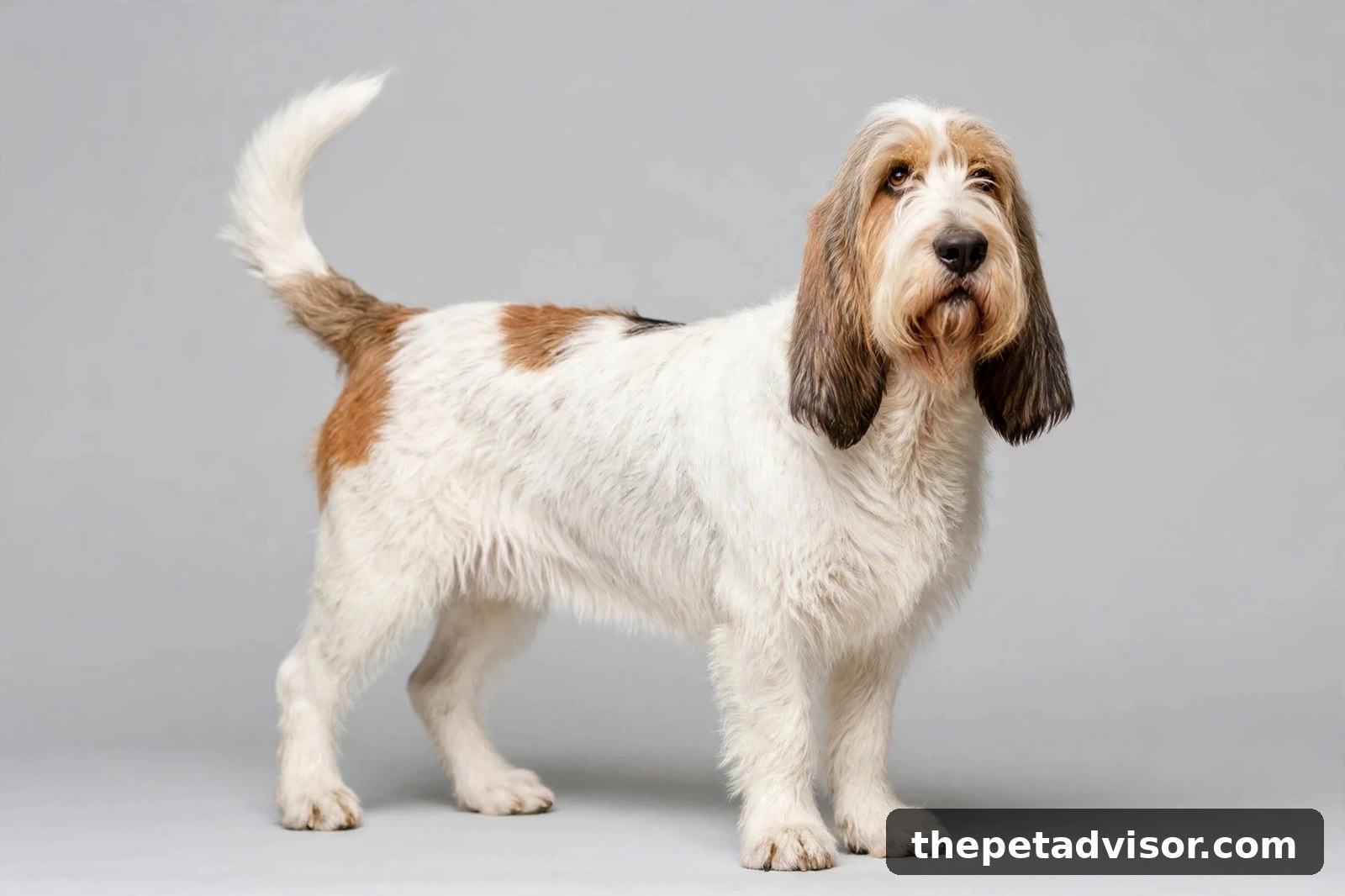
Do you have a photo of a Grand Basset Griffon Vendéen in the American show ring? We’d love this page to lead with one. If you have a show photo you’d let us use, email it to [email protected] — tell us the dog’s name and the show, and it may be featured here. Please only send photos you took yourself or have the photographer’s permission to share, and tell us the photographer’s name. We couldn’t find a public photo of a Grand Basset Griffon Vendéen in the American show ring that we were free to share, so the photo leading this page was made with AI. We’d much rather lead with a real one — if you’re a club member with an approved photo, we’d love to feature it.
1. Breed at a glance
Hound Group; full AKC recognition January 2018
Typically 15½–18 in at the shoulder; 40–45 lb
Harsh, straight, wiry double coat; tri-color, bi-color, or black and tan; solid color disqualified
13–15 years
Happy, outgoing, independent; a little stubborn, yet willing to please
Grand Basset Griffon Vendéen Club of America, the AKC parent club, established 2013
The name describes the dog piece by piece: Grand for the larger size, Basset for low to the ground, Griffon for the rough coat, and Vendéen for the Vendée region of western France, where the breed was developed. A Grand Basset Griffon Vendéen is a pack scent hound built to hunt rabbit and hare — and today boar and roe deer as well — at a fast pace through bramble and over rough terrain, using its voice freely on the trail. (Sources: Chenil de la Belle Chasse, Grand Basset Griffon Vendéen; AKC, Official Standard for the Grand Basset Griffon Vendéen.)
Size, coat, color, and temperament facts are from the AKC standard (approved October 28, 2011; effective January 1, 2014). Weight (40 to 45 pounds) and lifespan (13 to 15 years) are the breed’s commonly published figures (AKC Grand Basset Griffon Vendéen breed page; Basepaws, Grand Basset Griffon Vendéen).
2. History
The Grand Basset Griffon Vendéen comes from the Vendée region of western France, one of four rough-coated Griffon Vendéen hounds developed to hunt through the rough, bramble-filled terrain of that Atlantic coast country. The breed traces its line to the larger Griffon Vendéen, the big rough-coated hound of the sixteenth century. The first selections for the smaller, straight-legged type came at the end of the nineteenth century, when the Comte d’Elva looked for hounds with straight legs — and it was Paul Dezamy who fixed the type, settling the size at about 43 centimetres, the height of a dog built to catch a hare. (Sources: Dogs Australia, Grand Basset Griffon Vendeen; Furry Critter, Grand Basset Griffon Vendeen.)
The Club du Griffon Vendéen was formed in France in 1907, and its first president, Paul Dezamy, wrote the first standard for the Griffon Vendéen basset types — one standard covering both the Petit and the Grand. The Grand got its own standard in the 1950s, though interbreeding between the two sizes continued until the 1970s, when it was formally prohibited — and the two have been separate breeds ever since, with separate standards and separate breeding programs. (Sources: Furry Critter, Grand Basset Griffon Vendeen; Dogs Australia, Grand Basset Griffon Vendeen.)
In the United States the first Grand Basset Griffon Vendéens were imported from Holland in 1990. The breed entered the AKC Foundation Stock Service in 2004, and the Grand Basset Griffon Vendéen Club of America was created in 2013 to establish and legitimize the breed in America, with the goal of full AKC registration. Full acceptance into the AKC Hound Group followed in January 2018. The breed is still rare in the United States — a new breed, and a small one, in the parent club’s own words — and the national specialty at Perry, Georgia, is where most Americans ever see more than one at a time. (Sources: Furry Critter, Grand Basset Griffon Vendeen; Grand Basset Griffon Vendéen Club of America, Club Info; Grand Basset Griffon Vendéen Club of America.)
3. The standard and why it is written that way
- General appearance — a well-balanced, strongly built, rough-coated scent hound. “The Grand Basset Griffon Vendéen is a well-balanced, strongly built, rough-coated scent hound of friendly and noble character. He is of medium size with straight legs, deep chest. He is longer than he is tall with a moderately long muzzle, long ears and a long tail.” And the working brief underneath it: “His structure was designed to hunt rabbit and hare at a fast pace through the bramble, and over the rough terrain of the Vendee area of France.” The standard ends the paragraph with its governing rule: “Any feature that detracts from function is a serious fault.” (Source: AKC, Official Standard for the Grand Basset Griffon Vendéen.)
- Size — typically 15½ to 18 inches, longer than tall. “Height – typically 15½ to 18 inches. Proportion – longer than tall as measured from point of shoulder to point of buttocks. Never square nor long and low.” Substance is “in balance with the whole; strongly built and well boned without exaggeration,” firmly muscled and built for endurance, with parts in harmony and never clumsy. The standard gives no weight range. (Source: AKC, Official Standard for the Grand Basset Griffon Vendéen.)
- Head — noble, with a beard, a moustache, and protective eyebrows. The expression is noble with a proud head carriage, and the eyes convey an intelligent, warm, and friendly character: large, dark, and oval, of the same color, showing no white. The ears are supple, narrow, and fine, ending in an oval shape, draping and folding inwards, covered with long hair and reaching at least to the end of the nose, set on low — viewed from the side, they form a corkscrew shape when the dog is relaxed. The skull is domed, longer than wide, with a well-developed occipital bone. The muzzle is preferably slightly longer from tip of nose to stop than from stop to occiput, the lips covered with long hair forming a beard and moustache, the nose large with open nostrils, solid black except in white/orange and white/lemon coats, where brown is accepted. The bite is scissors, with a level bite tolerated. (Source: AKC, Official Standard for the Grand Basset Griffon Vendéen.)
- Body & tail — deep chest, saber tail, never docked. The neck is strong and far reaching, thicker at the base; the body well developed, sturdy and broad, with a deep forechest and a prominent sternum, the depth of chest reaching to the elbows, ribs well sprung extending well back. The tail is rather long, reaching to the hock, set on high, thick at the base and tapering gradually, well furnished with hair, “carried proudly like a saber or slightly curved but never kinked, curled too far over the back, gay or bent at the tip. Tail is never docked.” (Source: AKC, Official Standard for the Grand Basset Griffon Vendéen.)
- Coat — harsh and straight, never silky or woolly, never sculpted. “Harsh and straight with undercoat. Not too long, fringing not too abundant. Never silky or wooly. Hair from bridge of nose fans up between the eyes without obscuring the eyes; this protective hair along with shielding eyebrows is an indispensable characteristic of the breed. No blunt scissoring, maintaining a casual appearance. Hounds should be shown clean.” The coat is the breed’s armor against bramble — and the rule against scissoring keeps it that way. (Source: AKC, Official Standard for the Grand Basset Griffon Vendéen.)
- Color — tri-color, bi-color, or black and tan; solid not allowed. “Tri-color: white with any other colors, Bi-color: white with any other color, or Black and Tan. Solid not allowed.” The disqualification is a single line: “Disqualifications: Solid color.” A solid-colored dog is not a Grand in the ring at all. (Source: AKC, Official Standard for the Grand Basset Griffon Vendéen.)
- Temperament — happy, outgoing, independent, a little stubborn. “Pack hound, friendly, not easily agitated by others. Temperament is happy, outgoing, independent. A little stubborn, yet willing to please.” That is the whole temperament section — four short sentences, and the breed in them: a pack dog that likes company, does not start fights, thinks for itself, and can still be talked into cooperating. (Source: AKC, Official Standard for the Grand Basset Griffon Vendéen.)
- Why it is written that way. Every clause in the standard points back to a full day’s hunt through bramble: the straight legs and deep chest are there so the dog can push through rough cover at a fast pace all day, the harsh coat and the beard, moustache, and shielding eyebrows are there so the cover does not cut the dog’s face, and the long saber tail is there so the hunter can see the dog above the brush. The gait the standard asks for is “clean, balanced and efficient. Free and easy at all speeds” — a hound that covers ground without wasting it. And the color rule is the standard’s hardest line: the white-based coat with markings is there for visibility in the field, and a solid dog loses it.
4. Temperament & living with one
The AKC sums the breed up in a sentence: the Grand Basset Griffon Vendéen is “a French scenthound. Somewhat active and never high-strung, yet GBGVs are busy dogs who don’t tire easily.” The standard’s version is shorter still: happy, outgoing, independent, a little stubborn, yet willing to please — a pack hound, friendly, not easily agitated by others. Both are describing the same dog: a working pack hound that became a companion and never quite gave up the job. (Sources: AKC, Grand Basset Griffon Vendéen; AKC, Official Standard for the Grand Basset Griffon Vendéen.)
- With its own people: friendly, cheerful, and companionable — a pack hound that likes company and wants to be where its people are. It is independent rather than clingy, but it is a social dog, not a solitary one.
- With other dogs: a pack hound by breeding, and not easily agitated by others. That is a real advantage in a multi-dog home — but it is still a hound, and introductions and supervision matter, especially with small animals it may read as game.
- Training: willing to please, and a little stubborn. A Grand responds to patient, consistent, positive training and notices inconsistency at once. The independence that made it a good pack hound makes it a dog that thinks for itself rather than waiting for instructions — and the nose goes where it wants, so recall is a project, not a given.
- Exercise: a lot, every day. This is a medium hound bred for a full day’s hunt at a fast pace, with great stamina, and it needs real work — long walks, scent work, a job — not a turn around the block. A bored Grand is a destructive Grand, and a yard without a fence is not a containment plan for a scent hound.
- Voice: the standard says the breed “uses his voice freely while on the trail,” and the voice does not stay on the trail. A Grand bays, and a household that wants a quiet dog should look elsewhere.
- First-dog honesty: this is a rare breed with a wait for a puppy, a loud voice, a strong nose, and a stubborn streak, and it needs an owner who trains from day one and keeps training. If that sounds like a burden rather than a pleasure, a quieter or less driven breed is the honest choice.
5. Grooming
The Grand Basset Griffon Vendéen’s coat is harsh and straight with a dense undercoat — armor against bramble, not decoration — and the standard’s grooming rule is the coat rule: no blunt scissoring, a casual appearance, shown clean. The coat is not too long and the fringing not too abundant, which keeps the job smaller than it looks. (Source: AKC, Official Standard for the Grand Basset Griffon Vendéen.)
- Brushing: two or three times a week, every week. Work through the harsh double coat with a slicker brush and then a comb, checking behind the long ears and in the armpits where mats start, and the beard and leg furnishings where burrs collect. A Grand that hunts or hikes picks up burrs and tangles that have to come out the same day.
- Hand-stripping, not clipping: occasional hand-stripping — pulling the dead outer coat by hand or with a stripping tool — keeps the harsh texture and the tousled outline. Clipping softens the coat and changes its character, which is why the standard forbids blunt scissoring and shaping.
- Beard & ears: keep the beard clean and dry, and check the long, low-set ears weekly — they hang close to the head and trap moisture. A Grand that swims or hunts in wet cover needs its ears checked after every outing.
- Bathing: when the dog is dirty, and not much more. A scent hound that works in the field gets dirty; shampoo and rinse thoroughly, and dry the coat completely, because a damp undercoat mats faster than a dry one.
- Feet & nails: trim the nails every two to three weeks, and keep the hair between the pads trimmed so the dog does not slip on slick floors and does not pack mud and ice between its toes in winter.
- Shedding: moderate and year-round. Regular brushing is what keeps the harsh coat harsh and the house habitable — there is no non-shedding version of this dog.
6. Health testing
The Grand Basset Griffon Vendéen is a recently recognized breed with a small American population, so the testing that exists matters more, not less: the gene pool is narrow enough that every breeding decision carries weight. The parent club’s recommended tests, listed with the AKC, are two:
- Hip evaluation. An OFA or PennHIP hip evaluation screens for hip dysplasia, the malformed hip joint that causes pain and lameness in an active breed. The club’s health statement asks for final hip clearances from OFA, PennHIP, or FCI for all Grands prior to breeding, and final OFA hip certification comes at 24 months. (Sources: AKC, Hound Group Health Testing Requirements; Grand Basset Griffon Vendéen Club of America, Health Statement.)
- Ophthalmologist evaluation. An eye exam by a board-certified veterinary ophthalmologist screens for hereditary eye disease, and the club’s health statement asks for eye clearances from OFA for all Grands prior to breeding. Eye clearances are renewed, because some eye diseases develop later in life. (Sources: AKC, Hound Group Health Testing Requirements; Grand Basset Griffon Vendéen Club of America, Health Statement.)
- What some breeders add. The club’s health statement notes that, in addition to the hip and eye recommendations, a few breeders also do testing or certification of heart, patellas, and thyroid prior to breeding. Ask what a breeder has done beyond the two recommended tests — in a small gene pool, the extra screening is a good sign, not a sales pitch. (Source: Grand Basset Griffon Vendéen Club of America, Health Statement.)
- The Foundation behind it. The club established the Grand Basset Griffon Vendéen Club of America Foundation in October 2015 for, among other things, health and rescue — the fund that backs the breed’s health work as the population grows. (Source: Grand Basset Griffon Vendéen Club of America, Health Statement.)
Ask any breeder for the parents’ hip and eye results, and look them up in the OFA database yourself before you commit. The breed’s 13-to-15-year lifespan is a long one for a dog this size, and the testing exists so that those years are healthy ones.
7. The annual Grand Basset Griffon Vendéen specialty dog show
A specialty is the breed’s All-Star show — its Super Bowl. Once a year, the best Grand Basset Griffon Vendéens from across the country, and often from around the world, come together in one place.
The Grand Basset Griffon Vendéen Club of America’s national specialty: one national event each year, with conformation, sweepstakes, and junior showmanship. The 2026 national: April 11, at the Georgia National Fairgrounds & Agricenter in Perry, Georgia, with 17 entries and 13 competitors. The 2025 national: April 12, at the same venue, with 17 entries and 15 competitors. The 2027 national: April 17, at the Georgia National Fairgrounds & Agricenter in Perry, Georgia.
The standard, in brief: a well-balanced, strongly built, rough-coated scent hound of friendly and noble character, medium size with straight legs and a deep chest, longer than tall. Height typically 15½ to 18 inches. Coat harsh and straight with undercoat, never silky or woolly. Color: tri-color, bi-color, or black and tan; solid color disqualified. Temperament: happy, outgoing, independent, a little stubborn, yet willing to please.
The 2026 National Specialty — Saturday, April 11, 2026, at the Georgia National Fairgrounds & Agricenter, 401 Larry Walker Parkway, Perry, Georgia. Entry: 17 entries and 13 competitors. Entries closed March 25, 2026. Event Chair: Barbara Miller, Lady Lake, Florida. Superintendent: Onofrio Dog Shows, L.L.C. The 2026 national: a one-day conformation specialty, with the parent club’s regional specialty the day before, Friday, April 10, at the same venue. (Sources: AKC event search, event 2026709302; AKC event search, event 2026709301.)
National specialty judge: A Bradford MD — conformation. Junior showmanship: 1 entry, 0 competitors. (Source: AKC event search, event 2026709302.)
Results (2026 national). Best of Breed, Best of Opposite Sex, Winners Dog, Winners Bitch, and Best Junior Handler: not published in an accessible official source as of November 2026.
The 2027 National Specialty: Saturday, April 17, 2027, one day, at the Georgia National Fairgrounds & Agricenter in Perry, Georgia. Superintendent: Onofrio Dog Shows, L.L.C. AKC event number, judges, entries, and closing date not yet published as of November 2026. (Source: AKC Upcoming National Specialties.)
Past national specialties: 2025 · 2024
Grand Basset Griffon Vendéen Club of America — gbgv.net
8. Regional specialties through the year: smaller regional shows
The national is the anchor, but the breed’s year also runs through regional specialties — smaller regional shows, not the national — held around the country, including the regional specialty that runs with the national week in Perry. These are the 2026 regionals verified from club and AKC sources so far:
Two Grand Basset Griffon Vendéen specialties verified for 2026 so far, both parent-club specialties held by the Grand Basset Griffon Vendéen Club of America:
- GBGVCA Regional Specialty — Friday, April 10, 2026, Perry, Georgia: at the Georgia National Fairgrounds & Agricenter (AKC event 2026709301), with the Peach Blossom Cluster. Judge: Mrs. L M Riedel. Entry: 17 entries and 17 competitors. Best Junior Handler: Addison Lancaster. (Source: AKC event search, event 2026709301.)
- GBGVCA Regional Specialty — Saturday, August 29, 2026, Lexington, Kentucky: at the Kentucky Horse Park (AKC event 2026709303). Judge: J Hubbard. Entry: 7 entries and 7 competitors. (Source: AKC event search, event 2026709303.)
Past regional specialties: 2025 · 2024
More regional specialties will be added here as their programs are verified — this section is built from show data, not guesswork. Browse upcoming show weekends →
9. Clubs
- Grand Basset Griffon Vendéen Club of America (GBGVCA) (parent club) — the AKC-designated parent club for the breed in the United States, created in 2013 to establish and legitimize the breed in America, with the goal of full AKC registration. Since full acceptance into the AKC Hound Group in January 2018, the club has turned to public education and to promoting healthy breeding and participation in conformation and performance. It keeps the standard, holds the national specialty each year, runs a breeder directory — listing only breeders who have completed the recommended health testing and the club’s guidelines for responsible breeding — and works through committees including Rescue (Cindy Wilt, chair; Deborah Howd), Breeder Referral (Cindy Wilt, chair; Tiffany Cannon), and Breed Preservation (Gretchen Tanenbaum, chair). (Sources: Grand Basset Griffon Vendéen Club of America; Grand Basset Griffon Vendéen Club of America, Club Info.)
- GBGVCA Foundation. The club’s foundation, established in October 2015, supports health and rescue work for the breed. (Source: Grand Basset Griffon Vendéen Club of America, Health Statement.)
- In France and the United Kingdom. In France, the Club du Griffon Vendéen, founded in 1907, oversees all four Griffon Vendéen varieties. In the United Kingdom, the Basset Griffon Vendéen Club covers both the Grand and the Petit. (Sources: Furry Critter, Grand Basset Griffon Vendeen; Basset Griffon Vendéen Club.)
- AKC Marketplace and breeder referral. The parent club’s breeder directory is the first stop for anyone looking for a puppy from a breeder who works under the club’s code — and the club, not a classified ad, is where a rare breed’s waitlist starts. (Source: Grand Basset Griffon Vendéen Club of America.)
If you are new to the breed, the national specialty itself is the better first stop than a breeder’s website: the people there have owned, shown, and worked Grands, and they will tell you the truth about the energy, the independence, the voice, and the grooming before you fall for a puppy.
10. Rescue
- Start with the parent club’s Rescue committee. The Grand Basset Griffon Vendéen Club of America runs its own rescue: Rescue Chair Cindy Wilt, with Deborah Howd. The club is a small one for a rare breed, so the rescue committee is the first call if a Grand Basset Griffon Vendéen needs a new home — or if you want one. (Source: Grand Basset Griffon Vendéen Club of America, Club Info.)
- The GBGVCA Foundation. The club established the Grand Basset Griffon Vendéen Club of America Foundation in October 2015 for, among other things, health and rescue — the fund behind the club’s rescue work. (Source: Grand Basset Griffon Vendéen Club of America, Health Statement.)
- AKC Rescue Network. The AKC’s rescue network lists Grand Basset Griffon Vendéen rescue organizations under its G breeds page, and the parent club is the first stop if you do not know which contact covers your area. (Source: AKC Rescue Network, G Breeds.)
- Grands are uncommon in rescue. The breed’s small numbers cut both ways: a rescued Grand is usually an adult, and it will arrive with its temperament and size visible before you commit — but breed rescue often runs a waiting list, so patience is part of the deal. If you bought your Grand from a responsible breeder, contact the breeder first — most responsible breeders include a take-back clause and want to know if the dog needs help.
- In the United Kingdom. The Basset Griffon Vendéen Club runs a Welfare and Rescue scheme for both the Grand and the Petit, coordinated by Fiona Buchanan, with a code of practice and a rehoming application for anyone interested in taking on a BGV. (Source: Basset Griffon Vendéen Club, Welfare and Rescue.)
11. Breeder vs. rescue: honest guidance
- If you buy: start with the parent club, the Grand Basset Griffon Vendéen Club of America — its breeder directory lists only breeders who have completed the recommended health testing and the club’s guidelines for responsible breeding — and ask for the parents’ hip and eye results, and look the results up in the OFA database yourself. Expect to wait for a puppy from a careful breeder: this is a rare breed, and a good breeder will have the answers, will ask you as many questions as you ask them, and will take the puppy back for its whole life if you cannot keep it.
- If you rescue: a rescued Grand is usually an adult, and it will arrive with its temperament and coat visible before you commit. What you get in return is a dog whose character you can see before you commit and a lower price. Either way, be honest with yourself first: a Grand needs real daily exercise, a fenced yard, consistent training, and an owner who finds a loud, stubborn, scent-driven hound charming rather than exasperating — not a yard and a hope.
- Watch out for “rare color” marketing. A Grand Basset Griffon Vendéen is tri-color, bi-color, or black and tan — solid color is disqualified under the standard. A seller charging extra for a solid-colored Grand as a rare color is charging for a color the standard disqualifies.
- Watch out for “big Petit” marketing. The Grand and the Petit are separate breeds with separate standards, not two sizes of one breed. A breeder selling an oversized Petit as a Grand, or a “mini” Grand at a premium, is selling a label the standards do not recognize.
- Honest fit: a Grand is not a quiet apartment dog and not a dog for everyone. The voice that carries on the trail carries at home too, the nose goes where it wants, and the coat needs regular work. If that sounds like a burden rather than a pleasure, a quieter or less driven breed is the honest choice.
12. Claim this page
This page belongs to the breed, and the people who know the breed best are the Grand Basset Griffon Vendéen Club of America and its members. If you are with the parent club — or you are a breeder, a judge, a handler, or a rescue volunteer who spotted something wrong, missing, or out of date — this page is yours to set straight. Tell us what needs fixing and where the correction is documented, and we will fix it and credit the source. Contact the site through the About page, and mention “Grand Basset Griffon Vendéen breed profile.”
Sources
- AKC, Grand Basset Griffon Vendéen breed page — akc.org/dog-breeds/grand-basset-griffon-vendeen
- AKC, Official Standard for the Grand Basset Griffon Vendéen (Hound Group standards; approved October 28, 2011; effective January 1, 2014) — images.akc.org (PDF)
- AKC, Hound Group Health Testing Requirements — akc.org
- AKC Upcoming National Specialties — apps.akc.org
- AKC event search, event 2026709302 (2026 national) — apps.akc.org
- AKC event search, event 2026709301 (2026 regional, Perry Apr 10) — apps.akc.org
- AKC event search, event 2026709303 (2026 regional, Lexington Aug 29) — apps.akc.org
- AKC event search, event 2025709302 (2025 national) — apps.akc.org
- AKC event search, event 2025709301 (2025 regional, Perry Apr 11) — apps.akc.org
- AKC event search, event 2025709303 (2025 regional, Lexington Aug 30) — apps.akc.org
- AKC event search, event 2024709302 (2024 national) — apps.akc.org
- AKC event search, event 2024709301 (2024 regional, Perry Apr 12) — apps.akc.org
- AKC event search, event 2024709303 (2024 parent specialty, Lexington Aug 31) — apps.akc.org
- Grand Basset Griffon Vendéen Club of America — gbgv.net
- Grand Basset Griffon Vendéen Club of America, Club Info — gbgv.net/about
- Grand Basset Griffon Vendéen Club of America, Health Statement (June 1, 2016) — cdn.akc.org (PDF)
- Dogs Australia, Grand Basset Griffon Vendeen (breed standard and history) — dogsaustralia.org.au
- Furry Critter, Grand Basset Griffon Vendeen (history, standard, health) — furrycritter.com
- FurLyfe, Grand Basset Griffon Vendeen Breed Guide (FSS 2004–2017, AKC recognition 2018) — furlyfe.com
- Basepaws, Grand Basset Griffon Vendéen (height, weight, lifespan) — basepaws.com
- Chenil de la Belle Chasse, Grand Basset Griffon Vendéen (name breakdown) — canic.ws
- AKC Rescue Network, G Breeds — akc.org/akc-rescue-network-g-breeds
- Basset Griffon Vendéen Club (UK), Welfare and Rescue — bgvclub.co.uk