
Breed profile · Sporting Group · the black-and-tan setter from Scotland
Gordon Setter
The Gordon Setter is the black avenger of the Highlands — a substantial Scottish bird dog, coal-black with rich mahogany tan, bold and resolute in the field and sweetly affectionate by the fireside. The AKC calls the breed the most substantial of the setters, and one of the first nine breeds it ever recognized. The Gordon Setter Club of America is the parent club and the host of the annual Gordon Setter specialty dog show.
Help us improve it. This is one of ThePetAdvisor’s breed profiles, built from public sources with generous links to the people who actually own this breed’s knowledge. If something’s off or missing, the parent club can claim the page and set it straight — see the bottom of the page.
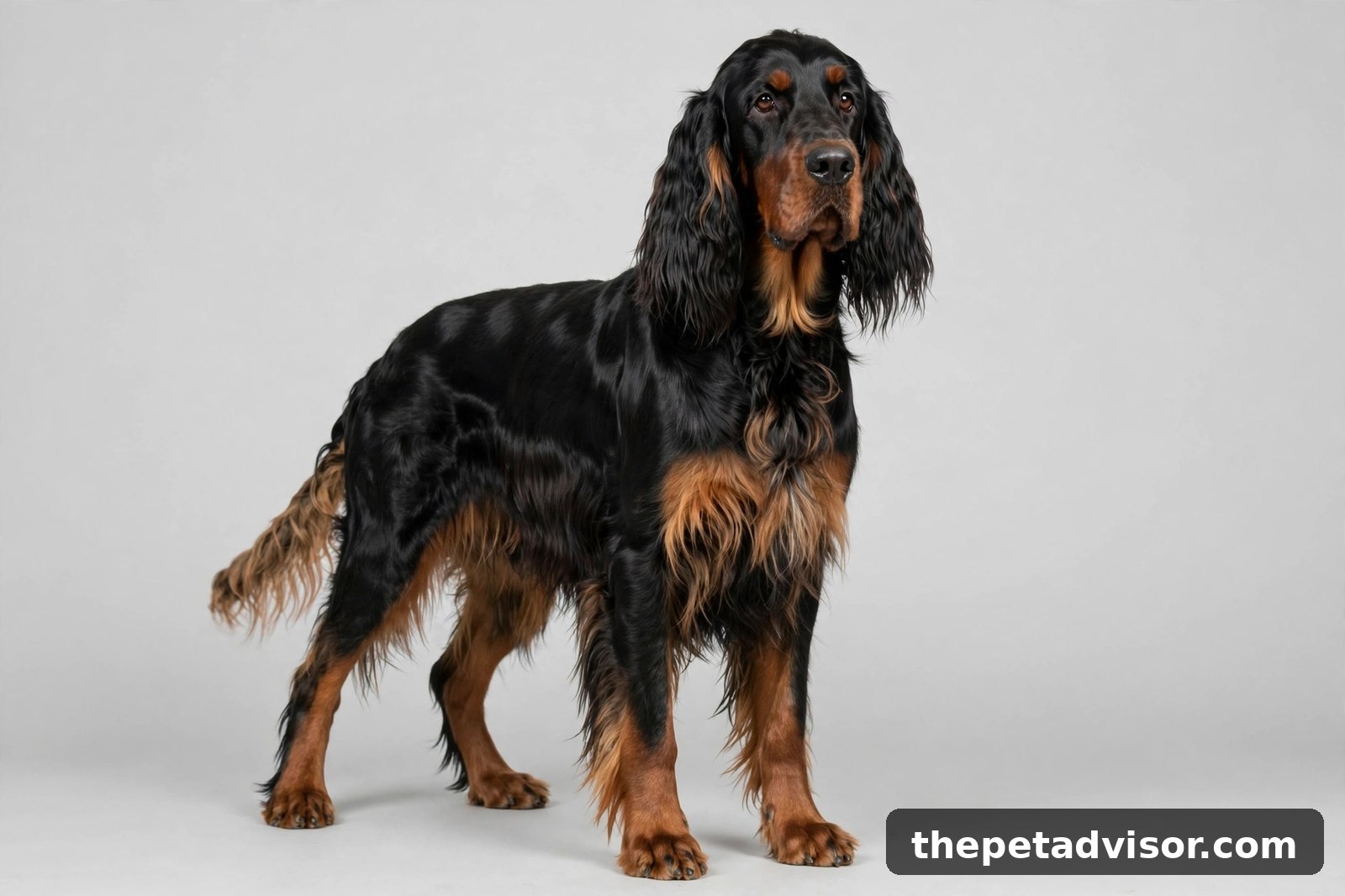
Do you have a photo of a Gordon Setter in the American show ring? We’d love this page to lead with one. If you have a show photo you’d let us use, email it to [email protected] — tell us the dog’s name and the show, and it may be featured here. Please only send photos you took yourself or have the photographer’s permission to share, and tell us the photographer’s name. We couldn’t find a public photo of a Gordon Setter in the American show ring that we were free to share, so the photo leading this page was made with AI. We’d much rather lead with a real one — if you’re a club member with an approved photo, we’d love to feature it.
1. Breed at a glance
Sporting Group; among the first nine breeds recognized by the AKC, in 1878
Males 24–27 in, 55–80 lb; females 23–26 in, 45–70 lb
Soft, shining, straight or slightly waved; black with rich chestnut or mahogany tan markings only
10–12 years
Alert, gay, interested, and confident; fearless and willing, loyal and affectionate
Gordon Setter Club of America, the AKC parent club, organized in 1924
A Gordon Setter is a big dog with a long memory — the AKC calls the breed “the black avenger of the Highlands,” a substantial bird dog named for a Scottish aristocrat, “bold, confident, and resolute in the field, and sweetly affectionate by the fireside.” The whole breed is built around two things: substance and color. A sturdily built, well-muscled dog with plenty of bone, in a coal-black coat with rich tan markings in exactly the places the standard names, is the silhouette that says Gordon at a glance — and the strong-minded, devoted temperament underneath it is the price of owning one. (Sources: AKC, Gordon Setter; AKC, Gordon Setter History.)
2. History
The Gordon Setter comes from Scotland, where black-and-tan setters worked the moors long before anyone wrote a standard for them. The breed takes its name from Alexander Gordon, the 4th Duke of Gordon, who kept a kennel of black-and-tan setters at Gordon Castle near Fochabers, on the River Spey — though the duke did not invent the dog, and black-and-tan setters were kept in many kennels besides his. The Kennel Club accepted the name Gordon Setter as a registered breed on January 1, 1924. (Sources: AKC, Gordon Setter History; Gordon Setter Club of America, A Brief History of the Gordon Setter.)
The first Gordons in America came straight from Gordon Castle: in 1842, two dogs, Rake and Rachel, were imported by George Blunt under an official importation order. The breed was an early American show dog — 79 Gordon Setters entered the first Westminster Kennel Club show in 1877 — and the “Gordon Castle Setter” was among the first nine breeds recognized by the American Kennel Club in 1878. The word “Castle” was dropped from the official name in 1892, leaving the Gordon Setter. (Sources: AKC, Gordon Setter History; Canine Chronicle, Mastermind – Duke of Gordon.)
The Gordon Setter Club of America was organized in 1924 — Harry Malcolm is credited with starting it, and the club’s first standard was written in 1891, before the club itself existed. The GSCA is a charter member of the AKC. Its first National Specialty was held in 1983 in Springfield, Ohio. The breed’s footprint has shrunk since its nineteenth-century heyday — the Gordon ranked 99th of the AKC’s 201 recognized breeds as of 2023 — but the club, its national specialty, and its rescue network have carried it through. (Sources: Gordon Setter Club of America, A Brief History of the Gordon Setter; Canine Chronicle, Mastermind – Duke of Gordon; AKC, Gordon Setter History.)
3. The standard and why it is written that way
- General appearance — a good-sized, sturdily built, black and tan dog. “The Gordon Setter is a good-sized, sturdily built, black and tan dog, well muscled, with plenty of bone and substance, but active, upstanding and stylish, appearing capable of doing a full day’s work in the field.” The first sentence of the standard is the whole breed in one line: substance first, style second, and a working dog throughout. (Source: AKC, Official Standard for the Gordon Setter.)
- Size — males 24 to 27 inches, 55 to 80 pounds. “Shoulder height for males, 24 to 27 inches; females, 23 to 26 inches. Weight for males, 55 to 80 pounds; females, 45 to 70 pounds.” The standard adds that the weight-to-height ratio makes the Gordon heavier than the other setters — it is the heaviest of the setter breeds, and the standard discourages extremely thin or fat dogs on the grounds that under- or overweight hampers the dog’s true working ability. (Source: AKC, Official Standard for the Gordon Setter.)
- Coat — soft and shining, straight or slightly waved, never curly. The coat is soft and shining, straight or slightly waved but not curly, with long hair on the ears, under the stomach, on the chest, on the back of the fore and hind legs, and on the tail. The feathering is part of the silhouette: the feather starting near the root of the tail is slightly waved or straight, triangular in appearance, growing shorter toward the end. (Source: AKC, Official Standard for the Gordon Setter.)
- Color — black with tan markings, and nothing else. “Black with tan markings, either of rich chestnut or mahogany color. Black penciling is allowed on the toes. The borderline between black and tan colors is clearly defined.” The tan sits in eight named places: two clear spots over the eyes, the sides of the muzzle, the throat, two large clear spots on the chest, the inside of the hind legs, the forelegs from the carpus down, and around the vent. A white spot on the chest is allowed, the smaller the better. And the line is absolute: “Disqualification – Predominantly tan, red or buff dogs are ineligible for showing and undesirable for breeding.” (Source: AKC, Official Standard for the Gordon Setter.)
- Head & bearing — intelligent, noble, and dignified. “His bearing is intelligent, noble, and dignified, showing no signs of shyness or viciousness.” The head is deep rather than broad, with dark brown, bright and wise eyes, a black nose, and a fairly long muzzle the same length as the skull. The bearing line is the standard’s character test in a sentence: a Gordon that is shy or sharp has lost the breed. (Source: AKC, Official Standard for the Gordon Setter.)
- Temperament — alert, gay, interested, and confident. “The Gordon Setter is alert, gay, interested, and confident. He is fearless and willing, intelligent and capable. He is loyal and affectionate, and strong-minded enough to stand the rigors of training.” Temperament carries 10 of the standard’s 100 scale points — as much as the head and neck — because a bird dog that will not stand training is no use in the field. (Source: AKC, Official Standard for the Gordon Setter.)
- Why it is written that way. Every clause in the standard points back to a full day’s work in the field: the bone and substance are there so the dog can push through rough cover all day, the short back and deep chest are there so it can keep going, and the gait is described as “a bold, strong, driving free-swinging gait” with the tail flagging constantly in motion. The standard says the Gordon “suggests strength and stamina rather than extreme speed” — the deliberate, methodical setter, not the fastest one. And the color rule is the standard’s hardest line: the black-and-tan pattern is the breed’s identity, so anything else is not a Gordon in the ring at all.
4. Temperament & living with one
The AKC’s summary is short: bold, confident, and resolute in the field, and sweetly affectionate by the fireside. The standard’s version is shorter still: alert, gay, interested, and confident — fearless and willing, intelligent and capable, loyal and affectionate, and strong-minded enough to stand the rigors of training. Both are describing the same dog — a working setter that became a companion and never quite gave up the job. (Sources: AKC, Gordon Setter; AKC, Official Standard for the Gordon Setter.)
- With its own people: intensely devoted and affectionate, often to one person above all. A Gordon leans on its people, follows them from room to room, and expects to be part of whatever is happening — on the couch, at the foot of the bed, or at the door when you come home. It is sensitive and empathic, and it notices its owner’s moods.
- With strangers: watchful and discerning rather than effusive. The breed is loyal to its own and wary of people it does not know, which makes it a good watchdog — and means early socialization matters, so that wariness stays confidence instead of turning into suspicion.
- Training: intelligent and capable — and strong-minded. A Gordon responds to firm, fair, consistent training and to praise, and it notices inconsistency at once. The independence that made it a good bird dog makes it a dog that thinks for itself rather than waiting for instructions, and it will take advantage of lax leadership.
- Exercise: a lot, every day. This is a large sporting dog bred to work a full day in the field, and it needs an hour or more of real exercise — walks, running, field work, or a job — not a turn around the block. A bored Gordon is a destructive Gordon, and an apartment without a serious exercise plan is the wrong home.
- Maturity: slow. Gordons stay puppy-like for a long time — boisterous, clumsy, and rambunctious well into their second year — and they are patient by nature but can be unintentionally rough with very young children. The adult dog is even-tempered and serious; getting there takes patience.
- First-dog honesty: this is a lot of dog — and a lot of energy — for a first-time owner. The size, the exercise needs, the slow maturity, and the strong mind all demand an owner who trains from day one and keeps training, and who has the time and the ground to work a sporting dog. If that sounds like a burden rather than a pleasure, a smaller or softer breed is the honest choice.
5. Grooming
The Gordon Setter’s coat is soft and shining, straight or slightly waved, with long feathering on the ears, chest, belly, legs, and tail — and feathering is the grooming job. The coat is moderate in length, not the floor-length curtain of some setters, but the feathering mats if it is ignored, and the ears need attention too. (Source: AKC, Official Standard for the Gordon Setter.)
- Brushing: two or three times a week, every week. Work through the feathering on the ears, chest, belly, and legs with a pin brush or slicker and then a comb, checking behind the ears and in the armpits where mats start. A Gordon that hunts or hikes picks up burrs and tangles that have to come out the same day.
- Bathing: every few weeks, or when the dog is dirty. A sporting dog that works in the field gets dirty; shampoo and rinse thoroughly, and dry the feathering completely, because damp feathering mats faster than dry.
- Ears: the long, well-feathered ears hang close to the head and trap moisture, so check them weekly and clean them as needed. A Gordon that swims or hunts in wet cover needs its ears checked after every outing.
- Feet & nails: trim the nails every two to three weeks, and keep the hair between the pads trimmed so the dog does not slip on slick floors and does not pack mud and ice between its toes in winter.
- Shedding: moderate and year-round, heavier in spring and fall. Regular brushing is what keeps the black coat shining and the house habitable — there is no non-shedding version of this dog.
6. Health testing
The Gordon Setter has CHIC requirements — the parent club’s checklist with the AKC and the Orthopedic Foundation for Animals, so there is a CHIC number to ask a breeder for. A dog earns a CHIC number when all the required tests are done and the results are public. The list:
- Hip evaluation. An OFA or PennHIP hip evaluation screens for hip dysplasia, the malformed hip joint that causes pain and lameness in a large, active breed. Final OFA hip certification comes at 24 months. (Source: AKC, Sporting Group Health Testing Requirements.)
- Elbow evaluation. An OFA elbow evaluation screens for elbow dysplasia, the inherited elbow disease that wears the joint down over time. Like hips, final certification comes at 24 months. (Source: AKC, Sporting Group Health Testing Requirements.)
- Ophthalmologist evaluation. An annual eye exam by a board-certified veterinary ophthalmologist screens for hereditary eye disease. Eye clearances are renewed annually, because some eye diseases develop later in life. (Source: AKC, Sporting Group Health Testing Requirements.)
- PRA-rcd4 DNA test — the big one. Progressive retinal atrophy, rod-cone dysplasia 4, is a blinding inherited eye disease in the breed. A DNA test for rcd-4 has existed since 2011, and the breed’s health guidance is that every breeding dog’s rcd-4 status should be known, with only clear-to-clear, clear-to-carrier, or clear-to-affected breedings. Ask for the DNA result by name: a breeder who cannot produce it has not done the breed’s most important test. (Sources: AKC, Sporting Group Health Testing Requirements; Gordon Setter Breed Council, Breed Health.)
- CHIC DNA repository. The parent club also asks breeders to bank a DNA sample in the CHIC DNA repository, so future tests can be run on today’s dogs as new markers are found. (Source: AKC, Sporting Group Health Testing Requirements.)
Ask any breeder for the parents’ results for the hip evaluation, the elbow evaluation, the eye exam, and the PRA-rcd4 DNA test, and look them up in the OFA database yourself before you commit. The breed’s 10-to-12-year lifespan is a long one for a dog this size, and the testing exists so that those years are healthy ones.
7. The annual Gordon Setter specialty dog show
A specialty is the breed’s All-Star show — its Super Bowl. Once a year, the best Gordon Setters from across the country, and often from around the world, come together in one place.
The Gordon Setter Club of America’s national specialty: one national event each year, with conformation, sweepstakes, junior showmanship, obedience, rally, and beginner puppy. The 2026 national: October 23, at the Dixon May Fairgrounds in Dixon, California, with 91 entries. The 2025 national: October 22–23, at the Boxboro Regency Hotel & Conference Center in Boxborough, Massachusetts, with 100 entries and 90 competitors. The 2027 national: April 17–18, at the Georgia National Fairgrounds & Agricenter in Perry, Georgia.
The standard, in brief: a good-sized, sturdily built, black and tan dog, well muscled, with plenty of bone and substance, active, upstanding and stylish, appearing capable of doing a full day’s work in the field. Males 24 to 27 inches at the shoulder, 55 to 80 pounds; females 23 to 26 inches, 45 to 70 pounds. Black with tan markings of rich chestnut or mahogany; predominantly tan, red or buff dogs: disqualified. Bearing: intelligent, noble, and dignified.
The 2026 National Specialty — Friday, October 23, 2026, at the Dixon May Fairgrounds, 655 S. First Street, Dixon, California. Entry: 91 entries. Entries closed October 7, 2026. Event Chair: Marilyn Orrick, El Dorado, California. Superintendent: BaRay Event Services, Inc. The 2026 national: national week October 20–24, with sweepstakes on Thursday, October 22, at the host hotel in Davis, and the National Specialty Competition on Friday, October 23, at the fairgrounds. (Sources: AKC event search, event 2026079829; Gordon Setter Club of America, 2026 National Specialty.)
National specialty judge: Mr. Phillip (Phil) Booth — conformation and junior showmanship. The sweepstakes ran Thursday, October 22, judged by Carolyn Gold (puppy sweepstakes 9 entries; veteran sweepstakes 13 entries); Lora Cox judged the national obedience and rally trials, and Denise Paquette judged the 4–6 month beginner puppy competition. (Sources: Gordon Setter Club of America, 2026 National Specialty; AKC event search, event 2026079829.)
Results (2026 national). Best of Breed, Best of Opposite Sex, Winners Dog, Winners Bitch, and Best Junior Handler: not published in an accessible official source as of November 2026.
The 2027 National Specialty: April 17–18, 2027, two days, at the Georgia National Fairgrounds & Agricenter in Perry, Georgia. Superintendent: Onofrio Dog Shows, L.L.C. AKC event number, judges, entries, and closing date not yet published as of November 2026. (Source: AKC Upcoming National Specialties.)
Past national specialties: 2025
Gordon Setter Club of America — gsca.org
8. Regional specialties through the year: smaller regional shows
The national is the anchor, but the breed’s year also runs through regional specialties — smaller regional shows, not the national — held around the country, including the regional specialties that run with the national. These are the 2026 regionals verified from club and AKC sources so far:
Ten Gordon Setter specialties verified for 2026 so far, all parent-club specialties held by the Gordon Setter Club of America except the Golden Gate concurrent specialty:
- GSCA Specialty — Thursday, February 19, 2026, Madison, Wisconsin: at the Alliant Energy Center (AKC event 2026079804). Judge: M S Wilson. Entry: 29 entries / 27 competitors.
- GSCA Specialty — Friday, February 20, 2026, Madison, Wisconsin: at the Alliant Energy Center (AKC event 2026079805). Judge: Mrs. P Nykiel. Entry: 35 entries / 32 competitors.
- GSCA Specialty — Saturday, February 21, 2026, Madison, Wisconsin: at the Alliant Energy Center (AKC event 2026079824). Judge: Mr. E Dziuk. Entry: 33 entries / 29 competitors.
- GSCA Specialty — Friday, April 10, 2026, Perry, Georgia: at the Georgia National Fairgrounds & Agricenter (AKC event 2026079808), with the Peach Blossom Cluster. Judge: Mr. J A Moses. Entry: 19 entries / 18 competitors.
- GSCA Specialty — Saturday, April 11, 2026, Perry, Georgia: at the Georgia National Fairgrounds & Agricenter (AKC event 2026079807), with the Peach Blossom Cluster. Judge: Mrs. A Pickett. Entry: 19 entries / 18 competitors.
- GSCA Specialties — Saturday, May 9, 2026, Lima, Ohio: at the Lima Kennel Club Showgrounds (AKC events 2026079809 and 2026079810). Judges: Mr. D Fabelo and Ms. B Hale. Entry: 56 entries / 49 competitors.
- GSCA Specialty — Thursday, August 13, 2026, Greeley, Colorado: at Island Grove Regional Park (AKC event 2026079814). Judge: Mr. D P McFarlane. Entry: 52 entries / 47 competitors.
- GSCA Specialty — Friday, August 14, 2026, Greeley, Colorado: at Island Grove Regional Park (AKC event 2026079815). Judge: Mr. S Dainard. Entry: 52 entries / 44 competitors.
- Golden Gate Gordon Setter Club Concurrent Specialty — Saturday, October 24, 2026, Dixon, California: at the Dixon May Fairgrounds, with the national week and the Sacramento Valley Dog Fanciers all-breed shows. Judge: Britt E. Jung (conformation and junior showmanship); Cindy Stanford judged sweepstakes. (Sources: Gordon Setter Club of America, 2026 National Specialty; Sacramento Valley Dog Fanciers premium list.)
Past regional specialties: 2025
More regional specialties will be added here as their programs are verified — this section is built from show data, not guesswork. Browse upcoming show weekends →
9. Clubs
- Gordon Setter Club of America (GSCA) (parent club) — the AKC-recognized national breed club for the Gordon Setter, organized in 1924 and a charter member of the AKC. It maintains the breed standard, holds the national specialty each year, runs the futurity and the national rescue network, and publishes a monthly newsletter. Much of the club’s local event work runs through Area Committees of GSCA members and through licensed independent Gordon Setter clubs. (Sources: Gordon Setter Club of America; Gordon Setter Club of America, A Brief History of the Gordon Setter.)
- Regional Gordon Setter clubs. Local and regional Gordon Setter clubs across the country hold the regional specialties in section 8, including the Golden Gate Gordon Setter Club in California, the TarTan Gordon Setter Club in New England, the Pacific Northwest Gordon Setter Club, the Nodrog Gordon Setter Club of Michigan, the North Country Gordon Setter Club of Minnesota, and the Paumanauk Gordon Setter Club. (Sources: AKC Club Search, G clubs; AKC event search, event 2025310402.)
- AKC Marketplace and breeder referral. The AKC’s club directory lists each club’s breeder-referral and rescue contacts, and the GSCA is the first stop for anyone looking for a puppy from a breeder who works under the club’s code. (Source: AKC Club Search, G clubs.)
10. Rescue
- GSCA National Rescue Committee. The parent club’s own national rescue network, formed in 1991 to establish and maintain a national network of rescue programs, with regional rescue contacts across the United States and a published adoption application. The committee does not charge for dogs placed in homes; it asks for a donation to help cover medical costs and expenses. National Rescue Chairman: Kathy Hubbard, DeKalb, Illinois. (Sources: Gordon Setter Club of America, Rescue Contacts; GSCA Rescue Adoption Application.)
- Regional Gordon Setter rescue. Each regional rescue program is established and run independently and funded locally, under the national committee’s guidelines — including the Missouri Valley Gordon Setter Club Rescue in Columbia, Missouri, and the TarTan Gordon Setter Club’s rescue work in New England. The GSCA rescue contacts page lists a contact for each state, or the national chairman where no local committee covers the area. (Sources: Gordon Setter Club of America, Rescue Contacts; Missouri Valley Gordon Setter Club Rescue.)
- Save Our Setters. An independent setter rescue that helps Irish, Gordon, and Irish Red & White Setters, taking owner surrenders and shelter dogs, fostering them, and placing them by application. (Source: Save Our Setters.)
- AKC Rescue Network. The AKC’s rescue network lists Gordon Setter rescue organizations under its G breeds page, and the parent club is the first stop if you do not know which contact covers your area. (Source: AKC Rescue Network, G Breeds.)
- Gordons are uncommon in rescue. The breed’s small numbers cut both ways: a rescued Gordon is usually an adult, and it will arrive with its temperament and size visible before you commit — but breed rescue often runs a waiting list, so patience is part of the deal. A rescue is the honest first stop if you want the breed without the puppy wait — and without the two-year slow maturity of a Gordon puppy.
11. Breeder vs. rescue: honest guidance
- If you buy: start with the parent club, the Gordon Setter Club of America — contact the club directly for a breeder referral — and ask for the parents’ health-test results — the hip evaluation, the elbow evaluation, the ophthalmologist evaluation, and the PRA-rcd4 DNA test — and look the results up in the OFA database yourself. A CHIC number means all of those are done and public. Expect to wait for a puppy from a careful breeder: a good breeder will have the answers, will ask you as many questions as you ask them, and will take the puppy back for its whole life if you cannot keep it.
- If you rescue: a rescued Gordon is usually an adult, and it will arrive with its temperament and size visible before you commit. What you get in return is a dog whose character you can see before you commit and a lower price. Either way, be honest with yourself first: a Gordon needs an hour or more of real exercise a day, firm and patient training from day one, and an owner who will still be exercising a large, boisterous dog when it is two years old and only just growing up — not a yard and a hope.
- Watch out for “rare color” marketing. A Gordon Setter is black and tan, and only black and tan. Predominantly tan, red, or buff dogs are disqualified from showing and undesirable for breeding under the standard. A seller charging extra for a red, tan, or buff Gordon as a rare color is charging for a color the standard disqualifies.
- Watch out for the field-versus-show split. Gordons have been bred both as field trial dogs and as show dogs, and the two lines can look and behave differently — a field-bred Gordon is often lighter and higher-energy than a show-bred one. Ask any breeder what their dogs actually do — field, show, or both — and match the answer to your life, not to a photograph.
- Big-dog honesty: a Gordon is not a starter pet and not a dog for everyone. The size that makes the breed impressive also makes it a serious commitment — a 55-to-80-pound dog that stays puppy-like for two years, needs a job, and will take advantage of lax leadership. If that sounds like a burden rather than a pleasure, a smaller or softer breed is the honest choice.
12. Claim this page
This page belongs to the breed, and the people who know the breed best are the Gordon Setter Club of America and its members. If you are with the parent club — or you are a breeder, a judge, a handler, or a rescue volunteer who spotted something wrong, missing, or out of date — this page is yours to set straight. Tell us what needs fixing and where the correction is documented, and we will fix it and credit the source. Contact the site through the About page, and mention “Gordon Setter breed profile.”
Sources
- AKC, Gordon Setter breed page — akc.org/dog-breeds/gordon-setter
- AKC, Gordon Setter History: Where the Breed Originated — akc.org
- AKC, Official Standard for the Gordon Setter — images.akc.org (PDF)
- AKC, Sporting Group Health Testing Requirements — akc.org
- AKC Upcoming National Specialties — apps.akc.org
- AKC event search, event 2026079829 (2026 national) — apps.akc.org
- AKC event search, event 2026079826 (2026 beginner puppy) — apps.akc.org
- AKC event search, event 2025079818 (2025 national) — apps.akc.org
- AKC event search, event 2026079804 (2026 regional, Madison Feb 19) — apps.akc.org
- AKC event search, event 2026079805 (2026 regional, Madison Feb 20) — apps.akc.org
- AKC event search, event 2026079824 (2026 regional, Madison Feb 21) — apps.akc.org
- AKC event search, event 2026079808 (2026 regional, Perry Apr 10) — apps.akc.org
- AKC event search, event 2026079807 (2026 regional, Perry Apr 11) — apps.akc.org
- AKC event search, event 2026079809 (2026 regional, Lima May 9) — apps.akc.org
- AKC event search, event 2026079810 (2026 regional, Lima May 9) — apps.akc.org
- AKC event search, event 2026079814 (2026 regional, Greeley Aug 13) — apps.akc.org
- AKC event search, event 2026079815 (2026 regional, Greeley Aug 14) — apps.akc.org
- AKC event search, event 2025079817 (2025 regional, Madison Feb 20) — apps.akc.org
- AKC event search, event 2025079813 (2025 regional, Lima May 10) — apps.akc.org
- AKC event search, event 2025079815 (2025 regional, Greeley Aug 14) — apps.akc.org
- AKC event search, event 2025310402 (2025 Golden Gate specialty) — apps.akc.org
- AKC event search, event 2025079828 (2025 regional, Bernalillo Nov 1) — apps.akc.org
- AKC event search, event 2025079829 (2025 regional, Bernalillo Nov 2) — apps.akc.org
- AKC Club Search, G clubs — apps.akc.org
- AKC Rescue Network, G Breeds — akc.org/akc-rescue-network-g-breeds
- Gordon Setter Club of America — gsca.org
- Gordon Setter Club of America, 2026 National Specialty — gsca.org
- Gordon Setter Club of America, A Brief History of the Gordon Setter — gsca.org
- Gordon Setter Club of America, Rescue Contacts — gsca.org
- GSCA Rescue Adoption Application — gsca.org (PDF)
- Sacramento Valley Dog Fanciers premium list (2026 Dixon cluster) — apps.akc.org (PDF)
- Showsight, GCHP CH Tamarack Valley View River Of Dreams — showsightmagazine.com
- Canine Chronicle, Mastermind – Duke of Gordon — caninechronicle.com
- Gordon Setter Breed Council (UK), Breed Health — gordonsetterbreedcouncil.co.uk
- Save Our Setters — saveoursetters.org
- Missouri Valley Gordon Setter Club Rescue — petshelters.org