
Breed profile · Sporting Group · the versatile wirehaired gundog
German Wirehaired Pointer
The German Wirehaired Pointer — the Deutsch Drahthaar, Germany’s rugged, versatile hunting dog — is a medium-sized gundog built to point, track, and retrieve on land and in water. The German Wirehaired Pointer Club of America runs the national specialty every year, and the 2026 national ran October 2 in Lincoln, Nebraska.
Help us improve it. This is one of ThePetAdvisor’s breed profiles, built from public sources with generous links to the people who actually own this breed’s knowledge. If something’s off or missing, the parent club can claim the page and set it straight — see the bottom of the page.
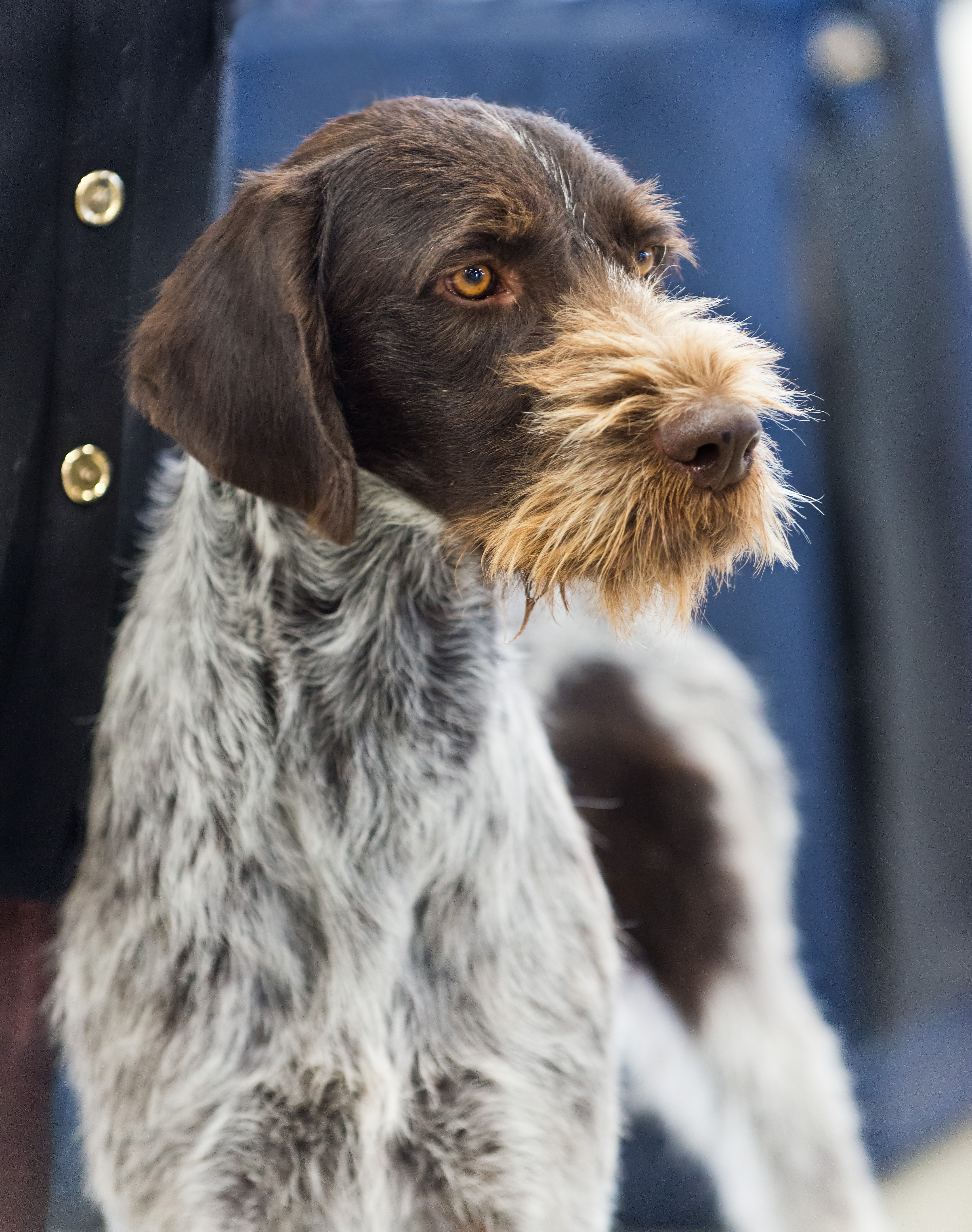

Do you have a better photo of a German Wirehaired Pointer in the American show ring? If you have a show photo you’d let us use, email it to [email protected] — tell us the dog’s name and the show, and it may be featured here. Please only send photos you took yourself or have the photographer’s permission to share, and tell us the photographer’s name.
1. Breed at a glance
Sporting Group; AKC-recognized since 1959
Dogs 24–26 in, bitches not under 22 in; 50–70 lb
Harsh, wiry, flat-lying double coat; liver and white
14–16 years (AKC)
Intelligent, energetic, determined; loyal and affectionate
German Wirehaired Pointer Club of America
2. History: Germany’s versatile gundog, the Deutsch Drahthaar
The German Wirehaired Pointer traces its history to Germany in the late 1800s, where breeders wanted a rugged, versatile hunting dog that would work closely with one person or a small party hunting on foot in varied terrain — from the mountainous regions of the Alps, to dense forests, to more open areas with farms and small towns. The breed was built from the German Shorthaired Pointer, the Griffon, the Stichelhaar, and the Pudelpointer, and Baron Sigismund von Zedlitz und Neukirch — writing as Hegewald — was a leading breeder in its early development. In Germany the breed is the Deutsch Drahthaar, and the Verein Deutsch-Drahthaar, founded in 1902, still governs it there.
The breed came to America in the 1920s. The American Kennel Club recognized it in 1959, and the German Wirehaired Pointer Club of America was established the same year. The breed has stayed a hunter’s dog first: it points, tracks, and retrieves on land and in water, and the national specialty week still runs a National Field Trial and hunt tests alongside the conformation show.
The breed’s biggest recent moment belongs to Greta, GCHG Wirewick Afterhours Feels Like A Regret. She won Best of Breed at the 2025 GWPCA National Specialty in Madras, Oregon, then Best in Show at the 2025 AKC National Owner-Handled Series Finals on December 14, 2025, judged by Pluis Davern — and then Best of Breed at the 2026 Westminster Kennel Club Dog Show.
3. The standard: the wiry coat is the breed
The AKC standard was approved on October 10, 2006, and effective January 1, 2007. It opens with the general appearance: “The German Wirehaired Pointer is a well muscled, medium sized dog of distinctive appearance. Balanced in size and sturdily built, the breed’s most distinguishing characteristics are its weather resistant, wire-like coat and its facial furnishings. Typically Pointer in character and style, the German Wirehaired Pointer is an intelligent, energetic and determined hunter.”
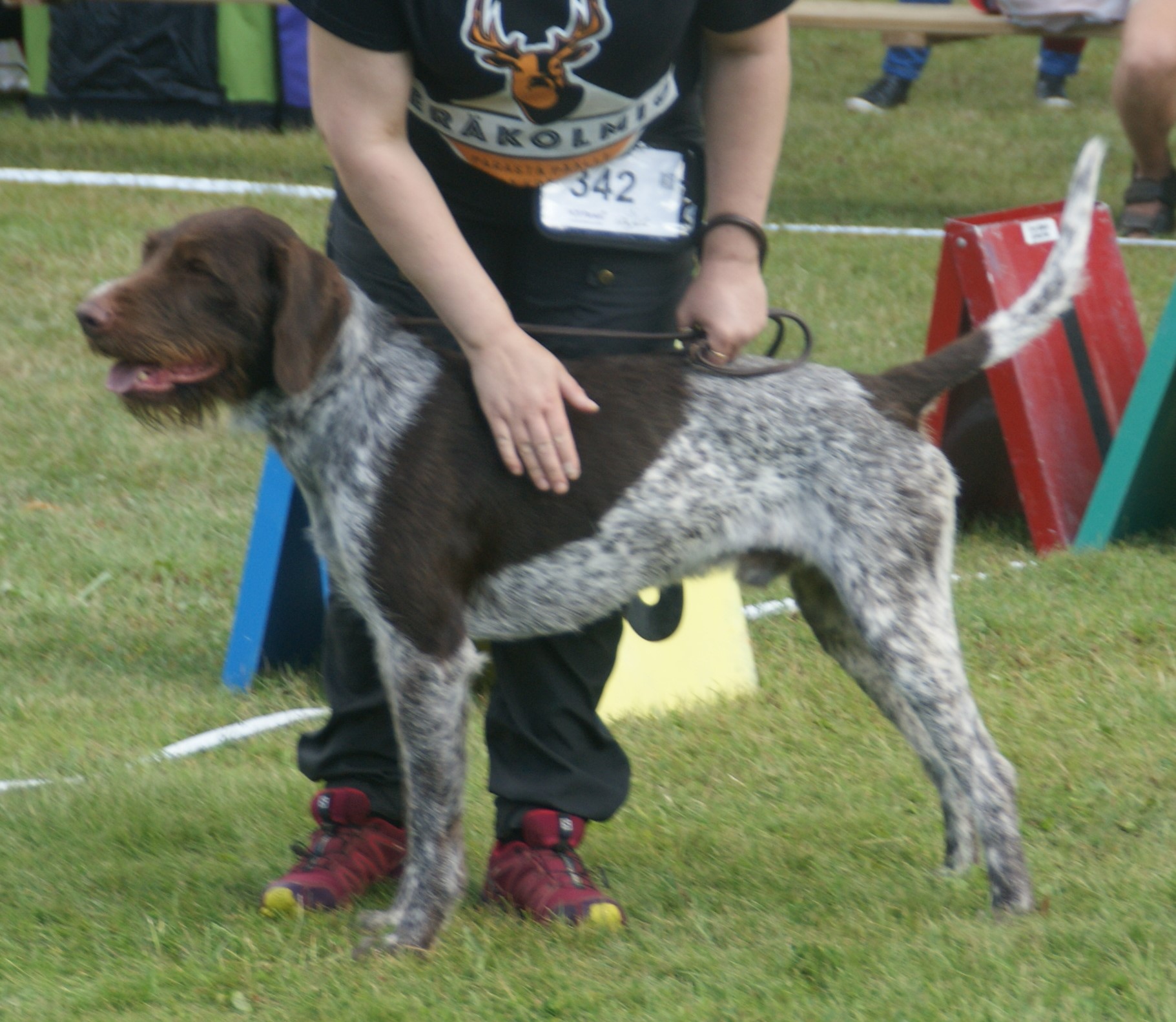

Size. Males 24 to 26 inches at the withers; bitches are smaller but not under 22 inches. Dogs either over or under the specified height must be severely penalized. The body is a little longer than it is high, as ten is to nine, and the breed runs 50 to 70 pounds. The tail is set high, carried at or above the horizontal when the dog is alert, and docked to approximately two-fifths of its original length.
Head. The head is moderately long, with brown, medium-sized, oval eyes, overhung with medium-length eyebrows — yellow eyes are not desirable. The ears are rounded but not too broad and hang close to the head. The muzzle is fairly long with a straight, broad nasal bone, and the nose is dark brown with wide-open nostrils; a spotted or flesh-colored nose is to be penalized. The jaws are strong with a full complement of evenly set teeth meeting in a true scissors bite.
Coat and color. The coat is the breed’s most distinctive feature, and the standard says plainly that a dog must have a correct coat to be of correct type: the outer coat is straight, harsh, wiry, and flat lying, one to two inches long, with a dense undercoat in winter that is almost invisible in summer. The eyebrows are of strong, straight hair, and the beard and whiskers are medium length. The color is liver and white — usually liver and white spotted, liver roan, liver and white spotted with ticking and roaning, or solid liver. The head is liver, sometimes with a white blaze, and the ears are liver. Any black in the coat is to be severely penalized.
Disqualifications. The standard lists none. The faults it punishes most severely are a dog over or under the specified height, a short smooth coat, a soft woolly coat, or an excessively long coat, any black in the coat, and extreme, excessive grooming that makes the dog look artificial.
4. Temperament: a determined hunter, a loyal companion
The standard sums the temperament up in a single paragraph: “Of sound, reliable temperament, the German Wirehaired Pointer is at times aloof but not unfriendly toward strangers; a loyal and affectionate companion who is eager to please and enthusiastic to learn.” The general appearance adds the working side: an intelligent, energetic, and determined hunter.
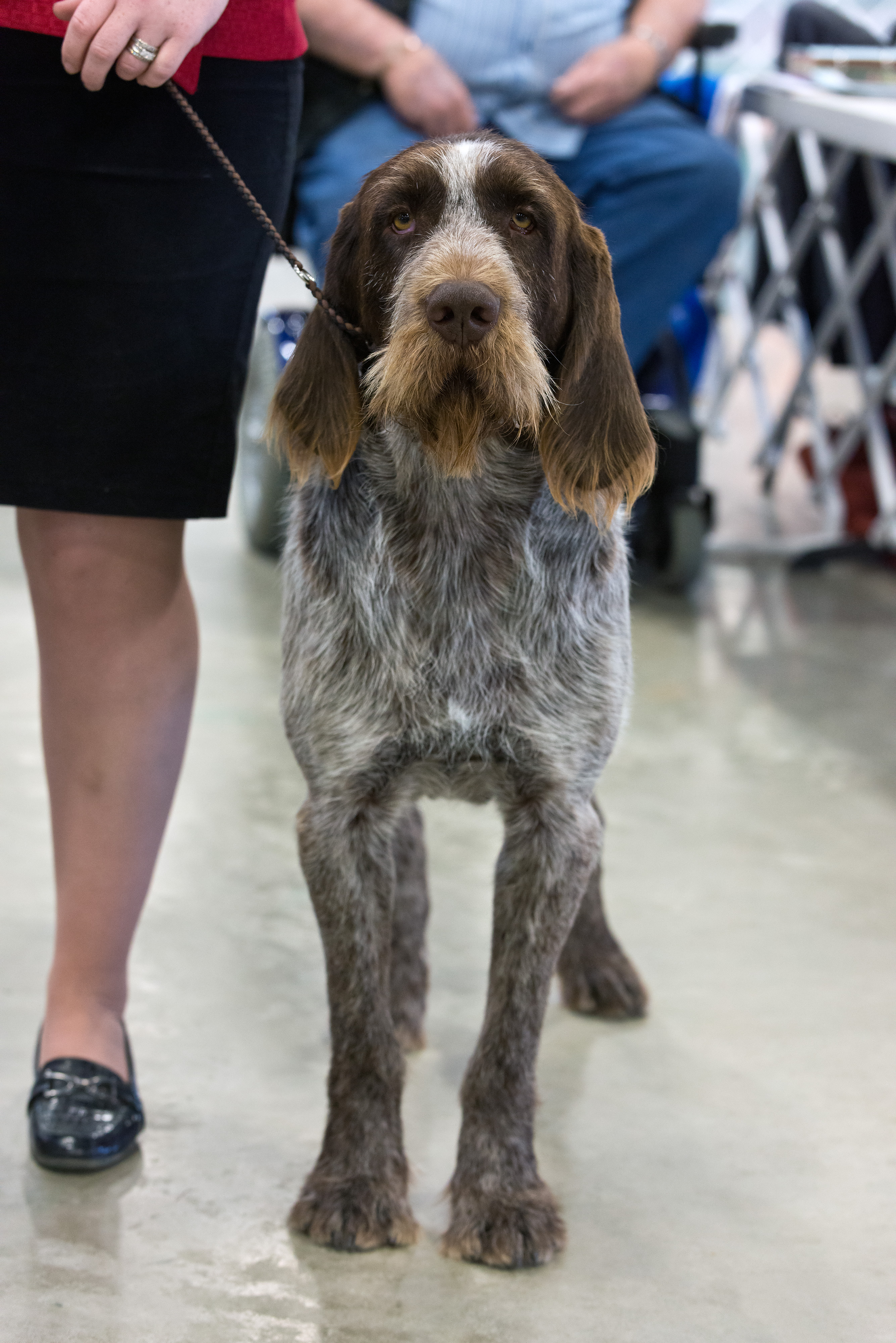

A German Wirehaired Pointer bonds hard to its people and is intensely affectionate and eager to please — and it wants a job. The hunting instinct is still there: the breed points, tracks, and retrieves, and it will work all day in rough cover and cold water, which is exactly what it was bred for. That drive has a cost: a German Wirehaired Pointer left alone for long hours gets anxious and destructive, and a bored one will chew and dig with real enthusiasm. The aloofness with strangers is correct for the breed, and early socialization keeps it from hardening; the breed responds to consistent, positive training, and harsh corrections shut it down.
5. Grooming and everyday care
Grooming is straightforward but not optional: brush the wiry coat weekly to keep it free of mats and dead hair, and bathe only when the dog is dirty, so the coat keeps its weather-resistant texture. Check the beard after meals, and check the ears regularly: drop ears on a water dog trap moisture. Nails need trimming, and teeth need brushing.
Exercise is the hard part, and it is non-negotiable: a daily outlet for real work — pointing, tracking, retrieving, and swimming are ideal, plus long walks and training. A German Wirehaired Pointer that gets real exercise and mental work is a calm, pleasant house dog; one that gets a walk around the block is a demolition crew. This is not a breed for a sedentary household or for an owner who is away all day.
Feeding is straightforward: a good-quality food, measured meals, and a lean weight at 50 to 70 pounds. A German Wirehaired Pointer in hard work burns more calories than a house dog, so feed to the dog’s condition, not to the bag’s chart.
6. Health: the tests that matter
The German Wirehaired Pointer Club of America’s CHIC profile calls for five tests for breeding stock: a hip evaluation (OFA or PennHIP), an elbow evaluation (OFA), a cardiac examination, an ophthalmologist eye examination, and a thyroid evaluation. A von Willebrand’s disease DNA test is optional. A CHIC number means the tests were done and published by the OFA — it does not mean the dog passed them. Ask for the parents’ CHIC numbers and look them up yourself on the OFA database.
The tests point at the breed’s known weak spots. Hip and elbow dysplasia are the most common orthopedic problems, and the hip and elbow evaluations watch for them. Autoimmune thyroiditis is a documented breed concern — the thyroid evaluation is done at two years of age and then yearly until age four. The eye examination watches for entropion, ectropion, cataracts, and progressive retinal atrophy. The AKC lists the breed’s lifespan as 14 to 16 years.
7. The annual German Wirehaired Pointer specialty dog show
A specialty is the breed’s All-Star show — its Super Bowl. Once a year, the best German Wirehaired Pointers from across the country, and often from around the world, come together in one place.
The German Wirehaired Pointer Club of America’s national specialty: one national event each year, a full specialty week built around conformation, sweepstakes, futurity and maturity, and junior showmanship, with obedience, rally, and a National Field Trial and hunt tests alongside. The 2026 national ran October 2 in Lincoln, Nebraska, with the regional specialty the next day and the field events the following week. The 2027 national: not yet announced — the club has said it will be in Michigan.
The standard, in brief: a well-muscled, medium-sized dog of distinctive appearance, males 24 to 26 inches at the withers and bitches smaller but not under 22 inches, in liver and white — spotted, roan, ticked, or solid liver — with the weather-resistant, wire-like coat and facial furnishings that are the breed’s most distinguishing characteristics. Any black in the coat is severely penalized. The temperament is sound and reliable: at times aloof but not unfriendly toward strangers, a loyal and affectionate companion, eager to please and enthusiastic to learn.
The 2026 GWPCA National Specialty — Friday, October 2, 2026, at the Sandhills Global Event Center, 4100 N 84th Street, Lincoln, Nebraska (event 2026009807), held indoors with the Cornhusker Kennel Club of Lincoln, Nebraska. The National Specialty regular and non-regular classes, junior showmanship, and the 4–6 Month Beginner Puppy competition were judged by Harry (Butch) H Schulman; Guy Fisher judged the national sweepstakes and veteran sweepstakes, Diana DeOnofrio-Fisher the futurity and maturity, and Hadley George the Pee Wee. Entries closed at noon on Wednesday, September 16, 2026. Show Chair: Joan Payton. Superintendent: Onofrio Dog Shows.
The national week opened with a welcome night and the 2025 GWPCA awards on Thursday, October 1, at the host hotel, the Country Inn and Suites Lincoln North, and the annual meeting and dinner followed the specialty on Friday evening. The regional specialty ran Saturday, October 3, and the All Star GWP Invitational ran Saturday afternoon. The National Field Trial and hunt tests ran Monday–Friday, October 5–9, at the Branched Oaks Recreation Area in Raymond, Nebraska.
Results (2026 national). Best of Breed and the other top winners had not been published in an official source as of November 2026 and will be added here when they are.
The dates for the annual 2027 German Wirehaired Pointer specialty dog show had not been announced as of November 2026. The AKC’s Upcoming National Specialties list, which runs through October 2027, carries no German Wirehaired Pointer Club of America entry. This page will be updated when the club announces the 2027 national.
The club has said the 2027 national events will be in Michigan, with the judges already selected — but no dates or venue had been announced as of November 2026.
Past national specialties: 2025 · 2024
German Wirehaired Pointer Club of America — gwpca.com
8. Regional specialties through the year: smaller regional shows
The national is the anchor, but the breed’s year also runs through regional specialties — smaller regional shows, not the national — held around the country, including the regional specialty that runs with the national. These are the 2026 regionals verified from club and AKC sources.
The 2026 regional specialty ran with the national: Saturday, October 3, 2026, at the Sandhills Global Event Center in Lincoln, Nebraska, concurrent with the Cornhusker Kennel Club of Lincoln all-breed shows, judged by Nancy E Talbott and limited to 100 entries. Other 2026 regional specialties had not been verified from club or AKC sources as of November 7, 2026.
More regional specialties will be added here as their programs are verified — this section is built from show data, not guesswork. Browse upcoming show weekends →
9. Clubs
The German Wirehaired Pointer Club of America, Inc. (GWPCA) is the AKC parent club for the breed in the United States, established in 1959, the year the AKC recognized the breed. It is the guardian of the breed and determines the official breed conformation standard, runs the national specialty every year, and sanctions field trials and hunt tests. The club’s 2026 officers: President Garnett Persinger, Vice President Christi Chism, Treasurer Lynn Sandor, and Secretary Gabriella Thornburg, with regional directors for the Eastern, Midwest, and Western regions. The club’s website is at gwpca.com.
Regional clubs around the country run the regional specialties and the local life of the breed, including the Seattle-Tacoma German Wirehaired Pointer Club, the German Wirehaired Pointer Club of Wisconsin, and the Fort Detroit German Wirehaired Pointer Club. The breed also has a field community of its own: the national specialty week still runs a National Field Trial and hunt tests alongside the conformation show, and the breed’s German parent organization, the Verein Deutsch-Drahthaar, founded in 1902, still governs the Deutsch Drahthaar in Germany.
10. Rescue
The national rescue for the breed is National German Wirehaired Pointer Rescue, at nationalgwprescue.com, which rehomes German Wirehaired Pointers across the country.
Expect an application, references, and a home visit — and expect an adult dog: puppies are rare in rescue. A rescue German Wirehaired Pointer comes with a known temperament, placed by a program that will match the dog to your life rather than the other way around.
11. Breeder vs. rescue: honest guidance
Either route starts with the same question: has this dog’s health been tested? From a breeder, ask for the CHIC numbers of both parents — the hip evaluation, the elbow evaluation, the cardiac examination, the eye examination, and the thyroid evaluation, with the von Willebrand’s disease DNA test as an optional extra — and check them on the OFA database yourself, by the parents’ registered names. Ask what health issues the breeder sees in their stock, and meet at least the dam. And be honest with yourself about the exercise: a German Wirehaired Pointer needs real work every day, and a breeder who asks how you will provide it is doing you a favor.
From rescue, expect an adult dog whose temperament is already known, placed by a program that will match the dog to your life rather than the other way around. Budget for the same things either way: training, exercise, and a vet who knows the breed’s health risks. Whichever route you take, the dog that fits is an intelligent, energetic, determined working gundog that wants to work — and will be happiest doing exactly that, with you.
12. Claim this page
This page was built from public sources — the AKC standard, the parent club’s own material, AKC event records, and the rescue program’s site — and it is a starting point, not the last word. If you are with the German Wirehaired Pointer Club of America or a regional club and something here is wrong or missing, you can claim this page and set it straight: email [email protected] and tell us what needs fixing. Corrections from the people who own the breed are how this page gets better.
Sources
- AKC, German Wirehaired Pointer
- AKC, Official Standard of the German Wirehaired Pointer (approved October 10, 2006, effective January 1, 2007)
- German Wirehaired Pointer Club of America, Breed Information
- AKC, Sporting Group Health Testing Requirements
- AKC, Upcoming National Specialties list
- Onofrio Dog Shows, 2026 GWPCA National Specialty premium
- German Wirehaired Pointer Club of America, 2024 National Specialties Week premium
- AKC event record, 2025 GWPCA National Specialty (event 2025009805)
- German Wirehaired Pointer Club of America, National Best in Specialty Show Winners
- AKC, German Wirehaired Pointer “Greta” Wins Best in Show at 2025 AKC National Owner-Handled Series Finals
- Westminster Kennel Club, German Wirehaired Pointer breed results
- National German Wirehaired Pointer Rescue, About GWPs
- Wikimedia Commons, AKC German Wirehaired Pointer Dog Show 2013 (SheltieBoy, CC BY 2.0)
- Wikimedia Commons, AKC Fall Dog Show 2013 (SheltieBoy, CC BY 2.0)
- Wikimedia Commons, GermanPointerWire-brownspeckled1 (Canarian, CC BY-SA 4.0)